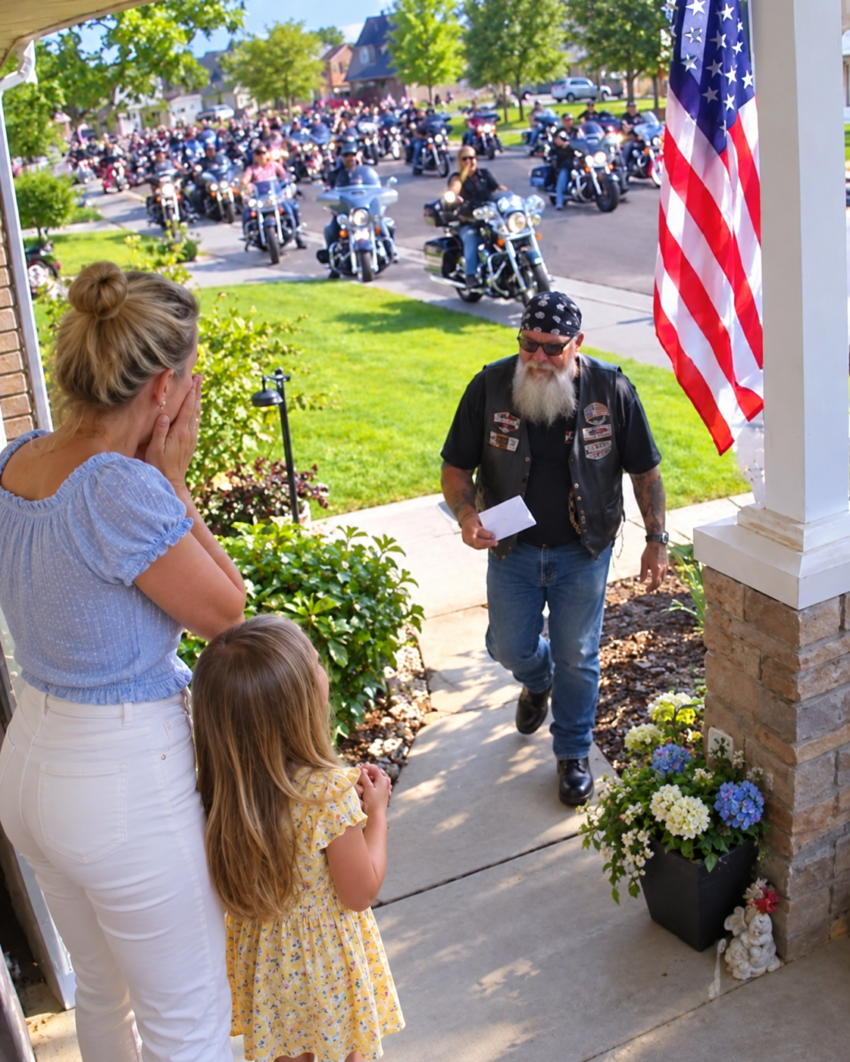
On a rainy night, a poor single mom spent her last $8 on a hot meal for a rough-looking biker that everyone in town crossed the street to avoid, not knowing he was a member of a large biker club. The next morning, the ground outside her tiny apartment shook as over a hundred bikes rolled by, and what they gave her on that sidewalk changed everything.
The night before, nothing had seemed cinematic.
It was just another stretch of American highway cutting through a sleepy small town, a faded flag fluttering on a short pole outside a dingy gas station, and a single mother in a thrift store coat counting crumpled bills under the industrial light. Sienna had only $8 left after paying rent. She should have eggs and milk for her eight-year-old daughter, Maya, in the morning. Maybe a box of cereal if nothing had gone wrong.
Then the exhaust roared, the chrome flashed.
The cyclist looked troubled from afar: leather vest, patches, tattoos smeared across his arms. He turned off the engine, swung his legs over, and then his face changed—pale, clutching his chest as he leaned against the pump and slid slowly down the concrete.
“Don’t,” the clerk called from the door, arms crossed. “They’re nothing but trouble. You don’t owe them anything, girl.”
Sienna froze… and saw another image superimposed on the cyclist’s body: her grandmother, on the cracked sidewalk fifteen years ago, knees bent, people stepping over her because they were “late” and “don’t want to get involved.”
She ran inside anyway. No time to argue, no time to bargain with fate. She slapped her last $8 bill on the counter.
“Aspirin. Bottle. Cold water. Now.”
Minutes later, she was on her knees in the winter air, her skirt soaked with gasoline and motor oil, pressing pills into a stranger’s palm, watching him wince and chew as the sirens grew louder in the distance. She stayed until the paramedics loaded him into the ambulance.
“Smart move,” the doctor said, nodding toward the empty bottle. “You probably just saved his life.”
Before the ambulance doors closed, the biker grabbed her wrist with surprising strength, his eyes sharp behind the oxygen mask.
“Tell them… Hawk sent you,” he said hoarsely.
By sunrise, the money was gone, the receipt crumpled in her pocket, replaced by a cheap paper business card with a simple logo: a crown on a pair of wings, Crown & Wings MC, and a number scrawled on the back.
The landlord didn’t want to hear about aspirin when she begged for an extra week. The school didn’t take “I bought a man time” as an excuse for Maya’s empty lunchbox. In their neighborhood, everyone had an opinion.
“You helped a Hells Angel?” Mrs. Johnson hissed on the steps, shaking her head. “Honey, that kind of kindness will get you in trouble in this country.”
At the laundry, Miss Linda squeezed her hand. “You did the right thing, Sienna. You reap what you sow. Maybe not where you think, but it will.”
At 3 p.m., the Maple Street diner, usually packed with truck drivers and tired nurses, was reduced to thick leather vests and quiet eyes. When Sienna walked in, business card in hand, the conversation died down. Men twice her size stood up as she passed. A silver-bearded giant wearing a brand-new hospital bracelet—Hawk—tapped the chair across from him.
On the table, he placed a photo of a little girl about Maya’s age. “She lost her mother in the parking lot because no one stopped,” he said. “I won’t let that happen to me.”
He pushed the photo aside, leaned in.
“Something’s going to happen in your neighborhood tomorrow morning,” he said. “Don’t be afraid. Don’t call the police. Just open the door, keep your daughter behind you, and trust me.”
The next morning, the rumble began before 9 a.m., low and distant like a storm sweeping across the flatlands. Windows rattled. Curtains fluttered across the street. In the distance, a flag on the awning of a corner grocery store flapped in the wind.Neighbors pulled their children inside. Someone shouted, “Oh my God, what’s going on?” as rows of motorcycles turned onto the deserted cul-de-sac, their chrome catching the winter sun. Engines started as they lined up on the sidewalk.
Sienna felt Maya’s small fingers slip under her sweater. “It’s okay,” she whispered, more to herself than to her daughter, and opened the door.
The lead motorcycle cut off. Hawk turned his foot to the side, all eyes on the street following. He held something thick and white in his hand. Beside him, a man with a shaved head and sunglasses—Cole—spoke loudly enough for everyone to hear: “We’re not here to cause trouble,” he said. “We’re here because last night, Sienna Clark saved a life.”
Then Hawk stepped onto Sienna’s porch, looked her straight in the eye, held out the envelope, and said…
“Eight dollars bought me another morning. This is what one more morning is worth to us.”
Sienna did not take the envelope.
The entire street seemed to hold its breath.
Behind her, Maya’s fingers tightened in the fabric of her sweater. Across the cul-de-sac, curtains shifted. Mrs. Johnson stood behind her screen door with one hand over her mouth.
Sienna looked at Hawk.
“What is it?”
“Open it.”
“Hawk—”
“Please.”
That word changed something.
Not an order.
Not charity delivered with an audience.
A request.
Sienna took the envelope.
It was heavier than paper should have been.
She slid one finger beneath the flap.
Inside was a cashier’s check.
Her eyes found the number.
Then lost it.
She blinked and looked again.
$25,000.
Sienna stopped breathing.
“No.”
Hawk’s expression did not change.
She pushed the envelope toward him.
“No. Absolutely not.”
He didn’t take it.
“Sienna.”
“I spent eight dollars.”
“And I know exactly what you bought with it.”
“You don’t owe me twenty-five thousand dollars.”
“No.”
Hawk’s voice softened.
“I owe my daughter the chance to keep having a father.”
The street went quiet enough for Sienna to hear the little metal tag on Maya’s coat zipper tapping against the doorframe.
Hawk nodded toward the envelope.
“That’s from the club. Not me.”
Sienna looked beyond him.
More than a hundred men and women stood beside their motorcycles.
Some wore leather.
Some wore denim.
Some had gray beards.
Some looked young enough to be her younger siblings.
One woman near the back held up a grocery bag.
Another had a box of children’s winter clothes strapped to her motorcycle.
Cole stepped forward.
“The check isn’t everything.”
Sienna stared at him.
“What do you mean?”
Cole turned.
The line of bikers moved.
Not toward her.
Toward two pickup trucks parked at the end of the street.
Tailgates dropped.
Boxes appeared.
Groceries.
Cleaning supplies.
School supplies.
Winter coats.
Canned food.
A microwave.
A small kitchen table.
Someone unloaded a bicycle with a purple ribbon tied around the handlebars.
Maya gasped.
Sienna’s knees nearly gave out.
“No.”
Her voice came out broken.
Hawk looked at her.
“You keep saying that.”
“Because this is too much.”
“You know what was too much?”
He touched two fingers to the hospital bracelet still circling his wrist.
“Lying on cold concrete and realizing I might never see my kid again.”
Sienna looked down.
Hawk continued.
“You didn’t know me.”
His voice carried across the sidewalk.
“You didn’t know whether I was good or bad. Didn’t know whether I could repay you. Didn’t know whether anybody would thank you.”
His jaw tightened.
“You saw somebody going down and decided he shouldn’t go down alone.”
Sienna’s eyes burned.
“That matters to people like us.”
A door opened across the street.
Then another.
Neighbors began stepping outside.
Cautiously at first.
Mrs. Johnson emerged in slippers and a robe.
The gas-station clerk stood at the far end of the sidewalk.
Sienna recognized him immediately.
He must have followed the motorcycles.
His face was pale.
Hawk noticed him too.
For one uncomfortable second, the biker and the clerk stared at each other.
Then Hawk looked away.
No threat.
No performance.
That somehow made the moment heavier.
Sienna folded the envelope closed.
“I can’t take twenty-five thousand dollars.”
Maya whispered behind her:
“Mom.”
Sienna turned.
Her daughter was staring at the purple bicycle.
Then Maya looked up at her.
“Are we in trouble?”
That question cut through everything.
Sienna crouched.
“No.”
“Then why are you crying?”
Sienna tried to answer.
Couldn’t.
Hawk looked away, giving her privacy.
Sienna touched Maya’s cheek.
“Because sometimes something good can scare you too.”
Maya considered that.
Then nodded as though adults were strange but she had decided to tolerate them.
Cole coughed into his fist to hide a laugh.
Hawk smiled.
Then an engine sounded behind the crowd.
Not a motorcycle.
A beige sedan.
Sienna’s stomach dropped.
She knew that car.
Mr. Pritchard.
Her landlord.
He pulled up hard beside the curb, climbed out, and stared at the motorcycles blocking half the street.
“What the hell is this?”
The warmth vanished from Sienna’s face.
Pritchard marched toward the porch.
“You.”
He pointed at her.
“I told you yesterday. Friday means Friday.”
Hawk stepped aside.
Not in front of Sienna.
Beside her.
That distinction mattered.
Sienna straightened.
“I know.”
Pritchard noticed the envelope.
Then the boxes.
His expression changed.
“What is all this?”
“None of your business.”
His eyes narrowed.
“You owe me eight hundred and sixty dollars.”
Sienna flushed.
“I know what I owe.”
“And I want it today.”
Hawk said nothing.
Neither did Cole.
Nobody threatened him.
They simply watched.
Pritchard’s confidence began shrinking under a hundred silent witnesses.
Sienna opened the envelope.
She stared at the check.
Twenty-five thousand dollars.
Enough to pay him.
Enough to breathe.
Enough to stop choosing between groceries and electricity.
She could have handed Pritchard the money.
Instead, something made her pause.
“Can I have a receipt?”
He frowned.
“For what?”
“For the rent.”
“You’ve never needed one before.”
“I do now.”
Pritchard’s jaw tightened.
“You think because your biker friends are here—”
“They’re not asking.”
Sienna’s voice surprised even her.
“I am.”
Maya moved closer behind her.
Pritchard stared at Sienna.
Then at Hawk.
Then back at her.
“I’ll bring one.”
“No.”
Sienna swallowed.
“Write it now.”
Pritchard laughed.
“You don’t tell me what to do on my property.”
Cole’s head turned slightly.
Sienna caught it.
My property.
Something about those words felt wrong.
She looked at Pritchard.
“You told me yesterday the rent was eight-sixty.”
“Yes.”
“But my lease says seven-fifty.”
His expression flickered.
Only for a second.
Hawk saw it.
So did Cole.
Pritchard recovered.
“Late fees.”
“What late fees?”
“Read your lease.”
“I did.”
“You obviously didn’t.”
Sienna’s hands began shaking.
For two years, Pritchard had raised amounts verbally.
Cash only whenever possible.
Repairs postponed.
Heat that failed every winter.
A ceiling leak patched with paint.
She had always paid because losing the apartment frightened her more than questioning him.
Cole removed his sunglasses.
“What does the lease say?”
Pritchard snapped:
“Stay out of this.”
Cole raised both hands.
“Gladly.”
Then he looked at Sienna.
“Your call.”
For the first time, she understood what they were giving her.
Not protection.
Not muscle.
Witnesses.
Sienna looked at Pritchard.
“I’ll pay what I legally owe when you provide an itemized statement.”
His face darkened.
“You’ll be out by tonight.”
Maya grabbed Sienna’s coat.
Hawk’s expression hardened, but he remained silent.
Sienna felt fear rise into her throat.
The old fear.
The one that made her apologize before she had done anything wrong.
Then another voice came from the crowd.
“Actually, she won’t.”
A woman stepped between two motorcycles.
Late fifties.
Short gray hair.
Brown leather jacket.
She carried a briefcase.
Hawk sighed.
“Couldn’t stay out of it, could you, Evelyn?”
“Nope.”
The woman approached Sienna.
“Evelyn Brooks. Legal aid attorney. Crown & Wings has been ruining my weekends for twelve years.”
Cole smiled.
“She loves us.”
“I tolerate you professionally.”
She handed Sienna a business card.
Then looked at Pritchard.
“Now. About that illegal lockout threat.”
Pritchard’s face changed.
He left ten minutes later.
Without the money.
Without throwing Sienna out.
And without knowing that his attempt to humiliate her in front of the entire street had just created the witness list that would destroy him.
Evelyn reviewed Sienna’s lease that afternoon.
Then she reviewed photographs.
Mold behind Maya’s bedroom dresser.
The leaking bathroom ceiling.
The heater.
Messages from Pritchard demanding cash.
Threats to remove belongings.
Unexplained fees.
Sienna thought she was showing Evelyn proof of why she had struggled.
Instead, Evelyn became quieter with every page.
Finally she asked:
“Do other tenants have this?”
Sienna looked toward Mrs. Johnson’s building.
“Yes.”
That one word opened everything.
Within three weeks, eleven tenants came forward.
Then nineteen.
Pritchard had been charging unauthorized fees to vulnerable renters for years.
He had withheld deposits.
Threatened undocumented tenants.
Entered apartments without notice.
Ignored dangerous repairs.
And whenever anyone challenged him, he found a reason their lease suddenly became a problem.
Sienna had believed poverty meant enduring whatever the person holding the keys decided.
Evelyn taught her otherwise.
The city inspected the properties.
Violations piled up.
Pritchard tried blaming tenants.
Then records surfaced.
Then messages.
Then receipts.
Then a former maintenance worker produced photographs and invoices showing Pritchard had billed for repairs that were never performed.
His insurance company became interested.
So did the housing authority.
The man who had threatened to put Sienna and Maya on the street lost control of three rental properties within eighteen months.
Two were sold under court supervision.
He paid settlements.
Fines.
Back rent adjustments.
Tenant compensation.
His downfall wasn’t dramatic.
Nobody punched him.
No motorcycles chased him out of town.
He simply encountered something he had spent years assuming poor people could never afford.
Documentation.
Representation.
Witnesses.
Consequences.
Sienna received money from the settlement.
But by then, the $25,000 check had already changed something more important.
She had not spent it recklessly.
The first thing she bought was groceries.
Eggs.
Milk.
Cereal.
Apples.
Chicken.
Maya put chocolate cookies in the cart and looked at her mother nervously.
Sienna stared at the price.
Then put two packages in.
Maya grinned.
Sienna cried in aisle seven.
The second thing she did was pay legitimate debts.
The third was open a savings account.
The fourth surprised everyone.
She enrolled in a community-college nursing program.
Hawk found out when he stopped by the diner.
“You’re going to be a nurse?”
Sienna poured coffee into his mug.
“If they’ll take me.”
He looked offended.
“You saved my life with eight dollars and a gas-station aspirin bottle.”
“That is not a medical qualification.”
“Feels like one.”
She laughed.
Hawk became a regular.
Not a savior.
That was important.
He never tried to become Maya’s father.
Never tried to make Sienna owe him gratitude.
Sometimes he fixed things.
Sometimes Sienna told him no.
Sometimes he listened.
Maya adored him because he let her put glitter stickers on his helmet.
Cole claimed this was an unforgivable violation of club dignity.
Hawk rode with a purple unicorn on the back of his helmet for six months.
Nobody dared mention it.
The Crown & Wings members became familiar around Maple Street.
The fear faded.
Mrs. Johnson started bringing peach cobbler to their charity rides.
Miss Linda became honorary queen of the clubhouse after beating six bikers at dominoes.
Even the gas-station clerk changed.
His name was Walter.
One evening, months after Hawk’s heart attack, he approached Sienna while she was leaving class.
“I owe you an apology.”
She stopped.
“For what?”
“That night.”
He rubbed his palms against his work pants.
“I told you not to help him.”
“I remember.”
“I’ve thought about it.”
Sienna waited.
Walter looked ashamed.
“My brother got killed in a fight with some bikers years ago. Different club. Different town.”
She softened.
“I didn’t know.”
“No reason you would.”
He looked toward the road.
“I saw a vest and decided I knew the man inside it.”
Sienna thought of how many people had done the same thing to her.
Single mother.
Poor.
Late rent.
Secondhand clothes.
Empty lunchbox.
People loved turning circumstances into character.
Walter swallowed.
“You saw a person.”
Sienna nodded.
“So can you.”
He looked at her.
She smiled.
“Next time.”
Walter nodded.
“Next time.”
There was one.
Two years later, a teenager collapsed near the gas station from an allergic reaction.
Walter was the first person through the door with the emergency kit.
He stayed until the ambulance came.
When Sienna heard, she sent him a message.
Next time.
He replied with one word.
Yep.
Sienna graduated nursing school at thirty-six.
The ceremony was held in a community auditorium with bad acoustics and folding chairs.
Maya screamed when her mother’s name was called.
Miss Linda screamed louder.
Mrs. Johnson rang a cowbell despite repeated instructions not to.
Then Sienna heard something outside.
Engines.
She stopped walking.
The auditorium doors opened.
Hawk stood there in a suit.
A suit.
Sienna stared.
“Where’s the leather?”
“Your graduation has a dress code.”
“You own a tie?”
“Cole tied it.”
From behind him, Cole shouted:
“Twenty-seven minutes!”
Sienna laughed until she cried.
Outside waited dozens of motorcycles.
Not a hundred.
They had learned subtlety.
Mostly.
Hawk held out a small box.
Sienna groaned.
“No more checks.”
“Open it.”
Inside was a stethoscope.
Engraved on the metal chest piece were eight words.
For the person who stopped when others didn’t.
Sienna pressed her lips together.
“Hawk.”
He looked suddenly uncertain.
“If it’s too much—”
She hugged him.
He froze.
Then carefully hugged her back.
“Thank you,” she whispered.
“No.”
His voice broke.
“Thank you.”
Years passed.
Maya grew taller.
Then sarcastic.
Then kind again.
At sixteen, she asked her mother the question Sienna had always known would come.
“Why did you spend our last eight dollars?”
They were sitting at the kitchen table in the small house Sienna had eventually bought.
Not large.
Two bedrooms.
Yellow kitchen.
A maple tree in the yard.
Paid for partly through years of nursing wages, partly through the housing settlement, and partly through stubborn saving.
Sienna looked at her daughter.
“Do you wish I hadn’t?”
Maya thought.
“No.”
“Then why ask?”
“Because we needed food.”
Sienna nodded.
“Yes.”
“You didn’t know he’d help us.”
“No.”
“You didn’t know he was important.”
“No.”
“You didn’t even know his name.”
“No.”
Maya frowned.
“Then why?”
Sienna looked down at her hands.
Older now.
Stronger.
Hands that had held patients through withdrawals.
Hands that had cleaned wounds.
Hands that had delivered one baby unexpectedly in an elevator.
Hands that had once counted eight dollars under fluorescent gas-station lights.
“My grandmother collapsed once.”
Maya knew pieces of the story.
Not all.
“People walked around her.”
Sienna’s voice softened.
“She died later that day.”
Maya went still.
“I promised myself I would never become so busy protecting what little I had that I forgot another human being might have even less time.”
Maya looked at the table.
“But what if Hawk had been dangerous?”
“He might have been.”
“What if nothing good happened afterward?”
Sienna smiled.
“Then helping him still would have been right.”
That answer stayed with Maya.
Sienna didn’t realize how deeply until years later.
Hawk’s second heart attack came twelve years after the first.
This one happened at home.
He survived.
Barely.
Sienna was working the emergency department when the ambulance arrived.
For one strange second, the years folded together.
The monitor.
The oxygen.
Hawk’s gray face.
His hand reaching.
Only this time, Sienna wasn’t kneeling in gasoline.
She wore navy scrubs.
Her badge said:
SIENNA CLARK, RN.
Hawk opened his eyes.
Recognition came slowly.
“You again.”
Sienna laughed through tears.
“You’re getting expensive.”
His mouth twitched.
“Got eight bucks?”
She squeezed his hand.
“I’ve got you.”
He recovered.
But not completely.
The club changed around him.
Cole took more responsibility.
Hawk rode less.
One spring afternoon, he asked Sienna and Maya to meet him at the clubhouse.
Maya was twenty now.
Medical school applications covered Sienna’s dining table.
Hawk looked at her.
“So you’re really doing it.”
Maya smiled.
“Trying.”
He shook his head.
“Your mother bought aspirin and accidentally created a dynasty.”
Sienna rolled her eyes.
Then Hawk became serious.
He placed the old photograph on the table.
The little girl.
The same one from Maple Street diner.
Maya picked it up.
“Your daughter?”
“Yes.”
Sienna had never met her.
Hawk had spoken about her carefully.
Her name was Emily.
She had grown up with relatives after her mother’s death.
Hawk had spent years rebuilding a relationship with her after his grief and life on the road had made him unreliable.
He had told Sienna once that losing Emily emotionally had frightened him more than dying.
“She wants to meet you,” he said.
Sienna blinked.
“Me?”
Hawk nodded.
“Why?”
His eyes lowered.
“Because I haven’t told you everything about that night.”
The room changed.
Cole, standing near the coffee machine, went still.
Sienna noticed.
“What?”
Hawk rubbed one hand over his beard.
“The picture I showed you.”
“Yes.”
“I said she lost her mother in a parking lot because nobody stopped.”
Sienna nodded.
“That was true.”
He inhaled.
“But not the whole truth.”
The door behind them opened.
A woman entered.
Early thirties.
Dark hair.
Hawk’s eyes.
Emily.
She carried an old manila envelope.
Hawk stood.
His chair scraped against concrete.
Emily approached Sienna.
“My mother wasn’t the only person there.”
Sienna felt something cold move through her.
Emily placed the envelope on the table.
Inside was an old newspaper clipping.
A grainy photograph.
A parking lot.
An ambulance.
Sienna stared.
Then her hand flew to her mouth.
There was another woman in the photograph.
Kneeling beside Emily’s mother.
Older.
Thin.
Gray cardigan.
Sienna whispered:
“No.”
Maya leaned closer.
“Mom?”
Sienna touched the photograph.
Her fingertip shook.
“My grandmother.”
Nobody spoke.
Hawk’s eyes filled.
Sienna looked at him.
“What is this?”
His voice cracked.
“Your grandmother was the one person who stopped.”
The room disappeared.
Sienna could hear only her own breathing.
Hawk continued.
“Emily’s mother collapsed first. Your grandmother went to help her.”
Sienna shook her head.
“No. Grandma collapsed on the sidewalk.”
“Afterward.”
Hawk’s voice was barely audible.
“She stayed with Emily’s mother until paramedics arrived.”
Emily wiped tears from her face.
“My mother died.”
Sienna closed her eyes.
“Your grandmother walked away from the ambulance.”
Hawk swallowed.
“Then collapsed two blocks later.”
Sienna gripped the table.
All her life, she had carried one version of that day.
Her grandmother falling.
Strangers stepping around her.
Human indifference carving itself into a fifteen-year-old girl’s memory.
That part was true.
But there had been something before it.
Her grandmother had already stopped for someone else.
Even while her own body was failing.
Sienna looked at Hawk.
“How did you know?”
“Your name.”
He wiped his face.
“At the diner. Sienna Clark.”
He looked at the clipping.
“I’d heard the name Clark before. Emily’s family kept everything from that day. Witness statement. Newspaper clipping.”
His voice trembled.
“I checked after you left.”
Sienna’s eyes widened.
“The morning you came to my apartment—”
“I already knew.”
She stood abruptly.
Her chair scraped backward.
“You knew my grandmother helped your daughter’s mother?”
“Yes.”
“And you didn’t tell me?”
“I was afraid.”
“Of what?”
“That you’d think the money was payment.”
Sienna stared at him.
Hawk stood slowly.
“It wasn’t.”
His voice broke.
“The club gave you that because of what you did for me.”
He touched the clipping.
“This?”
His eyes filled.
“This was something else.”
“What?”
Hawk looked at Sienna.
“Proof.”
She couldn’t speak.
“Your grandmother stopped.”
His voice shook.
“Then you stopped.”
He looked at Maya.
“And maybe someday she’ll stop.”
Maya was crying now.
Hawk whispered:
“I didn’t want kindness to become a debt passed between families.”
Silence filled the clubhouse.
Sienna looked at the old photograph again.
For years she had believed her grandmother’s death taught her what happens when nobody helps.
Now she understood it had taught her two things.
People had failed her grandmother.
And her grandmother had refused to fail someone else first.
Sienna sat down.
Then she laughed.
A tiny, broken sound.
Maya knelt beside her.
“Mom?”
Sienna touched the newspaper photograph.
“She spent her last minutes helping somebody.”
Emily crouched on the other side.
“My mother wasn’t alone because of her.”
Sienna looked at Emily.
Emily looked back.
Two daughters.
Two dead women.
One parking lot.
One act of kindness neither family had fully understood.
Emily whispered:
“My mother died with someone holding her hand.”
Sienna’s face crumpled.
“My grandmother died without anyone holding hers.”
Emily reached across the space.
She took Sienna’s hand.
“Not this time.”
Sienna cried then.
Not politely.
Not quietly.
She folded over their joined hands while Maya held her shoulders and Hawk turned away because his own face had collapsed.
Cole removed his glasses and wiped his eyes with the heel of his hand.
Nobody tried to fix the moment.
Some truths do not need fixing.
They need witnesses.
Hawk died six years later.
Peacefully.
Emily was beside him.
So was Sienna.
Cole stood at the foot of the bed.
Maya, home from medical school, arrived twenty minutes before the end.
Hawk’s breathing had become shallow.
His eyes opened once.
He saw Sienna.
His lips moved.
She leaned close.
“What’s that?”
“Eight dollars.”
She laughed through tears.
“You still owe me.”
His eyes flickered with humor.
“Interest.”
“Terrible rate.”
He tried to smile.
Then his fingers moved against hers.
Sienna held tighter.
“You’re not alone.”
Hawk looked toward Emily.
Then Maya.
Then Cole.
His eyes returned to Sienna.
“I know.”
Those were his last words.
At his funeral, motorcycles stretched farther down the road than Sienna could see.
No one revved an engine during the service.
The silence was the tribute.
Afterward, Cole handed Sienna a small envelope.
Inside was eight dollars.
Eight one-dollar bills.
And a note in Hawk’s handwriting.
You never owed me for what came after.
I never owed you for what came before.
That’s not how kindness works.
It doesn’t balance.
It multiplies.
Buy somebody lunch.
Sienna laughed until she cried.
She kept seven dollars.
Spent one that afternoon buying a bottle of water for an elderly man waiting at a bus stop.
Not because Hawk told her to.
Because she noticed he was thirsty.
Maya became an emergency physician.
Years later, during a brutal overnight shift, a homeless man came into her emergency department filthy, drunk, frightened, and shouting.
Security wanted him removed.
A nurse muttered:
“He’ll be back tomorrow anyway.”
Maya looked at him.
Then remembered a gas station she barely remembered herself.
A purple bicycle.
A huge biker wearing a unicorn sticker on his helmet.
Her mother counting eight dollars.
Her great-grandmother kneeling in a parking lot.
“Wait,” Maya said.
She walked toward the man.
He stopped shouting eventually.
He was septic.
Another few hours outside might have killed him.
When Maya told Sienna, she expected praise.
Sienna only asked:
“Were you scared?”
“Yes.”
“Did you have help?”
“Yes.”
“Good.”
Maya smiled.
“That’s it?”
Sienna smiled back.
“That’s enough.”
By then, Sienna had retired from nursing.
Her little yellow kitchen had become the place everyone gathered.
Emily came for Thanksgiving.
Cole came whenever invited and sometimes when he wasn’t.
Mrs. Johnson was gone.
Miss Linda too.
Walter still sent Christmas cards.
On Sienna’s refrigerator hung an old photograph of Hawk beside the purple bicycle, looking deeply offended while Maya covered his helmet in glitter stickers.
Beside it was the newspaper clipping of her grandmother.
Not the photograph of the ambulance.
A later one Emily had found.
It showed Sienna’s grandmother standing near the parking lot entrance moments before everything happened.
She was looking toward something outside the frame.
Ready to move.
Ready to notice.
Sienna liked that one better.
One winter evening, many years after the night at the gas station, Sienna sat on her porch while snow began falling softly over the yard.
Maya arrived carrying groceries.
“You didn’t have to buy those.”
“I know.”
“You’re busy.”
“I know.”
“I have money.”
“I know.”
Sienna narrowed her eyes.
Maya smiled.
“Can I bring my mother groceries without getting a lecture about independence?”
Sienna considered it.
“No.”
Maya laughed.
They carried the bags inside together.
At the bottom was a bottle of aspirin.
Sienna held it up.
Maya shrugged.
“You were out.”
For a second, neither spoke.
Then they both began laughing.
Sienna placed the bottle in the cabinet.
Not on an altar.
Not behind glass.
Just beside the cold medicine and bandages where aspirin belonged.
That mattered too.
The past did not need to remain sacred to remain meaningful.
Outside, snow covered the steps.
Maya made tea.
Sienna stood at the kitchen window.
She thought about the story people told when they heard about Hawk.
A poor single mother spent her last eight dollars helping a frightening biker.
The next morning, more than a hundred motorcycles arrived and changed her life.
It was a good story.
It was also wrong.
The motorcycles had not changed her life.
Neither had the check.
Not really.
The change happened under fluorescent lights before she knew Hawk’s name.
It happened when she looked at the last eight dollars she had and then looked at a human being collapsing beside a gas pump.
She had been afraid.
She had needed that money.
She had no guarantee.
And she moved anyway.
Everything afterward was consequence.
Not reward.
Consequence.
One person stopped.
Then another.
Then another.
Her grandmother for Emily’s mother.
Sienna for Hawk.
Hawk and Crown & Wings for Sienna.
Evelyn for the tenants.
Walter for the teenager.
Maya for the frightened man in the emergency room.
Kindness had never traveled in a circle.
It traveled forward.
That was the beautiful part.
You rarely got back what you gave.
You got something stranger.
Someone else learned to give.
Maya placed a mug beside her.
“What are you thinking about?”
Sienna looked outside.
“Eight dollars.”
Maya smiled.
“Best investment you ever made?”
Sienna shook her head.
“No.”
“What, then?”
Sienna wrapped both hands around the warm mug.
“It wasn’t an investment.”
Maya waited.
“I wasn’t buying a future.”
Her eyes moved to the photograph of her grandmother.
“I was buying a stranger a few more minutes.”
She smiled.
“Turns out that was enough.”
A car passed slowly beyond the window.
For just a second, its tires on the wet road made a low rolling sound.
Not motorcycles.
Not thunder.
Still, Sienna remembered.
Chrome filling Maple Street.
A hundred engines becoming silent.
Hawk standing on her porch with a white envelope.
Maya’s little fingers hooked beneath her sweater.
The fear.
The disbelief.
The first breath after years of holding one.
Sienna had once thought that morning was the day somebody rescued her.
She knew better now.
Hawk had helped her.
The club had helped her.
Evelyn had helped her.
Martha Street had eventually helped itself.
But rescue was not the lesson.
The lesson was that dignity could move in both directions.
The woman with eight dollars could save the man with a hundred motorcycles behind him.
The man everyone feared could protect someone without owning her.
A frightened child could grow into a doctor.
A grandmother who died unseen could leave behind an act of mercy that traveled through generations.
Nobody was only poor.
Nobody was only frightening.
Nobody was only helpless.
Nobody was only what strangers saw from across the street.
Maya leaned against her shoulder.
Sienna rested her cheek against her daughter’s hair.
“Mom?”
“Hmm?”
“If you could go back to that gas station, knowing everything you know now, would you still spend the eight dollars?”
Sienna smiled.
Outside, snow gathered along the railing.
She imagined herself young again.
Thrift-store coat.
Empty wallet.
Rent due.
A child waiting for breakfast.
A stranger falling.
It was not an easy choice even in memory.
That mattered.
If kindness cost nothing, it would tell us very little about who we were.
“Yes,” Sienna said.
Maya squeezed her hand.
“All eight?”
Sienna laughed.
“All eight.”
Then she looked toward the dark window and saw their reflections together.
Behind them, ordinary life filled the kitchen.
Groceries on the counter.
A kettle cooling on the stove.
A bottle of aspirin in the cabinet.
Photographs on the refrigerator.
Nothing cinematic.
Nothing grand.
Exactly like the night it began.
And somewhere beyond the glass, on another road, in another town, someone would eventually fall.
Someone else would have to decide whether to keep walking.
Sienna could not make that decision for them.
Neither could Hawk.
Neither could her grandmother.
All they could do was leave evidence that stopping mattered.
She turned away from the window.
Maya carried the tea into the living room.
Sienna switched off the kitchen light and followed her.
For a moment, the photograph of her grandmother caught the last glow from the hallway.
A woman standing at the edge of a parking lot.
Looking toward someone who needed help.
One second before she moved.
Sienna smiled.
Then she turned off the final light.
And somewhere inside the dark, quiet house, eight dollars’ worth of mercy was still traveling forward.