PART2:
That sentence makes some people imagine silence.
Owen was not silent.
God, no.
Owen hummed.
Squealed.
Laughed.
Cried.
Tapped.
Clapped.
Made a low “mmm” sound when he was content.
A sharp breathy sound when frustrated.
He could tell me more with the position of his shoulders than some people tell their spouses in a year.
He used an AAC tablet at school.
Picture cards at home.
Sometimes signs.
Sometimes he grabbed my hand and physically moved it to what he wanted.
Sometimes communication failed and both of us cried.
But no, he did not speak.
He could not tell a stranger:
“My name is Owen Hayes.”
He could not answer:
“Where is your mother?”
He could not say:
“I’m lost.”
That distinction mattered.
It mattered more than anything in the world that Saturday afternoon.
We were at Riverton Mall because Owen needed new shoes.
That sounds simple.
Nothing involving Owen and shoes was simple.
His old pair had Velcro straps and wide toe boxes.
Same brand.
Same style.
For fourteen months I had bought them one size larger each time.
Then the manufacturer changed the insole.
Owen noticed.
Of course he noticed.
I had made the mistake of buying two pairs online.
He put one foot into the new shoe, ripped it off, threw it across the kitchen, and spent twenty-seven minutes pressed beneath the dining table.
So we were going to try shoes in person.
My mother usually came with us.
She was sick that weekend.
Nothing major.
Sinus infection.
“I can still go.”
She said it three times over the phone.
“No.”
“You cannot do the mall alone.”
“I do things alone all the time.”
“I know.”
That was the problem hidden beneath her answer.
Owen’s father had left four years earlier.
I do not mean died.
I do not mean disappeared mysteriously.
He packed.
His name is Eric.
He loved Owen.
I believe that.
Maybe that makes what he did more complicated.
Owen was four when Eric finally said:
“I can’t live like this.”
Like this.
As though our son were weather.
At first I thought he meant our marriage.
Therapy.
Sleep deprivation.
Bills.
Fighting.
Then he pointed toward the hallway, where Owen was rocking after a difficult bath.
“This.”
I remember everything after that with cruel precision.
The kitchen light.
Eric’s duffel bag.
My hand around a dish towel.
The refrigerator humming.
“He’s four.”
I said.
“He’s never going to be independent if you keep doing everything for him.”
I stared at him.
“He cannot open a yogurt container.”
“He’ll learn.”
“He ran into the street last month.”
“You grabbed him before he got there.”
“Yes.”
“Exactly.”
I still do not know what he thought that proved.
He left anyway.
The final thing he said:
“Kids figure things out.”
I hated that sentence.
Years later, standing beside Interstate 80 watching my barefoot son face traffic, I would hear it again.
Kids figure things out.
Kids wander.
Give it fifteen minutes.
Everybody has a sentence that makes walking away easier.
But that Saturday had started well.
Owen ate breakfast.
No clothing fight.
We left early.
I parked on the second level of the garage because the ground level was crowded.
He kicked both shoes off during the drive.
That happened often.
Normally I put them back on before we got out.
He resisted.
I decided:
Fine.
We are buying shoes anyway.
He could walk through the mall barefoot for ten minutes.
Judge me.
Parents of sensory-sensitive children learn where to spend energy.
I put his old shoes on the passenger-side floor.
They had GPS tags.
Tiny trackers sewn into the tongues.
That fact would become its own special punishment later.
The tracker that could have helped me was sitting inside a shoe in my car.
Owen wore his favorite green dinosaur shirt.
Gray shorts.
No shoes.
Blue chew necklace.
I held his hand.
Always.
Parking garage.
Elevator.
Main corridor.
Food court.
His hand stayed in mine.
Owen liked the mall early in the day.
Before crowds peaked.
The food court had an enormous window facing the service road.
Sometimes trucks passed behind the loading area.
Delivery trucks.
Garbage trucks.
Occasionally a semi headed toward the highway.
Owen loved it.
We had a routine.
Pretzel first.
Then shoes.
If the shoe store went well, elevator ride twice as a reward.
Predictability.
That is not an autism rule.
It was an Owen rule.
I ordered one plain pretzel.
No salt.
Owen stood beside me.
Hand in mine.
The cashier said:
“That’ll be $4.86.”
I reached into my bag.
My wallet had shifted beneath wipes, hand sanitizer, emergency headphones, charger, granola bar, pull-up, AAC tablet, spare chew, and half the equipment required to invade a small country.
I let go of Owen’s hand.
Not absentmindedly.
I remember saying:
“Right here.”
He knew that cue.
Usually.
I turned my body maybe ninety degrees.
Found the wallet.
Handed over five dollars.
Cashier said:
“You want the change?”
I said:
“No, thanks.”
I turned back.
No Owen.
At first my brain produced no fear.
Because impossible.
He had been beside me.
I looked under the counter edge.
Around the pretzel kiosk.
“Owen?”
Nothing.
I stepped into the food court.
Green shirt.
Green shirt.
Green shirt.
There.
No.
Woman.
Another.
Advertising sign.
Not Owen.
I moved faster.
Tables.
Trash station.
Fountain corridor.
“Owen!”
Calling his name made me feel like I was doing something even though he would not answer.
Thirty seconds.
Maybe forty.
I grabbed a woman in a red polo.
“Do you work here?”
“Kinda. Food court.”
“Have you seen a boy?”
“What boy?”
“Eight.”
“Green dinosaur shirt.”
“No shoes.”
“He can’t talk.”
Her face changed.
“No.”
I ran toward the nearest security podium.
Empty.
Found two guards walking near the arcade.
“I need help.”
Both turned.
One older.
One young enough I would later learn he was twenty-two.
Brandon.
I did not know their names yet.
“My son is missing.”
“How old?”
“Eight.”
“When did you last see him?”
“Two minutes ago.”
“What’s he wearing?”
“Green dinosaur shirt.”
“Gray shorts.”
“Barefoot.”
“Why barefoot?”
The older guard asked.
I wanted to scream already.
“Because he took his shoes off.”
I shoved my phone toward them.
Picture.
Owen at breakfast that morning.
“His name is Owen.”
“He’s autistic.”
“He doesn’t speak.”
“If you ask his name, he cannot answer.”
Brandon gave me a smile.
Not cruel.
That mattered later.
He was trying to reassure me.
“Ma’am, kids wander off here all the time.”
“I know.”
“They usually hit the toy store.”
“He won’t.”
“Or fountain.”
“No.”
“Give us a few—”
“He likes trucks.”
They looked at me.
“What?”
“Trucks.”
I pointed toward the rear of the mall.
“This building backs onto I-80.”
“The loading docks are behind the food court.”
“There is a hole in the chain fence.”
I knew about the hole because teenagers used it as a shortcut toward the frontage-road convenience store.
I had seen it months earlier from the parking garage.
I had even thought:
Somebody should fix that.
Then forgot.
Now I could see it in my mind.
Bent chain link.
Weeds.
Highway.
I said:
“If Owen hears trucks, he will go toward them.”
The older guard lifted his radio.
“Okay.”
“Call a Code Adam.”
I had used that phrase before.
Hospitals.
Stores.
Missing-child protocols.
He hesitated.
“I need my supervisor to initiate it.”
“Then call him.”
“He’s at lunch.”
“Call him.”
“He’s off radio at the moment.”
I stared.
“Call his phone.”
“Ma’am—”
“CALL HIM.”
Brandon lifted both hands.
“Please calm down.”
There are sentences that become gasoline.
That was one.
“I am calm enough to tell you exactly what will happen.”
My voice shook.
“He will walk toward the loudest truck.”
“He does not understand traffic.”
“He does not understand that a horn means danger.”
“He may think it means come closer.”
“We’re going to search.”
“When?”
“We already radioed—”
I looked at the older guard.
He had requested:
“Possible wandering juvenile.”
Possible.
Wandering.
Juvenile.
No:
nonverbal.
No:
autistic.
No:
highway attraction.
No:
immediate danger.
I grabbed his radio hand.
He pulled back.
“Ma’am.”
“My son does not have fifteen minutes.”
Brandon repeated:
“Kids usually turn up quickly.”
That was when I broke.
Not because I was hysterical.
Because I understood that if I continued speaking at conversational volume, they were going to continue treating the situation at conversational speed.
So I screamed.
Across the food court.
At both guards.
At everyone.
“MY SON CAN’T TALK!”
Heads turned.
“He’s eight years old and he’s going toward the highway!”
People froze.
“He doesn’t know cars can kill him!”
My chest hurt.
“He’s going to die while you stand here telling me to calm down!”
Silence.
Hundreds of eyes.
A man holding a tray.
Teenagers near Chick-fil-A.
Woman with stroller.
Cashier.
Office workers.
Everybody looking.
Then most looked away.
That is a detail I wish I did not remember.
Humans do that when pain becomes socially awkward.
We look.
Assess.
Then decide:
Someone else is handling it.
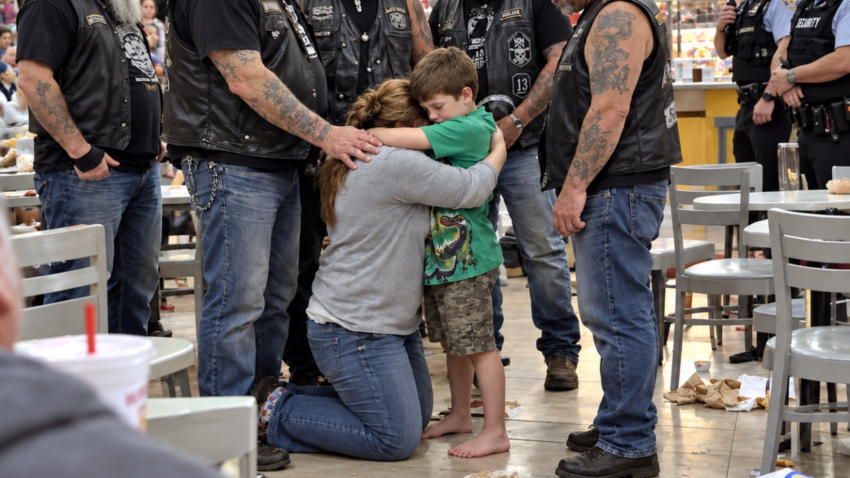
Except six people.
Corner table.
Leather vests.
Half-eaten burgers.
Motorcycle helmets piled beside chairs.
All six stood.
At once.
Chair legs scraped tile.
The biggest man was broad through shoulders.
Gray beard.
Maybe sixty.
Black T-shirt beneath leather vest.
His expression was not panicked.
That helped me immediately.
He walked toward me.
“What’s his picture?”
No:
What happened?
No:
Are you sure?
Picture.
I unlocked my phone.
Hands shaking.
He took it.
Studied Owen.
“What does he like?”
“Trucks.”
“Anything else?”
“Engines.”
“Vibration.”
“Trucks most.”
“Will he respond to his name?”
“No.”
“Will he run if somebody approaches?”
“Maybe.”
“Touch?”
“If scared, don’t grab him unless you have to.”
The man nodded.
Turned.
“Loading dock.”
He pointed at two.
“Marcus, Rhonda.”
Then two more.
“Garage and rear exits. Pete, Sal.”
Last man.
Younger.
Skinny.
Cross tattoo near his neck.
“Tully.”
“Fence line to highway.”
Tully nodded.
The gray-bearded man pointed.
“Nobody rushes the kid.”
“Nobody yells unless he’s stepping into traffic.”
“Eyes first.”
Then:
“Go.”
They ran.
Grown adults.
Leather boots.
One woman with a long gray braid.
They ran through Riverton Mall while two paid security guards held radios.
The gray-bearded man stayed with me.
“Name?”
I could barely answer.
“Owen.”
“Yours.”
“Rachel.”
“I’m Walt.”
He handed my phone back.
“Rachel, look at me.”
I did.
“Does Owen usually leave buildings through doors or follow sounds?”
“Sounds.”
“Can he open doors?”
“Yes.”
“Push bars?”
“Yes.”
“Climb?”
“Yes.”
“Fence?”
“There’s a gap.”
“Where?”
I showed him approximately.
Walt relayed everything through a group call.
Not shouting.
Specific.
“Green dinosaur.”
“Barefoot.”
“Do not call out unless immediate danger.”
“Watch hands.”
“Watch direction.”
It was the first moment since Owen vanished that I felt someone had heard what I was saying.
Security finally began moving.
Too late in my mind.
One headed toward the toy store.
Another called the supervisor.
I stood in the food court with Walt.
Every second became physical.
I felt each one pass.
Three minutes.
Five.
Seven.
I called Owen’s father.
Why?
Instinct.
Eric lived three states away.
Saw Owen maybe three times a year by then.
Voicemail.
I hung up.
Called Mom.
Couldn’t make myself speak.
Hung up before she answered.
At minute nine, Walt said:
“Breathe.”
I snapped:
“Don’t tell me to breathe.”
“Fair.”
He did not say it again.
At minute eleven, his phone rang.
He answered immediately.
Speaker.
Tully.
“I’ve got eyes on him.”
My knees disappeared.
Walt caught me beneath one arm.
“Where?”
“Northbound on-ramp shoulder.”
My vision went black at the edges.
Tully continued:
“Barefoot.”
“Green shirt.”
“He’s maybe thirty feet off the lane.”
“He’s watching semis.”
I heard engines through Tully’s phone.
Walt’s voice became flatter.
Controlled.
“Moving toward traffic?”
“No.”
“Rocking.”
“Every semi goes past, hands flap.”
“He kind of hops.”
A pause.
“He looks happy.”
Of course.
Owen.
At a parade.
My son had found heaven and it happened to be thirty feet from seventy-mile-an-hour traffic.
Walt asked:
“Where are you relative to him?”
“Forty yards back by the fence.”
“Has he seen you?”
“No.”
“Keep it that way.”
“I almost called him.”
“Don’t.”
Walt looked at me while speaking.
“Do not say his name.”
“Do not wave.”
“Do not move toward him.”
“Watch.”
“That’s it.”
Tully said:
“Got it.”
Walt hung up.
Then:
“Can you run?”
“Yes.”
I could.
I ran.
Food court emergency exit.
Employee corridor.
A worker yelled.
Walt said:
“Missing kid.”
Nobody stopped us.
Loading bay.
Concrete.
Dumpster smell.
Forklift alarm.
My sandals slapped awkwardly.
Walt ran shockingly fast for a man his age.
No dramatic music.
Just boots.
My breathing.
Traffic getting louder.
We reached the chain-link fence.
The gap was there.
Worse than I remembered.
Somebody had peeled fencing backward.
Big enough for an adult.
Owen must have walked right through.
Beyond it:
weeds.
Broken bottles.
Gravel.
Slope.
Then highway.
I looked down.
Bare footprints were impossible to see.
But I imagined them anyway.
We squeezed through.
My arm caught metal.
Cut me.
Did not notice until later.
The highway sounded like an ocean made of steel.
We moved down.
Then I saw him.
Green dinosaur.
Bare feet.
Back toward me.
Facing the road.
Owen.
Alive.
My body tried to run.
Walt grabbed the back of my shirt.
I almost hit him.
“What are you doing?”
“Look.”
Owen stood on gray gravel.
Maybe twenty-five or thirty feet from the white line.
Semis passed.
Wind buffeted his shirt.
Every time a truck came, both hands fluttered beside his head.
Happy.
His whole body bounced once.
Happy.
I knew that movement.
Tuesday mornings, garbage truck.
School bus hydraulics.
Delivery van.
Happy.
I opened my mouth.
“Ow—”
Walt’s palm covered it.
Hard.
I struggled.
He whispered against my ear:
“If you yell, he turns.”
I froze.
“He turns to find you.”
“He may step backward.”
“Forward.”
“Sideways.”
“You don’t know.”
My heart was trying to tear out.
“Do you understand?”
I nodded.
He removed his hand.
We crouched.
Tully stood farther back exactly where he said.
Hands visible.
Not moving.
Walt asked:
“What does he do when calm?”
“He is calm.”
“No.”
Walt shook his head.
“This is excited.”
“Happy excited.”
“I need calm.”
I stared.
“When he regulates.”
“What does he seek?”
“Vibration.”
“Dryer.”
“Car door.”
“He puts his ear against things.”
“And?”
“He hums.”
Walt watched Owen.
Then behind us.
Marcus and Rhonda appeared through fence.
Marcus was enormous.
Rhonda maybe late fifties.
Gray braid to waist.
Walt whispered:
“Marcus.”
“Go get Tully’s bike.”
“Bring it from behind.”
“Engine running.”
Marcus nodded.
“No eye contact.”
“Don’t approach Owen directly.”
“Pass fence side.”
“Slow.”
Marcus went.
“Rhonda.”
She looked at him.
“Stop ramp traffic.”
My head snapped around.
“What?”
Rhonda did not question him.
She walked down the embankment.
Pete and Sal appeared farther behind.
Walt signaled.
All three moved toward the on-ramp.
Rhonda stepped onto the white line.
A car came.
Fast.
Braked.
Horn.
She held both hands out.
Pete joined.
Sal.
Three leather-clad adults standing across an entrance ramp.
Cars stacked.
Drivers confused.
Some angry.
Nobody moved around them.
I whispered:
“They can’t stop the interstate.”
“They don’t need to.”
Walt’s eyes remained on Owen.
“They stop this ramp.”
“No cars entering near him.”
One risk reduced.
Not gone.
Reduced.
Then a semi in the main lanes saw Owen.
The driver hit the air horn.
Long.
Violent.
My body stopped.
Owen jerked.
Hands shot upward.
Then one foot stepped toward highway.
I lunged.
Walt grabbed me.
A sound came out of my throat I had never heard.
“Hold.”
He said.
“Hold.”
“Owen—”
“Look.”
“He stopped.”
He had.
One foot forward.
Body tilted.
Listening to the horn fade.
Twenty-five feet.
Maybe.
Twenty-five feet became the size of the universe.
Then:
motorcycle engine.
Behind us.
Low.
Steady.
Marcus walking Tully’s bike in neutral.
Engine idling.
Slow.
Not toward Owen.
Past.
Fence side.
Like a man moving his motorcycle.
Owen’s hands stopped.
Whole body froze.
A new sound.
Closer.
Controlled.
He listened.
Marcus never looked at him.
Kept walking.
Passed ten feet behind.
Then slightly ahead.
Stopped maybe fifteen feet away.
Motorcycle idled.
Low vibration.
Owen turned.
Away from the highway.
Toward the bike.
My hands started shaking harder.
One step.
Then another.
His little barefoot bounce.
Toward motorcycle.
Not road.
Marcus stood with his back angled away.
Owen reached bike.
Hands touched tank.
Then he leaned forward.
Cheek against warm metal.
Eyes closed.
And hummed.
Mmmmmmmm.
Matching vibration.
I cried immediately.
Walt whispered:
“Now.”
“What?”
“Walk.”
“Slow.”
“Other side of bike.”
“Do not grab him.”
“If he wants contact, he’ll tell you.”
My legs barely worked.
Gravel under sandals.
One step.
Another.
Owen hummed.
Marcus did not move.
I reached motorcycle.
Kneeled opposite side.
Put my palm on tank.
One inch from Owen’s hand.
Nothing.
Then his eyes opened.
He looked at my hand.
Not face.
Hand.
His pinky moved.
Touched mine.
Closed eyes.
Kept humming.
That was Owen saying:
I know you.
I put my forehead against the tank and sobbed.
Hard.
Ugly.
All the fear came out at once.
Someone killed engine eventually.
I do not know who.
Silence felt enormous after vibration stopped.
Owen stayed.
He touched tank.
Then handlebar.
Walt stood nearby.
Rhonda, Pete, Sal returned after police began managing ramp.
Tully approached last.
Six bikers.
One motorcycle.
One barefoot eight-year-old.
His mother falling apart in gravel.
Nobody said:
You’re okay now.
Because I wasn’t.
Nobody said:
Everything happens for a reason.
Thank God.
Rhonda handed me a bandana.
Gasoline smell.
I wiped my face.
“Thank you.”
Barely audible.
“I don’t know your names.”
Walt introduced everyone.
Marcus.
Rhonda.
Pete.
Sal.
Tully.
Then him.
Tully looked almost sick.
“I almost yelled.”
He said.
“When I saw him.”
“I had his name right here.”
He touched mouth.
“Walt said eyes first.”
“So I shut up.”
He stared toward highway.
“Longest eleven minutes of my life.”
I looked at Walt.
“How did you know?”
He glanced at Owen.
“Know what?”
“Everything.”
“Not to yell.”
“Engine.”
“Approach.”
Walt looked uncomfortable.
Then:
“Drove special-needs bus for county twenty-two years.”
I stared.
“Route Fourteen.”
“Preschool through transition-age kids.”
“Autistic kids.”
“Intellectual disabilities.”
“Kids with no speech.”
“Kids who bolt.”
“Kids who hit.”
“Kids who freeze.”
“All different.”
He added that deliberately.
“I’m not saying I know your son because I’ve known autistic kids.”
“I don’t.”
“Your kid’s your kid.”
“But I know you don’t turn a sensory-seeking runner around by making yourself louder than what they’re chasing.”
He nodded toward bike.
“You told me vibration.”
“That gave us something safer to compete with the road.”
I cried again.
Then the guilt came.
Fast.
“I let go.”
Walt looked at me.
“What?”
“I let go of his hand.”
“One second.”
“I turned around.”
“My job is to—”
“No.”
His voice changed.
Firm.
“Don’t.”
“You don’t know.”
“I know enough.”
“No, you don’t.”
“I should have—”
“Rachel.”
First time he used my name.
“You had your son’s hand.”
“You had a wallet.”
“You needed both hands for maybe ten seconds.”
“One second.”
“Ten.”
“Whatever.”
“I have seen parents let go for an hour.”
He looked directly at me.
“I have seen parents stop showing up at all.”
My throat tightened.
“You let go because you are one human being.”
“Not because you don’t love him.”
I looked at Owen.
Walt continued.
“You fix what you can.”
“GPS goes somewhere other than shoes now.”
“Maybe wrist.”
“Maybe belt.”
“You report fence.”
“You plan.”
“But don’t turn one human second into a life sentence.”
I nodded.
Did not believe him.
Not then.
Owen did not want to leave motorcycle.
Of course.
I tried once.
Touched his waist.
His body went rigid.
High scream.
I backed off.
“Okay.”
No force.
Walt asked:
“How long can he stay?”
“As long as it takes.”
Good answer.
Forty minutes.
That is how long it took to get Owen back.
Not by dragging.
Not restraining.
Not bribing.
The bikers walked motorcycles.
All six.
Engines mostly off except Tully’s briefly when Owen needed vibration.
We moved at Owen’s pace.
Through gap.
Loading dock.
Parking lot.
He kept one hand on Tully’s handlebar.
Tully on other side.
Never stared.
Never praised.
Never turned rescue into performance.
Marcus pushed another bike.
Rhonda another.
A strange slow procession.
At frontage road, a semi slowed.
Driver rolled window.
“That the boy?”
Rhonda nodded.
“I called highway patrol.”
He looked at Owen.
Relief on face.
“I saw him.”
“Been praying since.”
Then the driver pulled air horn.
Twice.
Soft.
Not blast.
Owen’s hands fluttered.
Happy.
I laughed while crying.
Best sound.
Worst sound.
Changed context.
That is life with Owen sometimes.
The same stimulus can mean joy in one place and danger in another.
Parking lot ahead.
Mall security waiting.
Three men.
Brandon.
Older guard.
Supervisor.
White shirt.
Tie.
Lanyard.
I expected:
Is he okay?
Instead supervisor said:
“This loading area is restricted.”
I thought I misheard.
“We’ve had reports of unauthorized people running through employee corridors.”
Walt stopped.
All motorcycles stopped.
Supervisor continued:
“We’ll need names for incident documentation.”
Walt said:
“Sure.”
“My name is Walter Henning.”
Supervisor took out clipboard.
Walt continued:
“I was sitting in your food court when this woman told your guards her nonverbal autistic son was missing.”
The supervisor looked up.
“She informed them he was likely to head toward the highway.”
Pause.
“One guard told her to give it fifteen minutes.”
Brandon’s face went pale.
Walt nodded toward older guard.
“The other said he couldn’t initiate a Code Adam without you.”
Supervisor started:
“Our procedures—”
“And you were at lunch.”
“My break status isn’t relevant.”
Walt’s voice stayed low.
“Your procedure put an eight-year-old barefoot kid on an interstate shoulder.”
Silence.
“Write that next to my name.”
I watched Brandon.
His eyes went to Owen’s feet.
Dirty.
A tiny cut.
Then toward highway noise.
Then down.
State trooper arrived.
Someone from ramp had reported bikers blocking traffic.
Trooper stepped out carefully.
Hand near belt.
Rhonda walked forward.
“Missing child.”
That was all she had to say initially.
Trooper’s posture changed.
He listened.
Asked questions.
Took statement.
Asked me if I wanted official documentation of mall response.
“Yes.”
Supervisor said:
“We will conduct internal review.”
Trooper nodded.
“That’s fine.”
“My report will also note mall security declined to initiate missing-child lockdown when requested.”
Older guard interrupted:
“We did not decline.”
Trooper looked at him.
“What did you do?”
“I radioed—”
“Code Adam?”
“No.”
“Immediate exterior search?”
“No.”
“Notify police?”
“No.”
He wrote.
Supervisor stopped talking.
Paramedics came.
Checked Owen.
Bare feet.
Small cuts.
Pulse high.
No serious injury.
He hated blood-pressure cuff.
Rhonda distracted him by spinning motorcycle glove.
Eventually:
cleared.
I called Mom.
This time I could speak.
Barely.
“We found him.”
She cried.
Then drove to mall.
When she arrived, she slapped me.
Not hard.
Then hugged me.
“I’m sorry.”
“I deserved it.”
“No.”
She cried.
“I don’t know.”
Neither did I.
Walt gave me number before leaving.
Back of gas receipt.
WALT HENNING.
Phone.
Under it:
SATURDAYS — FOOD COURT.
He said:
“If you ever come back here, call.”
I almost laughed.
“I’m never coming back.”
“Okay.”
“No, really.”
“Okay.”
Then:
“If that changes.”
I put receipt in wallet.
At home, I moved the GPS tracker.
Shoe had failed because Owen had not been wearing shoe.
I researched bracelets.
Waist clips.
Shirt tags.
Nothing perfect.
We added two.
One in chew-necklace housing.
One clipped inside waistband.
I installed higher deadbolt even though house already looked like a small prison.
Door chime.
Garage alarm.
More.
Safety planning can become obsession after you almost lose a child.
For two weeks, I barely slept.
Every time I closed my eyes:
green dinosaur.
White line.
One step.
Air horn.
I checked Owen’s room ten times.
Door.
Window.
Breathing.
He became irritated.
Understandably.
My mother said:
“You need help.”
“I need locks.”
“You need sleep.”
“I’ll sleep later.”
“Rachel.”
“No.”
She said:
“Your son survived.”
I snapped:
“Barely.”
She waited.
“So what do you want from him now?”
I stared.
“What?”
“You want him to become less Owen because you’re scared?”
That was cruel enough to be useful.
I cried.
Mom stayed.
Therapist appointment next week.
Not because parenting caused pathology.
Because trauma does.
I had stood close enough to imagine my child’s body under truck tires.
That needed somewhere to go.
Three Saturdays after mall, I called Walt.
I did not want to.
I needed shoes.
Could have gone elsewhere.
Ordered online.
But mall had exact store.
More importantly, I needed to know Riverton did not own part of my life now.
Walt answered:
“Henning.”
“It’s Rachel.”
Pause.
“Owen’s mom.”
“I know.”
“I’m going back.”
“What time?”
“Eleven.”
“Okay.”
“That’s it?”
“What else?”
“You don’t have to come.”
“I know.”
We arrived at 10:55.
Four bikers already at corner table.
Walt.
Rhonda.
Tully.
A man I had not met.
Deacon.
Owen entered food court holding my hand.
I expected shutdown.
He stopped.
Saw them.
Then something happened he had never done.
He let go of me intentionally.
Walked to table.
Climbed into chair beside Walt.
No prompting.
No hesitation.
I froze.
Owen did not approach people.
Grandma.
Me.
Teacher sometimes.
That was almost it.
Walt did not react.
No:
Buddy!
No hug.
No spectacle.
He pushed fries toward middle.
Continued talking to Deacon about carburetor.
Owen stole one.
Then another.
Eleven fries.
I counted.
Because mothers count weird things.
Shoes went better.
Velcro.
No GPS in shoe this time.
Tracker sewn into sock cuff.
Second on waistband.
Brandon found me near shoe store.
Young guard.
No uniform cap.
He stood several feet away.
“Ms. Hayes?”
I stiffened.
“Yes.”
“I wanted to apologize.”
I said nothing.
He continued.
“I got written up.”
I did not care.
“I deserved it.”
Still nothing.
“I went home and looked up autism.”
That irritated me.
“You’d never heard of autism?”
“I had.”
He flushed.
“I mean…”
“I looked up elopement.”
Better.
“I didn’t know the word.”
“Most people don’t.”
“I watched training videos.”
“One had a kid near water.”
“Another on highway.”
He swallowed.
“I thought your son was just a kid who wandered off.”
I stared.
“He was.”
Brandon looked confused.
“He is a kid.”
“Who wandered off.”
“The problem was you thought that meant the same risk for every child.”
He nodded.
“Yeah.”
Then:
“I didn’t know there’s a kind of kid who can’t wander back.”
That sentence stayed.
Not medically precise.
Emotionally true.
“Now you know.”
He nodded.
“Now I know.”
Mall changed policy.
Any employee could initiate Code Adam.
No supervisor approval.
Immediate exterior-door monitoring.
Security dispatch simultaneously notifies police if a vulnerable child is missing.
Back loading fence repaired within forty-eight hours after incident.
Bright metal patch.
Ugly.
Beautiful.
I photographed it.
Walt said:
“Good.”
I asked:
“You think Brandon really pushed for rule change?”
Walt shrugged.
“Maybe.”
“Believe him until he gives you reason not to.”
Walt had more grace than I did.
I was still learning.
News picked up story.
Local first.
“Bikers Help Locate Missing Autistic Child.”
Then social media.
Video from parking lot parade appeared.
Six motorcycles walking slowly.
Owen holding handlebar.
Me beside him.
Some captions were awful.
ANGELS IN LEATHER SAVE AUTISTIC BOY.
I hated angel language.
These were people.
That mattered more.
Another headline:
MALL SECURITY REFUSES TO HELP DISABLED CHILD.
Not exactly true.
They did help eventually.
Late.
Poorly.
The distinction mattered too.
I declined television interview.
Mall issued statement.
“Our team followed existing procedures while simultaneously assessing…”
Corporate language.
Trooper report contradicted enough of it.
Mall retrained staff.
Supervisor left months later.
Whether fired or transferred, nobody told me.
I found I did not care.
What I cared about was Owen.
He began drawing motorcycles.
This was shocking because previously:
trucks.
Hundreds.
Green crayon.
Box trucks.
Semis.
Garbage trucks.
Same shapes.
Different wheel counts.
Two weeks after incident:
one motorcycle.
Then another paper:
six motorcycles.
People like to overinterpret drawings from children who communicate differently.
I tried not to.
Still:
six.
Rhonda identifiable by long gray braid.
Stick person with yellow hair.
Me.
Small barefoot stick person.
Owen.
I brought picture to food court.
Walt stared.
Long.
Too long.
Then folded very carefully.
Fourths.
Placed inside vest.
“Thanks, kid.”
Owen stole fries.
Normal.
Rhonda later told me:
“He taped that inside windshield.”
“His bike?”
“Yeah.”
“Walt doesn’t put anything on bike.”
“Nothing?”
“Forty years.”
“No stickers.”
“No flags.”
“No photos.”
“Owen’s drawing.”
“Only thing.”
I cried in mall bathroom.
By winter, Saturday food court became routine maybe once per month.
Not every week.
That would be too much.
Owen recognized bikers.
Different group sometimes.
Walt’s club—though they hated when I called it a club—was mostly older riders who did charity runs and ate too much fried food.
They were not saints.
Tully got parking tickets constantly.
Pete complained about taxes.
Sal cheated at cards.
Marcus swore around children until Rhonda smacked his arm.
Rhonda had more tattoos than the others combined and knitted hats for premature babies.
Real people.
Owen liked bikes.
Not riders at first.
Then gradually some riders.
Walt most.
Their relationship looked strange to outsiders.
Walt spoke normally.
Never baby-talked.
Never demanded eye contact.
Never said:
Use your words.
He would announce.
“Fries.”
Place them.
“Bike outside.”
Wait.
Owen chose.
That was enough.
One Saturday Owen brought AAC tablet.
Tapped:
MOTORCYCLE.
Walt nodded.
“Yeah.”
Owen tapped:
LOUD.
“Yep.”
Then:
GOOD.
Walt smiled.
“Mostly.”
I laughed.
At school, Owen’s teacher noticed increased interest in transportation beyond trucks.
Used it educationally.
Counting wheels.
Matching signs.
Safety videos.
Road symbols.
Then, six months after mall, something happened that scared me differently.
Owen began trying doors more.
Not escape.
Exploration.
But my body reacted like each door was highway.
I shouted once.
Too loud.
He dropped to floor.
Hands over ears.
Meltdown.
I sat six feet away.
Cried silently.
Therapy had taught me:
My fear could become his environment.
I had to protect him without teaching that the world itself was panic.
Hardest balance of my life.
Walt helped unexpectedly.
I called.
“I’m messing him up.”
“No.”
“You don’t know.”
“No parent does.”
“I screamed because he touched door.”
“Why?”
“Highway.”
Walt understood.
Then:
“You know what bus kids taught me?”
“What?”
“Safety rules work better when they’re boring.”
“What does that mean?”
“If every doorway feels like emergency to you, it becomes emergency to him.”
“So?”
“Practice door.”
I was silent.
“Practice?”
“Yeah.”
“Open.”
“Close.”
“Stop.”
“Wait.”
“Same place.”
“Same cue.”
“Nothing scary.”
“Make safe behavior boring.”
His words were not professional therapy.
I checked with Owen’s occupational therapist and BCBA before changing routines.
They helped build a safety practice tailored to Owen.
Red stop marker.
Wait cue.
Hand contact.
Reward.
Not punishment.
We practiced.
It helped.
Not perfect.
Nothing is.
But helped.
I began learning something painful:
Walt had not rescued Owen because he possessed magical biker instincts.
He had experience.
Experience produced skill.
Skill produced faster action.
The mall guards lacked both.
That changed how I thought about the incident.
Heroes make good stories.
Systems prevent repetition.
So I pushed.
Mall meetings.
Accessibility committee.
Police vulnerable-person registry.
First responder autism training.
I hated public speaking.
Did it anyway.
Not every recommendation accepted.
Some cost money.
Some legal.
Some unrealistic.
But enough changed.
Rear fence fixed.
Code Adam policy.
Staff training.
Emergency contact cards.
Police dispatch notes for registered vulnerable residents.
Our town’s fire department created sensory-response bags.
None of it because Owen was special.
Because next child should not need six random bikers eating burgers nearby.
That sentence became my argument.
“I’m grateful they were there.”
I told mall executives.
“But gratitude is not a safety plan.”
Brandon attended one meeting.
In uniform.
Sat back.
Afterward:
“You were right.”
“About?”
“Systems.”
He had pushed for training.
He was telling truth.
I decided to believe him.
Eventually Brandon became shift lead.
Years later, another child wandered inside mall.
Six-year-old with Down syndrome.
He called Code Adam himself before parent finished description.
Child found four minutes later by employee near arcade exit.
Brandon texted me.
SAFE.
That was all.
I sent heart.
People can fail once and still become useful.
Important lesson.
Walt’s past came out slowly.
Not because he hid.
Because he did not center himself.
One year after incident, food court.
I finally asked:
“Why did you run?”
He looked confused.
“That day.”
“You heard me scream.”
“Six people stood.”
“Hundreds didn’t.”
He stared at coffee.
Rhonda went quiet too.
Walt said:
“1998.”
That was all at first.
Then story.
Boy named Danny.
Nine.
Nonverbal.
Loved water.
“Blue.”
Walt said.
“He’d go toward blue things.”
“Pools.”
“Ponds.”
“Lakes.”
Walt drove Danny on special-needs route.
Every morning.
Danny’s mom packed crackers.
He liked sitting behind driver.
Tapped window.
One summer family camped near lake.
Five in morning, Danny woke.
Tent zipper.
Walked.
Family noticed.
Campground management said:
Kids wander.
Probably bathrooms.
Playground.
Give him time.
Forty minutes before full search.
They found his shoes near water.
Walt stopped.
Did not say body.
Did not need to.
Rhonda looked at table.
Walt had attended funeral.
Danny’s mother screamed in parking lot.
He remembered.
“I promised myself.”
Walt said.
“If I ever heard a mother make that sound again…”
He rubbed thumb along coffee lid.
“I wasn’t going to decide whether she was overreacting.”
“I wasn’t going to assess.”
“Wasn’t going to wait for somebody with a badge.”
“I was going to stand up.”
That was why chairs scraped together.
Not macho instinct.
Not biker code.
Grief.
Old grief finding second chance.
I reached across table.
Touched his hand.
“I’m sorry.”
“For what?”
“Danny.”
Walt nodded.
“Yeah.”
Then Owen stole his last fry.
Walt looked offended.
Moment over.
Danny stayed with us afterward.
Not ghost.
Memory.
Walt eventually showed me photograph.
School bus.
Walt younger.
Brown beard.
Danny by open door.
Blue backpack.
I understood then:
Owen’s drawing inside windshield was not just thanks.
It was replacement image.
Not replacing Danny.
Nothing does.
But adding another ending to a story that once only had water.
Walt’s wife, Marie, told me later he had never forgiven himself.
“For what?”
“He wasn’t at campground.”
Exactly.
Guilt does not require logic.
“He thinks because he drove Danny safely five days a week, he should somehow have prevented a Saturday he wasn’t there.”
That sounded familiar.
Pretzel.
Wallet.
One second.
Maybe that was why Walt recognized my guilt so quickly.
He lived with cousin of it twenty-five years.
One Saturday, two years after incident, Owen and Walt walked through mall without me.
Not alone.
I followed fifty feet back with Rhonda.
This was planned.
Therapist-supported independence exercise.
Owen wore tracker.
Had ID card.
Walt knew.
They walked from food court to motorcycle display store and back.
Owen held no hand for stretches.
Stopped at red floor markers we practiced.
Waited.
My heart still tried to escape body.
Rhonda said:
“You’re chewing your cheek.”
“I know.”
“He’s okay.”
“I know.”
“Knowing and feeling aren’t same.”
“No.”
She handed gum.
I chewed.
Owen returned.
Tapped my arm.
AAC:
DONE.
I smiled.
“Done.”
He looked proud.
Maybe.
Or hungry.
Hard to know.
At twelve, Owen grew nearly as tall as me.
Elopement risk changed.
He was faster.
Stronger.
But also had more safety skills.
More AAC.
Could identify name on device.
Could show emergency card.
Could type:
MOM PHONE.
Progress does not mean cure.
He remained autistic.
Remained mostly nonspeaking.
Loved trucks.
Needed support.
But children grow.
That should not need saying.
People sometimes froze Owen forever at eight in green dinosaur shirt beside highway.
Viral story did that.
Our family did not.
At thirteen, he discovered buses.
Walt was delighted.
They visited county transportation depot.
Walt introduced him to retired coworkers.
Owen sat in driver seat of parked special-needs bus.
Hands on wheel.
Hummed.
Walt stood in aisle.
Cried quietly.
I pretended not see.
At fifteen, Owen joined school vocational transition program.
Helped at city fleet maintenance shop two mornings a week.
Not engines.
Inventory.
Sorting filters.
Wiping dashboards.
Checking tire labels with supervision.
He loved it.
Trucks everywhere.
Safe.
Structured.
At sixteen, he could use AAC to request:
TRUCK TIME.
MOM HOME.
WALT FOOD.
We interpreted last as food court.
Walt claimed it meant him.
Ego.
One afternoon I received call from school.
My body still assumes disaster.
Teacher said:
“Owen helped another student.”
“What happened?”
A younger autistic student got overwhelmed by fire drill.
Dropped.
Covered ears.
Owen walked over.
Sat several feet away.
Started humming.
The other student slowed.
Teacher cried telling me.
I called Walt.
“He used vibration without motorcycle.”
Walt laughed.
“Kid’s smarter than all of us.”
At seventeen, Owen was no longer interested in motorcycles much.
That wounded Walt.
Trucks reclaimed throne.
Garbage trucks specifically.
We arranged ride-along at sanitation yard.
Owen ecstatic.
Walt muttered betrayal.
Rhonda told him:
“Children grow up.”
“He chose garbage over Harley.”
“Humbling.”
Still, Owen kept one drawing.
Six motorcycles.
Original was in Walt’s windshield.
Photocopy in Owen’s room.
At eighteen, guardianship and supported decision-making discussions began.
Hard.
Legal.
Ethical.
What could Owen choose?
Where need assistance?
How preserve autonomy?
I remembered mall.
My worst fear had always been:
He cannot tell people who he is.
By eighteen, he could.
Not with speech.
With device.
Identity card.
Typing.
Pictures.
Communication is not only voice.
Important lesson I wish younger me knew.
He could say:
OWEN HAYES.
MOM RACHEL.
I LIKE TRUCKS.
NO TOUCH.
HELP.
HOME.
HUNGRY.
LOUD BAD.
LOUD GOOD.
That last distinction made Walt laugh for five minutes.
At twenty, Owen began working three days weekly at municipal fleet center.
Supported employment.
He cleaned cab interiors.
Sorted equipment.
Documented vehicle numbers by photo.
His favorite coworker drove a Peterbilt wrecker.
Life did not become independent in the movie sense.
He still lived with me then.
Still needed help with meals, money, appointments, transportation.
But life became his.
More than I once dared imagine.
Walt aged.
Knees.
Heart.
Stopped long rides.
Still food court.
One Saturday, he arrived without motorcycle.
Car.
Owen noticed immediately.
AAC:
BIKE?
Walt said:
“Sold it.”
Owen stared.
Walt corrected:
“Gave it to Tully.”
Owen typed:
WHY.
“Knees.”
Owen looked at Walt’s legs.
Then:
OLD.
Rhonda laughed so hard she choked.
Walt said:
“Your son’s a jerk.”
“Communicative jerk.”
“Progress.”
Then Tully rolled into lot on Walt’s bike.
Same windshield.
Owen’s old drawing taped inside.
Yellowed.
Edges curled.
Still there.
Walt had transferred motorcycle but not removed picture.
I said:
“You left it?”
“Belongs with bike.”
Tully nodded.
“He made me swear.”
Of course.
Walt died at seventy-eight.
Stroke.
Quick.
Marie called.
I sat kitchen floor.
Owen found me.
I told him.
“Walt died.”
No euphemism.
We learned that clarity helped.
Owen stared.
Then walked to drawer.
Pulled out green crayon.
Sat at table.
Drew truck.
Not motorcycle.
For twenty minutes.
Then beneath it, six circles.
Maybe wheels.
Maybe something else.
At funeral, food court bikers came.
Older.
Fewer.
Tully rode Walt’s bike.
Drawing still in windshield.
Marie asked if Owen wanted it.
I said:
“You ask him.”
She did.
Owen walked to motorcycle.
Touched windshield.
Then pointed to Tully.
AAC:
TULLY BIKE.
Tully cried.
Drawing stayed.
Walt’s ashes partly scattered near old bus depot.
Part with Marie.
Part at family cemetery.
No highway.
I was glad.
At memorial, Rhonda told Danny story.
For first time publicly.
Then Owen’s.
She said:
“Walt spent twenty-five years believing he failed one boy by not being somewhere he could not possibly have been.”
“Then one Saturday he heard Rachel scream.”
“He didn’t save Owen alone.”
“He’d hate that sentence.”
“Six of us helped.”
“Truck driver helped.”
“Trooper helped.”
“Rachel helped most because she told us exactly who her son was.”
“But Walt stood up.”
“That’s what mattered to him.”
Standing up.
Not knowing everything.
Not waiting to become certain.
Action under uncertainty.
I thought about people in food court.
Most looked away.
I resented them for years.
Eventually less.
Because people freeze.
They assume someone official is handling.
They fear making things worse.
Not everyone should run toward highway.
But everyone can do something.
Call police.
Block exit.
Ask what parent needs.
Look.
Stay.
The opposite of heroism is not cowardice.
Often it is diffusion.
Somebody else.
That day, six people rejected somebody else.
Years later, Riverton Mall installed permanent child-safety fence behind loading docks.
Steel.
No gap.
A sign near employees-only door:
MISSING CHILD — ANY EMPLOYEE MAY INITIATE CODE ADAM.
Brandon became security supervisor.
Yes.
The kid who smiled and told me wait fifteen minutes.
He earned that role, in my opinion.
Not because he never failed again.
Because he let failure educate him instead of harden into defense.
On tenth anniversary of incident, mall asked if Owen and I would participate in staff training video.
I said only if Owen agreed.
He did.
We filmed.
I told story.
Brandon told his part.
No excuses.
“I underestimated risk.”
He said.
“I thought reassurance was same as response.”
Good line.
True.
Owen appeared at end.
Not as inspirational prop.
He used AAC.
“My name is Owen.”
“I do not speak.”
“If I am lost, show me trucks safely.”
Then he added unprompted:
“NO HIGHWAY.”
Everyone laughed.
I cried.
Walt would have loved that.
I still carry gas receipt with his phone number.
Ink faded.
Wallet changed twice.
Receipt transferred.
Why?
Same reason he kept drawing.
Objects become proof.
That day happened.
We survived.
Not everybody does.
Danny did not.
That matters.
I refuse to tell story as though universe arranged Danny’s death so Walt could save Owen.
No.
That would be cruel.
Danny deserved to live.
His mother deserved another ending.
Nothing about Owen makes Danny’s death purposeful.
But people can carry pain forward and choose what to do when pain recognizes itself.
Walt heard my scream because he had heard another one decades earlier.
This time he could move.
So he did.
Owen is twenty-two now.
Still loves trucks.
Works four days per week.
Lives in supported apartment three nights a week and with me four, though ratio changes.
My mother says I need hobbies.
I tell her my hobby is worrying.
She says I’m excellent at it.
Owen visits food court occasionally.
Riverton changed.
Pretzel stand still there.
Corner table too.
Bikers less often.
Rhonda moved to Arizona.
Tully comes.
Sal died.
Pete stopped riding.
Marcus got hearing aids and pretends he doesn’t need them.
Deacon writes Owen postcards nobody requested.
One Saturday, Owen and I sat at corner table.
Teen mother nearby struggling with toddler.
Toddler screamed.
People stared.
I watched mother apologize to strangers.
“I’m sorry.”
Over and over.
Nobody had asked.
I walked over.
“You don’t have to apologize.”
She looked ready to cry.
I said:
“You need anything?”
She shook head.
“No.”
“Okay.”
I returned.
Owen looked at me.
AAC:
HELP?
“Maybe.”
He typed:
STAND UP.
My throat closed.
I looked toward him.
“Yeah.”
“Stand up.”
That was Walt’s rule.
Not literal every time.
But close.
Pay attention when somebody’s fear becomes visible.
Do not make them perform emergency until you believe them.
Do not wait for perfect certainty when stakes are obvious.
Ask useful questions.
What does he like?
What does calm look like?
What direction?
What helps?
Those questions saved Owen.
Not:
Why was he barefoot?
Why weren’t you watching?
Where is his father?
Those came later, if needed.
Emergency first.
Judgment later.
I wish every first responder, teacher, mall employee, neighbor, and family member understood that.
When vulnerable child is missing, speed matters.
When parent says risk is unusual, believe they know their child.
Autism is not one set of behaviors.
Non-speaking does not mean unaware.
Happy does not mean safe.
And a child standing beside a highway watching beloved trucks can look completely content while being seconds from death.
That image remains hardest.
Owen happy.
That was danger.
No crying.
No panic.
No waving for help.
A stranger could have driven past and thought:
Kid watching trucks.
He was not visibly asking to be rescued.
Some people cannot.
That is why community matters.
One day, not long ago, Tully brought Walt’s bike to our house.
Older now.
Both of us.
Owen came outside.
Saw windshield.
Old drawing still there.
Colors faded almost white.
Tully said:
“I’m repainting fairing.”
“Need windshield off.”
“Thought he might want this.”
He carefully removed drawing.
Plastic sleeve.
Tape residue.
Handed it to Owen.
Owen held.
Looked.
Then walked inside.
Returned with new drawing.
Six motorcycles.
Better now.
Perspective.
Details.
One woman with long braid.
One man with beard.
Yellow-haired woman.
Small barefoot boy.
And behind everyone:
big green garbage truck.
Of course.
Tully laughed.
“Upgrade.”
Owen took old picture.
Put it in his room.
New one went inside windshield.
History continued.
I stood in driveway watching.
Tully started bike.
Engine low.
Owen leaned hand on tank.
Hummed once.
Not because he needed regulating.
Maybe nostalgia.
Hard to know.
Then he tapped device.
WALT.
I nodded.
“Yeah.”
Walt.
Owen tapped:
GOOD.
“Yes.”
Then:
GONE.
I swallowed.
“Yes.”
Then after pause:
FRIEND.
That almost ended me.
“Yeah.”
“He was your friend.”
Owen looked at motorcycle.
Then:
SIX FRIENDS.
I corrected myself.
“Six.”
He smiled.
Small.
Some people think nonverbal children do not remember.
I do not know what Owen remembers from highway.
He has never described it in a way I fully understand.
Maybe trucks.
Motorcycle vibration.
Gravel.
My hand on tank.
Maybe nothing narrative.
Memory is strange for everyone.
But he remembers people.
In his way.
That is enough.
I started this by saying six bikers in a food court heard me scream that my son could not talk and stood up at once.
That is true.
But there is another truth.
Before I screamed, I had already been begging for almost ten minutes.
Explaining.
Warning.
Giving specific information.
No one needed me to scream.
I should not have needed to turn my terror into a public spectacle before somebody believed urgency.
That changed me.
Now when a parent says:
“He bolts.”
I do not say:
All kids run.
When somebody says:
“He doesn’t understand danger.”
I do not say:
He’ll learn.
When somebody says:
“She can’t tell you her name.”
I do not say:
Just wait.
I ask:
“What helps?”
That question is respect.
Walt taught me.
Not by lecture.
By standing up.
The six bikers were not extraordinary because they wore leather.
They were extraordinary because they treated the information I gave them as real.
They moved.
They divided tasks.
They listened.
They did not assume their own instincts mattered more than what I knew about Owen.
Even Walt, with twenty-two years of experience, asked:
“What does he like?”
“What does calm look like?”
That humility may have saved him.
People sometimes praise Walt for knowing motorcycle engine would work.
That was not magic.
I told him vibration.
He listened.
Owen told us too.
His whole life had told us.
Dryer.
Car door.
Hum.
Hands.
Cheek to metal.
Communication was there.
Not speech.
Communication.
When Owen put pinky against mine across that warm gas tank, he did not say:
Mom, I’m okay.
He didn’t need to.
I knew.
That tiny contact is still the moment I return to when guilt arrives.
Because guilt still arrives.
Pretzel.
Wallet.
Hand gone.
I hear:
I let go.
Then I hear Walt:
One second is being human.
Some days I believe him.
Most days now.
That is progress too.
The original green dinosaur shirt sits folded in a box.
I could not throw it out.
Barefoot photograph from morning still on phone.
I never deleted.
Not because I enjoy pain.
Because that boy came home.
Objects can be scars.
Scars can be evidence.
Tully once told me:
“Walt said the picture in windshield reminded him to stand up.”
I asked:
“He needed reminding?”
Tully shrugged.
“Everybody does.”
That might be final lesson.
Courage is not permanent personality trait.
Attention is not permanent.
Compassion is not permanent.
We need reminders.
A drawing.
A faded receipt.
A green shirt.
A fence patch.
A folded story inside vest.
Something that says:
Last time, somebody needed you.
Do not look away.
I still go to Riverton Mall.
Sometimes alone.
Sometimes Owen.
Every time I pass pretzel stand, my chest tightens slightly.
Every time I see rear hallway door, I remember boots.
Six pairs.
Running.
One gray braid swinging.
One younger man disappearing toward fence.
People staring.
I remember security radios.
I remember my scream.
I remember everyone looking.
Then looking away.
And I remember chairs scraping.
Six chairs.
Six people standing.
No meeting.
No vote.
No supervisor.
No permission.
Just:
Show me his picture.
What does he like?
Then:
Go.
Eleven minutes later, a voice came through speakerphone:
“I’ve got eyes on him.”
Those are the most beautiful words I have ever heard.
Not:
He’s safe.
Not yet.
But eyes.
Someone had found him.
Someone was watching.
Owen was no longer alone beside highway.
Sometimes rescue begins before touch.
Sometimes it begins with refusing to let somebody disappear unseen.
That is what Tully did.
That is what all six did.
They looked.
They kept looking.
And when they found my son, they did something even harder.
They did not make themselves the center of his rescue.
They waited.
Watched.
Used what he loved.
Let me come to him.
Let him choose contact.
Walked six motorcycles at his pace back through a hole in a fence while traffic stacked behind them.
Years later, people still call it heroic.
Maybe.
I think it was something simpler.
They believed me.
And then they believed Owen, even though he never said a word.
Every person in that food court heard me scream.
Six stood up.
Every other person looked at me.
Then looked away.
I used to think about the ones who looked away every single day.
I don’t anymore.