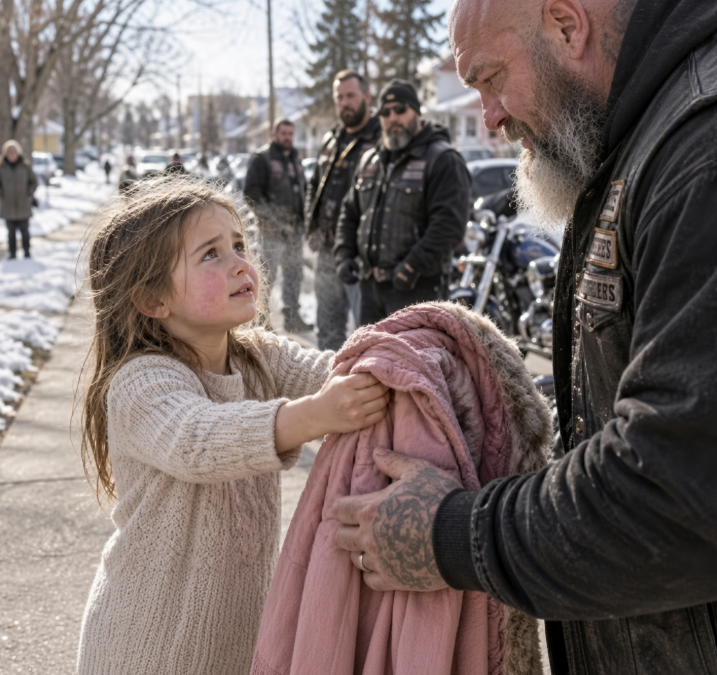
A 17-Year-Old Girl Gave Her Only Warm Coat to a Freezing Biker on an Empty Road—Weeks Later, 500 Motorcycles Rolled Toward Her Home for a Reason She Never Expected.
Sophie Bennett had only one real winter coat, and it still carried the shape of the father she had buried four years earlier.
When she found a biker freezing beside a deserted Ohio road, she gave it to him without asking who he was, what he had done, or whether he could ever repay her.
Three weeks later, the roar of five hundred motorcycles rolled toward her tiny house, and Sophie realized one quiet act of mercy had traveled farther than she ever imagined.
The thermometer nailed to the porch post read eleven degrees.
Sophie Bennett looked at it, pulled her father’s old navy coat tighter around her shoulders, and kept walking.
Eleven degrees did not shock her anymore.
Numbers had lost their power to surprise her.
The balance on the electric bill. The amount left in the checking account. The mortgage payment due in nine days. The hours her mother’s boss had cut after the holiday rush. The cost of the furnace repair estimate folded on the kitchen table like a bad report card.
Numbers were just another language life used to remind the Bennetts that they were always a little behind.
So eleven degrees was simply cold.
And Sophie had known colder.
She had known the cold of waking up before school and seeing her mother, Karen, sitting at the kitchen table in her waitress uniform, staring at bills with one hand pressed to her forehead.
She had known the cold of walking past the coat rack and seeing her father’s work jacket still hanging there four years after his funeral, because neither of them had ever been brave enough to move it.
She had known the cold of wanting to ask for something small—a new pair of boots, money for a class trip, a dress for winter formal—and swallowing the words before they could make her mother’s face change.
Milbrook, Ohio, in the last week of January looked like the whole world had been drained of color.
Snow lay gray along the roadsides. The sky sat low and heavy over the fields. Wind came down from Lake Erie with nothing to slow it once it crossed the open county roads, and by the time it hit Sophie’s face, it felt personal.
She was seventeen years old, walking to the Sunrise Gas Station for her evening shift after school, wearing the only warm coat she owned.
It had belonged to her father.
Navy wool. Too large once, until her mother cut and pinned and hemmed it at the kitchen table two winters earlier. The left pocket lining had torn twice, and Sophie had sewn it twice with thread that did not match. The right sleeve still held a faint dark stain from the winter her father fixed the snowblower and came inside laughing because he had somehow gotten grease on everything except the machine.
Her father, Michael Bennett, had died shoveling the driveway four years earlier.
A heart attack.
That was the official explanation.
But some days Sophie thought grief had more complicated math than that.
One minute, her father had been alive, stomping snow off his boots and promising hot chocolate after he finished clearing the walk.
The next, her mother was screaming his name into the cold.
After that, life divided itself into before and after.
Before, her mother sang while cooking.
After, she cooked in silence.
Before, the house smelled like coffee, motor oil, and cinnamon toast.
After, it smelled like laundry detergent, old paper, and worry.
Before, Sophie’s father had stood in every room like the answer to something.
After, every room held the question of how two people were supposed to keep going without him.
Sophie did not complain.
She had learned early that complaining did not heat a house or pay a bill. Complaining did not bring back fathers. Complaining did not make tips better at the diner or make the mortgage company more patient.
So she worked.
School during the day.
Three evenings a week at the gas station.
Homework after midnight.
A little cleaning at Mrs. Valdez’s house on Saturdays when Mrs. Valdez’s arthritis flared and she pretended Sophie was doing her a favor by accepting twenty dollars.
Sophie kept her head down against the wind and walked.
She was three quarters of a mile from the Sunrise Gas Station, passing the open field where County Road 12 bent toward town, when she saw the motorcycle.
At first, it did not make sense.
Nobody rode a motorcycle in January in northern Ohio unless something had gone badly wrong.
The bike leaned against the guardrail at an angle that looked defeated. Chrome dulled with road salt. A saddlebag hanging open. Steam no longer rising from the engine.
Beside it, on the frozen shoulder, sat a man.
He was hunched so far into himself that Sophie first thought he might be asleep.
Then his shoulders shuddered.
Sophie stopped walking.
Wind hit her back hard enough to push her forward one step.
The gas station was still half a mile away. No houses nearby. No cars coming in either direction. Just flat winter fields, a dead-looking road, a motorcycle, and a man folded beside it like the cold had already started putting him away.
She looked down at her phone.
Three percent battery.
Of course.
“Sir?” she called.
The man lifted his head.
His face was raw red from the cold, beard rimed with frost near the edges. His lips had gone a purple-gray color that made something in Sophie’s stomach tighten. His eyes looked more embarrassed than frightened, which somehow made it worse.
“Bike ran out of gas,” he said.
His voice came out rough and shaky.
“About two miles back. Walked it this far. Wasn’t smart.”
He tried to laugh.
It turned into a shudder.
“Didn’t figure on the wind.”
Sophie stepped closer.
His hands were bare, tucked deep beneath his arms, fingers stiff and curled. His leather jacket looked thick enough for riding, but not for sitting still in eleven degrees while sweat cooled under it and the wind tore through every seam.
“Do you have a phone?” she asked.
“Dead. Dropped it at the last stop. Cracked the screen.”
He glanced away, ashamed of the explanation.
“Bad day.”
Sophie looked down the empty road in both directions.
No cars.
No headlights.
No help.
The gas station was half a mile away, and by the time she got there, called someone, explained, waited, and got back, this man would be colder. Maybe dangerously colder. Sophie had sat through enough health classes to know what shivering meant, and what it meant when shivering stopped.
He was still shivering.
That was good.
For now.
She did not think about it the way people think about big decisions in movies.
She did not weigh the cost of the coat against the wind chill. She did not calculate how cold she would be walking without it. She did not ask whether he was a good man, whether he deserved help, whether helping him would cause trouble, whether anyone would do the same for her.
She only saw a human being freezing on the side of the road.
And she was the only person there.
Sophie unbuttoned her coat.
The wind struck her hoodie immediately, sharp enough to make her breath catch.
The man’s eyes widened.
“No.”
“Put this on.”
“I can’t take a kid’s coat.”
“We’re not arguing about it.”
“You’ll freeze.”
“I’ve got a hoodie under this, and I’m three minutes from indoor heat.”
“That gas station is half a mile.”
“Then you better start walking.”
He stared at her like she had offered him something impossible.
Sophie stepped closer and shoved the coat toward him.
“Put it on now.”
Something in her voice must have reached the part of him that still understood orders. He took the coat with shaking hands, but his fingers were too stiff to manage the buttons.
So Sophie buttoned it herself.
Her father’s coat looked wrong on him.
Too short in the sleeves.
Too tight in the shoulders.
But the wool covered his chest, and that mattered more than memory.
She tugged the collar up around his neck.
“What’s your name?” she asked.
“Derek,” he said through chattering teeth. “Derek Whitfield.”
“I’m Sophie. There’s a gas station half a mile up. We’ll call somebody from there. Sheriff, tow truck, whoever you need.”
He tried to stand.
Failed once.
Then managed it.
“Can you walk?” she asked.
“Slow.”
“Slow is fine.”
It was not fine.
He leaned on her more than either of them wanted to admit. Sophie looped one arm through his and started walking. The wind cut through her thin hoodie like it was made of paper. Within two minutes, her teeth began to chatter. Within three, her fingers hurt.
She did not tell him.
She focused on the road.
Step.
Breathe.
Hold him up.
Step.
Do not think about the coat.
Do not think about Dad.
Step.
“Your coat,” Derek said after a while. “Looks like it matters.”
Sophie kept her eyes forward.
“It’s warm.”
“That’s not what I mean.”
She did not answer.
Some things you did not hand a stranger along with your coat.
Her father’s death.
Her mother’s tired face.
The fact that the coat had been hanging in their hall for two years before Karen finally resized it because buying Sophie a new winter coat was impossible.
The fact that when Sophie first wore it, she cried in the school bathroom because the collar smelled faintly like cedar and the old soap her father used.
The fact that giving it away felt like tearing a piece of him from her shoulders and still, somehow, she did not regret it.
They reached the Sunrise Gas Station eight minutes later.
Gary, the heavyset clerk who had worked with Sophie for a year, looked up from behind the counter and froze.
“What the hell happened?”
“He needs heat,” Sophie said.
Gary did not ask another question.
He rushed Derek toward the space heater by the stockroom, grabbed a chair, and barked at Sophie to call the sheriff’s non-emergency line.
By then, Sophie’s hands shook too badly to dial right the first time.
She gave the dispatcher the mile marker, explained the motorcycle, requested help, and then sat across from Derek while color slowly returned to his face.
Gary put a cup of coffee in Derek’s hands.
Then one in Sophie’s.
“You’re late for your shift,” he said.
“I know.”
“You’re also blue.”
“I know.”
“Don’t die on my floor. It’s paperwork.”
Derek huffed something like a laugh.
Sophie wrapped her hands around the coffee.
The warmth hurt at first.
“You didn’t have to do that,” Derek said quietly.
“Yes, I did.”
“No. You didn’t.”
Sophie looked at him.
He held the coffee but did not drink. His eyes moved to the coat.
“Coat like that. Looked like it mattered to you.”
“It did.”
A pause.
Then she corrected herself.
“It does.”
Derek’s expression changed.
“I’ll get it back to you.”
“It’s okay.”
“No, it isn’t.”
“I didn’t give it to you because it was easy.”
The words surprised both of them.
Derek looked at her for a long moment, as if trying to memorize her face.
“What’s your last name, Sophie?”
“Bennett.”
“Bennett.”
She nodded.
“Sophie Bennett.”
She did not ask why he wanted it.
Polite people asked names. This had been, on the whole, a very polite and very cold half hour.
A tow truck arrived fifteen minutes later. The sheriff’s deputy offered to drive Sophie home after her shift, but she refused because pride is stubbornest when it is cold. Gary told her she was an idiot and then stood by the window at closing to make sure her mother’s spare jacket was zipped as high as it would go before she walked home.
The spare jacket was thin.
Too thin for January.
Karen found it in the back of the hall closet, an old brown quilted jacket with a missing snap and sleeves that ended too high on Sophie’s wrists.
At dinner, over grilled cheese and canned tomato soup, Sophie told her mother what had happened in the shortest possible version.
“Some guy’s bike broke down. He was freezing. I gave him my coat. He’ll probably send it back.”
Karen stared at her.
“You gave away your coat.”
“He needed it.”
“That was your father’s coat.”
“I know.”
Silence.
Sophie looked down at her soup.
“I know, Mom.”
Karen’s face folded for one second before she caught it.
She was not angry.
Not exactly.
That would have been easier.
She was proud and scared and grieving and exhausted all at once, which left no clean place for either of them to stand.
“What was I supposed to do?” Sophie asked. “Walk past him?”
Karen closed her eyes.
“No.”
That was all.
No.
Because Karen had raised her daughter to have exactly that kind of heart. She had taught Sophie to bring casseroles to sick neighbors, to shovel Mrs. Valdez’s walkway before school, to write thank-you notes, to stop if someone needed help.
She could not punish Sophie now for becoming the person she had raised.
But after dinner, when Sophie went upstairs, Karen stood in the hallway and touched the empty hook where the coat had hung.
One more loss.
Not a death.
Not a disaster.
Just another small hardship layered onto a winter that had already taken too much.
What Sophie did not know was that Derek Whitfield rode with nearly two hundred men and women who considered him something close to family.
She did not know that within an hour of being loaded into the tow truck’s cab, Derek would be calling a number half of eastern Ohio’s motorcycle clubs had saved in their phones.
She did not know that when Derek walked into the Steel Wolves Motorcycle Club that night, wrapped in a blanket the tow driver had given him, wearing a teenage girl’s navy wool coat that fit him wrong in every direction, the room would go silent.
The Steel Wolves clubhouse sat on the edge of Ashford in a converted feed warehouse with a wood stove that ran hot enough to make grown men strip down to T-shirts in February. The walls were covered with framed ride photos, memorial patches, old license plates, and a handwritten list of families the club had helped over the years.
Derek barely got through the door before Marcus Hale stood.
Marcus was the club’s sergeant at arms, broad-shouldered, gray-bearded, and built like a man who could lift a truck if friendship required it.
“That the coat?” Marcus asked.
Derek nodded.
He was still not fully warm.
Or maybe he was warm now, but something else in him had started shaking.
“Kid gave it to me right off her back,” he said.
The men nearest him turned.
A woman near the bar stopped wiping down glasses.
“Middle of County Road 12,” Derek continued. “Eleven degrees. Didn’t ask anything. Didn’t know me. Just said, put it on. Buttoned it for me because my hands wouldn’t work.”
Marcus looked at the coat.
Saw the mended pocket.
The worn collar.
The sleeves let out and re-hemmed.
“This isn’t a spare coat,” he said.
“No,” Derek said. “I don’t think it is.”
Word moved through the Steel Wolves the way stories always moved there—not by announcements, but by gravity.
One man told another near the stove.
Someone called Riley Ford, who ran an auto shop two towns over.
A rider texted Owen Pratt, the club president, who was at his daughter’s basketball game and replied only, I’m coming after.
By the time Owen walked in, the story had already become larger than Derek’s near miss.
Owen Pratt was a stocky, quiet man in his late fifties with the kind of calm that made other people lower their voices without knowing why. He had led the Steel Wolves for twelve years. Under him, the club had done food drives, veteran escorts, flood relief supply runs, Christmas toy collections, and more than one quiet envelope slipped under a door when a family was too proud to ask.
He listened to Derek without interrupting.
Then he picked up the coat.
Turned it over in his hands.
Ran his thumb over the repaired pocket lining.
“You get her name?”
“Sophie Bennett,” Derek said. “Works at the Sunrise Gas Station off County 12.”
“Anybody know the Bennetts?”
Riley Ford raised a hand from the back.
“I do. Or I know of them. Karen Bennett’s girl, I think. Karen works at the diner on Route 9. Husband died a few years back. Heart attack. My aunt knew her from church.”
The room went quieter.
It was one thing to hear that a stranger had shown kindness to a stranded biker.
It was another to learn the kindness had come from a girl whose family had already spent years scraping by.
A girl who had given away a coat she likely could not replace.
Derek sat near the stove, staring at the navy wool in Owen’s hands.
“I keep thinking,” he said, “she didn’t hesitate. Not even one second.”
Marcus crossed his arms.
“That kind of thing makes a man feel small.”
Owen looked at him.
“No. It tells him to stand taller.”
Nobody said anything for a while.
The wood stove popped.
Outside, the same wind that had almost killed Derek moved across the warehouse walls, indifferent to the small human reckoning happening inside.
Finally, Marcus asked, “So what do we do about it?”
Owen folded the coat carefully.
“We don’t do anything small.”
Derek looked up.
“What does that mean?”
“It means a girl like that doesn’t get a thank-you card and a gas station gift certificate. Not if we can help it.”
Over the following days, gratitude became organization.
Organization became phone calls.
Phone calls became a movement, though none of the riders would have used a word that grand.
Owen contacted three clubs first.
The Ashford Riders.
The Kettering Crew.
A veterans motorcycle association led by Nathan Cole, a retired Army sergeant who had lost his daughter to leukemia six years earlier and had never quite found steady ground again.
When Nathan heard the story, his face changed.
He did not say much.
He did not have to.
Some stories enter people through doors grief left unlocked.
Meanwhile, in Milbrook, Sophie Bennett went back to life.
School.
Gas station.
Homework.
Chores.
Walking in her mother’s thin spare jacket.
The coat did not come back.
At first, she expected it every day.
Then every few days.
Then only when the wind came hard enough to make her miss its weight.
She did not resent giving it away.
That was important.
If she saw Derek again freezing on the shoulder of County Road 12, she would do the same thing.
But some nights, walking home under a sky the color of metal, she missed her father’s coat so badly it felt like another version of missing him.
She missed the heaviness of it.
The smell.
The way it blocked the wind.
The way it made her feel, for a few minutes, like her father was still keeping part of the world off her shoulders.
At home, the furnace began knocking louder.
At first, it was a small sound in the basement.
Then a rhythm.
Then a threat.
Karen called a repairman, listened to him explain the problem, nodded politely, and thanked him at the door.
When he left, she sat at the kitchen table and stared at the estimate.
Four hundred dollars.
Might as well have been four thousand.
That evening, Sophie stood in the doorway still wearing her gas station uniform and watched her mother rub both eyes with the heels of her hands.
“We’ll figure it out,” Karen said.
She always said that.
Usually, Sophie believed her.
That night, she heard the crack in it.
“I could ask Gary for more hours,” Sophie said.
“No.”
“Mom—”
“You’re already working three nights and keeping your grades up. I’m not taking more from you.”
“You’re not taking. I’m offering.”
Karen looked up.
“You’re seventeen.”
Sophie almost laughed.
As if that number meant what it was supposed to mean.
Seventeen was supposed to be college applications and Friday night football games and arguments over curfew. Seventeen was supposed to be prom dresses and driving practice and pretending your mother was embarrassing.
Sophie’s seventeen was gas station shifts, mortgage whispers, and learning how to stretch soup.
“I know how old I am,” she said.
Karen’s face softened.
“I’m sorry.”
That was worse.
Sophie hated when her mother apologized for things neither of them had caused.
That night, Sophie sat by her bedroom window and let herself feel something she usually pushed away.
Tired.
She was tired of bills.
Tired of cold.
Tired of her mother pretending the math would work if she stared at it long enough.
Tired of being proud and scared at the same time.
Tired of missing a father who had been the one person who made everything feel survivable.
She thought about Derek sometimes.
Wondered if he had made it home.
Wondered if he still had the coat.
Wondered if he thought about her at all now that the emergency was over.
He did.
Nearly every day.
Derek returned to County Road 12 twice.
Once to retrieve his motorcycle.
Once just to stand by the guardrail and look at the place where he had sat freezing, ashamed, and closer to dying than he wanted to admit.
He had spent eight years becoming a man who did not ask for much from anyone.
After his divorce, after the fight with his daughter, after the silence hardened between them until it looked permanent, Derek had drifted toward a life where the club was the only thing keeping him connected to the world.
The Steel Wolves were family.
But even family can become a place to hide.
Sophie’s coat changed something.
Not because of the wool.
Because of the speed of it.
She had seen him suffering and moved before fear, inconvenience, suspicion, or self-preservation could talk her out of it.
Derek kept thinking of his own daughter, Emma.
Twenty-six now.
Married, he had heard.
Maybe with a little boy.
He had not asked anyone directly because pride is very good at pretending ignorance is accidental.
Twice after the coat incident, Derek picked up his phone and found Emma’s number.
Twice, he failed before it rang.
It was not that he did not know what to say.
He knew exactly what to say.
I was wrong.
I miss you.
I got stubborn and called it dignity.
I let the silence last too long because ending it meant admitting I had helped build it.
A seventeen-year-old girl on a frozen road had managed in four seconds what eight years of his own life had failed to do.
She made him ashamed of staying cold.
Two weeks after the rescue, Nathan Cole walked into the Steel Wolves clubhouse with a folder in his hand.
Marcus saw his face and turned off the radio.
“What did you find?”
Nathan set the folder on the bar.
“I did some digging.”
Owen frowned.
“How much digging?”
“Enough.”
He opened the folder.
Karen Bennett.
Waitress.
Widow.
Husband died four years earlier.
Mortgage behind.
Furnace failing.
Daughter working three nights a week.
Medical bills from Michael Bennett’s final hospitalization had eaten what little savings there had been. No meaningful life insurance. No wealthy relatives. No safety net.
Just a mother and daughter holding a house together with overdue notices and stubbornness.
Derek stared at the papers.
“She gave me that coat,” he said.
No one answered.
“She gave me her father’s coat.”
Nathan nodded once.
“That’s what the neighbor said.”
Derek stood abruptly and walked outside.
The cold hit his face.
He welcomed it.
For several minutes, he stood beside his bike with both hands on the handlebars, breathing hard.
Marcus came out but did not speak.
Finally, Derek said, “I want to cover it.”
“What?”
“The furnace. Mortgage. Whatever they need.”
Marcus shook his head.
“This isn’t about you buying forgiveness for being alive.”
Derek turned on him.
“That’s not what I’m doing.”
“Good. Because that girl didn’t save only you.”
Derek looked away.
“She reminded all of us who we’re supposed to be.”
Inside, Owen Pratt came to the same conclusion in different words.
“A girl like that doesn’t need charity dropped on her doorstep like she’s a project,” he said. “She needs to understand that what she did mattered. That it moved something bigger than herself.”
Nathan leaned forward.
“Then we make it bigger.”
The planning took three weeks.
Not one day, despite how the story would later be shortened by people who prefer miracles to logistics.
Real kindness often has paperwork behind it.
Permits.
Bank calls.
Fund accounts.
Furnace contractor estimates.
Mortgage payoff verification.
School counselor conversations.
A lawyer willing to set up an education trust without taking a fee.
A sheriff’s office willing to help coordinate traffic so five hundred motorcycles did not accidentally terrify half the town.
The Ashford Riders committed first.
Twenty bikes.
Then forty.
The Kettering Crew handled route planning.
Nathan’s veterans association started a fundraiser that spread faster than anyone expected. Veterans gave. Riders gave. Civilians gave. A woman in Indiana sent twenty dollars and a note saying, My father wore a coat like that. A retired nurse in Pennsylvania sent fifty. A club in Michigan asked if they could join the ride.
The story traveled.
A girl with almost nothing gave away the little she had to a stranger who could offer her nothing back.
People recognized something in that.
Maybe guilt.
Maybe hope.
Maybe the memory of who they had once meant to become.
By the first week of March, the fund had reached a number that made Owen Pratt sit back in his chair and say nothing for nearly a full minute.
That frightened Marcus.
“You all right?”
Owen nodded.
“Just thinking.”
“About what?”
“That maybe people are starving for a chance to answer goodness with goodness.”
Derek had the coat cleaned and repaired.
Not by a dry cleaner.
By a woman named Viola in Ashford who had spent forty years doing alterations and could make stitches so fine they looked like part of the original cloth. When Derek told her the story, she took the coat from him, ran one thumb over the torn pocket lining, and said, “No charge.”
Derek tried to argue.
Viola looked at him over her glasses.
“I said no charge.”
The pocket lining was repaired properly.
The weak seam at the shoulder reinforced.
The buttons reset.
A small inside patch added near the label, navy thread on navy wool, almost invisible unless you knew where to look.
It read:
For Sophie.
The coat that called us back.
Derek cried when he saw it.
Viola pretended not to notice and handed him a tissue without comment.
Four days before the ride, Derek rode past the Sunrise Gas Station.
This time, his tank was full.
His phone charged.
His coat warm.
He stopped across the street and watched through the window as Sophie rang up a customer’s coffee and gas. She looked smaller than he remembered. Younger too, under the fluorescent lights in her red work vest, hair pulled back, thin jacket hanging from a hook near the register.
For one second, he almost went in.
He wanted to say thank you without an audience.
Wanted to apologize for taking the coat.
Wanted to hand it back and tell her she had done more than she knew.
But Owen had been clear.
This needed to happen once.
All together.
In a way Sophie would never misunderstand.
So Derek rode back to Ashford beneath a sky finally beginning to soften toward spring.
The morning of the ride, Sophie woke to a knocking sound that was not the furnace.
It was her mother in the bedroom doorway.
Karen’s face held an expression Sophie could not read. Somewhere between fear, confusion, and disbelief.
“Sophie,” she said. “You need to come look at this.”
The sound reached them before the sight did.
A low rolling thunder in the distance.
At first, Sophie thought it was weather.
Then the sound grew.
Deeper.
Steadier.
Engines.
Many engines.
She followed her mother downstairs and out onto the porch in bare feet, the boards cold beneath her soles.
From the direction of County Road 12, the first motorcycles crested the rise.
Then more.
Then more.
The road filled with riders as far as Sophie could see, chrome catching the pale March sunlight. Engines rolled low and slow, not wild, not chaotic, but organized. Purposeful. The sound pressed through the cold air until Sophie felt it in her chest.
Neighbors came out onto porches.
Curtains moved.
Dogs barked.
Karen gripped Sophie’s shoulder.
Motorcycles began filling the field beside the Bennett house. Engines cut off one by one until the silence that followed felt almost as powerful as the roar had been.
Five hundred riders.
Sophie would learn the exact number later.
In that moment, she understood only scale.
Impossible scale.
A man dismounted from the lead bike and walked toward the porch carrying something folded over one arm.
It took Sophie a moment to recognize him without frost on his beard and terror in his eyes.
“Derek?”
His face changed when she said his name.
As if he had not been sure she would remember.
“Sophie Bennett,” he said.
His voice cracked slightly.
“I don’t know if you remember me.”
“Of course I remember you.”
It came out smaller than she meant it to.
“Are you okay?”
Derek swallowed.
“I’m alive because of you. That’s the short version.”
He held out what he carried.
Sophie stared.
Her coat.
Her father’s coat.
Cleaned.
Mended.
Folded carefully.
The navy wool looked better than it had in years, but still familiar. Same weight. Same buttons. Same shape. The left pocket lining repaired properly this time.
Sophie took it with hands that had started to shake.
Not from cold.
“I meant to get it back sooner,” Derek said.
Sophie looked at him.
Behind him stood hundreds of strangers in leather jackets, denim, riding gear, veterans’ patches, club colors, work boots, knit caps, gray beards, ponytails, tired eyes, kind eyes, solemn faces.
“You all came to return a coat?”
A few people laughed softly.
Derek did not.
“No,” he said. “We came because of why you gave it.”
Owen Pratt stepped forward then, quiet and steady.
“Sophie, my name is Owen Pratt. I’m president of the Steel Wolves Motorcycle Club. This is Nathan Cole, from the Veterans Riders Association.”
Nathan nodded.
His eyes were already wet.
Owen continued.
“Derek told us what happened on County Road 12. How you found him freezing. How you gave him the coat off your own back without knowing anything about him.”
Sophie’s face heated.
“I just did what anyone would do.”
“No,” Nathan said.
His voice was gentle.
“That’s the part you need to understand. It’s what everyone likes to think they would do.”
The yard went quiet.
Nathan took one step closer.
“I lost my daughter six years ago. For a long time after, I watched myself become smaller. Colder. I held tight to what little I had left because grief convinced me that was survival.”
He looked at the coat in Sophie’s hands.
“Then I heard about a girl who lost her father, whose family had every reason to hold tight to every little thing, and instead she gave away the warmest thing she owned to a man she didn’t know.”
His voice trembled but did not break.
“That is not nothing, Sophie. That is the whole thing.”
Karen made a small sound behind her.
Half sob.
Half breath.
Derek looked at Karen, then back at Sophie.
“We learned some things about your family,” he said. “Not to embarrass you. Not to make you feel like a charity case. We learned enough to understand that your coat wasn’t the only thing you gave that day.”
Owen nodded toward the field.
“Riders from three states contributed to this. Veterans. Clubs. Mechanics. Waitresses. Teachers. People who heard your story and wanted to answer it.”
Sophie could not speak.
Derek continued.
“Your mortgage arrears are covered.”
Karen’s hand flew to her mouth.
“The furnace repair is paid for. Contractor’s coming Monday, if that works for your mom.”
Karen began crying openly then.
“And there’s a college fund,” Derek said, voice rough now. “Set up properly through a trust. For whatever you decide to study.”
Sophie stared at him.
The words did not enter all at once.
Mortgage.
Furnace.
College.
They floated around her like another language.
“No,” she whispered.
Derek’s face fell slightly.
“You don’t have to accept anything today. We—”
“No, I mean…” She shook her head. “Why?”
That word broke something in him.
Why.
As if she truly did not know.
“I didn’t do anything special,” she said. “I just gave you a coat.”
Owen Pratt looked at her with an expression Sophie would remember for the rest of her life.
“You gave what you had when someone needed it more.”
Sophie looked down at the coat.
Her father’s coat.
The mended pocket.
The wool that had carried memory, warmth, loss, and now something else she did not know how to name.
Karen stepped beside her and touched the sleeve.
Four years of holding everything together.
Four years of bank notices and diner shifts.
Four years of trying not to let Sophie see how scared she was.
Now five hundred strangers stood in their yard because Sophie had refused to let a man freeze.
Karen began to sob.
Not the quiet crying Sophie had heard through bedroom walls.
Openly.
With one hand pressed to her chest.
“Four years,” Karen said. “Four years of feeling invisible to everyone but the bank.”
Derek’s eyes filled.
“You’re not invisible,” he said. “You never were. It just took the right moment for the rest of us to notice.”
Boxes were unloaded from several bikes.
Groceries.
Gift cards.
A proper winter coat in Sophie’s size.
One for Karen too.
A toolbox donated by Riley Ford for the furnace room because “every house needs one.”
And a hand-carved wooden box made by a Steel Wolves member who restored furniture. Derek handed it to Sophie last.
“This is for whatever matters most,” he said.
The box was simple and beautiful, dark wood polished smooth, with a small metal clasp. Inside, lined in blue felt, lay the patch Viola had sewn before making the hidden one in the coat.
For Sophie.
The coat that called us back.
Sophie pressed one hand over her mouth.
Then she put on her father’s coat.
Right there on the porch.
The familiar weight settled over her shoulders.
It did not feel like losing him this time.
It felt, somehow, like carrying him into what came next.
Somewhere in the crowd, someone started clapping.
Then another.
Then the whole yard erupted.
Five hundred riders clapping for a seventeen-year-old girl who had only meant to help a man survive one bad afternoon.
Sophie cried then.
Of course she did.
She cried into her father’s coat while her mother held her, while Derek stood at the bottom of the porch steps crying too, while neighbors watched with their hands over their mouths, while the field beside the Bennett house filled with the sound of engines cooling and people remembering that goodness could still move through the world like thunder.
Spring came slowly to Milbrook that year.
It always did.
But Sophie noticed it earlier than most.
She noticed it in the furnace running quietly for the first time in months. In her mother humming while making dinner instead of staring silently at bills. In the stack of college brochures on the kitchen table, no longer a fantasy reserved for other families.
There were hard adjustments too.
Nobody had warned Sophie that receiving help could feel frightening.
For weeks after the ride, she waited for the catch.
Some hidden condition.
Some person to call and say there had been a mistake.
Some bill to arrive proving relief had only been rented, not given.
She had grown up believing nothing good came without a cost hiding inside it. It took most of March and April for that instinct to loosen.
But the mortgage arrears stayed paid.
The furnace stayed fixed.
The groceries filled the pantry.
The education trust sat waiting, real and legal, for whatever future Sophie chose.
Nursing, maybe.
She had started thinking about it seriously after the ride.
Not because she wanted to be a hero.
Because she understood now that small acts at the right moment could keep people alive.
Derek began stopping by the Sunrise Gas Station every couple of weeks.
Not with grand gestures anymore.
Just coffee.
Sometimes a muffin he pretended was for himself and left behind “by accident.”
He asked about school the way an uncle might.
One afternoon in April, he came in smiling differently.
Nervously.
“My daughter called me back,” he said.
Sophie stopped wiping the counter.
“You called her?”
“Three times before I let it ring.”
“But you did.”
“I did.”
“And?”
He looked down at his coffee.
“She said I could come see her next weekend. Meet my grandson.”
Sophie smiled.
“Derek, that’s amazing.”
He nodded, blinking hard.
“You gave me a reason to remember who I used to be.”
“I just gave you a coat.”
“No,” he said. “You gave me proof that people can still reach across the cold. I needed that more than I knew.”
Nathan Cole visited twice that spring.
Once to check on the trust paperwork.
Once, without much explanation, to sit on the Bennett porch with Karen for over an hour.
They talked about grief in the language shared by people who had lost someone the world expected them to get over.
Afterward, Karen stood in the kitchen with red eyes and a lighter face.
“That was the first time,” she told Sophie, “that talking about your father made me feel less alone instead of more.”
The ride had not only fixed bills.
It had opened doors.
Kindness had circled back around, not just to the Bennetts, but through everyone it touched.
In June, the Steel Wolves held a cookout at their clubhouse.
Sophie and Karen were invited as guests of honor, though Sophie kept insisting she had done nothing worthy of that title.
The clubhouse looked intimidating from the outside.
Inside, it smelled like barbecue, coffee, wood smoke, motor oil, and old stories. People greeted Sophie like family. Riley Ford taught her how to check tire pressure on a motorcycle. Marcus showed Karen the memorial wall. Derek introduced Sophie to his daughter, Emma, and his three-year-old grandson, whose first act upon meeting Sophie was to hand her a sticky toy truck.
“Runs in the family,” Derek said.
Sophie laughed.
Later, Owen found her near the wood stove, unlit in the summer heat but still somehow the emotional center of the room.
“You know why this worked the way it did?” he asked.
Sophie shook her head.
“It wasn’t because you did something enormous. It’s because you did something small without holding anything back.”
She looked at him.
“Most people give halfway,” Owen said. “Half their attention. Half their comfort. Half their generosity, with the rest kept safe in reserve. You gave the whole coat.”
Sophie looked across the room at Derek laughing with his daughter.
At Nathan talking quietly with her mother.
At riders who had once been strangers and now felt woven into their lives.
“I didn’t know anyone would notice.”
Owen smiled.
“That’s why it mattered.”
By the following winter, Sophie had a new coat of her own.
She bought it with her gas station wages, because pride had not disappeared just because help had arrived. It was sturdy, warm, dark green, and properly sized.
But her father’s old coat stayed in the hall closet.
Cleaned.
Mended.
Hung carefully.
Not because she needed it anymore.
Because she wanted it close.
Sometimes she would touch the sleeve before leaving for work or school, feeling the hidden patch inside like a secret.
The coat that called us back.
On the anniversary of that frozen afternoon, Derek rode to the Bennett house alone.
No crowd.
No cameras.
No thunder of five hundred engines.
Just one motorcycle in the driveway and three cups of coffee going lukewarm on the porch in the cold.
Karen brought out a blanket.
Sophie wore the green coat.
Her father’s coat hung inside by the door.
They talked about ordinary things.
Emma’s son.
College applications.
The furnace.
Gary at the gas station slipping on ice and insisting he meant to sit down.
After a while, Sophie looked at Derek.
“Did you ever think about what would’ve happened if I kept walking?”
Derek stared into his coffee.
“Yes.”
The answer was immediate.
Too immediate.
“I try not to,” he added.
Sophie nodded.
“I think about it too.”
“Why?”
“Because I almost did.”
He looked at her.
“The first second, I thought, someone else will stop. Then I realized there was no one else.”
Derek’s face softened.
“That’s the part most people miss.”
“What?”
“There’s almost always a second where you can choose to keep going.”
The porch went quiet.
Sophie looked across the yard where snow had begun gathering lightly along the grass.
“I’m glad I stopped.”
Derek’s voice thickened.
“So am I.”
He no longer looked like the half-frozen stranger from County Road 12.
He looked like someone who belonged on their porch.
Which, Sophie supposed, was exactly what one torn coat and one impossible morning had quietly made him.
Family.
Years later, when people told the story, they often got parts wrong.
They said the riders showed up the next day.
They said Sophie was poor in a way that made her sound helpless.
They said Derek was saved by a miracle.
They said five hundred bikers changed a girl’s life.
Some of that was almost true.
But Sophie knew the real story was quieter.
A man was freezing.
A girl stopped.
A coat changed shoulders.
That was the moment.
Everything else—the motorcycles, the mortgage, the furnace, the college fund, the friendships, Derek finding his daughter again, Karen learning to breathe under grief, Sophie trusting her own kindness—grew from that one decision.
The gift had never really been the coat.
The gift was deciding, in a few frozen seconds, that someone else’s suffering mattered more than her own comfort.
That kind of decision rarely feels historic while you are making it.
It feels cold.
Inconvenient.
Immediate.
It feels like fingers too numb for buttons and wind cutting through a hoodie.
It feels like being late for work.
It feels like doing the only decent thing and then walking on.
But the world is not as indifferent as it sometimes looks.
Goodness moves.
Sometimes slowly.
Sometimes quietly.
Sometimes through phone calls and motorcycle clubs and repaired pocket linings.
Sometimes it disappears for three weeks and returns as thunder down a county road.
Sophie Bennett learned that before she turned eighteen.
She learned that a coat could be more than wool.
That grief could become generosity.
That help could arrive without humiliation.
That strangers could become family.
That her father’s love had not ended on the day he died; it had traveled with her down County Road 12, covered a freezing man’s shoulders, and somehow come back multiplied five hundred times.
And every winter after, when the wind swept across the fields outside Milbrook and rattled the Bennett porch, Sophie would pass the hall closet, touch the sleeve of her father’s old coat, and remember.
Not the cold.
Not first.
She remembered the sound of engines.
The sight of her mother crying in relief.
Derek’s voice saying, You’re not invisible.
The weight of the coat settling back over her shoulders.
And the truth she had learned on the shoulder of an empty road: