PART 1 — MY SON TOLD ME TO KEEP MY MOUTH SHUT
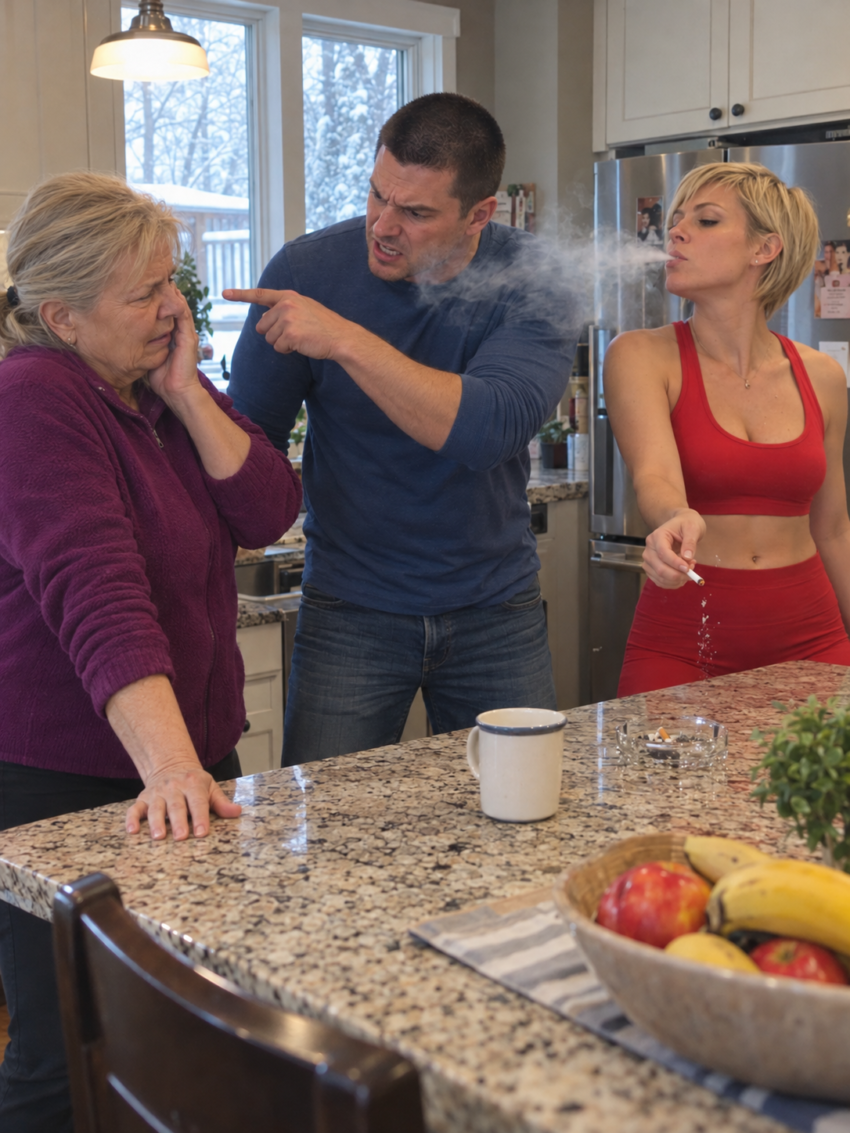
“YOU LIVE UNDER MY ROOF, MOM! YOU DON’T GET TO TELL MY WIFE WHAT TO DO!” My Son Snapped When I Asked His Wife to Stop Smoking Near Me. I’m 73, and My Doctor Had Warned Me That Cigarette Smoke Could Make My Breathing Worse. Before I Could Explain, My Son Slapped Me Across the Face. Then He Took His Wife Out to Dinner as Though Nothing Had Happened. Fifteen Minutes Later, I Picked Up My Phone and Called Three People He’d Never Met. By Nine the Next Morning, He Was Standing in His Own Kitchen, Staring at the People on His Doorstep—and the Gray Folder One of Them Was Carrying.
My name is Loretta Bennett. I’m seventy-three years old, and until that morning, I believed there were certain things a mother simply had to endure if she wanted to keep her family together.
I’d raised my only son, Daniel, by myself in Columbus, Ohio. His father left when Daniel was four, and for years I worked two jobs, sometimes three, to keep food on the table. I cleaned offices in the evenings, worked at a manufacturing plant during the day, and took whatever weekend shifts I could find.
I never expected Daniel to repay me for raising him. I did hope he’d remember that I’d always tried to give him a decent home.
Six months earlier, he’d persuaded me to leave my little apartment and move into the large house he shared with his wife, Sloan, in a Columbus suburb.
“Mom, you’re getting older,” he’d said. “You shouldn’t be living alone with those lungs of yours. Come stay with us. We’ll take care of you.”
My doctor had recently told me that years of breathing dust and industrial fumes had left me with chronic lung problems. I could still manage most things myself, but stairs were becoming difficult, and I sometimes needed to sit down after carrying groceries.
Daniel’s offer sounded generous.
At first.
He gave me the smallest guest bedroom, the one with a drafty window and a bathroom barely large enough to turn around in. I didn’t mind the size. I’d lived in smaller places. But I soon discovered that I was expected to stay out of the way whenever they entertained guests.
Sloan didn’t like my knitting basket in the living room. Daniel complained if I left my medications on the kitchen counter. I was also expected to contribute $600 a month toward household expenses, although Daniel frequently told people I was living there for free.
I paid without arguing. I bought groceries, folded laundry, and kept the kitchen tidy.
I thought that if I made myself useful enough, eventually I’d feel welcome.
Then came the afternoon that changed everything.
Sloan was standing beside the kitchen island, smoking while she looked through her phone. The smell had already filled the room, and I could feel the familiar tightness beginning in my chest.
“Sloan, honey, would you mind taking that outside?” I asked. “The smoke is making it hard for me to breathe.”
She didn’t look up.
“I’m almost finished.”
“I know, but my doctor was pretty clear about avoiding cigarette smoke. Could you please—”
Daniel came around the island before I finished.
“For heaven’s sake, Mom. Can you leave her alone for five minutes?”
“Daniel, I’m only asking her to smoke outside.”
“And I’m telling you to stop making everything about yourself.”
I opened my mouth to answer.
His hand struck my cheek.
The force turned my head, and I caught the edge of the marble counter to steady myself. For a moment, I could hear nothing but the refrigerator humming and the pounding of my own heart.
Daniel stood in front of me, breathing heavily.
“Maybe now you’ll learn to keep your opinions to yourself.”
Sloan didn’t come over. She finished her cigarette and pressed it into a little saucer I’d washed that morning.
Then Daniel turned toward her.
“You still want to go out for dinner?”
“Sure,” she answered, picking up her purse.
They walked past me without another word.
I stood there with one hand against my cheek, trying to understand how my son could hurt me and then casually discuss restaurant reservations.
Fifteen minutes later, I heard their SUV pull out of the driveway.
I went to my bedroom and sat on the edge of the bed.
Across from me stood a framed photograph from Daniel’s college graduation. He was wearing his cap and gown, grinning as he wrapped an arm around my shoulders. I’d saved for months to buy the blue dress I wore that day.
I remembered how he’d hugged me after the ceremony.
“We did it, Mom,” he’d whispered.
For years, that photograph had been proof that all the hard work had meant something.
Now I couldn’t bear to look at it.
I reached for my phone.
There were three people I hadn’t seen together in more than twenty years, but I still had their numbers.
Michael Harris had lived with us for nearly a year when he was seventeen. His mother had struggled with serious health problems, and he’d needed somewhere stable to finish high school. He was a lawyer now.
Emily Foster was the daughter of a neighbor I’d cared for during a long illness. Emily had spent countless afternoons doing homework at my kitchen table. She’d become a journalist.
And Thomas Reed had been a college student who sometimes went without dinner because he was trying to pay tuition. I used to send him home with containers of soup. These days, he worked as a financial analyst.
I’d never considered those kindnesses extraordinary.
At the time, they were simply people who needed help, and I had a little to give.
I called Michael first.
“Loretta!” he answered warmly. “Well, this is a surprise. How have you been?”
I almost gave him my usual answer.
Fine. Just fine.
Instead, I touched my cheek.
“Michael, something happened today. I don’t think I can stay here anymore.”
His voice changed.
“Tell me what happened.”
I told him about the cigarette, Daniel’s anger, and the slap. I told him I was frightened of what might happen when they came home.
Michael listened without interrupting.
“Are you safe right now?”
“They’re out to dinner.”
“All right. If you have trouble breathing or feel in immediate danger, call 911. Otherwise, keep your phone close. Can you get your medications and identification together?”
“Yes.”
“I’m going to come tomorrow morning. But Loretta, I want you to understand something. You don’t have to wait until tomorrow if you feel unsafe tonight.”
I thanked him and hung up.
Then I called Emily and Thomas.
Neither hesitated.
Emily offered me her guest room. Thomas said he’d help me figure out what I could afford if I decided to move.
When I finished those calls, I was still frightened. My cheek still hurt, and I had no idea what my son would do when he learned I’d told someone.
But I wasn’t entirely alone anymore.
THE PHOTOGRAPH I ALMOST LEFT BEHIND
That evening, I took a picture of my cheek. I also photographed the broken window in my room, the narrow bathroom, and the receipts showing what I’d paid toward household expenses.
I wasn’t trying to build a case against my son. I was trying to make sense of the six months I’d spent convincing myself that things weren’t as bad as they felt.
When Daniel and Sloan came home, they were laughing about something that had happened at dinner.
Neither came to check on me.
I lay awake for hours, listening to the house settle around me.
The next morning, I put on the blue cardigan Daniel had given me for Mother’s Day several years earlier. The left sleeve had a small snag near the cuff, but it was warm, and I liked it.
My cheek was bruised.
I photographed it again.
At breakfast, Daniel was scrolling through his phone while Sloan ate yogurt at the kitchen island.
Neither mentioned my face.
I poured myself coffee and sat down.
At exactly nine o’clock, the doorbell rang.
Daniel frowned.
“Are you expecting somebody?”
I set down my cup.
“Yes. I asked some friends to come.”
He looked up sharply.
“What friends?”
Before I could answer, the bell rang again.
I stood and walked toward the door.
Michael was on the porch carrying a gray folder. Emily stood beside him with a coat folded over one arm, and Thomas waited near a parked car.
Michael looked at my face, and his expression tightened.
“Loretta, would you like us to come inside?”
It was such a simple question.
Yet after six months of being told where to sit, what to move, and when to keep quiet, I nearly cried.
“Yes, please.”
Daniel appeared behind me.
“Hold on. Who are these people?”
“They’re friends of mine.”
“You can’t just invite strangers into my house without asking.”
Michael remained on the porch.
“I’m Michael Harris. Loretta called me yesterday because she needed help. We don’t want any trouble.”
Daniel glanced at the folder.
“What kind of help? Mom, what have you been telling people?”
I stepped aside to let them enter.
“I’ve been telling them what happened yesterday.”
His expression changed.
“Oh, for crying out loud. You’re not seriously making a big production out of that little argument.”
Emily looked directly at him.
“Did you hit your mother?”
“That’s not what happened.”
I felt the familiar urge to make excuses for him. I could have said he’d been tired or that we’d both been upset.
Instead, I spoke clearly.
“He slapped me because I asked Sloan not to smoke near me.”
Sloan came into the hallway.
“Loretta, really? You’re bringing people here over a family disagreement?”
Michael opened his folder but didn’t remove anything.
“Loretta asked us to help her find somewhere safe to stay. That’s what we’re here to do.”
Daniel folded his arms.
“My mother lives here without paying rent. We feed her, we take care of her, and this is the thanks we get.”
I reached into my cardigan pocket for my phone.
“I pay you six hundred dollars every month, Daniel.”
“That’s hardly enough to cover what you cost us.”
“Then say that. But don’t tell people I haven’t paid anything.”
I opened my banking app and showed Michael the transfers.
Six payments.
Three thousand six hundred dollars.
Michael studied them, then handed back my phone.
“Loretta, do you have copies of your medical records and identification?”
“Yes. They’re in my room.”
Daniel shook his head.
“You’re not seriously going to let these people talk you into leaving.”
I looked at him.
“I called them, Daniel. This was my decision.”
For the first time that morning, he had nothing to say.
THE DECISION I HAD BEEN AFRAID TO MAKE
Emily helped me pack while Thomas waited downstairs. I gathered my medications, clothing, bank statements, and a few books. Everything I’d brought into that house six months earlier seemed to fit into two suitcases.
I found the graduation photograph on my dresser.
For a moment, I considered leaving it behind.
Emily noticed me holding it.
“You don’t have to decide what it means today,” she said gently.
I looked at the young man smiling beside me.
“He was a good boy once.”
“I’m sure he was.”
“I don’t know what happened to him.”
Emily sat beside me.
“You can love the boy you raised and still protect yourself from the man he is today.”
I placed the photograph carefully between two sweaters.
Downstairs, Daniel was waiting.
“Mom, you’re being ridiculous. You have no idea what it costs to live alone these days.”
“Then I’ll find out.”
“You’re seventy-three. You need somebody looking after you.”
I glanced at my suitcases.
“I needed somebody looking after me yesterday.”
He looked away.
Michael explained that we’d arrange a time to collect anything I couldn’t take immediately. He also said he could help me understand my options for reporting the incident and seeking protection if necessary.
Daniel gave a nervous laugh.
“Reporting? You’re talking about getting the police involved over one mistake?”
I waited for him to say he was sorry.
He didn’t.
Instead, he looked at Michael.
“She’s my mother. This is a private family matter.”
“It’s Loretta’s decision what happens next,” Michael replied.
I walked toward the front door.
Daniel stepped closer.
“Mom, don’t do this. People are going to think I’m some kind of monster.”
I turned around.
“Daniel, you haven’t asked me once whether I’m all right.”
His mouth opened, then closed.
I waited another moment.
Still nothing.
So I picked up my purse and left.
As Thomas helped me into the car, I looked back at the house. It had beautiful landscaping, expensive windows, and a front porch large enough for four rocking chairs.
For six months, I’d tried to convince myself that living there meant I was fortunate.
Now, with two suitcases in the trunk and a bruise on my cheek, I felt something I hadn’t expected.
Relief.
PART 2 — THE GRAY FOLDER
Emily took me to an urgent care clinic before we went to her house. The doctor examined my cheek, checked my breathing, and asked what had happened.
I almost told him I’d fallen.
The words were already forming in my mouth when I remembered Daniel’s face after he’d hit me.
“My son slapped me,” I said.
The doctor didn’t look shocked or doubtful. He simply asked a few more questions, documented what he observed, and made sure I understood when to seek emergency care for my breathing.
Michael had advised me to keep the original photographs and messages. He also explained that I could make a police report and ask about available protective measures, but that no particular legal outcome was guaranteed.
I decided to report what happened.
The following morning, Michael accompanied me to the police station.
I gave my account, answered the officer’s questions, and provided the photographs I’d taken. I was nervous enough that I had to stop twice for water.
Nobody applauded. Nobody promised me that everything would be settled by Friday.
But when I walked outside, I felt as though I’d finally told the truth without apologizing for it.
That afternoon, Thomas arrived at Emily’s house with his laptop and a notebook.
“Loretta, before we start, I want you to know I’m not here to tell you what to do with your money,” he said. “I just want to help you see what your choices are.”
We sat at Emily’s dining table and reviewed my Social Security income, retirement savings, medical expenses, and monthly transfers to Daniel.
I had more money available than I’d allowed myself to believe.
Not a fortune. Nothing that would buy me a mansion or let me spend carelessly.
But enough to rent a modest apartment if I kept a careful budget.
Thomas showed me the figures.
“You can afford a small place of your own, Loretta. You’ll have to watch your expenses, but you won’t be dependent on Daniel.”
I stared at the numbers.
“Are you sure?”
“I’ve checked them twice. And I want you to check them with me.”
For six months, Daniel had reminded me how expensive everything was. He’d talked about rising property taxes, insurance premiums, and grocery bills until I’d begun to think I was a burden he could barely afford.
Now I could see that my contributions had been real.
I’d paid $3,600 toward household expenses, bought groceries regularly, and helped with chores. Daniel had every right to decide what he could afford in his own home, but he had no right to pretend I’d contributed nothing.
Thomas closed the notebook.
“There’s something else I want to ask you. When was the last time you made a financial decision without worrying about Daniel’s reaction?”
I thought about it.
Then I shook my head.
“I can’t remember.”
He didn’t offer a lecture. He simply slid the notebook toward me.
“Well, this one’s yours.”
I kept that notebook beside my bed for the next several weeks.
THE MESSAGE MY SON DIDN’T EXPECT ME TO KEEP
Daniel began texting me the day after I left.
His first message said I’d embarrassed him in front of strangers.
The second accused Michael of turning me against my family.
The third said Sloan was upset because people were asking questions about my departure.
Not one asked how I was feeling.
I answered only once.
“I’m safe. I need time. Please don’t come to Emily’s house.”
Two days later, he left a voicemail.
“Mom, look, I shouldn’t have slapped you. But you were pushing Sloan, and you know how things get when everybody’s stressed. You didn’t need to bring outsiders into our business.”
I listened to it sitting at Emily’s kitchen table.
For a moment, hearing Daniel’s voice made me want to call him back. I remembered him at eight years old, standing in our little apartment with a homemade Mother’s Day card and a crooked grin.
Then I listened again.
He’d admitted what he’d done, but he was still explaining why I had supposedly made him do it.
I saved the original message and told Michael about it.
He asked me not to delete anything and explained that the voicemail might be relevant to the report, depending on how the matter proceeded.
“You don’t have to respond right now,” he told me. “And you don’t have to argue with him to prove your account.”
That was difficult advice to follow.
I’d spent most of my life solving problems by talking, explaining, and making peace. When Daniel was little, I could usually calm him down with a patient conversation and a plate of toast.
But he wasn’t a little boy anymore.
And I couldn’t fix what he’d done by finding better words.
A week later, Sloan sent me a message.
She said Daniel had been under tremendous pressure at work. She reminded me that they’d opened their home to me and claimed I’d repaid their kindness by making them look cruel.
Then she asked whether I could reconsider moving out because the household budget had become difficult without my monthly contribution.
I read that sentence three times.
For months, they’d told me my money barely covered what I cost them.
Now they were struggling without it.
I showed Thomas the message.
He read it quietly, then handed my phone back.
“You don’t have to answer their financial questions, Loretta. They’re adults. They can work out their own budget.”
I sat with that thought for a long time.
Then I wrote Sloan a short reply.
“I hope you and Daniel work things out. I won’t be returning to live there.”
She didn’t respond.
THE LAST VISIT TO MY SON’S HOUSE
Ten days after I moved out, Michael arranged a time for me to collect the rest of my belongings. Emily came along, and Daniel agreed that we could enter while he and Sloan were home.
I was nervous before we arrived.
My hands shook so badly that I had trouble fastening the buttons on my cardigan. Emily noticed but didn’t comment. She simply waited until I was ready.
Daniel opened the door.
He looked tired. There were dark circles beneath his eyes, and his hair was messier than usual.
For one foolish second, I wanted to ask whether he was sleeping enough.
Instead, I said, “Good morning, Daniel. I’ve come for the rest of my things.”
He stepped aside.
My bedroom looked exactly as I’d left it. The curtains were closed, and a layer of dust had settled on the dresser. I began packing my books, spare shoes, and a little wooden jewelry box Ed had given me on our twentieth anniversary.
Emily helped me carry the boxes into the hallway.
When I returned for the last one, Daniel was standing in the doorway.
“Mom, can we talk?”
I looked toward Michael, who was waiting in the hall.
“We can talk here.”
Daniel frowned.
“Do we really need an audience?”
“For now, yes.”
He rubbed his forehead.
“I don’t understand why you’re doing this. One bad afternoon, and you’re throwing away our whole relationship.”
I set the box on the bed.
“I’m not throwing anything away, Daniel. I’m leaving a house where I don’t feel safe.”
“I already told you I made a mistake.”
“You told me I made you do it.”
He looked down.
“I was angry.”
“I know.”
“Sloan and I have been fighting about money. Work’s been awful. I shouldn’t have taken it out on you.”
It was the closest he’d come to an explanation that didn’t begin by blaming me.
I waited.
“I’m sorry I hit you,” he said finally.
My throat tightened.
I’d wanted those words from the moment his hand struck my face.
But hearing them didn’t make the fear disappear.
“Thank you for saying that,” I answered.
He looked relieved.
“So you’ll come home?”
I shook my head.
“No.”
His expression hardened.
“Then what’s the point of apologizing?”
I picked up the box.
“An apology doesn’t mean everything goes back to the way it was.”
He stared at me as though I’d spoken a language he didn’t understand.
“I’m your son.”
“And I’m your mother. I love you, Daniel. But I won’t live somewhere I’m afraid to ask for clean air.”
For a moment, I saw shame cross his face.
Then he looked away.
“I don’t know what else you want from me.”
“I want you to understand what happened. Not just what it cost you.”
I carried the box into the hallway.
Sloan was standing near the staircase. She looked at the blue cardigan I was wearing and then at the belongings in my arms.
“You really think you’re better off alone?” she asked.
I thought about the last ten days. Emily had given me a quiet bedroom. Michael had helped me understand my options. Thomas had shown me that I could support myself.
But more important than any of that, I’d been able to breathe without wondering whether asking for something would start another argument.
“I think I’m better off somewhere I can feel safe,” I said.
She didn’t answer.
As I reached the front door, Daniel called after me.
“Mom, wait.”
I turned.
He stepped forward, lifting his arms as though he intended to hug me.
Without thinking, I moved backward.
He stopped immediately.
For several seconds, neither of us spoke.
Then I said, “I’m not ready for that yet.”
His face changed. He looked wounded, but he didn’t come any closer.
“Okay,” he said quietly.
It was the first time in months he’d accepted a boundary without arguing.
I left before I could change my mind.
A SMALL APARTMENT WITH A WINDOW THAT OPENED
Three weeks later, I signed a lease on a one-bedroom apartment on the quieter side of Columbus.
It wasn’t fancy. The kitchen cabinets were old, the carpet had seen better days, and the living room was barely large enough for my couch and Ed’s old rocking chair.
But the windows opened easily, and the rent fit the budget Thomas had helped me prepare.
Emily brought a potted basil plant for the kitchen windowsill. Michael helped me carry my books upstairs, and Thomas checked that I’d arranged my bills so I could manage them without depending on anyone.
They didn’t treat me like a helpless old woman.
They asked what I wanted and helped me do it.
That first evening, I stood in the middle of my new living room with a cup of tea in my hand. The apartment was quiet except for the ticking of the wall clock.
I walked to the window and opened it.
Cool October air moved through the room.
I took a slow breath.
There was no cigarette smoke.
No one telling me I was making a fuss.
No one waiting to criticize where I’d put my things.
I sat in Ed’s rocking chair and cried for a while.
Not because I regretted leaving.
Because I wished it hadn’t been necessary.
Over the next month, I attended my medical appointments and continued cooperating with the authorities. Michael reminded me that the process could take time and that we couldn’t predict the outcome.
I didn’t need a dramatic courtroom victory.
I needed my son to understand that what he’d done mattered, and I needed to know I wouldn’t be forced to endure it again.
Daniel sent occasional messages.
Some were angry. Some were apologetic. Others sounded almost like the son I remembered.
One afternoon, he wrote that he was considering counseling and wanted to talk when I felt ready.
I answered that I hoped he followed through, but that I needed more time.
Then I put my phone down and went back to the sweater I was knitting.
For the first time, I wasn’t spending the entire afternoon wondering how my response might affect his mood.
THE PHOTOGRAPH ON MY WINDOWSILL
One Saturday, I unpacked the final box from Daniel’s house.
At the bottom, beneath a stack of old recipe cards, was the photograph from his college graduation.
I carried it to the kitchen table.
There we were, twenty-five years younger. Daniel had his arm around my shoulders, and I was smiling so hard my cheeks looked round.
I remembered the restaurant where we’d celebrated afterward. He’d ordered the most expensive steak on the menu and insisted I have dessert.
“You’ve worked hard enough, Mom,” he’d told me. “One day I’m going to take care of you.”
I’d believed him.
Perhaps he’d believed it, too.
I ran my thumb along the edge of the frame.
I still loved the young man in that picture. I still loved the grown man who’d hurt me, though I no longer trusted him the way I once had.
Both things could be true.
My phone buzzed on the table.
It was a message from Daniel.
“Mom, I started seeing a counselor. I know that doesn’t fix what I did. I’m sorry. I hope you’re doing okay.”
I read it twice.
Then I wrote back.
“I’m doing better. I’m glad you’re getting help. We can talk when I’m ready.”
I didn’t promise a visit. I didn’t invite him over. I didn’t offer to help with his bills or ask whether Sloan was still upset.
I simply answered his message.
Then I placed the graduation photograph on the windowsill beside Emily’s basil plant.
The picture no longer had to convince me that I’d been a good mother. It could simply remind me of a day when my son and I had been happy.
That evening, Michael stopped by with a loaf of bread from a bakery near his office. Emily called to ask whether I wanted to come over for Sunday dinner, and Thomas sent me a reminder about a senior exercise class I’d mentioned wanting to try.
I smiled at the thought of all three of them.
Years ago, I’d opened my door to people who needed a little kindness. I’d never kept a record of what I’d given them or expected anything in return.
Now, when I needed help, they’d opened theirs.
After Michael left, I washed our coffee cups and hung the blue cardigan over the back of Ed’s rocking chair.
The sleeve still had that little snag near the cuff.
I took out my sewing basket, threaded a needle, and repaired it.
Then I opened the window, sat down with my tea, and looked at the photograph of my son beside the green basil leaves.
Outside, the evening air was cool and clear.
For the first time in six months, I could breathe freely in a home that was truly mine.