FULL STORY – THE DENTS HE NEVER REPAIRED
The first time I watched a fourteen-year-old boy swing a hammer into Ray Dawson’s priceless Harley-Davidson, I thought I was about to witness the worst mistake of that child’s life.
Instead, I witnessed the moment a man finally stopped running from a secret he had carried for thirty-seven years.
The sound cracked through Dawson Iron Works like a gunshot.
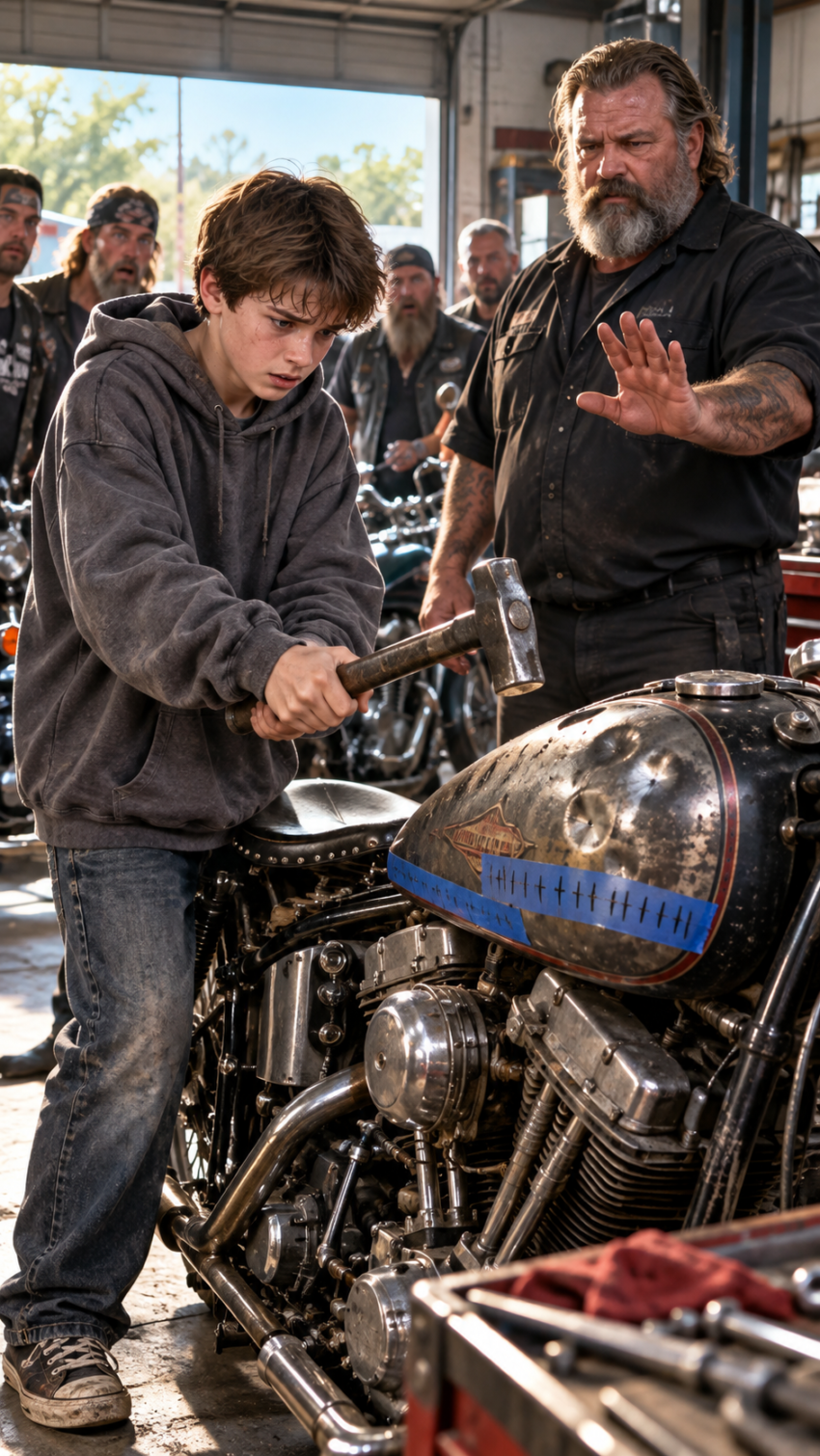
Every wrench stopped turning, every conversation died, and every pair of eyes swung toward the frightened boy standing beside Ray’s seventy-eight-year-old Harley-Davidson Panhead.
Eli Mercer held the hammer with both hands, his oversized hoodie hanging from narrow shoulders and his worn sneakers planted awkwardly on the concrete floor.
A fresh dent glimmered in the old fuel tank.
Someone cursed beneath his breath.
Another customer whispered, “That motorcycle is worth more than your house.”
I had known Ray Dawson for eleven years, long enough to understand that the giant biker with the scarred hands and intimidating beard had only one possession he treated as sacred.
That Panhead.
He had rebuilt engines for veterans who could barely afford groceries, repaired motorcycles for strangers without accepting payment, and quietly helped people whose troubles were bigger than anything a mechanic could fix.
But nobody touched that Harley.
Nobody.
So when one of the bikers lunged toward Eli, I expected Ray to move faster than all of us.
He did move, but not toward the boy.
Ray raised one enormous hand.
“Nobody touches him.”
The words were quiet enough to sound almost gentle, yet the entire garage obeyed.
Eli stared at Ray, his face pale.
“I’m sorry,” he whispered.
Ray looked at the damaged tank.
“Again.”
For a moment, nobody breathed.
Eli blinked.
“What?”
“Hit it again.”
The boy’s fingers tightened around the hammer handle.
“Why?”
Ray pointed toward a strip of blue tape beneath the tank, where dozens of small black marks had been carefully placed.
“Every dent gets a mark.”
Eli studied the marks as though they were written in a language he almost remembered.
“What are they?”
Ray’s expression changed.
“Memories.”
The hammer rose again.
This time the strike was weaker, but the metallic sound seemed louder.
Tink.
Another dent.
One of the customers turned away in disgust.
“He’s destroying history.”
Ray never looked at him.
He watched Eli instead, studying every tremor in the boy’s hands and every frightened movement of his eyes.
I noticed something strange then.
Ray was not behaving like a man watching his favorite possession being destroyed.
He was behaving like a man standing beside someone trying desperately not to fall apart.
When the hammer finally lowered, Eli’s breathing had become uneven.
Ray did not ask him to explain himself.
He simply waited.
The garage remained silent until Eli placed the hammer down and stepped away from the motorcycle.
His eyes lingered on the fresh dents.
“Are you going to fix it?”
Ray shook his head.
“No.”
Eli looked as though he wanted to ask another question, but the words never came.
That afternoon, he left Dawson Iron Works with his shoulders still hunched, although something about the way he walked seemed slightly less burdened.
I watched him disappear through the garage door.
Then I turned toward Ray.
“What was that?”
He said nothing.
His oldest friend approached the Harley, running his eyes over the damage without touching the metal.
“Brother, I can fix those dents.”
Ray continued staring toward the doorway.
“No.”
“That tank has survived longer than most of us have been alive.”
“I know.”
“Then why let a kid destroy it?”
Ray slowly opened his scarred hand.
A tiny brass key rested against his palm.
“Because that tank isn’t the only thing that survived.”
None of us understood.
Ray closed his fingers around the key and walked toward the motorcycle.
I thought he intended to start repairing the damage.
Instead, he reached beneath the old leather seat.
There was a small concealed compartment, nearly invisible beneath the aged frame.
He fitted the brass key into its lock.
The mechanism resisted, then opened with a faint click.
Inside lay a folded piece of paper, yellowed at the edges, and a narrow metal plate protected beneath the seat.
Ray unfolded the paper so carefully that I wondered whether it might crumble.
His hands, which had never trembled while lifting engines or handling heavy tools, were shaking.
“Ray?”
He didn’t answer.
He tilted the seat toward the light.
There, engraved into the metal, were a name and a date.
The name belonged to someone I had never heard him mention.
The date was thirty-seven years old.
I looked from the engraving to the paper.
“What happened?”
Ray sat down heavily on a nearby stool.
For the first time in eleven years, the man who always seemed to have an answer looked afraid of his own words.
“I made a promise,” he said.
“To who?”
He ran his thumb along the engraving.
“Someone who believed I could save him.”
The garage seemed colder, although the afternoon sunlight still poured through the open door.
Ray told me that decades earlier, before Dawson Iron Works became the place where broken motorcycles and broken people found help, he had been a younger man who believed strength meant never admitting fear.
He had owned the Panhead then, too.
It was already old, already temperamental, and already the only thing he possessed that felt permanent.
One afternoon, someone he loved had stood beside that motorcycle with trembling hands.
There had been anger, grief, and a terrible silence between them.
Ray had wanted to repair everything with the same tools he used on engines.
He had offered solutions when the other person needed understanding.
He had demanded explanations when he should have listened.
Then came the first dent.
Ray stopped speaking.
I glanced at the tank.
“Someone hit it?”
He nodded.
“With a hammer.”
I waited for him to continue.
“I thought the motorcycle was the important thing,” he said.
“So I got angry.”
His voice grew rough.
“I remember the look on his face better than I remember anything I said.”
The room was silent.
“He wasn’t trying to hurt the bike,” Ray continued.
“He was trying to show me how much he was hurting.”
Ray rubbed both hands over his face.
“By the time I understood, I had already made him feel ashamed for telling me the only way he knew how.”
I thought about Eli, the oversized hoodie, the shaking hands, and the way Ray had refused to let anyone interfere.
“That’s why you let the boy hit it?”
Ray looked at me.
“That’s why I didn’t stop him.”
He lifted the folded paper.
The writing was faded, but several lines remained legible.
It was a promise written thirty-seven years earlier.
Not a promise to preserve a motorcycle.
A promise to remember what mattered more than one.
Ray explained that he had kept the tank’s original damage hidden beneath careful repairs for years.
Every time another mark appeared, he had wanted to smooth it away, polish the steel, and pretend the past could be made perfect.
But some memories resisted repair.
Some were supposed to remain visible.
The black marks on the blue tape were his private record of those moments.
“Why keep them?” I asked.
“Because forgetting was easier than changing.”
He turned the brass key over in his palm.
“And I got tired of choosing easy.”
I wanted to ask whose name was engraved beneath the seat.
But Ray’s expression told me he had reached the edge of what he could bear to explain.
Then I noticed the last line on the folded paper.
It had been written in different ink, with a steadier hand.
It said that if another frightened child ever stood beside that motorcycle, Ray should remember the first one.
My throat tightened.
“Did you know Eli was coming?”
Ray shook his head.
“No.”
“Then how did you know what he needed?”
“I didn’t.”
He looked toward the doorway.
“I just recognized the look in his eyes.”
For a long time, neither of us spoke.
Outside, the afternoon continued as though nothing extraordinary had happened.
Cars passed on the road, a breeze moved through the open entrance, and sunlight glinted against the damaged tank.
Inside, the bikers who had been furious only minutes earlier stood quietly around the old motorcycle.
Ray’s oldest friend finally broke the silence.
“So we’re leaving the dents?”
Ray nodded.
“Every one.”
“And the tape?”
“That stays too.”
His friend studied the marks, then stepped away.
Nobody argued.
I thought that was the end of it.
But as Ray began closing the compartment beneath the seat, the folded paper slipped from his fingers.
It landed near my boots.
I bent to retrieve it.
The back of the page carried a second inscription, almost hidden beneath years of creases.
I read it once.
Then again.
The handwriting was unmistakably different from Ray’s.
There was a date, the same one engraved beneath the seat, followed by a sentence that made my chest tighten.
“If you ever find someone carrying what I carried, please don’t make him feel alone.”
I handed the paper back without speaking.
Ray stared at those words for a long moment.
Then he folded it and returned it to the compartment.
“Who wrote that?” I finally asked.
He closed the little brass lock.
“Someone I should have listened to.”
The answer was not enough, and he knew it.
I looked at the old Harley, at the dents Eli had made, and at the tiny black marks stretching along the blue tape.
For eleven years, I had believed Ray protected that motorcycle because it reminded him of happier days.
Now I understood that he had protected it because it held the memory of a day he could never undo.
And the boy who had entered our garage carrying a hammer had unknowingly brought that memory back into the light.
Ray stood, placed the brass key in his pocket, and rested his scarred hand against the damaged tank.
“Will you ever tell Eli?” I asked.
Ray looked toward the empty doorway.
“When he’s ready.”
“Tell him what?”
Ray’s eyes returned to the hidden compartment.
“The part I still haven’t told you.”
I waited.
He said nothing more.
Then, just before turning off the workshop lights that evening, Ray touched the newest dent and whispered a name.
It was the name engraved beneath the seat.
And suddenly I realized the secret was not simply about what had happened thirty-seven years earlier.
It was about why Ray Dawson had recognized something in Eli Mercer that nobody else in the garage could see.
The motorcycle had survived.
Ray had survived.
But the question that kept me awake that night was whether the person whose name lay hidden beneath that seat had survived too.
And why Ray had waited thirty-seven years to speak of him again.