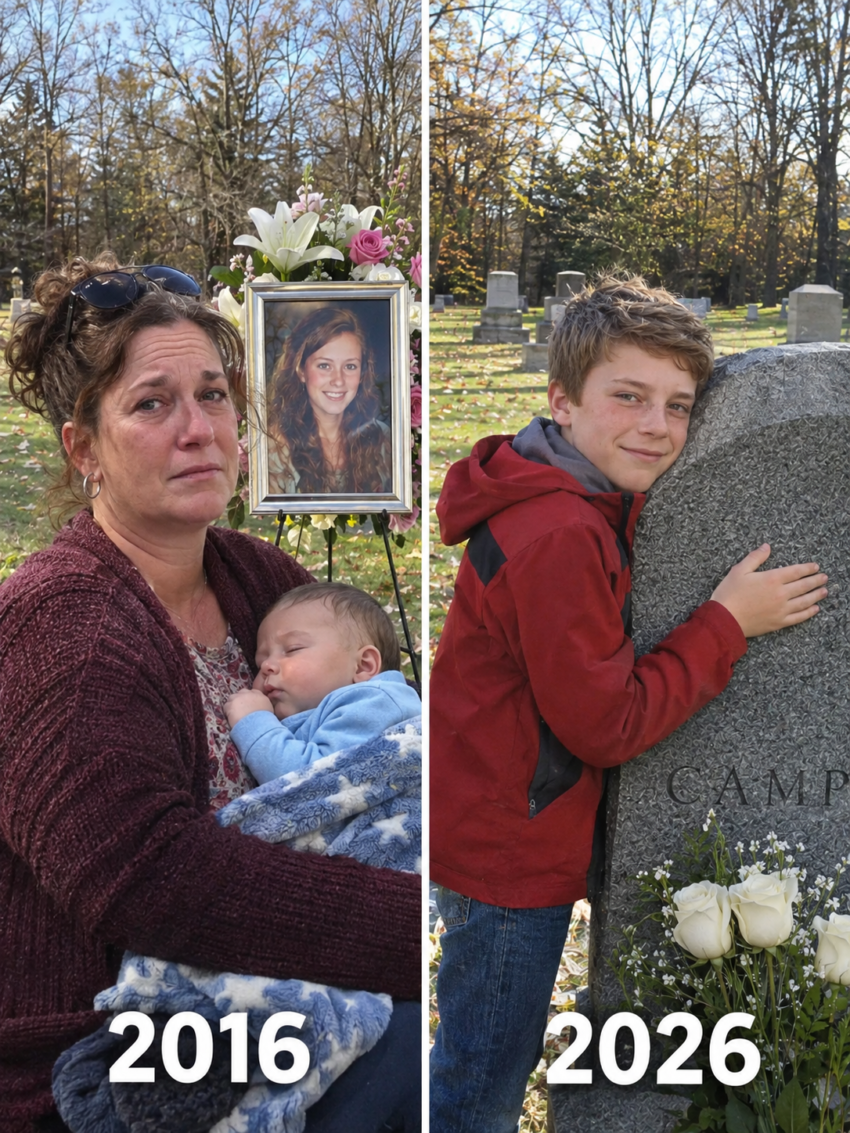
“Your daughter trusted me with this letter ten years ago, Mrs. Dawson. I should have given it to you the day she died.”
The woman standing beside my daughter’s grave held out a yellowed envelope, and I felt the ground shift beneath my feet. My name was written across the front in Hannah’s familiar handwriting. I hadn’t seen those looping letters in a decade, yet I recognized them before the woman said another word.
“Who are you?” I demanded. “And why do you have something that belongs to my daughter?”
Her eyes filled with tears. “My name is Brenda Collins. I was one of Hannah’s nurses when she gave birth. There’s something about Owen’s father you don’t know.”
Before I could answer, my grandson called from the cemetery path. Brenda glanced toward him, then lowered her voice.
“Please don’t open it in front of the boy. Whatever you think happened ten years ago, it wasn’t the whole story.”
I stood there holding the envelope while Owen ran toward us with a handmade birthday card for his mother. He was ten years old that morning, the same age as the secret this woman had apparently been carrying.
And for the first time since we buried Hannah, I wondered whether I’d spent an entire decade blaming the wrong person.
My name is Margaret Dawson. I’m sixty-four, a retired medical billing clerk, and I’ve raised my grandson in the same modest Boise, Idaho, house where I raised his mother. Owen and I have our routines. I make pancakes on Sundays, drive him to Little League practice, and remind him to take his muddy shoes off before he tracks half the backyard through my kitchen.
He calls me Grandma, but I’ve been the only parent he’s ever really known.
Hannah was eighteen when she became pregnant. She’d graduated from high school, was considering community college, and had been talking about finding a part-time job at a veterinary clinic. Then one evening, she sat across from me at our kitchen table and told me she was having a baby.
I remember setting down my coffee so abruptly that it spilled onto the tablecloth.
“Hannah, sweetheart, are you sure?”
She nodded, staring at her hands.
“Does the father know?”
“Yes, Mom.”
“Then where is he?”
Her face tightened. “Can we please not start with that?”
I told myself I was being practical. Her own father had left when she was twelve, and I’d spent years working overtime to keep our little family afloat. I knew what it meant to raise a child without dependable help. The thought of Hannah facing that same struggle frightened me more than I wanted to admit.
So I kept asking.
I asked who the boy was, whether his parents knew, and whether he intended to help. Hannah answered less and less. Eventually, she stopped mentioning him altogether.
“You can’t protect somebody who won’t tell you the truth,” I told her one evening.
She looked at me with tired eyes. “Maybe I just need you to listen for once.”
I remember being offended by that. I thought listening was exactly what I’d been doing.
Now, ten years later, I wasn’t so certain.
After the woman at the cemetery left, Owen asked who she was. I told him she’d known his mother at the hospital, which was true, but I didn’t mention the letter. He was already excited about the small birthday dinner I’d planned, and I didn’t want to introduce something I couldn’t yet explain.
That night, after he’d gone upstairs, I sat at the kitchen table with the envelope.
Inside was a photograph of Hannah standing beside a teenage boy. He had dark hair, a shy smile, and an old leather baseball glove tucked beneath one arm. I recognized him immediately, though I couldn’t remember his name.
He’d come to our house twice during Hannah’s pregnancy.
I’d assumed he was a friend from school.
The letter itself was written on lined notebook paper.
Dear Mom,
I know you’re angry because I won’t tell you who the baby’s father is. But I’m not keeping his name from you to hurt you.
He knows about the baby. He wanted to stay with me, but his parents keep telling him he’ll ruin his future if he becomes a father now. He’s scared, Mom. I can see that. And I’m scared too.
I told him not to come back until he was ready to choose us for himself. I don’t want you forcing him to do the right thing, because I need to know whether he’ll do it when nobody is standing over him.
I stopped reading and looked toward the stairs.
For ten years, I’d believed Hannah had been abandoned by a boy who never cared enough to acknowledge his child.
But she’d known exactly who he was.
She’d made a decision I hadn’t understood.
I forced myself to read the final paragraph.
I know you’re trying to protect me. But every time I come to you, you ask about him before you ask how I’m doing. I’m scared about the hospital. I’m scared I won’t be a good mother. Sometimes I just want you to sit beside me and tell me we’re going to figure it out.
I love you, Mom. I hope you know that.
I read those words three times.
Then I remembered an evening during Hannah’s seventh month. I’d been sitting at the kitchen table, trying to balance the checkbook, when she appeared in the doorway.
“Mom, can I talk to you about something?”
I’d barely looked up.
“If this is another conversation where you won’t tell me who the father is, Hannah, I can’t do it tonight.”
She stood there for a moment.
“Never mind,” she whispered. “It can wait.”
I hadn’t followed her upstairs.
For ten years, I’d remembered that evening as another example of Hannah shutting me out. Now I could see the possibility that she’d come downstairs because she needed her mother, and I’d turned her away before she could say a word.
I pressed the letter against the table and cried.
Not because I believed I’d caused what happened to Hannah. Her death had been a medical tragedy, and I knew better than to pretend a conversation could have changed that.
I cried because she’d spent those final months frightened, and I’d been so busy trying to solve her problems that I hadn’t always noticed.
The next morning, I called Brenda.
“I read the letter,” I said when she answered. “Now I want to know why you kept it from me.”
She asked to meet at a diner near the hospital.
Brenda was waiting in a back booth when I arrived. She looked to be in her late sixties, with silver hair and the exhausted expression of someone who hadn’t slept well in a long time.
I sat across from her and placed the envelope on the table.
“Ten years, Brenda. My grandson has spent ten years asking questions, and you had this the whole time.”
She stared at the envelope.
“I know. I don’t expect you to understand.”
“Then explain it anyway.”
Brenda told me Hannah had handed her the letter during the early hours of labor. She’d asked Brenda to give it to me if something went wrong and the baby’s father didn’t come to the hospital.
“She wasn’t expecting to die,” Brenda said. “She was frightened, like a lot of young mothers are. I think she wanted to make sure you understood her if she couldn’t explain things herself.”
“Then why didn’t you give it to me?”
Brenda swallowed.
“I saw you afterward. You were holding that baby, and you looked completely lost. I told myself the letter would only hurt you more.”
“That wasn’t your decision to make.”
“You’re right.”
She admitted that she’d put the envelope away, intending to contact me after the funeral. Weeks became months. Eventually, she was ashamed to explain why she’d waited.
“I retired this spring,” she said. “I found it while clearing out a box of personal things. I realized I’d spent ten years telling myself I was protecting you when I was really protecting myself.”
I looked at her for a long moment.
“You didn’t just keep Hannah’s letter from me. You kept it from her son.”
Brenda lowered her head.
“I know.”
I pulled the photograph from the envelope and slid it across the table.
“Do you recognize him?”
She studied it carefully.
“I don’t know his name. But I think I saw him at the hospital.”
My hand tightened around my coffee cup.
“When?”
“Shortly after Hannah died. A young man came to the maternity floor asking about her. He matched the description she’d given me.”
“Did you speak to him?”
Brenda hesitated.
“No. By the time I understood who he might be, he’d already seen you.”
“Seen me doing what?”
“Walking out of the nursery with Owen in your arms.”
I stared at her.
“He saw his baby?”
She nodded.
“He stood there for a moment. Then he turned around and left.”
I felt something cold settle in my stomach.
For ten years, I’d imagined a boy who hadn’t bothered to show up.
Now I was hearing that he’d come close enough to see his newborn son, then chosen to walk away.
“And you watched him leave?”
Brenda wiped her eyes.
“Yes.”
I pushed the photograph back into the envelope.
“You know what hurts the most, Brenda? Owen has asked me whether his father ever wanted him. I told him I didn’t know. All that time, you knew there was a man who’d come to the hospital, and you never thought that might matter to him.”
“I’m sorry, Margaret.”
I stood.
“I’m sure you are. But being sorry doesn’t give us those years back.”
I left before she could answer.
That afternoon, I pulled Hannah’s storage box from the hallway closet. I hadn’t opened it properly in years. There were school programs, birthday cards, old photographs, and the inexpensive silver charm bracelet she’d worn almost every day.
Near the bottom, I found another picture of the boy with the baseball glove. Behind it was a torn notebook page containing Hannah’s handwriting.
Buy diapers. Finish thank-you cards. Ask Mom about night classes. Tell Mom the truth.
I sat on the bedroom floor, staring at those last four words.
Hannah had planned to tell me.
She’d planned to finish school, raise her baby, and work through the difficult conversations we’d been avoiding. She hadn’t expected her life to end at eighteen.
“Grandma?”
Owen stood in the doorway with his backpack hanging from one shoulder.
“What are you doing?”
I showed him the box.
“Looking at some of your mom’s things.”
He sat beside me and began examining the photographs.
“Was she good at baseball?”
I smiled. “Not particularly. She was better at telling everybody else how to play.”
He laughed, then noticed the picture of the teenage boy.
“Who’s that?”
I hesitated.
“Someone who was important to your mom.”
Owen looked at the photograph, then at me.
“Is he my dad?”
I could have lied. I could have told him I didn’t know and hoped he’d forget about it.
Instead, I said, “I think he is, sweetheart. I’m trying to find out for certain.”
He was quiet for a moment.
“Did that lady from the cemetery tell you about him?”
“She told me some things.”
Are they bad things?”
I looked at my grandson, with Hannah’s eyebrows and the same stubborn little chin.
“They’re difficult things. But I promise I won’t keep you wondering forever.”
Owen studied me.
“You always say people shouldn’t hide things just because they’re scared.”
I nodded slowly.
“You’re right.”
“Are you scared, Grandma?”
I reached for his hand.
“A little.”
He squeezed my fingers.
“Me too.”
That evening, after Owen went to bed, I found the boy’s first name in an old high school graduation program. I searched online using his name, graduation year, and school until I located a man whose photographs matched the teenager standing beside Hannah.
His name was Nolan.
I sent him a short message.
My name is Margaret Dawson. I’m Hannah’s mother. I need to speak with you about something important.
His reply arrived less than two hours later.
Is this about Owen?
I read those five words again and again.
He knew my grandson’s name.
He’d known it for ten years.
And when I finally met him the following morning, I intended to find out why knowing had never been enough.
PART 2 — THE FATHER WHO WAITED TEN YEARS
Nolan was already seated when I entered the coffee shop. He was nearly thirty now, with broad shoulders and tired eyes, but I recognized him immediately. He was turning a ceramic mug between his hands, just as he’d done at my kitchen table when he was eighteen.
I sat across from him and placed Hannah’s photograph between us.
“You knew his name,” I said.
Nolan nodded.
“Hannah told me she wanted to name him Owen.”
“And you knew she was pregnant?”
“Yes, ma’am.”
“Then let’s not waste time pretending you didn’t understand what was happening.”
He looked down at the photograph.
“I wasn’t going to pretend.”
I studied his face.
“Were you at the hospital the day he was born?”
His hands stopped moving.
“Yes.”
“Did you see me carrying him?”
He swallowed.
“I did.”
I leaned back in my chair.
“Then tell me why you left.”
Nolan said his parents had been furious when they learned about Hannah’s pregnancy. They’d threatened to stop paying for college and warned him that becoming a father at eighteen would ruin his future. He’d argued with them, backed down, and spent months trying to convince himself he could somehow keep everybody happy.
Hannah eventually told him not to return until he was prepared to make his own decision.
“I loved her,” he said quietly. “But I was scared of disappointing my family.”
I looked at him.
“You were so worried about disappointing your parents that you left Hannah to face everything alone.”
He nodded.
“You’re right.”
“And when she died?”
Nolan rubbed his forehead.
“I’d finally decided to go to the hospital. I was going to tell her I’d help raise the baby, whether my parents liked it or not. But when I got there, they told me she’d passed away.”
His voice shook.
“Then I saw you carrying Owen. I didn’t know what to say. I panicked and left.”
I sat very still.
“You saw your son, Nolan. You knew his mother was gone. And you walked away.”
“I know.”
“What about the next day?”
He didn’t answer.
“Or the next week? What about his first birthday?”
Nolan stared at his hands.
“I kept telling myself I’d already waited too long.”
“You could have called.”
“I know.”
“You could have written a letter.”
“I know.”
I leaned forward.
“Then stop telling me what you know and tell me why you did nothing.”
He finally looked up.
“Because I was ashamed. Every year that passed made it harder to admit what I’d done. I kept thinking Owen would be better off without somebody who’d already failed him.”
I shook my head.
“That’s a convenient decision to make for a child you’ve never bothered to meet.”
He lowered his eyes.
“You’re right.”
I was beginning to dislike those two words.
“You don’t get to sit here and agree with everything I say as though that makes up for ten years, Nolan. My grandson asked me why his father didn’t want him. Do you have any idea what it’s like to hear a little boy ask that?”
Nolan’s eyes filled.
“No, ma’am.”
“Then listen carefully. Owen has spent his entire life wondering whether there was something wrong with him. And all this time, you knew exactly where he was.”
Nolan wiped his face.
“I don’t expect you to forgive me.”
“Good. Because I haven’t decided whether I ever will.”
He nodded slowly.
After a moment, he asked whether Owen knew about him.
“He knows his father exists,” I said. “He doesn’t know why that father stayed away.”
“Would you let me meet him?”
I looked at the man across from me. He was no longer the frightened teenager Hannah had loved, but he was still trying to find a way around the consequences of what he’d done.
“Not yet.”
He straightened.
“Mrs. Dawson, I’m his father.”
I held his gaze.
“You helped bring him into this world. Being his father is something you’ll have to prove.”
Nolan went quiet.
“What do you want me to do?”
“Write him a letter. Tell him who you are, why you weren’t there, and why you’re asking to be part of his life now. Don’t blame Hannah. Don’t blame your parents. And don’t ask him to forgive you just because you’re finally ready to apologize.”
He nodded.
Before leaving, I asked him one final question.
“Have you ever tried to find out how Owen was doing?”
Nolan hesitated.
“I’ve looked him up online. I found a school photograph once. I knew he played baseball.”
I stared at him.
“You knew he played baseball?”
“Yes.”
“Then you knew enough to find him. You just never did.”
He had no answer.
I left him sitting there with his coffee untouched.
Two days later, a white envelope arrived in our mailbox with Owen’s name written across the front.
I called Nolan before opening it. I told him I needed to read what he’d written before giving something so important to a ten-year-old. He agreed without argument.
The letter was simple.
He told Owen that he was his biological father, that he’d known Hannah was expecting a baby, and that he’d been too frightened to accept responsibility when he was young. He wrote that growing older hadn’t excused his silence.
One paragraph stayed with me.
You didn’t do anything wrong, Owen. I was the one who stayed away. I’m sorry I missed so much of your life, and I understand if you don’t want to meet me.
I read those words twice.
For the first time, Nolan had said something that wasn’t about his own fear.
It was about Owen.
Still, I wasn’t ready to hand the letter over.
I called Brenda and asked her to meet me by the Boise River.
We sat on a wooden bench overlooking the water. I had spent days being angry with her, and I was still angry, but there were questions about Hannah’s final hours that nobody else could answer.
“Was she frightened?” I asked.
Brenda nodded.
“Yes. She was eighteen and having her first baby. But she wasn’t alone. We stayed with her.”
I looked down at my hands.
“Did she ask for me?”
“Several times. She knew you were waiting nearby.”
My throat tightened.
“Did she think I was angry with her?”
“No, Margaret. She knew you loved her.”
I wiped my eyes.
“I keep thinking about all the times I pushed her to tell me things she wasn’t ready to say.”
Brenda was quiet for a moment.
“She talked about you during labor,” she said.
I looked up.
“What did she say?”
Brenda smiled faintly.
“She said you made Sunday pancakes so thick nobody could eat more than two, but you’d get offended if anyone suggested making them thinner.”
A laugh escaped me before I could stop it.
“That sounds like Hannah.”
“She said you always saved the last pancake for her, even when you pretended there weren’t any left.”
I covered my face.
For ten years, I’d worried that my daughter might have spent her final hours remembering our arguments.
Instead, she’d been remembering breakfast.
Brenda waited while I cried.
When I finally looked up, she said, “I should have given you that letter, Margaret. I can’t change what I did. But I am sorry.”
I nodded.
“I don’t know whether I’ll ever be comfortable with your decision. But thank you for telling me about my daughter.”
It wasn’t forgiveness.
Not yet.
But it was enough for that afternoon.
That evening, Owen found Nolan’s photograph on the kitchen table.
“That’s him, isn’t it?” he asked.
I turned off the faucet, dried my hands, and sat beside him.
“Yes, sweetheart. That’s your father.”
He climbed into the chair across from me.
“Did he know about me when I was born?”
“Yes.”
Owen studied the photograph.
“Then why didn’t he come?”
I told him Nolan had been frightened when he was young and had listened to his parents instead of making his own decision. I also explained that he’d had many opportunities to contact us afterward and hadn’t taken them.
“So he didn’t want me?” Owen asked.
I moved my chair closer.
“Honey, his decision to stay away was about his own fears and mistakes. It wasn’t because there was anything wrong with you.”
He was quiet for a long moment.
“Do you hate him?”
I thought carefully.
“I’m angry about what he did. I understand him better than I did last week, but that doesn’t mean I’m ready to forgive him.”
Owen nodded.
“Do I have to forgive him?”
“No. You don’t owe him that.”
“Do I have to meet him?”
“No, sweetheart.”
He looked at the photograph again.
“Can I meet him anyway?”
Every protective instinct I had wanted to say no.
For ten years, Owen and I had been enough for each other. I knew his teachers, his favorite meals, the way he slept with one foot outside the blanket, and how he always checked the mailbox when he was expecting a birthday card. Letting Nolan into our lives meant accepting that I couldn’t control everything that might happen next.
Then I remembered Hannah’s letter.
Sometimes I just want you to sit beside me and tell me we’re going to figure it out.
I reached for Owen’s hand.
“Yes,” I said. “If you want to meet him, we’ll figure it out together.”
I gave him Nolan’s letter, and we read it together. He asked a few questions, then took it upstairs to keep in his desk.
The following Saturday, we met Nolan at a public baseball field near town.
Owen had chosen the location himself. He said meeting somebody while sitting at a restaurant table sounded awkward, and I couldn’t argue with that.
Nolan was waiting beside the dugout with an old leather baseball glove.
Owen stopped when he saw it.
“That’s the glove from Mom’s picture.”
Nolan looked down.
“Yeah. I’ve had it since high school.”
“You kept it all this time?”
“I did.”
Owen stepped closer.
“I’m Owen.”
Nolan gave him a small, nervous smile.
“I’m really glad to meet you, Owen.”
My grandson looked toward the empty field.
“Are you good at baseball?”
Nolan laughed softly.
“Not nearly as good as I used to think I was.”
“Want to play catch?”
“Sure.”
They walked onto the grass and began tossing the ball back and forth.
I stayed near the bleachers.
For the first few minutes, they barely spoke. Then Nolan threw a ball too high, and Owen had to chase it toward the fence.
“Sorry,” Nolan called.
“It’s okay,” Owen answered. “My coach says everybody makes bad throws.”
“Your coach sounds like a smart man.”
Owen grinned and threw the ball back.
After a while, they stopped near the dugout. I couldn’t hear everything they said, but I saw Owen ask something that made Nolan lower himself onto one knee so they could speak face-to-face.
My first instinct was to walk over.
I stayed where I was.
When Owen returned, he told me Nolan had apologized again for missing his birthdays.
“I told him I don’t know if I’m ready to call him Dad,” Owen said.
“And what did he say?”
“He said I can call him Nolan.”
I put my arm around Owen’s shoulders.
“How do you feel about that?”
He thought for a moment.
“I think that’s okay.”
I nodded.
“Then that’s okay with me too.”
I didn’t suddenly trust Nolan because he’d played catch with my grandson for an hour. Trust takes longer than that, especially when a child is involved.
But over the following weeks, Nolan did what he said he would do.
He called when he’d promised to call. He asked before making plans. When Owen didn’t feel like talking one evening, Nolan accepted it without making him feel guilty. He didn’t pressure Owen to call him Dad, and he didn’t try to convince me that one apology had settled the past.
I watched carefully.
There were awkward conversations, uncertain pauses, and a few times when Owen came to me afterward with questions neither of us could answer immediately. We worked through them together.
I also began doing something I hadn’t done enough when Hannah was alive.
I asked what Owen thought before deciding what he needed.
Three weeks after their first meeting, we were eating Sunday pancakes when Owen mentioned that Nolan wanted to attend his Little League game.
I set down the syrup.
“Would you like him to come?”
Owen nodded.
“I think so.”
“Then he can come.”
He watched me for a moment.
“You won’t be upset?”
“No, honey. I’m glad you told me what you want.”
He smiled and went back to his breakfast.
There was syrup on the table, a crooked napkin beside his plate, and pancake crumbs scattered across the wood. Normally, I would have reached over and straightened everything before he finished eating.
Instead, I left it alone.
Later that afternoon, I opened Hannah’s storage box again.
I placed her letter in a protective sleeve beside the photographs and her silver charm bracelet. Then I found the old notebook page with the unfinished checklist.
Tell Mom the truth.
I ran my finger beneath those words.
Hannah hadn’t gotten the chance to finish that conversation. For years, I’d believed her silence meant she didn’t trust me enough to begin it.
Now I understood that she’d tried.
I put the checklist back in the box and carried it upstairs.
Owen was sitting on his bedroom floor, oiling the leather glove Nolan had let him borrow.
“Grandma, can you show me some more pictures of Mom?” he asked.
I sat down beside him and opened the box.
We spent the next hour looking at school photographs, birthday cards, and snapshots of Hannah laughing with her friends. I told him about her terrible singing, her love of strawberry milkshakes, and the time she tried to make pancakes without baking powder.
Owen laughed so hard he nearly dropped the glove.
“Were they as thick as yours?”
“Worse. They were practically bricks.”
He leaned against my shoulder, still smiling.
When we reached the photograph of Hannah and Nolan, he held it carefully by the edges.
“She looks happy here,” he said.
“She does.”
He studied her face for a moment before setting the photograph beside the glove.
Then he asked me to tell him another story about his mother.
This time, I didn’t rush to find the right answer.
I simply stayed beside him and began talking.