The Twenty Dollars in His Pocket
I had been riding long enough to believe I understood the weight people carried when they came looking for men like us. Most of the time, it was a flat tire, a broken fence, a family short on groceries, or a rescue dog nobody else wanted to bring home. Our club, the Steel Lantern Riders, had seen plenty of rough afternoons and hard stories. But nothing in all my years on the road prepared me for the day a ten-year-old boy walked into our world with an oxygen tank on his back, a scarred pitbull at his side, and a folded twenty-dollar bill clutched in his hand like it was the only thing he had left to offer.
My name is Silas Boone. I am sixty-six years old, a former Marine, a grandfather, and the oldest active rider in our chapter outside San Antonio, Texas. Most people in town know me as the man with the silver beard and the black Road Glide parked outside a coffee shop every Thursday morning. The younger riders call me Boone. Kids at charity events usually call me Sir, until I hand them a sticker or let them sit on my bike, and then suddenly I become their favorite old man in boots. Life has a strange way of giving you a reputation before you even notice you have one.
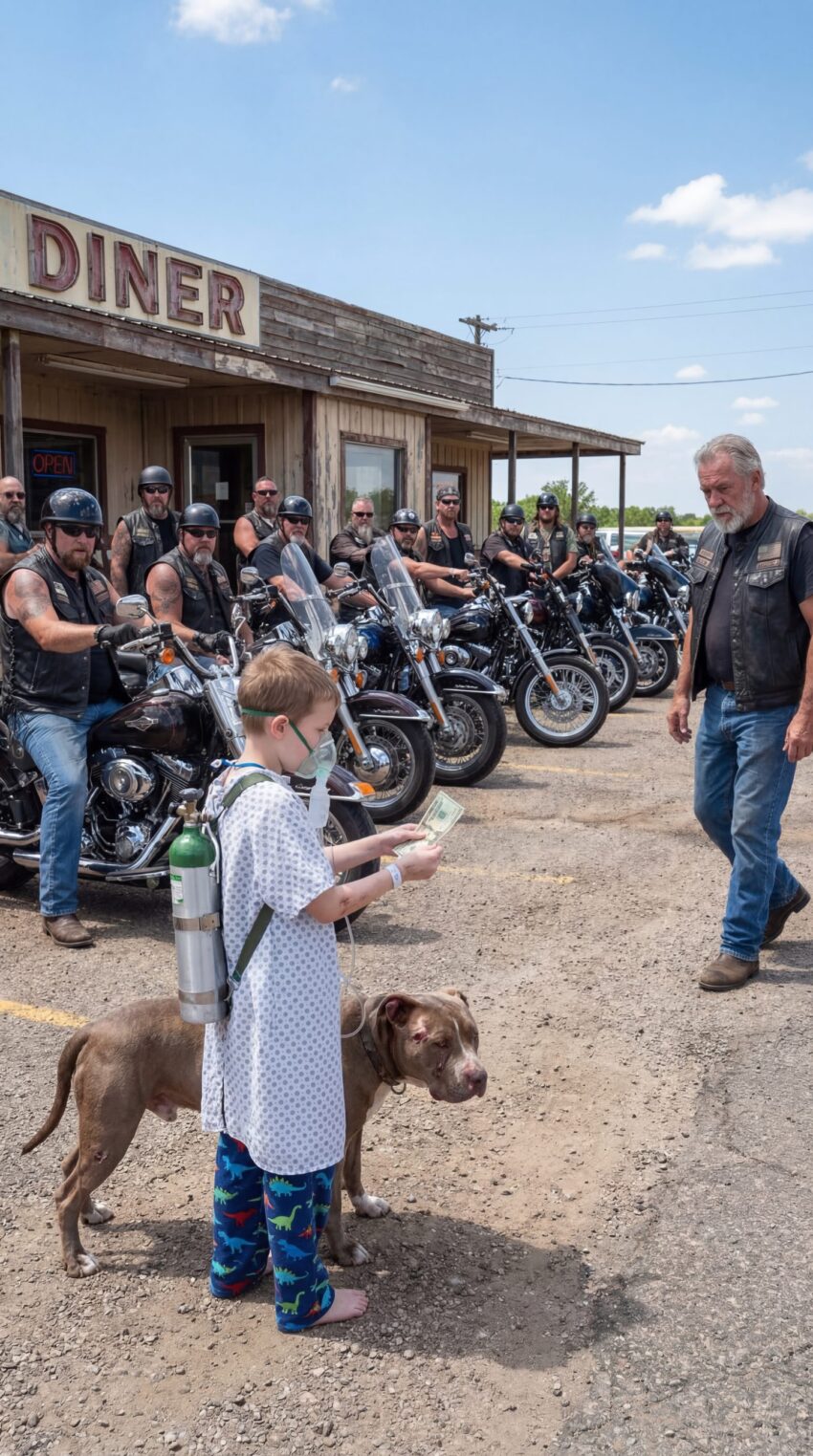
That afternoon, twelve of us were gathered outside a weathered diner called Red Willow Café just off a service road near the edge of town. The sky was pale and heavy with low clouds, and the kind of wind that comes before rain kept pushing dust across the parking lot. We had stopped for coffee and pie after a supply run for an animal shelter. Jax Holloway was arguing about spark plugs with Micah Trent, and somebody had put old country music on the diner jukebox. It felt like an ordinary day. The kind that drifts by without leaving a mark.
Then a faded blue station wagon pulled into the gravel lot and stopped at an awkward angle near our bikes.
At first, nobody paid it much attention. Vehicles came and went all the time. But then the driver’s side door opened, and every man in our group went still.
A little boy climbed out.
The Boy and the Dog
He was too thin for his age, the kind of thin that made his arms look fragile under the sleeves of his sweatshirt. A clear oxygen tube curved around his ears and beneath his nose, and a small portable tank was strapped to his back with careful homemade straps. His face was pale in the way hospital rooms make people pale, and the cap on his head did not fully hide how little hair he had left. He looked exhausted before he had taken three steps.
Then the dog jumped out after him.
The pitbull landed between the boy and our motorcycles so fast and so firmly that even the loudest men among us went silent. He was broad-chested and powerful, with a torn ear, patches of healed skin, and the kind of wary eyes that told you he had survived a life that had not been kind to him. He did not lunge. He did not bark. He simply stood there, steady and alert, like his whole body had one purpose: protect the boy.
The child placed a shaking hand on the dog’s neck.
“It’s okay, Roscoe,” he whispered.
The dog glanced back, relaxed just enough, and stayed close.
I remember how that single moment changed the feeling in the lot. We were twelve large men in leather vests and heavy boots, and yet the one creature in control of that space was the dog standing guard over a sick child. It was not fear that made us pause. It was respect.
I stepped forward slowly with my hands where both the boy and the dog could see them.
“Hey there,” I said as gently as I could. “You need some help?”
The boy looked up at me with tired blue eyes that seemed older than ten years should ever look.
Then he held out a wrinkled twenty-dollar bill.
“I need to hire you,” he said.
The Job He Came to Offer
For a second, nobody answered.
Jax, who usually had something to say about everything, said nothing at all. Micah took off his sunglasses. I could hear the wind, the song from the diner, and the dog’s slow breathing.
I crouched down so I was closer to the boy’s eye level.
“Hire us for what?” I asked.
He swallowed hard before answering, and it was obvious that even speaking took effort.
“My name is Eli Dawson,” he said. “I’m ten. The doctors told my mom I probably don’t have much time left.”
No one moved.
He lowered his eyes and rested his hand against the dog’s shoulder.
“This is Roscoe. I found him behind an empty storage shed last year. He was tied up and hurt real bad. My mom said we couldn’t keep him at first, but then he slept by my bed the whole first night, and after that nobody could make him leave.”
Roscoe leaned against him as if he understood every word.
Eli took another breath, slow and careful.
“My mom works all the time. When I’m gone, she won’t be able to take care of him. The shelters don’t want dogs that look like this. People get scared before they even meet him.”
His voice cracked on the last sentence, but he kept going.
“I need somebody strong to keep him safe. Somebody who won’t look at his scars and think that’s all he is.”
I felt my chest tighten.
Then Eli said the part that none of us were ready to hear.
“And I need you to come to my funeral too.”
Behind me, someone inhaled sharply.
Eli stared at the gravel while he spoke, like he had already repeated this fear a hundred times in his mind.
“Some boys from school call me names. They laugh when I miss class, and they make jokes online. One time they recorded me when I got sick at school and posted it for people to laugh at. They told me they’re going to come to the service and act like they cared about me.”
His fingers tightened around that twenty-dollar bill until his knuckles turned white.
“They said they’d take pictures and smile and pretend we were friends. I just don’t want that to be the last thing, you know? I want somebody there who’ll make them leave. And I don’t want Roscoe to end up alone.”
A Promise Made in a Gravel Lot
There are moments in life when your answer shows up before your thoughts do. That was one of them.
I took the folded bill from Eli’s hand, looked at it for one second, and placed it back into his palm.
“We don’t take money from kids,” I told him.
I heard boots crunching behind me as the others stepped closer.
Then I smiled at him, though it took effort because my throat had gone tight.
“But we do take promises seriously.”
Eli blinked at me.
I reached out my hand toward Roscoe and let the dog decide what happened next. He studied me for a long moment, then stepped closer and pressed his broad head into my palm.
“That means yes,” Micah said quietly from behind me.
A faint smile touched Eli’s face for the first time.
“So you’ll do it?” he asked.
“I will,” I said. “We all will.”
His eyes moved from one rider to the next, as if he still could not believe that twelve strangers had just agreed to carry a piece of his world for him.“Really?”
Jax cleared his throat and nodded. “Really.”
Eli looked down at Roscoe again and whispered, “I told you bikers would understand.”
That line stayed with me.
Not that bikers were tough. Not that bikers looked scary. But that bikers would understand. Somehow, this child had looked at our worn vests, our loud engines, our weathered faces, and decided we might know something about loyalty.
He was right.
Learning Who Eli Really Was
We did not let him leave alone. One of the waitresses called his mother, who arrived breathless and embarrassed and frightened all at once. Her name was Marissa Dawson, and exhaustion seemed to follow her like a shadow. She apologized three times before she even reached us, but none of us blamed her. It was clear she had been carrying more than one person should ever have to carry.
She explained that Eli had taken the spare keys while she was inside changing out of her work scrubs after a night shift. He had not driven far. Thank God for that. Fear had pushed him farther than strength ever could.
Before they left, Eli asked if I would visit him.
“Only if you bring Roscoe when I’m feeling okay,” he said.
I told him I would.
That night, after I got home, I sat at my kitchen table with my reading glasses low on my nose and searched for his name online. It did not take long to find his little video page. It was called “Eli Builds Big Things.”
The page had almost no followers.
Most of the videos were simple and sweet. Eli sat in a hospital bed or at the kitchen table building miniature cities, rockets, garages, and dogs out of blocks. Roscoe was almost always there, either asleep beside him or watching him with quiet devotion. Eli talked to the camera in the kind of voice that made you want to keep listening. He explained every detail like it mattered. He named buildings after his mother. He built a dog park for Roscoe out of green pieces and tiny plastic trees.
And then I saw the comments.
They were cruel in the lazy, thoughtless way people become when a screen stands between their face and someone else’s pain. A few boys from school had found the page. They mocked his voice, his treatment, the way his hands sometimes shook. Someone had even clipped a hard moment from a school event and used it to make him the joke.
I closed the laptop and sat there in silence.
Age teaches you that anger is loud, but purpose is quieter and stronger.
By morning, I knew exactly what we were going to do.
When a Pack Decides to Show Up
I wrote a message and sent it everywhere I could think of: biker groups, rescue pages, church volunteers, dog advocates, veteran circles, local community boards.
I wrote, “A brave ten-year-old boy saved a dog everyone else overlooked, and now he needs to know that his dog will never be abandoned and his life will never be treated lightly. Let’s show him what a real pack looks like.”
Then I shared his page.
I did not expect much at first. Maybe a few kind comments. Maybe a handful of messages. Maybe enough to brighten one difficult week.
Instead, the story spread.
By evening, people from across Texas were sending encouraging words. By the next day, dog rescue groups had shared Eli’s videos. Then a few local news pages noticed. Then parents. Then teachers. Then strangers from states away. His follower count rose faster than any of us had imagined. Letters began arriving at the hospital. So did building sets, art supplies, custom dog bandanas, handmade cards, and photos of rescue dogs sleeping safely in new homes.
Eli was overwhelmed by it all.
The first time I visited him after that, he was propped up in bed with Roscoe’s head resting on the blanket beside him. The room was crowded with cards taped to the wall and boxes stacked in corners. A small plastic airport he had built covered an entire rolling tray table.
He looked at me like I had brought the sky inside.
“Did all these people really write to me?” he asked.
“They did,” I said.
“Why?”
I pulled a chair beside the bed.
“Because you reminded them what love looks like when it has no time to waste.”
He was quiet after that. Then he smiled.
It was not a big smile. It did not need to be.
The Days That Mattered Most
For the next few weeks, our club took turns visiting him. Some of the men were awkward at first. Large, tattooed bikers do not always know what to do with hospital chairs and whispering hallways. But Eli made it easy. He treated everyone like they belonged there.
He asked Micah to help him build a service garage out of blocks because “you look like you know where all the tools go.” He asked Jax to tell him about the longest ride he had ever taken. He asked me if motorcycles felt different at sunrise than they did at night.
“Yes,” I told him. “At sunrise they feel hopeful, and at night they feel honest.”
He thought about that answer for a long time.
Roscoe became part of the routine too. The nurses adored him. Kids in nearby rooms asked if the big dog could visit them for a minute. Roscoe, scarred and solemn and deeply gentle, would lie down beside hospital beds as if he had been born for that exact work. Children who were too tired to talk would rest their hands on his back. Parents would cry quietly in corners when they thought nobody noticed.
Eli noticed everything.
One afternoon, as I adjusted the blanket near his feet, he asked, “Do you think Roscoe remembers what happened before I found him?”
I looked at the dog, who was asleep with his chin on Eli’s mattress.
“Maybe he remembers enough to know what kindness feels like now,” I said.
Eli nodded.
“That’s good enough, then.”
There was wisdom in that child that many adults spend a lifetime trying to learn.
The Last Promise He Asked For
His strength went up and down. Some days he talked nonstop. Some days he barely had the energy to lift his hand. But when he could speak, he kept planning things for Roscoe.
He wanted a blue blanket for the sidecar because Roscoe liked soft things. He wanted a patch on the dog’s vest with a lantern on it because he said lanterns meant somebody would help you find the way home. He wanted us to take Roscoe to open roads, to rivers, to quiet places where the wind felt clean.
On one of my last visits with him, the late afternoon sun was falling across the window, and the room was quieter than usual. Eli had just finished placing the last piece on a block-built motorcycle with a tiny brown dog sitting in the sidecar.
He held it up for me to see.
“That’s Roscoe after,” he said.
“After what?”
“After I’m not here anymore.”I did not answer right away.
He looked straight at me, brave and calm in a way that made my heart ache.
“Promise me he’ll still have fun,” he said. “Promise me he won’t think I left because I wanted to.”
I leaned forward and placed my hand over his small one.
“I promise,” I said.
He nodded once.
“And don’t let those boys turn my service into something ugly.”
“I won’t.”
He rested his hand on Roscoe’s neck and closed his eyes for a moment.
“I knew you wouldn’t.”
A few days later, Marissa called me before sunrise.
I knew before I answered.
Eli passed quietly in the early morning with his mother beside him and Roscoe pressed against the bed.
The Day the Riders Came
The memorial service was meant to be small. That is what Marissa told me at first. Family, a few neighbors, maybe some hospital staff, maybe our club.
But word had traveled farther than any of us understood.
By the morning of the service, motorcycles were already lined along the church road before the sun had fully risen. Riders came from Houston, Austin, Corpus Christi, and towns I had never even heard of. Some came alone. Some came in pairs. Some brought rescue dogs in sidecars or on special platforms. Men and women in leather stood quietly outside the chapel with flowers in their hands and grief on their faces for a child they had never met but somehow loved anyway.
Roscoe stayed close to Marissa as people entered. He wore a small black vest with a stitched lantern patch and sat near the front with the kind of stillness that drew tears from half the room.
The service had already begun when the three boys arrived.
I recognized them immediately from the comments and the clips we had saved. They came in with their phones in hand and expressions that told me they had expected an easy moment, a simple room, a chance to make themselves look close to someone they had treated carelessly.
Instead, they walked into a full chapel and rows of riders who had come for one reason only: respect.
The air changed when they stepped in.
I rose from my seat near the aisle and turned to face them. I did not shout. I did not threaten. I did not need to.
I simply looked at them and said, “Today is not for pretending.”
They froze.
Behind me, Roscoe stood up.
He did not bark. He did not strain forward. He only stood, steady and silent, beside the front row like a living reminder that loyalty remembers everything.
One of the boys lowered his phone. Another looked toward the door. The third tried to hold his confidence, but it slipped quickly under the weight of that room.
Marissa, who had every right to anger, spoke with more grace than they deserved.
“If you came to honor my son, you may sit quietly,” she said. “If you came for anything else, leave.”
They left.
No one followed them. No one needed to.
Some moments teach more than punishment ever could.
The Road That Kept Going
Six months passed.
I had a sidecar built onto my motorcycle just like Eli wanted. We lined it with a blue blanket. Roscoe learned quickly that open roads were something to love. He sat upright with his goggles on and his ears catching the wind, and for the first time in a long while, he looked like a dog who expected good things to keep happening.
But that was not the end of Eli’s story.
It turned out Roscoe had a gift. Around children, especially children in hospitals, he became softer than sunlight. Nurses invited us back. Families asked if we could visit again. Kids who were frightened or lonely lit up when they saw the big dog with the scarred face and the calm eyes. Roscoe would rest his head on a mattress or curl up by a chair as if he understood exactly what was needed.
So we kept going.
We rode to hospitals. We visited pediatric units. We brought cards, toy building sets, and stories about a brave boy who once saved a dog, and in doing so, taught an entire community how to show up for one another. We never used Eli’s pain as a performance. We carried his kindness instead.
Sometimes, when Roscoe settles beside a child and lets out a long, peaceful sigh, I think about that first afternoon in the gravel lot. I think about a ten-year-old boy holding out twenty dollars like it was a formal contract. I think about how certain he was that the right people would understand him.
He was right.
He did not leave behind money or years or some grand public title. He left behind something better. He left behind proof that tenderness can survive hard places, that loyalty can grow in wounded hearts, and that even the shortest life can create a long road of goodness for others to travel.
Roscoe still rides with us.
And every mile says the same thing.
We kept the promise.
Love is often measured the wrong way by the world, because people count it in years, possessions, or public success, when in truth its deepest measure is the way one gentle heart can make others more human long after it is gone.
A child does not need power, wealth, or status to leave a permanent mark on the world, because courage wrapped in kindness can move farther than noise, farther than cruelty, and farther than the careless words of people who never understood what mattered.
Animals who have been hurt do not always need perfect homes as much as they need patient hands, safe voices, and one person willing to believe that scars are not the same thing as danger.
There is something sacred about showing up for someone during the hardest chapter of their life, because presence itself becomes a kind of shelter when fear, sadness, and uncertainty have taken almost everything else away.
People often underestimate how deeply children understand loyalty, dignity, and love, yet again and again it is children who remind adults that gentleness is not weakness and that protecting the vulnerable is one of the clearest forms of strength.
Cruelty may spread quickly in classrooms, online comments, and thoughtless jokes, but compassion still has the greater reach when ordinary people decide that silence is no longer acceptable and that someone small deserves to be defended in a big way.
The strongest communities are not built by people who merely agree with each other, but by people who choose to carry one another’s pain with respect, humility, and action when life becomes too heavy for one family to hold alone.
A promise made to someone who is afraid and running out of time should never be treated as a small thing, because sometimes keeping one promise with your whole heart becomes the beginning of healing for many other people you have not even met yet.
No life should be reduced to its hardest diagnosis, its most fragile moment, or the ignorance of those who mocked it, because every person deserves to be remembered by the love they gave, the goodness they sparked, and the hope they planted in others.
The most lasting legacy is not fame, applause, or being known by everyone, but being loved so truthfully that even after you are gone, people keep doing kinder things because once, for a little while, they were lucky enough to know your heart.