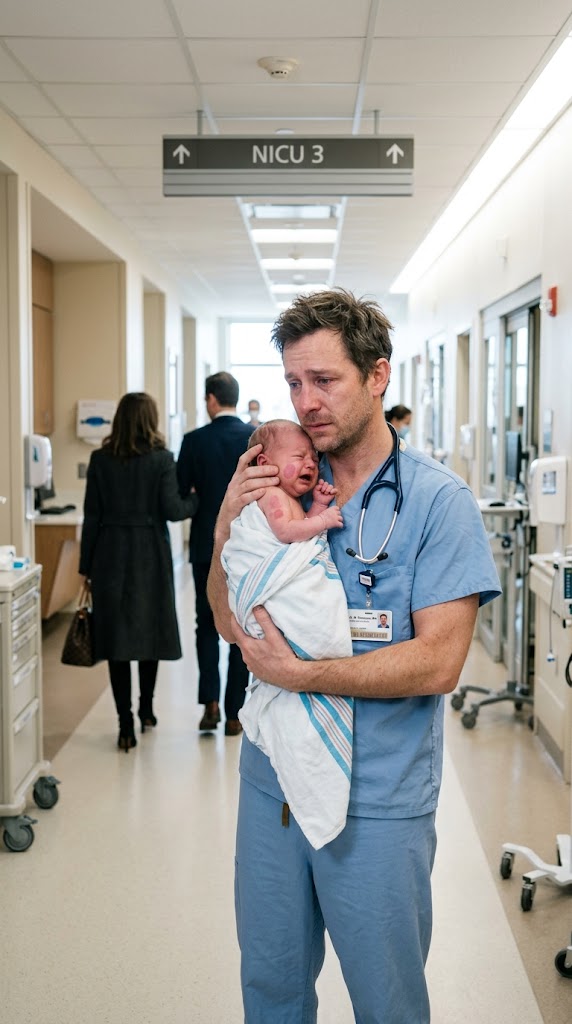
The Baby They Left Behind at Birth
The maternity floor at Brighton Memorial Hospital in Asheville, North Carolina, was usually one of the happiest places in the building. Soft newborn cries drifted through the hallways. Families whispered emotional prayers beside hospital beds. Nurses walked carefully from room to room carrying blankets, flowers, and tiny hats stitched with pastel thread.
But inside Room 518, the atmosphere had changed so suddenly that even the machines seemed quieter.
Dr. Nathan Calloway stood near the hospital bassinet, holding a newborn baby boy carefully against his chest. The child was perfectly healthy. His lungs were strong, his heartbeat steady, and his tiny fingers curled tightly around the edge of the doctor’s glove.
Across the left side of the baby’s face, however, stretched a deep red birthmark.
It was harmless.
It would not stop him from living a full life.
But the moment his wealthy parents saw it, the room turned cold.
Celina Barrington stared at the baby with visible panic in her eyes.
Her husband, Preston Barrington, remained near the doorway with his jaw clenched tightly, refusing to step any closer.
They were famous across North Carolina and much of the East Coast. Their luxury cosmetic company had built an empire around beauty, image, and perfection. Their faces appeared in magazines, charity events, and television interviews every month.
And now they were staring at their own child as though he had ruined something important.
“No,” Celina whispered sharply. “That can’t be my baby.”
Dr. Calloway looked at her in disbelief.
“Ma’am, your son is healthy. He needs his parents right now.”
Celina immediately turned her face away.
“Take him out of this room.”
Preston finally spoke, his voice calm in a way that felt far worse than anger.
“We’ll have our attorneys handle the paperwork.”
Dr. Calloway had worked in hospitals for nearly twenty years. He had seen frightened parents. He had seen families overwhelmed by unexpected medical news. But this was something different entirely.
This was rejection.
Within hours, legal discussions had already begun.
Before sunset, the Barringtons quietly left the hospital through a private parking entrance, more concerned about public attention than the child they had abandoned behind them.
Long after his shift should have ended, Dr. Calloway remained alone in the nursery holding the baby while the lights dimmed around them.
The little boy slowly stopped crying in his arms.
Nathan looked down at him and whispered softly,
“You are not unwanted. Not while I’m here.”
That single sentence changed both of their lives forever.
A Decision That Changed Everything
Nathan Calloway had once imagined a very different future for himself.
Years earlier, he had been engaged to marry a woman he deeply loved. They had dreamed about children, a house near the water, and growing old together. But life had slowly pulled those dreams apart. Illness, loss, and heartbreak had left him living alone in a modest home outside Asheville with little except his work.
Medicine became the center of his world.
He poured everything into caring for children because somewhere deep inside him, he still carried the quiet ache of the family he never had.
And now this tiny newborn boy had somehow reached directly into that empty place.
The hospital system immediately began discussing foster placement options. Several administrators privately suggested that children with visible facial differences were often harder to place quickly with adoptive families.
Nathan hated hearing those conversations.
The baby deserved better than being discussed like a problem waiting for paperwork.
So he fought for him.
At first, he simply extended the child’s hospital observation through every legal option available. Then he contacted attorneys during lunch breaks. He spent nights reading adoption laws at his kitchen table until dawn crept through the windows.
The process became exhausting.
Social workers questioned his schedule, his age, and his ability to raise a child alone while working as a physician. Some people politely implied that a successful doctor should focus on his career instead of taking on a complicated adoption case.
But Nathan refused to walk away.
He used nearly all of his savings on legal fees.
He canceled vacations.
He sold the vintage motorcycle he had spent years restoring.
And eighteen months later, just two weeks before Christmas, a family court judge finalized the adoption.
The little boy officially became Eli Calloway.
When Nathan carried him outside the courthouse wrapped in a thick navy blanket, snowflakes drifted gently across the parking lot.
Eli reached upward with his tiny hand and grabbed the edge of Nathan’s coat sleeve.
Nathan laughed through tears.
“We made it, buddy,” he whispered. “You and me.”
The House Filled With Small Joys
Their home was nothing luxurious.
It sat near a quiet lake outside Hendersonville, surrounded by tall trees and old wooden fences. The floors creaked during winter. The kitchen heater made strange rattling sounds every January. The porch paint chipped faster than Nathan could repaint it.
But it became a home full of warmth.
Nathan learned how to braid tiny shoelaces for preschool mornings.
He learned how to cook dinosaur-shaped pancakes badly enough to make Eli laugh every Saturday.
He learned how to stay awake after overnight hospital shifts just to attend school events and soccer practices.
Eli grew into a thoughtful little boy with observant eyes and an unusually gentle heart.
At six years old, he thanked restaurant workers before leaving every meal.
At seven, he carried extra snacks in his backpack for classmates who forgot lunch.
At eight, he stayed after school helping an elderly janitor gather fallen books from the hallway floor.
Nathan often watched him quietly and thought the world had almost lost someone extraordinary before he ever had the chance to grow.
But the world still noticed Eli’s birthmark before noticing anything else.
There were stares in grocery stores.
Whispers at school.
Cruel comments from children too young to understand how deeply words could cut.
One afternoon when Eli was ten years old, he came home unusually quiet. He dropped his backpack beside the front door and stood silently in the kitchen while Nathan prepared soup for dinner.
Finally Eli asked softly,
“Dad… if my face looked different, would people like me more?”
Nathan immediately set the knife down.
The question hurt more than he expected.
He walked across the kitchen and knelt beside his son.
“Listen to me carefully,” he said gently. “Some people only notice what’s easy to see. But the best people in this world notice character first.”
Eli looked down.
“But everyone always sees the mark first.”
Nathan carefully placed both hands against his son’s cheeks.
“Then let them see it first,” he whispered. “And let your kindness become the thing they remember.”
That night Eli cried quietly against his father’s shoulder while Nathan held him for nearly an hour.
The world outside did not magically become kinder the next morning.
But Eli stopped believing he needed to hide.
The Boy Who Refused to Give Up
As Eli grew older, his intelligence became impossible to ignore.
He loved science.
He spent evenings building small medical models from cardboard and reading anatomy books far beyond his grade level. By middle school, teachers regularly called Nathan to discuss how advanced his son had become.
At thirteen, Eli won first place at a statewide science competition with a project focused on tissue healing and pediatric recovery.
That was the day he met Dr. Walter Mercer, a retired reconstructive surgeon invited to judge the event.
Unlike everyone else, Dr. Mercer never stared at Eli’s face with discomfort.
Instead, he stared at Eli’s research board for nearly twenty minutes.
Then he smiled.
“You don’t just study medicine,” he told him. “You study people.”That sentence stayed with Eli for years.
Dr. Mercer slowly became a mentor, introducing him to physicians, lending him textbooks, and encouraging him to believe he belonged in rooms that once intimidated him.
Nathan watched the bond between them grow with quiet gratitude.
Because for the first time, Eli was beginning to see his future more clearly than his past.
The Truth Hidden Inside a Box
When Eli turned sixteen, a storm rolled through Hendersonville one rainy Saturday afternoon.
Nathan was working an emergency shift at the hospital when Eli searched through an old hallway closet looking for tax documents his father needed.
A cardboard storage box slipped from the shelf and crashed onto the floor.
Papers scattered everywhere.
Eli bent down to collect them.
Then he froze.
One document contained his birth date.
Another contained hospital transfer forms.
And printed clearly across the top of one page were two names:
Celina and Preston Barrington.
His biological parents.
Eli read the papers again and again, hoping he had misunderstood something.
But the truth remained exactly where it was.
Later that evening, with shaking hands, he searched the names online.
Magazine interviews appeared instantly.
Luxury charity galas.
Television appearances.
Articles praising the Barrington family for building one of the most successful cosmetic companies in America.
Eli sat motionless staring at the screen.
The people who had built an empire around physical perfection had abandoned their own child because of his appearance.
When Nathan returned home late that night, exhausted and still wearing hospital scrubs beneath his winter coat, he immediately saw the papers spread across the kitchen table.
His face fell.
For several seconds neither of them spoke.
Then Eli stood up and walked across the room.
Instead of anger, he wrapped his arms around his father tightly.
“You knew I would find out someday,” Eli said quietly.
Nathan’s voice shook.
“I never wanted you to feel unwanted.”
Eli pulled back with tears in his eyes.
“I don’t,” he answered honestly. “Because you stayed.”
That moment became the emotional foundation of the rest of his life.
Building a Future Bigger Than Pain
After learning the truth, Eli could have allowed bitterness to consume him.
Instead, he worked harder than ever.
He studied constantly.
He volunteered at clinics.
He tutored younger students.
He shadowed surgeons every chance he got.
By the time college applications arrived, his academic record was extraordinary.
He earned admission into one of the nation’s top pre-medical programs, then later entered medical school with national honors.
News outlets slowly became interested in his story.
A young medical student raised by a single adoptive father after being abandoned at birth had become one of the brightest future physicians in the country.
Eventually, a documentary crew asked permission to feature him in a national program about resilience and compassion.
Eli hesitated at first.
Nathan did too.
But Dr. Mercer encouraged him.
“There’s another child out there watching television tonight wondering if they matter,” he said. “Let them see your story.”
So Eli agreed.
The documentary aired on a Sunday evening.
It showed Nathan preparing breakfast in their small kitchen before heading to work.
It showed Eli studying late at night surrounded by medical textbooks.
It showed both of them laughing together on the old porch overlooking the lake.
And millions of people watched.
Including the Barringtons.
For the first time in nearly two decades, they saw the son they had abandoned become a man the country admired.
And suddenly, the carefully polished image they had spent years protecting no longer felt untouchable.
The Doctor Children Trusted Most
During medical school, Eli discovered his true calling.
Pediatric reconstructive care.
Not cosmetic perfection.
Not vanity.
Children.
Especially children who felt invisible, rejected, or ashamed because of visible medical differences.
He understood them in ways textbooks never could.
When nervous young patients cried before procedures, Eli often knelt beside them quietly and said,
“You don’t have to hide from me. I understand more than you think.”
The children trusted him immediately.
So did their families.
After finishing his residency, Eli shocked many people by refusing several prestigious offers from luxury hospitals in Los Angeles and Manhattan.
Instead, he opened a nonprofit pediatric clinic in Raleigh, North Carolina.
The Calloway Center for Pediatric Hope.
The building itself was modest at first.
Donated furniture.
Secondhand equipment.
Volunteers working long hours simply because they believed in the mission.
Nathan managed operations beside him.
Dr. Mercer advised the center until his retirement.
And within one year, hundreds of children had already received life-changing care.
The Parents Who Finally Returned
The request arrived on a gray Thursday morning.
Celina and Preston Barrington wanted to meet.
Several staff members immediately asked whether Eli planned to refuse.
He thought quietly for a long time before answering.
“No,” he finally said. “Let them come.”
They arrived that afternoon looking far older than their magazine photographs.
Their confidence had disappeared.
Celina cried almost immediately.Preston soon followed.
They admitted everything.
Fear.
Pride.
Shame.
Selfishness.
They called their actions unforgivable.
Then they offered Eli everything they still owned: their luxury clinic, their business assets, public apologies, financial donations, and control of their medical empire.
Eli listened silently until the room became quiet again.
Then he folded his hands calmly across the desk.
“I cannot erase the years we lost,” he said softly. “And nothing you offer will change what happened.”
Celina lowered her head in tears.
Then Eli continued.
“But I will accept the clinic under one condition.”
Both of them looked up immediately.
“It will no longer exist for image or status,” he said. “It will become a nonprofit center for children who need real care.”
Preston swallowed hard.
“And what do you want from us?”
Eli answered without hesitation.
“If your regret is real, prove it through service. No control. No privilege. No luxury treatment. You work for the children now.”
At that exact moment, Nathan appeared quietly near the office doorway holding patient files.
Eli looked toward him with a small smile.
“Including answering to my father.”
Celina completely broke down crying.
And for the first time in their lives, both Barringtons understood what love should have looked like years earlier.
The Man Who Changed Thousands of Lives
The transformation of the Barrington luxury institute into a nonprofit pediatric care center became national news.
Families arrived from across the country seeking treatment, counseling, and support.
What had once been a symbol of exclusivity became a place filled with children’s drawings, recovery rooms, therapy programs, and laughter.
Over time, Celina and Preston slowly changed too.
Not quickly.
Not perfectly.
But honestly.
One afternoon, a little girl arrived holding a stuffed rabbit tightly against her chest. A red birthmark stretched across the same side of her face Eli once feared people would judge.
The little girl looked up nervously and whispered,
“Is my face ugly?”
Celina immediately covered her mouth as tears filled her eyes.
She knelt carefully in front of the child.
“No, sweetheart,” she whispered back. “Not even a little.”
That moment changed her forever.
The Father Who Never Let Go
Fifteen years after opening the clinic, Dr. Eli Calloway received one of the nation’s highest humanitarian honors in Washington, D.C.
The ballroom overflowed with physicians, lawmakers, donors, and families whose children had been helped through his foundation.
Nathan sat quietly in the front row.
His hair had turned silver now.
Time had softened his face and slowed his steps.
But to Eli, he still looked exactly like safety.
When Eli stepped onto the stage, applause thundered through the hall.
He thanked his colleagues.
He thanked the families.
Then he paused.
The room slowly became silent.
“People often believe success belongs to the person standing in the spotlight,” he began. “But the truth is, success usually begins with someone who quietly refused to give up on you.”
Nathan lowered his eyes immediately.
Eli’s voice thickened with emotion.
“I was given life by biology. But I was raised by sacrifice, patience, and unconditional love.”
Many people in the audience were already wiping tears away.
Eli stepped down from the stage and walked directly toward the front row.
Nathan shook his head softly.
“Eli…”
But Eli smiled.
“Come on, Dad.”
The audience rose to its feet as Eli helped him onto the stage.
Standing beside the man who had chosen him years earlier, Eli looked back toward the crowd.
“Nathan Calloway did not give me his blood,” he said. “He gave me something far greater. He gave me belonging. He gave me confidence. He gave me a future.”
Nathan covered his face emotionally.
Eli wrapped an arm around his shoulders.
And throughout the ballroom, people stood applauding the quiet doctor who had once looked at an abandoned newborn and simply decided not to walk away.
That was the real miracle.
Not fame.
Not success.
Not awards.
Love.
The kind that stays.
The kind that protects.
The kind that chooses someone again and again even when life becomes difficult.
And in the end, that kind of love changed thousands of lives far beyond the walls of one hospital room.
People who are deeply loved often grow strong enough to help others heal too.
A child does not need perfect parents; a child needs steady care, honest kindness, and someone who refuses to abandon them during difficult moments.
The world often notices appearances first, but true character is revealed through patience, compassion, and the way someone treats people who can offer nothing in return.
Sometimes the greatest parents are not the ones connected by blood, but the ones who quietly choose responsibility, sacrifice, and unconditional love every single day.
No child should ever feel less valuable because they look different, because dignity and worth are never measured by appearance.
Real strength is not becoming cold after experiencing rejection; real strength is remaining compassionate despite it.
The most meaningful form of success is using your own pain to create safety, hope, and healing for someone else.
A single caring adult can completely change the direction of a frightened child’s life simply by staying present when everyone else walks away.
Healing does not always begin with grand speeches or apologies; sometimes it begins with one person gently saying, “You are safe with me.”
The people who judge others only by appearances often miss the deepest beauty a human being can carry inside.
Love given consistently over many years becomes stronger than fear, stronger than shame, and stronger than the painful moments that once seemed impossible to survive.