PART2:
Christopher relaxed slightly.
“He laughed. Then he said he was Brian and he fixes motorcycles at the shop right there, so he’s not that much of a stranger because anybody on the street could tell me he’s harmless.”
I closed my eyes.
“Did he say harmless?”
“Yeah.”
“Adults who are harmless don’t usually have to announce it.”
Christopher frowned.
“He was joking.”
Maybe he had been.
Maybe he had not.
Mothers do not get the luxury of maybe when their children are involved.
The next afternoon, I left the diner early and walked to the corner before Christopher’s bus arrived.
Brian was already there.
Not talking to any children.
Not lurking.
Just standing beside an old Harley-Davidson Sportster near the curb, helmet in one hand, looking uncomfortable under my stare before I had even introduced myself.
He was thirty-four then, broad-shouldered, beard going gray at the edges, forearms marked with faded tattoos that looked like he had gotten them in his twenties and regretted at least half. His boots were scuffed. His hands were scarred. He wore a canvas work jacket with grease on one cuff.
He looked exactly like the kind of man a tired mother would cross a street to avoid.
That is not pretty to admit.
It is true.
“You Brian Kesler?” I asked.
He straightened.
“Yes, ma’am.”
“Michelle Whitfield. Christopher’s mother.”
His face changed immediately.
Not fear.
Not annoyance.
Respect.
“Yes, ma’am. I figured you’d come by sooner or later.”
“You talk to my son?”
“Sometimes.”
“Why?”
He did not answer too quickly.
That helped.
“I saw him sitting alone a few afternoons in a row. He looked like he was used to waiting, and I didn’t like that.”
Neither did I.
That was the problem.
“What exactly do you want from him?”
Brian looked at me then, steady.
“Nothing.”
“People don’t usually want nothing.”
“I don’t know what to tell you except the truth. I ride by this corner anyway. I take my break about when his bus lets out. I stop five, ten minutes. We talk about motorcycles and school. I leave when someone comes for him or when I have to get back.”
“Why?”
He glanced down the street toward his shop.
“I was that kid once.”
I heard the bus before I could respond.
Christopher climbed down with his oversized backpack and saw us both at once. His little face tightened with dread.
He thought I was going to take Brian away.
That realization struck me harder than I expected.
“Hey, buddy,” Brian said, easy and calm.
Christopher looked at me first for permission.
I hated that too.
Not because he asked.
Because he felt he had to.
I nodded once.
His shoulders dropped.
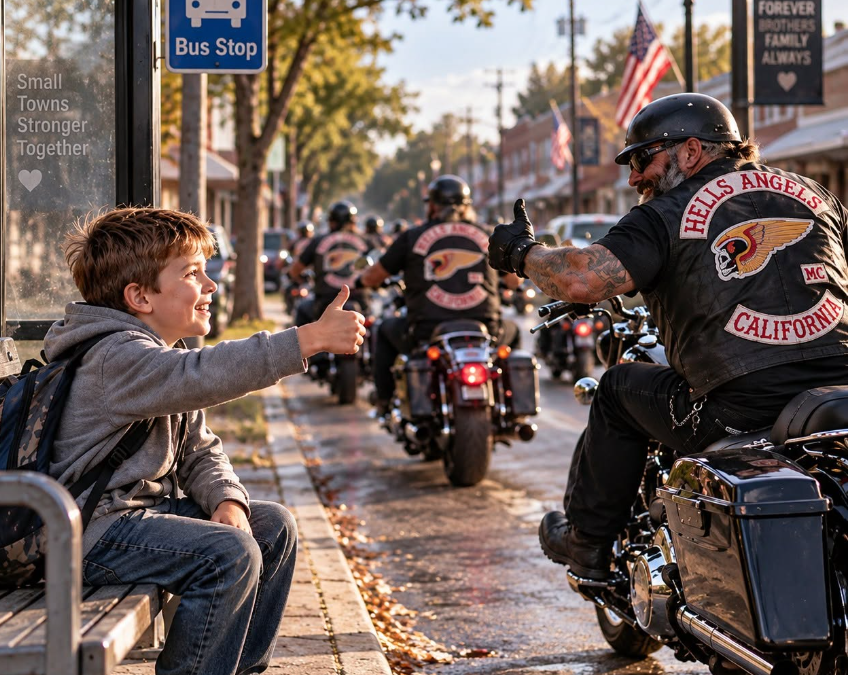
Brian crouched slightly—not dramatically, just enough to be less towering.
“How was school?”
Christopher made a face.
“Math.”
“That bad?”
“There were fractions.”
“Fractions are just numbers that got cut up.”
Christopher laughed.
A real laugh.
Not the polite one he used when adults tried too hard.
Something in me loosened despite myself.
I stayed that day. I listened. Brian never overstepped. He did not ask where we lived. Did not touch Christopher. Did not offer rides. Did not make promises. He talked about a carburetor he was rebuilding and explained, when Christopher asked, that chrome had to be polished a certain way because fingerprints and weather were enemies of shine.
Christopher listened like he was being handed treasure.
After ten minutes, Brian checked his watch.
“I’ve got to get back.”
Christopher nodded, trying not to look disappointed.
“See you around?”
“Most likely.”
That became the beginning.
I did not approve exactly.
Approval felt too formal for what it was.
I allowed it.
Then I appreciated it.
Then I depended on it in the quiet way you depend on a streetlight you did not install but are grateful for every time you come home after dark.
Brian began stopping most afternoons around 3:30.
Sometimes five minutes.
Sometimes twenty.
He would cut the engine, sit on the low wall near the bench, and ask Christopher about his day. Christopher, who had become careful with adults after his father left, answered him more openly than he answered almost anyone.
They talked about motorcycles first.
The difference between a Sportster and a Softail.
Why engines knocked.
How oil worked.
Why leather jackets were not just “for looking cool,” as Christopher put it, but for skin protection.
Then they talked about other things.
School.
Mountains.
Dogs.
Why some people wave at motorcycles and others glare.
Whether clouds over the Blue Ridge looked more like smoke or bruises.
Christopher started carrying a small spiral notebook. Blue cover. Bent corners. He wrote down facts Brian taught him.
Sportster = smaller Harley.
Chrome hates fingerprints.
Engine knock means listen closer.
Always check oil before long ride.
A person can know a machine by sound if they pay attention.
That last one mattered later.
I saw it happening.
Not all at once.
A boy without a father in his daily life had found a man who showed up without making it a production. A man who never called himself a mentor, never acted like a savior, never tried to make himself bigger in my son’s eyes.
He just came.
Day after day.
And Christopher began standing a little taller.
That is how some people change a child’s life.
Not with speeches.
With reliable arrivals.
For the better part of a year, Brian Kesler became part of our routine.
Mrs. Alvarado knew him.
The crossing guard knew him.
The bus driver knew him.
The owners of the bakery on the corner knew him and occasionally handed Christopher day-old muffins through the window when they saw Brian sitting with him.
I once told Brian he did not have to keep doing it.
He shrugged the way men do when gratitude makes them uncomfortable.
“Kid’s good company.”
“That’s not an answer.”
“Best one I’ve got.”
I let it be.
Then came the Tuesday in November.
Brian did not show up.
Christopher waited forty minutes.
I know because Mrs. Alvarado called me at work.
“He doesn’t want to leave,” she said gently. “He says Brian might still come.”
I left the grocery store early, which meant losing two hours of pay I could not afford, and walked to the bus stop with a fear I was trying not to name.
Christopher sat on the bench with his notebook open on his lap.
Every time an engine sounded down Haywood Road, his head lifted.
Every time it passed without slowing, he looked down again.
“Maybe he got busy,” I said.
Christopher nodded too fast.
“Yeah. Maybe a bike broke.”
“Probably.”
The next day, Brian did not come either.
Or the next.
By Friday, Christopher had begun asking strangers if they knew Brian Kesler.
Most shook their heads and kept walking.
That afternoon, I walked to Kesler’s Cycle Repair.
The shop was dark.
The roll-up bay door locked.
A handwritten sign was taped crookedly to the front glass.
Closed. Family emergency.
No phone number.
No date.
No explanation.
Family emergency.
Those words can mean anything.
A death.
A hospital.
A fight.
A collapse.
A choice.
I stood in front of that door for a long time, angry at Brian and ashamed of being angry because maybe something terrible had happened.
Then I went home to tell my son I knew nothing.
Christopher did not stop waiting.
At first, I tried to be patient.
“He’ll call if he can.”
“He knows where we are.”
“Maybe he had to leave fast.”
“Maybe the emergency is still happening.”
Those explanations worked for a week.
Maybe two.
Then they became thinner each time I repeated them.
Winter came.
The mountains went bare.
The bus stop bench turned cold enough that Christopher sat on his gloves. Still, he asked to wait.
“Ten minutes,” he would say.
Sometimes I let him.
Sometimes I said no because rain was coming or I was exhausted or dinner still needed making. On the days I said no, Christopher did not argue. That was worse. He simply looked toward Haywood Road as we walked home, listening for an engine that did not come.
People in the neighborhood began offering theories.
Brian moved away.
Brian died.
Brian got arrested.
Brian lost the shop.
Brian got tired of the responsibility.
That last one made me furious.
Not because I was sure it was not true.
Because I was afraid Christopher might hear it.
He did hear it eventually, of course.
Children always hear the things adults think they are shielding them from.
One evening, while I folded laundry on the couch, he said, “Do you think Brian stopped coming because of me?”
The shirt in my hands froze.
“No.”
“You don’t know.”
“I know it wasn’t because of you.”
“How?”
Because if it was, I would have hated him.
Because if Brian had built something in my son just to abandon it casually, I did not know what I would do with that anger.
Instead, I said, “Because grown-up problems are usually about grown-ups.”
He thought about that.
“Then why didn’t he tell me?”
There it was.
The question I could not answer.
The one that would sit between us for 431 days.
Spring came.
Then summer.
Then fall again.
Christopher turned eight.
He still carried the notebook.
The Brian section remained separate from everything else. He would not mix new motorcycle facts with Brian’s facts. It was as if keeping that section untouched preserved the man himself, sealed him in a place where disappearance could not rewrite memory.
That was when Daniel Reyes noticed him.
Daniel rode down Haywood Road every afternoon on his way home from managing a hardware store. He was fifty-one, a longtime member of the Blue Ridge Riders, one of those men with weathered skin, kind eyes, and the ability to make silence feel companionable instead of awkward.
He saw Christopher at the bus stop more than once.
Then more than enough.
He noticed the way my son watched every motorcycle that passed.
Not like a kid admiring bikes.
Like someone checking faces.
Waiting for one specific shape.
One specific sound.
Daniel mentioned it to his riding buddy, Steven Marsh, over coffee before a Saturday ride.
“There’s a kid down on Haywood,” he said. “Sits at the bus stop every day watching bikes like he’s expecting somebody.”
“Maybe he likes motorcycles.”
“It’s not the bikes.”
On Monday, Daniel slowed as he passed and gave Christopher a small wave.
Christopher waved back automatically.
Then looked crushed when Daniel kept going.
The next day, Daniel waved again.
The day after that, too.
Eventually, he stopped.
I was not there the first time.
Christopher told me at dinner.
“A man named Daniel stopped today.”
I tried not to tense.
“What did he want?”
“He asked if I was waiting on somebody.”
I set my fork down.
“What did you say?”
“I said Brian.”
“What did he say?”
“He knows him.”
The room changed.
“What?”
“He said he knows Brian. He hasn’t seen him either.”
I tried to keep my voice even.
“And then?”
“He said he rides that way every day and he can stop and keep me company until you or Mrs. Alvarado gets there.”
I closed my eyes.
Another biker.
Another man.
Another risk.
Another kindness I did not have the luxury to refuse too quickly.
“Did he ask you anything else?”
“No. He said he can’t promise he’s as good as Brian, but he knows a thing or two about bikes.”
Despite myself, I almost smiled.
“What did you say?”
“I said okay, but I’m still waiting for Brian too.”
Of course he did.
Daniel kept stopping.
Then Steven Marsh stopped with him.
Then David Ferris, a high school shop teacher who rode on weekends.
Then other members of the Blue Ridge Riders.
At first, I panicked when I arrived to find three motorcycles at the corner.
I walked faster, ready to be polite but sharp.
Then I saw Christopher showing his notebook to Steven, who listened with genuine attention, nodding at every motorcycle fact as if it mattered.
Daniel stood when he saw me.
“Ms. Whitfield.”
“You don’t have to do this,” I said.
I sounded more defensive than grateful because gratitude to strangers is frightening when your child is involved.
Daniel did not take offense.
“We know,” he said simply. “That’s kind of the point.”
That sentence stayed with me.
Within weeks, the bus stop changed.
What had been the loneliest corner of my son’s life became a place people showed up.
Not always the same people.
That was part of the beauty.
A rotating cast of riders came through: mechanics, truck drivers, veterans, teachers, men and women with leather jackets and patient voices. They did not try to replace Brian. They seemed to understand instinctively that replacing was impossible and insulting.
They simply stood in the gap he had left.
Someone was always there when Christopher’s bus arrived.
Not crowding him.
Not making a spectacle.
Just present.
They asked about school. Told him about rides through Pisgah National Forest. Let him ask questions about engines. Waited until I or Mrs. Alvarado arrived.
They became, almost without anyone announcing it, a community wrapped around one boy’s waiting.
For Christopher’s eighth birthday, the Blue Ridge Riders held a small party at their clubhouse off Riverside Drive. I almost said no. Then I saw how Christopher’s face changed when Daniel invited him, and I said yes with conditions.
No rides without me present.
No beer around the kids.
No inappropriate patches or jokes.
Daniel listened solemnly.
“We can manage not being fools for two hours.”
They did.
Mostly.
They gave Christopher a miniature leather vest with Junior Rider stitched on the back.
He wore it constantly.
To the grocery store.
To bed once, until I made him take it off.
To school, which resulted in a call from his teacher asking why my second grader had arrived dressed like the world’s smallest motorcycle club member.
“He is emotionally attached to the vest,” I explained.
There was a pause.
“Is this related to the bus stop men?”
That was how the school referred to them.
The bus stop men.
“Yes.”
Another pause.
“All right,” she said. “He did explain engine oil to the class today.”
“I’m sorry.”
“No, it was actually very thorough.”
David Ferris began teaching Christopher basic mechanical skills on Saturdays. How to check oil. How to identify engine parts. Why tools had to be cleaned and put back where they belonged. Christopher came home smelling faintly of metal and pride.
Still, he watched for Brian.
Every new engine made his head turn.
Every Sportster made him freeze for half a second.
Every disappointment settled a little deeper.
“He’s not gone,” he told Daniel one evening nearly a year after Brian vanished. “He’s coming back. I know it.”
Daniel told me later he almost said what adults say when they want to be kind but are really trying to protect themselves from hope.
Maybe, buddy.
We’ll see.
Sometimes people don’t come back.
Instead, Daniel said, “Well, when he does, he’s going to owe us all a drink for covering his shift.”
Christopher laughed.
A real laugh.
The kind that made the whole club feel, for one second, like maybe they had done something right even if they could not fix the wound at the center.
What none of us knew was that Brian Kesler had spent that entire year three hundred miles away in Richmond, Virginia, inside the slow violence of a hospital room.
His younger brother, Steven, had been sick before Brian ever met Christopher.
A degenerative illness.
Eighteen months diagnosed.
Manageable, Steven had insisted.
Treatments were working.
No need for Brian to hover.
Brian believed him because people believe what they need to believe when the alternative is terror.
Then in November, everything collapsed in a week.
Steven’s wife, Laura, called Brian in a panic.
Brian closed the shop that day. Taped the sign to the door. Drove to Richmond without stopping to explain.
Not to his neighbors.
Not to customers.
Not to me.
Not to my son.
He told himself he would call once things settled.
But things did not settle.
That is what he told us later.
And I have come to understand that some emergencies do not become manageable chapters. They become weather systems. They swallow days, then weeks, then months. Hospital corridors. Bad coffee. Insurance calls. Doctors with careful faces. Small improvements that turn cruel. Decisions no brother wants to make. Nights in a cheap motel where sleep feels like betrayal because someone you love is suffering under fluorescent lights.
Brian barely ate.
Barely slept.
He became the person everyone turned to because Steven became too weak to make decisions and Laura was breaking in her own way.
And every day, somewhere in the back of his mind, there was a phone call he owed.
To me.
To Christopher.
Tomorrow, he told himself.
Then tomorrow came full of fever, forms, pain management, test results, another specialist, another collapse.
Tomorrow became a pile he could not climb.
Guilt grew teeth.
The longer he waited, the harder calling became.
He imagined Christopher had moved on.
He told himself children are resilient.
He told himself a boy he had known for less than a year would forget.
That lie must have been easier than facing what his silence was doing.
Steven died in early October, nearly eleven months after Brian left Asheville.
The funeral was small.
Afterward came paperwork, bills, house matters, bank accounts, medical records, death certificates, the endless administrative debris grief leaves for the living to trip over.
It was Laura who finally forced him to face us.
Late December, as Brian prepared to return to Asheville, she sat across from him at her kitchen table and asked, “What are you going to do about that boy?”
Brian had told Steven about Christopher during the better months.
The kid at the bus stop.
The notebook.
The motorcycle questions.
The way a small friendship had crept into his life and made afternoons feel less empty.
Steven had liked those stories.
He told Brian more than once, “You owe that kid consistency.”
Now Laura said it differently.
“You can’t show back up like nothing happened. Not after disappearing on a seven-year-old with no explanation. You need to be ready for him to be hurt. Angry. Maybe not trust you anymore.”
Brian said, “That’s fair.”
Laura shook her head.
“No. Fair would’ve been calling. This is just what’s left.”
He carried that sentence back to Asheville.
He did not go straight to the bus stop.
He went to the shop.
He had been paying rent on it the whole time, which I still cannot decide was responsibility or denial.
Probably both.
For two days, he sat in the empty space, lights on for the first time in over a year, breathing dust and old oil and trying to figure out how to face a child.
Daniel found him there.
He had noticed the lights.
He walked in expecting a new tenant, a landlord, a thief, anyone but Brian Kesler sitting on an overturned crate in the middle of his own shop, looking older, thinner, hollowed out.
Daniel did not say hello.
His first words were, “You have any idea what that kid’s been through?”
Brian’s face crumpled.
That told Daniel enough to keep him from swinging.
Not that he would have.
Probably.
“I know,” Brian said quietly. “I know I don’t have an excuse good enough.”
“Try me.”
So Brian told him.
The illness.
The phone call.
Richmond.
The hospital year.
Steven’s death.
The guilt.
The longer silence.
The shame that turned a phone call into a mountain.
Daniel listened without interrupting.
When Brian finished, Daniel let out a long breath.
“That’s a real reason,” he said finally. “Doesn’t undo the hurt. But it’s real.”
Brian wiped his eyes with the heel of one hand.
“I don’t know if he’ll even want to see me.”
Daniel looked at him with something like pity.
“Brian, that kid has been at that bus stop nearly every day for over a year waiting for you. You have no idea how much he wants to see you.”
Three days later, Daniel told Christopher there was something important coming.
He would not explain.
“Just keep coming to the bus stop like you always do,” Daniel said. “Trust me on this one.”
Christopher had learned to trust Daniel.
He had also learned, painfully, that trust did not guarantee outcomes.
So that Tuesday afternoon, he sat on the bench with a guarded hope that hurt to look at.
I was there, but not right beside him.
Daniel had asked me to stay back at the bakery corner. I did not like it. He said Brian needed to face Christopher first, not me. I hated that he was right.
Christopher’s notebook was open on his lap, though he had stopped adding to Brian’s section months earlier because there was nothing new to add.
The mountains beyond the roofs were blue-purple, just like the first day.
Traffic moved along Haywood Road.
A bus hissed away.
A dog barked somewhere behind the laundromat.
Then Christopher’s head snapped up.
I heard it a second later.
An engine.
Not just any engine.
A particular low rattle at idle, uneven in a way I had heard only in memory for fourteen months.
Christopher stood so fast his notebook slid off his lap onto the sidewalk.
Down the block, turning onto Haywood Road, came an old Harley-Davidson Sportster.
Same bike.
More weathered.
Same engine.
Same sound.
The motorcycle slowed at the corner and stopped exactly where it used to.
The engine cut off.
For a moment, neither of them moved.
Brian sat with both boots on the pavement, helmet still on, hands gripping the bars like they were the only things keeping him upright.
Christopher stood by the bench, small body rigid, all the waiting in the world gathered into one child.
Brian removed his helmet.
His beard had more gray.
His face looked tired in a way time alone does not cause.
“Christopher,” he said.
My son’s face changed so quickly it broke me.
Disbelief.
Anger.
Relief.
Pain.
All of it too large for eight and a half.
“You came back,” he said.
So quietly Brian almost missed it.
Brian got off the bike.
His hands shook.
“I’m sorry,” he said. “I’m so sorry, Christopher.”
Christopher did not move toward him.
Good, I thought through tears.
Let him earn the step.
“I should have called,” Brian said. “I should have found some way to tell you what was happening. There’s no excuse good enough for how long I let it go. But I need you to know it wasn’t because of anything you did. It was never that.”
Christopher’s voice cracked.
“Then why?”
That word.
Fourteen months inside it.
Why didn’t you tell me?
Why did you leave?
Why wasn’t I worth a phone call?
Why did everyone tell me to stop waiting?
Why did I know you’d come back and still feel stupid for believing it?
He said some of it.
Not all.
“I waited every day,” he said, crying now. “Every single day, Brian. I thought…”
He could not finish.
He did not have to.
Brian crouched to his eye level the way he used to when Christopher was seven and needed things explained clearly.
“My brother Steven got very sick,” he said. “Sicker than anyone expected. I had to go take care of him. It happened so fast I didn’t think straight about anything except getting to him.”
Christopher wiped his face with one sleeve.
“And then?”
“Then once I was there, the days kept running into each other. I kept telling myself I’d call tomorrow. Then tomorrow. Then so much time passed I didn’t know how to call anymore.”
He swallowed.
“That’s not a good reason for staying silent. It’s just the truth of what happened. My brother died in October. I lost him. And somewhere in all that grief, I lost track of how much you needed me to tell you something instead of disappearing.”
Christopher cried harder.
“I’m sorry about your brother.”
Brian’s eyes filled.
“Thank you.”
“I’m mad at you.”
“I know.”
“I missed you.”
“I know.”
“No, you don’t.”
Brian lowered his head.
“You’re right. I don’t. Not all of it.”
That mattered.
I saw it land in Christopher.
Adults love to say I know when they do not.
Brian did not hide behind it.
He said, “You deserved someone who would tell you the truth even if the truth was hard. Not someone who vanished.”
They stayed that way for a long moment, my son crying and Brian kneeling in front of him, not asking to be forgiven too quickly.
Then Christopher stepped forward.
Not into a hug exactly.
He leaned into Brian’s shoulder like his body had made the decision before his pride approved it.
Brian wrapped one arm around him carefully.
I turned away because the bakery window was reflecting my face and I could not bear the sight of my own relief.
Daniel approached after a while, with Steven Marsh and David Ferris behind him. They had parked a little down the block to give the reunion privacy.
“Everything okay over here?” Daniel asked gently.
His eyes were on Brian, still carrying a protective anger I appreciated.
Christopher wiped his face.
“This is Brian,” he told them, as if they did not know. “He’s back.”
Steven smiled.
“We can see that.”
Brian stood, one hand still resting lightly on Christopher’s shoulder.
“I heard what you all did while I was gone,” he said. “Daniel told me. I don’t know how to thank you for looking out for him when I couldn’t.”
David shrugged.
“Wasn’t really a choice. Kid needed people showing up for him. We showed up.”
That evening, after Brian told me everything and I cried in the privacy of my kitchen because I was angry and relieved and sorry for him and sorry for my son all at once, the Blue Ridge Riders organized an impromptu gathering at their clubhouse.
It was not a celebration.
Steven Kesler’s death was too fresh.
Christopher’s hurt was too real.
Brian’s guilt sat visibly on him.
But it was something adjacent to celebration.
A recognition that something broken had been addressed honestly, if not repaired completely.
The clubhouse was a low brick building off Riverside Drive with a gravel lot that filled with more motorcycles than usual that night. Someone ordered pizza. Someone brought soda for Christopher and coffee for the adults. Daniel kept one eye on Brian like he might disappear again if not watched, and Brian accepted the surveillance without complaint.
Christopher sat between Brian and Daniel with his notebook open.
For the first time in months, he added a new entry under Brian’s section.
Brian came back.
Sportster still has same engine sound.
Brother Steven died.
Sometimes people disappear because grief makes them stupid.
Brian said that, not me.
I almost laughed and cried at the same time.
Brian read it and covered his mouth with one hand.
“Fair,” he said.
In the months that followed, Brian reopened Kesler’s Cycle Repair.
He did not go back to life as it was before because life does not work that way. He moved differently. More deliberately. He checked in even when busy. If he could not stop at the bus stop, he called. If he had to leave town, he told Christopher why, where, and when he would return.
He learned, the hardest way, what unexplained absence can do to a child who already knows adults can vanish.
The bus stop changed too.
It was no longer just a place where my son waited.
It became a meeting point.
Daniel, Steven, David, and the others kept stopping by, not out of duty now, but because affection had become habit. The Blue Ridge Riders called Christopher their youngest member with half-joking ceremony and full sincerity.
I watched my son rebuild trust piece by piece.
Not because the hurt had not happened.
Because the hurt had been answered truthfully.
That may be one of the most important things a child can learn.
Not that people will never fail you.
They will.
Not that love guarantees perfect attendance.
It does not.
But that when someone fails you, repair is possible if they return with truth instead of excuses.
A year after Brian came back, he organized a ride into Pisgah National Forest.
Christopher was nine by then, taller, louder, less fragile around the eyes. Brian had fitted a sidecar to his Sportster for him. I made them both endure a lecture on helmets, speed, weather, and road safety so detailed that Daniel pretended to take notes.
Christopher wore his Junior Rider vest, now slightly too small.
He spent the entire ride pointing out landmarks from stories Brian had told him.
At the overlook, where Asheville spread below in autumn color, Brian pulled him aside.
I watched from a distance.
“What happened to us,” Brian told him, “me leaving, you waiting, all of it, was not your fault. It never will be. Sometimes people who love you go through things that make them disappear for a while, even when they don’t want to. But the difference between someone who is really gone and someone going through something hard is whether they come back and tell you the truth once they can.”
Christopher listened with the seriousness he brought to everything that mattered.
“I should have found a way sooner,” Brian said. “But I’m not going anywhere again without telling you exactly what’s happening and why.”
Christopher nodded.
“I know.”
Brian smiled sadly.
“Daniel told me that too,” Christopher added.
“Daniel’s a smart man.”
“He said the whole club would’ve kept coming to the bus stop even if you never came back. He said that’s just what you do for people you care about.”
Brian looked out over the valley.
“He’s right.”
They rode back down into Asheville as the sun dropped behind the mountains, the whole procession moving together through golden light.
When they reached Haywood Road and Clingman Avenue, the entire club stopped.
Just for a moment.
Engines idling.
No one needed to be there anymore.
Christopher no longer needed to sit on that bench listening for one specific engine. Brian no longer needed to prove he could return. The Blue Ridge Riders no longer needed to fill a silence.
But they stopped anyway.
Some places earn the right to be remembered.
That corner had begun as the loneliest place in my son’s life.
Then a man noticed him.
Then the man vanished.
Then a community stepped into the empty space.
Then the man returned and told the truth.
Now, when I pass that bus stop, I do not only remember Christopher sitting there alone with his oversized backpack and notebook.
I remember Daniel’s wave.
Steven’s laugh.
David teaching him how to hold a wrench.
Mrs. Alvarado bringing gloves in winter.
Brian kneeling on the sidewalk, telling my son the truth he should have told much sooner.
I remember that love is not always one person arriving perfectly on time.
Sometimes love is a whole imperfect community refusing to let a child wait alone.
And sometimes healing sounds like an old Harley engine slowing at the corner after 431 days of silence.
Christopher still knows that engine by sound.
He says he always will.
I believe him.
Some sounds become part of a person’s heart.
Not because they never hurt us.
Because they came back.
Because they carried truth.
Because once, at a bus stop on Haywood Road, a boy who had been told to stop waiting heard the exact engine he had refused to forget.
And for one painful, beautiful moment, every adult who had doubted him understood something children know better than we do.
Hope can be foolish.
Hope can be stubborn.
Hope can sit on a cold bench for 431 days with a notebook open in its lap.
But sometimes, if the person who vanished finds the courage to return with the truth, hope is not foolish at all.
Sometimes hope is the sound of an engine turning the corner.
Sometimes it is a man stepping off a motorcycle and saying the words a child deserved a year earlier.
I am sorry.
It was not your fault.
I came back.
And sometimes, that is not enough to erase the hurt.
View more
Fake HOA Cop Dragged My 15-Year-Old Daughter by Her Hair—Then I Stepped Out With My Pistol and His Entire “Authority” Collapsed in Minutes.
12/10/2026
HOA Karen Called 911 on Me for Open Carry in a Grocery Store—Then My Own Deputies Walked In and Called Me “Sheriff.”
12/10/2026
After 14 Months Undercover, I Came Home to Find HOA Karen Handcuffing My Dad—Then Her Fake Court Order Linked Her Entire HOA to My Federal Case.
12/10/2026
But it is enough to begin.