PART2:
A crooked little sparrow with one wing shorter than the other.
I had seen it on homework.
Napkins.
The inside of his lunchbox.
Receipts.
My bathroom mirror when it fogged after a shower.
I had never once asked where it came from.
That fact would keep me awake for years.
That night, Caleb was supposed to be in the back seat of my Honda with his tablet while I pumped gas.
I had left the rear window cracked because the evening was warm.
The station lights buzzed overhead.
A semi rolled past on Route 31.
Somebody was buying lottery tickets inside.
I was staring at the numbers climbing on the pump when I heard a sound that did not belong.
Pop.
Small.
Plastic.
I knew it immediately.
A marker cap.
I turned.
The back door of the Honda was open.
Caleb wasn’t inside.
“Caleb?”
Nothing.
Then I saw him.
Twenty feet away.
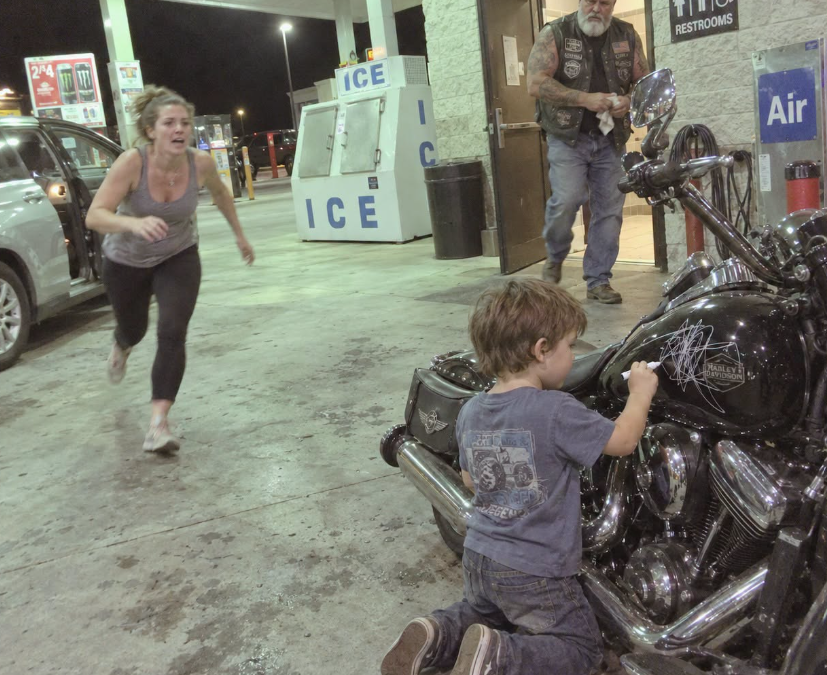
Kneeling beside a motorcycle.
A huge black touring bike stood near the air pump, polished until the station lights rolled across its tank like water.
Chrome exhaust.
Leather saddlebags.
A black helmet resting on the seat.
And my son was drawing on it.
With a white paint marker.
Not a washable school marker.
A paint marker.
One of the permanent ones I used at the motel to label cleaning supplies.
“Caleb!”
I have never moved that fast in my life.
The nozzle was still in my gas tank.
My purse hit the pavement.
I nearly tripped over the curb.
Caleb looked over his shoulder.
His face changed instantly.
He knew.
I reached him just as the men’s restroom door slammed open.
A man stepped outside.
He was enormous.
At least six-four.
Broad through the shoulders.
Gray threaded through a heavy beard.
Jeans.
Black boots.
Leather vest covered with patches.
One said MARINES.
Another had a faded American flag.
A larger patch across the back belonged to some veterans’ riding club I didn’t recognize.
There were tattoos down both forearms.
And he was walking directly toward us.
I did something ridiculous.
Instinctive.
I stepped between him and Caleb.
I am five-foot-two.
At the time I weighed maybe a hundred and ten pounds.
This man looked like he could lift me with one arm.
But mothers do stupid mathematics when their children are involved.
You don’t calculate whether you can win.
You calculate how long you might delay the damage.
“I’m sorry.”
The words came too quickly.
“I’m so sorry. He didn’t understand. He’s eight. I’ll pay for it.”
The biker kept coming.
“I have insurance.”
That made no sense.
“I mean—I can give you my number.”
He walked past me.
“Please don’t yell at him.”
That finally made him look at me.
Just for a second.
Not angry.
Confused.
Then he crouched beside the motorcycle.
Caleb pressed himself against my hip.
I could feel him trembling.
The biker placed both hands on his knees.
He stared at the white paint.
Caleb had drawn his bird right across the side of the black tank.
One wing short.
One wing long.
Body like an upside-down raindrop.
A dot for an eye.
Three little lines for a tail.
It looked like it was falling.
The biker did not speak.
Five seconds passed.
Ten.
Then he leaned closer.
His beard almost touched the tank.
I thought he was inspecting the damage.
I started talking again.
“I’ll pay for repainting it. Maybe they can buff it out. I don’t know how these markers work on—”
He lifted one hand.
Not threatening.
Just asking me to stop.
Then he turned his head toward Caleb.
“What are you drawing, son?”
His voice shocked me.
Low.
Quiet.
Gentle.
Like he was asking what Caleb wanted for breakfast.
Caleb swallowed.
His stutter came immediately.
“A—a—a b-bird.”
The biker looked back at the tank.
I did too.
And something about the moment changed.
Because the man wasn’t looking at damage anymore.
He was looking at recognition.
His shoulders went rigid.
He leaned closer.
Then sat back on his heels.
His hands began shaking.
Actually shaking.
This huge man who looked as though he had been carved out of old lumber suddenly couldn’t keep his fingers still.
He stared at Caleb.
“Where did you see this?”
Caleb looked at me.
The biker pointed at the tank.
“That bird.”
His voice cracked.
“Where did you see it?”
Caleb’s mouth opened.
Nothing came out.
The man swallowed.
Then said the sentence that changed all of our lives.
“Because that right there is my daughter’s bird.”
For a second I thought I had misunderstood him.
“What?”
He stood slowly.
His knees popped.
He walked toward the motorcycle’s right saddlebag and opened it.
His movements had become careful.
Almost ceremonial.
He dug beneath a rain jacket, a tool roll, and a pair of gloves.
Then he pulled out a piece of paper folded into a small square.
He came back.
Opened it.
Once.
Twice.
Three times.
The paper had been folded so often that the creases looked soft.
The corners were furry.
Tape reinforced one edge.
It was a missing-person flyer.
At the top was a photograph.
JESSICA LYNN KESSLER.
AGE 17.
LAST SEEN APRIL 18, 2015.
Brown hair.
Green eyes.
Five foot six.
A girl with a small gap between her front teeth and her chin tilted toward the camera like she had been daring whoever held it to take the picture already.
And in the bottom corner of the flyer, next to the police contact information, was a drawing.
A crooked bird.
One short wing.
One long wing.
One dot eye.
The same bird Caleb had just painted across the biker’s motorcycle.
My stomach turned to ice.
Because I knew that girl.
Not the seventeen-year-old version.
Not exactly.
But I knew that face.
Older.
Thinner.
Her hair was black now and cut just below her jaw.
There were lines near her eyes that didn’t belong on somebody her age.
But the gap between the teeth was the same.
The chin was the same.
And I had watched that woman eat saltine crackers out of the plastic sleeve four nights a week for almost two years.
Her name, as far as I knew, was Jess Mallory.
She worked the weekend desk at the Starlite Motor Inn six miles south of that gas station.
My second job.
My ears started ringing.
The biker was talking.
“My name’s Ray.”
I barely heard him.
“Ray Kessler.”
He pointed at the drawing.
“Jess started drawing that stupid thing when she was six.”
He smiled for half a second.
It wasn’t happiness.
It was memory.
“Every notebook. Every birthday card. Every grocery list. Teachers used to call us because she’d cover test papers with them.”
Caleb stared at the flyer.
Ray looked at him again.
“Where’d you learn it?”
Caleb inhaled.
“J—”
I squeezed his shoulder.
He stopped.
Ray noticed.
His eyes moved from my hand to my face.
I will not pretend otherwise.
I lied because I was afraid.
Not for myself.
For Jess.
Months earlier, during my first week working nights at the Starlite, I’d found Jess standing beside the ice machine at eleven-thirty.
I’d gone back there to refill the cleaning cart.
She had been smoking beside the emergency exit even though Dot, the manager, would have fired her for it.
When she saw me, she crushed the cigarette under her boot.
Then she said something strange.
“Emily?”
“Yeah?”
“If anybody ever comes here asking for me, you haven’t seen me.”
I laughed because I thought she was joking.
She didn’t.
Her hands were flat against the ice machine.
Her face was pale.
“I’m serious.”
“What do you mean?”
“Anybody.”
“Who?”
“Doesn’t matter.”
“Jess—”
“If a man comes asking questions, you don’t know me.”
She stared directly into my eyes.
“Promise.”
There are different kinds of fear.
Some people cry.
Some shake.
Some talk too fast.
Jess’s fear turned her quiet.
Dead quiet.
I knew it because I’d lived some version of it with Caleb’s father before he left.
Not the same story.
But enough.
So I had promised.
And now a man who looked like every warning sign my exhausted brain had ever collected was standing in front of me with her photograph.
Six foot four.
Leather vest.
Motorcycle.
Scar across one knuckle.
Gray beard.
Looking for a woman who had specifically asked me to hide her existence from men looking for her.
I chose.
Instantly.
Maybe wrongly.
But I chose.
“I don’t know.”
Ray stared at me.
“What?”
“I don’t know where he saw it.”
Caleb turned toward me.
Children know the sound of their parents lying.
He knew.
“Kids see things,” I said.
“Online. School. Cartoons.”
Ray kept looking at my face.
I thought he might challenge me.
Instead he folded the flyer.
Slowly.
Along the ancient creases.
“Okay.”
That was all.
No intimidation.
No demand.
No accusation.
He pulled a pen from inside his vest.
Wrote a phone number on the back.
Then, strangely, handed the paper to Caleb.
Not me.
“You keep drawing that bird.”
Caleb looked uncertain.
Ray nodded toward the motorcycle.
“You draw it anywhere you want.”
I stepped forward.
“Sir, I really do need to pay for the paint.”
He looked genuinely puzzled.
“For what?”
“The tank.”
Ray looked at the crooked white bird.
His eyes filled.
He blinked hard.
“Ma’am.”
He ran one thumb beneath his nose.
“You don’t owe me anything.”
He looked at Caleb.
“That’s the best thing that’s happened to this motorcycle in eleven years.”
Then he put on his helmet.
Climbed onto the bike.
Started it.
The engine rolled through the parking lot like distant thunder.
He backed away.
Before pulling onto Route 31, he looked once more at the bird.
Then at Caleb.
Then at me.
He didn’t wave.
He rode south.
I stood beside the pump until the sound disappeared.
Caleb picked up the folded flyer.
“Mom?”
“Get in the car.”
“Was that Jess?”
“Car, Caleb.”
“Mom.”
“Please.”
He got in.
I finished pumping gas with hands that barely worked.
The total stopped at twenty-three dollars.
Exactly.
I remember that because trauma attaches itself to stupid details.
Twenty-three dollars.
Pump number six.
A crushed Dr Pepper bottle under the trash can.
The smell of gasoline.
The buzzing lights.
The white bird drying on a black motorcycle.
Three miles down Route 31, Caleb asked, “Why’d you lie?”
“I didn’t.”
“You did.”
I gripped the steering wheel.
“Some things are complicated.”
“Jess drew the bird.”
My eyes snapped toward him.
“What?”
“Jess showed me.”
“When?”
“At the motel.”
“Why didn’t you tell me?”
He shrugged.
“You didn’t ask.”
Those three words went through me.
You didn’t ask.
How many things had I stopped asking?
Where did that drawing come from?
Why do you like it?
What happened at school?
Are you scared?
Are you lonely?
Who are you becoming when I’m too exhausted to look?
I worked all the time because I loved my son.
But love can become so busy surviving that it forgets to pay attention.
“How did she show you?”
Caleb looked out the window.
“On a hotel card.”
“What hotel card?”
“The paper people fill out.”
“A registration card?”
He nodded.
“She said my bird looked boring.”
Despite everything, I almost smiled.
“That sounds like Jess.”
“So she showed me hers.”
“And did she say where it came from?”
Caleb nodded.
I waited.
“She drew it on her dad’s motorcycle.”
My foot came off the accelerator.
“What?”
“When she was little.”
“She told you that?”
“Yeah.”
“What else?”
Caleb thought.
“She stole a white marker.”
“From where?”
“Hardware store.”
I pulled into the empty lot of the closed tire shop.
The Honda rolled to a stop.
“What happened?”
“She drew it on the motorcycle.”
“And?”
“Then she hid.”
“Why?”
“Because she thought her dad would get mad.”
“What did he do?”
Caleb smiled faintly.
“He left it there.”
My throat closed.
“Jess said everybody asked him why his nice motorcycle had an ugly bird on it.”
“Ugly?”
“She said it was ugly.”
“And what did he say?”
“He told everybody his daughter made it.”
I put both hands over my face.
Caleb sat quietly.
After a while he asked, “Is Jess in trouble?”
“I don’t know.”
“Is that man bad?”
I lowered my hands.
“I don’t know.”
“Then why were you scared?”
That question was harder.
Because the truth wasn’t flattering.
“I decided something about him before I knew him.”
“Because he’s a biker?”
I looked at my eight-year-old.
“Yeah.”
“That’s not nice.”
“No.”
He considered that.
“You tell me not to judge people.”
“I know.”
Another pause.
“Are grown-ups allowed?”
“No.”
He looked satisfied with that answer.
I wasn’t.
The next evening I drove to the Starlite feeling sick.
The motel had twenty-eight rooms arranged in an L around a cracked parking lot.
The sign lost the T whenever it rained, so some nights we worked at the “Sarlite.”
Room Twelve’s air conditioner leaked.
Room Nineteen smelled permanently like cigarettes no matter how often we shampooed the carpet.
Dot Alvarez managed nights.
Sixty-seven.
Five feet tall.
Smoked Marlboro Reds behind the laundry room and could identify which guests were going to steal towels within ten seconds of check-in.
Caleb sat at the front desk doing homework while I cleaned.
Technically against policy.
Dot called it “employee family accommodation.”
The owner called it something he didn’t need to know about.
Jess was behind the counter.
Boots propped on a trash can.
Saltines in one hand.
Paperback in the other.
“Hey, Cal.”
Caleb looked at me.
Jess noticed.
Her boots came down.
“What?”
I pushed the cleaning cart to a stop.
“Somebody showed me a picture of you last night.”
Every bit of color left her face.
“What picture?”
“A missing-person flyer.”
Silence.
The soda machine hummed.
Dot looked up from paperwork.
Jess stared at me.
“Who?”
I told her about the station.
The motorcycle.
The bird.
Ray.
When I said his name, she closed her eyes.
“He still has those?”
“The flyers?”
She nodded.
“Yes.”
“Jesus.”
Her voice barely existed.
Then her eyes opened.
“What did you tell him?”
“Nothing.”
“Emily.”
“I told him I’d never seen you.”
Something broke in her expression.
Relief came first.
Then pain followed so closely I almost couldn’t separate them.
She put both hands over her face.
Her shoulders started shaking.
Caleb stood from his chair.
I motioned for him to stay where he was.
Dot quietly locked the lobby door.
Flipped the sign to NO VACANCY even though half the rooms were empty.
Nobody questioned Dot.
She walked around the counter and set a box of tissues beside Jess.
“Talk or don’t,” she said. “But breathe.”
Jess sat.
For several minutes, she did nothing except cry.
Not loudly.
Jess never did anything loudly.
When she finally lowered her hands, her makeup had streaked beneath her eyes.
“My mom died when I was sixteen.”
She stared at the countertop.
“Stroke.”
“I’m sorry.”
“She was making coffee.”
Her voice went flat.
“I found her.”
No one spoke.
“Dad wasn’t home.”
Jess rubbed her fingers together.
“He was working at the plant.”
Ray.
“When he got home, the ambulance was already there.”
She swallowed.
“He loved her.”
The sentence came with bitterness.
“Like stupid love. Thirty years later and he’d still pull her onto his lap in front of people just to embarrass me.”
A tiny smile appeared.
Then vanished.
“After she died, he stopped being my dad.”
“Did he hurt you?”
Jess looked up sharply.
“No.”
Then again.
“No.”
The second time mattered.
“He never hit me.”
She breathed slowly.
“He disappeared while standing six feet away.”
Ray started drinking.
At first nights.
Then afternoons.
Then mornings on weekends.
He stopped cooking.
Stopped asking about school.
Stopped attending parent meetings.
Stopped answering friends.
He came home from the plant and sat in his garage with country music playing and bourbon in a coffee cup.
Jessica cooked boxed macaroni for herself.
Washed her own clothes.
Signed school forms in her father’s handwriting.
She had become an orphan inside a house where one parent was still alive.
“I tried everything.”
Her eyes fixed on the counter.
“I poured bottles out.”
“He bought more.”
“I hid his keys.”
“He screamed.”
“I called my aunt.”
“She said grief takes time.”
“I told the school counselor.”
“She asked if he ever touched me.”
“When I said no, she told me to give him patience.”
Jess laughed bitterly.
“Everybody wanted me to be patient with the adult.”
She was seventeen when patience broke.
April 18, 2015.
Ray had missed an anniversary dinner Jessica’s mother used to host for her birthday.
Jess made spaghetti anyway.
Two plates.
Ray never came inside.
At eleven, she walked into the garage.
He was drunk.
The old motorcycle stood behind him.
And across its black tank was the crooked bird she’d drawn when she was six.
“I told him he had to stop.”
Jess looked at me.
“I screamed at him.”
“What did he say?”
Her eyes filled.
“He said I sounded like my mother.”
A pause.
“Then I said good.”
Another pause.
“And he looked at me…”
Her mouth trembled.
“And said he wished I’d died instead of her.”
Caleb gasped softly from the desk.
Jess looked toward him.
For a second I thought she’d forgotten he was there.
“I’m sorry.”
Caleb shook his head.
Jess looked back at me.
“I left.”
That night she stuffed clothes into two trash bags.
A boy named Travis from English class picked her up in a rusted Pontiac.
Ray followed her to the driveway.
Not sober enough to stand straight.
“I heard the bottle hit the floor behind me.”
“Did he try to stop you?”
Jess stared at nothing.
“No.”
That answer still hurt her.
“That’s what I hated most.”
She left.
Travis lasted nine months.
At first he seemed like a rescue.
Then rescue became ownership.
He wanted to know where she went.
Who she spoke to.
Why she wore certain shirts.
Why she needed her own money.
When she finally left him, she had sixty-eight dollars.
After that came couches.
Cheap apartments.
Bad jobs.
People who offered help with conditions attached.
A boyfriend in Kentucky who introduced her to pills.
Then stronger things.
Jess didn’t tell me details.
She didn’t owe me details.
She only said, “There are three years I don’t talk about.”
She eventually entered rehab under a different last name.
Relapsed.
Went back.
Relapsed again.
Then one morning she woke in a hospital after an overdose and decided that if she survived another twenty-four hours, they belonged to her.
One day became three.
Three became thirty.
Thirty became a year.
By the time I met her, she’d been clean three years.
She had an apartment above a laundromat.
A fourteen-year-old Toyota.
Four thousand dollars saved.
A checking account.
A plant on her windowsill she hadn’t killed.
She had built an ordinary life the way some people build castles.
Brick by brick.
“And he’s been looking for me?”
Jess whispered.
“For eleven years.”
She looked at the folded flyer I had brought.
Ray’s number was on the back.
“That man has probably handed out ten thousand of these.”
Dot spoke from the desk.
Jess looked at her.
“You knew?”
Dot’s face changed.
“I knew you weren’t Mallory.”
“You never asked.”
“Wasn’t my business.”
Jess picked up the flyer.
Studied the seventeen-year-old girl.
“She looks stupid.”
“You look young,” I said.
“Same thing.”
Her thumb moved over the old photograph.
Then she saw the bird.
She closed her eyes.
“I can’t.”
Nobody told her she had to.
I put the flyer on the counter.
“He didn’t threaten me.”
Jess said nothing.
“He didn’t yell at Caleb.”
Still nothing.
“I thought he would.”
That got her attention.
“He caught Caleb drawing on the motorcycle.”
Jess’s eyes widened.
“What?”
“The bird.”
For one impossible second she almost laughed.
“He drew it?”
“Right across the tank.”
“Oh my God.”
“I thought Ray was going to explode.”
Jess stared at me.
“What did Dad do?”
Dad.
First time she’d called him that.
“He got down beside Caleb.”
I watched her face.
“He asked what he was drawing.”
Jess’s eyes filled again.
“He didn’t yell?”
“No.”
I left it there.
The choice had to be hers.
Three days passed.
Ray’s number remained beneath the cash drawer.
Jess didn’t touch it.
On Saturday, Caleb came to work with me.
He climbed onto his stool at the desk.
Jess gave him a packet of crackers.
For twenty minutes nobody mentioned Ray.
Then Caleb did what children do.
Walked directly into the room adults have spent days avoiding.
“Jess?”
“Yeah, Cal?”
“Do you want to know what happened when I drew your bird?”
Her hand stopped.
“Sure.”
“I thought he was mad.”
She stared at him.
“But he wasn’t.”
Caleb began describing Ray.
The restroom.
My panic.
The biker kneeling.
“He made this sound when he got down.”
Caleb demonstrated a knee cracking.
Jess laughed despite herself.
“He always had bad knees.”
“He said I could draw it anywhere.”
Her smile disappeared.
“He did?”
“Yeah.”
Caleb ate a cracker.
Then added, “He was crying.”
Jess stopped breathing.
“He tried to hide it.”
The lobby became silent.
Caleb looked at her innocently.
“Why was he sad?”
Jess stood.
Walked into the back office.
Closed the door.
She stayed there twenty minutes.
When she returned, she picked up Ray’s number.
“I need the office.”
Dot handed her the key.
“No one goes in.”
Jess looked at me.
“Especially you.”
I nodded.
“Especially me.”
The phone call lasted seven minutes.
Jess never told me what they said.
Ray never told Caleb.
Some things belong only to the people who survived them.
But afterward Jess came out looking as though somebody had removed a weight and replaced it with a different one.
She sat down.
“He stopped drinking.”
“When?”
“Eleven years ago.”
That surprised me.
“The week I disappeared.”
Ray had apparently awakened three days after Jessica left and found her bedroom stripped.
Called Travis’s parents.
School.
Friends.
Police.
Nobody knew where she’d gone.
By the time he understood that she had truly disappeared, he’d been sober almost forty-eight hours because he’d been too terrified to drink.
He never started again.
“He went to meetings,” Jess said.
“AA?”
She nodded.
“Still goes.”
“Did he apologize?”
Jess gave me a strange look.
“For what?”
I understood.
One phone call cannot apologize for eleven years.
“He wants to meet.”
“Do you?”
“I don’t know.”
“Then don’t.”
“I didn’t say no.”
She rubbed her arms.
“I told him Saturday.”
That surprised me.
“Where?”
“Here.”
“The Starlite?”
“Parking lot.”
“Why?”
“Because I know every exit.”
The answer hurt.
“And I want you here.”
“Okay.”
“And Caleb.”
“Jess—”
“Please.”
She looked directly at me.
“If he becomes who I remember…”
Her voice dropped.
“I need witnesses.”
Saturday morning arrived cold and clear.
Seven o’clock.
The motel parking lot was almost empty.
Jess wore jeans, boots, and a green jacket.
She had been outside since six-forty.
Smoking one cigarette after another even though she’d promised herself she was quitting.
Caleb stood beside me.
Dot watched through the lobby window with her phone in one hand.
At 7:03, we heard a motorcycle.
Jess went rigid.
The sound rolled up Route 31.
Then the black bike appeared.
Ray turned into the lot.
He parked fifteen feet away.
Shut off the engine.
Removed his helmet.
And froze.
He couldn’t get off the bike.
This giant man.
Veteran.
Biker.
Father.
Both hands locked around the handlebars.
Jessica did not run to him.
Ray did not open his arms.
Nobody moved.
Then Jess saw the tank.
The crooked white bird.
She walked toward it.
Not toward Ray.
Toward the motorcycle.
She crouched.
Touched Caleb’s paint with two fingers.
“Who did this?”
Caleb raised his hand.
Like he was answering a teacher.
Jess laughed.
Then sobbed.
At the same time.
Ray looked at his daughter for the first time in eleven years.
His mouth opened.
Closed.
Finally he climbed off the motorcycle.
He stood six feet away.
Helmet hanging from two fingers.
“I washed yours off.”
Jess stopped crying.
Ray nodded toward the tank.
“After you left.”
His voice shook.
“I couldn’t look at it.”
Jess stood.
“I had the tank repainted that summer.”
Ray swallowed.
“I’ve regretted it every day since.”
Jess said nothing.
He continued.
“I thought if I removed it, maybe…”
He laughed once.
Broken.
“I don’t know what I thought.”
Jessica put her hands into the back pockets of her jeans.
Ray’s eyes filled.
“And what I said about your mother.”
“I remember.”
“I know.”
He stepped forward half a foot.
Then stopped himself.
“I was drunk.”
Jess’s expression hardened.
“I know.”
“It isn’t an excuse.”
“No.”
“I was angry at God.”
“No.”
Ray looked at her.
Jess’s voice sharpened.
“You were angry at me.”
He nodded.
“That night I was.”
“For being alive.”
Ray closed his eyes.
“Yes.”
The truth seemed to physically hurt him.
When he opened his eyes, he said, “And it was the ugliest thing I’ve ever done.”
Jess’s face trembled.
“I spent years wondering if you meant it.”
“I didn’t.”
“Doesn’t matter.”
Ray flinched.
“It mattered to me.”
“You still said it.”
“Yes.”
“You let me walk away.”
“Yes.”
“You didn’t come after me.”
Ray wiped his face.
“I was drunk.”
“Stop saying that.”
He nodded immediately.
“You’re right.”
Silence.
Then Ray said something I didn’t expect.
“I failed you before that night.”
Jess stared at him.
“Your mother died and I decided I was the only person who lost her.”
Her mouth tightened.
“You needed me.”
He looked down.
“I made you take care of yourself because I was too busy feeling sorry for myself.”
Jess looked away.
Ray continued.
“You were sixteen.”
His voice cracked.
“I made you act forty.”
Nobody moved.
“I can’t give you those years back.”
Ray looked toward Caleb.
“I can’t tell you I deserve anything from you.”
Then back at his daughter.
“I wanted to know you were alive.”
“That’s all?”
“If that’s all you’ll give me.”
Jess studied him.
For a very long time.
Then said, “I’m alive.”
Ray’s face collapsed.
He covered his mouth.
Nodded.
“Okay.”
Jessica didn’t hug him.
She didn’t forgive him.
There was no music.
No miracle.
She walked toward the curb outside Room Four.
Sat.
Ray hesitated.
Then sat three feet away.
They talked for two hours.
I didn’t hear most of it.
Caleb and I went inside.
Dot made pancakes on a hot plate she wasn’t supposed to own.
Around nine-thirty, Jessica came in alone.
Her eyes were swollen.
“You okay?”
“No.”
That was the first time I’d ever heard her admit it without pretending.
“Do you want him gone?”
She shook her head.
“No.”
Ray came in ten minutes later.
He stopped when he saw me.
For the first time since the gas station, we were face-to-face.
“I lied to you,” I said.
“I know.”
I blinked.
“You knew?”
Ray nodded.
“Your boy knew the answer.”
Caleb froze.
“I saw you stop him.”
“Why didn’t you push?”
Ray looked toward Jessica.
“Because if my daughter was hiding from somebody, I needed to consider the possibility she had a reason.”
Shame burned my face.
“I thought maybe you were that reason.”
“I was.”
I looked up.
Ray’s eyes were tired.
“Just not the reason you thought.”
He looked at Jess.
“I gave her a reason to leave.”
That sentence changed how I saw him more than anything.
Not because it absolved him.
Because he didn’t try to absolve himself.
Over the next month, Ray and Jessica moved carefully.
One phone call.
Then another.
Coffee at a diner.
Forty minutes.
Next time an hour.
Jess made rules.
No surprise visits.
No asking where she lived.
No questions about the years she wasn’t ready to discuss.
No touching without permission.
No alcohol around her, ever.
No guilt.
Ray agreed to all of it.
Then came the first real test.
A local woman recognized Jessica.
Her name was Sharon Pike.
She had been friends with Ray and his wife years earlier.
She saw Ray and Jess leaving a diner.
Within two hours, somebody posted on a community Facebook group:
RAY KESSLER’S MISSING DAUGHTER FOUND ALIVE AFTER ELEVEN YEARS.
By dinner, people were sharing the old flyer.
By morning, a local news station had called the Starlite.
Jessica was furious.
“Who told them?”
Ray swore he hadn’t.
She didn’t believe him.
The fragile trust they had built almost shattered immediately.
“I told you no publicity.”
“I didn’t call anybody.”
“Eleven years you hand out my face, then suddenly I’m found and everybody knows?”
“I swear to God.”
“Don’t.”
Jessica grabbed her coat.
Ray followed.
“Jess.”
She spun.
“Do not follow me.”
He stopped instantly.
She drove away.
For three days she didn’t answer Ray’s calls.
She barely spoke to me.
Then things got worse.
The county sheriff’s office contacted her.
Because technically Jessica’s disappearance case had never been formally closed.
Detective Aaron Mills arrived at the motel.
Middle-aged.
Soft-spoken.
No uniform.
Jessica nearly left through the back door.
I stood beside her.
“You don’t have to talk alone.”
“I know.”
She agreed to ten minutes.
The interview lasted ninety.
Detective Mills wasn’t investigating Jessica.
He was trying to establish what had happened.
Whether anyone had harmed her.
Whether she’d been trafficked.
Whether another crime was involved.
Then he asked about Travis Mercer.
The English-class boyfriend.
Jessica’s face changed.
“What about him?”
Detective Mills opened a folder.
“He told investigators in 2015 that he’d dropped you at a bus station.”
Jess laughed bitterly.
“He lied.”
Ray, seated across the room, went still.
Detective Mills noticed.
“Mr. Kessler, let her answer.”
Ray nodded.
Jess explained.
Travis had taken her to Indianapolis.
They stayed with friends.
He gradually became controlling.
When she tried to leave, he kept her identification.
Took her phone.
Told her Ray had reported her as unstable.
Told her police would drag her home.
“Did he physically assault you?”
Jess became very quiet.
“Sometimes.”
Ray stood.
His chair hit the wall.
Jessica jumped.
“Sit down!”
He froze.
Her face had gone white.
Ray slowly sat.
“I’m sorry.”
That moment mattered.
The old Ray might have turned rage into the center of the room.
The man trying to become her father again swallowed it.
Detective Mills continued.
Travis had been questioned in the original investigation.
Never charged.
No evidence.
Jessica had disappeared from his life too.
What she told the detective reopened questions.
The investigation became public.
Reporters showed up.
One waited near the motel driveway.
Another called my dental office.
Somebody found Jessica’s old high school photograph.
The story transformed into entertainment.
MISSING TEEN FOUND 11 YEARS LATER.
BIKER DAD REUNITES WITH DAUGHTER.
Questions filled comment sections.
Why hadn’t she called?
Why hide?
Why let her father suffer?
Strangers judged eleven years of pain from their couches.
Jessica read one comment.
Just one.
A woman wrote:
If my father loved me enough to search eleven years, I’d crawl over broken glass to apologize to him.
Jessica shut the laptop.
Then smashed a coffee mug against the motel wall.
I found her in the laundry room afterward.
Sitting between industrial washers.
“I hate them.”
“I know.”
“They think I’m cruel.”
“They don’t know you.”
“He searched.”
“Yes.”
“He suffered.”
“Yes.”
“So did I.”
“I know.”
Her voice cracked.
“Why does his suffering erase mine?”
“It doesn’t.”
She looked at me.
“People like simple stories.”
“What does that mean?”
“They want one villain and one victim.”
I sat beside her.
“But families aren’t always built that way.”
Sometimes everybody is wounded.
Sometimes somebody causes harm because they are wounded.
That explains.
It does not excuse.
Sometimes the person who hurt you changes.
And you are still not obligated to return.
Sometimes you return anyway.
Not because the past wasn’t real.
Because you decide the future might be.
The sheriff eventually arrested Travis on charges unrelated to Jessica after another woman came forward.
That woman had seen the news.
She recognized his name.
Then another woman spoke.
Then another.
Jessica gave a formal statement.
Not because Ray asked.
He didn’t.
Because she wanted the record to say what had happened.
Travis eventually accepted a plea agreement involving assault and unlawful confinement in cases spanning several years.
Jessica wasn’t his only victim.
For the first time, Ray learned pieces of the years Jessica had refused to discuss.
Not from gossip.
From court.
He attended one hearing.
He sat in the back.
Never approached Travis.
Never caused a scene.
Afterward Jessica found him outside beside the motorcycle.
“What are you doing here?”
Ray looked startled.
“I wanted to hear.”
“Why?”
His eyes filled.
“Because I wasn’t there when it happened.”
Jessica’s jaw tightened.
“I don’t need you to punish him.”
“I know.”
“I mean it.”
“I know.”
“You’re not twenty years younger. You’re not some Marine anymore.”
Ray almost smiled.
“Still a Marine.”
“You know what I mean.”
“Yeah.”
She looked at him.
“What would you have done if he’d walked past you?”
Ray considered.
“A year ago?”
“Yeah.”
“Probably something stupid.”
“And now?”
He glanced toward the courthouse.
“Nothing.”
Jessica raised an eyebrow.
Ray exhaled.
“Maybe follow him home.”
“Dad.”
“Kidding.”
She stared.
He lifted both hands.
“Mostly.”
For the first time in eleven years, Jessica called him Dad and didn’t seem to realize she’d done it.
Ray realized.
I could see it.
He did not react.
That restraint may have saved everything.
Christmas was the next milestone.
Ray invited Jessica to his house.
The house she had left.
She said no immediately.
Then changed it to maybe.
Then no again.
Finally she asked me to drive her.
“Why me?”
“Because I might need to leave.”
“Okay.”
Caleb came too.
Ray’s house was a small ranch outside town.
Same house.
He had never sold it.
Jessica sat in my car at the end of the driveway for eleven minutes.
“You don’t have to.”
“I know.”
“We can turn around.”
“I know.”
She stared through the windshield.
Then whispered, “What if her stuff’s gone?”
“Your mom’s?”
Jess nodded.
“What if it isn’t?”
“That’s worse.”
I understood.
She got out.
Ray opened the door before we reached it.
He had cooked too much food.
Turkey.
Mashed potatoes.
Green beans.
Three pies.
Enough for fifteen people.
There were five of us.
Nervous people cook.
The living room had changed.
Different couch.
Different television.
Same family photographs.
Jessica stopped in front of one.
Her mother.
Young.
Laughing.
Holding baby Jessica.
Ray stood behind her.
“I couldn’t take them down.”
She didn’t answer.
Then she walked toward the hallway.
Ray’s face tightened.
“Your room…”
She looked back.
“I didn’t keep it like some shrine.”
“Okay.”
“I changed the mattress.”
“Okay.”
“Painted once.”
“Okay, Dad.”
He stopped talking.
She opened the door.
Blue walls.
Bookshelf.
Old desk.
No teenager’s clothes.
No frozen bedroom waiting for a ghost.
But on the shelf sat a small wooden box.
Jessica opened it.
Inside were hundreds of paper birds.
Receipts.
Napkins.
School papers.
Every crooked sparrow Ray had found after she disappeared.
Jessica sat on the floor.
Ray stayed in the doorway.
“I couldn’t throw them out.”
Her hands shook.
“Why?”
He looked confused.
“Because you made them.”
That answer finished her.
She sobbed.
Ray did not touch her.
He crouched several feet away.
Waited.
Eventually Jessica extended one hand.
Ray took it.
That was their first touch.
Not a hug.
Just hands.
Father.
Daughter.
Eleven lost years between their fingers.
Caleb watched from the hallway.
Later he whispered to me, “I think the bird fixed them.”
I shook my head.
“No.”
“But—”
“The bird opened a door.”
“What’s the difference?”
“They still had to walk through it.”
He thought about that.
“That sounds harder.”
“It is.”
Spring came.
Then summer.
Healing refused to follow a straight line.
Jessica visited Ray three Sundays in a row.
Then stopped for a month.
He didn’t pressure her.
She went to therapy.
So did Ray.
Separately.
Then, eventually, together.
The first joint session went terribly.
Jessica came out furious.
Ray looked destroyed.
I assumed they’d never return.
They went back the next week.
That became the pattern.
Not dramatic forgiveness.
Work.
Awkward dinners.
Boundaries.
Old wounds.
New arguments.
Learning.
One afternoon Ray came to the Starlite and found Caleb drawing at the desk.
“Hey, Picasso.”
Caleb smiled.
He almost never stuttered around Ray anymore.
“Your motorcycle’s loud.”
“It’s supposed to be.”
“It hurts people’s ears.”
“That’s how they know I’m cool.”
“Mom says people who say they’re cool aren’t cool.”
Ray looked at me.
“Your mom talks too much.”
Caleb laughed.
Ray set something on the counter.
A small black helmet.
Youth size.
I looked at him.
“No.”
“Didn’t even ask.”
“No.”
“Neighborhood speed.”
“No.”
“Ten miles an hour.”
“No.”
Caleb looked betrayed.
“Mom.”
“Absolutely not.”
Ray sighed.
“She’s mean.”
“I know.”
He pushed the helmet toward Caleb anyway.
“For bicycles.”
I narrowed my eyes.
Ray grinned.
He had learned.
A month later, he took the motorcycle to a custom paint shop in Kokomo.
Jessica thought he was finally removing Caleb’s bird.
She got angry.
Then Ray brought the bike back.
The bird looked unchanged.
“What did you do?”
“Clear coat.”
She stared.
Ray rubbed the tank carefully.
“Guy said that marker would fade.”
He looked at Caleb.
“So we sealed it.”
“For how long?” Caleb asked.
Ray smiled.
“Long as the bike exists.”
Jessica touched the bird.
“You’re insane.”
“Probably.”
She looked at him.
“You kept mine ten years.”
“Until I got stupid.”
“You got sad.”
Ray’s smile faded.
“Same result.”
She shook her head.
“No.”
He looked at her.
“They’re not the same.”
That might have been the moment I realized Jessica had begun forgiving him.
Not because she excused what happened.
Because she could finally see grief without letting grief erase responsibility.
Ray could finally see his guilt without using guilt to demand mercy.
That’s the part people misunderstand about forgiveness.
Forgiveness isn’t saying the wound didn’t matter.
Sometimes forgiveness means you stop asking the wound to be the only thing that matters.
The next year, Caleb turned ten.
Ray arrived at his birthday carrying a long box.
Inside was a professional drawing set.
Real pencils.
Ink pens.
Markers.
Heavy paper.
Caleb stared.
“These are expensive.”
“You planning to vandalize more motorcycles?”
“Maybe.”
Ray nodded.
“Then use quality materials.”
Jessica rolled her eyes.
I laughed.
After cake, Caleb disappeared into the kitchen.
He returned with a piece of paper.
Another bird.
But different.
Both wings still uneven.
Yet this time the bird was tilted upward.
Flying instead of falling.
He gave it to Jessica.
“For you.”
She stared at it.
“Why’s it different?”
Caleb shrugged.
“Birds learn.”
Jessica looked at Ray.
Ray looked away before anyone saw him cry.
We saw anyway.
Years passed.
The Starlite eventually closed.
A developer bought the property and tore it down for apartments.
Dot retired to Florida and sent Caleb postcards with terrible jokes.
Jessica became an assistant manager at a medical supply company.
Then manager.
She bought a little house.
Two bedrooms.
Small yard.
For a long time Ray wasn’t given the address.
Then one Sunday she invited him over.
He stood on the porch holding a houseplant.
Jessica opened the door.
“What is that?”
“Housewarming present.”
“You know I kill plants.”
“That’s why it’s a cactus.”
She stared.
“That’s insulting.”
“It’s practical.”
She let him in.
There were still bad days.
Anniversaries.
Her mother’s birthday.
April eighteenth.
Ray never called on that date unless Jessica called first.
One April, she did.
“Want to go for a ride?”
Ray asked.
“Where?”
“Nowhere.”
She hesitated.
Then said yes.
He brought the motorcycle.
Caleb was twelve by then.
I watched from Jessica’s driveway as she put on a helmet and climbed behind her father.
She wrapped her hands lightly around his waist.
Ray looked down.
For just a second.
At her hands.
Then started the engine.
They rode Route 31 north.
Past the Shell station.
Past the place everything had begun.
They were gone two hours.
When they returned, Jessica’s eyes were red.
Ray’s were too.
Neither explained.
They didn’t need to.
Caleb is sixteen now.
Tall.
Still skinny.
The blue glasses are gone.
Contacts.
He hates when I remind people he used to stutter.
It still appears occasionally when he’s nervous, but mostly the words come easily.
He draws constantly.
He wants to study industrial design.
Motorcycles, ironically.
Ray says he’s creating a monster.
Jessica says Ray created the first one.
They argue about who gets credit.
Last summer Ray’s knees finally got too bad for long rides.
He denied it until the orthopedic surgeon used words like replacement.
One afternoon he called Caleb over.
The black motorcycle stood inside the garage.
Same leather seat.
Same chrome.
Same tank.
Same crooked white bird.
Protected beneath layers of clear coat.
Ray handed him the keys.
Caleb stared.
“What?”
“Don’t get excited.”
“You’re giving it to me?”
“No.”
“Oh.”
“You don’t even have your motorcycle license.”
“Oh.”
“I’m putting you in the will.”
I almost dropped my coffee.
“Ray.”
He shrugged.
“He drew on it.”
“That isn’t how property law works.”
“Should be.”
Caleb touched the tank.
“You’re not dying.”
“Everybody’s dying.”
Jessica, standing beside him, slapped his shoulder.
“Don’t talk like that.”
Ray winced dramatically.
“Abuse.”
She rolled her eyes.
He smiled.
There are photographs in Ray’s garage now.
Old Jessica.
New Jessica.
Caleb.
Me.
Dot.
Ray’s late wife.
One photograph from Jessica’s sixth birthday shows her beside the motorcycle.
Black tank.
Crooked white bird.
The original.
Beside it hangs another photograph.
Taken almost twenty years later.
Jessica kneeling beside the same motorcycle.
Caleb beside her.
Ray behind them.
The replacement bird glowing white beneath the clear coat.
I have thought about that Shell station thousands of times.
About what I saw.
And what I invented.
I saw leather.
Tattoos.
A motorcycle.
A man large enough to frighten me.
And I built the rest of the story myself.
Violent.
Dangerous.
Controlling.
Maybe abusive.
Then I saw Jessica’s fear and built another story.
Victim.
Monster.
Escape.
Some parts were almost right.
Others were completely wrong.
Ray had hurt his daughter terribly.
But he was not hunting her to hurt her again.
He had spent eleven years searching because one drunken sentence had become the last thing his child ever heard him say.
Jessica had hidden for good reasons.
But she wasn’t only hiding from Ray.
She was hiding from an entire version of herself she had nearly died trying to escape.
Neither of them was innocent.
Neither of them was evil.
They were people.
Broken people.
And sometimes that is harder to accept because villains are simpler.
Heroes are simpler.
People are complicated.
The most important lesson didn’t come from Ray.
Or Jessica.
Or me.
It came from an eight-year-old boy who saw a blank motorcycle tank and remembered a story somebody once told him.
A little girl had drawn a crooked bird on her father’s motorcycle.
Her father had loved it.
Years later, Caleb saw the motorcycle without the bird.
He didn’t know about death.
Addiction.
Abandonment.
Grief.
Eleven missing years.
He didn’t know the father had washed the first bird away because looking at it hurt too much.
He didn’t know the daughter was working six miles away under another name.
He didn’t know his exhausted mother was going to lie.
He didn’t know police files would reopen.
He didn’t know women would eventually come forward against a man who had hurt Jessica.
He didn’t know reporters would turn private pain into headlines.
He didn’t know father and daughter would spend years carefully rebuilding something neither believed could survive.
He knew one thing.
The bird was missing.
So he put it back.
Ray is seventy now.
He doesn’t ride much.
Some Saturday mornings he pulls the bike into his driveway anyway.
Polishes the chrome.
Checks the tires.
Runs the engine.
Caleb helps.
A few months ago I walked over with coffee.
Ray was sitting on a shop stool.
Caleb had grease across one cheek.
Jessica was under the porch awning arguing with both of them because neither had eaten lunch.
Some things change.
Some don’t.
Ray ran one hand over the tank.
Over Caleb’s bird.
“It’s getting old,” I said.
“The motorcycle?”
“You.”
He laughed.
“Careful.”
I handed him coffee.
For a while we watched Caleb work.
Then I said something I’d wanted to say for years.
“That night at the gas station…”
Ray looked at me.
“I thought you were going to hurt us.”
“I know.”
“I judged you.”
“Yep.”
“I lied.”
“Yep.”
“Are you ever going to make this easier for me?”
“Nope.”
I laughed.
Then grew serious.
“I’m sorry.”
Ray rubbed his beard.
“You protected your kid.”
“From you.”
“You didn’t know me.”
“I should’ve asked.”
“Maybe.”
He looked toward Jessica.
“Maybe not.”
I waited.
Ray took a drink.
“Sometimes being wrong for the right reason still gets somebody home safe.”
He nodded toward Caleb.
“You were scared.”
Then toward Jessica.
“She was scared.”
Then at himself.
“So was I.”
He smiled faintly.
“We were all just scared people making decisions with half the story.”
That may be the truest description of life I’ve ever heard.
A minute later, Jessica called from the porch.
“Caleb, wash your hands.”
“In a minute.”
“Now.”
Ray whispered, “She sounds like her mother.”
Jessica heard him.
She froze.
For one terrible second, the old sentence lived between them.
The garage.
The bourbon.
The night she left.
I saw Ray realize what he’d said.
His face changed.
But Jessica walked over.
Stopped in front of him.
“You remember her voice?”
Ray swallowed.
“Every day.”
Jessica looked toward the ground.
Then smiled.
“Me too.”
Ray’s eyes filled.
Jessica put one hand on his shoulder.
Not dramatic.
Not perfect.
Enough.
Caleb wiped grease onto a rag.
“Why is everybody being weird?”
Jessica laughed.
“Go wash your hands.”
He headed inside.
Ray looked down at the motorcycle.
At the crooked bird.
“That’s staying there until they bury me.”
Jessica shook her head.
“You’re not being buried with a motorcycle.”
“Then I’m changing the will.”
“To what?”
He pointed toward Caleb.
“Bike’s his.”
Jessica laughed.
“You realize Emily is standing right here.”
Ray looked at me.
“You still won’t let him ride?”
“Absolutely not.”
“Kid’s sixteen.”
“Exactly.”
Caleb shouted from inside, “I can hear you.”
“Good,” I called.
Ray smiled.
Then ran his thumb over the uneven wing.
A little boy’s white paint marker.
A stranger’s motorcycle.
A missing girl’s childhood signature.
Such a stupid small thing.
Small enough that I might once have ignored it.
Small enough that I had ignored it hundreds of times when Caleb drew it at home.
But sometimes lives do not change because of enormous events.
Sometimes they change because somebody notices the tiny thing everybody else stepped past.
A drawing.
A tremble in someone’s voice.
A folded piece of paper.
A father who doesn’t raise his voice.
A frightened woman who finally makes a phone call.
A person who says, “I hurt you,” without adding “but.”
A person who says, “I’m not ready,” and is allowed to mean it.
A child who believes that if something important is missing, you should put it back.
Ray never got those eleven years again.
Jessica never got the father she needed at sixteen.
There was no justice capable of returning what had already been taken.
What they got instead was harder.
Truth.
Boundaries.
Consequences.
Time.
And the chance to choose each other again without pretending they had never lost each other.
That is not the kind of miracle people make movies about.
It is slower.
Less clean.
More painful.
But I think it may be the only kind that lasts.
The black motorcycle still sits in Ray Kessler’s garage.
And right across the tank, protected beneath layers of clear coat, is a ridiculous crooked white bird with one wing too short and the other too long.
Ray could have had it removed.
He could have restored the tank to perfection.
He never will.
Because perfection isn’t what brought his daughter home.
A mistake did.
A little boy’s mistake.
My mistake.
Ray’s mistakes.
Jessica’s decision to survive all of ours.
And every time I see that bird now, I remember myself standing beneath the Shell station lights, five-foot-two and terrified, trying to shield my son from a man I had already convicted in my imagination.
I remember Ray walking past me.
I remember his knees hitting the pavement.
I remember the giant hands beginning to shake.
I remember the missing-person flyer unfolding.
And I remember the moment the story I had invented about a stranger fell apart.
Because sometimes the person you are afraid of is dangerous.
Sometimes your instincts save you.
You should listen to them.
But sometimes fear only gives you half a story.
And half a story can make a monster out of a grieving father, a villain out of a frightened daughter, a vandal out of a little boy who thought he was repairing something, and a lie out of a mother who was only trying to keep somebody safe.
The rest of the story takes longer.
You have to stay.
You have to listen.
You have to let people tell you who they were, what they did, what they regret, and who they are trying to become.
Ray once told me he searched eleven years for his daughter.
I don’t think that is completely true anymore.
He searched eleven years for the seventeen-year-old girl who left his driveway.
The woman who came back was twenty-eight.
Stronger.
Scarred.
Sober.
Angry.
Independent.
Alive.
He had to learn that finding somebody isn’t the same as getting them back.
He didn’t get his old daughter back.
Jessica chose, slowly, to let him know the woman she had become.
And maybe that’s why the bird matters so much.
The first one belonged to a little girl.
Ray lost it.
The second one came from a little boy who knew none of their history.
Ray protected that one forever.
Not because it replaced what was lost.
Nothing can.
But because it reminded all of us that losing something once doesn’t mean you are forbidden from caring for what comes next.
And someday, when Ray is gone, that motorcycle really will belong to Caleb.
Ray already put it in writing.
Jessica witnessed it.
I complained.
Nobody listened to me.
Caleb says he will never repaint the tank.
I believe him.
He says if he has a daughter someday, he’ll tell her the whole story.
The six-year-old girl who drew the first bird.
The father who loved it.
The mother who died.
The father who disappeared into grief.
The terrible sentence in the garage.
The girl who ran.
The years nobody saw.
The father who searched.
The exhausted motel worker who lied.
The eight-year-old who stole his mother’s paint marker.
The Shell station.
The second bird.
The phone call.
The parking lot.
The long, imperfect road back.
And when his daughter asks why one wing is shorter than the other, Caleb already knows what he’ll say.
Because Jess taught him the answer when he was eight.
Anybody can draw a bird with perfect wings.