PART2:
Marlene Pritchard, who owned the diner, had almost done it with her hand hovering over the telephone.
Even Jack knew the stories.
Everybody did.
Hells Angels.
Bar fights.
Guns.
Drugs.
Men who did not call police because police were usually who they were avoiding.
But Elias had done something strange when he walked outside.
He had not grabbed Jack.
Had not barked questions.
Had not stood over him.
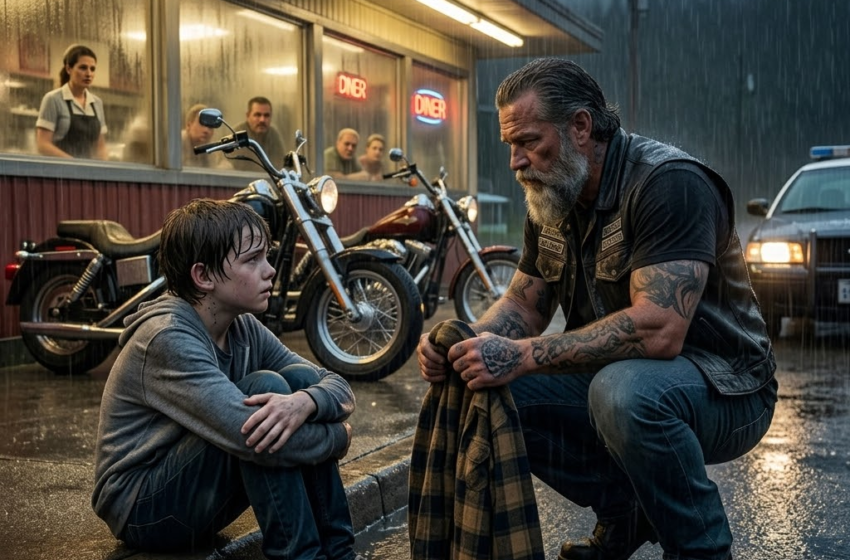
He had sat down.
In the rain.
At eye level.
Far enough away that Jack could leave.
Close enough to notice the blue beginning around his lips.
“What’s your name?” Elias asked.
Jack kept staring at the highway.
“Jack.”
“Okay, Jack.”
Elias rested his elbows on his knees.
“You know what time it is?”
Jack nodded.
“What day?”
“Wednesday.”
That answer had made Marlene, standing in the doorway, pause.
She had assumed confusion.
Elias had not.
“So you know tomorrow is Thursday.”
“Yes.”
“But you’re waiting tonight.”
“Yes.”
“For who?”
Jack swallowed.
“My dad.”
Elias waited.
Jack’s teeth chattered hard enough to click.
“He comes back on Thursdays.”
Marlene softened her voice.
“Honey, tomorrow’s Thursday.”
“I know.”
Something about the way he said it changed Elias’s face.
Not confused.
Not mistaken.
Terrified.
The boy knew exactly what day it was.
That meant the day was not the problem.
The promise was.
Twenty minutes earlier, none of them had known Jack existed.
The Wheelhouse was five minutes from closing.
Marlene had spent twenty-six years running the place and had a routine so practiced she could complete half of it while talking.
Turn coffee pots off.
Count register.
Stack pie trays.
Flip chairs.
Mop black-and-white tile.
Remind Milton Stalworth that buying one slice of pie did not technically entitle him to sit until midnight.
Milton always reminded her he tipped forty percent.
She always told him arithmetic did not change closing time.
He and the three riders with him came most Wednesdays.
Never loud.
Never drunk.
Never troublesome.
That had surprised Marlene the first few months.
She had expected problems.
Everybody expected problems from men wearing those patches.
Instead, they drank black coffee, ate pie, discussed weather and engines, paid cash, and left.
She had learned their orders before learning their names.
Milton: apple pie.
Ray: cherry.
Cole: whatever was fresh.
Elias: coffee.
Nothing else.
Always coffee.
Always black.
Elias rarely spoke.
Marlene knew he was called Elias only because Milton said it once.
She had never asked what he did for work.
Never asked where he lived.
Never asked why he sometimes stared at ambulances passing on Marine Drive as though they were carrying something away from him personally.
That Wednesday, the rain had started before noon and never stopped.
By ten, gutters overflowed.
By eleven, Marine Drive looked like a dark river.
Marlene was reaching for the front lock when she saw the boy outside.
Small.
Alone.
Motionless.
Her first thought was runaway.
Second was lost.
Third was call police.
Then Elias stood.
Didn’t say a word.
Went outside.
That was when Deputy Fitch arrived.
He had been three blocks away.
One glance was enough to build a story.
Child.
Midnight.
Motorcycles.
Hells Angels.
Large man beside boy.
The flashlight came up.
“Sir, step away from the kid.”
Elias looked over his shoulder.
“Just talking.”
“I said step away.”
Jack never looked up.
That bothered Elias more than the deputy’s tone.
A healthy nine-year-old would look.
Would react.
Would be embarrassed.
Would be scared.
Would argue.
Jack kept staring south.
Elias had spent enough of his life around shock to recognize when attention had narrowed too far.
He said, “He’s cold.”
“I’ll handle it.”
“Then handle the cold.”
Fitch’s jaw tightened.
“You want to make this difficult?”
“No.”
Elias looked at Jack.
“I want somebody to notice his lips.”
Fitch turned the flashlight.
Saw them.
Pale.
Faint blue edge.
His certainty slipped.
Only slightly.
“Son, where do you live?”
Jack said nothing.
“Jack.”
Nothing.
Elias kept his voice low.
“Hey, bud.”
Jack’s eyes moved toward him.
“Where’s home?”
“Up the hill.”
“With who?”
“Beatrice.”
“Your mom?”
Jack looked back toward the road.
“My mom’s dead.”
Marlene stopped breathing for a second.
Fitch lowered the light.
“When?”
“Last year.”
“Dad?”
“He drives.”
“A truck?”
Nod.
“Where?”
Jack didn’t answer.
Elias asked, “What happens Thursdays?”
That was the right question.
Jack’s eyes filled.
“Pie.”
Marlene looked confused.
Elias didn’t.
“You and your dad.”
Nod.
“Here?”
Another nod.
“What booth?”
Jack pointed through the glass.
Booth six.
Red vinyl.
Split corner.
Marlene knew it.
A truck driver and a little boy sat there Thursdays.
Of course.
She had seen them.
The father was tall.
Brown work jacket.
Always tired.
The boy always ordered chocolate cream.
The father pretended to take one bite.
The boy always accused him of stealing it.
She had never known their names.
“How long?” Elias asked.
“Every Thursday.”
“Since your mom died?”
Jack nodded.
Fourteen months.
Every Thursday.
No matter the load.
No matter the weather.
Glenn Donovan came home.
Picked up Jack.
Wheelhouse.
Pie.
That had become the surviving structure of Jack’s family.
Then came the scanner call.
None of them knew that yet.
Not fully.
But Elias could see that Jack had not wandered into this parking lot because he forgot the calendar.
He was trying to repair reality.
Inside Beatrice Nolan’s little blue house, four blocks uphill, a police scanner still whispered into an empty living room.
Beatrice was seventy.
She had spent most of her life working at a cannery.
Her fingers were stiff with arthritis.
She took pain medication at eight-thirty.
Usually stayed awake until ten.
That night the storm made the whole house dim and warm.
She fell asleep at nine.
Jack sat cross-legged on the rug.
He should have been in bed.
Instead he listened to the scanner.
He liked it because Beatrice did.
Traffic stops.
Neighbors.
Weather.
Noise complaints.
Mostly nothing.
Then at 9:52:
“Multi-vehicle accident, Highway 30, mile marker seventy-eight. Commercial tractor-trailer reported jackknifed. Second vehicle involved.”
Jack froze.
Mile seventy-eight.
The long curve near Svensen.
His father’s route.
But Wednesday.
Dad comes Thursday.
Except Sunday, during a phone call, Glenn had said one sentence Jack remembered.
“Load got moved. If Longview goes quick, I might beat Thursday home this week.”
Might.
Adults hear possibility.
Children hear threat to the pattern.
Jack called his father.
Voicemail.
Again.
Voicemail.
Third time.
Nothing.
The scanner crackled.
“Commercial vehicle.”
No name.
“Driver status unknown.”
Jack’s hands shook.
He looked toward Beatrice.
Sleeping.
He almost woke her.
Then didn’t.
Why?
Later, he could not explain.
Maybe because adults had already failed once.
His mother had gone to buy laundry detergent on a rainy evening and never come home.
The driver who crossed the center line survived.
Carol Donovan did not.
Jack had heard adults say everything they were supposed to say afterward.
Nothing you could do.
Nobody’s fault.
Terrible accident.
Life changes.
You have to be strong.
He stopped trusting phrases.
He trusted Thursday.
Thursday happened.
Thursday had rules.
Dad comes home.
They eat pie.
If Jack went to the diner and waited in booth six, Thursday might stay intact.
It made no logical sense.
It made perfect emotional sense.
So he put on his hoodie.
Left Beatrice asleep.
Walked downhill.
Rain soaked him before the first block.
He slipped once.
Scraped his palm.
Kept going.
By the time he reached Marine Drive, he was shivering.
The Wheelhouse sign became a lighthouse.
Then he saw motorcycles.
He almost turned around.
He had heard kids at school talk.
Hells Angels would stab you for looking at their bikes.
Hells Angels kidnapped people.
Hells Angels had secret tunnels.
One boy claimed his uncle knew one who kept a human skull on a shelf.
Children inherit fear with embellishment.
Jack stood across the street for almost a minute.
Then decided a father in a wreck mattered more than bikers.
He crossed.
Sat.
Waited.
That was where Elias found him.
And that was where Deputy Fitch almost ordered the wrong man away.
Elias unzipped his leather cut.
Fitch’s hand moved toward his belt.
Elias noticed.
“Relax.”
“Keep your hands where I can see them.”
“They are.”
He removed the cut slowly.
Then his flannel shirt.
His T-shirt sleeve slid up.
Marlene saw faded ink on his forearm.
An anchor.
Snakes wrapped around a staff.
Old naval medical insignia.
She did not recognize it.
Fitch didn’t either.
Elias handed the shirt to Jack.
“Put this under the hoodie.”
Jack stared.
“It’s dry.”
“I’ll get it wet.”
“Shirt’s easier to replace than you.”
Jack looked up.
That got through.
He put it on.
Elias helped without touching more than necessary.
Then the radio cracked.
All heads turned.
“Update Highway 30 collision, mile seventy-eight. Commercial unit confirmed independent hauler. One driver. Transport requested.”
Jack’s breathing changed.
Fast.
Shallow.
Fitch noticed.
“What company?” he asked dispatch.
Static.
Then partial plate.
“Registered owner appears to be Donovan…”
Jack stood suddenly.
“My dad.”
Elias caught his arm before he fell.
“Easy.”
“That’s my dad.”
“Jack—”
“His truck’s black.”
Fitch keyed radio.
“Dispatch, confirm commercial vehicle make.”
Static.
“Black Peterbilt flatbed.”
Jack made a sound.
Not quite a cry.
“He painted fire.”
“What?” Elias asked.
“On the doors. Flames. Red.”
Fitch repeated.
Dispatch answered.
“Affirmative, unit has red flame graphics.”
The world changed.
Jack tried to run toward the road.
Elias blocked him.
“No.”
“I have to go.”
“No.”
“That’s my dad.”
“I know.”
“He’s there.”
“And you’re here.”
“I can walk.”
“Not seventy miles.”
Jack pushed Elias.
It did nothing.
“Move!”
“No.”
Jack hit his chest.
Elias let him.
“Move!”
“No.”
The boy’s panic finally found a target.
“You don’t know!”
Elias’s voice stayed steady.
“You’re right.”
“My mom died there!”
Not the same exact location.
But close enough.
Rain.
Highway.
Curve.
Truck.
Police scanner.
To Jack, the map had folded.
“He’s going to die too!”
Marlene began crying.
Fitch looked away.
Elias did not.
He took the words.
“He might not.”
“You don’t know!”
“No.”
That honesty stopped Jack.
Adults had spent fourteen months telling him comforting things before facts existed.
Elias didn’t.
“I don’t know.”
Jack stared.
“But I know you’re cold enough that you’re not thinking straight.”
“I am.”
“You’re slurring.”
“No.”
“You are.”
Jack swayed.
Elias caught his elbow.
Marlene touched Jack’s cheek.
Too cold.
“Oh, honey.”
Elias looked at Fitch.
“Ambulance.”
“For him?”
“Now.”
“He’s awake.”
“So are people right before they crash.”
Fitch hesitated.
Elias’s voice changed.
Not louder.
Sharper.
Professional.
“Prolonged cold exposure. Wet clothes. Slurred speech. Decreased coordination. Blue lips. He’s nine.”
Fitch stared.
“How do you know?”
Elias did not answer.
Jack’s head tilted.
His focus drifted.
That was enough.
Fitch keyed his radio.
“Need medical at Wheelhouse. Juvenile. Possible hypothermia.”
Elias was already moving.
“Marlene, blankets.”
She ran inside.
“Not hot.”
She stopped.
“What?”
“Warm. Dry. No direct high heat.”
Fitch looked at him.
“You a doctor?”
“No.”
“EMT?”
“Used to be.”
Something moved behind Elias’s eyes.
A door opening.
Twenty-six years earlier, he had worn Navy white instead of black leather.
Hospital Corpsman Elias Buckner.
He served aboard the USS Cole.
October 12, 2000.
A small boat approached in Aden harbor.
Men waved.
Then the world opened.
Explosion.
Smoke.
Metal.
Seventeen sailors killed.
Dozens wounded.
Elias remembered fragments.
The deck tilted.
Blood running in directions blood shouldn’t.
Hands.
Always hands.
Pressure.
Airways.
Tourniquets.
Names shouted.
People praying.
One nineteen-year-old sailor asking Elias whether his mother knew.
Elias said yes.
He had no idea.
He told him anyway.
The sailor died.
Years later, Elias still remembered the lie more clearly than some faces.
After the Navy, he became a paramedic.
Twelve years.
Traffic accidents.
Overdoses.
Children.
Heart attacks.
Then one winter night, an ambulance siren hit a tone that sounded too much like an alarm from Aden.
Elias froze at an accident scene.
Thirty seconds.
Maybe forty.
His partner took over.
Nobody died because of him.
That did not matter.
Elias resigned three weeks later.
He stopped trusting his hands.
He drove freight.
Then rode.
The club didn’t ask him why he flinched at sirens.
Didn’t ask why he kept a trauma bag in his saddlebag though he claimed not to be a medic anymore.
Didn’t ask why he could not sleep near fireworks.
Milton knew pieces.
Not all.
Tonight, Jack’s lips turned blue.
Training pushed through twelve years of avoidance.
Elias checked pulse.
Weak.
Fast.
“Jack.”
Eyes fluttered.
“Look at me.”
Jack did.
“Tell me your dad’s name.”
“Glenn.”
“Your name?”
“Jack.”
“What day?”
“Wednesday.”
“Good.”
“What happens tomorrow?”
“Thursday.”
“Good.”
“Dad comes back.”
Elias swallowed.
“Yeah.”
Marlene brought blankets.
Dish towels.
A wool lap throw.
Elias removed Jack’s wet hoodie.
Then stopped.
“Deputy.”
Fitch stepped closer.
“Need privacy.”
Fitch understood.
He and Marlene formed a visual barrier while Elias replaced the soaked outer layers with dry fabric.
No rubbing limbs.
No hot water.
Passive warming.
Slow.
Jack’s hands shook violently.
“That’s good,” Elias said.
Jack looked frightened.
“I’m shaking.”
“Shaking means your body’s still fighting.”
“Will it stop?”
“When you warm up.”
“You sure?”
Elias almost said yes.
Then caught himself.
“Most likely.”
Jack stared.
“You don’t promise stuff.”
“What?”
“You keep saying maybe.”
Elias looked at him.
“I don’t make promises about things I don’t control.”
Jack’s face tightened.
“My dad does.”
“Thursday?”
Nod.
“Sounds like he controls that one pretty well.”
The radio crackled again.
“Driver identified as Glenn Donovan.”
Jack stopped shaking for half a second.
Every adult froze.
“Conscious.”
Marlene’s hands flew to her mouth.
“Transport to Columbia Memorial. Suspected clavicle fracture, concussion. Stable. Non-life-threatening.”
Jack stared at Fitch.
“What?”
Fitch crouched.
“Your dad’s alive.”
No reaction.
“He’s hurt.”
Jack’s mouth opened.
“But he’s alive.”
Nothing.
“Jack.”
Then the boy collapsed emotionally.
Not physically.
The sob came from somewhere so deep Elias felt it in his own chest.
Jack folded forward.
Elias caught him.
The boy buried his face in Elias’s wet T-shirt.
“He’s alive?”
“Yes.”
That word Elias allowed himself.
“Yes.”
“He’s alive?”
“Yes.”
“My dad?”
“Yes.”
Jack clutched the leather cut lying beside him.
Elias let him.
The ambulance arrived six minutes later.
The paramedics stepped into a scene already organized.
Dry insulation.
Wet clothing removed.
Warm environment.
Pulse monitored.
Jack responsive.
One paramedic, a young woman named Teresa Kim, looked at Elias.
“Who started rewarming?”
“He did,” Fitch said.
Teresa checked Jack.
“Good call.”
Elias shrugged.
“Old habit.”
“You medic?”
“Used to be.”
“Where?”
“Places.”
She looked at him.
Recognized the answer as a boundary.
Didn’t push.
Jack refused to release Elias’s cut.
Teresa said, “Can that come with us?”
Jack looked terrified.
Elias said, “Long as you give it back.”
“When?”
“Thursday.”
Jack almost smiled.
“Tomorrow?”
“Technically.”
The ambulance left without siren.
Milton watched.
Then looked at Elias.
“You okay?”
“No.”
“Good answer.”
Elias stood in rain wearing only his T-shirt.
His hands started shaking.
Milton saw.
Didn’t comment.
Instead handed him his own jacket.
Elias said, “Don’t.”
“You’re freezing.”
“I’m fine.”
“Jack said that too.”
Elias glared.
Milton held jacket out.
Elias took it.
Deputy Fitch remained.
Shame changes posture.
Earlier he stood with shoulders squared.
Now they had dropped.
“I owe you an apology.”
Elias looked at the road.
“For?”
“You know.”
“Say it.”
Fitch flinched.
Elias looked at him.
“You want an apology to matter, say what it’s for.”
Fitch inhaled.
“I saw the patch.”
Milton watched.
“I saw a big biker next to a kid and assumed you were the problem.”
Elias nodded.
“Yes.”
“I stopped looking.”
“Yes.”
“That was wrong.”
Elias looked back toward the wet curb.
“Kid didn’t have time for you to be wrong long.”
Fitch swallowed.
“No.”
For a second, Elias wanted to be cruel.
He had earned it.
Then he remembered Jack asking whether his father was alive.
“You corrected.”
Fitch nodded.
“Eventually.”
“Do it sooner next time.”
“I will.”
That was all.
Marlene locked the diner twenty-three minutes late.
Nobody complained.
The riders followed the ambulance to Columbia Memorial.
Fitch drove too.
Beatrice woke at 12:14.
The television had gone to an infomercial.
Scanner low.
Front door unlocked.
Jack’s shoes gone.
For eleven seconds she stood perfectly still.
Then panic arrived.
She called his name.
Upstairs.
Bathroom.
Closet.
Porch.
Nothing.
She called Glenn.
Voicemail.
Then 911.
The dispatcher knew immediately.
“Ms. Nolan, Jack is safe.”
Beatrice sat down hard on the stairs.
“Where?”
“Columbia Memorial.”
She started crying before hearing why.
Milton called her from the hospital twenty minutes later.
He introduced himself carefully.
“Ma’am, my name is Milton Stalworth. I’m with some men who were at the Wheelhouse.”
Beatrice heard “Hells Angels” in the background and almost hung up.
Then he said, “Jack’s asking for you.”
She froze.
“What happened?”
“He got cold.”
“How cold?”
“Enough they wanted him observed.”
“Oh, God.”
“His dad’s here too.”
Silence.
“What?”
“Glenn was in the Highway 30 wreck.”
Beatrice covered her mouth.
“He’s alive.”
Milton had learned from Elias.
Facts first.
No vague comfort.
“Broken collarbone. Concussion. Stable.”
Beatrice cried harder.
“How did Jack—”
“We’ll explain.”
“I fell asleep.”
Milton heard the self-accusation.
“Ma’am.”
“I fell asleep.”
“He left quietly.”
“I was supposed to watch him.”
“We can sort blame later.”
Milton’s voice was gentle.
“Right now, there’s a nine-year-old in a hospital bed who needs the person he trusts.”
Beatrice arrived in pajama pants under a raincoat.
She saw four motorcycles outside the emergency entrance.
Stopped.
The old fear came.
Then Elias stepped through automatic doors.
No vest.
He had not gotten it back.
Beatrice recognized him from stories.
Not personal stories.
Town stories.
She stiffened.
Elias saw.
“Jack’s okay.”
That was all he said.
She walked toward him.
“What happened?”
“He heard the wreck on your scanner.”
Beatrice’s face broke.
“I left it on.”
“Yeah.”
“He knew the route.”
“Yeah.”
“I took my medication.”
Elias said nothing.
“I should’ve—”
“No.”
She looked up.
“No?”
“You want guilt, wait until morning.”
His voice wasn’t soft.
It was kind anyway.
“Tonight, go hug him.”
Beatrice stared.
Then nodded.
Jack was wrapped in heated blankets.
Color better.
IV.
Elias’s leather cut folded beside him.
When Beatrice entered, Jack started crying again.
She hugged him.
“I’m sorry.”
“You didn’t do anything.”
“I was asleep.”
“I didn’t wake you.”
“I should’ve heard.”
“I didn’t want you scared.”
That sentence nearly destroyed her.
Nine.
Trying to protect a seventy-year-old woman by walking into a storm alone.
Beatrice held him tighter.
“You don’t protect me like that.”
Jack sniffed.
“Why?”
“Because I’m the grown-up.”
“You were sleeping.”
She laughed and cried at the same time.
“Still grown-up.”
Down the hall, Glenn woke around three.
First question:
“My son?”
The nurse assumed he meant at home.
“He’s safe.”
“Call him.”
“Your phone was destroyed.”
“Hospital phone.”
The nurse hesitated.
Then smiled.
“He’s actually here.”
Glenn stared.
“What?”
Ten minutes later, Jack sat carefully on the edge of his father’s bed.
Glenn’s arm was in a sling.
Bandage above eyebrow.
Face bruised.
He looked terrible.
Jack looked at him like he had never seen anything more beautiful.
“You walked to the diner?”
Jack nodded.
“In that storm?”
“Yes.”
“Why?”
“You always come on Thursdays.”
Glenn closed his eyes.
When he opened them, tears were there.
“Buddy.”
“I heard the truck.”
“I know.”
“It was Wednesday.”
“I know.”
“You said you might come early.”
“I did.”
Jack’s lip trembled.
“I thought if I waited there, you’d come.”
Glenn pulled him close with one arm.
“I’m sorry.”
Jack buried his face in his father’s chest.
“I broke the rule.”
Glenn stiffened.
“What rule?”
“Thursday.”
It took Glenn a moment to understand.
Then pain crossed his face more sharply than any fracture.
“No.”
Jack looked up.
“No, you listen.”
Glenn touched the back of his head.
“Thursday was never a rule.”
“Yes, it was.”
“It was a promise.”
“Same thing.”
“No.”
Glenn’s voice broke.
“A promise means I try.”
Jack frowned.
“You always came.”
“Because I wanted to.”
“What if you can’t?”
“That does not mean you go out alone and make it happen for me.”
Jack stared.
Glenn continued.
“You don’t hold the whole world together, Jack.”
Tears rolled down Jack’s face.
“If I don’t, who does?”
There it was.
The question grief had put inside him fourteen months earlier.
Glenn had never heard it aloud.
Who holds the world together after Mom dies?
Dad?
Thursday?
Pie?
A booth?
A routine?
Somebody must.
Glenn pulled him close.
“Lots of people.”
Jack cried.
“You.”
Glenn kissed his hair.
“Beatrice.”
Another breath.
“Teachers.”
Pause.
“Friends.”
Jack looked toward the hallway.
“The biker?”
Glenn laughed despite his shoulder.
“Apparently.”
Jack almost smiled.
“His name is Elias.”
“Then Elias.”
The story of Elias Buckner came out slowly.
Not through Elias.
Never through Elias.
Milton told Fitch a piece.
Fitch told the hospital staff only what mattered.
A nurse recognized the faded corpsman tattoo when Elias reached for coffee.
Someone searched his name.
Then the local paper found an old veterans feature.
Elias had received a Navy Commendation Medal for emergency medical actions following the USS Cole bombing.
After leaving the service, he worked twelve years as a paramedic.
He had left after a post-traumatic stress episode at a crash scene.
No disciplinary record.
No patient harm.
He simply resigned.
The article appeared Saturday.
HELLS ANGEL WHO SAVED LOCAL BOY WAS DECORATED NAVY CORPSMAN.
Elias hated it.
He walked into the Wheelhouse.
Dropped the newspaper on the counter.
“Who talked?”
Marlene pointed at nobody.
“Not me.”
Milton drank coffee.
Elias glared.
“You.”
“I told one deputy.”
“You told the deputy the Cole.”
“He asked why your hands knew what to do.”
“They didn’t need biography.”
Marlene poured coffee.
“You’re famous.”
“I was perfectly happy being suspicious.”
She smiled.
“No, you weren’t.”
He looked at her.
She had served him for a year without asking anything personal.
Now she looked directly at him.
“You were used to it.”
That hit harder.
Elias sat.
Marlene placed coffee down.
“No charge.”
“I pay.”
“Not today.”
“I pay.”
“Then leave tip.”
He did.
Forty percent.
Milton laughed.
Word moved through Astoria.
Stories expand in small towns.
By Monday, Elias had “carried Jack five miles through floodwater.”
By Tuesday, he had “performed surgery on the sidewalk.”
By Wednesday, someone claimed the whole club formed a human shield around the ambulance.
None true.
The truth was simpler.
He sat down.
He noticed.
He stayed.
Sometimes people dislike simple heroism because it makes responsibility harder to avoid.
If heroism requires combat, medals, superhuman courage, most people are excused.
If it requires paying attention to a cold kid while everyone else is busy judging who looks dangerous, suddenly the standard becomes uncomfortable.
Deputy Fitch felt that discomfort most.
He returned to the Wheelhouse the following Wednesday.
No uniform.
Marlene looked surprised.
“Coffee?”
“Yes.”
“Pie?”
“No.”
“You police types never commit.”
He ignored that.
Elias sat at the far booth with Milton.
Fitch approached.
Milton looked up.
“Trouble?”
“No.”
Elias kept drinking.
Fitch sat across without invitation.
“I want to tell you something.”
“That’s usually how talking works.”
Milton smirked.
Fitch exhaled.
“I reviewed my body camera.”
Elias’s eyes shifted.
“Why?”
“Training.”
“Whose?”
“Mine.”
That got his attention.
Fitch continued.
“First thirty seconds, I never look at the boy’s mouth.”
Elias said nothing.
“I look at you.”
Silence.
“My light’s on you most of the time.”
“Yes.”
“I heard you say he’s cold.”
“You did.”
“I heard it as resistance.”
“Yes.”
Fitch looked ashamed.
“What should I have heard?”
Elias leaned back.
“A fact.”
Fitch nodded.
“I’m showing it at briefing.”
“What?”
“The video.”
Elias’s face hardened.
“No.”
“Your face can be blurred.”
“No.”
“It’s useful.”
“No.”
“Why?”
Elias stared.
“Because that kid’s worst night is not your training prop.”
That stopped Fitch.
Milton looked down.
Elias continued.
“You want to teach deputies something, recreate it. Use me. Use an actor. Don’t make Jack watch himself freezing while adults argue.”
Fitch nodded slowly.
“You’re right.”
“Again.”
“Don’t get used to it.”
Elias almost smiled.
Fitch left.
He did recreate it.
Training scenario.
Unattended child.
Biker.
Bias.
Medical cues.
The lesson wasn’t “trust bikers.”
It was better.
Do not let appearance consume assessment.
Scene safety matters.
So does actual evidence.
Observe patient.
Observe behavior.
Ask.
Update.
The first recruit failed exactly as Fitch had.
Focused on the biker.
Missed hypothermia.
Fitch stopped the scenario.
Asked, “What did you see?”
The recruit listed leather.
Tattoos.
Motorcycle.
Size.
Fitch pointed at the actor playing the child.
“What color are his lips?”
Silence.
That became the lesson.
Jack returned to school Monday.
Everyone knew.
Children were mercilessly curious.
“Did you get kidnapped?”
“No.”
“Did a Hells Angel save you?”
“Kind of.”
“Did he have a gun?”
“I don’t know.”
“Did your dad’s truck explode?”
“No.”
“Did you almost freeze to death?”
Jack hated that one.
He began avoiding lunch.
A counselor named Mrs. Watkins noticed.
She invited him in.
Jack sat in a beanbag.
Said nothing.
She did not ask about bikers.
Good choice.
She asked about Thursday.
He stared.
“What about it?”
“What did Thursdays mean before the storm?”
Jack shrugged.
“Pie.”
“What else?”
“Dad.”
“What else?”
Nothing.
Mrs. Watkins waited.
Jack finally said, “Mom died on a Tuesday.”
She nodded.
“Did Thursdays start after?”
“Yes.”
“What were Wednesdays like?”
He thought.
“Waiting.”
There it was.
Thursday was relief.
Every week.
A checkpoint confirming Dad still returned.
Mrs. Watkins did not tell him the routine was unhealthy.
It had helped him survive grief.
She simply asked:
“What could happen if Dad misses one Thursday?”
Jack’s eyes watered.
“I don’t know.”
“Want to practice finding out without it being an emergency?”
That sounded insane.
But they did.
Two weeks later, Glenn stayed home Thursday evening on purpose.
No diner.
They ordered pizza.
Jack hated it.
At 7:15, he asked if they could go.
Glenn said no.
At 7:40, Jack became angry.
At 8:00, he cried.
“This is stupid.”
Glenn sat beside him.
“Probably.”
“Why are we doing this?”
“So Thursday can be a day, not a life support machine.”
Jack glared.
“That sounds like Mrs. Watkins.”
“She helped.”
“I don’t like her.”
“She likes you.”
“That’s her problem.”
Glenn laughed.
Jack didn’t.
Then Glenn took out two slices of grocery-store chocolate cream pie.
Jack stared.
“That’s cheating.”
“Absolutely.”
They ate at home.
Nothing collapsed.
The next week they returned to the diner.
Thursday remained special.
Just not sacred enough to destroy him.
Elias avoided Jack for a while.
Not intentionally, he claimed.
Jack knew better.
Every Thursday, Elias and the club had moved their usual Wednesday dinner.
Why?
Marlene asked.
Milton said, “Scheduling.”
Marlene laughed.
“Liar.”
They wanted to see Jack and Glenn.
Elias pretended he did not.
Jack returned the leather cut cleaned and folded.
Elias examined it.
“You wash this?”
“Beatrice did.”
“Machine?”
“Yeah.”
Elias closed his eyes.
“What?”
“Nothing.”
“Did she ruin it?”
“Twenty years of road rain couldn’t kill it. One washing machine might.”
Jack smiled.
Then Elias handed him something.
Small navy pin.
Anchor and medical symbol.
Worn.
“What’s this?”
“Old.”
“What does it mean?”
“I used to fix people.”
Jack looked at him.
“You still do.”
Elias’s jaw tightened.
“Sometimes.”
“Why’d you stop?”
Milton, two booths away, went quiet.
Glenn watched.
Elias could have refused.
Instead he said, “I got scared.”
Jack frowned.
“You?”
“Yeah.”
“Of what?”
“Doing it wrong.”
Jack thought.
“But you did it right with me.”
“One day.”
“That counts.”
Elias looked at him.
Children occasionally say things that bypass defenses adults spent decades building.
One day.
That counts.
Elias looked at the pin.
“Keep it.”
“Forever?”
“No.”
“How long?”
“Until you don’t need it.”
“How do I know?”
“You’ll know.”
Jack clipped it to his backpack.
For weeks, kids asked.
He said it belonged to a medic.
Not a Hells Angel.
Not a hero.
A medic.
Elias preferred that.
The aftermath of Glenn’s wreck was financially ugly.
The truck was totaled.
Insurance delayed.
Glenn could not drive for eight weeks.
Independent trucking is unforgiving.
No truck.
No income.
Medical bills.
Repair debt.
Rent.
Grief had already eaten savings after Carol’s death.
By December, Glenn was in trouble.
He did not tell Jack.
Adults hide money problems because they believe children should feel safe.
Children notice tension anyway.
Jack heard phone calls.
Saw envelopes.
Saw his father rubbing his forehead.
Then one Thursday, Glenn canceled pie.
“Money?”
Jack asked.
Glenn lied.
“No.”
Jack stared.
“You said don’t promise things you can’t control.”
Glenn sighed.
“Where did you learn that?”
“Elias.”
“Of course.”
Glenn told the truth.
“Yeah. Money.”
Jack nodded.
“Okay.”
Too easy.
The next Wednesday, Jack walked into the Wheelhouse carrying a jar.
Marlene frowned.
“What’s that?”
“Pie money.”
“Why?”
“Dad can’t.”
“How much?”
“Twenty-three dollars.”
Allowance.
Birthday money.
Coins.
Marlene looked like she might cry.
Then Elias came in.
Saw jar.
Asked.
Jack explained.
Elias said, “Put it away.”
“Why?”
“Because no.”
“That’s not a reason.”
“You’re nine.”
“So?”
“Your dad’s pride is already going to hate what happens next.”
“What happens next?”
Elias did not answer.
The Hells Angels chapter bought Glenn’s totaled truck.
Technically.
They bought the salvage rights from the insurer.
Then moved it to a member’s garage.
Rebuilt what could be rebuilt.
Frame damage too severe.
So instead, Milton found a used Peterbilt from a retiring owner.
Club members pooled money.
Not charity, Elias insisted.
Loan.
No interest.
Glenn could repay after returning to work.
He was furious.
“I didn’t ask.”
Elias stood in his driveway.
“I know.”
“I don’t want charity.”
“Good.”
“It looks like charity.”
“Then pay it back.”
Glenn stared.
“How much?”
“Cost.”
“Interest?”
“Pie.”
“What?”
“One slice each Thursday until the note’s paid.”
Glenn almost laughed.
“I’m serious.”
“You’re insane.”
“Possible.”
Jack stood behind his father grinning.
Glenn looked at the truck.
Black.
Older.
No flames.
He cried.
Tried not to.
Failed.
“I can’t take this.”
Elias said, “Then Jack can.”
Jack gasped.
Glenn laughed despite himself.
“Absolutely not.”
“Problem solved.”
Glenn took the truck.
Paid every dollar over three years.
Elias accepted pie.
That mattered.
Dignity.
Help works better when it does not demand surrender.
Beatrice’s guilt took longer.
She stopped taking her arthritis medication.
Jack found out because she stopped sleeping.
Pain worsened.
One night she dropped a coffee cup because her fingers locked.
“Why’d you stop?”
“Didn’t need it.”
“You do.”
“Mind your business.”
“You fell asleep.”
Beatrice froze.
Jack instantly regretted saying it.
“I’m sorry.”
She looked away.
“That’s why.”
“What?”
“I was supposed to be watching you.”
“You were.”
“I failed.”
“No.”
“I slept while you walked out into a storm.”
Jack’s eyes filled.
“I chose to.”
“I should’ve heard.”
“I didn’t want you to.”
“I’m the adult.”
Jack sat beside her.
“You told me not to protect you.”
“Yes.”
“So stop protecting me from you sleeping.”
Beatrice stared.
The logic was unfairly good.
“I hate when you sound like grown people.”
“I hate your hand hurting.”
She resumed medication.
Added a door alarm.
Scanner moved to the kitchen.
Lower volume.
No heroics.
Just systems.
That was another lesson the storm left.
Love is not enough.
Procedures help.
Door alarms help.
Phones help.
Neighbors help.
Promises need backup.
Months passed.
The town’s view of Elias changed.
Some of it irritated him.
People who once crossed the street now waved too enthusiastically.
A church asked him to speak.
He declined.
School asked for career day.
Declined.
Veterans group invited him.
Declined.
Then Jack’s class asked.
Elias said no.
Jack said, “Coward.”
Elias looked at him.
“Excuse me?”
“You said you got scared of being a medic.”
“That has nothing to do with third graders.”
“You’re scared they’ll ask stuff.”
“Yes.”
“So coward.”
Milton almost fell out of his chair laughing.
Elias went to career day.
He brought no motorcycle gear.
No medals.
No old photos.
He stood in a classroom.
A kid asked, “Did you shoot people in the Navy?”
Teacher panicked.
Elias said, “My job was trying to keep people alive.”
Another asked, “Are you a criminal?”
Teacher nearly died.
Elias said, “I’ve been arrested.”
Jack covered his face.
A girl asked, “For what?”
Elias looked at teacher.
She looked helpless.
“Things I shouldn’t have done.”
“Like what?”
“Adult things.”
“Bad?”
“Yes.”
“Are you bad now?”
The room went quiet.
Elias thought.
“I try not to be.”
The girl accepted that.
Children can tolerate moral complexity better than adults if adults stop rushing to simplify it.
Then a boy asked, “How do you know when somebody needs help?”
Elias looked at Jack.
“Sometimes they tell you.”
He paused.
“Sometimes you have to look.”
That was the best answer he gave.
A year after the storm, the Wheelhouse placed a small brass plaque under booth six.
Marlene did it without asking.
THURSDAY BOOTH.
Jack hated it.
Elias hated it more.
Tourists began asking.
Marlene enjoyed telling the story.
She exaggerated nothing.
Mostly.
Jack turned ten.
Then eleven.
Thursdays continued.
Sometimes missed.
That became progress.
Glenn might be in Spokane.
Or Eugene.
Or stuck behind snow.
They would go Friday.
Or skip.
The first missed Thursday still hurt Jack.
The fifth barely did.
He learned promises can bend without breaking.
Elias kept riding Wednesdays.
Then Thursdays.
Then whenever.
He and Fitch became something close to acquaintances.
Not friends.
Fitch once pulled Milton over for speeding.
Milton complained.
Elias sided with Fitch.
“Traitor.”
“You were doing eighty-two.”
“Allegedly.”
“Radar.”
“Technology can lie.”
“So can you.”
Fitch laughed.
Small changes.
Trust built through ordinary contact.
Not speeches.
The body-camera incident stayed private.
Fitch’s department training became standard.
Years later, another deputy encountered a homeless man leaning over an unconscious teenager in a park.
Initial assumption: assault.
Training kicked in.
Look at patient.
Man was performing CPR.
Deputy joined instead of tackling him.
The teenager survived.
Fitch called Elias afterward.
“Your parking lot did something.”
“My parking lot?”
“Training.”
“What happened?”
Fitch told him.
Elias went quiet.
“Kid okay?”
“Yes.”
“Good.”
No more.
But Milton found Elias sitting alone outside later.
“You okay?”
“Yeah.”
“Liar.”
Elias smiled.
“Something good happened.”
Milton nodded.
“Dangerous habit.”
Years passed.
Jack became a teenager.
He grew taller.
Voice dropped.
Stopped hugging adults without embarrassment.
Still carried the navy pin.
At sixteen, he got his first job.
Wheelhouse dishwasher.
Marlene said she hired him because he owed her for fourteen years of cocoa.
At seventeen, he wanted to become an EMT.
Glenn blamed Elias.
Elias said, “Don’t.”
Jack said, “Why?”
“Do something less exhausting.”
“I want to.”
“Wanting doesn’t make you good at it.”
“You taught me that.”
“I taught you?”
“Facts first.”
Elias regretted everything.
Jack became an EMT anyway.
First bad call: child bicycle accident.
Blood.
Screaming parent.
Kid survived.
Jack sat in ambulance bay afterward shaking.
He called Elias.
Not Glenn.
Not because he loved Glenn less.
Because Elias knew the shape.
“I froze for like two seconds.”
“Two?”
“Maybe three.”
“Did patient suffer because of it?”
“No.”
“Then learn.”
“I thought you’d say something better.”
“That is better.”
“I feel sick.”
“Good.”
“How is that good?”
“Means you’re not numb.”
Jack breathed.
“What if I freeze next time?”
“You might.”
“Elias.”
“What?”
“I need you to tell me I won’t.”
“No.”
Jack laughed bitterly.
“You still don’t promise.”
“No.”
“What do I do then?”
“Train.”
Pause.
“Ask for help.”
Pause.
“Don’t build your whole identity around one bad moment.”
That last one came from somewhere old.
Jack heard it.
“So that’s what you did.”
Silence.
“Yes.”
“You quit because of one call.”
“Yes.”
“Was that wrong?”
Elias took a long time.
“For me?”
“Yes.”
“I don’t know.”
Jack waited.
“It kept me alive at the time.”
Another pause.
“Then it kept me hiding longer than I needed.”
Jack wrote that down after the call.
He never told Elias.
When Jack was twenty-one, Elias finally stopped riding.
Hands stiff.
Knees worse.
Reaction time slower.
He sold his primary bike to Milton’s nephew.
Kept the old cut.
It hung by his door.
Same one Jack had clutched in the ambulance.
Still carried a faint coffee stain from the hospital.
Elias never washed it again after Beatrice’s machine nearly destroyed it.
Jack graduated paramedic school.
At the ceremony, he wore the navy pin beneath his collar.
Elias noticed.
Said nothing.
Glenn cried shamelessly.
Beatrice, eighty-two, shouted louder than everyone.
Fitch attended in uniform despite being close to retirement.
Marlene brought pie.
Thursday, naturally.
Later that evening, Jack and Elias sat outside the Wheelhouse.
Marine Drive wet from light rain.
No storm.
Jack asked, “Do you remember what I said?”
“When?”
“That night.”
“You said a lot.”
“He comes back on Thursdays.”
Elias looked at the road.
“Yeah.”
“I thought if Dad didn’t come, it meant Mom dying had started happening again.”
Elias nodded.
“Never told anyone that.”
“I figured.”
“How?”
“Because trauma’s repetitive.”
Jack smiled.
“Paramedic answer.”
“Old man answer.”
They sat.
Jack said, “You know what’s weird?”
“Everything.”
“I thought you saved me.”
Elias looked over.
“You were hypothermic.”
“I know.”
“You needed medical help.”
“I know.”
“So?”
“You saved the body.”
Elias groaned.
“Don’t make this poetic.”
Jack laughed.
“But the thing I remember most is you saying you didn’t know if Dad was okay.”
Elias’s expression changed.
“Everybody else tried to make me calm.”
“People do that.”
“You didn’t.”
“I was never good at comfort.”
“That was comfort.”
Elias looked toward the river.
Maybe.
At seventy-eight, Elias Buckner had a heart attack.
Minor, according to the cardiologist.
Nothing about a heart attack feels minor to people who care about you.
Jack was on shift when dispatch came.
Male.
Chest pain.
Address.
He recognized it.
His stomach dropped.
He arrived.
Elias sat in a chair.
Annoyed.
“You?”
Jack set down kit.
“Unfortunately.”
“I’m fine.”
“Everybody says that.”
“I taught you better.”
“Shut up.”
Jack assessed.
Aspirin.
Monitor.
ST changes.
Transport.
Elias looked at him.
“Don’t make a fuss.”
“You once made me ride in an ambulance for being cold.”
“You were nine.”
“You’re seventy-eight.”
“Not the same.”
“Correct. You’re less cooperative.”
In ambulance, Elias watched Jack’s hands.
Steady.
Competent.
“Your hands don’t shake.”
Jack smiled.
“They do later.”
Elias nodded.
“Good.”
The same answer.
After discharge, Elias stayed with Jack for two weeks.
He complained constantly.
Glenn enjoyed it.
“Now you know.”
“Know what?”
“What raising Jack felt like.”
Jack said, “You’re both terrible.”
Beatrice died peacefully at eighty-six.
Her funeral was on Wednesday.
Jack almost laughed when he realized.
Elias stood beside him.
“You okay?”
“No.”
“Good.”
Jack looked.
Elias shrugged.
“You hate fake answers.”
“I do.”
At the grave, Jack remembered Beatrice saying the scanner volume would never again reach a scared child before an adult.
Her blue house had been sold years earlier.
The scanner stayed with Jack.
He never turned it on.
Not once.
He kept it on a shelf.
Some objects finish their jobs.
Glenn retired.
Thursdays changed again.
No routes.
No waiting.
Father and son still ate pie.
Sometimes Elias joined.
Sometimes Fitch.
Sometimes all.
The Wheelhouse replaced the red vinyl booths.
Marlene resisted for years.
Eventually split vinyl became exposed foam.
Health inspector forced it.
She saved a piece of booth six.
Gave it to Jack.
He laughed.
“What am I supposed to do with this?”
“Remember.”
“I have memories.”
“Physical objects are better.”
“Why?”
“Ask old people.”
He framed it ironically.
Then stopped thinking it was ironic.
Elias died at eighty-three.
Not dramatic.
Sleep.
Home.
Leather cut hanging near the door.
Jack found him because Elias failed to arrive for Thursday coffee.
The phrase hit so hard Jack had to sit down.
He comes back on Thursdays.
Except sometimes they don’t.
That was what nine-year-old Jack had feared.
Now, decades later, it happened.
No panic.
No storm.
No magical arithmetic.
Jack entered Elias’s house with Milton’s son.
Found him peaceful.
Called.
Waited.
Handled what needed handling.
Then sat alone on porch.
Cried.
At the funeral, Hells Angels lined the road.
Dozens.
People who once locked doors when those motorcycles came through town now stood on sidewalks.
Deputy Fitch, retired, wore a suit.
Marlene was gone by then.
Her daughter represented the diner.
Glenn sat front row.
Jack spoke.
He held the old navy pin.
“I met Elias when I was nine.”
Everyone knew.
“They tell the story like he saved me because he knew hypothermia.”
Pause.
“He did.”
Jack looked toward the casket.
“But what saved me first was that he sat down.”
The room quieted.
“Everybody else was standing.”
He swallowed.
“Some were standing over me. Some behind glass. Some behind a badge.”
Fitch looked down.
“Elias sat on the wet curb.”
Jack touched the pin.
“He didn’t know my name.”
“Didn’t know my dad.”
“Didn’t know whether I’d run away or been abandoned or was lying.”
“He sat anyway.”
Jack’s voice broke.
“For the rest of my career, every time I met someone in crisis, I tried to remember that posture.”
He demonstrated slightly with one hand.
“Not above.”
“Beside.”
A biker in the front row wiped his eyes.
Jack continued.
“Elias once told me people had decided who he was the second they saw his vest.”
He looked around.
“He was right.”
“Some of those people were wrong about him.”
“Some weren’t completely wrong.”
A ripple of knowing laughter.
“He had done bad things.”
“He did good things.”
“He carried both.”
Jack breathed.
“What mattered to me was that on one Wednesday night, when he had every reason to keep his own history buried, a kid was cold.”
“So he used the hands he didn’t trust anymore.”
“And they worked.”
Jack looked at the casket.
“One day counted.”
Afterward, Deputy Fitch approached.
Old now.
White hair.
“You remembered.”
“What?”
“His hands.”
Jack nodded.
Fitch said, “I remembered his lips comment every shift.”
Jack smiled.
“You ever tell him?”
“Once.”
“What’d he say?”
“‘Good.’”
Jack laughed.
“That sounds right.”
The Wheelhouse kept Elias’s coffee mug.
Marlene’s daughter placed it behind the register.
No plaque.
Elias would have hated that.
The mug simply stayed.
Black ceramic.
Small chip.
Every Wednesday night, if Jack was in town, he sat at the counter.
Coffee.
Sometimes pie.
Thursday remained for Glenn.
Until Glenn died at eighty-one.
Cancer.
Slower.
Enough time to say things.
Enough time to apologize for things that no longer needed apologies.
On Glenn’s last Thursday, Jack brought Wheelhouse pie to hospice.
Chocolate cream.
Glenn took one bite.
“You still think I steal yours?”
“Yes.”
“I’m dying.”
“Convenient excuse.”
Glenn laughed.
Then winced.
Jack sat beside him.
“Dad.”
“Yeah?”
“You came back.”
Glenn understood immediately.
Every Thursday?
Every promise?
The highway wreck?
Thirty years?
All of it.
“I tried.”
“I know.”
Glenn touched his hand.
“That’s all promises really are, Jack.”
“I know now.”
“Good.”
He died Friday morning.
Jack had once believed Thursday was the only safe day.
Now he understood there were no safe days.
Only people.
Routines.
Systems.
Help.
Attention.
Love.
Things that lower risk.
Nothing cancels uncertainty.
He had spent his career as a paramedic learning that truth in bodies.
The heart can stop Tuesday.
Cars crash Wednesday.
Babies are born Friday.
People overdose Sunday.
Emergency medicine does not respect calendars.
Neither does grief.
But neither does kindness.
That was the part Elias taught him.
Help can arrive on the wrong day.
From the wrong-looking person.
In the wrong vehicle.
Wearing the wrong clothes.
With a history you would not choose.
It can still be help.
Years later, Jack became a training officer.
One rainy October evening, a new recruit asked why Jack made crews practice “scene reassessment” so obsessively.
“You say it every scenario.”
“Yes.”
“Why?”
“Because first impressions are fast.”
“Isn’t that good in emergency work?”
“Sometimes.”
Jack looked out at rain streaking station windows.
“But fast isn’t the same as right.”
He told them a story.
Not all of it.
No names at first.
Nine-year-old.
Diner.
Biker.
Deputy.
Cold exposure.
“What’s the danger?” he asked.
A recruit said, “Biker.”
Jack shook his head.
“Evidence?”
“Child alone with adult male.”
“Concern.”
“Not evidence of harm.”
Another said, “Weather.”
“Good.”
“Exposure.”
“Good.”
“Missing guardian.”
“Good.”
He smiled.
“Keep looking.”
They did.
At the end, Jack showed a photograph.
Old.
Wheelhouse parking lot.
Taken by Marlene through the diner window after things settled.
Rain.
Cruiser.
Motorcycles.
Elias sitting on curb.
Jack wrapped in his flannel.
Two figures.
One enormous.
One tiny.
Same height because one chose to sit.
Jack said, “This photograph is why I teach this.”
A recruit asked, “What happened to the biker?”
Jack looked at image.
“He became family.”
That answer surprised them.
It still surprised Jack sometimes.
Family is not always blood.
Sometimes family is the man who refuses to step away when everyone misunderstands why he stayed.
Sometimes it is an arthritic woman who leaves a scanner on.
A diner owner with blankets.
A deputy willing to admit he was wrong.
Three bikers making phone calls.
A paramedic warming a child.
A father coming home one day early and nearly not making it.
Nobody held the whole world together.
That was the lie Jack had believed at nine.
The truth was messier.
Everyone held a piece.
Beatrice held home.
Glenn held Thursday.
Marlene held warmth.
Fitch held authority.
Milton held Elias’s past without exposing it.
Elias held Jack’s wrist.
Jack held the cut.
Paramedics held the gurney.
Hospital held them all.
A world survives by distributed weight.
That might have been the greatest lesson from that night.
Years after Elias was gone, Jack returned to the Wheelhouse after a late shift.
The diner had changed owners twice.
Still called Wheelhouse.
Neon sign restored.
Booth six replaced.
Coffee worse.
A teenage waitress asked, “You Jack?”
He smiled.
“Depends.”
She pointed at an old framed newspaper clipping near the register.
A younger Elias.
A soaked child.
Headline.
HELLS ANGEL SAVES BOY DURING HIGHWAY STORM.
Jack groaned.
“They still have that?”
“My mom says you hate it.”
“Correct.”
“She also says Elias hated it.”
“Correct.”
“So why not take it down?”
Jack looked.
Because memory is complicated.
Public stories reduce people.
Elias the Hells Angel.
Elias the hero.
Elias the medic.
Elias the veteran.
Elias the traumatized man.
Elias the criminal.
Elias the friend.
Every label true partly.
None enough.
Jack said, “Leave it.”
The waitress poured coffee.
“Thursday special?”
Jack looked at clock.
Wednesday.
11:36 p.m.
Almost the exact time.
Outside, light rain fell.
No storm.
No child.
No emergency.
He sat at counter.
Then heard motorcycles.
Four.
Pulling in.
For one second his body remembered before his mind did.
Chrome.
Leather.
Engines cooling.
Men entering.
Young.
Loud-looking.
One had tattoos across his neck.
The waitress stiffened.
Jack noticed.
He smiled.
“Coffee pot’s full?”
“Yeah.”
“Then you’re prepared.”
She looked confused.
The bikers sat.
Ordered pie.
Tipped well.
Nobody died.
Nothing happened.
That mattered too.
Sometimes growth is when ordinary things become ordinary again.
Jack drank coffee.
At 11:59, Wednesday became Thursday.
No miracle.
Just a clock.
He thought of his father.
Elias.
Beatrice.
Marlene.
All gone.
Thursday remained.
But not as a promise that nobody would ever leave.
As evidence that some routines survive people and some don’t need to.
Jack paid.
Outside, rain had stopped.
The river foghorn sounded once.
Low.
Long.
Exactly like that night.
He stood beneath the neon.
For a moment, he could see himself.
Nine years old.
Gray hoodie.
Wet sneakers.
Waiting for headlights.
He wanted to tell that boy:
Your father is alive.
You will see him tomorrow.
You do not need to freeze to prove the promise matters.
You are allowed to wake Beatrice.
You are allowed to ask.
You are allowed to be terrified.
A stranger will sit down.
He looks frightening.
He is frightened too.
He will not tell you.
His hands will shake after.
Not during.
You will carry one of his pins for most of your life.
You will become a medic.
You will lose people anyway.
You will save others.
One day counts.
You are not the only one holding the world together.
Jack closed his eyes.
Then opened them.
No nine-year-old.
Just wet curb.
He walked to his car.
Before leaving, he looked back through the window.
One biker laughed.
Waitress refilled coffee.
Ordinary Wednesday.
Good.
The old story was usually told one way:
A boy waited for his father.
A Hells Angel saved him.
But Jack knew that wasn’t complete.
A scared child also saved something in Elias.
Not by trying.
Not because children exist to heal damaged adults.
That is too heavy a job to give them.
But because circumstance placed Elias in front of a choice.
Walk away.
Or trust his hands again.
He chose the second.
That night gave Jack his father back.
It also gave Elias one part of himself.
Years later, Elias once admitted it.
Only once.
They were sitting outside the Wheelhouse.
“You know, kid.”
“What?”
“I’d been carrying a trauma kit in my saddlebag twelve years.”
Jack stared.
“Twelve?”
“Yeah.”
“You quit medicine.”
“Yeah.”
“Why carry it?”
Elias shrugged.
“Didn’t know.”
Jack smiled.
“You were waiting.”
“For what?”
“Thursday.”
Elias looked at him.
Then laughed so hard coffee came out his nose.
“You’re an idiot.”
But he never denied it.
Maybe everyone is waiting for some private Thursday.
A day when something broken returns.
A person walks through a door.
A promise proves itself.
A version of ourselves we thought disappeared comes back.
Sometimes Thursday arrives on schedule.
Sometimes it doesn’t.
Sometimes it shows up Wednesday night in a flooded parking lot wearing black leather and an expression that says it does not care whether you trust it yet.
Jack had learned not to judge help by its uniform.
His mother’s killer had looked ordinary.
The man who kept Jack alive looked dangerous.
Appearance had never been a reliable moral system.
Action was better.
Who stops?
Who looks?
Who stays?
Who admits error?
Who uses what they know when it matters?
Those questions carried him farther than the old rules.
And whenever new paramedics asked Jack why he still carried a battered naval pin clipped inside his medical bag, he gave them the shortest version.
“It belonged to a man who taught me to look twice.”
They assumed he meant patients.
Sometimes.
Mostly he meant people.
Because on the worst Wednesday of his childhood, everyone saw a giant biker sitting beside a small boy.
Some saw danger.
Some saw trouble.
Some saw a criminal.
Only Elias looked at the child long enough to see hypothermia.
And only Jack was scared enough not to care what the man looked like.
The boy said:
“He comes back on Thursdays.”
It was Wednesday night.
His father did come back.
Just not to the diner.
And another man—one who had spent twelve years convinced his hands should never again be responsible for another life—stayed with Jack until he could get there.
That was the promise Jack remembered in the end.
Not that people always return when they say they will.
They don’t.
Not that bad things wait politely for the right day.
They don’t.
The promise was smaller.
More realistic.
More powerful.
When the world breaks schedule, you do not have to wait alone.
Sometimes someone will notice.
Sometimes someone will sit down beside you.
Sometimes someone who has every reason to walk away will stay.
View more
Boss Karen Fired Me to Save $50,000 a Year—Then His Shop Learned the Certification They Needed Belonged to Me, Not the Company.
20/10/2026
My Boss Fired Me During Bereavement—Then the $11 Million Contract She Bet Her Career On Started Collapsing Without Me
20/10/2026
HOA Karen Had Her Husband’s Tow Company Take My Truck From My Private Driveway—Then She Learned His Entire Tow Yard Sat on Property I Owned.
20/10/2026
And sometimes the person everybody else is afraid of is the one who sees you clearly enough to keep you alive until morning.