The Morning the Riders Returned
The narrow road that led to Mabel Sloane’s house was usually so quiet that even the sound of a broom sweeping dry dirt could be heard from one end of the lane to the other. It was the kind of road people passed without remembering, tucked at the edge of a worn-out neighborhood outside Jackson, Tennessee, where the summer sun faded paint, bent fence posts, and made every roof look older than it really was.
Mabel’s house stood near the end of that road, small and tired but still standing. The front porch leaned slightly to one side. The wooden steps had been repaired more than once with whatever scraps she could find. The tin roof had survived years of heavy rain, strong wind, and long winters, though not without leaving stains across the ceiling inside. Nothing about the place looked impressive. Still, it was home. Every board in that house had held the weight of her life.
That morning, Mabel was outside with a broom in her hands, pushing dust away from the front door in slow, steady strokes. She wore a faded apron over a simple cotton dress, and her silver hair was pinned back the same careful way it always was. Her body had grown frail over the years, but there was nothing weak about the calm in her face. She had lived long enough to stop being surprised by much.
Then the stillness broke.
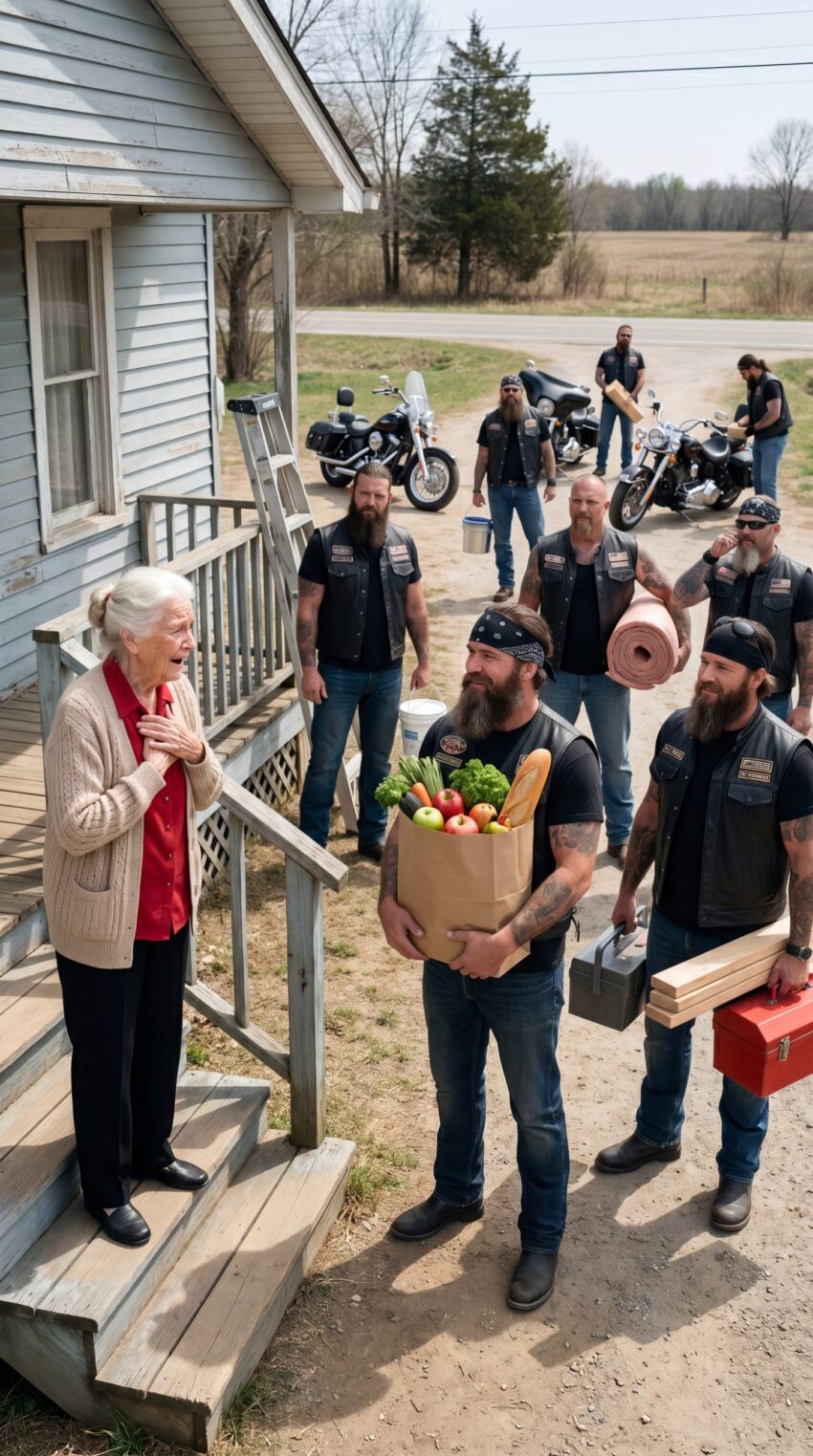
The low thunder of motorcycle engines rolled into the lane and filled the air so suddenly that curtains shifted in nearby windows. A few neighbors stepped out onto porches. Others peeked through half-open doors. One by one, a group of riders in worn leather vests and heavy boots pulled up in front of Mabel’s house, their bikes shining beneath the morning light.
Most people on that street did not know what to make of men who looked like that. Broad shoulders. Sun-browned skin. Tattoos curling down their arms. Faces shaped by hard roads and harder years. But Mabel did not step back.
She rested both hands on the broom handle and looked at them with quiet curiosity.
“Well now,” she said, her voice soft but steady, “what brings all of you to a place like mine?”
The tallest rider removed his helmet first.
A pale scar ran from the edge of his jaw down the side of his neck, and his face carried the roughness of a man who had seen more pain than he ever talked about. But his eyes were not cold. They held something deeper than toughness that morning. Respect. Gratitude. Something close to emotion.
He took one step toward her.
“Ma’am,” he said, “a year ago, you saved my life.”
A Memory from the Ditch
For a moment, Mabel just looked at him. Time had thinned her memory in small places, but not in the ones that mattered. Then recognition flickered across her face.
Last summer had been especially hot. The kind of heat that made even the weeds seem tired. She had been walking back from a patch of woods with a bundle of fallen branches tied together with old rope. She used them for the stove when bills ran higher than she could manage. On the bend of a back road, where tall grass grew wild along the ditch, she had seen what looked like a broken piece of metal glinting in the sun.
Then she had heard a sound.
Not a cry. Not even a proper call for help. Just a rough, painful breath from someone too weak to speak loudly.
She had found the man there half-conscious, thrown from his motorcycle after taking a turn too fast on loose gravel. His bike had landed several yards away. His shoulder was badly hurt, one side of his face was cut open, and he had lost enough strength that even lifting his head seemed almost impossible.
Mabel had not asked whether he was dangerous. She had not stopped to wonder what kind of man he was or whether someone else might come along to help. There was no one else on that road. There was only a wounded stranger and an old woman with a choice to make.
So she made it.
She dragged him, little by little, all the way back to her house.
For three days, she cared for him there in the only way she knew how. She cleaned his cuts. She cooled his fever. She used herbs her own mother had once taught her about and fed him soup made from nearly everything she had left in the kitchen. When he could finally sit up on his own, she shared the last pieces of cornbread she had been saving for herself.
Back then, he had asked her why she would do so much for someone she did not even know.
And Mabel, with her usual plain honesty, had answered, “Because leaving you there wasn’t something I could live with.”
Now, standing in front of her house one year later, the man lowered his head slightly.
“My name is Boone Mercer,” he said. “I never forgot what you did.”
Mabel’s eyes softened.
“You were in bad shape,” she replied gently. “Anyone with a heart would’ve helped.”
Boone gave the faintest smile.
“Not everyone would have.”
They Did Not Come Empty-Handed
The other riders climbed off their bikes and removed their helmets too. None of them laughed. None of them acted restless. They stood with the kind of quiet respect people usually reserve for churches or cemeteries.
Then Boone turned to one of the motorcycles and opened a side compartment. He pulled out a thick envelope. Another rider began unloading bags. Then another. And another. Before Mabel could even ask what was happening, her front yard began to fill with groceries, blankets, medicine, cleaning supplies, and boxes of things she had gone years without buying for herself.
There were canned goods stacked neatly in crates. Fresh produce packed in coolers. Warm quilts still folded in store wrapping. A new kettle. A heater. Proper work boots in her size. A small radio. Even a rocking chair cushion because Boone remembered the old one on her porch had split open along the seam.
Mabel stared at everything as if she had stepped into someone else’s life.
“Boone,” she said, almost in a whisper, “this is far too much.”
He held out the envelope.
“No, ma’am,” he answered. “It’s not enough. Not for what you did.”
Her hands trembled when she took it. She did not even open it at first. She was too overwhelmed by the sight of so many people carrying kindness into her yard as if it were the most natural thing in the world.
A few neighbors had moved closer by then. They watched from the roadside, stunned by the care being shown to a woman many of them knew had been getting by on almost nothing.
Mabel pressed one hand to her chest and blinked back tears.
“I didn’t help you because I wanted anything in return,” she told him.
Boone nodded.
“I know,” he said. “That’s exactly why we came.”
A Promise Bigger Than Gratitude
If the gifts had been all they brought, the day would still have been unforgettable. But Boone had not ridden back to thank her with supplies alone. What he carried in his heart had grown much larger than that.
He lifted a small radio from his belt and spoke into it.
Within minutes, more engines sounded in the distance.
The noise grew louder and louder until another line of motorcycles turned into the road, followed by two trucks loaded with lumber, roofing panels, paint, tools, and furniture wrapped in protective cloth. Men and women stepped down from the trucks wearing jeans, work gloves, tool belts, and expressions that made it clear they had not come to visit. They had come to build.
Mabel looked from Boone to the trucks and then back again, confused.
“What is all this?” she asked.
Boone’s voice softened.
“This house took care of me when I couldn’t stand on my own,” he said. “Now it’s our turn to take care of it.”
She shook her head in disbelief.
“You mean repair a few things?”
He glanced at the sagging roof, the porch rail held together with wire, the window frame patched with cardboard inside one corner, and the uneven steps she climbed every day with aching knees.
Then he looked back at her.
“I mean make sure you never have to worry about this place falling apart around you again.”
Before she could answer, the work began.
The House That Love Rebuilt
What happened over the next several days felt almost unreal to everyone who saw it.
One crew tore away the sections of roof that had rusted through and replaced them with strong new metal panels that would hold against the seasons. Another team reinforced the floor joists beneath the house where years of weather had weakened the wood. Old windows were taken out and new ones installed, windows that opened smoothly and sealed tight when shut. The porch was rebuilt level and secure. Fresh siding covered the warped boards. The tiny kitchen was fitted with shelves that did not lean, cabinets that closed properly, and a stove that worked with a single turn of the knob.
Boone had spoken to a licensed contractor in advance, and he had also brought in an electrician and plumber who donated their labor after hearing why the work mattered. For the first time in her life, Mabel had dependable hot water inside the house. Proper wiring replaced the old dangerous tangle that had worried her every winter. A ramp was built beside the front steps so she would not struggle carrying groceries. Solar lights were placed along the walkway so she would never have to walk in darkness after sunset.
The yard changed too.
Brush was cleared. The broken fence was replaced. Raised garden beds were built where Mabel could grow tomatoes, beans, and herbs without kneeling too low. A simple bench was placed beneath the old shade tree where she liked to sit in the evenings. Someone even painted the mailbox a cheerful blue because one of the riders said every good home deserved one bright thing at the road.
At first, the neighbors only watched.
Then one of them brought lemonade.
Another offered extra extension cords.
A teenage boy from two houses down spent the afternoon carrying shingles. An older couple donated flower pots. Little by little, the same neighborhood that had once looked at the riders with suspicion began to join them. By the second day, the worksite no longer looked like a group of strangers helping a woman. It looked like a community remembering what decency felt like.
Mabel moved through it all with tears in her eyes and disbelief in every breath.
More than once, she told Boone, “I don’t know how to thank you.”
Each time, he gave her the same answer.
“You already did, back on that road.”
The Children Who Came Too Late
News travels quickly when generosity is visible.
By the third afternoon, photos of the rebuilt house and the line of motorcycles outside had spread online through neighbors’ phones. Before sunset, three people arrived in a shiny sedan from Nashville.
They were Mabel’s children.
Her eldest son, Randall, stepped out first, wearing an expensive watch and a pressed button-down shirt. His sister, Denise, followed him with dark sunglasses pushed into her hair. The youngest, Clifford, stayed near the car at first, already looking irritated by the dust and noise.
They had not visited often in recent years. Calls were rare. Help was rarer. Mabel had gotten used to making excuses for them whenever anyone asked. They were busy. Life was complicated. The city was far. She always protected them with gentler explanations than they had earned.
But that afternoon, none of them had come because they missed her.
Their eyes moved immediately to the new appliances, the building materials, and the envelope Mabel had finally tucked away inside her apron pocket.
Randall walked toward the porch with forced concern.
“Mama, what exactly is going on here?” he asked. “People online are saying strangers are bringing you money and remodeling your property.”
Before Mabel could respond, Boone stepped beside her.
“We’re helping someone who once helped one of our own,” he said.
Randall gave him a thin smile that held no warmth.
“That’s generous,” he replied. “But family should probably handle these matters.”
Mabel lowered her eyes, and something in Boone hardened.
He had heard enough over the past few days from neighbors to understand how long she had been carrying life alone.
Denise stepped forward next.
“Mama, you should let us hold on to anything valuable,” she said. “You know, just until all this settles down.”
That was when Mabel finally looked up, not angry, just deeply tired.
“I managed alone when none of you came,” she said quietly. “I think I can manage now.”
Clifford muttered under his breath and started toward the door as if he had the right to walk in and inspect what he might claim. He did not get far.
One of the riders, a massive former Marine named Wade Hollis, stepped into his path without raising his voice.
“Not today,” Wade said.
Clifford stopped.
The entire yard fell silent.
The Line That Could Not Be Crossed
Boone had prepared for this possibility long before Mabel’s children arrived.
He had spoken with a local attorney who came out that evening carrying printed documents. The lawyer sat at Mabel’s newly leveled kitchen table and explained everything clearly to her. If she wished, ownership protections could be updated. Medical and housing directives could be put in place. Legal records could reflect her choices, not assumptions made later by children who appeared only when something valuable entered the picture.
Mabel listened carefully. Her hands were folded in her lap the entire time.
Her children stood outside, furious that strangers had seen through them so easily.
At last, Mabel signed the papers she wanted signed.
Not out of revenge. Not to make a spectacle of anyone. She did it because for the first time in a long while, someone had asked what would make her feel safe.
When Boone walked the attorney back to his truck, Randall followed.
“You have no right to interfere in family business,” he snapped.
Boone turned, calm and direct.
“The day she needed help and nobody came, it stopped being family business.”
Randall had no answer for that.
The children left before dark, embarrassed under the stare of neighbors who had seen more than enough over the years. No one shouted after them. No one needed to. Their absence had already said everything that mattered.
Mabel watched their car disappear down the road. Her face was sad, but peaceful too, as if she had finally stopped holding open a door for people who never planned to walk through it with love.
Boone came back to stand beside her.
For a long moment, neither of them spoke.
Then Mabel said softly, “I used to think being related meant you belonged to each other no matter what.”
Boone looked toward the road and then back at the house.
“Sometimes,” he said, “the people who show up become the family.”
A Porch Full of Light
By the end of the week, the house looked almost new.
Not fancy. Not oversized. Not the kind of place that would appear in magazines. But strong. Warm. Safe. The kind of home that let a person breathe easier the moment they stepped inside.
The riders gathered on the porch that final evening while the sun sank low behind the trees. Someone grilled burgers in the yard. Children from nearby houses ran back and forth, laughing between the bikes. A folding table held bowls of potato salad, cornbread, beans, and peach cobbler a neighbor had brought over. For the first time in years, Mabel’s property sounded less like survival and more like joy.
She sat in her new porch chair with a light blanket over her knees, watching it all with eyes that kept filling no matter how many times she blinked.
Boone brought her a plate of food and set it gently in her lap.
“You need to eat,” he told her.
Mabel smiled up at him.
“You sound bossy when you’re grateful.”
He laughed then, a real laugh from deep in his chest.
“Maybe that’s because I plan on checking on you often.”
She studied him for a second.
“How often?”
He looked out at the line of bikes.
“Every weekend, if I can help it.”
And he meant it.
That house became a regular stop for the riders after that. They kept her pantry full. They fixed little things before they turned into big problems. They sat on the porch and listened to Mabel tell stories about growing up in another time, another kind of America, where people had less but sometimes gave more. In return, she reminded them there was still goodness in the world, even after the road had shown them its roughest edges.
The lane outside her home changed too. Neighbors waved more. People checked on one another. Children learned the names of riders they once would have hidden from behind screen doors. What began as gratitude grew into something even larger: a place where kindness stayed in motion.
What She Gave Came Back
Months later, on a cool Saturday morning, Mabel sat on her porch and watched the familiar line of motorcycles roll in again. The mailbox was still blue. The garden was thriving. The porch no longer leaned. Inside, her home was filled with things she had needed for years but never dared ask for.
She thought about that day on the roadside when she had found a stranger at his lowest point. Back then, she had not known his name, his story, or what would come of helping him. She had only known that mercy matters most when it costs something.
Now she understood something else too.
Nothing given in sincerity is ever truly lost.
Sometimes it comes back in quiet ways. Sometimes it returns years later. And sometimes, if a heart has been generous enough, it comes back with engines, work gloves, grocery bags, laughter, protection, and a porch full of people who choose to stay.
Mabel Sloane had once believed she was growing old alone.
She was not.
Not anymore.
And every time the riders pulled into that lane, every child who waved at them, every neighbor who stopped to talk, every meal shared under the shade tree stood as living proof that compassion has a way of building a home far beyond the walls where it first began.
In the end, the finest thing Mabel ever owned was not her rebuilt house, the garden, the safer roof, or the warm lights along the path.
It was the love that came back looking for her.
Sometimes the smallest act of kindness feels almost invisible in the moment, but life has a mysterious way of protecting the memory of what is done with a sincere heart and bringing it back when it is needed most.
A person does not need wealth, status, or power to change someone’s future, because even a little food, a safe room, and a compassionate decision made at the right moment can echo further than anyone expects.
Many people are judged by how they look, how they dress, or the stories others tell about them, but true character is often revealed not in appearances, only in the way someone chooses to respond when gratitude, loyalty, and decency are tested.
There are seasons in life when good people feel forgotten, overlooked, or left behind, yet that does not mean their goodness has gone unseen, because what is planted in love is often growing quietly long before it returns.
Family is not always defined by blood alone, since the deepest form of belonging often comes from the people who show up, remain steady, protect your peace, and prove with actions that your life matters to them.
A heart that helps others without keeping score carries a rare kind of strength, and that strength can inspire entire communities to remember their own humanity when they witness real compassion in motion.
It is easy for the world to celebrate success, comfort, and polished appearances, but there is something far more powerful in honoring the person who gave from scarcity, served from sincerity, and loved without demanding anything back.
When someone has spent years carrying hardship quietly, one act of public kindness can do more than solve practical problems, because it can restore dignity, rebuild trust, and remind them they were never as alone as they feared.
The people who arrive only when there is something to gain may share your name, but the people who arrive when you are vulnerable, tired, and in need often reveal the truest meaning of care, loyalty, and home.
If this story leaves anything behind, let it be this simple truth: never hesitate to show mercy when you have the chance, because the love you give to a stranger on an ordinary day may one day return as the very light that carries you through your darkest season.