The Question at the Motorcycle Lot
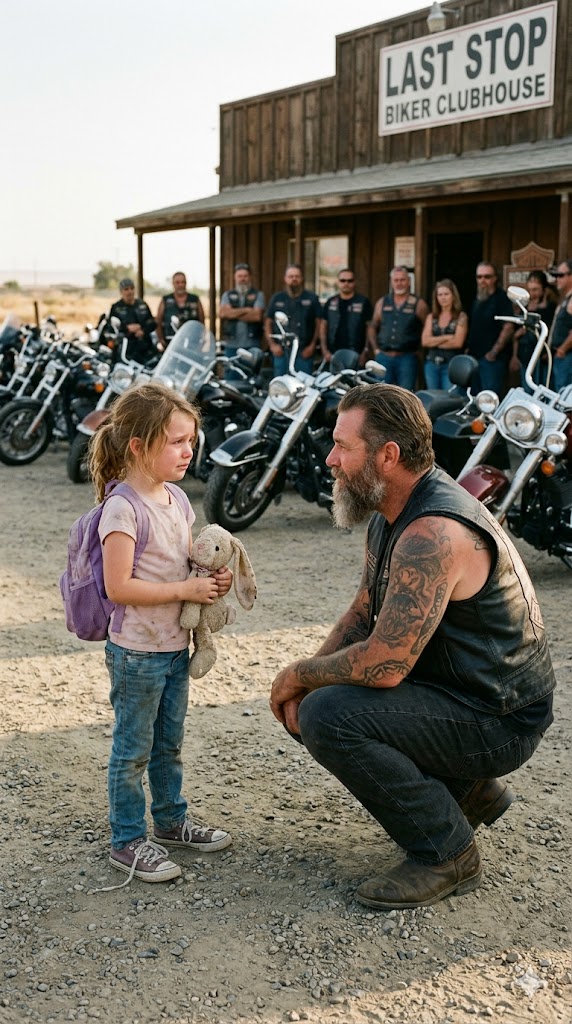
The little girl stood at the edge of the motorcycle lot with one untied shoe, a faded purple backpack, and a stuffed bunny pressed tightly against her chest.
It was late afternoon in Bakersfield, California, and the summer heat made the pavement shimmer. Engines rumbled behind the chain-link fence. Men in leather vests were talking near a row of bikes, their voices low, their faces weathered by sun, road dust, and years most people never asked about.
Caleb “Bear” Rourke was the first one to notice her.
He was a big man with gray in his beard, broad shoulders, tattooed arms, and the kind of silence that made strangers step aside before he said a word. People in town knew him as the former president of the Iron Wolves Motorcycle Club. Some respected him. Some feared him. Most simply avoided making eye contact.
But the child did not move away.
She looked straight at him and asked in a small, steady voice, “Do you know anyone who wants a daughter?”
The whole lot went quiet.
Caleb thought he had misheard her. “What did you say, sweetheart?”
The girl swallowed. Her lips were dry. Her cheeks were dusty. But her eyes did not break.
“I’m not asking for much,” she said. “Just somewhere I can stay.”
The Girl Who Walked Away
Her name was Emma Keller. She was seven years old.
She said it plainly, as if names and ages were facts that could not hurt her.
Caleb crouched in front of her, slowly, so he would not scare her. Even crouched, he was still huge beside her.
“Emma, where are your people?”
She looked down at the stuffed bunny. One ear was half loose, hanging by a few threads.
“I don’t have people,” she said.
A younger biker named Wade muttered under his breath, but Caleb lifted one hand and the man went silent.
“Were you staying with a family?” Caleb asked.
Emma nodded once. “A foster house. The blue one on Marigold Street.”
“And why aren’t you there now?”
Her fingers tightened around the bunny.
“Mrs. Bell said I was too hard to keep,” Emma whispered. “She told someone on the phone she wanted me moved before school started. So I left before they could send me somewhere worse.”
Caleb felt something cold move through his chest despite the heat.
“You walked here by yourself?”
“I didn’t run,” Emma said. “Running means somebody cares enough to chase you.”
No one spoke after that.
Caleb had heard many hard things in his life. He had sat across from men who lied with smiles. He had seen families break in quiet kitchens and back rooms. But this small voice, saying something so adult with so little surprise, hit him harder than any shouted threat ever had.
A Call That Changed Everything
Caleb brought Emma to a shaded picnic table behind the clubhouse. Someone gave her cold water. Someone else found crackers, an apple, and a clean towel.
She ate carefully, as if taking too much would make the food disappear.
Caleb stepped away and called Miranda Hayes.
Miranda ran a small legal aid office downtown. She was sixty-three, sharp-eyed, and known for making county officials nervous. Years ago, Caleb had helped her nephew after a bad situation on the road. Since then, they had kept a quiet respect between them.
She answered with her usual impatience. “Caleb, if this is about another parking ticket, I’m hanging up.”
“I found a kid.”
The line went silent.
“Define found.”
Caleb looked through the fence at Emma, who was giving a tiny piece of cracker to her stuffed rabbit.
“She walked into the lot and asked if I knew anyone who wanted a daughter.”
Miranda’s voice changed. “Tell me everything.”
So he did.
By six that evening, Miranda had confirmed that no emergency report had been filed.
By seven, she had learned that the foster parent had “assumed the child would come back.”
By eight, Miranda arrived at the clubhouse carrying a grocery bag, a legal folder, and the kind of expression that made even grown men stand straighter.
She looked at Emma for one long second, then set the bag on the table.
“I brought peanut butter crackers,” Miranda said.
Emma blinked. “For me?”
“Unless that rabbit eats them first.”
For the first time, Emma almost smiled.
The Promise in the Hallway
That night became a storm of phone calls, forms, and careful decisions.
County services agreed that Emma could stay temporarily under supervision until morning because transport was delayed and Miranda refused to let anyone treat the child like misplaced luggage.
Caleb cleaned the spare bedroom as best he could. Wade brought a clean blanket from his house. An older club member named Roy found a night-light shaped like a moon. Someone set a glass of water beside the bed.
Emma did not sleep.
At two in the morning, Caleb heard movement. He found her sitting upright on the mattress, the stuffed bunny tucked under her chin.
“You okay?” he asked from the doorway.
She nodded too fast.
“That didn’t sound true.”
Her eyes dropped.
“What if it changes when I wake up?”
Caleb leaned one shoulder against the doorframe. “Morning usually changes things.”
“Not that,” she whispered. “Sometimes people are nice for one day.”
Caleb had no easy answer.
He had spent years being useful because people thought he was dangerous. He knew how to stand in front of a door. He knew how to make grown men reconsider bad choices. But he did not know how to repair the kind of hurt that made a child measure kindness by the day.
So he told the truth.
“I don’t know what the county will decide,” he said. “I don’t know how long the paperwork takes. But when morning comes, I’ll still be here.”
Emma looked at him.
“Promise?”
Caleb had broken promises in his life. He had made promises too late. He had lived with the weight of them.
But this one was different.
“Yeah,” he said quietly. “I promise.”
A House Made Ready
The next day, Emma was taken to a temporary children’s facility near Fresno.
She did not cry when she left. Somehow that hurt Caleb more.
At the car window, she pressed one small hand to the glass. Caleb put his palm on the other side.
Her lips moved.
“You promised.”
After the car drove away, Caleb stood in the empty lot feeling more helpless than he had felt in years.
Then he went home and began to change his life.
His small house on the edge of Bakersfield had two bedrooms, a porch, a garage full of motorcycle parts, and the quiet neglect of a man who had stopped expecting visitors. The spare room held old tires, boxes, tools, and a broken treadmill covered in dust.
By Sunday night, half of it was on the curb.
Wade stood in the doorway watching Caleb carry out another box.
“Are you cleaning or having a personal awakening?”
“Hold the door.”
“That feels like both.”
Caleb painted the room pale yellow because the woman at the hardware store said it felt cheerful without being too much. Miranda found a twin bed from a church sale. Roy built a small bookshelf. Wade bought crayons but pretended they were “shop supplies.”
Caleb bought cereal, applesauce cups, sandwich bread, child-safe cabinet locks, and a package of star stickers he stared at for ten minutes before dropping into the cart.
At night, he sat in the finished room and looked at the clean bed, the soft lamp, the empty shelf waiting for books.
He told himself he was preparing just in case.
But deep down, he already knew.
Visits on Tuesdays and Thursdays
The visits began two weeks later.
Emma came into the county visitation room wearing jeans too short at the ankle and a yellow shirt from the donation closet. Her hair had been brushed, but not carefully.
The moment she saw Caleb, she ran to him.
He froze for half a second before placing one large hand gently on her back.
Nobody had held him like that in a long time.
Not since Ava.
Ava Bennett had been his fiancée twenty years earlier. She had loved lemon pie, old country songs, and the idea that Caleb could be softer than the world believed. She had been expecting their baby when an accident took both of them before Caleb ever got the chance to become a father.
After that, he closed every door inside himself.
Now a little girl with tired eyes and a one-eared bunny was leaning against him like she had already decided he was safe.
“You eat today?” Caleb asked.
Emma nodded into his shirt. “Pancakes.”
“Good pancakes?”
“County pancakes.”
“That bad?”
“They tried.”
He almost laughed.
The County Had Questions
The assigned social worker was Nadine Porter, a calm woman with silver glasses and a clipboard that seemed permanently attached to her hand.
She did not dislike Caleb. That almost made things harder. She simply knew the system, and the system did not easily understand men like him.
“Mr. Rourke,” she said after one visit, “you understand this will not be simple.”
“Most things worth doing aren’t.”
“You have a record from your younger years.”
“I do.”
“You are connected to a motorcycle club with a difficult reputation.”
“I am.”
“You live alone. You have no parenting history.”
Caleb looked through the glass at Emma, who was coloring a rabbit with careful purple ears.
“I’m learning.”
Nadine studied him.
“Why this child?”
Caleb did not answer right away.
Then he said, “Because she asked me like I was someone who could help. I don’t know why she saw that in me. But I’m not going to punish her for believing it.”
Nadine wrote something down.
“Impossible and difficult are not the same thing,” she said.
It was the first hopeful sentence anyone from the county had given him.
Learning How to Stay
Caleb took parenting classes at the community center.
He sat in the back, too large for the plastic chair, writing notes in a spiral notebook with a pen that looked tiny in his hand.
He learned about children who hide food because they are afraid there will not be more. He learned not to ask sharp questions during fear. He learned that routines can become a language of safety.
He learned that love was not only feeling something.
Love was showing up on time.
Every Tuesday and Thursday, he arrived thirty minutes early.
He brought books about animals. He brought colored pencils. He learned that Emma hated tomatoes unless they were sauce, liked rabbits because they were “polite,” and believed pancakes should never be gray.
One afternoon she asked, “Why do people call you Bear?”
Caleb looked at the coloring page between them.
“Because I used to make people nervous.”
Emma thought about that.
“Bears aren’t always mean,” she said. “Sometimes they’re just big.”
He stared at her, surprised by the ache in his chest.
“Yeah,” he said. “Sometimes.”
Coming Home
In November, the county approved a temporary placement with strict supervision.
Miranda called Caleb before sunrise.
“Go get your girl,” she said.
Caleb sat on the edge of his bed, unable to speak.
“Caleb?”
“I heard you.”
“Then move before I come drag you there myself.”
He drove to Fresno in his truck because Miranda had warned him not to bring a motorcycle to a child placement pickup unless he wanted every county employee in California to faint.
Emma came out carrying a plastic bag of belongings.
Everything she owned fit inside it.
Caleb opened the truck door.
“Need help?”
She shook her head and climbed in carefully.
For several miles, she said nothing.
Then she whispered, “If I don’t unpack everything, will you be upset?”
Caleb kept both hands on the wheel.
“No.”
“At other houses, people got annoyed if I unpacked too much and then had to leave.”
His jaw tightened.
“You can unpack when you’re ready.”
“What if I have to go?”
“Then we pack together.”
She looked out the window, holding her bunny close.
When they reached the house, she stood in the doorway of the yellow bedroom and touched the quilt with two fingers.
“This is mine?”
“Yeah.”
“Can I sleep here every night?”
Caleb swallowed.
“That’s the plan.”
The Hard Work of Ordinary Days
The first month was messy, loud, and beautiful.
Caleb learned school drop-off was a battlefield of minivans. He learned children had strong opinions about sandwich shapes. He learned Emma would brush her teeth only if he brushed his teeth beside her.
He also found crackers under her pillow.
The first time, he stood in the doorway holding the hidden food in his hand and felt anger rise—not at her, but at every adult who had taught her to fear an empty plate.
He did not scold her.
Instead, he placed a small basket on the kitchen counter with fruit snacks, crackers, and applesauce.
“This stays here,” he told her. “You don’t have to hide food in this house.”
Emma stared at the basket for a long time.
It took weeks before the hidden crackers stopped.
At bedtime, she asked the same questions every night.
“Door open?”
“A little.”
“Hall light on?”
“Always.”
“What if I have a bad dream?”
“I’m in the next room.”
“What if you don’t hear me?”
“Then call louder.”
Slowly, the questions became fewer.
The hallway light stayed on anyway.
When the World Looked Twice
Not everyone understood.
At school, some parents stared at Caleb’s tattoos and leather vest. A mother in workout clothes whispered to another parent one afternoon while Emma stood beside him.
Emma noticed.
That night at dinner, she pushed peas around her plate.
“Are you scary?”
Caleb looked up.
“To some people.”
“Am I supposed to be scared?”
His voice softened.
“No, Em. Not of me.”
She studied him carefully.
“You look like a storm cloud,” she said. “But you make grilled cheese.”
Caleb laughed before he could stop himself.
“That may be the nicest thing anyone has ever said to me.”
The next week, a boy at school told Emma that bikers could not be real dads.
She came home quiet.
Caleb found her sitting on the porch steps, her backpack still on.
“Tyler said you’re not my real dad,” she said.
Caleb sat beside her.
“What do you think?”
Emma hugged her bunny.
“I think real means who comes back.”
For a moment, Caleb could not answer.
Then he said, “That sounds right to me.”
The Hearing That Changed Her Name
Months passed.
There were home visits, school reports, parenting certificates, doctor appointments, and more paperwork than Caleb believed could exist in one state.
There were also library trips, burnt pancakes, bedtime stories, flu medicine, bike practice, and a Thanksgiving dinner where the clubhouse men behaved so politely that Miranda called it “a small miracle.”
By spring, Emma’s teacher said she smiled more.
By summer, she had stopped asking if Caleb would pick her up.
She simply expected him to be there.
The adoption hearing was scheduled for a warm Friday morning in June.
Emma wore a blue dress with tiny white flowers. Caleb wore a clean shirt and a tie Miranda had tightened because, in her words, “The judge should see your neck, not your panic.”
The courtroom was small and bright. Nadine sat in the back. Miranda sat beside Caleb. Wade and Roy waited in the hallway with flowers they both pretended not to have bought.
The judge looked kindly at Emma.
“Do you understand why you are here today?”
Emma nodded. “Yes, sir.”
“And is this what you want?”
She looked at Caleb, then back at the judge.
“Yes, sir.”
“Would you like to tell me why?”
Caleb’s heart nearly stopped.
Emma stood with her bunny under one arm.
“Because when I asked if anyone wanted a daughter, he didn’t laugh,” she said. “He listened. And when I was scared at night, he kept the light on. And when I hid food, he didn’t get mad. He just made sure there was more.”
The courtroom went completely still.
Emma took a breath.
“I picked him,” she said. “And he picked me back.”
The judge cleared his throat and looked down at the papers.
“Then this court is honored to make it official.”
He signed the order.
Emma Keller became Emma Rourke.
Caleb lifted her into his arms, and for the first time in years, he did not care who saw him cry.
Emma pressed her face into his shoulder.
“Does this mean forever?”
Caleb closed his eyes.
“Yeah, kid,” he whispered. “It means forever.”
The Miracle of Staying
That evening, after ice cream, photos, and too many congratulations, Caleb and Emma sat on the porch as the California sky turned soft orange.
Her blue dress was wrinkled. Her face was sticky from chocolate. Her bunny sat between them like an old family witness.
Emma leaned against his arm.
“Do you think Clover is happy here?”
Caleb looked at the stuffed rabbit with its repaired ear.
“I think Clover finally unpacked.”
Emma smiled.
“Me too.”
Across the street, sprinklers clicked. Somewhere far off, a motorcycle engine passed and faded into the evening.
Caleb looked at the small house, the open front door, the yellow room glowing down the hall, and the child who had walked into his life with one impossible question.
People in Bakersfield still looked twice sometimes.
They saw the beard, the tattoos, the leather, the old reputation.
But Emma saw something else.
She saw the man who stayed.
And because she saw it first, Caleb learned to become it.
What This Story Leaves Behind
Sometimes the person who looks the toughest on the outside is carrying the softest promise inside, waiting for one small voice to call it forward.
A child does not need a perfect home as much as she needs a steady one, where the light stays on and the adult comes back when they say they will.
Family is not always created by blood, paperwork, or matching last names; sometimes family begins when one person asks for help and another person refuses to walk away.
The most powerful kind of love is often quiet, shown through packed lunches, safe rooms, patient answers, and the courage to keep showing up on ordinary days.
A child who has been disappointed too many times may not trust happiness quickly, so real care must be patient enough to let belief grow slowly.
People can change when someone gives them a reason bigger than their past, and Caleb became a better man because Emma believed there was something good in him before he fully believed it himself.
No child should ever feel like they are too much to love, because needing food, comfort, patience, and safety is not a burden; it is what childhood is supposed to ask for.
The world often judges people by their clothes, their history, or their rough edges, but love has a way of proving that character is measured by what someone protects, not what they look like.
A safe home is not built in one dramatic moment; it is built through repeated promises kept, doors left open, meals shared, and one person saying, again and again, “I am still here.”
And sometimes grace arrives in the most unexpected place, letting a lonely little girl with a stuffed rabbit find the father she needed in the very man everyone else had learned to fear.