The Girl in the Yellow Dress
Wade Mercer had spent most of his life being judged before he ever opened his mouth.
People saw the motorcycle jacket, the old road scars, the heavy boots, and the tired eyes, and they decided they already knew him.
They never saw the man who packed school lunches at 6 a.m.
They never saw the father who learned how to braid hair from a video because his little girl wanted to look nice for picture day.
They never saw the man who had rebuilt his life around one small voice calling him Dad.
But on a gray Monday morning in Knoxville, Tennessee, Wade sat inside a courthouse with his hands folded so tightly his knuckles had gone pale.
His seven-year-old daughter, Nora, sat three rows behind him in a yellow dress.
She called it her brave dress.
Wade had begged her to stay home with his neighbor, Mrs. Padgett.
Nora had simply looked at him and said, “You always stay with me when I’m scared, Daddy. So I’m staying with you.”
And Wade had no answer for that.
The Accusation

The trouble had started two weeks earlier at the home of Evelyn Hartwell, a wealthy widow who lived in a large white house outside Franklin.
Wade had been hired to repair a broken pantry cabinet and fix a few loose fixtures in her kitchen.
He did the job carefully, quietly, and honestly.
That was how he worked.
A man without much money still had his name. And Wade protected his name because he wanted Nora to grow up knowing that dignity did not come from expensive things.
It came from how you lived.
That evening, Evelyn claimed a valuable family necklace had disappeared from a drawer near the kitchen.
There were no other workers in the house, she said.
No visitors.
No signs that anyone had come in.
Only Wade.
By the next morning, his name was attached to a story he could not outrun.
The biker.
The repairman.
The man with rough hands and old mistakes behind him.
To people like Evelyn Hartwell, he already looked like the kind of man who could be blamed.
A Room That Did Not Believe Him
Wade’s lawyer tried his best, but the courtroom felt cold from the beginning.
The prosecutor spoke smoothly, using words that made Wade sound careless, desperate, and dishonest.
Wade sat still.
He had learned long ago that reacting only made people more certain about the story they had already chosen.
When Evelyn took the stand, she looked calm and polished. Her voice never shook.
She said Wade had been alone near the drawer.
She said the necklace had never gone missing before.
She said she did not want to accuse anyone unfairly, but the facts were “difficult to ignore.”
Wade lowered his eyes.
Not because he was guilty.
Because he knew what it felt like to be reduced to someone else’s assumption.
When his turn came, he told the truth.
He explained that Nora had been feeling sick that day. He had finished quickly, picked her up from the living room couch, and gone straight to a pharmacy for medicine.
The prosecutor asked why he had no receipt.
Wade answered honestly.
“I paid cash. I was worried about my daughter. I wasn’t thinking about saving proof for something I didn’t do.”
The room did not soften.
Truth, Wade realized, could feel very small when the wrong people were holding all the power.
Nora Remembered
Behind him, Nora sat with her hands pressed against her knees.
She had been quiet for hours.
Adults often thought quiet children were not paying attention.
But Nora noticed everything.
She remembered Evelyn’s house.
She remembered lying on the couch under a knitted blanket while her father worked in the kitchen.
She remembered keeping her eyes almost closed because she felt tired.
And she remembered Evelyn walking back into the room when she thought no one was watching.
Nora had seen her open the drawer.
She had seen the shine of the necklace.
She had seen Evelyn slip it into a small purse.
Then Evelyn had whispered something Nora did not understand at the time.
“If he refuses, this will make him listen.”
Nora had not known what that meant.
Now, sitting in the courtroom, she understood enough.
Her father was telling the truth.
And no one believed him.
The Small Hand That Rose
The judge was preparing to move forward.
Wade lowered his head, feeling the case slipping away from him.
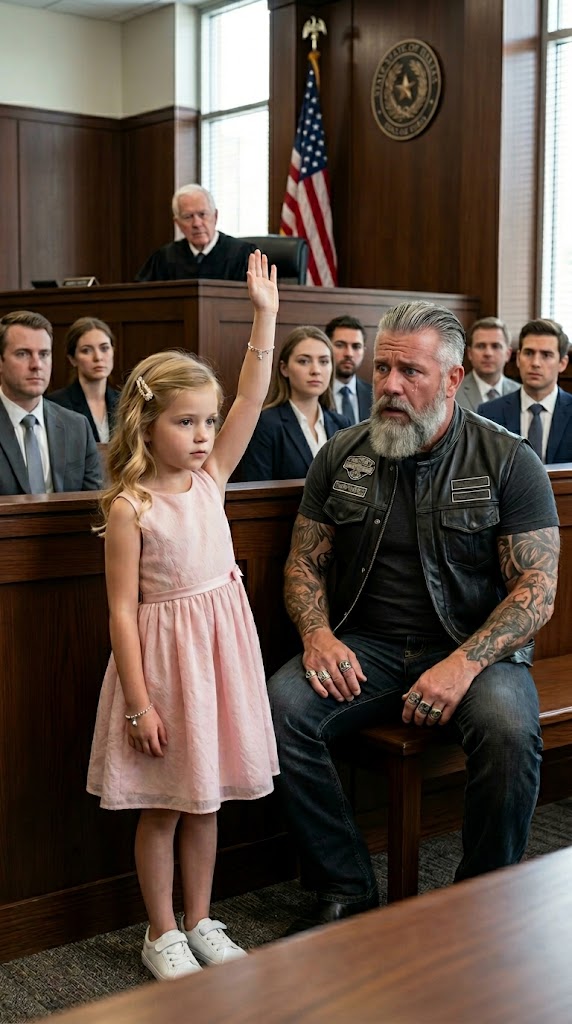
Then a tiny hand rose from the third row.
At first, no one noticed.
Then one woman turned.
Then another person looked back.
Soon the whole courtroom grew quiet.
Nora stood beside the bench, her yellow dress trembling slightly around her knees.
Wade turned and felt his heart drop.
“Nora,” he whispered, his voice rough. “Baby, sit down.”
But Nora did not sit.
The judge looked at her gently.
“Young lady, do you understand where you are?”
Nora swallowed.
“Yes, sir.”
“Do you understand this is serious?”
Her voice shook, but she kept standing.
“Yes, sir. They’re saying my dad took something. But he didn’t.”
Evelyn’s face changed for less than a second.
But Wade saw it.
So did the judge.
The Truth in a Child’s Voice
The judge leaned forward.
“What would you like to tell the court?”
Nora gripped the side of her dress.
“I was there,” she said. “I was on the couch. I was pretending to sleep because I didn’t feel good.”
The room stayed silent.
Nora pointed toward Evelyn.
“She took the necklace. She put it in her purse. Then she said, ‘If he refuses, this will make him listen.’”
No one moved.
The lie that had filled the courtroom all morning suddenly had nowhere left to stand.
Evelyn’s calm expression cracked. Her attorney leaned close and whispered quickly. The prosecutor looked down at his notes as though the pages had changed in front of him.
Wade could not breathe.
For days, he had felt alone inside the truth.
But the truth had been sitting three rows behind him, wearing a yellow dress and shaking knees.
The judge asked Nora carefully, “Are you sure?”
Nora nodded.
“I’m sure. My daddy didn’t take it.”
Going Home
The court paused while new information was reviewed.
A housekeeper later confirmed that Evelyn had been upset about Wade refusing extra work without proper payment. A neighbor’s camera also showed Wade and Nora leaving the house earlier than Evelyn had claimed.
Piece by piece, the accusation fell apart.
When the judge returned, his voice was firm.
“Mr. Mercer, based on the testimony and the evidence now before this court, the charge against you is dismissed.”
For a moment, Wade did not move.
Then Nora reached for his hand.
“Does that mean we can go home now?”
Wade looked down at her and nodded, his eyes bright.
“Yeah, sweetheart,” he whispered. “We can go home.”
That evening, they sat together on their small apartment couch.
Wade’s motorcycle jacket hung over the chair nearby.
Nora leaned against him, sleepy and quiet.
After a while, she whispered, “Daddy, was my voice too shaky?”
Wade kissed the top of her head.
“No,” he said softly. “That was the bravest voice I’ve ever heard.”
Nora closed her eyes.
“You told me the truth is still strong, even when people don’t want to hear it.”
Wade held her closer.
“And today, you proved it.”
What Nora Taught Him
Weeks later, Nora drew a picture and taped it beside her bed.
It showed a big man in a motorcycle jacket holding hands with a small girl in a yellow dress.
Above them, in careful purple letters, she wrote:
“We told the truth.”
Wade looked at that drawing every night before turning off her light.
He had once believed the road had taught him everything about strength.
But he was wrong.
Strength was not always loud.
It was not always leather, engines, or hard miles.
Sometimes strength was a little girl standing in a courtroom with trembling hands, saying what every adult in the room needed to hear.
Wade had spent his life trying to protect Nora.
But on the day he needed saving most, his daughter stood up and protected him right back.
Sometimes the strongest person in the room is not the one with the loudest voice, but the one brave enough to speak when silence feels safer.
A parent may spend years protecting a child, only to discover that love has quietly taught that child how to protect them too.
People may judge a man by his clothes, his past, or the way he looks, but the truth has a way of revealing the heart they refused to see.
A child who grows up watching honesty will often recognize unfairness faster than adults who have learned to look away.
Real courage does not mean your voice never shakes; it means you say the right thing even while your hands are trembling.
The world can be quick to believe the worst about someone who looks different, but one honest voice can change the entire room.
A good father’s greatest legacy is not what he owns, but what his child learns from watching him live with dignity.
Some victories do not arrive with applause; they arrive quietly, through one sentence that finally lets the truth breathe.
Never underestimate what children notice, because their hearts often remember the details adults think they can hide.
Love becomes powerful when it teaches someone not only to feel deeply, but to stand firmly for what is right.