The Morning the Riders Came Back
On a bright Tuesday morning in Cedar Falls, Indiana, Harriet Winslow heard the sound before she saw anything.
It began as a deep rumble far beyond Main Street, rolling over the quiet town like distant thunder. She stood behind the counter of Honeybell Bakery with flour on her hands, waiting for the first tray of cinnamon rolls to cool.
Then the windows began to shake.
A Town Holding Its Breath
Cedar Falls was not used to surprises.
People knew every delivery truck, every mail carrier, and every old pickup that passed the bakery before noon. So when a long line of motorcycles turned onto Main Street in perfect order, the whole town stopped moving.
Harriet walked to the front window.
Advertisements
One bike became ten.
Ten became fifty.
By the time she counted ninety-seven riders, her hand was pressed against the wooden frame of the window.
The Bakery That Carried Her Grief
Harriet was sixty-six years old, and Honeybell Bakery had been her life for nearly thirty years.
Her late husband, Raymond, had built the first counter himself. After he passed away, Harriet kept the bakery open because closing it felt like losing him twice.
Every morning, she made bread, smiled at customers, and told herself that small routines could hold a heart together.
The Boy from Long Ago
Twenty-two years earlier, on a cold winter morning, Harriet had opened the bakery before sunrise and found a teenage boy standing outside.
His coat was too thin. His shoes were worn down. His eyes looked tired in a way no child’s eyes should.
He stepped back when she opened the door.
“Ma’am, I’m not trying to bother you,” he said quietly. “I just haven’t eaten since yesterday.”
Harriet did not ask where he came from.
She simply opened the door wider.
“Come inside, sweetheart,” she said. “Questions can wait. Breakfast cannot.”
Warm Bread Before Answers
She made him eggs, toast, and a warm roll with honey butter.
The boy stared at the plate as if kindness itself had been placed in front of him.
He ate fast at first, then slowed down when he realized no one was going to take the food away.
Harriet poured him a cup of hot cocoa and sat across from him.
“What should I call you?” she asked gently.
He hesitated.
“Evan,” he said.
Harriet could tell there was more behind that name, but she did not push.
“All right, Evan,” she said. “Around here, nobody has to earn a meal before they are treated like a person.”
The boy lowered his head, and his shoulders trembled.
A Small Room and a Second Chance
For the next week, Evan slept in the storage room behind the bakery on a folded quilt near the heater.
Harriet gave him small jobs. He swept the floor, carried flour bags, washed trays, and slowly began to speak more.
He never told her the whole story of what he had left behind.
She never demanded it.
Some people need safety before they can tell the truth. Harriet understood that.
One evening, after Evan burned a tray of bread and nearly broke down from shame, Harriet placed a hand on the counter between them.
“A ruined tray is not a ruined life,” she told him. “Tomorrow still belongs to you if you are brave enough to meet it.”
The Note He Left Behind
Three days later, Evan was gone.
On the counter, Harriet found a note folded beneath a coffee mug.
It said he was grateful.
It said he would try to become someone good.
It said he would come back one day when he had something worth showing her.
Harriet cried while reading it, then tucked the note into her recipe box beside Raymond’s old handwriting.
Years passed.
Life moved on.
But she never forgot the boy who had needed breakfast more than judgment.
The Man at the Front of the Line
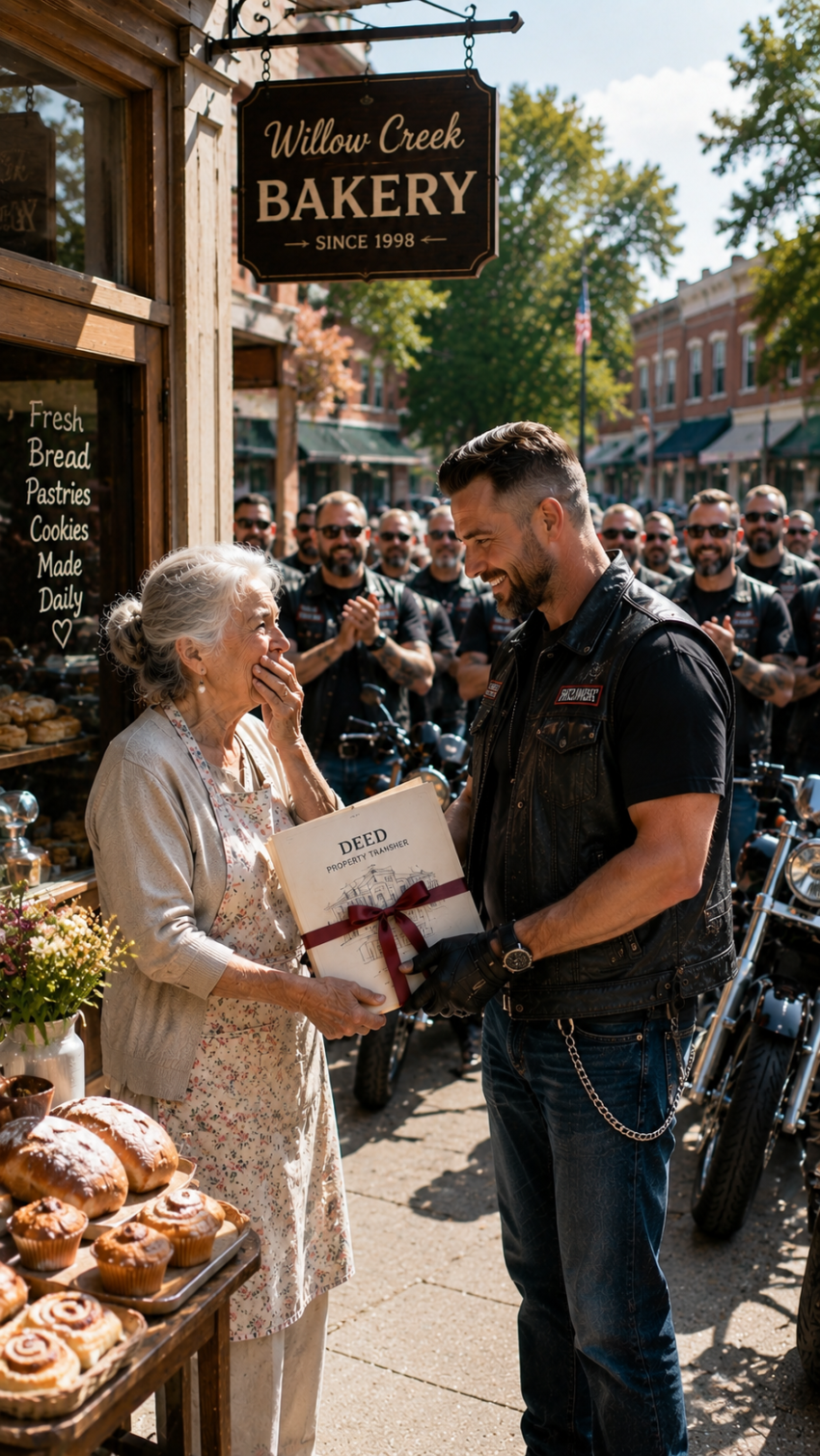
Now, twenty-two years later, the motorcycles stopped outside Honeybell Bakery.
Advertisements
The lead rider removed his helmet.
He was tall, broad-shouldered, and calm, with silver at his temples and kindness in his eyes.
He stepped inside, and the bakery fell silent.
“Are you Harriet Winslow?” he asked.
Harriet nodded slowly.
“I am.”
His face softened.
“You fed a boy once,” he said. “You told him tomorrow still belonged to him.”
Harriet’s breath caught.
Evan, No Longer Lost
The man smiled through eyes that were suddenly bright.
“My real name is Miles Archer,” he said. “But when I met you, I called myself Evan.”
Harriet covered her mouth with one hand.
For a moment, she did not see the leather vest, the motorcycles, or the grown man standing before her.
She saw the cold, hungry boy at her door.
“You came back,” she whispered.
Miles nodded.
“I promised I would.”
What One Meal Became
Miles told her about the years after he left.
He found work in a repair shop. He learned discipline. He met people who expected honesty from him, not perfection.
Later, he opened his own garage. Then he started training young people who had nowhere steady to land.
The riders behind him were not there to frighten anyone.
They were mechanics, veterans, business owners, fathers, grandfathers, and mentors.
“Every program we built started with what you gave me,” Miles said. “You didn’t fix my whole life that morning. You just made me believe it was still worth fixing.”
The Gift She Never Expected
Miles handed Harriet a folder.
Inside were papers for a newly renovated building in Indianapolis. It would become a training center and safe housing space for young adults learning to build stable lives.
Harriet stared at the documents.
“Why are you giving this to me?” she asked.
Miles smiled.
“Because you already know how to open doors for people.”
Harriet shook her head.
“Miles, I’m only a baker.”
He answered softly.
“No. You were the first person who made me feel like I was not a problem to be removed, but a person worth helping.”
The Daughter Who Understood
Harriet’s daughter, Claire, rushed into the bakery after hearing the noise on Main Street.
She stopped when she saw her mother surrounded not by trouble, but by gratitude.
Harriet held the folder with trembling hands.
“They want me to help run a center,” she said. “Can you imagine that?”
Claire stepped close and squeezed her mother’s hand.
“Mom, you have been doing that your whole life,” she said. “You just called it baking.”
The Condition
Harriet looked around the bakery.
She saw the counter Raymond built, the ovens that had warmed thousands of mornings, and the doorway where one lost boy had once stood.
Advertisements
Then she looked at Miles.
“I will help,” she said.
Miles smiled.
“Anything you need.”
Harriet lifted her chin.
“Then we start with breakfast,” she said. “No one learns how to build a future on an empty stomach.”
The riders laughed gently, and some wiped their eyes.
Where Kindness Returns
That morning, Harriet served cinnamon rolls, coffee, biscuits, and fresh bread to ninety-seven riders and half the town.
Children sat carefully on parked motorcycles while their parents took pictures.
Neighbors who had been afraid only an hour earlier stood in line, listening to Miles tell the story of a woman who had given him food without making him feel small.
By noon, Cedar Falls no longer remembered the motorcycles as a threat.
They remembered them as proof.
The Door That Stayed Open
In the years that followed, the center helped hundreds of young people find work, shelter, training, and confidence.
Harriet did not become famous.
She did not want to.
She simply showed up, made breakfast, listened well, and reminded people that one hard season did not have to become their whole story.
And every time someone asked how it all began, Miles told them the same thing.
“It began with a woman who opened a bakery door when everyone else might have looked away.”
What Harriet Learned
Near the end of her life, Harriet returned to Honeybell Bakery one quiet morning.
She touched the old doorframe and smiled.
The world had always seemed too large for one person to change.
But now she knew the truth.
You do not have to change the whole world in one day.
Sometimes, you only have to open the door for one person who is still hoping someone will.
A small act of kindness may look ordinary in the moment, but it can become the first safe step in someone else’s entire future.
You may never know how deeply your gentle words stay with a person who was close to giving up on themselves.
Feeding someone, listening to someone, or making them feel welcome can be more powerful than advice spoken from a distance.
The people who seem hardest to reach are often the ones who have gone the longest without being treated with patience.
Kindness does not need attention to matter, because its real value is often revealed years later in lives quietly changed.
When you help someone without asking what they can give back, you remind them that human worth is not something they must earn.
One open door can become a bridge, one warm meal can become courage, and one caring voice can become a memory that saves a person more than once.
The good you do may leave your hands quickly, but it does not disappear; it keeps moving through people you may never meet.
Never underestimate the strength of a person who chooses compassion after life has given them many reasons to become cold.
Sometimes the legacy we leave behind is not built from money or titles, but from the moments when we made someone feel safe enough to try again.