The Wedding He Was Asked Not to Attend
My name is Everett “Rhett” Dawson.
I am sixty-four years old, and I live in a modest blue house outside Lancaster, Pennsylvania, where the mornings smell like wet grass and the evenings settle quietly over the cornfields.
For most of my life, I worked with my hands. I welded beams, fixed old machines, and spent years on construction sites where a man’s word mattered more than his suit. For almost twenty-five years, I have also ridden with the Iron Hollow Riders, a motorcycle club made up of ordinary men with weathered faces, loyal hearts, and stories they rarely tell out loud.
But before I was any of those things, I was a husband.
Then I was a father.
My wife, Marianne, left this world seven years ago. After she was gone, my daughter, Lillian, became the brightest part of my life. She was thirty years old, a third-grade teacher in Reading, soft-spoken but strong, the kind of woman who remembered small details about people and made them feel seen.
Advertisements
So when Lillian told me she was getting married, I was happy for her.
Her fiancé’s name was Clayton Vale.
He came from a polished family in Philadelphia. He wore expensive watches, spoke carefully, and smiled in a way that never quite reached his eyes. From the first time we met, I could feel he did not know what to do with me.
At first, I thought he was nervous.
Later, I understood.
He was ashamed.
The Visit That Changed Everything
Two months before the wedding, Lillian showed up at my house without calling first.
That alone told me something was wrong.
She sat at my kitchen table, the same table where she used to color pictures as a little girl, and stared down at the mug of coffee I had placed in front of her.
Her hands trembled.
I waited because a father knows when silence is safer than questions.
Finally, she whispered, “Dad… Clayton doesn’t want you at the wedding ceremony.”
For a moment, the whole room felt smaller.
I looked at her, sure I had misunderstood.
But then she explained everything. Clayton had told her his family cared about appearances. He said there would be doctors, attorneys, donors, and people from his father’s professional circle. He said a group of bikers would make people uncomfortable.
He told her he respected me.
He just did not want that part of her life visible.
But I heard what he really meant.
He wanted the gentle schoolteacher. He wanted the white dress, the flowers, the perfect church photos, and the smiling guests.
He did not want the man who had raised her.
Lillian’s face broke as she said, “I told him you’re my father. I told him you’re the reason I made it through losing Mom.”
I reached across the table and took her hand.
“Sweetheart,” I said quietly, “you deserve a peaceful wedding day. If my being there makes that harder for you, I will step back.”
She shook her head fast. “That isn’t what I want.”
“I know,” I told her. “But love is not always about standing where everyone can see you. Sometimes love stands back so the person you care about does not have to suffer in front of others.”
She cried harder.
And though I did not show it fully, something inside me cracked too.
A Small Walk in the Living Room
The wedding was planned for June at a beautiful church in West Chester.
My name quietly disappeared from the guest list.
Lillian asked me for one thing.
She wanted a private moment before the wedding, just for us.
So one week before the ceremony, she came to my house wearing a simple cream-colored dress. It was not her wedding gown. It was plain, soft, and beautiful in the way only honest things can be.
I wore my cleanest black shirt. I polished my boots. I stood in the living room where her mother used to sing while folding laundry.
Lillian held a small bouquet of grocery-store flowers.
Then she slipped her hand through my arm.
I walked my daughter from the hallway to the fireplace.
Ten steps.
That was all life gave me.
But I treated those ten steps like the longest aisle in the world.
When we reached the fireplace, she turned to me with tears in her eyes and whispered, “I’m so sorry, Dad.”
I kissed her forehead.
“Don’t you carry shame that belongs to someone else,” I said. “You are not responsible for another person failing to recognize love.”
She leaned into my chest and cried until her shoulders stopped shaking.
I thought that was the only walk I would ever get.
I was wrong.
The Men Who Would Not Stay Silent
I told only one person at the clubhouse.
His name was Harold Granger, president of the Iron Hollow Riders. He was sixty-eight, a retired truck mechanic with silver hair, a stiff knee, and the kind of steady gaze that made younger men listen.
I told him I had accepted Lillian’s request.
I told him not to make a scene.
Harold nodded and said, “I hear you, Rhett.”
Harold was loyal.
He was also not very good at doing nothing.
Behind my back, he called several longtime members. They opened an old metal cabinet in the clubhouse office and searched through dusty papers until they found the club’s first handbook.
Inside was a faded rule written decades earlier.
If a brother stepped away from a family moment out of love, the club could stand nearby in quiet respect.
No shouting.
No pressure.
No trouble.
Just presence.
Harold called Lillian and asked her one question.
“Would it hurt your wedding day if some of us parked across the street, stood quietly, and left without bothering anyone?”
Lillian was silent for a long time.
Then she answered, “No. I think it would be the only part of the day that feels completely true.”
They did not tell me at first.I found out three days before the wedding when I walked into the clubhouse and heard Harold confirming the route.
I sat down hard in a chair.
For the first time since Marianne’s service, I cried in front of another man.
Harold placed one heavy hand on my shoulder and said, “Rhett, you stay home Saturday. We’ll stand where your heart should have been allowed to stand.”
The Morning Across Town
On the morning of the wedding, I stayed home.
I made coffee and did not drink it.
Advertisements
I put on a clean shirt, then changed out of it.
I walked past Lillian’s old bedroom again and again, staring at the faded stickers still on the mirror.
At noon, I sat in my chair and looked at a framed photo of her at eight years old, smiling with a missing tooth and holding a paper medal she had made at school.
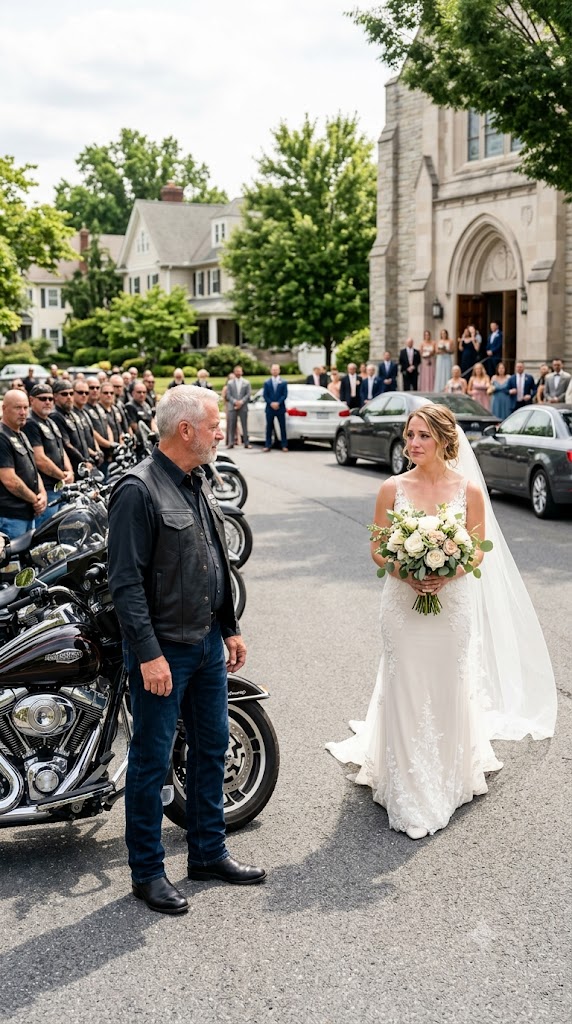
Across town, forty-seven motorcycles rolled into West Chester.
They did not pull into the church parking lot.
They parked across the street, along the edge of a quiet public lot.
Every man stood beside his bike.
No engines roaring.
No shouting.
No one crossing the road.
Just men in clean vests, standing still with their hands folded in front of them.
A quiet line of loyalty.
Of course the guests noticed.
Clayton noticed too.
He stepped outside before the ceremony in his tailored suit and walked toward Harold with a tight face.
“Is there some kind of problem?” Clayton asked.
Harold looked at him calmly.
“No problem,” he said. “We’re not here for you. We’re here for her.”
Clayton had no answer.
So he turned around and went back inside.
The Bride Who Looked Across the Street
The ceremony went on.
Lillian walked down the aisle without me.
She smiled when she was supposed to smile. She held her flowers. She stood beside Clayton beneath the soft church lights.
But after the ceremony, when the doors opened and guests gathered outside for photos, she stopped on the top step.
Everyone expected her to pose.
Instead, she looked across the street.
She saw the motorcycles.
She saw Harold.
She saw the men who had watched her grow up, men who had eaten birthday cake in our backyard and taught her how to check tire pressure before her first road trip.
Then Lillian lifted the front of her gown and walked down the church steps.
People went quiet.
Clayton reached for her arm, but she moved past him.
She crossed the street in her wedding dress while almost two hundred guests watched.
Harold removed his sunglasses.
Every rider straightened.
Lillian stopped in front of him.
Her voice shook, but it carried.
“Where is my father?”
Harold answered gently, “At home, honey. Like he promised you.”
Lillian nodded as tears slid down her face.
Then she turned back toward the church, toward her new husband, his parents, and every guest standing frozen on the steps.
“My father was not invited today because some people thought he didn’t match the picture,” she said. “But he is the reason I know what love is supposed to look like.”
No one moved.
She wiped her cheek.
“He raised me after my mother was gone. He showed up for every school play, every fever, every broken heart, and every hard day. Today, he gave up the seat he deserved because he thought it would protect me.”
Then she looked at Clayton.
“I cannot begin my marriage by pretending I am not his daughter.”
The Call That Opened the Door
A few minutes later, Clayton’s father walked across the street.
His name was Dr. Raymond Vale, a respected physician from Philadelphia. He had barely spoken to me during the few times we met.
He stood before Harold and looked down the row of riders.
Then he removed his glasses and cleared his throat.
“Which one of you is closest to Mr. Dawson?”
Harold lifted his chin.
“I am.”
Dr. Vale swallowed.
“Please call him.”
So Harold did.
I answered on the second ring.
“Everything all right?” I asked, though my voice already knew it was not.
Harold said, “Rhett, someone wants to speak with you.”
Then another man came on the phone.
“Mr. Dawson,” he said, “this is Raymond Vale. I owe you an apology.”
I sat up slowly.
He continued, “My son made a poor choice. I made one too by staying quiet. Your daughter just reminded all of us what dignity looks like.”My hand tightened around the phone.
Then I heard Lillian in the background.
“Dad?”
I stood so quickly my chair scraped the floor.
“I’m here, sweetheart.”
She cried when she heard my voice.
Advertisements
“Will you come?”
I closed my eyes.
“Are you sure?”
Her answer was clear.
“I should have been sure from the beginning.”
The Second Aisle
I drove to the church in my old pickup.
When I arrived, the motorcycles were still across the street. The guests were still outside. My daughter was waiting at the bottom of the steps in her wedding gown.
I did not wear my vest.
I did not need to prove anything.
Lillian ran to me and wrapped both arms around my neck.
For a moment, she was a little girl again, holding on after a bad dream.
I whispered, “Your mother would be so proud of you.”
She pulled back, crying and smiling at the same time.
Then Clayton walked over.
He looked different now. Not polished. Not proud. Just humbled.
“Mr. Dawson,” he said, “I was wrong.”
I looked at him for a long moment.
“Yes,” I said. “You were.”
He lowered his head.
“I’m sorry.”
I looked at my daughter before answering.
“Then spend your life proving you understand what she is worth.”
Clayton nodded.
“I will.”
The photographer asked if we wanted a picture.
Lillian shook her head.
“No,” she said. “I want a walk.”
So my daughter took my arm.
And in front of everyone, we walked up those church steps together.
It was not before the ceremony.
It was not the way we had imagined when she was young.
But sometimes life gives you a second aisle.
And sometimes that second aisle tells the truth better than the first one ever could.
The Sound of Loyalty
Later, when Lillian and Clayton left the church, the guests tossed flower petals into the air.
Across the street, Harold looked at me.
I nodded once.
Then forty-seven motorcycles came alive.
Not loud enough to frighten anyone.
Just deep enough to be felt in the chest.
Lillian laughed through her tears.
The sound rolled through the afternoon like a blessing.
Not a warning.
Not a show.
A promise.
Dr. Vale came to me before leaving and held out his hand.
This time, I took it.
“Thank you for coming,” he said.
I looked at my daughter standing in the sunlight.
“I was always there,” I told him. “Some people just needed to look across the street.”
And that is what I learned that day.
A father’s love does not disappear because someone asks it to stand outside.
Sometimes love waits quietly.
Sometimes it gives up the front row.
And sometimes, when the truth finally has room to breathe, everyone sees who had been standing there all along.
A person’s value should never be measured by their clothes, their job, their income, or the way strangers choose to judge them from far away.
Real family is not built from perfect pictures, expensive rooms, or polished introductions, but from the people who keep showing up when love becomes difficult.
A quiet sacrifice can speak louder than a perfect speech when it is made with a humble heart and not with pride.
The people who truly love you may not always stand in the spotlight, but they will remain close enough to protect your heart when it matters most.
No wedding, home, or family gathering becomes more beautiful by hiding the very people who helped shape your life.
Sometimes the strongest kind of love is the love that steps back, not because it is weak, but because it refuses to make another person carry pain in public.
A good heart may be misunderstood by people who only care about appearances, but time has a way of revealing what kindness really looks like.
True loyalty does not need to shout for attention; it simply stands where it is needed and waits with patience.
When someone is embarrassed by the people who raised you, they may not understand the deepest and most honest parts of your heart.
And when love is finally honored in front of everyone, even the quietest presence across the street can become the loudest truth of the whole day.