The Morning Everyone Looked Away
The morning at Miller’s Roadside Kitchen began like every other ordinary morning along Route 66 outside Kingman, Arizona.
The coffee was too strong. The toast came out a little too dark. Truckers sat at the counter with tired eyes, tourists studied maps on their phones, and regular customers complained about the weather as if the desert had personally offended them.
Behind the counter, Lena Whitaker kept moving.
She refilled mugs, carried plates, wiped tables, and smiled even when her feet hurt.
At twenty-six, Lena had learned how to keep going even when life felt heavy. She had moved to Arizona with two bags, an old blue sedan, and a quiet promise to herself that she would never again stay somewhere that made her feel small.
This diner was not perfect.
The pay was low. The manager was impatient. The walls smelled like old grease and burnt coffee.
But it was work.
It was routine.
It was a beginning.
Then, just before eleven, everything fell apart.
The Job She Couldn’t Afford to Lose
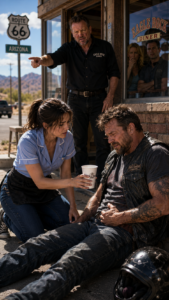
Lena’s manager, Grant Mercer, cornered her near the storage hallway with his arms folded tightly across his chest.
“You left the front counter again,” he snapped.
Lena blinked. “I was helping a customer at booth seven. Angela asked me to check on them.”
Grant shook his head like he had already decided the truth did not matter.
“I don’t pay you to wander around.”
Lena took a slow breath. “I wasn’t wandering. I was working.”
His face hardened.
Grant was the kind of man who confused control with leadership. He liked people quiet. He liked people nervous. Most of all, he liked reminding everyone that he could take away their paycheck with one sentence.
That morning, he finally said it.
“Take off the apron, Lena. You’re done.”
For a second, she could not speak.
The diner noise faded behind her.
The clinking forks. The hiss of the grill. The low country song playing from the radio near the kitchen.
All she heard was her own heartbeat.
“You’re firing me?” she asked.
Grant’s mouth twisted.
“You made that choice yourself.”
Lena looked down at the apron tied around her waist.
Six weeks.
That was all she had managed to build before someone decided she was disposable again.
The Man Outside the Door
Before Lena could answer, she heard a sound from the front of the diner.
A dull scrape.
Then a heavy thud.
She turned.
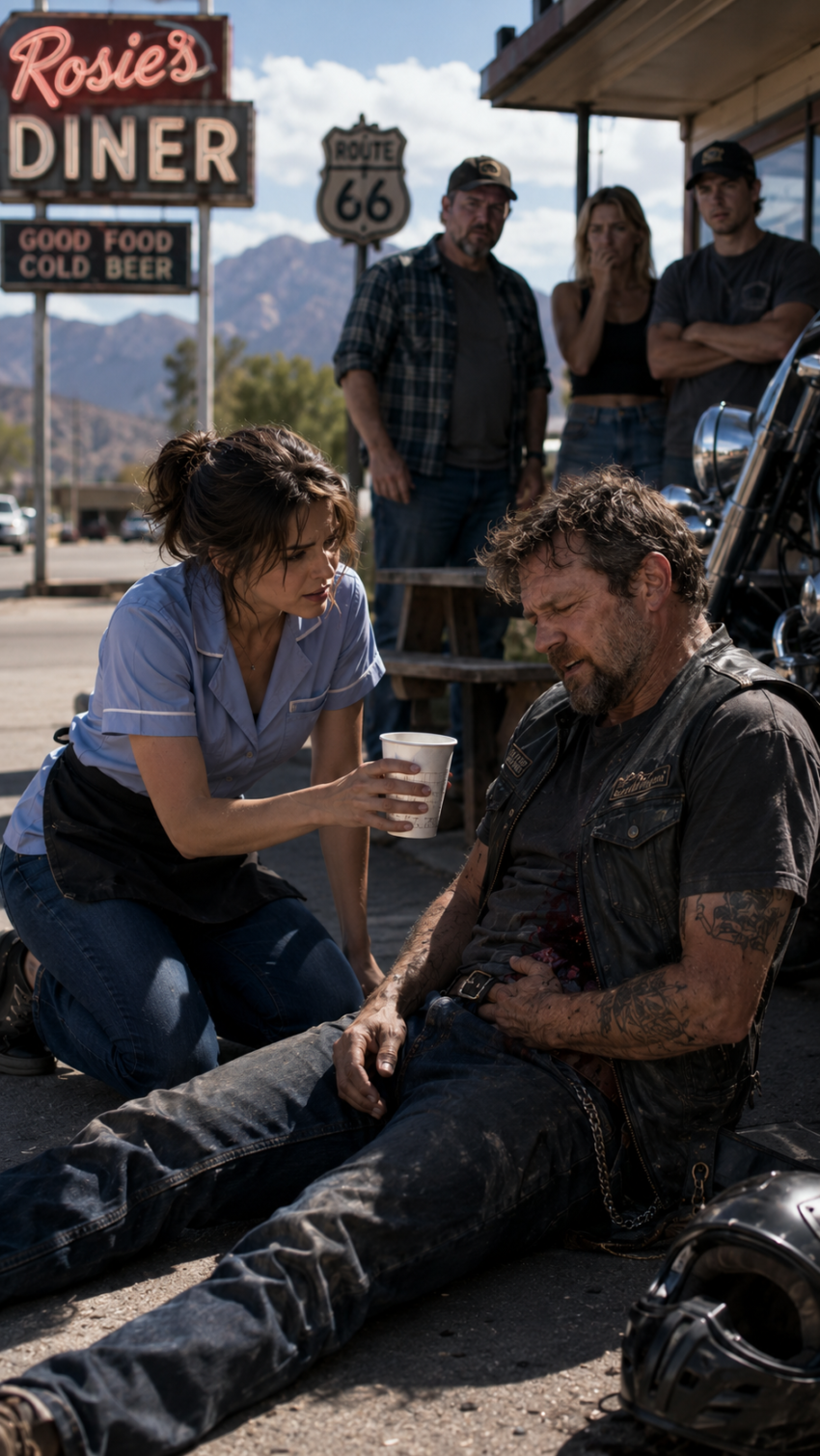
Through the glass front door, a large man had leaned against the brick wall outside. He wore a faded black leather vest, dusty jeans, and heavy boots. A motorcycle helmet rested near his foot.
He was broad-shouldered and rough-looking, the kind of man strangers judged before he ever opened his mouth.
But Lena noticed something else.
His face was pale.
One hand pressed firmly against his side.
His breathing was slow and careful, like every breath cost him something.
No one moved.
A woman near the door glanced at him and quickly looked away. Two young men at a booth whispered and laughed under their breath. A customer near the register rolled his eyes as if the man outside was an inconvenience.
Grant followed Lena’s gaze.
“Don’t even think about it,” he said.
Lena looked at him. “He might need help.”
Grant gave a short laugh.
“That is not our problem.”
She stared at the biker through the glass.
His head dipped forward.
His fingers tightened against the wall.
Lena thought about every time someone had looked at her and decided she was not worth helping.
Then she untied her apron.
Grant stepped closer.
“Lena.”
She placed the apron on the counter.
“You already fired me.”
Then she grabbed a cup of water and walked outside.
The Choice That Changed Everything
The heat hit her first.
Arizona sunlight spilled across the parking lot, bright and unforgiving.
Lena knelt beside the man carefully.
“Sir? Can you hear me?”
His eyes opened slowly. They were blue-gray, tired, and sharper than she expected.
“I’m fine,” he muttered.
Lena glanced at his hand.
There was a dark stain near the bottom of his shirt. Not dramatic. Not something she wanted to stare at. But enough to tell her he was not fine.
“You don’t look fine,” she said gently.
The man tried to smile, but it came out more like a wince.
“Bike slipped when I was backing out. Thought I could walk it off.”
“What’s your name?”
He looked surprised that she asked.
“Caleb.”
“I’m Lena. I think you need someone to check you.”
He shook his head.
“No ambulance.”
“Caleb, you’re hurt.”
“I’ve had worse.”
Lena’s voice stayed calm.
“That doesn’t mean this is nothing.”
Behind her, the diner door flew open.
Grant stood there, red-faced and furious.
“Get away from him.”
Lena turned slowly.
“He needs help.”
Grant pointed toward the road.
“Then he can call somebody. We don’t need trouble here.”
Caleb lowered his eyes, not angry, just tired.
That bothered Lena more than anger would have.
He had heard words like that before.
She knew that look.
When the Engines Arrived
Grant stepped closer, keeping his voice loud enough for customers to hear.
“People like him bring problems. I’m not letting this diner become some biker hangout.”
The words hung in the air.
Lena stood up.
“You don’t know anything about him.”
Grant sneered.
“I know enough.”
Caleb tried to push himself upright.
The moment he stood, his knees weakened.
Lena caught his arm before he fell.
Grant stepped backward instead of helping.
That was when the sound came.
Low at first.
Then louder.
Motorcycle engines rolled down the highway like distant thunder.
One bike.
Then another.
Then a long line of them appeared, moving in steady formation beneath the white desert sun.
The entire diner went quiet.
Customers pressed closer to the windows.
Grant’s expression changed.
The motorcycles turned into the parking lot one by one. Chrome flashed. Tires crunched over gravel. Riders in leather vests parked with calm precision, then shut off their engines.
The silence afterward felt heavier than the noise.
A woman removed her helmet first. She was in her early fifties, with silver-black hair, steady eyes, and the kind of presence that made people listen before she said a word.
She walked straight toward Caleb.
“Captain,” she said softly. “We’ve been looking for you.”
Captain.
The word moved through the crowd like a spark.
Grant’s face went pale.
Caleb sighed.
“Didn’t want to make a scene, Jo.”
The woman looked at the stain on his shirt, then at Lena’s hand supporting his arm.
“Looks like someone already had enough decency to help.”
Grant suddenly forced a smile.
“Of course. We were handling it.”
Lena looked at him.
For years, she had swallowed truth to keep peace.
Not today.
“No,” she said.
Everyone turned toward her.
“He told me not to call anyone, but I brought him water and tried to help him. Grant told me to leave him outside. Then he said people like him bring trouble.”
Grant’s jaw tightened.
“Lena, stop talking.”
But she did not stop.
“He fired me five minutes before this because I stepped away from the counter to help another customer.”
The parking lot went completely still.
The Truth Behind the Leather Vest
The silver-haired woman looked at Grant with quiet disappointment.
“You fired her for helping people?”
Grant lifted both hands.
“This is being taken out of context.”
A waitress appeared in the doorway.
Her name was Molly, and she had worked at the diner longer than anyone.
“No, it isn’t,” Molly said.
Then the dishwasher stepped out behind her.
Then a teenage busboy.
Then one of the customers near the window raised his hand awkwardly.
“I heard it too,” he admitted.
Another customer nodded.
“She was the only one who went outside.”
Grant looked around as if the whole world had betrayed him.
But the truth was simpler than that.
For once, the room had stopped protecting the loudest person.
Caleb sat down carefully on the low concrete step while one of the riders opened a medical bag.
The silver-haired woman knelt beside him.
“You should have called us.”
Caleb gave a tired half-smile.
“You would’ve made a fuss.”
“You needed a fuss.”
Lena almost smiled at that.
Then Caleb looked up at Grant.
His voice was quiet, but everyone heard it.
“I came here today for a reason.”
Grant swallowed.
Caleb continued.
“The company that owns this property accepted my offer yesterday. I was on my way to meet their regional representative.”
Grant stared at him.
“Your offer?”
Caleb nodded once.
“I’m buying this diner.”
No one spoke.
A fork dropped inside the dining room.
Grant’s mouth opened, then closed.
Caleb’s eyes moved around the parking lot, then back to Lena.
“I wanted to see how this place ran when nobody knew who I was.”
His gaze settled on Grant.
“Now I know.”
The Woman Everyone Underestimated
Grant’s voice changed immediately.
It became soft, nervous, almost polite.
“Mr. Hayes, I think we got off on the wrong foot.”
Lena realized then that Caleb’s full name meant something to him.
Caleb Hayes.
Maybe Grant had heard it in business calls. Maybe he had seen it on paperwork. Maybe he knew Caleb was not just a biker passing through, but a man with money, influence, and a whole group of loyal people behind him.
Caleb did not raise his voice.
That made it stronger.
“You judged me by my vest. You judged her by her apron. That tells me everything I need to know.”
Grant turned toward Lena.
“Lena, please. Tell him this was a misunderstanding.”
She stared at the man who had spent weeks making her feel invisible.
There had been a time when she might have softened.
She might have rescued him from the consequences of his own cruelty.
But healing changes a person.
Not all at once.
Quietly.
Day by day.
Until one morning, you realize you no longer have to protect people who would never protect you.
Lena said nothing.
Caleb nodded to the silver-haired woman.
“Call the regional office. Tell them I still want the property, but management changes immediately.”
Grant’s face drained of color.
“You can’t just—”
The woman stood.
“Actually, he can.”
The Offer She Never Expected
By early afternoon, the diner had changed completely.
Grant was gone.
Molly made fresh coffee.
The customers spoke in lower voices, as if the room itself had learned shame.
Caleb had been checked by one of his riders, a former emergency medical technician named Russell Kane, who insisted he get proper care afterward. Caleb argued. Russell ignored him.
Lena sat at the end of the counter, unsure whether she still belonged there.
She had lost her job that morning.
Then somehow, the man she helped turned out to be buying the place.
It felt impossible.
Like life had opened a door she had not even known how to ask for.
Caleb walked over slowly, moving with care. His shirt had been changed, and a clean bandage rested beneath it.
He placed a set of keys on the counter.
Lena looked down.
“What are those?”
“Office keys.”
She looked up quickly.
“Why are you giving them to me?”
Caleb’s expression stayed steady.
“Because this place needs someone who understands people.”
Lena let out a small, nervous laugh.
“I’ve never managed a diner.”
“Grant managed one,” Caleb said. “That didn’t make him good at it.”
Molly laughed from behind the coffee machine.
Lena shook her head.
“You don’t know me.”
Caleb leaned one hand on the counter.
“I know you helped a stranger when it cost you something. I know you told the truth when it would’ve been easier to stay quiet. I know you saw a person before you saw a label.”
His voice softened.
“That is more than enough to start.”
Lena looked at the keys.
For years, people had told her who she was.
Too quiet.
Too soft.
Too damaged.
Too easy to overlook.
But that afternoon, inside a roadside diner in Arizona, someone looked at her kindness and called it strength.
She picked up the keys.
The Café That Learned a Lesson
By sunset, the motorcycles were still parked outside, lined up beneath the orange sky.
But they no longer looked frightening to the people inside.
They looked like witnesses.
Like guardians.
Like proof that a person’s appearance rarely tells the whole story.
Lena stood near the front window and watched Caleb speak quietly with his riders. He looked tired, but peaceful.
Molly came up beside her.
“You okay?”
Lena smiled faintly.
“I don’t know yet.”
Molly nudged her shoulder.
“That’s still better than no.”
Lena laughed softly.
For the first time in a long time, she felt something she had almost forgotten.
Not certainty.
Not safety.
But possibility.
Behind her, the diner kept moving.
Coffee poured.
Plates clinked.
The old neon sign buzzed above the door.
But something had shifted forever.
That morning, people had judged a wounded man by his leather vest.
They had judged a young woman by her apron.
They had mistaken kindness for weakness and silence for agreement.
By nightfall, everyone in Miller’s Roadside Kitchen understood the truth.
The strongest person in the room had not been the loudest one.
It had been the woman who walked outside when everyone else looked away.
Kindness does not need a crowd to become powerful; sometimes it begins with one person choosing to step forward when everyone else stays seated.
Never judge someone by their clothes, their job, their silence, or the vehicle they arrive in, because the truth of a person is often hidden behind the first thing people notice.
A person who helps when there is nothing to gain reveals more character in one quiet moment than others reveal in a lifetime of loud promises.
Sometimes losing the job that kept you small becomes the doorway to a life that finally recognizes your worth.
The world often mistakes gentle people for weak people, but real gentleness requires courage, patience, and a heart that refuses to become cold.
When someone is hurting, the right question is not whether they look like someone you understand, but whether you are willing to see their humanity.
People who use power to embarrass others eventually meet a moment where truth becomes louder than fear.
You do not have to defend someone who never cared about protecting you; sometimes silence is the strongest answer you can give.
The smallest act of compassion can travel farther than you think, touching strangers, changing rooms, and opening doors you never expected.
In the end, people remember who looked away, who made excuses, and who quietly chose to help anyway.