PART2:
My mother sat beside me in a blue cardigan, hands folded over her purse.
She listened.
Asked two questions.
Then nodded.
“Okay.”
That was it.
Outside the clinic, I expected her to cry.
I expected anger.
Instead she looked at me and said:
“Your father always said I’d outlive him just so I could keep telling people he was wrong.”
Then she smiled.
It was a good line.
Normally she would have laughed at herself.
She did not.
That was the first thing cancer took that medicine could not measure.
My mother’s name was Marie Bennett.
She was sixty-nine when she died.
If you met her before cancer, you remembered her.
Five-foot-three.
Dark hair gone mostly silver by her sixties.
Red lipstick whenever she left the house.
Boots instead of sensible shoes.
A laugh that could cut through a crowded bar.
And the stubborn belief that motorcycles looked better when they were loud.
She met my father, Frank, when she was nineteen.
According to family legend, her car broke down at a gas station outside Yakima.
Dad pulled in on a Harley.
Long hair.
Denim vest.
Bad mustache.
Apparently irresistible in 1973.
He asked:
“Need a ride?”
Mom said:
“I need someone who knows engines.”
Dad replied:
“I know engines.”
He did not.
Not enough to repair her car, anyway.
But he knew enough to convince her to get on the motorcycle while he took her to a mechanic.
The repair shop was six miles away.
Dad drove twenty.
Mom realized halfway there.
She stayed on.
Six months later, he proposed on one knee beside the same highway.
Not at a romantic overlook.
On gravel.
Cars going past.
His motorcycle leaking something.
He barely got the ring out before Mom said yes.
They were married forty years.
Not a peaceful forty years.
That distinction matters.
They fought.
Dad was stubborn.
Mom was worse.
He bought motorcycle parts without telling her.
She moved money into savings so he could not buy motorcycle parts without telling her.
They once refused to speak for two days because Dad insisted chili needed beans and Mom believed this was evidence of moral decline.
But they loved each other with the certainty of people who had grown up side by side.
Their friends were bikers.
Not television bikers.
Not men who spent every waking moment doing crimes in leather vests.
Mechanics.
Electricians.
A retired firefighter.
A plumber.
A truck driver.
One accountant nobody was allowed to mention was an accountant.
They called themselves the Black River Riders.
At their peak there were almost thirty of them.
By the time my mother got sick, age had reduced the regular group to about twelve.
Knees gave out.
Eyesight changed.
People moved.
People died.
Dad was one of those.
He died nine years before Mom.
Heart attack.
Fast.
Too fast.
He was sixty-two.
He had been in the garage cleaning his motorcycle.
Mom found him.
For the first year afterward, she kept Dad’s Harley under a cover.
Would not let anyone move it.
Every spring, Ray started it for her.
Ray Callahan had been my father’s closest friend since their twenties.
Same club.
Same terrible judgment when young.
Different hairline now.
Ray had been there when my parents married.
There when my older brother was born.
There when I broke my wrist falling out of a tree at ten.
There when Dad died.
He stood next to Mom at the funeral without saying much.
That was Ray.
He did not talk when silence worked.
After Dad died, the riders kept coming around.
Fix a gutter.
Change oil.
Check furnace.
Drop off food.
Mom pretended to complain.
“You boys know I’m not helpless.”
Ray always answered:
“We know, Marie.”
Then they kept helping.
But something in her dimmed.
Dad had been her witness.
That is the only word I have for it.
He knew every version of her.
Nineteen-year-old girl on the back of a motorcycle.
Young mother.
Angry wife.
Tired mother of teenagers.
Woman who gained weight.
Woman who lost it.
Woman who buried her own parents.
Woman who danced barefoot at my wedding even after I asked her not to.
When Dad died, Mom did not only lose her husband.
She lost the person who remembered the entire road behind her.
Nine years later, cancer took what grief had left.
Chemo was brutal.
She did it anyway.
Because we asked.
Because she wanted time.
Because hope and fear are hard to tell apart when someone you love is dying.
She lost weight.
Then hair.
Then appetite.
Then patience.
By the final months, the cancer was winning quickly.
The doctors stopped treatment.
No more chemotherapy.
No surgery.
No trial likely to help.
Comfort.
Pain management.
Hospice discussions.
Words that sound gentle until they belong to your mother.
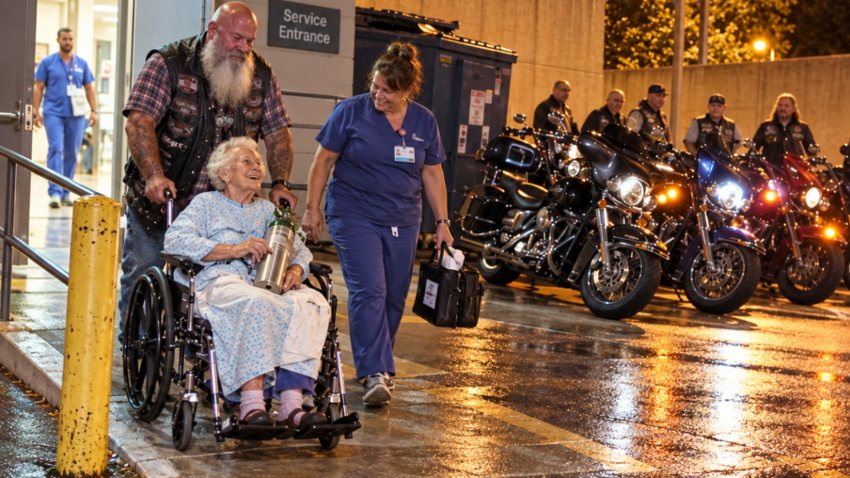
She ended up in room 412 at the county hospital after a pain crisis we could not control at home.
She never left.
Not until the bikers came.
Three weeks in, she had become almost unrecognizable.
Not physically only.
Emotionally.
My mother, who once rode through a thunderstorm in Idaho because Dad refused to stop, now spent entire afternoons staring at television without following the program.
She asked what time it was every twenty minutes.
Sometimes she asked when she could go home.
Sometimes she knew she could not.
Sometimes she said:
“I’m tired.”
I never knew whether she meant that day or life.
I visited every day.
My brothers came when work and children allowed.
I came daily because I lived closest.
Flowers.
Books.
Her soup.
Lip balm.
A clean nightgown.
Pictures of grandchildren.
I talked.
She listened.
She smiled.
“Thank you, baby.”
Always thank you.
No anger.
No laughing.
No Marie.
I began mourning her before she died.
That happens.
People do not tell you how guilty it feels.
You sit beside someone who is still breathing and miss who they were.
Then feel disloyal for missing them while holding their hand.
The Monday before the ride, I stayed until ten at night.
Mom had been especially quiet.
Ray visited that afternoon.
I arrived while he was there.
He stood beside her bed wearing his old Black River Riders vest.
The patches were faded.
His beard almost entirely gray.
Mom looked at him.
“Still wearing that ugly thing?”
Ray smiled.
“Frank liked it.”
“Frank had terrible taste.”
“In friends too.”
“Especially friends.”
It was the closest thing to old Mom I had heard in weeks.
Ray sat for an hour.
I noticed he kept looking at the medication pump.
Oxygen.
The line in her chest.
The wheelchair.
At one point he asked me:
“How bad is she?”
I answered honestly.
“Bad.”
“Could she sit up on a bike?”
I stared.
“What?”
He looked away.
“Nothing.”
“Ray.”
“Just asking.”
“Why would you ask that?”
He shrugged.
Something about his face bothered me.
“Ray.”
“Sarah, I’m not doing anything.”
That should have warned me.
If Ray Callahan says he is not doing anything, locate your mother.
I did not.
That night I kissed Mom.
She smelled like hospital soap.
“See you tomorrow.”
She nodded.
“Drive safe.”
Always that.
Even dying.
I went home.
Showered.
Sat on kitchen floor sorting a pile of mail I had ignored.
Around midnight, I fell asleep on couch.
At 3:22 AM my phone rang.
MOM.
My body knew fear before my brain read the name.
I sat upright so fast I dropped the phone.
This is it.
That was the thought.
The hospital is calling from her phone.
Maybe nurse grabbed it.
Maybe Mom is scared.
Maybe she is dying.
I answered.
“Mom?”
Noise.
A lot of noise.
Wind.
Engines.
Then laughter.
My mother.
Laughing.
Not smiling.
Not politely chuckling.
Laughing.
The old laugh.
The table-slapping, breathless laugh I had not heard in two years.
“Sarah!”
“Mom?”
“Baby!”
“Where are you?”
More laughter.
“I’m on a bike!”
I stood.
“What?”
“I’m on Ray’s bike!”
The wind swallowed half the sentence.
“Mom, what are you talking about?”
She held the phone away.
Motorcycles.
Multiple.
Deep engines.
Highway wind.
Someone shouted something.
Mom screamed with delight.
I felt my knees go weak.
“Mom!”
She came back.
“Can you hear them?”
“Where are you?”
“Highway.”
“What highway?”
“I don’t know. Ask Ray.”
She laughed again.
I sat down on kitchen floor.
“Are you still in the hospital?”
“No.”
No.
As though she had stepped out for coffee.
“What do you mean no?”
“Your father’s idiots came for me.”
In background Ray shouted:
“She means brothers!”
Mom shouted back:
“I said what I said!”
I put one hand over my face.
“Mom, you have an IV.”
“Central line.”
“That is not better.”
“They know.”
“You’re on oxygen.”
“Got that too.”
“Mom!”
“Linda’s here.”
I stopped.
Linda Mercer.
Former ER nurse.
Married to Gus, one of Dad’s oldest club brothers.
I remembered her vaguely from cookouts.
“She is?”
“Riding behind Gus with my meds.”
They had planned it.
That realization was somehow more frightening than believing Mom had simply escaped.
Eight old bikers had apparently executed an extraction from a hospital.
“Put Ray on.”
“No.”
“Mom.”
“I want to talk to my daughter.”
“Where are you going?”
“Dutton’s.”
My heart stopped a second time.
Dutton’s Diner.
Forty miles west.
Twenty-four-hour place off the old highway.
My parents went there every Saturday night when we were children.
They would leave my brothers and me with Grandma, ride out, drink coffee, eat pie, come back near midnight smelling like wind and cigarettes and each other.
Dad quit smoking later.
The diner remained.
“Mom, you can barely stand.”
“I’m not standing.”
She sounded offended.
“I’m riding.”
Then quieter:
“There’s a difference.”
There was.
I heard it in her voice.
Then she said:
“I’m wearing your father’s jacket.”
Everything stopped.
Dad’s leather jacket had been hanging in Mom’s hall closet since he died.
Heavy black leather.
Club patch.
Soft at elbows.
Small burn mark near pocket from an exhaust pipe incident nobody ever explained.
“I can smell him.”
Her voice broke.
“Sarah, I can still smell him in the leather.”
Then she started crying.
Not sick crying.
Not afraid crying.
The kind of crying that arrives because joy is too large for the body carrying it.
“I feel alive.”
I pressed my forehead to my knee.
“Mom…”
“For the first time in two years, baby.”
I had no argument against that.
“I feel like me.”
I cried silently.
Mom said:
“Please don’t call hospital.”
“They know you’re gone.”
“Probably.”
“That is not reassuring.”
“Ray handled it.”
“That is even less reassuring.”
She laughed.
God, that laugh.
Then:
“I spent two years dying.”
Wind behind her.
“I’m tired of it.”
She paused.
“Tonight I’m Marie.”
Not patient.
Not cancer.
Marie.
“Let me have tonight.”
I was thirty-four years old.
Had spent my entire adult life following rules.
Seat belts.
Insurance.
Appointments.
Emergency contacts.
Expiration dates.
I worked in administration for a dental group.
I color-coded my calendar.
My mother was dying on a motorcycle at three-thirty in the morning with an oxygen tank.
Every responsible instinct in my body screamed.
Call hospital.
Call police.
Stop them.
Then she laughed again.
I had not heard it in two years.
“Okay.”
“What?”
“Okay.”
I wiped my face.
“But you call me every hour.”
“Bossy.”
“I learned from you.”
“That’s my girl.”
We hung up.
I sat on kitchen floor for ten minutes.
Then stood.
Put on jeans.
Sweater.
Shoes.
Grabbed keys.
If my dying mother was going to commit medical truancy with eight senior-citizen bikers, I was not sitting home.
Dutton’s parking lot looked like a memory.
Neon sign.
Half the letters slightly dimmer than I remembered.
Eight Harleys lined up under yellow lights.
Chrome catching reflections.
I parked.
Walked inside.
And stopped.
There she was.
Corner booth.
My mother.
Hospital gown under Dad’s leather jacket.
Oxygen tubing beneath nose.
Portable tank beside her.
Medication bag hanging from improvised hook on back of booth.
Chocolate milkshake in front of her.
Eight bikers around table.
Talking.
Laughing.
Marie.
Not the gray little woman in room 412.
My mother.
Her cheeks had color.
Her eyes were awake.
Her hands moved when she talked.
She saw me.
“Sarah!”
Everyone turned.
“You came!”
I slid beside her.
“You are insane.”
“Probably.”
She grinned.
“Isn’t it wonderful?”
I hugged her carefully.
She was so light.
Dad’s jacket swallowed her.
But she smelled like cold air.
Leather.
A little gasoline.
And chocolate.
For the first time in months, she did not smell primarily like hospital.
Ray sat across.
Older.
Gray beard.
Same calm eyes.
“Sorry about scare, kid.”
“You kidnapped my mother.”
Mom interrupted.
“I consented.”
“You broke her out of a hospital.”
Ray considered.
“Breakout sounds criminal.”
“It was three in morning.”
“Less traffic.”
I stared.
Gus raised both hands.
“Before you kill anybody, Linda’s watching her.”
Linda came from counter carrying coffee.
Early sixties.
Silver hair pulled back.
Leather jacket over jeans.
Small medical kit over shoulder.
“Her pain meds are on schedule. Oxygen sat is acceptable. Her blood pressure is better than it was yesterday.”
I looked at her.
“You helped them?”
“Absolutely.”
“You’re a nurse.”
“Retired nurse.”
“That is not defense.”
“No.”
She sat.
“But she is competent. She understood risks. She wanted to go.”
I looked at Mom.
She was drinking milkshake.
Chocolate foam on upper lip.
“I cannot believe this.”
Mom licked foam.
“I can.”
“How did you even get out?”
Gus grinned.
“That part was easy.”
Ray looked at him.
“Do not explain crimes.”
Mom laughed so hard she coughed.
Linda immediately checked her.
The table went silent.
Mom waved everyone off.
“I’m okay.”
Linda listened to breathing.
Checked oxygen.
Then nodded.
Conversation resumed.
That was when I realized the jokes did not mean they were careless.
They watched Mom constantly.
Ray glanced at her between every sentence.
Gus carried extra oxygen.
Linda had medications labeled.
They had blankets.
Water.
A wheelchair folded outside.
Someone had even packed an emergency binder.
This was reckless.
But not thoughtless.
I looked at Ray.
“Why tonight?”
The whole table changed.
He set coffee down.
Looked at Mom.
Then me.
“Because I made Frank a promise.”
Mom stopped.
“What promise?”
Ray reached into wallet.
Pulled folded paper.
Old.
Creased.
Soft from years of being carried.
He handed it to her.
“Your dad knew something was wrong before heart attack.”
I frowned.
“What?”
“He didn’t know exactly.”
Ray looked at Mom.
“But he knew.”
My mother’s hands began shaking.
Ray continued.
“Couple weeks before he died, we were in his garage.”
He smiled faintly.
“Two beers. He was pretending carburetor needed cleaning so he didn’t have to go inside and help you pick curtains.”
Mom whispered:
“That sounds like him.”
“He told me chest had been acting up.”
I looked at Ray sharply.
“You knew?”
“He made me promise not to say until he saw doctor.”
Anger flashed.
Then died.
Nine years too late.
“He said something else.”
Ray’s voice softened.
“He said if anything happened to him, I had to look after you.”
Mom stared at paper.
“I told him you didn’t need looking after.”
Several bikers smiled.
“That’s when he said, ‘Exactly. That’s why she’ll never ask.’”
Mom’s eyes filled.
Ray continued.
“Then he said…”
His voice caught.
“When Marie’s time comes, don’t let her die staring at a hospital ceiling.”
My mother covered mouth.
“Take her riding.”
Ray looked down.
“Take her to Dutton’s.”
The diner became very quiet.
“Let her feel wind.”
Ray swallowed.
“Let her remember who she is before she goes.”
Mom unfolded paper.
I leaned closer.
Dad’s handwriting.
Messy block letters.
FRANK — 2014
MARIE — DUTTON’S — LAST RIDE.
DON’T LET HER GET STUCK IN SOME DAMN ROOM.
SHE DESERVES WIND.
Ray tapped bottom.
“I wrote it because I knew I’d forget exact words.”
Mom read it twice.
Then pressed it against her chest.
“Nine years.”
She whispered.
“Nine years gone and that bastard is still ordering people around.”
Ray smiled.
“You married him.”
Mom began crying.
Ray reached across table.
Held her hand.
I cried too.
Gus stared hard at menu as if pancakes had become emotionally complicated.
Mom folded paper carefully.
Put it inside Dad’s jacket.
“He’s still taking care of me.”
Nobody argued.
We stayed until five.
Mom ate half grilled cheese.
That alone would have been miracle.
For weeks she had barely eaten.
She drank two chocolate milkshakes.
Always chocolate.
She told stories.
Some I knew.
Some I had never heard.
How Dad deliberately rode twenty miles out of way on first date.
How he nearly dropped ring in gravel when proposing.
How once in Oregon they got caught in rain so hard Mom’s boots filled with water.
How they slept in motel where bed vibrated because someone put quarters in a machine.
I said:
“You never told me that.”
“You didn’t need to know everything.”
“Clearly.”
Ray told stories too.
Dad getting lost and refusing to admit it.
Dad trying to cook bacon on camping trip and attracting raccoon.
Dad once driving seventy miles to bring Ray a clutch cable.
Mom laughed.
Then cried.
Then laughed again.
“I forgot what this felt like.”
Her voice softened.
“What?”
“Being happy.”
That sentence hurt more than cancer.
“I actually forgot.”
Linda checked her vitals every thirty minutes.
Around 4:45 she looked at monitor.
Then at me.
“Her numbers are better.”
Mom smirked.
“See?”
Linda said:
“Do not make medical policy out of this.”
Gus raised milkshake.
“To irresponsible medicine.”
Linda glared.
Then smiled.
“Joy counts for something.”
I never forgot that.
Not cure.
Not replacement for treatment.
But something.
A body can be dying and still respond to life.
Around five-thirty, Mom looked outside.
Sky beginning to lighten.
“One more ride.”
I shook my head.
“Mom.”
“Just up hill.”
She looked at Linda.
Linda checked everything.
Then nodded slowly.
“Short.”
Mom grinned.
“Sarah, come.”
“I have a car.”
“Ride with Gus.”
“No.”
She looked at me.
Real eyes.
My mother’s eyes.
“Please.”
I had not been on motorcycle since sixteen.
Dad took me one summer afternoon.
I loved it.
Then scared myself thinking about accidents.
Never rode again.
I liked safe.
Safe routes.
Safe plans.
Predictable outcomes.
Mom knew.
“Come feel wind.”
I looked at Gus.
He handed me helmet.
“Your father would haunt me if I dropped you.”
“Comforting.”
Eight bikes started.
The sound filled parking lot.
Ray helped Mom onto his bike.
She was trembling badly.
He strapped her oxygen carefully.
Linda checked line.
Mom put arms around Ray.
Dad’s jacket around her.
I climbed behind Gus.
Helmet.
Hands uncertain.
“Hold on.”
“To what?”
“Me is generally recommended.”
We pulled out.
I was terrified for first mile.
Then road opened.
Cold air.
Engines.
Pink sky ahead.
Eight bikes in formation.
My dying mother in middle.
I watched her.
At one point, on a straight empty stretch, Mom lifted her face into wind.
She loosened one arm.
Then both for a moment while Ray slowed.
Arms out.
Like a girl.
Like nineteen.
Like cancer had missed the appointment.
The sky changed.
Pink.
Orange.
Gold.
We rode east.
And I understood something I had been too frightened to understand in hospital.
We were not trying to keep my mother alive forever.
That option was gone.
The choice was what kind of alive she would be while she remained.
We stopped at an overlook above valley.
Dad and Mom had been there before.
Of course.
They had apparently lived an entire parallel life on roads while my brothers and I thought they simply went out for coffee.
Gus helped me down.
Ray helped Mom.
She leaned against me.
Small.
Warm.
Exhausted.
Happy.
“Your father and I watched sunrise here on our first anniversary.”
I wrapped an arm around her.
“You never told me.”
“You were not born.”
“You had thirty-four years after.”
She considered.
“Busy.”
I laughed.
Then cried.
“I’m scared.”
“I know.”
“I don’t want you to die.”
“I know.”
She rested her head against shoulder.
“Sarah, safe isn’t living.”
I looked at her.
“It’s just not dying yet.”
That sentence stayed with me longer than anything a doctor said.
“I spent two years making every decision around cancer.”
She looked at sunrise.
“What can I eat? What can I tolerate? What can I risk? How much time will this buy?”
Her breath trembled.
“I forgot time is not only something you buy.”
She squeezed my hand.
“It is something you spend.”
I cried harder.
“Whatever I have left, I want to spend it.”
“Then we will.”
She smiled.
“There’s my girl.”
We returned to hospital at eight.
Through front doors.
No stealth.
No service entrance.
Eight bikers.
One exhausted dying woman in hospital gown and leather.
One daughter.
One retired nurse.
Chaos.
Nurses furious.
Security called.
Charge nurse nearly exploded.
“You cannot remove a patient without discharge.”
Mom said:
“I removed myself.”
“You have central access.”
“I’m aware.”
“You could have died.”
Mom looked at her.
“I’m already dying.”
Nobody had a good response.
Ray stepped between voices.
“Marie left voluntarily.”
Linda documented medications.
Vitals.
Oxygen.
Times.
Everything.
The hospital threatened police.
Ray said:
“Call them.”
They did not.
Probably because the legal and administrative reality was more complicated than emotion.
Mom was mentally competent.
She had voluntarily left.
She returned.
No treatment had been deliberately interrupted in a way they could point to as immediate harm.
Mostly everyone was angry because they had been scared.
I understood.
So did Mom.
Eventually.
Back in 412, they reconnected everything.
Same bed.
Same monitors.
Same ceiling.
But the woman beneath them was different.
Dad’s jacket remained over gown.
One nurse tried to remove it.
Mom growled.
The nurse left it.
“Best night of my life.”
I sat beside her.
“Really?”
“Second best.”
“What was first?”
“Meeting your father.”
She closed eyes.
“Don’t tell him.”
“Pretty sure he knows.”
She smiled.
Then slept six hours.
When she woke, she asked for a milkshake.
The next eleven days were not a miracle in way stories often use word.
Cancer did not disappear.
She did not get stronger overall.
No scan changed.
No doctor walked in shocked by recovery.
She was dying.
Every one of those eleven days.
But she lived them differently.
That mattered.
On first day, she asked nurse:
“Do you have chocolate milkshake?”
“No.”
“Then what exactly is this hospital for?”
I drove to Dutton’s.
Forty miles.
Bought one.
It melted partly.
She drank half.
Day two, Ray came carrying flowers.
Mom said:
“Who died?”
Ray looked at her.
She laughed.
He sat three hours.
Day three, Gus visited.
Brought the carved table story.
Mom made me promise we would go back sometime.
I said yes even though both of us knew there probably would not be another sometime.
Day four, she asked me to bring lipstick.
I had not seen her care what she looked like in months.
I brought red.
She put it on crooked.
I fixed it.
She looked into phone camera.
“Better.”
Day five, she asked to see grandchildren on video.
Not because we asked.
Because she wanted.
Day six, she told my brothers exactly where all important papers were.
Then changed subject and told us which childhood injuries we had lied about successfully.
Apparently none.
Day seven, she asked Ray to bring club photo.
Twenty-seven people outside Dutton’s in 1989.
Mom and Dad in middle.
Young.
Impossible.
She stared at Dad for long time.
“He was so handsome.”
Ray said:
“No.”
Mom said:
“You were always jealous.”
Ray:
“Of the bike, maybe.”
She laughed.
Day eight, pain increased.
The good hours became shorter.
Still she asked:
“What are we doing today?”
That question alone was new.
Before the ride, she asked how many days she had left as if counting down.
Afterward, she asked what we were doing with one.
Day nine, she requested paper.
“Why?”
“Letters.”
“To who?”
“Everybody.”
She wrote for hours.
Slowly.
Resting.
Then writing.
Me.
My brothers.
Grandchildren.
Ray.
Gus.
Linda.
Each rider from that night.
Even nurses.
She sealed them.
“You read after.”
“No.”
She glared.
“Yes.”
I did not argue.
Day ten, she barely ate.
Ray sat beside bed telling story about Dad dropping motorcycle at gas station and pretending he had meant to inspect pavement.
Mom laughed weakly.
Then said:
“Ray?”
“Yeah?”
“You kept promise.”
He stopped.
His eyes filled.
“I should’ve done it sooner.”
“No.”
She reached hand.
“Right night.”
He held her fingers.
“Frank would be proud.”
Mom smiled.
“Frank would say he planned whole thing.”
Ray laughed.
“He absolutely would.”
Day eleven, I knew.
Nobody told me.
Her breathing changed.
Her face softened.
She seemed farther away.
Around noon she whispered:
“Jacket.”
I knew which one.
Dad’s jacket had hung over chair since ride.
I lifted it.
It looked enormous.
She raised arms weakly.
We put it around her.
Leather swallowed her.
She pulled collar toward face.
Closed eyes.
“I can still smell him.”
I sat.
She held my hand.
The monitors continued.
Nurses came and went quietly.
Around three, Mom opened eyes.
“Sarah.”
“I’m here.”
“Did you read?”
“No.”
“Good girl.”
She smiled.
Then:
“Ride.”
“What?”
“You ride.”
“I will.”
“Promise.”
“I promise.”
She closed eyes.
At 3:47 PM, my mother died.
No drama.
No panic.
One breath.
Another.
Then none.
Holding my hand.
Wearing Dad’s jacket.
A small smile still at corner of her mouth.
The nurse cried.
She tried not to.
Did anyway.
I sat there a long time.
Ray arrived twenty minutes later.
I do not remember calling him.
Maybe my brother did.
He stood doorway.
Saw her.
Removed his cap.
Then placed one hand on Dad’s jacket.
“Hey, Marie.”
His voice broke.
“Tell Frank he still owes me twenty bucks.”
I laughed while crying.
Exactly the kind of thing Mom would have appreciated.
That night, I went home.
Sat on kitchen floor.
Same spot where I had answered her 3:22 AM call.
I opened my letter.
Sarah,
If you are reading this, then you ignored my instructions until I died, which means you are still my daughter.
I laughed.
Then kept reading.
I wasn’t afraid of dying.
Not exactly.
I was afraid of dying after spending all my time being afraid.
There is a difference.
For two years I counted appointments, pills, scans, numbers, and bad days.
I stopped counting things that made life mine.
Your father would have hated that.
That night on the bike, I remembered myself.
Not Frank’s widow.
Not your mother.
Not a cancer patient.
Marie.
Those eleven days after were worth more to me than many months before them because I was present for them.
Do not misunderstand me.
Take medicine.
Wear your helmet.
Do not do anything stupid just because your mother did something stupid.
I laughed again.
But find your ride.
Whatever makes you feel the wind.
Do not wait until somebody tells you how much time is left.
Nobody knows anyway.
Love people while they’re here.
Go places.
Eat chocolate.
Say yes sometimes when safe little voice says no.
And learn to ride your father’s Harley.
It has sat long enough.
I’ll say hi to him for you.
I imagine he’s already got the bike running.
Love you forever,
Mom
P.S. He still owes Ray twenty dollars. Do not pay it.
I cried until dawn.
The funeral was three days later.
Black River Riders came.
Not eight.
Twenty-three.
Some had not ridden in years.
One came from Oregon.
One trailered his bike because his back could no longer handle highway.
They lined motorcycles outside chapel.
Dad’s Harley sat at front, still covered in garage until Ray brought it out.
Mom’s casket had Dad’s jacket folded across it.
Ray spoke.
Not long.
He said:
“Marie was one of us before half of us deserved to know her.”
People laughed.
Then:
“Frank asked us not to let her forget the road.”
Ray looked at me.
“We were late.”
His voice caught.
“But she remembered.”
After funeral, engines started one by one.
The sound rolled through cemetery.
A final salute.
I hated it.
Loved it.
Cried through all of it.
For months after, Dad’s Harley remained in my garage.
Mom had transferred it to me years earlier on paper.
I did not touch it.
I promised.
Promises are easier beside deathbed.
Life returns.
Work.
Laundry.
Bills.
Grief.
Then one Saturday, Ray pulled into driveway.
Helmet under arm.
“No.”
He had not spoken.
“No.”
He looked at garage.
“I know why you’re here.”
“Good.”
“I am not riding that thing.”
“Marie would haunt me.”
“Let her.”
“She’d haunt you worse.”
Fair.
We uncovered Dad’s Harley.
Dust.
Leather seat.
Old chrome.
Ray ran hand over tank.
“Frank loved this machine.”
“I know.”
“He also abused it.”
“I know.”
“Needs work.”
That part I did not know.
For next month, Ray came weekends.
We cleaned.
Changed fluids.
Battery.
Tires.
Inspected everything.
I learned names for parts Dad had talked about when I was a child and never listened.
The first time engine started, sound filled garage.
I began crying so hard I could not see.
Ray immediately shut it down.
I sat on concrete floor.
“That normal?”
He leaned against bench.
“No.”
Then sat beside me.
“But nothing about this is normal.”
The smell was Dad.
Oil.
Gasoline.
Leather.
For one second, childhood returned so strongly I could almost hear parents arguing in kitchen.
I took riding course.
Helmet.
Proper gear.
Every safety measure Mom had mocked and secretly would have wanted.
First ride was in empty lot.
I stalled.
Again.
Again.
Ray said nothing.
Third time, I moved.
Slow.
Twenty feet.
Then fifty.
I laughed.
It startled me.
My mother’s laugh came into my head.
Months passed.
I learned.
Not reckless.
Not fast.
Comfortable.
A year after Mom died, I rode to Dutton’s.
Saturday night.
Ray came.
Gus too.
Linda drove because she had decided motorcycles were for people with better knees.
We sat at same booth.
The diner had changed upholstery but not table.
Mom had said Dad carved initials underneath.
I leaned down.
There.
F + M.
Small.
Crooked.
Probably committed with pocketknife.
I touched them.
Ray watched.
I took a key.
Added an S beneath.
Not because I wanted to belong between them.
Because they were the road that made me.
Then I ordered chocolate milkshake.
Ray lifted coffee.
“To Marie.”
Gus:
“To Frank.”
Linda:
“To not getting arrested that night.”
I laughed.
We rode home.
I have ridden every Saturday night since when weather allows.
Sometimes Ray.
Sometimes club.
Sometimes alone.
Dutton’s and back.
Forty miles.
I wear Dad’s jacket.
It hangs in my closet when I am not riding.
It still smells like old leather.
Maybe Dad.
Maybe memory invents scent.
And now, faintly, I swear it smells like Mom.
Every Tuesday at 3:22 AM, I wake.
Not because alarm.
I deleted it.
My body just knows.
For a few seconds, I lie still.
And sometimes I hear her.
Not literally.
I know.
But memory is almost sound when strong enough.
My mother laughing over motorcycle engines.
“Sarah! Baby! I’m on a bike!”
I thought that call was going to tell me she had died.
Instead, it told me she had come back to life.
Only for eleven days.
But eleven days mattered.
People sometimes hear this story and focus on hospital escape.
They ask whether it was legal.
Whether it was safe.
Whether it was medically appropriate.
Fair questions.
It was risky.
It could have gone differently.
No one should hear this and conclude seriously ill patients should leave hospitals on motorcycles without medical coordination.
That is not what the story means to me.
What matters is what happened after.
My mother had stopped being treated, by all of us including herself, as a whole human being.
She was becoming a diagnosis.
Stage four.
Pain score.
Oxygen.
Medication schedule.
Fall risk.
DNR.
Room 412.
Necessary things.
Important things.
But incomplete things.
The bikers remembered something we had forgotten.
Marie existed underneath patient.
She loved wind.
Chocolate milkshakes.
Harleys.
Bad jokes.
My father.
She hated waiting.
Loved red lipstick.
Could drink coffee at midnight and sleep at one.
She was still there.
Dying had not erased her.
The ride did not save her life.
It returned ownership of it.
That is different.
For two years, cancer had dictated terms.
That night, she chose something.
Choice mattered.
Afterward, she still suffered.
She still needed morphine.
Still got weaker.
Still died.
But she laughed.
She wrote.
She talked.
She asked for things.
She planned the hours she had instead of only fearing the ones she might lose.
That is what I remember.
Ray is older now.
His hands shake more.
He rides less.
Sometimes I pick him up in car and take him to Dutton’s.
He complains.
“A car?”
“Your knees.”
“My knees are traitors.”
“Get in.”
He does.
Gus sold his Harley after shoulder surgery.
Still comes for milkshakes.
Linda says all of us are idiots.
Then orders pie.
Black River Riders is smaller.
A few patches now hang framed instead of on backs.
People die.
People age.
Clubs change.
Road remains.
One evening, Ray gave me the folded note from his wallet.
Dad’s promise.
The original.
He had carried it eleven years by then.
“You keep it.”
I stared.
“No.”
“It belongs to you.”
“It belongs to you.”
“It did.”
He placed it in my hand.
Paper almost cloth from folds.
Dad’s words.
MARIE — DUTTON’S — LAST RIDE.
SHE DESERVES WIND.
I keep it inside Dad’s jacket pocket.
The same pocket Ray says Dad used to hide money from Mom.
Mom knew.
Of course she knew.
I asked her once when I was a kid why she loved motorcycles.
She said:
“Because a car separates you from the world.”
I thought that sounded ridiculous.
She explained.
“In a car, rain is outside. Wind is outside. Heat is outside. Everything happens through glass.”
“On a bike?”
“You’re in it.”
I was twelve.
I said:
“That sounds uncomfortable.”
She laughed.
“It is.”
Then:
“That’s part of it.”
I understand now.
My life before that 3:22 AM call was comfortable.
Careful.
Protected.
Not unhappy.
But often lived through glass.
Work.
Home.
Plans.
Fear.
I postponed things.
Trips.
Relationships.
Conversations.
Not because I disliked life.
Because later always seemed available.
Mom’s letter broke that illusion.
Do not wait until someone tells you how much time is left.
Nobody knows anyway.
I did not turn into a reckless person.
I still check weather twice before rides.
Wear helmet.
Carry first-aid kit.
Ray mocks me.
I ignore him.
But I say yes more.
I traveled alone for first time.
Took pottery class and was terrible.
Called old friend I had avoided because too much time had passed.
Started dating again, briefly, then stopped when it was not right instead of staying because loneliness scared me.
I tell my brothers I love them before ending calls.
They hate it.
Good.
Maren—my daughter, named after my grandmother, not connected to this story except that life keeps moving—once asked why I ride same route every Saturday.
“Doesn’t it get boring?”
No.
Ritual is not boredom.
Ritual is remembering on purpose.
I pull into Dutton’s.
Sit at booth.
Sometimes order grilled cheese.
Always chocolate milkshake.
Touch initials underneath.
F.
M.
S.
Dad.
Mom.
Me.
Not a chain of deaths.
A chain of lives.
My mother taught me more about living in eleven days than I had learned in thirty-four years of trying not to get hurt.
She did not tell me fear disappears.
It doesn’t.
The first time I rode highway alone, I was terrified.
The first time I dated after a long relationship, terrified.
The first time I told my employer I was taking a month off to travel, terrified.
Living does not mean fear is gone.
It means fear is no longer the only vote.
That was Marie.
Cancer could vote.
Pain could vote.
Doctors could vote.
Safety could vote.
But on that Tuesday at 3:22 in the morning, Marie voted too.
For the first time in two years.
She chose the road.
She chose Dad’s jacket.
She chose Dutton’s.
She chose sunrise.
She chose laughter.
And because eight aging men remembered a promise made over two beers in a garage nine years earlier, she got to make that choice.
People think loyalty is dramatic.
Usually it is not.
Usually loyalty is remembering.
A promise nobody would know you broke.
A note kept in a wallet.
A motorcycle maintained.
Showing up years after the person who asked is gone.
Ray could have forgotten.
Dad was dead.
Nobody knew.
He could have told himself it was impractical.
Dangerous.
Too late.
Instead, he carried the paper.
Nine years.
Then one afternoon he looked at my mother in room 412 and realized the time had come.
That is love too.
Not romantic.
Brotherly.
Stubborn.
Ridiculous.
Beautiful.
I once asked Ray:
“Were you scared that night?”
He snorted.
“Terrified.”
“You didn’t look it.”
“Neither did your father half the time.”
“What were you afraid of?”
He looked at me.
“That she’d die on my bike.”
I had never considered that.
“What would you have done?”
“Never forgiven myself.”
“So why?”
He took a long time.
“Because I was more afraid she’d die in that room after Frank made me promise.”
Then:
“Sometimes every choice scares you.”
He shrugged.
“You pick the one you can live with.”
I do not know whether I agree with every choice they made.
Even now.
Part of me remains the woman on kitchen floor wanting to call police.
Maybe that is why story matters.
Love is not always neat.
Sometimes it is disagreement between protection and dignity.
Between safety and freedom.
Between extending time and inhabiting it.
There are no easy universal answers.
My mother knew what she wanted.
She was competent.
She accepted risk.
That mattered.
And in the end, the greatest gift was not motorcycle itself.
It was being asked:
Who are you besides your illness?
What do you still want?
What part of you is still here?
Those are questions I wish we asked dying people more often.
Not only:
How is pain?
Did you eat?
Do you need anything?
But:
What would make today yours?
Sometimes answer is quiet.
A song.
A pet.
A meal.
A porch.
A hand.
A sunrise.
For Mom, it was a Harley and a chocolate milkshake at four in morning.
Of course it was.
The last photo I have of her alive was taken at Dutton’s.
She is in corner booth.
Dad’s jacket swallowing shoulders.
Oxygen tube beneath nose.
Milkshake in hand.
Ray beside her.
Gus behind.
My face half visible at edge.
Mom is laughing.
Her head back.
Eyes closed.
Mouth open.
No polite smile.
No cancer-patient bravery.
Laughing.
If you saw photo without context, you would not know she had eleven days left.
Maybe that is the point.
A life is not less alive because it is almost over.
My mother was dying.
And she was alive.
Both true.
For two years, we let first truth erase second.
Then eight bikers came.
At 3:22 AM.
And reminded us.
The jacket still hangs in my closet.
Dad’s note in pocket.
Mom’s letter in drawer.
Her handwriting gets harder for me to look at as years pass, not easier.
But I read one line whenever I start postponing myself.
Find your ride, baby.
Whatever makes you feel the wind.
Mine happened to become literal.
Yours does not have to be.
Maybe it is a plane ticket.
A painting class.
A conversation.
A porch swing.
A dog.
A phone call.
A divorce.
A marriage.
An apology.
A guitar gathering dust.
A road you have driven past for twenty years.
The point is not motorcycles.
The point is recognizing what makes you feel present in your own life.
Then not waiting until room 412 to admit you want it.
Every Saturday night, I zip up Dad’s jacket.
Wheel his old Harley from garage.
Start engine.
The sound still shakes something loose inside me.
Sometimes Ray rides beside me.
Sometimes younger members of club.
Sometimes nobody.
I take old highway west.
Forty miles.
To Dutton’s.
If sky is clear, I stay until late.
On ride home, I think about Mom leaning into sunrise.
Arms open.
Small body nearly gone.
Still claiming entire sky.
I think about Dad’s promise.
Ray’s wallet.
Linda carrying medication on back of a motorcycle.
Gus giving me a helmet.
Eight engines in formation.
And my mother laughing so hard she could barely breathe.
The first call I thought would tell me she was dying became the call that taught me how she wanted to live.
She died eleven days later.
But those eleven days were not an epilogue.
They were hers.
Entirely.
Marie’s.
And when I ride now, especially early enough to catch sunrise, I sometimes hear her voice as clearly as that Tuesday morning.
Safe isn’t living.
Safe is just not dying yet.
Then I hear Dad somewhere in my imagination complaining that she is going too fast.
Mom telling him to shut up.
Ray insisting Frank still owes him twenty dollars.
And I laugh.
Out loud.
Inside my helmet.
On a highway that seems, for a little while, like it might go on forever.
Find your ride, she told me.