The school bus camera didn’t catch the first insult — it caught the moment the boy stopped flinching and started disappearing.
The bus rattled the way old buses always do, metal groaning with every pothole, windows buzzing like they were tired of holding the noise inside.
It was a normal afternoon route in a quiet American town. Same streets. Same stops. Same kids.
Same boy.
He sat halfway back on the right side, backpack pulled tight against his chest like a shield that had stopped working weeks ago. His sneakers were scuffed. One lace dragged loose, unnoticed.
“Hey, move.”
The voice came from behind him.
He didn’t turn.
A foot kicked the metal bar under his seat.
“MOVE.”
A few kids laughed. Not loudly. The kind of laughter that pretends it’s harmless.
The boy slid closer to the window, eyes fixed outside. Houses blurred past. Trees. Driveways. Safety he couldn’t reach yet.
Something hit the back of his head. A crumpled piece of paper.
Another laugh.
The bus driver didn’t look up.
Someone filmed on their phone — not to stop it, but because watching was easier than intervening.
The boy’s shoulders tightened. His breathing changed. He stared at his reflection in the glass, practicing stillness, because stillness sometimes made people bored.
“Crybaby.”
“Freak.”
“Say something.”
He didn’t.
And that’s when the bus stopped — not at a student’s house, but at the corner where the gas station met the highway.
The doors hissed open.
Heavy boots hit the steps.
And every voice on the bus went quiet.
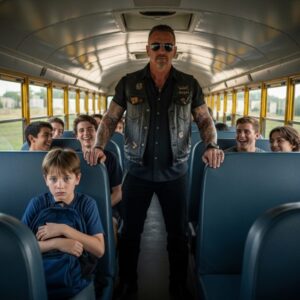
The man who stepped onto the bus didn’t look like anyone’s father.
Mid-40s. White. Weathered skin. Short dark hair. Sunglasses still on even indoors. Tattoos ran down his forearms beneath a short-sleeve shirt. A leather vest hung open, heavy with years, not decoration.
The bus driver stiffened.
“Sir—” she started.
The biker didn’t raise his voice. Didn’t argue. He held up one hand.
“I’m here about the kid,” he said.
Every head turned.
The boy shrank in his seat.
That sentence — about the kid — landed wrong.
A girl whispered, “Is he talking about you?”
Someone muttered, “Who lets this guy on a school bus?”
The biker took one step forward, eyes scanning the aisle. He didn’t smile. Didn’t soften himself for comfort.
To the kids, he looked dangerous.
To the driver, he looked like a problem.
“You can’t be on here,” she said sharply. “This is a school bus.”
“I know,” he replied.
That calm answer made the tension spike.
A boy near the back laughed nervously. “Dude looks like he’s gonna flip.”
Phones came up again.
The biker stopped beside the bullied boy’s seat.
The boy felt it before he looked up — the weight of an adult’s attention, unfamiliar and terrifying.
The biker didn’t touch him.
Didn’t lean close.
He just said, quietly, “You alright?”
The boy didn’t answer.
Someone snorted. “He’s fine. Just sensitive.”
The biker’s jaw tightened.
He turned slightly, blocking the aisle — not aggressively, but enough to be noticed.
That’s when the driver reached for her radio.
“I’m calling this in,” she said. “You need to step off the bus.”
The biker didn’t move.
Now the whispers turned sharp.
“Call the cops.”
“My mom would freak if she saw this.”
“He’s threatening kids.”
The word threatening stuck.
The biker glanced at the camera mounted above the windshield — the red light blinking steadily.
Recording.
He looked back at the boy.
“Did anyone put hands on you?” he asked.
The boy hesitated.
The bus held its breath.
A pause too long to ignore.
And suddenly, what looked like protection began to look like intimidation.
The bus driver stood up.
“That’s enough,” she said. “Sir, step off now or I call the police.”
The biker finally straightened fully, filling the narrow aisle.
A few kids flinched.
He reached into his vest.
Gasps rippled through the bus.
The boy’s heart slammed.
Someone yelled, “Oh my God!”
The biker stopped mid-motion.
Slowly pulled out his phone.
“That’s all,” he said. “Just my phone.”
He typed something. Short. Precise.
Hit call.
Put it to his ear.
“I’m on Route 7,” he said quietly. “Bus 14. Yes. I’ll wait.”
He hung up.
Slid the phone back.
The driver’s voice shook. “Who did you call?”
The biker didn’t answer.
That silence — refusing to justify himself — felt like confirmation to everyone who already believed the worst.
The boy stared at his hands. They were shaking.
One of the bullies leaned forward. “Told you you’d get in trouble.”
The biker heard that.
He turned his head slightly.
Didn’t glare.
Didn’t threaten.
Just said one sentence — flat, steady, impossible to misread:
“Not today.”
The bus door creaked as someone outside stepped onto the first stair.
Then another set of footsteps.
Heavy. Familiar.
The kids leaned toward the windows.
The camera kept rolling.
And as voices rose, parents gathered, and the word police floated through the bus like a spark near gasoline — the biker did the last thing anyone expected.
He stepped aside.
Cleared the aisle.
And waited.
The sound came first.
Not shouting.
Not sirens.
Boots on metal steps. Slow. Heavy. Familiar.
The bus door opened wider.
A man stepped inside — late 50s, broad shoulders, plain jacket zipped halfway. He didn’t look angry. He looked concerned in a way that didn’t need volume. Behind him, two more adults waited on the sidewalk, staying put.
The bus driver stiffened. “Sir, you can’t—”
“I’m with the district,” the man said calmly. He held up an ID without shoving it in anyone’s face. “Transportation oversight.”
The aisle loosened by an inch.
Then another voice spoke from outside. “We’ll wait here.”
No rush. No crowding.
The biker didn’t move closer to the boy. He stayed where he was — making space instead of taking it.
The oversight officer scanned the bus, eyes landing on the blinking camera light. He nodded once. “Good. This helps.”
The kids had gone quiet. Not obedient quiet. Uncertain quiet.
“What’s the situation?” the officer asked.
The driver answered too quickly. The bullies answered louder. Explanations overlapped. Accusations tried to find a shape.
The officer raised a hand. Silence returned.
He looked at the biker. “You called.”
“Yes.”
“Why?”
The biker didn’t posture. Didn’t defend. He pointed — not accusing, not dramatic — just precise.
“The kid hasn’t moved seats in weeks,” he said. “Because he knows where it’s worst.”
A few heads turned.
The officer looked at the boy. “Is that true?”
The boy’s throat worked. He nodded.
A beat.
Then the officer did something small and unexpected: he sat down in the empty seat across from the boy. Lowered himself to eye level. Changed the geometry of the moment.
“Can you tell me what happens back here?” he asked.
The boy glanced at the biker. The biker didn’t nod. Didn’t signal. He just stayed still.
“They… kick my seat,” the boy said. “They take my stuff. They say things.”
“Every day?” the officer asked.
The boy nodded again.
The bus felt different now. Like the story had found its spine.
The officer stood. Turned to the aisle. “Phones down,” he said — not angrily. “You don’t need them anymore.”
One by one, phones lowered.
He faced the biker again. “You’re not a parent.”
“No.”
“You’re not staff.”
“No.”
“So why today?”
The biker looked at the camera. Then back to the officer. “Because today he stopped flinching.”
That landed.
Outside, another engine idled — not a bike, but a district vehicle. Doors opened. Steps approached.
Presence multiplied without pressure.
The truth didn’t arrive with a speech.
It arrived with paperwork.
The oversight officer spoke quietly with the driver. Notes were taken. Names were written — not theatrically, just carefully. The bullies’ bravado thinned. Shoulders slumped. Eyes avoided the aisle.
A counselor boarded. Then the school liaison officer — calm, measured, not in a hurry to be the center.
The biker stepped back another half step.
The boy noticed.
The officer returned to the biker. “You were a bus mechanic here,” he said, reading. “Years ago.”
“Yes.”
“You still volunteer with the after-school shop.”
“Yes.”
“You weren’t supposed to board a bus.”
“No.”
A pause.
“But you called the right number,” the officer said. “And you didn’t touch anyone.”
The biker nodded. “I didn’t need to.”
The officer turned to the boy. “We’re going to change your seat today,” he said. “And we’re going to change some other things too.”
The boy nodded — not relief, not joy — just air returning to his lungs.
The driver cleared her throat. “I didn’t see it,” she said. Not defensive. Just honest.
The biker picked up his vest from the seat where he’d set it earlier. Brushed imaginary dust from the leather. Slipped it on without ceremony.
The oversight officer extended a hand. The biker shook it once. Firm. Brief.
“Thank you,” the officer said.
The biker shook his head. “Don’t thank me,” he replied. “Fix the back of the bus.”
That was it.
He stepped off.
Outside, he didn’t wait for applause that never came. He walked past the district vehicle. Past the parents who had gathered. Past the kids who stared through glass.
The engine started.
Low. Controlled.
As the bus pulled away, the camera kept rolling.
It caught the boy sitting in a new seat near the front — window open an inch, air moving. It caught the bullies staring forward. It caught the driver adjusting the mirror to watch the back more often.
And it caught the biker riding away — not looking back — because the work he came to do didn’t need witnesses.
The video would circulate later. Cropped. Commented on. Misread again by strangers.
But on that bus, something quieter remained.
A rule rewritten without a lecture.
A line drawn without a threat.
A moment where being seen changed what was possible.
And a boy who learned — not that bullies vanish — but that sometimes, someone steps in long enough for the world to correct itself.
Without raising his voice.
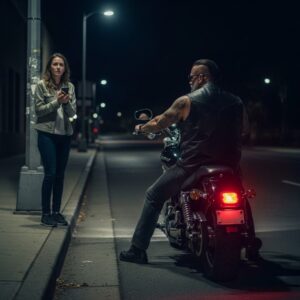
The motorcycle stayed where it was.
Not revving.
Not passing.
Just… there.
She could feel it — the weight of being watched, even before she confirmed it.
Her fingers tightened around her phone.
She turned slowly.
The biker sat astride a large black motorcycle, parked half a lane behind her. Headlight on. Helmet off. Sunglasses still on, even at night. Tattoos ran down his forearms beneath a short-sleeve shirt. A leather vest rested heavy on his shoulders.
He didn’t smile.
Didn’t wave.
Didn’t speak.
And that silence was worse than words.
She took a step back.
He didn’t move.
Another step.
Still nothing.
Her mind filled the gaps faster than logic ever could.
Why here?
Why now?
Why not just pass?
She glanced around for help.
Empty street. Closed buildings. One flickering streetlight.
She raised her phone, pretending to text, really opening the camera. Her thumb hovered over the emergency call button.
“Please don’t,” she said suddenly, hating how small her voice sounded. “I don’t have anything.”
The biker tilted his head slightly — as if he hadn’t expected her to speak.
“I’m not asking for anything,” he said.
His voice was low. Calm. Too controlled to be comforting.
That made her angrier than afraid.
“Then why are you following me?” she snapped. “My driver just left me here. I don’t need this.”
The biker looked past her, down the street she’d been walking toward.
“That way’s not safe,” he said.
There it was.
The sentence that flipped something inside her.
Not safe — according to who?
“You don’t get to tell me where to go,” she shot back. “Stay away from me.”
A car approached from the opposite direction, slowed when it saw them, then sped up.
She noticed.
So did he.
The biker lifted one hand slowly, palm open, showing he wasn’t holding anything.
“I’m just making sure you’re okay,” he said.
She laughed — sharp, bitter.
“That’s what everyone says right before they’re not.”
She stepped into the street, putting distance between them.
The biker sighed quietly.
He reached into his vest.
Her heart slammed.
She took another step back and shouted, “Don’t!”
Windows down the block flickered with movement. A porch light clicked on somewhere. A man across the street paused, watching.
The biker stopped.
He pulled out his phone.
Held it up.
“I’m calling someone,” he said. “You can hear it ring.”
He dialed.
Put it on speaker.
The call connected.
But she didn’t relax.
Because now she wasn’t just afraid.
She was angry.
And fear mixed with anger never stays quiet for long.
The voice on the other end answered.
Calm. Familiar.
The biker spoke briefly. Gave a location. Nothing else.
He ended the call.
She stared at him, heart still racing.
“You think that proves something?” she demanded. “Because it doesn’t.”
He nodded once. “Fair.”
That word — fair — disarmed her more than any threat could have.
A second motorcycle engine echoed in the distance.
Then another.
She heard them before she saw them — low, measured, controlled, like they weren’t in a hurry but knew exactly where they were going.
Her stomach dropped.
She backed away instinctively, hand shaking as she raised her phone higher.
“You called them,” she said. “You actually called them.”
Headlights appeared at the far end of the street.
Two bikes. Maybe three.
She turned, looking for somewhere to run — but the sidewalk ended in a chain-link fence. The bus stop offered no cover. No help.
A neighbor shouted from a porch, “Everything okay over there?”
“Call the police!” she yelled back. “Please!”
The biker looked at her then — really looked at her.
Not predatory.
Not angry.
Just focused.
“Stay where you are,” he said. “No one’s going to touch you.”
She didn’t believe him.
The motorcycles rolled closer and stopped — not surrounding her, but parking in a straight line behind the first bike.
Engines idled.
No one got off.
No one approached.
The street felt suddenly smaller.
Charged.
She stood there, shaking, phone recording now, convinced she was about to become a headline.
And in the middle of it all — with neighbors watching, police possibly on the way, and her fear spiraling out of control — the biker did the strangest thing.
He stepped off his bike.
Removed his vest.
And placed it on the ground between them.
Then he took three steps back.
Hands visible.
Waiting.
The sound reached her before the sight.
Not loud.
Not aggressive.
Just present.
Engines idling — steady, disciplined — the kind of sound that didn’t rush or chase. It claimed space without demanding it.
Three motorcycles now. Then a fourth.
They stopped in a clean line along the curb, headlights angled down, not blinding her. No one revved. No one dismounted at first.
The woman’s breathing came fast, uneven. Her phone shook in her hand.
Neighbors gathered at a distance. Porch lights flicked on. A couple of doors opened. Someone was already on the phone — probably the police.
The biker who had stopped first didn’t move closer.
He stood back, hands loose at his sides, shoulders squared, posture too controlled to be threatening.
Then another biker stepped off his bike.
Mid-50s. White. Gray beard. No vest — just a plain jacket, zipped halfway. He looked at the woman first. Really looked.
“You alright, ma’am?” he asked.
Not loud.
Not rushed.
Just enough.
She swallowed. “I… I was left here. My ride just— he drove off.”
The older biker nodded once. Like that explained everything it needed to.
He turned to the first biker. “This the spot?”
“Yes,” the man replied.
No more words.
A police cruiser pulled up at the end of the block, lights washing the street in red and blue. Another followed.
Officers stepped out cautiously, hands near their belts, eyes scanning the group of bikers.
The woman felt it again — that shift — where people decide who they think is dangerous before anyone speaks.
The officer nearest her looked at the bikes, then at the leather vest on the ground.
“What’s going on here?” he asked.
Before she could answer, the older biker spoke.
“She was abandoned by her driver,” he said calmly. “We stopped so she wouldn’t be alone.”
The officer raised an eyebrow. “You follow her?”
“No,” the biker answered. “We stayed behind her.”
Silence stretched.
The officer looked down at the vest. Then at the first biker — still standing back, still silent.
“You mind explaining why your jacket’s on the street?” the officer asked.
The biker finally spoke again.
“So she wouldn’t think I was hiding anything.”
That landed.
Not with force.
With weight.
The officers exchanged glances.
One of them asked the woman gently, “Did anyone touch you?”
She shook her head.
“Threaten you?”
Another shake.
“Try to stop you from leaving?”
She hesitated.
Then said quietly, “No.”
The street seemed to exhale.
An ambulance arrived.
Not because of the bikers — but because someone had insisted she get home safely.
The paramedic wrapped a blanket around her shoulders even though she wasn’t injured. Asked if she had someone to call.
She did.
The older biker spoke briefly with the police, showing identification. Nothing flashy. Nothing performative. Just facts.
The officers’ posture changed.
Not suddenly.
Gradually.
The tension drained out of their shoulders. Their voices softened.
One of them walked back to the first biker.
“You can pick up your vest,” he said.
The biker did — brushing off the dust quietly.
The woman watched him now with different eyes.
Not fear.
Something closer to embarrassment.
“I’m sorry,” she said suddenly. “I thought…”
He shook his head once.
“You had reason to,” he said. “Night does that.”
That was all.
Her ride arrived shortly after — not an app this time, but a friend who hugged her tight under the streetlight.
As she got into the car, she looked back.
The bikers were already mounting their bikes. No smiles. No nods toward the crowd.
Just engines starting.
Low.
Controlled.
Gone.
By morning, no one would remember the exact words spoken.
But the image would stay.
A woman standing alone on a dark street.
A biker stopping behind her — and choosing not to move closer.
A leather vest placed on the ground like a boundary.
Hands kept visible.
Distance respected.
And a moment where fear was allowed to breathe…
until it passed.
No hero speeches.
No credit taken.
Just someone staying when leaving would’ve been easier.