PART2:
It moved across the room like a shadow.
First the counter.
Then the trucker near the window.
Then Patty behind the register.
Then our table.
A little boy stood just inside the doorway.
Barefoot.
Dust covered his legs up to the knees.
His shirt was too big and hung off one shoulder.
His hair was dark, sweat-stuck to his forehead, and his lower lip trembled like he was trying hard not to cry through sheer force of will.
He looked maybe six.
Maybe seven if life had kept him small.
He held nothing.
No backpack.
No toy.
No shoes.
Just both hands curled tight in front of him as if he had been told all his life not to touch things that did not belong to him.
He looked around the room.
Past Patty.
Past the couple in the corner.
Past the truckers.
Past the old man at the counter who had immediately softened his face into kindness.
The boy passed every friendly-looking person in that diner.
Then his eyes found me.
My name is Grant Harlan.
Most people in the club called me Bishop.
I was six feet four, broad across the shoulders, with a gray-streaked beard, old road rash near my left temple, and a leather vest that made strangers decide I was either dangerous, unemployed, or both.
The boy did not run from me.
He walked straight toward me.
My brothers stopped eating.
A fork touched a plate.
Somebody behind the counter whispered, but no one moved.
I leaned forward slowly, keeping my hands where he could see them.
“Hey, buddy,” I said, soft as my voice allowed. “Are you lost?”
The boy shook his head.
His eyes dropped to the patch on my vest.
IRON WATCH RIDERS
ASHFORD, AZ
Then to the smaller patch beneath it.
PROTECT THE SMALL. RESPECT THE FALLEN.
He reached out with one small hand and touched the edge of my vest like he needed proof it was real.
Then he asked, barely above a whisper:
“Are you one of the bad men?”
The whole table froze.
Mack’s face changed first.
Mack had grandkids. He always heard children differently.
I swallowed hard.
“No,” I said gently. “We ride motorcycles. That doesn’t make us bad.”
The boy looked at my face for a long second.
“Some men ride motorcycles and they’re bad.”
“That’s true.”
“Some men don’t ride motorcycles and they’re bad.”
“That’s true too.”
His fingers curled in the edge of my vest.
Then he said the words that made every sound in the café disappear.
“Please don’t let him take me back.”
Patty locked the register drawer.
It made a small metallic click that sounded louder than a gun in the silence.
A trucker in the corner stood up slowly.
Mack moved toward the front door.
Nolan pulled out his phone and stepped aside to make a call.
I shifted my body so I was between the boy and the entrance.
“What’s your name?” I asked.
His eyes flicked to the door.
“Owen.”
“How old are you, Owen?”
“Six.”
“Who’s trying to take you back?”
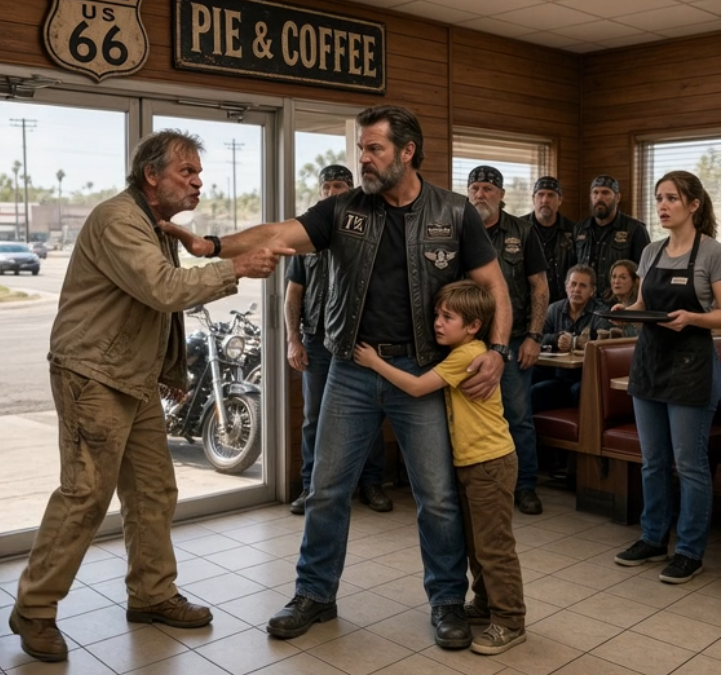
Before he could answer, the door swung open hard enough to smack the wall.
A man stepped inside.
Wrinkled shirt.
Sweating.
Red-faced.
Late thirties, maybe older if liquor and anger had done extra work on him. His hair was stuck to his forehead. Dust clung to his jeans. His eyes swept the room fast, searching.
Then they found Owen.
“Get over here,” he snapped.
Owen made a sound behind me.
Not quite a cry.
Not quite a word.
He pressed both hands into the back of my vest and hid.
The man took one step forward.
I did not raise my voice.
“He’s not going anywhere with you.”
The man stopped.
For the first time, he seemed to notice the room.
Mack standing near the door.
Carter rising from the booth.
Nolan on the phone.
Patty behind the counter with one hand beneath it, where I knew she kept a short wooden bat her father had carved from an old chair leg.
The trucker by the window.
The cook looking through the pass-through with a skillet still in his hand.
And me, standing between him and the boy.
“That’s my kid,” the man said.
Owen whispered behind me, “No.”
One word.
Small.
Terrified.
Enough.
The man’s eyes darted toward the parking lot.
Mack moved half an inch, blocking the door more completely.
“What’s your name?” I asked.
The man glared at me.
“None of your business.”
“It became my business when a barefoot child ran in here and asked not to be taken back.”
His jaw worked.
“I’m his stepdad.”
Owen whispered, “No.”
Again.
Nolan spoke from near the window, phone still in hand.
“Police are on the way.”
The man’s face changed.
That told me plenty.
Innocent men get annoyed when police are called.
Guilty men calculate exits.
This man calculated.
“There’s been a misunderstanding,” he said.
Patty’s voice cut across the diner.
“Funny how misunderstandings always sound like scared children when they walk in my café.”
The man pointed at Owen.
“He runs off. He lies. He’s got problems.”
Owen’s hands twisted in my vest.
I turned my head slightly.
“You okay?”
He shook his head.
Then tugged once, pulling me lower.
I crouched without taking my eyes off the man.
Owen leaned close to my ear.
“There’s a blue folder under the front seat,” he whispered. “He said if anyone saw it, everything would be my fault.”
The man lunged for the door.
Carter moved first.
He was fast for a man with bad knees.
Mack was faster.
They did not hit the man.
They did not have to.
Mack planted himself between the man and the exit like a brick wall grown from the floor.
Carter stood beside him.
The man stopped short.
For half a second, the café erupted.
Chairs scraped.
Patty told Owen to come behind the counter.
The trucker cursed.
Nolan relayed something into the phone.
I did not touch the man unless I had to.
I only stepped in front of him and said, very quietly:
“You are done frightening this child.”
That was when the first patrol car pulled into the lot.
Officer Daniel Reeves stepped out first.
I knew Reeves.
Ashford was small enough that everybody knew everybody if they had been arrested, helped, ticketed, warned, or fed in the same town for more than ten years.
Reeves was a steady cop. Former Marine. Not friendly exactly, but fair, which mattered more.
His eyes went from the motorcycles to the dusty sedan parked crooked near the edge of the lot, then to the man in the café doorway.
His expression hardened.
“Russell Crane,” he called. “Step away from the child.”
That name did something to the room.
Russell Crane.
So this was not the first time trouble had worn that face.
Russell lifted both hands, angry and false.
“I didn’t do anything.”
Officer Reeves kept his hand near his holster.
“I said step away.”
“He’s my wife’s kid.”
“Your wife is deceased, Russell.”
Owen flinched behind me.
I turned slightly.
His face had gone white.
Reeves noticed too and softened his voice without taking his eyes off Russell.
“Mack, keep the door clear.”
Mack looked at me.
I nodded.
He stayed where he was.
A second patrol car arrived. Officer Marissa Holt stepped out, younger than Reeves but sharp-eyed. Reeves pointed toward the sedan.
“Front seat. Blue folder.”
Russell shouted, “You can’t search my car!”
Holt looked at Reeves.
Reeves said, “Exigent circumstances. Child says evidence relevant to immediate safety is under the seat. Also, I can see the folder from here.”
Russell’s face drained.
Officer Holt opened the sedan door.
Owen stood behind Patty now, holding a glass of water with both hands. His knuckles were pale around it.
I stayed between him and Russell.
Holt crouched beside the open sedan.
She reached under the front seat.
She found the blue folder.
She did not say much.
Her face said enough.
She placed it carefully into an evidence bag and called for detectives.
Russell started shouting.
“He’s making it up! That boy lies! He steals! He runs! You don’t know what he is!”
Owen shrank.
I took one step toward Russell.
Reeves saw it.
“Bishop.”
I stopped.
Not because Russell did not deserve what my body wanted to do.
Because Owen deserved better than another frightening man in a room full of shouting.
So I turned away from Russell and walked to the counter.
Owen looked up at me.
His lower lip trembled harder now.
“You did good,” I said.
He shook his head.
“He said it would be my fault.”
“Bad men say that when they know it’s theirs.”
Patty set a plate of toast on the counter in front of him.
“Eat if you can, baby.”
Owen stared at the toast like it might vanish.
Then he took one corner and held it but did not bite.
A detective named Laura Benton arrived before sunset.
She came in wearing jeans, a dark blouse, boots dusty from the lot, and an expression I had seen before on people who dealt with the ugliest parts of humanity and still chose gentleness when children were watching.
She did not rush Owen.
She did not stand over him.
She did not start with questions.
She pulled a chair several feet away, sat down sideways so she did not face him too directly, and spoke like every word mattered.
“Hi, Owen. My name is Detective Benton. You do not have to say anything until you are ready. But when you are ready, I will listen.”
Owen looked at her.
Then he looked at me.
I gave him a small nod.
That was all he needed.
“He said my mom gave me to him,” Owen whispered.
Detective Benton nodded once.
“Did she?”
Owen shook his head.
“She got sick.”
“Okay.”
“She was in the hospital.”
“When was that?”
He looked confused.
“Before the motel.”
Detective Benton did not show frustration.
“Do you know your mom’s name?”
“Leah Crane. But she wasn’t married to him anymore. She said not to call him Dad.”
Russell shouted from near the door, where Reeves had him cuffed now.
“That boy doesn’t know what he’s talking about!”
Reeves tightened his grip.
“Quiet.”
Owen flinched.
Detective Benton waited until his eyes returned to her.
“What was in the folder, Owen?”
He looked at the evidence bag on the table near Officer Holt.
“Papers.”
“What kind of papers?”
“Mom’s papers. My papers. A letter with Aunt Sarah’s name. And pictures.”
Benton’s eyes sharpened.
“What pictures?”
Owen’s voice dropped.
“Pictures of bruises.”
Every adult in that café went still.
Benton did not react the way the rest of us did.
That was her skill.
She stayed steady so Owen could borrow steadiness from her.
“Did your mom take those pictures?”
Owen nodded.
“She said if anything happened, I needed the blue folder. She hid it. He found it.”
“Where was your mom when you last saw her?”
Owen looked down at the toast in his hand.
“Hospital. She told me to go with Nurse Amy, but he came first. He said Mom said I had to go with him. I said no. He squeezed my arm and smiled at the nurse.”
His face twisted.
“He smiles good when people look.”
That sentence told a whole life.
Detective Benton’s jaw tightened, but her voice remained gentle.
“Did he take you from the hospital?”
Owen nodded.
“He said we were visiting Aunt Sarah. But then we went to motels. He said Aunt Sarah didn’t want me.”
“Do you know Aunt Sarah’s last name?”
“Milton.”
Benton wrote it down.
“Do you know where she lives?”
“New Mexico. Maybe. Mom said mountains.”
“That helps.”
Russell began yelling again.
“He’s lying! Leah was a junkie! She gave him to me!”
I felt Carter shift beside me.
Patty slammed one palm on the counter.
“Shut your mouth in my café.”
The whole diner obeyed Patty before Russell did.
Reeves pulled Russell outside.
The moment the door closed behind them, Owen breathed.
Like he had been underwater and had only just realized air still existed.
Detective Benton looked at me.
“Can he stay near you while I ask a few more questions?”
I looked at Owen.
“You want me here?”
He nodded.
So I sat on the floor beside the counter because I was too big for the space and did not want to loom over him.
Owen leaned against my shoulder.
Not fully.
Just enough.
For the next hour, Detective Benton built a map out of broken pieces.
Owen’s mother, Leah, had been admitted to a hospital in Flagstaff after an emergency no one in the café needed to hear in detail. She had been conscious long enough to tell a nurse that her sister Sarah Milton had legal documents and should be contacted if Leah could not care for Owen. Russell Crane, Leah’s ex-husband but not Owen’s father, had shown up before anyone verified anything. He had taken Owen, claiming family authority.
The blue folder held the truth.
A protective order Leah had filed months earlier.
Photographs documenting injuries.
A notarized statement naming Sarah Milton as the person Leah wanted contacted.
Owen’s birth certificate.
Social Security card.
A letter from Leah addressed to Sarah.
And a handwritten note from Leah to Owen.
Detective Benton did not read that note aloud.
She only looked at it for a long time, then placed it back in the folder like it weighed more than paper.
Russell had hidden the folder under the front seat because he needed the documents and feared destroying them would create other problems. He had told Owen that if anyone saw it, his mother would get in trouble, his aunt would not want him, and everything would be Owen’s fault.
Bad men do not always need chains.
Sometimes they use guilt.
By the time the detectives finished the first round, Russell Crane was under arrest.
Custodial interference.
Child endangerment.
Violation of protective order.
Evidence tampering.
More charges would come later.
I wish I could tell you Owen relaxed when they put Russell in the patrol car.
He did not.
Children do not become safe the moment danger leaves the room.
Their bodies keep guarding doors long after the lock changes.
A woman from child protective services arrived after dark.
Her name was Tessa Morales.
She carried a soft blue blanket, a clean pair of socks, and the heavy expression of someone who had been called too many times after adults failed at the beginning.
She crouched beside Owen.
“Hi, Owen. I’m Tessa. I’m going to help figure out what happens tonight.”
Owen looked at me.
“Do I have to go with her?”
I did not answer quickly.
That mattered.
“Yes,” I said gently. “But not like before. She’s not taking you to Russell. She’s taking you somewhere safe while Detective Benton finds your aunt.”
“Will you come?”
The question hit me straight in the chest.
Tessa looked at me.
Detective Benton looked at me.
Patty looked at me.
Eight bikers, one waitress, two cops, a trucker, and a cook waited.
I had no legal right to go anywhere with that boy.
I also had no right to disappear from his life after becoming the person he clung to in the worst hour of it.
I looked at Tessa.
“What are the rules?”
Tessa studied me for one second.
Then she said, “You can follow us to the child advocacy center. You can sit in the waiting room if Owen wants. You cannot interfere with interviews or medical care. You cannot make placement promises. And you will give me your full name, date of birth, and consent to a background check if this contact continues.”
Nolan snorted.
“Bishop getting background-checked. That’ll be a short novel.”
I ignored him.
“My name is Grant Harlan,” I said.
Owen looked up.
“I thought your name was Bishop.”
“That’s what my brothers call me.”
“Why?”
“Long story.”
“Is it bad?”
“Embarrassing.”
That almost made him smile.
Almost.
At the advocacy center, Owen sat in a room with soft chairs, muted lights, and shelves of toys that looked too clean to be real. He refused to remove the socks Tessa gave him even though they were too big. He drank two juice boxes. Ate crackers. Fell asleep sitting upright against my side while adults spoke in low voices across the hall.
I sat there for four hours.
Mack and Carter waited outside in the parking lot the entire time.
Patty sent sandwiches with Nolan.
At two in the morning, Detective Benton came into the waiting room.
She looked tired.
But not defeated.
“We found Sarah Milton,” she said.
Owen stirred against my arm but did not wake.
“She lives outside Santa Fe. She has been looking for him for nine days.”
I closed my eyes.
Nine days.
“She reported him missing?”
“Yes. In New Mexico and Arizona. Hospital records were a mess. Russell used an old address and lied about destination. Sarah had no vehicle for the first few days and couldn’t get straight answers. She’s on her way now.”
“Is she safe?”
Benton nodded.
“Preliminary checks are clean. Tessa is verifying emergency kinship options. We’ll move carefully.”
Owen woke enough to hear one word.
“Aunt Sarah?”
Benton crouched.
“We found her.”
His face folded.
Not crying at first.
Just collapsing inward.
Then the sob came.
Small body.
Huge grief.
I did not tell him it was okay.
It was not.
I put one hand gently on his back and said, “She’s coming.”
He cried harder.
“She’s coming,” I repeated.
Sometimes hope hurts when it returns.
Sarah Milton arrived at 6:18 the next morning in a borrowed pickup with New Mexico plates, wearing jeans, no makeup, and the face of a woman who had spent the night driving through fear.
She ran into the advocacy center, then stopped when Tessa raised a hand.
Not because she did not want to grab Owen.
Because she loved him enough to be told how.
Owen stood behind my chair.
He peeked around me.
Sarah covered her mouth.
“Owen.”
His whole body trembled.
“Aunt Sarah?”
“Yeah, baby.”
He ran.
She dropped to her knees and caught him so hard they both nearly went over.
She cried into his hair.
He cried into her shoulder.
I stood there like an idiot with my hands hanging uselessly at my sides, feeling something inside me break open.
Sarah kept saying, “I looked for you. I looked everywhere. I promise I looked.”
Owen said something I could not hear.
She held him tighter.
“I know. I know. None of it was your fault.”
There it was.
The sentence he needed more than food, water, socks, police, bikers, detectives, or evidence.
None of it was your fault.
Tessa gave them time.
Not forever.
Systems never give forever.
But enough.
By noon, emergency kinship placement had begun. Sarah would stay locally while paperwork moved. There would be court hearings. Interviews. Verification. The kind of slow adult machinery children hate but need when done correctly.
Before leaving the center, Owen came to me.
He wore shoes now.
Someone had found a pair in the donation closet.
Blue sneakers with white stripes.
He looked down at them.
“They’re not mine.”
“They can be.”
He considered that.
Then looked up.
“Are you leaving?”
“For now.”
“Will I see you again?”
I felt every adult in the hallway listening.
I chose my words carefully.
“If your aunt and the people in charge say it’s okay, I’d like that.”
He frowned.
“That’s not a promise.”
“No.”
“Why?”
“Because I don’t get to make all the rules.”
He studied me.
“But if they say yes?”
“Then yes.”
Owen nodded.
Then he held out his hand.
I shook it.
His hand vanished inside mine.
“Thank you for not being a bad man,” he said.
I could not speak for a second.
“You’re welcome.”
He left with Sarah holding one hand and Tessa holding the folder.
The blue folder.
The one Russell had tried to hide.
The one Owen had remembered.
The one that proved a child who had been called a liar had been carrying the truth all along.
For the next several weeks, Miller’s Café felt different.
Same coffee.
Same grease.
Same rattling air conditioner.
Same sun burning the road outside.
But every time the bell above the door rang, I looked.
Mack did too.
So did Patty.
Owen had changed the room.
Children do that.
They enter a place you thought you understood, and suddenly every corner holds the possibility of need.
Russell Crane’s case moved forward.
More evidence came out.
None of it belonged in a diner story.
What mattered was this: Owen had told the truth. Leah had tried to protect her son. Sarah had looked for him. Russell had lied. And the blue folder made all the difference because one frightened boy ran into the right room and trusted the people everyone else feared.
Leah survived the hospital.
That part surprised us.
She was not suddenly well. Life is rarely generous enough for clean endings. She had recovery ahead of her, legal matters, supervised contact, treatment, grief, and the long work of becoming someone Owen could safely know again.
Sarah did not speak badly of her.
Neither did I.
Owen loved his mother.
That mattered.
Loving someone unsafe is one of the cruelest knots a child can carry.
Three months later, Sarah brought Owen to Miller’s Roadside Café.
It was a Saturday.
Our bikes were outside.
We were in the same back booth.
The bell rang.
I looked up.
Owen stood in the doorway wearing blue sneakers, clean jeans, and a green T-shirt with a dinosaur on it. His hair had been cut. His cheeks had filled out a little. He held Sarah’s hand, but he was not hiding behind her.
Patty burst into tears before anyone said a word.
“Oh, for heaven’s sake,” she muttered, wiping her face. “I am too old for children with improved nutrition.”
Owen smiled.
Actually smiled.
He walked to our table.
“Hi, Bishop.”
“Hey, buddy.”
“I’m not lost.”
“No. I can see that.”
He looked around the table at Mack, Carter, Nolan, and the rest.
Then he leaned closer to Sarah and whispered loudly, “Those are the bikers.”
Sarah looked at us with tears in her eyes.
“Yes,” she said. “I know.”
She shook every hand.
When she got to me, she held on longer.
“Thank you,” she said.
I nodded.
Words felt too small.
Owen climbed into the booth beside me without asking. Patty brought pancakes with extra syrup because apparently she had appointed herself head of recovery nutrition.
Owen ate like a boy who trusted the plate would stay until he finished.
That was when I knew he was healing.
Not healed.
Healing.
There is a difference.
Before he left, he handed me something.
A drawing.
Eight motorcycles outside a diner.
A little stick figure boy in the doorway.
A giant bearded stick figure between him and a red scribble labeled BAD MAN.
Above it, in crooked letters, he had written:
GOOD MEN CAN LOOK SCARY.
I framed it.
It hangs in our clubhouse now.
Right beside the ride maps.
Under it, Mack put a small brass plate that reads:
Believe the whisper.
That became our rule.
Not official at first.
Then very official.
The Iron Watch Riders started a fund that year with Patty and Detective Benton’s help. Shoes, motel vouchers for kinship families traveling for emergency placements, gas cards for relatives driving across state lines, trauma-informed teddy bears at the advocacy center, diner meal cards for children waiting through interviews and court delays.
We called it the Blue Folder Fund.
Eleanor Grant from another county heard about it and sent us paperwork templates because women like that can sense when men with good intentions need forms before they hurt themselves administratively.
Detective Benton trained us on what to do and, more importantly, what not to do.
Do not interrogate children.
Do not promise outcomes.
Do not post stories online.
Do not chase suspects.
Do not contaminate evidence.
Do not confuse anger with protection.
Stay calm.
Call professionals.
Make space.
Listen.
Believe the whisper.
Russell Crane took a plea nearly a year later.
Owen did not have to testify in open court.
Detective Benton made sure of that.
The blue folder, hospital records, officer statements, and other evidence carried enough weight. Russell went to prison. Not forever. Never long enough, if you ask men like us. But long enough for Owen to grow without his shadow at the door.
Leah entered treatment.
Sarah became Owen’s legal guardian.
The first time Owen’s school held a family day, he invited Sarah, his mother for a supervised hour, Detective Benton, Patty, and me.
His teacher looked alarmed when I walked in.
Owen announced, “This is Bishop. He’s not one of the bad men.”
I waved.
The teacher said, “Good to know.”
At the end of the year, Owen wrote a short report about heroes.
Most kids wrote about firefighters, soldiers, parents, superheroes.
Owen wrote:
A hero is somebody who stands in front of the door until help comes.
Sarah sent me a picture of it.
I kept that too.
Years have passed now.
Owen is taller.
Still cautious in new rooms.
Still checks exits.
Still loves pancakes.
Still wears shoes every day like he knows exactly what barefoot means.
He visits Miller’s sometimes with Sarah. He no longer runs to me, but he always comes over. Fist bump now. He says hugs are for little kids, then sometimes gives one anyway when he thinks nobody is looking.
Patty pretends not to cry every time.
The café still gets quiet when strangers in trouble walk in.
Not from fear.
From attention.
There is a difference.
People in Ashford still look at us before they hear us speak.
They still see leather, scars, motorcycles, and old men with more past than polish.
Some still decide the story before the first page is read.
That is their mistake.
A frightened little boy once read us differently.
He walked past every soft face in Miller’s Roadside Café and chose the scariest table in the room because somewhere in his six-year-old heart, fear had taught him something most adults forget.
Sometimes danger looks friendly.
Sometimes safety looks like a wall.
Sometimes a child does not need the sweetest voice in the room.
Sometimes he needs the person least likely to move when the door swings open.
I still remember Owen’s hand on my vest.
The way he asked if I was one of the bad men.
The way he whispered, “Please don’t let him take me back.”
The way everything after that became simple.
Not easy.
Simple.
Stand between.
Call help.
Listen.
Believe.
And do not look away.
Because the truth is, most of us are not tested by grand battles.
We are tested by small voices.
A child at a diner door.
A whisper behind a leather vest.
A blue folder under a front seat.
A moment when looking away would be easier and quieter and none of your business.
That day, eight bikers everyone feared became exactly what one frightened boy needed.
Not heroes.
Not saviors.
Just men who stayed.
Men who blocked a door.
Men who believed the whisper.