PART3:
Associates assigned sections.
Garden center.
Restrooms.
Pharmacy.
Grocery.
Apparel.
Parking lot.
You would not think a Walmart could feel enormous until you were searching for one missing person inside it.
People hear store and picture aisles.
They forget stockrooms.
Bathrooms.
Garden areas.
Pharmacy waiting spaces.
Dressing rooms.
Offices.
Parking lots stretching beneath heat shimmer.
Delivery areas.
Vestibules.
Restaurants.
Corners where somebody can fall and disappear behind a crowd.
Lucy sat on the customer-service bench with her backpack beside her.
Her feet did not reach the floor.
She kept twisting the straps around her fingers.
I checked the backpack.
I hated doing it, but identification mattered.
Stuffed rabbit.
Apple-juice box.
Crayon drawing.
Pink plastic sunglasses.
One sock.
Why only one sock, I will never know.
No wallet.
No visible emergency card.
No phone number.
No useful address.
I remember thinking that if I ever had children, I would put my phone number on everything they owned.
It is easy to become an expert after somebody else’s emergency begins.
Our security officer was Dennis Cole.
Former Army.
Forty-two.
Solid.
Careful.
Not the kind of person who panicked easily.
He stood several feet from Lucy and spoke into his radio.
“Check the cereal aisle again. Pharmacy too.”
Lucy stared at every woman walking past.
Each time one came close, hope lifted her face.
Each time the woman continued, hope disappeared.
I had never watched hope hurt that many times in ten minutes.
Then the bikers entered.
I heard them before I really looked.
Heavy boots.
Leather.
Low voices.
Not rowdy.
Nothing dramatic.
Just the subtle change that happens in a public space when people notice a group they do not immediately understand.
Four men entered together.
The biggest walked first.
Wesley Mercer.
Nobody called him Wesley.
His brothers called him Grim.
I later learned why.
Not because he enjoyed hurting people.
Because he almost never smiled.
That first day, all I saw was size.
Six-foot-four.
Maybe 280 pounds.
Shaved head.
Thick salt-and-pepper beard.
Bent nose.
Both arms tattooed almost completely.
Hands scarred across the knuckles.
A pale scar crossed the left side of his face from near his eyebrow to below his cheekbone.
His black leather cut carried Mongols colors.
I saw the patch.
Dennis saw it.
Half the front end of the store saw it.
A father shopping with two boys moved them closer.
An older woman shifted her purse to the opposite shoulder.
One associate whispered:
“Oh, great.”
That detail bothers me now too.
Grim noticed all of it.
He reacted to none of it.
He pushed a cart toward pharmacy.
His brothers stayed several feet back.
They looked intimidating too.
One white.
One Black.
One Latino.
One younger guy with a shaved head and a red beard.
None behaved badly.
None raised voices.
None stared at Lucy.
Grim began shopping.
Children’s pain reliever.
Strawberry toothpaste.
Pink adhesive bandages.
Two boxes of crayons.
Bubble bath.
Shampoo.
Flashlights.
Night-lights.
A few paperback books.
At the time, those items made no sense together.
I assumed he was shopping for family.
Lucy noticed him.
Not the other bikers.
Grim.
She stopped crying.
That should have interested me.
Instead it worried me.
She slid off the bench.
“Lucy.”
She ignored me.
“Sweetheart, stay here.”
She walked toward Grim.
Dennis took one step.
I shook my head.
“Maybe she knows him.”
We watched.
Lucy passed an assistant manager.
Passed Dennis.
Passed an elderly customer who smiled and held out a tissue.
She continued toward the biggest man in the building.
Grim stood comparing two bottles of bubble bath.
He looked absurdly serious about it.
Lucy stopped beside him.
He did not notice immediately.
She reached up.
Took his ring finger.
Grim froze.
The entire upper half of his body stopped moving.
He looked down.
Lucy’s hand looked impossibly small around one finger.
For several seconds, neither spoke.
Then Lucy said:
“Can you keep me?”
Grim stared at her.
She added:
“I’m scared.”
He looked around.
Actually looked behind himself as if another adult might be the intended recipient.
Nobody.
Grim set the bubble bath into his cart.
Then he crouched.
Slowly.
No touching.
“You lost?”
Lucy nodded.
“What’s your name?”
“Lucy.”
“Lucy what?”
“Carter.”
“Okay.”
His voice surprised me.
Deep.
Rough.
But quiet.
“You know your mama’s phone number?”
“No.”
“Where’d you see her last?”
“The cereal.”
“Then?”
“Juice.”
“Then?”
“She was gone.”
Grim looked toward us.
“You looking for her?”
Dennis answered.
“Yes.”
Grim nodded once.
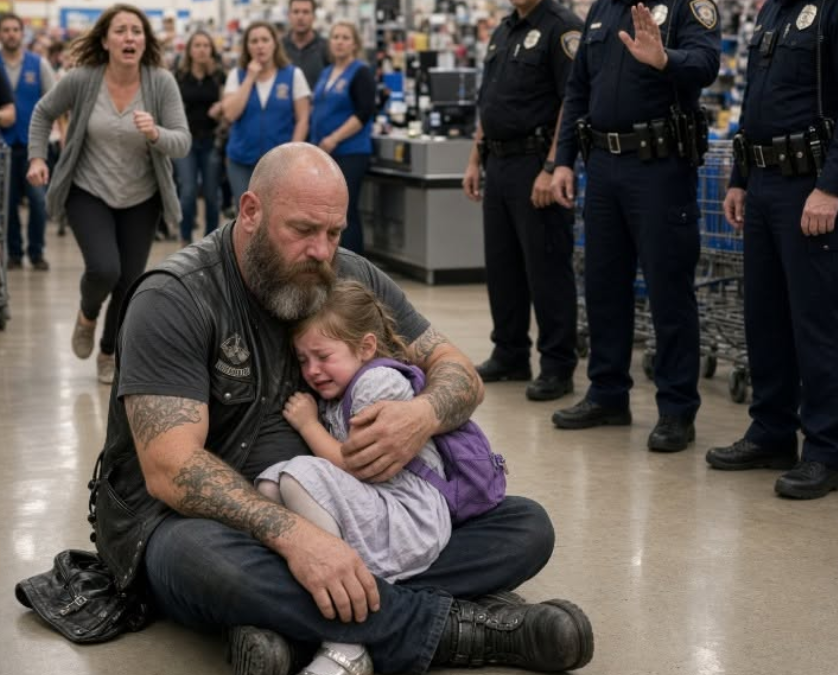
Then sat down.
Right there on the tile.
Cross-legged.
Like a six-foot-four biker deciding Walmart’s floor was the most reasonable chair in Oklahoma.
He had not invited Lucy onto him.
That matters.
She chose.
She stepped between his knees.
Then climbed into his lap.
Grim’s hands lifted instinctively, then stopped in the air.
He looked at me.
“Can I?”
I did not know what he was asking.
Then I realized.
Permission to support her.
I nodded before Dennis could speak.
Grim put one hand lightly behind Lucy’s back.
Not closing.
Just there.
Lucy curled against his chest.
Her cheek rested against the leather.
Both fists clutched his vest.
Her body changed immediately.
That was the first thing we should have respected.
Her shoulders dropped.
Her breathing slowed.
She stopped scanning every face in the crowd.
She still looked scared.
But the panic eased.
Dennis approached.
“Sir?”
Grim looked up.
“We need the child back with an employee.”
Grim glanced at Lucy.
“Ask her.”
Dennis’s expression tightened.
“This is not optional.”
Grim’s voice stayed calm.
“I’m not taking her anywhere.”
“You’re an unidentified adult holding a missing child.”
“Then identify me.”
Dennis paused.
Grim reached toward his pocket.
Slowly.
Two fingers.
Pulled out a wallet.
Placed it on the floor.
“ID’s inside.”
Dennis collected it.
“Thank you.”
“Now ask her.”
I knelt a few feet away.
“Lucy?”
She turned her face just enough to look.
“Do you want to sit with me again?”
“No.”
“With Mr. Dennis?”
“No.”
“Do you want to stay there?”
She nodded.
Then buried her face back against Grim.
Dennis whispered to me:
“We can’t do this.”
“What do you want me to do?”
“Remove her.”
“You want to physically pull her off him?”
He looked toward Grim’s vest.
I followed his eyes.
That patch was doing a lot of talking for a piece of leather.
Dennis said:
“We’re responsible for her.”
“So keep watching.”
“If something happens—”
“He hasn’t moved.”
“He refuses to release her.”
“He hasn’t been asked by her.”
Dennis looked frustrated.
Grim heard us.
“Look.”
He slowly removed his vest.
Lucy made a frightened sound as the leather shifted.
“Easy.”
Grim folded the cut and placed it beside him.
Now he wore only a faded charcoal T-shirt.
Tattoos visible from shoulders to wrists.
“No patch.”
He looked at Dennis.
“Still scared?”
Dennis did not answer.
Grim’s expression stayed flat.
“Figured.”
Behind him, his brothers had started moving closer.
That changed the room instantly.
Dennis put one hand near his radio.
Our assistant manager stepped forward.
Customers began filming.
One person whispered:
“They’re surrounding security.”
Another said:
“Call the cops.”
I saw the younger biker tense.
Grim saw him too.
He raised one hand.
Pointed toward the grocery entrance.
“Back up.”
The younger rider stopped.
“Grim—”
“Back.”
The man obeyed.
All three riders moved away.
One of them, Calvin Haskins, the one they called Rook, said:
“Brother, we’re not leaving you.”
Grim looked at him.
“You can see me from there.”
Rook nodded.
They backed almost thirty feet.
That should have told us something too.
Power did not seem to interest Grim.
Control did.
Not control over Lucy.
Control over everybody else so she did not get more frightened.
At minute six, Lucy asked:
“Can bad people come in Walmart?”
Every adult near them went still.
Grim looked down.
“Sometimes.”
Dennis frowned, probably wishing he had said no.
Lucy asked:
“Can they take kids?”
Grim did not give her some ridiculous promise that bad things never happen.
“No one’s taking you while all these people are looking for your mom.”
“Will you stop them?”
Grim paused.
“If they show up.”
Lucy accepted that.
Five-year-olds value certainty more than eloquence.
At minute eight, police were on the way.
Not because Grim had committed a crime.
Because a lost child was involved and the situation had become crowded.
Grim knew they were coming.
He did not run.
Did not argue.
Did not call his club brothers over.
He stayed seated.
Hands visible.
Lucy wrapped around him.
At minute nine, she touched the scar on his face.
Grim flinched.
Not much.
Enough.
“What happened?”
“A window.”
Lucy frowned.
“A bad guy broke it?”
“No.”
“How?”
“Truck rolled.”
“Were you driving fast?”
“No.”
“Then why did it roll?”
“Somebody else was.”
Lucy considered this.
Then touched the scar again.
Grim allowed it.
I remember thinking children sometimes ask exactly the questions adults avoid.
We see a scar and wonder.
They ask.
We see a patch and decide.
They ask.
We see tattoos and create a biography.
They ask what the picture means.
Two police officers arrived around minute eleven.
Officer Daniels and Officer Ruiz.
Daniels approached first.
“Mr. Mercer?”
Grim nodded.
“You mind if I see your hands?”
Grim opened them.
Lucy was wrapped around his waist now.
Her legs locked against him.
Daniels glanced at Dennis.
“Situation?”
Dennis explained.
Lost child.
Mother being searched for.
Child independently approached Grim.
Grim remained in supervised area.
No attempt to leave.
Refused staff transfer because Lucy became distressed.
Grim interrupted.
“I didn’t refuse.”
Daniels looked at him.
“What would you call it?”
“Waiting.”
“For?”
“For her to stop being scared.”
Daniels looked at Lucy.
“Sweetheart, can I talk to you?”
“No.”
“You know I’m a police officer?”
Lucy peeked.
“Yes.”
“Police help lost kids.”
She thought.
Then:
“He’s bigger.”
Ruiz coughed to hide a laugh.
Daniels looked at Grim.
Grim shrugged.
“Her logic.”
The officers took his identification.
Confirmed it.
No active warrants.
No immediate issue requiring removal.
They still wanted Lucy under store or law-enforcement control.
Understandably.
But every attempt to move her increased panic.
One step toward Grim and Lucy’s fingers tightened.
Another and she cried.
At minute thirteen, Officer Ruiz’s radio came alive.
A woman had been found near pharmacy.
Medical issue.
Possible connection to missing child.
My stomach flipped.
“What kind of medical issue?”
He listened.
“Low blood sugar. She collapsed.”
I looked at Lucy.
Cereal.
Juice.
Mom vanished.
Not abandonment.
Not distraction.
Not someone walking off.
Medical emergency.
Then a woman ran toward us.
Barely ran.
More staggered quickly.
Brown hair.
Pale face.
One employee supporting her elbow.
“Lucy!”
The little girl’s entire body jolted.
“Mommy!”
She scrambled off Grim so fast his arms instinctively opened.
Emily Carter dropped to her knees.
Lucy slammed into her.
Mother and daughter collapsed together.
Emily kissed Lucy’s hair.
Her forehead.
Her cheeks.
“I’m sorry.”
Again.
“Oh my God, I’m sorry.”
Lucy sobbed.
“I couldn’t find you.”
“I know.”
“You left.”
“No.”
Emily’s face shattered.
“No, baby. No. I got sick.”
“You left.”
“I know it felt like that.”
Grim looked away.
That was the first time his scarred hand trembled.
I noticed.
So did Rook.
Emily held Lucy.
Lucy held Emily.
And still one of Lucy’s hands reached backward.
Searching.
Her fingers found Grim’s boot.
Then his hand.
She held him too.
The three of them remained on that floor in a strange human knot.
Mother.
Daughter.
Stranger.
Fear did not switch off simply because the emergency ended.
Emily looked at Grim.
For the first time, really looked.
Shaved head.
Scar.
Tattoos.
Club vest folded beside him.
Her expression changed.
Not disgust.
Confusion.
“Were you with her?”
Grim nodded.
Lucy answered:
“He kept me.”
Emily’s eyes widened slightly.
Grim said:
“She means I sat here.”
“I didn’t mean—”
“It’s fine.”
Emily looked at Lucy.
“Why him?”
Lucy blinked.
“What?”
“There were employees. Police. Nice ladies.”
Lucy shrugged.
Grim looked down.
Emily tried again.
“Why did you go to him?”
Lucy opened her mouth.
Then the crowd shifted.
Questions.
Radios.
People filming.
A medic approached Emily.
The answer got lost.
At least for the moment.
Emily’s medical problem turned out to be severe hypoglycemia.
She had type 1 diabetes.
She worked nights as a nursing assistant at a rehab center.
Finished a double shift that morning.
Ate poorly.
Insulin timing got off.
She started sweating in cereal.
Tried to reach pharmacy.
Collapsed.
Two shoppers caught her.
Someone moved her cart.
Lucy followed the wrong cart.
Seven minutes.
That was all.
Seven minutes is nothing to an adult.
To a five-year-old, it can become a whole world.
Emily did not abandon her child.
I need to say that clearly because later, strangers online did not.
Emily agreed to be evaluated but declined hospital transport once her glucose stabilized.
Her friend was coming.
Until then, she remained with Lucy.
Grim should have left.
He had somewhere to be.
We did not know that.
His cart of children’s supplies was still near pharmacy.
The popsicles inside were softening.
Rook checked his watch twice.
Finally I asked:
“Are you guys late for something?”
Rook looked at Grim.
Grim said:
“We’re fine.”
Rook frowned.
Grim gave him a look.
Conversation over.
Later, I learned they were supposed to deliver those supplies to a children’s group home in Norman before 4:30.
Fourteen children lived there.
The Mongols riders went the final Saturday of every month.
No cameras.
No social posts.
No roaring motorcycles outside.
In fact, Grim required the bikes be parked down the block because several kids at the home were sensitive to loud noise.
The pink bandages.
Crayons.
Bubble bath.
Toothpaste.
Pain medicine.
All of it was for children.
We saw the patch.
We did not see the destination.
That still bothers me.
Emily sat down beside Grim.
Dennis asked the other bikers to step outside.
Grim gave one hand signal.
They obeyed immediately.
That surprised Dennis.
He later told me:
“I expected resistance.”
Instead, twenty seconds later, every rider was outside.
No argument.
No chest puffing.
No “you can’t tell us what to do.”
Grim did not need an audience.
That was when I started feeling ashamed of some of my assumptions.
Officer Daniels returned his ID.
“You have a scarier license photo than actual face.”
Grim accepted the card.
“Worked hard on it.”
Daniels almost smiled.
Lucy had calmed enough to study Grim again.
She touched the scar.
“Did a bad guy do that?”
“A window.”
Emily whispered:
“Lucy.”
Grim shook his head.
“It’s okay.”
“Did the window get arrested?”
That got an actual laugh out of Officer Ruiz.
Grim’s mouth twitched.
“No.”
“It should.”
“Probably.”
Lucy looked at the pink bandages in his cart.
“Those yours?”
“No.”
“Your kid’s?”
The change in Grim was immediate.
Tiny.
But I saw it.
Jaw tightened.
Rook looked away.
“No.”
“Then whose?”
“Some kids I know.”
Lucy picked up the package.
“Girls?”
“Some.”
“I like pink.”
“Apparently.”
She smiled.
Then something slid from beneath Grim’s sleeve.
A faded purple plastic bracelet.
Too small for his wrist.
Old.
Scratched.
The kind hospitals put on patients.
One name was still readable.
MADDIE.
Lucy touched it.
“Who’s Maddie?”
Grim pulled his sleeve down.
“Someone who got lost.”
Rook closed his eyes.
Emily looked at him.
I did too.
Grim clearly did not intend to explain.
That should have been the end.
Then the internet decided otherwise.
The first video went online before Emily even left the store.
Twenty-two seconds.
That is all.
Twenty-two seconds from a fifteen-minute situation.
The clip began with Grim holding Lucy.
Dennis standing above him.
Dennis saying:
“I need you to release the child.”
Grim saying:
“Ask her.”
Lucy’s face mostly hidden.
Someone behind the phone whispered:
“That biker won’t give her back.”
End.
No context.
No beginning.
No Lucy walking to him.
No Grim asking permission.
No employees watching continuously.
No mother missing due to medical emergency.
No Grim ordering his club brothers away.
No police cooperation.
No reunion.
Just:
Biker refuses to surrender missing child.
Twenty minutes later:
Mongols member holds lost five-year-old despite Walmart security demands.
Then:
OUTLAW BIKER REFUSES TO GIVE CHILD BACK.
Then:
ATTEMPTED KIDNAPPING AT OKLAHOMA WALMART?
Question marks are useful things online.
You can accuse anyone of anything if you place punctuation at the end.
By the time Emily, Lucy, and Grim reached the parking lot, one repost had twenty thousand views.
Rook showed Grim.
“Brother.”
Grim watched the clip without sound.
“They’re calling you a kidnapper.”
“I know words.”
“They used the club name.”
That changed the other riders.
I saw it.
Not rage exactly.
Concern.
One lie about one patched member can become a headline about everybody.
A younger biker named Nash said:
“We need the full footage.”
“We’ll handle it.”
“We go inside—”
Grim looked up.
“No.”
“They’re saying you tried to take a kid.”
“Then twenty Mongols march into Walmart demanding surveillance video?”
Nash stopped.
Grim waited.
“What picture do they get?”
Nash’s shoulders lowered.
“The wrong one.”
“Exactly.”
Rook said:
“We can call legal.”
“Call legal.”
“Club statement?”
“No.”
“Grim—”
“Not yet.”
Then a gray SUV pulled into the lot too fast.
Thomas Carter got out.
Emily’s father.
Lucy’s grandfather.
Mid-sixties.
Broad.
Former construction foreman, I later learned.
Already angry before he reached us.
Someone had sent him the video while he was driving.
He saw the patch first.
Then his granddaughter’s hand in Grim’s.
Everything exploded.
“Get away from her.”
Grim released Lucy immediately.
Lucy grabbed him again.
Thomas crossed the distance.
Shoved Grim square in the chest.
Every biker moved.
Rook.
Nash.
Two others.
Not attacking.
Moving.
But fast enough.
Grim turned his head.
“Hold.”
One word.
All of them stopped.
Thomas shoved him again.
Grim did not lift his hands.
That impressed me more than almost anything else he did.
He understood cameras were everywhere.
One defensive push from a giant biker against an angry grandfather and the story would become permanent.
So he kept his hands beside his thighs.
Thomas yelled:
“You kept her from security!”
“No.”
“I saw the video.”
“You saw twenty-two seconds.”
“You think that vest gives you the right to touch somebody’s child?”
“No.”
Thomas drew his fist back.
Emily caught his wrist.
“Dad.”
“Move.”
“No.”
“She was in his lap.”
“Because she climbed there.”
“He wouldn’t give her back.”
“She didn’t want him to.”
Thomas looked at his daughter.
That was the first crack.
Lucy stepped around him.
Took Grim’s finger again.
“Grandpa, he kept me.”
Thomas stared.
“Kept you from what?”
Lucy shrugged.
“The bad people.”
“What bad people?”
“The ones who maybe came.”
Thomas looked at Grim.
“You tell her that?”
“No.”
“Then where’d she get it?”
Grim’s scar moved slightly as his jaw tightened.
“You ever been five and lost in a store?”
Thomas did not answer.
A news van arrived.
I still do not know who called them.
Maybe a customer.
Maybe someone tracking the viral clip.
Reporter.
Camera operator.
Microphone.
The exact ingredients needed to turn pain into programming.
The reporter approached.
“Mr. Mercer?”
Grim ignored him.
“We understand a video shows you refusing to surrender a missing child.”
“No.”
“Did security ask you to release her?”
“Yes.”
“And you refused?”
Grim looked at Lucy.
“I waited.”
“For what?”
“For her.”
The reporter glanced at Lucy.
“Why would a five-year-old child choose an adult member of an outlaw motorcycle club over store employees?”
I hated the phrasing.
So did Emily.
Before either could respond, Lucy did.
“Because he was the biggest.”
The reporter lowered the microphone slightly.
“What?”
Lucy pointed at Grim.
“He was the biggest one.”
Thomas frowned.
“That’s why?”
Lucy nodded.
“Bad people are scared of big people.”
She spoke like she was explaining basic arithmetic.
“So I picked the biggest.”
For a second, even the parking-lot traffic seemed quieter.
Then Lucy added:
“And his face already got hurt.”
Grim’s eyes moved toward her.
She touched the scar again.
“So maybe he knows how being scared feels.”
Grim’s hand began shaking.
Not dramatically.
Just enough.
Rook whispered:
“Maddie said that too.”
Grim turned.
“Rook.”
Too late.
The reporter heard.
“Who’s Maddie?”
Grim walked away.
Three steps.
“Mr. Mercer?”
Four.
Lucy cried:
“Mr. Big Man!”
He stopped.
She ran after him.
Emily started to follow.
I did too.
Lucy reached Grim beside his Road King.
He turned.
She was still carrying his purple bracelet.
I had not noticed she had taken it.
Grim knelt.
“You keep that?”
Lucy held it up.
“Who’s Maddie?”
He stared.
Not ready.
Not there.
Not in a parking lot.
Not with a camera.
He gently closed Lucy’s fingers around the bracelet.
“Hold it till I come back.”
“Where are you going?”
“To get your picture.”
“What picture?”
Grim looked toward the store.
“The one you made.”
He returned inside.
Not for surveillance.
For Lucy’s backpack.
I handed it over.
“What are you looking for?”
He unzipped the small front pocket.
Pulled out her crayon drawing.
I remembered seeing it.
Three figures.
A woman with brown hair.
A small yellow figure.
A huge black figure with arms spread wide.
Jagged marks around him.
Grim stared.
“That you?” I asked.
“Guess so.”
“What are those?”
The jagged marks.
He studied them.
Lucy later explained.
Bad people flying away.
Grim folded the picture.
Then his fingers found something inside the inner lining.
A laminated card.
Stitched in.
Emily Carter.
Phone number.
Address.
Allergy information.
Emergency contact.
Everything we had needed.
I stared.
“How did we miss that?”
“You looked in the bag.”
“Yes.”
“Not the lining.”
“How did you know?”
Grim looked down.
That purple bracelet again.
“Maddie House puts them there.”
“What’s Maddie House?”
He did not answer.
Not yet.
Back in the parking lot, Grim handed the backpack to Emily.
“Put your phone number where she can find it faster.”
Emily’s shoulders collapsed.
“I should’ve—”
Grim shook his head.
“Before’s closed.”
She looked at him.
“What?”
“Before’s closed.”
He pointed gently toward Lucy.
“Teach her now.”
No accusation.
No lecture.
Just forward.
Thomas approached.
Slower.
“I owe you an apology.”
Grim nodded.
Thomas offered his hand.
Grim glanced toward Lucy.
She still held the bracelet.
He did not take Thomas’s hand.
Not disrespect.
His own hand was occupied.
The reporter asked again:
“Who is Maddie?”
Grim ignored him.
Rook did not.
“His daughter.”
The world changed.
Grim looked at him.
“Rook.”
“She’s already here, brother.”
“No.”
Rook pointed at the purple bracelet.
“She’s been here every mile since Tulsa.”
The bikers gave Grim space.
Nobody crowded him.
Nobody forced.
He sat on his Harley.
The parking-lot heat shimmered around us.
I should have walked away.
It was private.
But Grim looked at Lucy.
Then at Emily.
Then at the bracelet.
Maybe he realized the story had already opened.
“My daughter was five.”
Lucy stopped moving.
Grim continued.
“Her name was Maddie.”
Twenty-two years earlier, Grim had been twenty-eight.
Recently divorced.
Working nights at a tire shop in Tulsa.
His marriage had been ugly near the end.
Not violent, he insisted.
But Grim had a temper back then.
Bar fights.
Drinking.
Bad decisions.
The kind of history family courts notice.
His ex-wife had primary custody.
After months of supervised visitation, Grim earned his first unsupervised weekend.
He planned everything.
Zoo.
Pizza.
State fair.
Maddie wanted the fair most.
“She liked rides?” Lucy asked.
“Hated them.”
“Then why?”
“Cotton candy.”
Reasonable.
They went.
Maddie wore purple.
Purple shoes.
Purple shirt.
Purple plastic bracelet from a children’s booth.
That bracelet.
The one Lucy had been holding.
Near a game stand, Maddie asked for lemonade.
Grim turned.
Paid.
Turned back.
Gone.
I saw him disappear while telling it.
Not physically.
Emotionally.
The giant man became twenty-eight again.
“First I thought she ducked behind something.”
His voice flattened.
“Then five seconds passed.”
Nobody interrupted.
“Then ten.”
His hands tightened.
“I started yelling.”
He searched booths.
Midway.
Animal barns.
Bathrooms.
Food tents.
Parking areas.
Police questioned him.
Not because they were wrong to.
Because witnesses described an angry tattooed man grabbing people and screaming.
Grim knew how he looked.
That made it worse.
Thirty minutes.
Thirty-five.
Forty.
At forty-three minutes, police found Maddie.
Sitting beside a security guard.
Arthur Bell.
Six-foot-five.
Black.
Former college lineman.
Largest security officer at the Tulsa State Fair.
Maddie had walked past female vendors.
Families.
A police booth.
Food workers.
Then chosen Arthur.
Arthur had not grabbed her.
He sat down.
Let her hold his radio.
Waited.
When Grim came running, Maddie still refused to let Arthur’s hand go.
Grim asked her why she had chosen him.
Her answer:
“Because he was the biggest.”
Lucy looked at Grim.
Exactly her own answer.
Grim continued.
“Maddie said bad guys don’t pick the biggest person.”
Lucy nodded.
“I told you.”
The reporter’s camera lowered slightly.
Grim barely seemed aware of it now.
Arthur eventually placed Maddie’s hand into Grim’s.
Before letting go.
That day changed him.
He stopped drinking.
Stopped fighting.
Started therapy.
Kept Arthur’s number.
Called him every year on Maddie’s birthday.
His custody situation improved.
He became the father he had been insisting he could become.
For a while.
Then Maddie got sick.
Seventeen.
Acute lymphoblastic leukemia.
Treatment.
Remission.
Relapse.
More treatment.
Grim spent nights in hospital chairs.
He learned medication names.
Lab values.
Which cafeteria stayed open latest.
How to sleep sitting upright.
Which nurses let Maddie choose music during procedures.
Maddie hated standard beige bandages.
Wanted pink.
Always.
That explained the package in his cart.
The purple bracelet came from Maddie’s final admission.
She was nineteen.
She died before her twentieth birthday.
Grim had worn the bracelet ever since.
Three years.
The parking lot remained silent.
Emily covered her mouth.
Thomas looked at the pavement.
Lucy understood only the simplest part.
“Your little girl got lost too?”
“Once.”
“Did a big man keep her?”
Grim swallowed.
“Yeah.”
Lucy thought.
“Then you were doing his job.”
Grim looked away.
His jaw flexed.
He did not cry.
Some people have cried so much privately that public tears become physically impossible.
Lucy opened his palm.
Placed the bracelet inside.
“I’m not lost now.”
His fingers closed.
That should have been the ending.
It was already enough.
Then somebody screamed.
Near the grocery entrance, a six-year-old boy had slipped away from the crowd.
He was running between parked cars.
An SUV was reversing.
The driver could not see him.
Everything happened in seconds.
Grim moved first.
He grabbed the back of the boy’s shirt.
Pulled him against his chest.
Turned his own body toward the vehicle.
Rook slammed both palms against the SUV’s rear panel.
The driver braked.
Three feet.
Maybe less.
The boy’s mother ran toward them.
Grim handed him over instantly.
No ceremony.
No holding.
She thanked him once.
Then saw the distance between the bumper and where her son had been.
Thanked him again.
Somebody filmed that too.
Of course.
This time, the video started early.
Grim noticing.
The child running.
SUV reversing.
Grim moving.
Body between bumper and child.
Within an hour, the same pages that called him a kidnapper wanted:
EXCLUSIVE: “OUTLAW BIKER” SAVES CHILD AFTER FALSE ACCUSATION.
He refused.
One reporter said:
“People deserve the full story.”
Grim answered:
“You wanted me locked up when I sat still.”
The reporter went quiet.
“Now you want me a hero because I ran six steps.”
“It changes the public perception.”
“Kid’s face off your page?”
“We can blur—”
“Do that first.”
Walmart corporate eventually released a statement.
Careful.
Legal.
Accurate.
Lucy had approached Grim voluntarily.
He had remained in a monitored area.
He had cooperated with store personnel and police.
He had not attempted to remove the child.
When staff observed Lucy becoming increasingly distressed at forced separation, procedures were adjusted while the search continued.
Adjusted.
That word became important to me.
We had not abandoned responsibility.
We had not decided some random stranger could take control.
We adjusted.
Visible adult.
Security observation.
Police verification.
Child remained in place.
No forced physical removal unless safety required it.
It seems obvious now.
It did not feel obvious while looking at Grim.
That was my lesson.
Emily recorded a statement later.
Lucy sat beside her at their kitchen table eating cereal.
One pink bandage wrapped around an uninjured finger.
“My daughter did not choose a gang,” Emily said. “She chose the person she believed would protect her.”
Then:
“He never removed her from store supervision. He respected her boundaries. When I arrived, he helped her come back to me.”
Thomas appeared too.
“I saw a vest and decided I knew the man wearing it.”
He paused.
“I was wrong.”
The original accusation video never fully disappeared.
That is the cruelty of the internet.
Corrections chase lies.
Lies sprint.
But complete footage followed.
People saw Grim keeping his hands visible.
Saw him direct his brothers away.
Saw Lucy climb into his lap.
Saw employees present the entire time.
Heard the sentence missing from the first clip.
Dennis had asked:
“What if we need to move her?”
Grim answered:
“She says go, I let go.”
Then he looked at Lucy.
“Until then, I don’t scare her twice.”
That line spread more widely than the accusation eventually.
Maddie House received attention too.
That was when I finally learned what it was.
A group home in Norman.
Children removed from unsafe homes.
Temporary care.
Transitional placements.
Some stayed weeks.
Some months.
Many arrived carrying belongings in trash bags.
Grim hated the trash bags.
So the Mongols riders began donating backpacks.
Every backpack came with basics.
Toothpaste.
Shampoo.
Crayons.
Notebook.
Night-light.
Stuffed toy.
Pink bandages when available.
And an identification card stitched into the inner lining.
Child’s name.
Caseworker.
Safe contacts.
Medical alerts.
That was why Grim knew to check Lucy’s lining.
Maddie House had been named partly for Grim’s daughter.
Arthur Bell, the fair security guard who once kept Maddie calm, had a daughter who worked in child welfare.
Years later, she helped establish the home.
Grim and Arthur became connected through it.
Pain doing strange work across decades.
Two weeks after Walmart, Emily brought Lucy there.
I was invited too.
Not as employee.
As the woman who had been wrong.
I almost declined.
Grim did not ask me to come.
Emily did.
“You were there.”
I said:
“That’s exactly why I shouldn’t.”
She shook her head.
“That’s exactly why you should.”
Maddie House was an old red-brick school building.
Fenced playground.
Bicycles.
Chalk drawings.
Harleys parked three blocks away.
Grim’s rule.
No loud bikes near children who might have trauma around noise.
The riders carried supplies on foot.
Seeing them there destroyed the simplified image I had created on that Walmart floor.
Nash assembled furniture.
Rook fixed a sticking door.
Another rider helped a teenager repair a bicycle.
Grim sat cross-legged on the floor.
Again.
Needle in one scarred hand.
Backpack in the other.
Sewing identification cards inside.
His stitches were horrible.
Crooked.
Uneven.
One staff member inspected them.
“Did you do this?”
“Yes.”
“Looks like it.”
Grim glared.
Lucy came running.
“Mr. Big Man!”
Grim’s arms started to open.
Stopped.
Waited.
Lucy hugged him first.
Only then did he hug back.
I noticed.
Consent had become a habit for him.
Not a slogan.
Arthur Bell arrived near sunset.
Seventy-two.
Silver mustache.
Cane.
Still enormous.
Grim stood.
“Biggest man at the fair.”
Arthur smiled.
“Scariest man in Walmart.”
Lucy looked between them.
“Who’s bigger?”
Arthur straightened.
Grim took off his boots.
Everybody laughed.
Arthur still won by half an inch.
Lucy announced:
“So bad people are more scared of Mr. Arthur.”
Grim nodded.
“Always were.”
Arthur looked at the purple bracelet.
“You finally told somebody?”
“Rook did.”
“Good.”
“He talks too much.”
“Also true.”
Then Arthur took an envelope from his coat.
Inside was an old photograph.
Taken accidentally by a tourist.
Tulsa State Fair.
Twenty-two years earlier.
Five-year-old Maddie sitting on pavement beside Arthur.
Small hand wrapped around his radio.
Arthur younger.
Huge.
Grim visible in the background.
Running toward his daughter.
Terror across his face.
On the back, Maddie’s mother had written:
SHE PICKED THE BIGGEST.
Grim stared.
I watched his lips move without sound.
Lucy stood beside him.
Arthur said:
“Been waiting to give you that.”
“Twenty-two years?”
“Twenty-two years.”
“Why now?”
Arthur looked toward Lucy.
“Now you’ll understand it different.”
Grim’s hand trembled.
Again.
He put the photograph into Lucy’s purple backpack beside her drawing.
The old photograph.
The new drawing.
Same story.
Different children.
One child saw danger and chose the biggest stranger near her.
That stranger waited.
Years later, the father who once received a lost child from a huge security guard became the huge stranger another lost child chose.
Life rarely gives symmetry that clean.
When it does, people call it fate.
Grim called it responsibility.
He never liked mystical explanations.
“World repeats mistakes,” he told me once. “People get chances to repeat something better.”
That line stayed with me.
The Walmart incident faded from public attention.
Of course.
Internet outrage has a short attention span.
A politician said something.
Celebrity scandal.
Storm.
Sports controversy.
Grim disappeared from trending feeds.
Inside our store, things changed.
Dennis and I reviewed lost-child procedure with management.
Not because we believed random adults should replace staff.
The opposite.
We wanted structure for what had happened.
If a frightened child independently attached to a safe, stationary adult in full public view, employees would not automatically force physical transfer if doing so increased panic and there was no immediate safety threat.
Instead:
Observe.
Verify identity when appropriate.
Keep exits secured.
Police as necessary.
Keep child visible.
Keep chosen adult stationary.
No leaving the area.
No unsupervised contact.
No photographing.
Continue search.
Offer transfer.
Let child retain some control.
Some employees hated it.
“What if the adult is dangerous?”
Then staff intervene.
“What if they run?”
Then they are no longer a safe stationary adult.
“What if—”
There will always be what if.
Policy cannot eliminate judgment.
Good policy improves it.
The first time we used the adjusted procedure, the chosen adult was a seventy-year-old grandmother who did not know the child at all.
No drama.
No viral video.
A lost boy sat beside her until his father arrived.
Nobody needed to force him away.
That felt like progress.
Emily changed too.
She began volunteering at Maddie House twice a month.
She worked nights already.
I asked how she had energy.
“I don’t.”
Fair answer.
She helped with medication records.
Emergency contact cards.
Photo IDs.
Diabetes education.
She also changed Lucy’s backpack.
Phone number in an outer tag.
Emergency card easy to access.
Lucy memorized Emily’s number.
Their address.
Grandpa’s name.
A meeting point.
The first week, Emily quizzed her constantly.
Lucy got annoyed.
“Mommy, I know.”
Emily cried.
Then apologized for crying.
Trauma makes parents weird too.
Thomas began volunteering at Maddie House.
Nobody expected that.
He still disliked motorcycles.
He said so loudly.
“If a machine needs to be that loud, it is compensating.”
Rook nearly threw him out.
Instead, Thomas built shelves.
Good shelves.
Straight.
Heavy.
One shelf carried a metal plate:
PICKED FAMILY.
Grim pretended not to notice.
I saw him touch it once when nobody else watched.
The riders kept returning the final Saturday of every month.
Always parking three blocks away.
Grim always carried the heaviest box.
Always kept one pink bandage in his vest.
When a new child arrived, he sometimes offered it.
Never stuck it on them.
Just held it out.
Choice.
Some took it.
Some didn’t.
That was the point.
Maddie had spent years in hospitals losing choices.
Grim became obsessed with giving children small ones.
Pink or blue cup?
Door open or closed?
Sit here or there?
Want a hug?
No?
Fine.
Children who have had major control taken from their lives sometimes rebuild safety through tiny decisions.
He knew.
Not from textbooks.
From watching Maddie.
From losing her.
One afternoon, I finally asked him about the scar.
Not the Walmart version.
The full truth.
We sat outside Maddie House.
He was drinking gas-station coffee.
“It really was a window?”
“Yes.”
“Rolled truck?”
“Minivan.”
“Yours?”
“No.”
Nine years earlier, Grim had been returning from a charity ride.
State Highway 9.
Pickup crossed the centerline.
Hit a minivan.
Minivan rolled into a drainage ditch.
Grim laid his bike down.
Slid across gravel.
He heard a child screaming.
Crawled through a broken side window.
Glass opened his face from eyebrow to cheek.
He did not notice until paramedics arrived.
The girl survived.
Her father did not.
“Why do you always say ‘window won’?”
Grim shrugged.
“Shorter.”
“You rescued a child.”
“Pulled her out.”
“That’s rescuing.”
“Firefighters rescued everybody.”
“You crawled through glass.”
He looked annoyed.
“What do you want?”
“I’m trying to understand why you hide every good thing.”
He stared at his coffee.
Finally:
“Good things get weird when you start using them to describe yourself.”
That answer irritated me because it was better than anything I had.
“You know people can accept credit without becoming narcissists.”
“Sounds risky.”
I laughed.
That was when his scar moved.
Small smile.
The one-year anniversary arrived quietly.
Lucy was six.
She remembered the incident.
Not every detail.
Enough.
Emily asked whether Lucy wanted to avoid Walmart that day.
Lucy said no.
Instead, she saved money.
Allowance.
Coins from Thomas.
Birthday cash.
Bought a purple backpack.
Crayons.
Strawberry toothpaste.
Stuffed rabbit.
Two juice boxes.
Pink bandages.
She carried it to customer service.
I was working.
Grim was waiting nearby.
Arthur with him.
Same leather cut.
Same scar.
Same tattoos.
Strangers still looked twice.
Lucy handed him the backpack.
“For somebody who gets lost.”
Grim inspected it.
Inside the lining:
A laminated card.
No child name.
Instructions:
STAY WHERE PEOPLE CAN SEE YOU.
CHOOSE A SAFE GROWN-UP.
HELP IS COMING.
Grim nodded.
“Good rules.”
Lucy smiled.
“I added one.”
“What?”
“Pick the biggest.”
Arthur laughed loud enough to scare a toddler.
Grim crouched.
“Big ain’t the same as safe.”
Lucy nodded.
“I know.”
“How?”
She touched his scar.
Then the purple bracelet.
“Safe waits.”
Grim stopped breathing for a second.
I did too.
Safe waits.
Five years old when they met.
Six now.
She had reduced everything we had learned into two words.
Not biggest.
Not strongest.
Not uniform.
Not patch.
Not appearance.
Safe waits.
Safe asks.
Safe does not drag.
Safe does not make your fear about their authority.
Safe stays visible.
Safe gives choices where possible.
Safe knows when to call professionals.
Safe knows when to let go.
The front doors opened.
Several children from Maddie House entered with caregivers.
Shopping trip.
A boy around seven stopped near the entrance.
Lights.
Carts.
People.
Noise.
Overwhelmed.
Grim noticed.
He did not approach.
Did not kneel in the boy’s face.
Did not say:
“Hey, buddy.”
He sat down on the floor.
Cross-legged.
Same posture as that first day.
The boy watched.
Thirty seconds.
Forty.
Almost a minute.
Then walked over.
Took one tattooed finger.
Grim stayed still.
The boy asked:
“Can you keep me until I’m ready?”
Grim opened his hand.
“Your call, little man.”
The child climbed into his lap.
Nobody filmed.
That might be the part that moved me most.
No phones.
No gasps.
No fear.
No one demanding Grim prove himself again.
We knew him.
The boy sat.
Grim waited.
Fifteen minutes.
Then the child got down.
Grim stood after him.
Simple.
Outside, engines started one by one.
Low rumble beyond the glass.
Lucy held Emily’s hand.
She waved.
Grim walked toward the doors last.
I called:
“Grim.”
He turned.
I had wanted to say something for a year.
“I’m sorry.”
His expression barely changed.
“For?”
“The first day.”
“What about it?”
“I was one of the people asking you to let her go.”
“You were working.”
“I judged you.”
“So?”
“So I was wrong.”
He looked at me for a long moment.
“About what?”
“You.”
He shrugged.
“You didn’t know me.”
“That’s the problem.”
“No.”
He shook his head.
“That’s normal.”
“Normal doesn’t make it right.”
His scar pulled slightly.
“Then learn faster next time.”
That was all.
No absolution speech.
No “don’t worry about it.”
No performance.
Learn faster next time.
I have tried.
I wish I could tell you I stopped judging people.
That would be another lie.
We all judge.
Constantly.
Faces.
Clothes.
Body language.
Patches.
Tattoos.
Accents.
Jobs.
Neighborhoods.
The human brain categorizes before morality gets a vote.
The goal is not pretending first impressions never happen.
The goal is refusing to confuse first impressions with final evidence.
Grim looked intimidating.
That was true.
He belonged to a club with a reputation that reasonably made security more cautious.
Also true.
He had a history of fighting when younger.
True.
He had changed.
True.
He followed every instruction that mattered.
True.
He never attempted to remove Lucy.
True.
He protected her sense of control.
True.
He commanded his own brothers to back away when their presence made the situation more volatile.
True.
He cooperated with police.
True.
He could have defended himself physically when Thomas shoved him.
He did not.
True.
The whole person existed at once.
That is what stereotypes erase.
Complexity.
Years passed.
Lucy grew.
Grim aged.
Arthur died when Lucy was eleven.
Peacefully.
His funeral was packed.
Security officers.
Bikers.
Child-welfare workers.
Former kids from Maddie House.
Grim sat in the second row.
Purple bracelet visible.
Afterward, Lucy—eleven now—walked to him.
“He was still bigger.”
Grim laughed.
“Barely.”
“You cheated with boots.”
“He cheated with hair.”
Arthur had been bald.
Lucy laughed.
Then cried.
Grim stood there.
Did not rush.
At eleven, Lucy no longer climbed into his lap.
Instead, she took his hand.
Same ring finger.
Same gesture.
“Safe waits,” she whispered.
Grim looked toward Arthur’s casket.
“Yeah.”
Maddie House expanded.
Not because of the viral story alone.
Things like that require grants.
Boards.
Staffing.
Inspections.
Donors.
Years.
But the attention helped.
They added transitional apartments for older teens.
Backpacks became a formal program.
Every new child received one.
Not trash bags.
Never trash bags.
Grim hated those more than almost anything.
“Kids remember what adults use to carry their life,” he told me once. “So use something that closes.”
That sentence hurt.
Thomas’s PICKED FAMILY shelves filled multiple rooms.
Emily helped create medical information cards.
Lucy, as a teenager, volunteered with new children.
Not as some inspirational mascot.
Grim forbade that.
When a local station wanted a reunion segment for the tenth anniversary, he said no.
“They already got their story.”
Lucy agreed.
She had her own life now.
School.
Friends.
Volleyball.
A driver’s permit that terrified Emily.
She did not exist to keep teaching strangers not to judge bikers.
Grim became slower.
His knees.
Back.
Old motorcycle injuries.
The scar never changed.
His beard turned almost entirely white.
He eventually sold the Road King.
Swore he would never ride a trike.
Then bought a trike eighteen months later.
Rook sent me a picture.
I printed it and brought it to Maddie House.
Grim saw it taped to the staff refrigerator.
“Who did this?”
Everyone pointed at me.
I accepted responsibility.
“You said you’d never ride one.”
“My knees changed the contract.”
“Nice trike.”
“Get out.”
He was smiling.
Barely.
By then, the purple bracelet had become too brittle to wear.
One day it cracked.
Grim stared at it for nearly an hour.
He could have replaced it.
He did not.
He put it inside a small box.
With the Tulsa photograph.
Maddie’s hospital ID.
Lucy’s drawing.
One pink bandage.
I know because years later, Lucy told me.
When she turned eighteen, Grim gave her a new bracelet.
Purple.
Simple.
No name.
She looked confused.
“What’s this?”
He held up his wrist.
Empty now.
“The old one’s retired.”
“So?”
“So you were the last kid to hold it.”
Lucy cried.
Grim looked uncomfortable.
“Don’t do that.”
“Do what?”
“Leak.”
She laughed through tears.
“Why are you giving me this?”
He shrugged.
“Reminder.”
“Of Maddie?”
“Of choosing.”
Lucy understood.
Not choose the biggest.
Choose safe.
Choose visible.
Choose the person who waits.
Choose the adult who respects fear.
Choose help.
Years after that first Walmart day, I received a wedding invitation.
Lucy Carter.
All grown.
I stared at the name for a long time.
Emily called me.
“You coming?”
“Absolutely.”
Grim was there too.
No motorcycle.
Cane.
Dark suit.
No leather cut during the ceremony.
Scar.
White beard.
Still big enough to look intimidating to somebody who didn’t know him.
Lucy had reserved a front-row seat for him.
Not as father.
Thomas had passed by then.
Not as grandfather.
Not as replacement anything.
His place had its own name.
Grim.
The man who sat down.
At the reception, Lucy gave a short speech.
She thanked Emily.
Family.
Friends.
Then looked at Grim.
“People have told the Walmart story wrong for most of my life.”
Grim’s face tightened.
He hated speeches about himself.
Lucy continued.
“They say a biker saved me.”
She shook her head.
“He didn’t.”
Guests got quiet.
“My mom was coming.”
Emily started crying.
“Store employees were searching.”
She looked toward me.
I cried too.
“Police were there.”
Then Lucy looked back at Grim.
“He didn’t save me.”
Pause.
“He gave me somewhere to be scared until the people who loved me could reach me.”
Grim lowered his head.
Lucy’s voice shook.
“That is different.”
She smiled through tears.
“And maybe more important than people understand.”
Nobody clapped immediately.
It was too quiet.
Then Lucy said:
“He taught me safety doesn’t always look safe.”
Another pause.
“And being strong doesn’t mean pulling somebody out of fear before they’re ready.”
Grim rubbed one hand across his face.
“He waited.”
Lucy lifted the purple bracelet he had given her years before.
“So did I.”
People finally clapped.
Grim hated every second.
I loved it.
Of course, men like Grim escape ballrooms when emotion gets excessive.
He sat on a bench outside.
Cane beside him.
I sat too.
“You survived.”
“Barely.”
“You cried.”
“Dust.”
“Inside a hotel?”
“Bad ventilation.”
I laughed.
For a while, we watched the lights.
Then I asked:
“Do you think about Maddie every day?”
He did not hesitate.
“Yes.”
“Still?”
He looked at me.
“Why would grief have an expiration date?”
“Fair.”
He stared at his hands.
“I don’t hurt the same.”
“What changed?”
“Shape.”
That sounded like Grim.
One word where most people would use paragraphs.
I waited.
He elaborated anyway.
“Used to feel like falling.”
His thumb rubbed a scar across one knuckle.
“Then like carrying.”
“And now?”
He looked toward the ballroom.
Lucy dancing with her husband.
Emily laughing.
Rook much older, still loud.
“Now it’s more like direction.”
I understood.
Maddie’s loss had become direction.
Stop drinking.
Stop fighting.
Call Arthur.
Visit hospitals.
Create Maddie House.
Backpacks.
Pink bandages.
Wait.
He could not save Maddie from leukemia.
He could decide what her life continued to teach him.
That is not the same as claiming tragedy happened for a reason.
Grim hated that phrase.
So do I.
Maddie should have lived.
There is no noble explanation that makes a nineteen-year-old dying fair.
But once unfairness exists, survivors still have choices.
Grim chose to use grief without pretending grief was a gift.
There is dignity in that.
One summer afternoon, decades after the Walmart incident, I was shopping on my day off.
Different Walmart.
Different city.
I heard a child crying.
Instinct turned my head.
Little boy.
Maybe four.
Standing near electronics.
Alone.
A man was already crouched nearby.
Young.
Long hair.
Face piercings.
Black clothing.
The boy had taken hold of his sleeve.
An employee hurried toward them.
For one second, I felt the old reflex.
Who is that man?
Then I stopped.
I watched behavior.
He stayed visible.
Hands open.
Did not move the child.
Pointed toward the employee.
Waited.
The employee spoke gently.
The boy stayed with the stranger while they called for his family.
I stood twenty feet away.
Not interfering.
Just watching.
Grim’s words returned.
Learn faster next time.
I did.
Not perfectly.
Faster.
The boy’s father arrived three minutes later.
The child ran to him.
The stranger stood.
Walked away.
No cameras.
No headline.
No biker patch.
No secret tragedy revealed.
Just ordinary kindness.
Maybe that is what Grim wanted.
For waiting to become ordinary.
For adults not to need a dramatic backstory before extending trust where evidence supports it.
For a child’s fear to matter enough that authority can be flexible without becoming careless.
For every scared kid to have somewhere safe to sit until the world makes sense again.
Grim never liked being called a protector.
“Sounds like a dog food brand.”
That was his response.
He preferred practical language.
“I sat down.”
That is how he described Walmart.
“You did more than sit.”
“No.”
He would point at Lucy.
“She did the hard part.”
“What hard part?”
“Picked.”
That was his view.
Lucy picked.
He waited.
Emily returned.
Simple.
Except nothing in life is simple when trauma touches it.
On the twentieth anniversary of Maddie House, they placed a small plaque near the entryway.
Grim refused anything with his own name.
So the board used Maddie’s.
Underneath:
FOR EVERY CHILD WHO NEEDS A PLACE TO BE AFRAID WITHOUT BEING HURRIED.
When Grim saw it, he stood in front of the plaque for a long time.
Lucy, now with children of her own, stood beside him.
Her daughter was five.
Exactly five.
The same age as Lucy at Walmart.
The same age as Maddie at the state fair.
The little girl looked up at Grim.
“Mom says you were really scary.”
Lucy gasped.
“I did not say that.”
“You said he looked scary.”
“Different.”
Grim nodded solemnly.
“She’s right.”
The girl touched his scar.
“What happened?”
Grim smiled.
Finally, fully.
“Window won.”
Lucy rolled her eyes.
“You have been telling that answer for forty years.”
“Still accurate.”
The girl climbed beside him on the bench.
Not into his lap.
He was too old.
She leaned against his arm.
“Are you the biggest?”
“Used to be.”
“Who is now?”
Grim looked around.
Rook had passed.
Arthur gone.
Most original riders older or dead.
Then he looked toward Lucy.
“Your mom.”
The girl frowned.
“She’s not big.”
Grim nodded.
“Not that kind.”
Lucy covered her face.
“Don’t make me cry at the picnic.”
Grim smiled.
Safe had changed shape again.
At eighty, Grim could not pull a child away from a moving SUV.
Could not crawl through a window.
Could not carry heavy boxes.
Could barely walk long distances.
But Lucy had become strong.
Emily.
Maddie House staff.
Former residents.
The people he had helped build around him.
Protection had never truly been size.
Size simply attracted two frightened little girls first.
The real protection was what came afterward.
Waiting.
Listening.
Restraint.
Boundaries.
Showing up.
Returning.
Accepting that sometimes the kindest thing you can do is sit on the floor and not demand anything from somebody whose world just disappeared.
That is what I remember most.
Not the Mongols patch.
Not the scar.
Not the phones.
Not even Lucy running to Emily.
The image that stayed with me is Grim sitting cross-legged on tile.
Huge body.
Scarred hands.
Little girl pressed against him.
His hand beside her back.
Not holding her.
Available if she leaned.
Security asking him to release her.
And Grim saying:
“Ask her.”
At the time, I heard defiance.
Years later, I hear something else.
Agency.
A frightened child had lost almost every piece of control.
Where is Mom?
I don’t know.
Why is everyone asking questions?
I don’t know.
Who is safe?
I don’t know.
Will I be taken somewhere?
I don’t know.
Then she made one decision herself.
That man.
The biggest one.
The one whose scar looked like fear had already visited him and failed to finish the job.
Maybe her logic was childish.
Of course it was.
She was five.
But it brought her nervous system somewhere calmer until we found Emily.
That mattered.
Grim did not override it.
That mattered too.
When law enforcement arrived, he cooperated.
When Lucy’s mother arrived, he shifted her toward Emily.
When Lucy held his hand anyway, he let her.
When his brothers moved closer, he sent them back.
When Thomas shoved him, he kept his hands down.
When reporters praised him, he distrusted praise as much as blame.
When Maddie House got attention, he redirected it toward backpacks.
When Lucy wanted to hug him, he waited.
Always.
That is why “safe waits” became the phrase everyone remembered.
Not because waiting is always right.
Emergencies sometimes require immediate action.
A child in danger needs intervention.
A child running into traffic needs grabbing.
Grim proved that minutes later.
Safety is not passive.
It is responsive.
Sometimes you wait.
Sometimes you move in six steps before an SUV reaches a child.
Wisdom is knowing which moment you are in.
Grim had learned both.
From Maddie.
From Arthur.
From cancer wards.
From highways.
From years of carrying anger badly and then learning how to carry grief better.
He was never a saint.
I need to keep saying that.
Saints are easier than people.
Grim was impatient.
Sarcastic.
Had a temper he spent years managing.
His language could be rough.
He distrusted institutions.
Held grudges.
Had a history he did not romanticize.
He belonged to a club that made people cautious for reasons bigger than him.
He could be difficult.
None of that erased his tenderness.
Tenderness did not erase any of that either.
That is adulthood.
People are complete sentences, not labels.
Biker.
Employee.
Mother.
Diabetic.
Gang member.
Lost child.
Widower.
Felon.
Volunteer.
Grandfather.
Security officer.
Every label tells something.
None tells enough.
Lucy knew less than all of us.
And somehow, in the one moment that mattered, she saw what we missed.
Not whether Grim was good.
She did not know.
Whether he felt capable of holding fear.
That was enough for fifteen minutes.
I sometimes wonder what would have happened if we had forced Lucy away immediately.
She would have survived.
Of course.
Emily would still have arrived.
Police would still have helped.
The world would not have ended.
But I think we would have taught her something unnecessary.
That when frightened, even the one choice she made about where to sit could be taken from her because adults preferred procedure over observation.
Instead, eventually, we adjusted.
I am proud of that.
Even if it took too long.
The store changed.
I changed.
Emily changed.
Thomas changed.
Even Grim changed a little, though he would deny it.
Lucy definitely changed.
She stopped believing the biggest person was automatically safest.
That was important.
At six she told Grim:
“Safe waits.”
At eleven she understood safe also tells Mom the truth.
At sixteen, safe meant leaving a party when a friend was drinking and calling Emily.
At eighteen, safe meant learning first aid.
At twenty-three, she became a social worker.
That surprised nobody except Lucy.
“I swore I would never work with paperwork.”
I laughed.
“Paperwork gets everybody eventually.”
She specialized in children entering emergency placement.
Maddie House.
Of course.
Her first week, a seven-year-old arrived carrying clothes in a grocery bag.
Lucy cried in the supply room.
Then handed him a backpack.
Blue.
Inside:
Toothpaste.
Crayons.
Stuffed dog.
Contact card.
One pink bandage.
He asked:
“Why pink?”
Lucy said:
“Tradition.”
He accepted that.
Grim was alive then.
Lucy called him after work.
“I gave out my first backpack.”
Silence.
Then:
“Stitching straight?”
“Yes.”
“Then it wasn’t mine.”
She laughed.
He added:
“Good work.”
Good.
Funny how powerful one uncomplicated word can be.
Not heroic.
Not amazing.
Good.
Keep going.
Grim died years later.
Eighty-three.
Not dramatically.
Heart failure.
Hospital room.
No motorcycle crash.
No final rescue.
Just age.
Lucy visited.
Emily too.
Rook was already gone.
Several younger riders stood outside.
Maddie’s purple bracelet sat on the bedside table.
Lucy brought the Tulsa photograph.
Her old Walmart drawing.
The two images Grim had kept together.
She held his hand.
He could barely speak.
“You still biggest?” she asked.
His eyes moved toward her.
Tiny smile.
“No.”
“Who is?”
He looked at Lucy.
“You.”
She cried.
He whispered:
“Quit leaking.”
Those were almost his final coherent words.
The next morning, Grim died.
Maddie House held no motorcycle parade.
He would have hated that.
The riders parked three blocks away.
Always.
They walked.
Thirty years of tradition.
Inside the entryway, backpacks lined the wall.
Each with an identification card.
Each with belongings instead of trash bags.
Each representing some child entering a life they did not choose.
Lucy placed Grim’s old purple bracelet in a small shadow box.
Beside Maddie’s name.
Beside Arthur’s photograph.
Underneath they put only two words.
SAFE WAITS.
That is where the bracelet remains.
I saw it last spring.
I am retired from Walmart now.
Dennis retired too.
Emily still gets embarrassed if anyone calls her story inspirational because, as she says:
“I passed out beside cereal and traumatized my child. Please raise your standards.”
Thomas is gone.
Arthur is gone.
Grim is gone.
Lucy is not.
She still works with children.
Still gives out backpacks.
Still keeps an emergency card in every bag her own children carry.
Her daughter knows the family rule:
If you get separated, stay visible.
Find an employee, police officer, caregiver, or safe adult.
Do not leave the building with anyone.
Know your parent’s number.
Ask for help.
Lucy no longer teaches:
Pick the biggest.
She tells her children what Grim taught her later.
“Big isn’t safe.”
Then they ask:
“What is?”
She answers:
“Safe listens.”
“Safe stays where other people can see.”
“Safe gets help.”
“Safe doesn’t make you keep secrets.”
“Safe respects no.”
And finally:
“Safe waits when waiting is what you need.”
That is better than the lesson we started with.
More complete.
People sometimes send Lucy copies of the old viral video.
She hates it.
Not because Grim looks bad.
Because she remembers being scared.
Her smallest self trapped forever inside a twenty-two-second clip.
That taught me something else.
Even uplifting stories can turn people into objects.
A child’s fear becomes content.
A grieving biker becomes a symbol.
A diabetic mother becomes a cautionary tale.
Real people continue after the clip ends.
Their dignity should too.
That is why I tell this story differently now.
I do not say:
A dangerous-looking biker proved everyone wrong.
Too easy.
I do not say:
Never judge by appearances.
Too simple.
Sometimes appearances do contain information.
Uniforms.
Gang insignia.
Behavior.
Context.
Caution has value.
The better lesson is:
Do not stop gathering evidence after your first impression feels emotionally satisfying.
We saw a patch.
Keep watching.
We saw a scar.
Keep watching.
We saw a huge man holding a child.
Keep watching.
He sat beneath cameras.
He gave ID.
He sent his brothers away.
He kept his hands visible.
The child approached him.
The child remained calmer with him.
He did not move her.
He cooperated.
Evidence.
Then change your judgment when evidence changes.
That is the part people struggle with.
We like consistency more than accuracy.
Once we decide someone is dangerous, new information feels like a threat to our intelligence.
It should not.
Changing your mind is what intelligence is for.
I changed mine about Grim in fifteen minutes.
Then kept changing it for years.
First:
Potential threat.
Then:
Cooperative stranger.
Then:
Comfort for Lucy.
Then:
Grieving father.
Then:
Man carrying another man’s kindness forward.
Then:
Volunteer.
Then:
Friend.
Then:
Old pain-in-the-neck who always chose pink pens after asking my opinion.
One night years after the incident, I saw Grim at Walmart comparing glitter pens.
“Pink or purple?” he asked.
“Purple.”
He put pink in the cart.
“Why do you ask?”
“Need somebody to blame.”
His scar moved.
Smile.
By then, nobody in our store flinched when he entered.
New employees did.
Old employees simply waved.
He remained the same size.
Same scars.
Same tattoos.
What changed was knowledge.
That is the tragedy and hope of first impressions.
The person may not change at all.
Only what you know.
Grim had already crawled through a shattered window before I met him.
Already raised and lost Maddie.
Already stopped fighting.
Already called Arthur every birthday.
Already helped fund a children’s home.
Already parked motorcycles far away because loud engines frightened some kids.
Already carried pink bandages.
Already learned to sit.
I just did not know.
The goodness was not created by my discovery.
My discovery merely removed my ignorance.
That realization has stayed with me.
People do not become worthy when we learn their story.
They were worthy before we bothered.
Lucy understood something like that without having language for it.
Maybe children sometimes see function before category.
Big.
Scarred.
Still.
Not approaching.
Not demanding.
Possible shelter.
She chose him.
She was not proving anything about bikers.
She was frightened.
That matters because people later tried to use her decision as a slogan.
See? Bikers are safer than cops.
No.
That is not what happened.
Police helped.
Employees helped.
Pharmacy staff saved Emily from a medical emergency.
Security kept the exits controlled.
Grim helped.
It took everybody.
Safety was a network.
Lucy simply chose where to sit inside it.
That is the real story.
Nobody alone was the hero.
Not Grim.
Not Walmart.
Not police.
Not Emily.
The system worked because eventually people cooperated.
Even imperfectly.
And because one intimidating stranger understood that being trusted by a frightened child did not give him ownership.
It gave him responsibility.
Responsibility to stay put.
Responsibility to obey police.
Responsibility to keep his friends back.
Responsibility to release her when she chose.
Responsibility not to turn her fear into his ego.
That last one is rare.
Lucy once asked him, years later:
“Why didn’t you pick me up and take me to customer service?”
Grim stared.
“You were already at customer service.”
She laughed.
“No. I mean when I came to you.”
He thought.
“Because you didn’t ask me to take you anywhere.”
“I asked you to keep me.”
“Exactly.”
She frowned.
“What’s the difference?”
Grim answered:
“Keeping somebody safe ain’t the same as choosing where they go.”
Lucy remembered that.
So did I.
At Maddie House, she later taught staff a version:
Support is not control.
Trauma-informed care has more academic language.
But that is the heart of it.
Support is not control.
Safety is not domination.
Authority is not always urgency.
Sometimes the strongest thing a person can do is resist the instinct to prove they are in charge.
Grim looked like power.
What made him safe was restraint.
That is why Lucy held tighter when we approached.
Maybe some part of her understood.
He was not asking anything from her.
We were.
Name.
Phone.
Address.
Move here.
Sit there.
Come to me.
Let go of him.
Reasonable things.
Necessary things.
But still demands.
Grim sat.
That was all.
No demand.
Her nervous system chose the least demanding place.
I wish I had recognized that sooner.
Learn faster next time.
I did.
I still do.
When I think back to that afternoon, I remember the silver shoes first.
Lucy’s feet not reaching the floor.
Then Grim’s boots.
Huge.
Black.
Still.
Her silver shoes eventually resting against them.
Tiny beside massive.
People took photographs of that contrast.
They thought that was the story.
Small innocent child.
Scary biker.
Appearances deceiving.
But the boots mattered for another reason.
They never moved.
For fifteen minutes.
He could have stood.
Could have taken over.
Could have demanded security trust him.
Could have argued about rights.
Could have used his size.
He did none of it.
His boots stayed planted.
His brothers stayed back.
His hands stayed open.
Lucy eventually chose to move.
That is why, of every sentence said that day, the one I remember most did not come from a cop, a reporter, a manager, or Grim.
It came from Lucy a year later.
Safe waits.
Two words.
A whole philosophy.
The scar-faced biker she chose because he looked capable of frightening imaginary bad people eventually taught her that size was never the reason she had been safe.
The reason was simpler.
He did not hurry her fear.
He did not use it.
He did not own it.
He sat beside it.
And when her mother finally came running through those doors, he opened his hand.
Lucy went home.
Grim went on to Maddie House.