The Blue Mark on Interstate 84
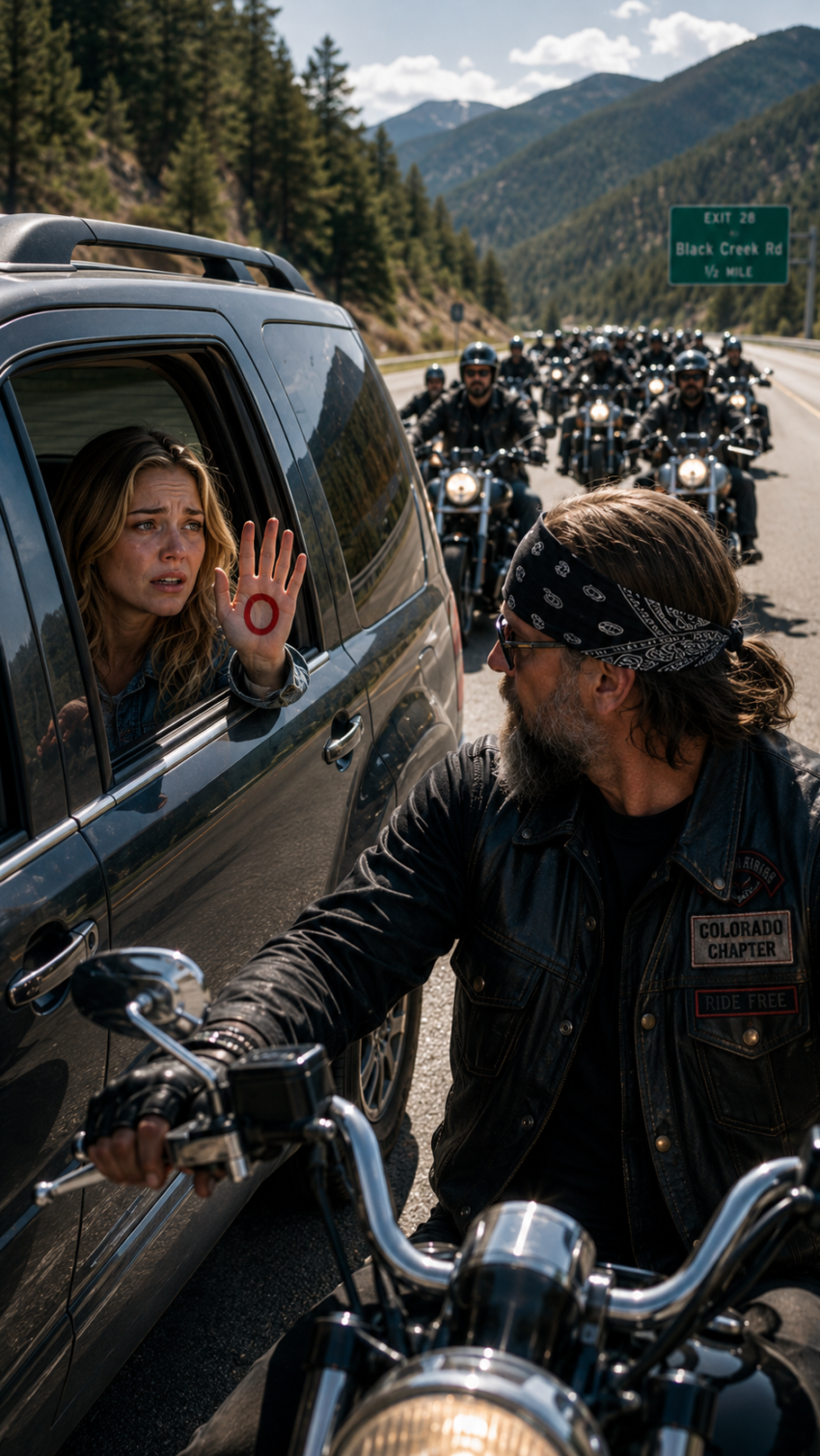
A young woman sat in the back seat of a charcoal-colored SUV moving west on Interstate 84 outside Boise, Idaho.
Her hand was pressed flat against the rear window.
On her palm, drawn with an unsteady marker, was a blue X.
The lines were uneven. One side was darker than the other. The ink had already started to smear against her skin.
Most people on the highway never noticed.
They kept driving, changing lanes, sipping coffee, checking mirrors, thinking about work, dinner, errands, and the ordinary worries of an ordinary day.
Advertisements
But one man saw it.
Everett “Hawk” Tanner was riding his motorcycle in the next lane when the back window of the SUV caught the morning light. At first, he only saw a face.
A young woman.
Pale.
Still.
Watching him like she was trying not to look desperate.
Then she lifted her hand.
The blue X appeared against the glass.
Hawk’s expression changed, but his body stayed calm. His hands remained steady on the handlebars. He did not speed forward. He did not swing his bike recklessly across traffic.
He only looked once more.
A young woman in the back seat. Two men in the front. No phone visible. A silent signal on her palm.
Hawk reached for the small communication device clipped near his vest.
“Charcoal SUV, westbound on I-84. Young woman in the back. Blue X on her palm.”
A voice answered through the line.
It belonged to Owen Briggs, one of Hawk’s closest friends.
“You certain?”
Hawk kept his eyes on the SUV.
“I saw her face.”
There was a short pause.
Then Owen said, quiet and sharp, “We’re close.”
The Woman Behind the Glass
Her name was Paige Sullivan.
She was twenty-six years old, born and raised in Meridian, Idaho, and she worked part-time with a community road-safety program that taught people how to recognize silent signs of trouble.
She had spent months helping others understand what to do when someone could not speak freely.
She never thought she would need the lesson herself.
That morning, Paige had gone to meet a woman who claimed she needed help leaving a difficult situation. The message had sounded nervous. The address had seemed believable. Paige had told herself it was only a quick meeting.
She had been kind before she had been careful.
Now her phone was gone.
The doors were locked.
The two men in the front seat spoke in low voices, never turning around unless they had to.
Paige sat with her back straight and forced herself to breathe slowly.
In for four seconds.
Hold.
Out for four seconds.
Again.
Her trainer’s voice came back to her.
If you cannot speak, show the sign.
If you cannot explain, make yourself visible.
If one person understands, stay calm long enough for help to arrive.
The blue X was not magic.
It was only ink.
But it was simple enough to remember when fear made everything else feel impossible.
Paige had drawn it with a marker she found in the pocket of her denim jacket. Her fingers had trembled so badly that the lines came out crooked.
When the biker came near the window, she lifted her hand and stared directly at him.
For three seconds, her whole life depended on a stranger looking closely enough.
Then his motorcycle moved ahead.
Paige lowered her hand and looked down, pretending nothing had happened.
But less than a minute later, another motorcycle appeared beside the SUV.
Then one behind it.
Then two more near the exit lane.
Paige closed her eyes for one brief second.
For the first time that morning, she felt something stronger than fear.
She felt seen.
The Riders Who Did Not Look Away
The riders did not arrive like people in a movie.
There was no shouting.
No wild chase.
No careless anger.
They came from gas stations, frontage roads, on-ramps, and nearby lanes, joining the flow of traffic so smoothly that most drivers barely noticed.
One motorcycle moved ahead of the SUV.
Another stayed several cars behind.
A third held the left lane at a safe distance.
Two more settled near the right side, careful not to crowd other vehicles.
To everyone else, it looked like normal highway movement.
But to the man driving the SUV, the road was slowly becoming harder to control.
Hawk stayed ahead, steady and measured.
Owen appeared to the right, his face unreadable behind his helmet.
A broad-shouldered rider named Marcus Vail moved into the left lane, close enough to be seen, far enough to avoid danger.
The SUV driver noticed.
His hands tightened around the steering wheel.
The passenger leaned forward and said something Paige could not hear.
Then the SUV suddenly picked up speed.
Paige grabbed the edge of the seat.
Her heart slammed hard against her ribs.
Hawk saw the change before the SUV fully committed to it.
He did not panic.
He did not race.
He matched the movement while keeping enough space for traffic around him.
Owen spoke through the channel.
“He knows we noticed.”
Hawk answered, voice low.
“Then we stay smart. No showing off. No sudden moves. We keep her visible until help gets here.”
The Exit Near Black Creek
The SUV drifted toward the next exit.
The movement was too sharp.
Too fast.
Too nervous.
One rider had to slow down quickly to avoid being pushed too close, but he held control and kept his bike upright.
Hawk’s jaw tightened.
He moved ahead, crossed safely toward the ramp lane, and positioned his motorcycle near the mouth of the exit, angled just enough to slow the SUV without causing traffic to break apart behind them.
The SUV braked hard.
It stopped several yards away.
Engines hummed.
Advertisements
Cars slowed.
A few drivers stared as they passed.
The riders formed a careful wall, not threatening, not reckless, only present.
Hawk stepped off his motorcycle and removed one glove.
He walked toward the driver’s window with his phone already in his hand.
The driver stared at him through the glass.
Hawk called emergency services on speaker.
His voice stayed calm.
“My name is Everett Tanner. I’m on Interstate 84 near the Black Creek exit outside Boise. Charcoal SUV. Two men in the front. Young woman in the back showed a silent distress signal. Vehicle is stopped. We need officers here.”
The dispatcher asked him to stay on the line.
Hawk gave clear details.
Plate number.
Location.
Direction.
Description.
Then he stepped away from the driver’s window and moved toward the back door.
He did not yank the handle.
He did not bang on the glass.
He only knocked three times.
Softly.
Paige looked up.
Hawk lowered his voice.
“Miss, my name is Everett. I saw your hand. You are not alone now.”
For a moment, nothing happened.
Then Paige reached for the door handle.
A small click sounded.
The door opened.
She stepped out onto the shoulder of the road, legs shaking, one hand still pressed against her jacket pocket as though she needed something to hold.
She looked at the line of motorcycles.
Then she looked at Hawk.
Her voice was almost too quiet to hear.
“You understood it.”
Hawk nodded.
“I understood you.”
Why Hawk Knew What It Meant
Two years earlier, Hawk had been sitting in a community room at a small library in Twin Falls with fifteen other riders.
A woman named Elise Porter stood at the front with a whiteboard and a blue marker.
She ran a local awareness group called Safe Mile, which trained drivers, truckers, delivery workers, and riders to notice quiet signs that someone might need help while traveling.
Elise drew a blue X across her palm.
Then she held up her hand.
“This sign does not mean you become reckless,” she told them. “It does not mean you confront people with anger. It means you notice, report, stay nearby when it is safe, and help professionals find the person.”
Hawk had stared at the mark for a long time.
He had spent half his life on highways.
He knew how many cars passed every minute.
He knew how easy it was to see a face through glass and forget it five seconds later.
That evening, he made everyone in his riding group practice the signal.
Again and again.
Some of them laughed at first.
Owen had held up his palm and said, “How many times do we need to draw this?”
Hawk had answered, “Until your eyes know it before your brain catches up.”
They practiced until the motion felt familiar.
Until the mark became impossible to ignore.
Until each rider could recognize it at highway speed without guessing.
Owen had shaken his head and smiled.
“You really think we’ll ever see this?”
Hawk had looked at the blue X on his own palm.
“I hope we never do,” he said. “But if we do, I don’t want us wondering what it means.”
Now, on the shoulder of Interstate 84, Paige Sullivan was standing beside him because he had remembered.
Because he had not looked away.
The Officers Take Over
The first patrol vehicle arrived within minutes.
Then another.
The lead officer, a woman named Officer Rebecca Nolan, stepped out and looked over the scene quickly.
She saw the stopped SUV.
The riders keeping distance.
The young woman standing beside Hawk with her arms wrapped tightly around herself.
Officer Nolan walked toward them.
“Who made the call?”
Hawk raised one hand.
“I did.”
“Tell me exactly what happened.”
He did.
No drama.
No extra details.
No guesses.
He explained the signal, the vehicle, the back seat, the two men in front, the riders’ positions, and the stop near the exit.
Officer Nolan listened carefully.
Then she turned toward Paige.
Her voice softened.
“Ma’am, are you able to come with me?”
Paige nodded.
Before she followed the officer, she looked back at Hawk.
Her eyes were wet, but she did not fall apart.
“I taught that sign to other people,” she said. “I never thought I would be the one using it.”
Hawk looked at the fading blue mark on her palm.
“That is why you practiced.”
Paige swallowed.
“How did you know I really needed help?”
Hawk answered without hesitation.
“Because your hand was quiet, but your eyes were asking me not to miss you.”
A Quiet Kind of Courage
After the officers took control of the situation, the riders stepped back.
No one tried to make a speech.
No one took pictures.
Advertisements
No one treated it like a performance.
They simply waited until Paige was safely with Officer Nolan.
Then, one by one, the motorcycles started again.
Owen rode past Hawk and gave him a small nod.
Marcus checked on the rider who had been pushed too close near the exit, making sure he was steady enough to continue.
Traffic slowly returned to normal.
The highway opened again under the bright Idaho sky.
But it did not feel like the same road anymore.
Hawk stayed until Paige was seated safely in the patrol vehicle.
Before the officer closed the door, Hawk reached into his vest pocket and pulled out a blue marker.
He held it out to Paige.
“Keep one with you.”
Paige stared at it for a moment.
Then she took it with both hands.
“I will.”
Hawk put his helmet back on.
He looked once at the highway stretching ahead.
A road could carry thousands of strangers in one morning.
Most would never know each other’s names.
Most would pass and disappear.
But sometimes, one person pressed a hand against a window.
And someone else noticed.
Paige Returns to Safe Mile
One week later, Paige returned to the Safe Mile office.
The building was small, with pale brick walls, a coffee machine that always made too much noise, and folding chairs stacked against the back wall.
Elise Porter was waiting inside.
She did not rush Paige with questions.
She did not ask for every painful detail.
She only placed a warm cup of tea on the desk and sat across from her.
Paige told her everything.
The message that pulled her into danger.
The missing phone.
The locked doors.
The highway.
The blue X.
The biker who saw her.
When Paige finished, the office was quiet.
Elise opened a drawer and took out a fresh blue marker.
She placed it on the table between them.
“We have new volunteers coming Thursday,” Elise said gently. “I want you to teach them.”
Paige stared at the marker.
Her hand trembled as she reached for it.
Then she uncapped it and drew a clean blue X across her palm.
This time, both lines were straight.
This time, the mark did not shake.
She looked up at Elise.
“How many times should they practice?”
Elise smiled.
“As many times as it takes.”
Paige looked down at her palm.
“Then we start with twenty.”
The Lesson Left on the Highway
A blue X is only ink.
It can fade by sunset.
It can smear when someone is afraid.
It can disappear beneath water, sweat, or time.
But on one bright morning outside Boise, it helped stop a moving vehicle, gather a line of careful riders, and bring one young woman back to safety.
Not because the world suddenly became perfect.
Not because fear disappeared.
But because someone had learned what to notice.
And because one rider chose to look twice.
Sometimes, the smallest signal carries the heaviest meaning.
Sometimes, a quiet hand against a window says more than a scream ever could.
Sometimes, help begins with one person paying attention when everyone else keeps moving.
Hawk did not know Paige’s whole story before he helped her.
He did not need to.
He saw enough to understand that someone was asking for help in the only way she could.
That was enough.
The strongest kind of courage is not always loud. Sometimes it is calm, careful, organized, and patient enough to protect without making things worse.
Paige survived that morning not because she felt fearless, but because she remembered what she had practiced when fear tried to take over.
And Hawk helped her not because he wanted attention, but because preparation had turned his kindness into action.
The highway went quiet again.
Cars kept moving.
The sun stayed bright.
But for Paige, that road would always hold the moment when a stranger saw her hand and chose not to look away.
Sometimes people do not need us to understand their entire story before we help them; they only need us to notice the one small sign that says they are scared, alone, and hoping someone still cares enough to pay attention.
The world becomes safer not only because of brave people, but because of prepared people who learn what to do before the difficult moment arrives and then act with calm responsibility when it finally does.
Paige’s story reminds us that fear does not erase strength; sometimes strength is simply remembering one small lesson, lifting one trembling hand, and believing that someone on the other side of the glass might understand.
Hawk was not powerful because he was loud or reckless; he was powerful because he stayed steady, used what he had learned, and helped without turning someone else’s pain into a performance.
A highway may be full of strangers, but it should never be full of people who refuse to see one another, because one careful glance can change the ending of a life that was quietly asking for help.
The smallest signs are often the easiest to miss, which is why compassion must be more than a feeling; it must become attention, awareness, patience, and the willingness to act wisely.
We often imagine heroes arriving with noise, but sometimes the person who saves the moment is simply the one who remembers the training, makes the call, keeps distance, and refuses to panic.
Paige did not become weak because she needed help; she became proof that even in a frightening moment, a person can still think, still signal, and still hold on until someone arrives.
Hawk and his riders did not take over the situation; they made space for safety to happen, and that kind of restraint is one of the most overlooked forms of real courage.
If this story leaves one message behind, let it be this: learn the quiet signs, look twice when something feels wrong, and never underestimate how much one attentive person can matter to someone who has no voice in that moment.