The Day the Line of Motorcycles Meant Something Else
A Table No One Offered
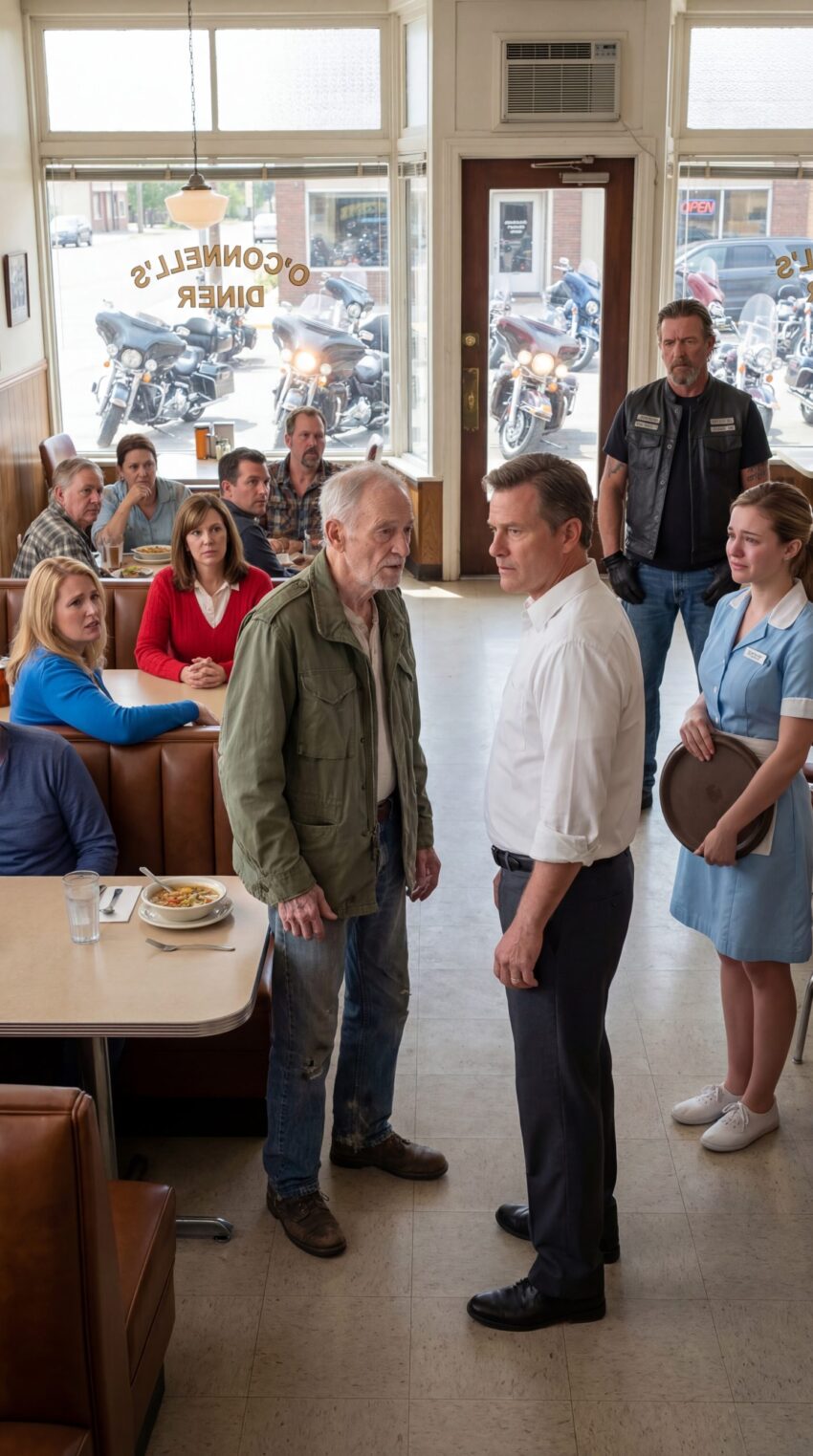
At 12:47 on a windy afternoon in Casper, Wyoming, the lunch crowd had settled into the kind of routine that made a diner feel safe. Coffee cups clinked softly against saucers. A country song drifted from a radio near the kitchen. The smell of grilled onions, hot soup, and fresh bread wrapped around the room like something dependable.
Prairie Lantern Diner was full, but not noisy. It was the kind of place where people came because they liked knowing what to expect. The same booths. The same pie case by the register. The same owner walking around as if the whole room answered to the sound of his shoes.
Then the front door opened, and a man stepped inside who did not seem to belong to the rhythm of the room.
He looked to be in his late seventies, maybe older. His frame was narrow, and his coat hung from his shoulders as if it had once fit someone stronger. The faded military jacket he wore had been repaired more than once. His hands shook slightly—not enough to draw attention at first, but enough to reveal the long years pressing down on him. His face was lined and tired, yet there was something careful in the way he moved, as though he still believed manners mattered even when life had stopped being gentle.
He paused just inside the entrance, looking around the room with quiet uncertainty. Not demanding. Not bold. Just hopeful enough to make what happened next harder to watch.
He took two slow steps toward an empty table near the back, and before he could reach it, the owner’s voice cut across the room.
Advertisements
“Sir, you need to stop right there.”
The old man turned at once. “I’m sorry,” he said softly. “I just wanted to sit for a minute and maybe get something warm.”
Dennis Rourke, the owner, folded his arms. He was a broad man with a red face, a stiff jaw, and the kind of confidence that grew from running a room where most people did not challenge him. He did not lower his voice.
“We serve paying customers here.”
The old man swallowed. “I understand. I was hoping maybe I could get a bowl of soup. I can try to pay part of it.”
A few people looked up from their plates. A few more looked down again.
The waitress behind the counter, Ivy Mercer, froze with two coffee mugs in her hand. She was young, maybe twenty-six, with tired eyes and a face that still held a softness life had not managed to take away. She glanced at the old man, then at Dennis, and for a second it looked like she might say something.
But Dennis spoke first.
“If you don’t have enough, then you don’t order. That’s how it works.”
The old man nodded once, as if the answer had not surprised him. That made it worse somehow. It made the whole thing feel less like an argument and more like a familiar disappointment.
“All right,” he said. “I didn’t mean to bother anyone.”
No one stopped him as he turned toward the door.
No one called out.
No one told Dennis to let him stay.
The bell above the entrance gave a small, cheerful ring as the man stepped back into the cold, and that ordinary sound seemed almost cruel.
The Sound Outside the Window
For a few seconds after the old man left, the diner tried to return to normal.
Forks moved again. A woman stirred sugar into her coffee. Somebody laughed too quickly at something that was not very funny. The room did what people often do when they are uncomfortable: it pretended the moment had already passed.
Then a man sitting near the front window leaned slightly toward the glass.
“Who are those guys?” he murmured.
Heads began to turn.
Across the street, motorcycles were pulling up one after another. Not fast. Not wild. Not making a scene. They came in a quiet line, rolling into place along the curb with a kind of calm precision that drew attention more effectively than noise ever could.
Leather vests. Heavy boots. Sun-darkened faces. Men who looked weathered by road, wind, and hard years. There was nothing reckless in the way they moved. That was what made people uneasy.
The engines rumbled low, then faded one by one.
Inside the diner, the room changed.
No one had said the word fear, but it slipped in all the same.
The front door opened again, and cold air spilled across the floor.
One of the bikers stepped inside.
He was tall, somewhere in his mid-forties, broad through the shoulders, with a dark beard threaded with gray at the chin. A worn leather vest rested over a long-sleeved thermal shirt, and there was a steadiness in his face that made him look less like a man who enjoyed conflict and more like one who had seen enough of it to stop wasting words.
He stood just inside the entrance and let his eyes move across the room once.
When he spoke, his voice was low and even.
“Where did he go?”
Dennis frowned. “Excuse me?”
The biker did not blink. “The older man who was just in here.”
A hush spread through the diner so quickly it felt like something physical.
Dennis lifted his chin. “That’s not your concern.”
The biker took a few measured steps forward.
“It is now.”
Nobody raised a voice. Nobody touched anyone. Yet the tension in the room thickened so fast that even Ivy stopped pouring coffee mid-motion.
Dennis planted his feet. “You don’t come into my place and tell me how to run it.”
The biker looked at him for a long second, then said, “I’m not telling you how to run anything. I’m asking where he went.”
Before Dennis could answer, the door opened again.
Another biker entered.
Then another.
Then three more.
Within moments, the front of the diner held half a dozen men who said nothing, did nothing, and yet made the room feel smaller. A woman in a booth clutched her purse more tightly. Someone near the register reached for a phone, then hesitated.
The first biker kept his gaze on Dennis.
“You put him out because he couldn’t pay?”
Dennis snapped, “That’s right.”
The biker nodded once, almost to himself.
“Then put it on my bill.”
What Everyone Thought Was Coming
The words should have eased the room, but they did not.
They confused it instead.
A man at the counter whispered, “This isn’t about lunch.”
Another muttered, “They’re trying to make a point.”
Dennis’s face hardened. “I don’t want trouble.”
The biker answered without changing expression. “Neither do we.”
But fear has a way of writing its own story when people do not yet know the truth.
More motorcycles appeared outside. More riders dismounted and stood near the curb. No shouting. No threats. Just a quiet, watchful presence that the customers inside did not know how to interpret.
Ivy felt her heart beating harder than it should have. She knew Dennis could be harsh. She knew the old man should never have been treated that way. But she also knew how quickly a room could become something else when pride took over.She looked at the first biker again. There was anger in him, yes, but it was not wild. It seemed held back by something heavier, something older. His jaw tightened once and then released, as if he were carrying a memory that mattered more than the insult of the moment.
Dennis pointed toward the door. “I said all of you need to leave.”
No one moved.
The biker said, “He eats today.”
Nothing in his tone sounded like a performance. It sounded like a promise.
Dennis opened his mouth, ready to push back again, when the diner door rang once more.
Advertisements
This time the room went still before anyone turned.
Because the old man had come back.
The Man at the Door
He stood just inside the entrance, uncertain again, shoulders slightly hunched against the cold. Two bikers remained behind him, not touching him, not steering him, simply making sure he did not walk back in alone.
The old man looked from one face to another, clearly uncomfortable with every eye in the diner now fixed on him.
The first biker stepped back and cleared a path.
When he spoke, his voice changed. The hard edge in it softened into something respectful.
“Sir, your table is waiting.”
The old man blinked. “Mine?”
“Yes, sir,” the biker said. “If you still want something warm.”
Something shifted in the room at those words. The tension did not disappear all at once, but it lost its shape. It was no longer the tension of a threat. It was the tension of realizing you may have judged a scene too quickly and your own silence may be part of what made it painful.
Ivy moved before Dennis said anything. She grabbed a menu and hurried toward the back table.
“Please,” she said gently to the old man. “Come sit down.”
He walked carefully, almost cautiously, as if expecting someone to stop him again.
No one did.
He lowered himself into the booth with visible effort. His hands rested on the table, still trembling slightly.
Ivy offered the menu, but he barely looked at it.
“Just soup would be fine,” he said. “Anything hot.”
“You can have more than that,” Ivy replied before she could stop herself.
The old man gave her a tired, almost embarrassed smile. “Soup is enough.”
She nodded. “Then I’ll bring you the best soup we have.”
Behind her, Dennis remained near the register, still trying to understand why the room no longer belonged to him in the way it had twenty minutes earlier.
The first biker did not sit. He stood off to the side with his hands loose at his sides, saying nothing, watching the old man as if he were protecting not just a person but a moment that should never have been denied in the first place.
A Face from Long Ago
When Ivy returned with a bowl of beef stew, warm bread, and coffee, the old man looked at the food for a second with such quiet gratitude that she had to turn away before her face gave too much away.
He wrapped both hands around the coffee cup, letting the heat settle into his fingers.
Then he looked up at the biker again.
This time he studied him longer.
Really studied him.
His brows slowly drew together.
“I know you,” he said.
The room, already silent, seemed to lean closer.
The biker said nothing.
The old man looked at the man’s face, then at the old scar near his temple, partly hidden by his hairline. His own eyes widened little by little as memory surfaced.
“Texas,” he whispered. “No… not Texas. Eastern Afghanistan. The ridge road.”
The biker lowered his head briefly.
No one in the diner moved.
The old man’s voice shook, but now for a different reason.
“There was smoke everywhere. The convoy got hit in the pass. You were trapped.”
Ivy stood still with the coffee pot in her hand.
Dennis had stopped pretending to check receipts.
The old man kept staring.
“You were barely conscious,” he said. “I dragged you out before the second blast reached the truck.”
A deep silence settled over the room after that—not dramatic, not sharp, just heavy with the recognition that something far older than the argument in the diner had stepped into view.
The biker finally spoke.
“You remember.”
The old man gave a weak, almost surprised laugh. “I remember your eyes. You kept trying to stay awake. I told you not to talk.”
A faint smile touched the biker’s face for the first time.
“You told me if I gave up, you’d be mad enough to drag me back just to scold me.”
The old man looked down, overwhelmed. “I never knew what happened to you after that.”
“My name’s Cole Braddock,” the biker said. “I spent years hoping I’d run into you again. Nobody could tell me where you went after you got back home. I only knew your first name—Walter.”
The old man’s expression softened.
“Walter Gentry,” he said quietly.
Cole nodded as if confirming something he had carried for a long time.
“You saved my life, Walter.”
No one in the diner seemed comfortable moving, eating, or even breathing too loudly.
Walter stared at the bowl in front of him. “I did what anyone should do.”
Cole shook his head. “No. You did what not everyone does. That’s the difference.”
The Room That Had Been Watching
Something about that sentence settled over the diner with more force than anything else said that day.
Because now everyone in the room had two truths sitting beside each other.
An old man who had once pulled someone out of danger had been turned away for being poor.
A room full of decent, ordinary people had seen it happen and let convenience decide their silence.
Ivy set the bread basket down near Walter and stepped back, blinking quickly.Dennis looked smaller now, though nothing about his size had changed. Pride still held him upright, but it was thinner than before, less certain. He opened his mouth once as if to explain himself, then seemed to realize there was no explanation that would clean what had already happened.
Walter lifted his spoon with care and took his first bite.
No one applauded. No one offered dramatic apologies. The moment did not need any of that. It only needed to be allowed to exist with dignity.
Outside, the row of motorcycles remained in place, but the tension people had imagined around them was gone. They were not a wall. They were a witness.
Cole stayed standing until Walter finished half the bowl.
Then Ivy quietly refilled the coffee and asked, “Would you like pie too?”
Advertisements
Walter gave a shy smile. “Only if it’s not too much trouble.”
“It’s not trouble,” Ivy said. “Not even a little.”
When she brought him a slice of apple pie, warm and fragrant, Walter looked at it with an expression that seemed to belong to another generation, one that still believed gratitude should be spoken carefully.
“Thank you, miss,” he said.
“You’re welcome, sir,” Ivy answered.
Behind them, Dennis finally stepped forward.
He stopped at the edge of the table and cleared his throat.
For a second, no one knew if Walter would even look at him.
Dennis said, “Your meal is on the house.”
Walter lifted his eyes.
Dennis shifted uncomfortably. “And… I was wrong.”
It was not an elegant apology. It was not perfect. But it was real enough to make the room soften around it.
Walter gave a small nod. “Thank you.”
Cole did not praise Dennis. He did not need to. The point had never been to humiliate him. The point had been to make sure Walter was seen.
The Kind of Debt That Cannot Be Repaid
By the time Walter finished eating, the sky outside had turned paler with afternoon light. Some customers had quietly paid and left. Others remained, as though they understood they were witnessing something they would remember far longer than whatever they had come there to do.
Walter rose carefully from the booth.
Cole stepped back at once, giving him space instead of help, perhaps knowing that dignity sometimes looks like allowing a man to stand on his own when he still can.
Walter looked at him and said, “You didn’t need to bring all these men.”
A few of the bikers near the door smiled faintly.
Cole replied, “I didn’t bring them to scare anybody. I sent one message that said I found the man who saved me. They came because some debts are carried by more than one heart.”
Walter’s eyes glistened.
“You don’t owe me that much.”
Cole answered, “Maybe not. But we owe respect where respect is due.”
Walter glanced around the room, perhaps at the customers, perhaps at Dennis, perhaps at the place itself, now changed by what had happened inside it.
Then he looked back at Ivy.
“That was the best hot meal I’ve had in a long while.”
Ivy smiled through wet eyes. “You come back anytime.”
This time, Dennis said, “He will.”
Walter moved toward the door. The bikers stepped aside one by one, not surrounding him, not claiming him, simply honoring the path in front of him.
At the entrance, Walter paused and turned back.
For a moment his gaze rested on the room that had first ignored him, then watched him, then finally understood something about itself.
He nodded once.
No speech. No grand gesture.
Then he stepped outside.
The bikers followed in a quiet line. Engines came alive one by one, low and steady. Within minutes they were gone, leaving only the fading sound of motorcycles and a silence inside the diner that felt different now.
Not fearful.
Thoughtful.
The kind of silence that arrives when people realize how close they came to missing the truth.
What Stayed Behind After They Left
Long after the motorcycles disappeared down the street, Prairie Lantern Diner did not fully return to normal.
Dennis spoke less loudly the rest of the day.
Ivy noticed customers meeting each other’s eyes more often, as if embarrassed by how easy it had been to look away earlier.
And everyone who had been there carried home the same lesson in their own way: the most important thing in the room had not been the line of motorcycles, or the tension, or even the old memory from a distant battlefield.
It had been the worth of a man that had almost been measured by what he could not pay.
Walter Gentry had entered the diner looking invisible.
He left it remembered.
And somewhere between those two moments, a room full of strangers had been reminded that kindness is not proven when it is easy, public, or comfortable. It is proven in the exact moment when a person has nothing to offer except the chance to reveal who we are.
Some people passed that test late.
But at least, in the end, they saw it clearly.
Life has a quiet way of returning the things we once gave away in love, dignity, and courage, even if it takes years for that kindness to find its road back to us.
Never decide a person’s value by the state of their clothes, their shaking hands, or the amount of money in their pocket, because some of the greatest people carry their history in silence rather than display it for the world.
The people who appear forgotten by society are often carrying stories of sacrifice, loyalty, and endurance that would humble anyone who took the time to truly listen.
Real strength is not in raising your voice, controlling a room, or making others feel small, but in using your presence to protect someone whose dignity is slipping away in plain sight.
A single warm meal, a respectful invitation, or one act of public decency can restore more to a hurting soul than most people will ever understand.
The saddest failures in life are not always loud or cruel on the surface; sometimes they happen in ordinary places when good people choose silence because speaking up feels inconvenient.
Gratitude is one of the purest forms of honor, and when it is carried faithfully over the years, it can turn an ordinary afternoon into proof that goodness is never truly wasted.
We should all remember that the person standing alone at the edge of the room may once have carried burdens, protected lives, or survived hardships we cannot begin to imagine from a quick glance.
Mercy becomes powerful the moment it stops being a feeling in the heart and becomes a decision in the hands, the voice, and the actions we choose in front of others.
No act of compassion is ever too small when it helps someone feel seen again, because being treated with respect is sometimes the first warmth a weary person has felt all day.
In the end, people may forget the menu, the weather, or the details of the afternoon, but they will remember who was welcomed, who was turned away, and who stood up when it would have been easier to remain seated.