The Stranger Beside My Mother
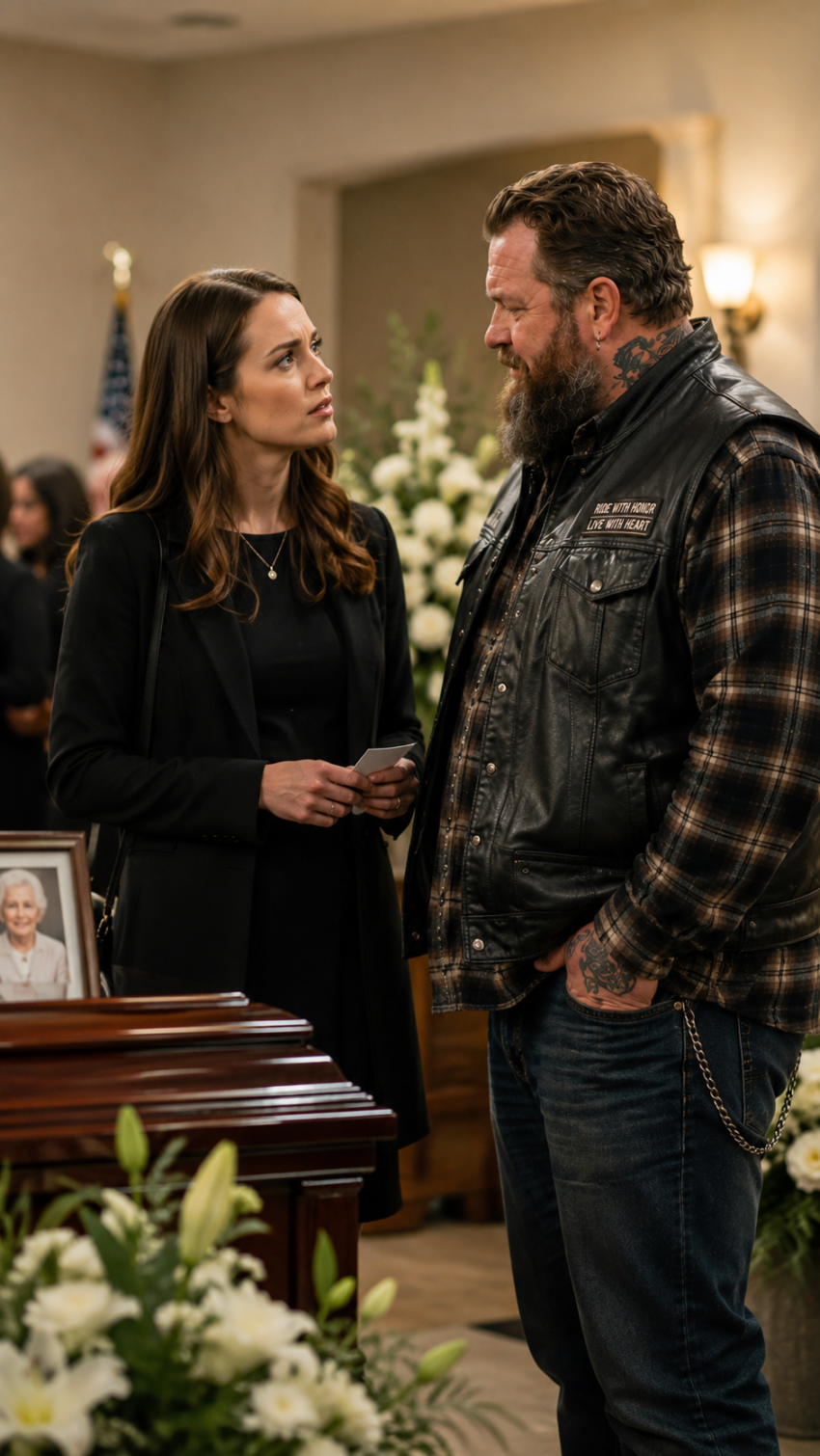
At my mother’s memorial service, I noticed a man standing near the front of the chapel who looked completely out of place and somehow exactly where he belonged.
He was tall, broad-shouldered, and dressed in a clean black button-down shirt that looked like it had been ironed with care. His gray beard was trimmed, his hands were folded in front of him, and a faded leather vest rested across his wide chest. Even in a quiet chapel filled with flowers, soft music, and family members speaking in hushed voices, there was no mistaking what he was.
He was a biker.
Not the polished kind people use in commercials. A real one. Weathered face, thick arms, heavy boots, and the kind of presence that made people glance twice before looking away.
But what caught my attention was not his size. It was the way he looked at my mother’s photograph.
He looked at it like he had lost family.
Advertisements
I had never seen him before in my life.
My mother, Margaret Bellamy, was ninety-four when she passed away peacefully in her sleep. She lived in a small town near Butler, Pennsylvania, in the same white house where my father had planted roses along the fence forty years earlier.
I lived in Ohio, several hours away. I called her often. I sent groceries. I visited when work allowed. But if I am being honest, I was not there as much as I should have been.
That truth sat in my chest during the whole service.
And then I saw him.
A large, quiet biker standing beside my mother’s casket like he had every right to be there.
The Name She Mentioned For Years
For the last few years of her life, my mother often mentioned someone named Owen.
She never made it sound dramatic. She would just say it in the middle of ordinary phone calls.
“Owen stopped by and fixed the back gate today.”
Or, “Owen took me for a little ride after lunch.”
Or, “My biker brought me peaches from the farm stand.”
I used to smile politely when she said it.
At first, I thought Owen was a neighbor. Then I thought maybe he was someone from a local church volunteer group. Sometimes, I even wondered if my mother was mixing up details. She was sharp for her age, but she had lived a long life, and I did not always ask enough questions.
That is the part I regret.
I heard her say “my biker” dozens of times, and somehow I never understood what those words meant to her.
I never asked, “Mom, who is he really?”
I never said, “Tell me about Owen.”
I simply assumed he was one small part of her week.
I did not know he had become one of the most important people in her final years.
The Question I Finally Asked
After the service ended, people gathered near the door, speaking softly and holding paper cups of coffee they were not really drinking.
The biker stayed near the front.
He stood alone, his head slightly bowed, one hand resting on the back of a pew. I watched him wipe his eyes with his thumb, quickly, as if he did not want anyone to notice.
Something inside me moved toward him before I had time to think.
I walked down the aisle and stopped a few feet away.
“Excuse me,” I said gently.
He turned at once. His eyes were red, but his voice was steady.
“Yes, ma’am?”
I looked at his face, searching for something familiar and finding nothing.
“My mother talked about you all the time,” I said. “She called you her biker. But I never met you. I don’t even know your full name.”
He lowered his eyes for a moment.
“Owen Maddox,” he said. “I’m sorry we never met sooner.”
I swallowed hard.
“Who were you to my mother?”
That question seemed to hurt him.
He looked toward her photograph, then back at me.
“Ma’am,” he said quietly, “I’m nobody special. I’m just a man who stopped his motorcycle on a cold afternoon four years ago.”
Then he told me the story I should have known long before that day.
The Day He Found Her Walking
Four years earlier, my mother had been ninety.
It was late November, one of those Pennsylvania afternoons when the sky turns pale gray and the wind feels sharper than it should. Owen had finished a welding job outside town and was riding home on his old Harley with a sidecar attached.
He saw a small figure walking along the shoulder of a country road.
At first, he thought it was someone checking a mailbox. Then he got closer and realized it was an elderly woman, moving slowly, wearing a sweater far too light for the weather.
That woman was my mother.
Her car had stopped working in the driveway that morning. Most people would have stayed home and called a mechanic.
My mother did not.
Because every afternoon, for years, she had driven to the cemetery to visit my father.
My parents had been married for sixty-seven years. My father, Daniel Bellamy, had passed away five years before this happened, and my mother never stopped speaking to him. Every day, she went to his grave, sat beside the stone, and told him about the weather, the neighbors, the birds, the aches in her hands, and the family he had loved.
That daily visit was not a habit.
It was how she kept breathing through loneliness.
So when her car would not start, she decided to walk.
Miles.
In the cold.
Owen slowed his motorcycle and stopped beside her.
“Ma’am,” he called, “are you all right?”
My mother, stubborn as ever, lifted her chin and said, “I’m fine, young man. I’m just going to see my husband.”
Owen looked up and down the empty road.
“Where is he?”She pointed toward the cemetery gates in the distance.
“Waiting for me.”
The Ride To The Cemetery
Owen told me he did not know what to say at first.
He was a big man, used to people being nervous around him. He worried that if he pushed too hard, she might be frightened. So he spoke softly.
“How about I give you a ride there?”
My mother looked at the motorcycle, then at his vest, then back at his face.
Advertisements
“I’ve never ridden with a biker before.”
Owen smiled.
“Then I’ll make sure your first ride is a good one.”
That made her laugh.
He helped her into the sidecar and wrapped his spare jacket around her shoulders. He drove slowly, carefully, like he was carrying something precious.
When they reached the cemetery, Owen did not rush her.
He helped her out, offered his arm, and walked her to my father’s grave.
Then he stepped back.
He gave her space.
For fifteen minutes, my mother sat beside the stone and talked to the man she had loved most of her life.
Owen waited in the cold.
He did not check his phone. He did not sigh. He did not make her feel strange for grieving in her own way.
When she was finished, he helped her back to the sidecar and drove her home.
At her porch, my mother tried to thank him, but he only shook his head.
“I’ll come back tomorrow,” he said.
My mother frowned.
“Tomorrow?”
“Until your car is fixed,” he said. “You shouldn’t have to miss seeing him.”
She told him he did not need to do that.
He told her he already knew that.
Then he came back the next day.
The Promise That Became A Routine
For three weeks, Owen came every afternoon.
Rain or cold, workday or weekend, he showed up. He helped my mother into the sidecar, drove her to the cemetery, walked her to my father’s grave, and waited until she was ready to go home.
When her car was finally repaired, my mother hugged him on the porch.
She was tiny beside him, barely reaching his chest.
“You are the finest grandson I never had,” she told him.
Owen said he laughed when she said it, but only because he did not want to cry.
Most people would have ended the story there.
A kind stranger helps an elderly woman for a few weeks. A sweet memory. A good deed.
But Owen did not disappear.
He came back the next Sunday.
And the Sunday after that.
And then almost every Sunday for four years.
The Family I Did Not Know She Had
Owen became part of my mother’s life in a quiet way that never asked for attention.
He fixed her loose porch rail. He replaced the broken latch on her garden gate. He changed lightbulbs she could no longer reach. He brought soup when she had a cough. He sat at her kitchen table and listened to stories about my father, even when she told the same ones more than once.
Every Sunday, he took her to the cemetery in the sidecar because she said the wind made her feel young.
And every Sunday, he waited.
Sometimes she talked to my father for fifteen minutes. Sometimes thirty. Sometimes she simply sat in silence.
Owen never hurried her.
He told me, “Your mother never needed much. She just needed somebody who understood that love doesn’t end because one person has gone ahead.”
Those words broke something open inside me.
Because I had loved my mother. I truly had.
But Owen had been present in a way I had not.
Not because I did not care, but because I always thought there would be more time.
There is a kind of guilt that comes when you realize someone else saw a need you were too busy to notice.
And there is also gratitude so large it almost feels like grief.
Why He Stayed
I asked Owen why he kept coming back after her car was fixed.
He rubbed both hands together and stared down at the floor.
“I never had grandparents,” he said. “Not really. Mine were gone before I was old enough to remember them. Your mother started calling me her grandson, and I guess something in me needed that more than I knew.”
He smiled a little through his tears.
“She made coffee too strong. She kept cookies in a tin that was older than me. She told me what flowers to plant and then corrected me while I planted them. She was bossy, funny, kind, and sharper than half the men I work with.”
Then his voice changed.
“She didn’t make me feel like some scary guy on a motorcycle. She made me feel like I belonged at her table.”
That was when I understood.
He had not simply helped my mother.
They had helped each other.
My mother had been lonely after losing the man she had built her life with. Owen had carried his own empty spaces quietly. Somehow, on a cold road outside a small Pennsylvania town, two strangers found a piece of family in each other.
The Photo In His Vest
Before I walked away from him at the chapel, Owen reached into the inside pocket of his leather vest.
He pulled out a small plastic sleeve.
Inside was an old black-and-white photograph of my parents on their wedding day. My mother was young, smiling, holding a bouquet. My father stood beside her in a suit that looked slightly too big, proud as could be.
On the back, in my mother’s shaky handwriting, were the words:
To my biker, Owen. The best grandson I never expected. Thank you for bringing me back to him. Love, Margaret.
I covered my mouth with my hand.
Advertisements
Owen looked down at the photo like it was something sacred.
“She gave me this two years ago,” he said. “I carry it everywhere.”
I had spent weeks sorting through my mother’s house, touching her teacups, her sweaters, her recipe cards, her old letters.
But that little photo in Owen’s vest told me something no object in her house could.
My mother had not spent her last years forgotten.
She had been seen.
She had been loved.
She had been accompanied.
The Last Sunday
Owen told me that the last Sunday he took my mother to the cemetery, she was weaker than usual.
She still insisted on going.
He helped her into the sidecar, tucked a blanket over her knees, and drove slower than ever. When they reached my father’s grave, she held Owen’s arm tightly.
She did not say much that day.
She simply placed her hand on the stone and whispered, “I’ll see you when it’s time.”
Owen looked away when he told me that part.
“I think she knew,” he said.
A few days later, she passed peacefully in her sleep.
And when Owen heard, he came.
Of course he came.
He stood beside her at the memorial service because for four years, he had stood beside her in life.
He was not pretending to be family.
He was family.
What I Wish I Had Known
I wish I had asked more questions.
I wish I had driven more often.
I wish I had listened closer when my mother said, “My biker came today.”
But I am learning not to turn gratitude into punishment.
Owen did not tell me the story to make me feel ashamed. He told me because he loved my mother, and because he wanted me to know she had been happy in ways I had not seen.
Before he left the chapel, I hugged him.
It was not polite or careful. It was the kind of hug you give when words are too small.
“Thank you,” I said into his vest. “Thank you for being there when I wasn’t.”
He held me gently, like he had held my mother’s arm on all those cemetery walks.
“Your mom was easy to love,” he said. “I was the lucky one.”
The Man Who Stopped And Stayed
People still look at Owen and think they understand him.
They see the beard, the tattoos, the motorcycle, the leather, and the size of him. They make a quick little story in their heads and move on.
They do not know about the ninety-year-old widow walking in the cold.
They do not know about the sidecar rides.
They do not know about the Sunday visits, the repaired gate, the coffee at the kitchen table, the old wedding photo carried over his heart.
They do not know that one afternoon of kindness became four years of loyalty.
Owen told me he was just a biker who stopped on the side of the road.
But that is not the whole truth.
He stopped.
Then he stayed.
And because he stayed, my mother did not have to spend her final years feeling forgotten.
She had someone to bring her to my father.
She had someone to laugh with.
She had someone to call grandson.
She had someone standing beside her until the very end.
Sometimes the people who look the roughest on the outside are carrying the gentlest hearts, and we should be careful not to measure kindness by clothing, age, tattoos, silence, or the shape of someone’s life before we have heard the story behind their hands.
A small act of kindness can matter for one afternoon, but the rarest kind of love is the kind that returns again and again without applause, without reward, and without needing anyone else to know what it has done.
Elderly people do not always need grand gestures; sometimes they only need someone to notice the loose gate, the empty chair, the quiet kitchen, the appointment they refuse to miss, and the loneliness they are too proud to name.
We often believe we have more time with the people we love, but time has a quiet way of moving forward while we are busy, so every phone call, every visit, and every question we ask with real attention can become a gift we never regret giving.
Family is not only made by blood, last names, or old photographs on a wall; sometimes family is made when one person keeps showing up until their presence becomes part of another person’s peace.
Grief does not always ask to be fixed; sometimes it only asks to be respected, given a ride, allowed fifteen quiet minutes, and treated as proof that love was once deep enough to keep living inside someone’s daily routine.
The world teaches us to admire big success, loud confidence, and visible achievements, but some of the most beautiful lives are changed by people who quietly repair a porch rail, bring soup, wait in the cold, and never ask to be called a hero.
If someone you love mentions a name again and again, listen closely, because that name may belong to the person who is filling the empty spaces you cannot see from far away.
It is possible to feel regret and gratitude at the same time, and sometimes healing begins when we stop denying what we missed and start honoring the person who stepped in with love.
Stopping for someone is kind, but staying is rare; staying through seasons, ordinary Sundays, repeated stories, quiet grief, and aging years is the kind of love that turns strangers into family.