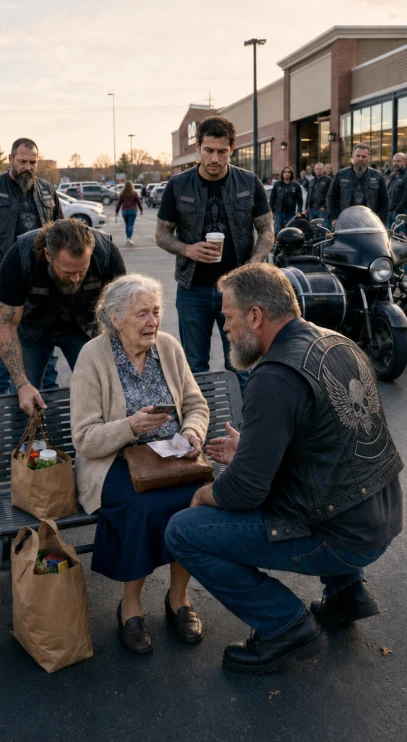
I was still sitting on the frozen metal bench when the afternoon light began to fade, gripping a grocery list my son had written as if it were the last proof that I still belonged to someone. Three hours earlier, Paul had told me to hurry, and three hours later, I was staring at a text message that had ended my life as his mother without even giving me the dignity of a spoken goodbye.
My hands were so cold I could barely feel the phone in my palm, but the words on the screen burned into me. Margaret found a nursing home with an opening. They’ll pick you up tomorrow. It’s time. I read it once, then again, then so many times the letters seemed to swim and blur, as if my own eyes were trying to protect me from what my son had done.
The grocery list was still folded in my other hand. Bread. Milk. Tea bags. Soup. Apples if they’re on sale. He had scribbled it impatiently that morning while standing in my kitchen, tapping his keys against the counter as if every second he spent with me was a punishment. I had thought he was tired. I had thought maybe his wife was pressuring him. I had thought a hundred gentle excuses because a mother’s heart is always the last thing to accuse her child.
“Get your own stuff, Mom. I’ll be in the car.”
Those were the last words he said to my face before he abandoned me outside Dawson’s Market with two small bags of groceries and eighty-two years of life suddenly reduced to an inconvenience. I remembered turning back to ask if he needed anything for dinner, but he was already walking away. He did not look back then, either.
The wind blew through the parking lot in sharp little knives, lifting the corner of my thin cardigan and pressing it against my ribs. People passed in and out of the grocery store, their carts rattling over the pavement, their children whining for candy, their car doors slamming shut. No one looked at me for more than a second. Old women on benches become part of the background, like newspaper stands, like trash cans, like things waiting to be moved.
I had two grocery bags at my feet. One had a loaf of bread with the corner crushed because I’d had to choose between bread and eggs, and I had chosen bread because toast could stretch further. The other had canned soup, tea bags, and a single apple because the apples were not on sale, but I had wanted one anyway. At my age, small rebellions become sacred.
I tried to call Paul after the text came. The phone rang until it went to voicemail. I tried again. Then I called Margaret, my daughter-in-law, though my thumb trembled before I pressed her name because I knew she had never once answered me with warmth.
She sent me straight to voicemail.
For a while, I told myself there had been a misunderstanding. Maybe Paul had gone to pick up medicine. Maybe his phone had been stolen. Maybe the message was some cruel mistake, typed by someone else. But then I looked across the parking lot at the empty space where his shiny black SUV had been, and the truth settled over me like a wet blanket.
My son had not forgotten me. He had planned this.
I should have called a taxi, but the thought of going home frightened me almost as much as the thought of not going. My house was small, old, and in need of repairs, but it was mine in the way a place becomes yours after it has listened to you cry in every room. It held my husband’s laugh in the hallway, Paul’s baby pictures in the living room, the dent in the kitchen floor from the time Frank dropped a cast-iron pan while dancing with me to the radio.
I had already given Paul more than money. I had given him my youth, my strength, my sleep, and most of my choices. After Frank died, I worked mornings at the diner, afternoons cleaning offices, and nights folding laundry at the motel so Paul could stay in school. When he graduated, he hugged me in front of everyone and whispered that he would take care of me someday. I believed him because mothers are foolish in the most holy way.
When Paul wanted a wedding that looked grand enough for Margaret’s family, I sold the little house Frank and I had bought together and moved into the smaller one on Cedar Lane. Paul said it was temporary. He said he would make sure I was comfortable. He said families made sacrifices for each other, and I had smiled because that was exactly what I had taught him.
I sat on that bench until my legs ached and my back stiffened. The cold had crept into my knees, and every time someone’s car slowed near the curb, my heart lifted like a fool. Then the car would move on, and I would lower my eyes again, embarrassed by hope itself.
That was when I heard the first motorcycle.
At first it was only a low tremor in the distance, a heavy vibration that seemed to rise from the pavement beneath my shoes. Then another joined it, and another, until the air filled with the kind of thunder that makes people turn their heads before they know why. Seven motorcycles rolled into the parking lot together, black and chrome gleaming under the gray sky, their engines growling like a storm with teeth.
I shrank back against the bench, clutching my purse against my chest. Their leather vests had patches across the back: Savage Angels MC. I had seen men like them on television, or at least I thought I had. Big men with tattoos, boots, beards, and faces carved by weather and hard living. Men people stepped around.
They parked in a row near the front of the store, engines cutting off one by one until the sudden silence rang in my ears. A few shoppers stared, then quickly pretended not to. I lowered my gaze and tried to become invisible again. At eighty-two, you learn that attention can be dangerous, especially when you are small and alone.
But one of them noticed me.
He was the largest of the group, a broad-shouldered man with a gray beard, thick arms, and a face that looked stern enough to frighten the truth out of a liar. His vest strained across his chest, and on the front was a small patch that said Bear. He stood beside his motorcycle for a moment, watching me with narrowed eyes, not cruelly but carefully, as if something about me did not sit right with him.
Then he came toward me.
Each step of his boots sounded heavy against the pavement. I looked down at my grocery bags and prayed he would keep walking. Instead, he stopped a few feet away and removed his sunglasses. His eyes were not hard. They were blue, tired, and strangely gentle.
“Ma’am? You okay? You’ve been sitting here since we went into the store.”
The kindness in his voice undid me. Not the question itself, but the way he asked it, as though the answer mattered. My mouth opened, but no words came out. The tears arrived first, hot and humiliating, spilling down cheeks that had already endured too many losses in one lifetime.
Bear crouched slightly, not too close, keeping his large hands visible like he was trying not to frighten a wounded animal.
“Did someone hurt you?”
I shook my head, but the lie broke before it formed. I looked at the phone in my hand, then at the grocery list, then at the empty road beyond the parking lot. My chest tightened until speaking felt like pushing words through broken glass.
“My son left me here,” I whispered.
Bear’s face changed. It was not dramatic. He did not gasp or curse. But something in his eyes went still.
Another biker approached, a lean man with silver hair pulled into a short ponytail. Two younger ones drifted closer behind him, their expressions shifting from curiosity to concern. I wiped at my face with my sleeve, ashamed of being seen this way by strangers.
Bear’s voice stayed low. “What do you mean he left you?”
I held up the phone. My hand shook so badly he had to lean in to read it. His eyes moved across the screen once, then again. When he looked back at me, his jaw had tightened.
The silver-haired man muttered, “Jesus.”
I tried to defend Paul even then. “He’s been under stress. His wife doesn’t like the extra responsibility. I’ve been slowing down lately. I forget things sometimes, little things. Maybe he thought—”
“No,” Bear said.
It was not loud, but it stopped me.
He took a breath, then softened his tone. “No, ma’am. Nobody gets thrown away by text message.”
The words entered me quietly, but they landed deep. For three hours, I had been trying to convince myself that perhaps I deserved what was happening, that perhaps needing help made me a burden, that perhaps love had an expiration date if your hands grew too shaky or your steps too slow. Hearing a stranger reject that lie felt like someone had opened a window in a burning room.
Bear looked toward the others. “Get her bags.”
One of the younger men immediately picked up my groceries. He handled them so carefully you would have thought the cans were crystal. Another man took off his own jacket and draped it over my shoulders before I could protest.
“No, no, you’ll be cold,” I said, trying to push it back.
He smiled. “Ma’am, I’ve ridden through hail in Wyoming. I’ll survive a parking lot.”
Bear held out one massive hand. “Can you stand?”
I nodded, though I was not sure. My knees had stiffened badly. When I tried to rise, pain shot through my hips, and for one terrible second I thought I might fall into this stranger’s arms like a useless thing. Bear moved quickly but gently, bracing my elbow with a touch so careful it nearly made me cry again.
“There you go,” he murmured. “Easy.”
I stood, unsteady but upright. The cold bench had left a numb ache through my bones. The whole parking lot seemed to tilt around me, and I realized I had not eaten since breakfast. Bear must have seen something in my face because he turned his head sharply.
“Danny, grab something hot.”
The youngest biker, maybe not even thirty, hurried back toward the store. I almost told him not to waste money, but the look Bear gave me silenced the protest before it escaped. He was not commanding me exactly. He was simply making room for me to accept care, and I had forgotten what that felt like.
A few minutes later, Danny came back with a paper cup of tea and a wrapped sandwich. He looked nervous as he handed them to me, like he was afraid of doing it wrong.
“It’s turkey,” he said. “I didn’t know if you liked mustard, so I got it on the side.”
That small consideration nearly broke me all over again. Paul had not asked how I liked anything in years. Margaret bought the cheapest tea and complained if I used too many bags. But this tattooed young man, a stranger in a leather vest, had remembered that preferences mattered.
Bear waited until I had taken a sip of tea. Then he asked, “What’s your name?”
“Eleanor Carter.”
At that, his expression flickered.
The silver-haired biker beside him lifted his head. “Carter?”
Bear’s eyes narrowed slightly. “Your husband wouldn’t have been Frank Carter, would he?”
The cup trembled in my hands. “Yes. Frank was my husband.”
For the first time since the motorcycles arrived, Bear seemed to lose his words. He looked away toward the street, then back at me, and the stern lines of his face softened with something that looked painfully close to reverence.
“I knew Frank,” he said quietly.
My breath caught. “You did?”
“Yes, ma’am.” He swallowed. “A long time ago.”
The other bikers exchanged glances I could not read. Something passed between them without a word, something heavy and old. Bear stood a little straighter, as if the name Frank Carter had summoned a different version of him from somewhere deep inside.
“Where do you live, Mrs. Carter?” he asked.
“Cedar Lane,” I said. “Number 418.”
The silver-haired man cursed under his breath. Bear looked at him sharply, then back at me.
“What is it?” I asked.
Bear’s voice was careful. “Your son’s name is Paul?”
I nodded slowly. “Paul Carter.”
Bear and the others looked at one another again. This time, I understood enough to feel frightened.
“What has he done?” I whispered.
Bear crouched in front of me once more. “Mrs. Carter, we’ve got some business with your son.”
I should have been alarmed by that sentence. Perhaps another woman would have refused to go anywhere with them. But there was a steady protection in his voice, not violence, not recklessness, but something older and firmer. It reminded me of Frank standing between me and a drunk man outside the diner in 1968, calm as stone, saying, “You need to walk away now.”
Bear led me toward one of the motorcycles with a sidecar attached. The machine was enormous, black and polished, with chrome edges that caught the weak afternoon light. He helped me sit inside as though I were made of thin porcelain, tucking his jacket around my knees while Danny secured my grocery bags.
“I’ve never ridden one of these,” I admitted.
Bear’s mouth curved slightly. “First time for everything, Queen.”
The word startled me. Queen. No one had called me anything tender in so long that even a joke felt like a gift. I looked down to hide the fresh tears in my eyes.
The engines started one by one, and the sound rolled through my chest. It should have terrified me. Instead, as we pulled out of the parking lot in a tight formation, I felt something I had not felt in years. Not safety exactly. Not happiness. But presence. Witness. The impossible relief of no longer being alone.
The town blurred past us in cold streaks of gray and gold. People on sidewalks turned to stare as the seven motorcycles moved together, one carrying an old woman wrapped in a biker’s jacket like some strange parade. I held the side of the sidecar with one hand and my grocery list with the other, though I no longer knew why I kept it.
The closer we came to Cedar Lane, the harder my heart pounded. I imagined my dark house waiting for me, silent and locked. I imagined Paul gone, my key no longer working, my life already rearranged by someone else’s decision. Then we turned the corner, and I saw the boxes.
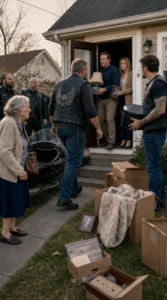
At first my mind refused to understand what my eyes were seeing. Cardboard boxes lined the front lawn, some sealed with packing tape, others half-open and sagging from careless handling. A framed photo lay face-down in the grass. A quilt I had made when Paul was twelve hung over the side of a box like a discarded rag. My front door stood wide open, and Paul’s shiny SUV gleamed at the curb.
He had not only left me at the store. He had gone home and started erasing me.
The motorcycles slowed. One by one, they parked along the street in front of my house. The engines cut off, leaving behind a silence so tense I could hear the flap of loose cardboard in the wind.
I stared at the lawn. There was the hatbox where I kept Frank’s letters. There was the cracked blue mixing bowl my mother had given me. There were my winter coats in a heap, one sleeve dragging through damp grass. My whole life had been dragged out into public view, not with grief, not with ceremony, but with irritation.
I tried to get out of the sidecar too quickly. My foot caught on the edge, and Bear was there instantly, steadying me.
“Easy,” he said.
“My things,” I whispered.
“I see them.”
“No, you don’t understand.” My voice shook. “Those letters—Frank’s letters are in that box. If it rains—”
Bear turned his head. “Danny.”
Danny moved immediately, lifting the hatbox from the grass and holding it against his chest with both arms. “Got it.”
The front door banged wider, and Paul stepped out carrying a lamp under one arm. He was wearing the navy sweater I had bought him last Christmas, the one he never thanked me for. His face was pinched with annoyance, as if the motorcycles were an inconvenience on an already busy afternoon.
Then he saw Bear.
Then he saw me.
The lamp slipped in his grip.
“Mom?” he said, and the guilt in his voice came too late to matter.
I stood beside the sidecar, wrapped in a stranger’s jacket, and for one breath I was not sure which hurt more: seeing him frightened, or realizing that he had not expected to see me at all.
Margaret appeared behind him in the doorway. She was holding one of my photo albums against her hip, her manicured fingers pressed over the cover where Frank’s face was visible through the plastic sleeve. She looked from the bikers to me, then to Paul, and her mouth tightened.
“What the hell is this?” Paul demanded, though his voice cracked on the last word.
Bear walked up the path slowly. He did not rush. He did not raise his fists. Somehow that made him more frightening. The other bikers stayed behind him, spread out across the lawn and walkway, not blocking anyone exactly, but making it clear that Paul no longer controlled the space.
Bear stopped at the bottom of the porch steps. “You Paul Carter?”
Paul swallowed. “Who’s asking?”
“Bear.”
“That supposed to mean something to me?”
Bear’s eyes stayed fixed on him. “Maybe not. But Frank Carter should.”
Paul’s face changed. Just slightly. Enough.
Bear took one step up. “You’re Frank Carter’s boy.”
Paul’s mouth opened, then closed. “My father’s been dead twenty years.”
“I know how long he’s been gone.” Bear’s voice deepened. “Men like that don’t leave easy.”
Margaret lifted her chin, recovering some of her sharpness. “This is a family matter. You people need to leave.”
One of the bikers gave a low, humorless laugh. Bear did not look at her.
“No, ma’am,” he said. “This became our matter when your husband dumped his mother at Dawson’s Market and came here to throw her life onto the lawn.”
Paul’s face flushed. “She needs care. Professional care. You don’t know what you’re talking about.”
I flinched at the rehearsed phrase. Professional care. It sounded clean, reasonable, almost kind, unless you had read the text. Unless you had sat on the bench. Unless you had seen your letters in the grass.
Bear looked back at me for a brief second. Then he faced Paul again.
“I was seventeen when I met your father,” Bear said. “I was stupid, angry, and half-starved, though I would’ve punched anybody who said so. I tried to siphon gas out of Frank Carter’s truck behind Miller’s garage.”
The street seemed to hold its breath. Even Margaret went still.
Bear continued, his voice rough but controlled. “He caught me with the hose in my hand. He could’ve called the cops. Should’ve, probably. Instead, he grabbed me by the collar, dragged me inside, and made me sit at his kitchen table.”
I remembered suddenly. Not Bear, not this enormous gray-bearded man, but a skinny boy with bruised knuckles and hollow eyes, sitting at my table one rainy evening while Frank stood by the stove. I had made him a sandwich. Ham, mustard, and pickles. I had asked if he wanted soup, too. He had eaten as if he expected someone to snatch the plate away.
I whispered, “Robert?”
Bear turned toward me. The whole hard mask of him cracked.
“Yes, ma’am,” he said softly. “Robert Bell.”
The years fell away in an instant. I saw the boy he had been, damp-haired and defensive, trying not to cry into a bowl of tomato soup. Frank had taken him to the garage the next morning and found him work sweeping floors. Months later, that boy had come back with clean hands and a shy thank-you card I kept for years in a drawer.
Paul stared between us, confused and increasingly pale.
Bear faced him again. “Your mother made me a sandwich. Your father gave me work. But more than that, he gave me a rule. He said a man’s worth isn’t measured by what he owns, or who fears him, or how loud he can talk. He said a man’s worth is measured by how he honors his debts.”
Paul looked away.
Bear pointed toward me, not harshly but with terrible certainty. “That woman is the biggest debt you will ever owe.
The words struck the porch like a hammer. Paul’s shoulders stiffened, but he said nothing. Margaret set the photo album down on a box inside the doorway and stepped forward.
“You have no idea what we’ve dealt with,” she snapped. “She forgets bills. She calls at inconvenient times. She can’t keep up with the house. We have our own lives.”
Something inside me folded inward. Not because she said anything new, but because she said it in front of strangers without shame. I had become a list of irritations. Bills. Calls. Housework. An obstacle to their schedule.
Bear’s eyes shifted to Margaret, and his voice turned colder. “Then you help her. You don’t abandon her in a grocery store.”
Paul found his voice, brittle with defensiveness. “The nursing home is decent. We looked it up.”
I turned to him. “You didn’t tell me.”
He would not meet my eyes.
I took one step toward the porch, Bear’s jacket heavy around my shoulders. My knees hurt, but I kept going until I stood at the bottom of the steps, looking up at the boy whose fever I had once cooled with wet cloths through three long nights. He looked older than I remembered, not in his face, but in the cowardice around his mouth.
“You texted me,” I said.
“Mom—”
“You texted me while I was sitting on a bench with groceries.”
He pressed his lips together. “I didn’t know how else to say it.”
“You could have looked me in the eyes and remembered I was your mother.”
The sentence left me quietly, but it changed the air more than shouting would have. Paul’s face twisted, and for a moment I saw shame there. Then Margaret touched his arm, and the shame hardened into resentment.
“This is exactly what I mean,” she said. “She makes everything emotional.”
One of the bikers muttered something under his breath. Bear lifted a hand, and the man fell silent.
Bear looked past Paul into the house. “You got paperwork for this nursing home?”
Paul hesitated.
Bear caught it. “You do, don’t you?”
Margaret’s eyes darted toward the dining room.
My stomach tightened. “What paperwork?”
No one answered.
Bear turned his head slightly. “Mack.”
The silver-haired biker moved toward the porch. Paul stepped in front of the door.
“You can’t go in my house,” Paul said.
“My house,” I said.
Everyone looked at me.
My voice shook, but I forced the words out. “This is my house.”
Paul looked suddenly trapped. “Mom, we discussed transferring—”
“No,” I said. “You discussed it. You brought papers last month and said they were for taxes.”
Bear’s gaze snapped to Paul.
The memory rose slowly, sickeningly. Paul had come by with Margaret and a folder. He had said the bank needed updated information because I was getting older, and it would make things easier if anything happened. I had been tired that day. My arthritis was bad. He had placed his hand over mine and said, “Trust me, Mom.” I had signed where he pointed because that was what I had always done with him. Trusted.
Margaret’s face lost color.
Bear’s voice was almost a growl. “What did she sign?”
Paul backed up half a step. “It was legal.”
“That’s not what I asked.”
“It was for power of attorney,” Paul said quickly. “Just in case.”
Margaret interrupted, too fast. “And the house transfer was necessary for financial planning.”
My breath stopped.
House transfer.
The words echoed inside my skull until the lawn seemed to tilt under me. My home. Frank’s dent in the kitchen floor. My roses along the fence. My bed, my table, my walls. They had not been preparing to care for me. They had been preparing to remove me.
The nursing home was not the plan. It was the final step.
Danny, still holding the hatbox, looked as if someone had struck him. The other bikers went rigid. Bear did not move for several seconds, and that stillness frightened Paul more than any threat could have.
Then Bear took out his phone.
“Lou,” he said after a moment. “Need you on Cedar Lane. Bring your notary friend if she’s with you. And call that elder-law attorney who helped your aunt. Yeah. Now.”
Paul’s eyes widened. “You can’t just—”
Bear lowered the phone. “I can call whoever I want.”
Margaret’s voice sharpened into panic. “This is harassment.”
Bear looked at her. “No. Harassment is dumping an elderly woman at a grocery store so you can empty her house before she gets back.”
Paul tried to step down from the porch, maybe to grab my arm, maybe to plead, maybe to reassert some old authority. Bear moved only one foot, but it was enough. Paul stopped.
For the first time in my life, I saw my son afraid of consequences.
I did not enjoy it. That surprised me. A part of me had wanted him to feel a fraction of what I had felt on that bench, but seeing him pale and cornered did not bring satisfaction. It only made the grief larger. I had not raised Paul to be cruel. Somewhere between my sacrifices and his success, he had learned to treat love like a resource he could spend and discard.
Bear turned to the other bikers. “Boys. Put it all back.”
No one questioned him.
They moved at once. The lawn, which had looked like the aftermath of a death, became a scene of fierce restoration. Danny carried Frank’s letters inside first. Mack lifted the box of photo albums. Another biker gathered my winter coats from the grass and shook them out gently before taking them in. Two others began hauling heavier boxes from the lawn back through the front door, walking past Paul and Margaret as if they were pieces of furniture.
Paul sputtered, “You can’t just move things back in.”
Bear said, “Watch us.”
I stood near the walkway, shivering despite the jacket, as the Savage Angels carried my life back into my home. Not dumped. Not tossed. Returned. They asked where things belonged. They waited when I needed to think. They placed my blue mixing bowl on the kitchen counter, my framed photo of Frank back on the mantel, my sewing basket beside my chair.
Inside, the house smelled wrong at first, like cardboard and dust and Margaret’s sharp perfume. Drawers had been opened. Cabinets emptied. My good dishes were wrapped in newspaper, though one plate had cracked. In the bedroom, the quilt had been stripped from my bed and folded badly in a box marked DONATE.
I touched the word with two fingers.
Donate.
As if I were already dead.
Danny saw me staring and quietly peeled the label off. He crumpled it in his fist and put the quilt back on my bed, smoothing it with clumsy tenderness.
“My grandma had one like this,” he said.
I nodded, unable to speak.
In the dining room, Mack found the folder.
It had been tucked under a stack of magazines on the sideboard, half-hidden but not well enough. Margaret lunged for it, but Mack picked it up first and handed it to Bear. Bear did not open it immediately. He looked at me.
“Mrs. Carter, may I?”
My throat felt tight. “Yes.”
Bear opened the folder. His eyes moved across the pages. The more he read, the darker his expression became. There were forms I recognized only vaguely, signatures that looked like mine but seemed to belong to a woman who had been too tired and too trusting to understand. Power of attorney. A deed transfer request. Facility admission papers. Payment authorization.
My knees nearly gave out.
Bear closed the folder with care, as if slamming it would have frightened me. “We’re going to get this looked at.”
Paul stood in the doorway, desperate now. “Mom, I was trying to protect the house from medical costs. Margaret’s cousin said—”
I turned on him with a pain so sharp it felt clean. “Were you protecting the house when you put my letters in the grass?”
He had no answer.
Margaret folded her arms. “This is being blown out of proportion. Eleanor can’t live alone forever.”
“No,” I said, surprising myself with the steadiness of my voice. “Maybe not forever. But I can be spoken to. I can be asked. I can be loved through it instead of tricked.”
The room went silent.
Bear looked at Paul. “You hear that?”
Paul’s eyes were wet now, but whether from shame or fear, I could not tell. “Mom, I didn’t think you’d take it like this.”
That almost made me laugh. Not because it was funny, but because it was so small compared to the wound he had made.
“How did you think I would take it?” I asked. “Did you think I would thank you from the bench?”
He flinched.
Outside, another vehicle pulled up. A woman in jeans and a dark coat stepped out, followed by a thin older man carrying a leather briefcase. Bear went out to meet them, and I heard low voices on the porch. Later, I learned the woman was Lou’s sister, a retired notary, and the man was an attorney who had once helped one of the club members save his aunt’s home from a predatory relative. At that moment, all I knew was that strangers kept arriving to help while my own son stood in my hallway looking inconvenienced by my survival.
The attorney introduced himself as Mr. Alvarez. He spoke gently, but his eyes were sharp. He asked me a series of questions, slowly and clearly, making sure I understood every word. Had I known I was signing a deed transfer? No. Had I agreed to enter a nursing facility tomorrow? No. Had I been left at the market intentionally? I looked at Paul, and he looked away.
“No,” I said. “I did not agree.”
Mr. Alvarez took notes. The retired notary examined the signatures and asked Paul for his copies. Margaret argued. Paul hesitated. Bear stood near the doorway with his arms crossed, saying nothing, and eventually Paul produced a second folder from his SUV.
It took nearly an hour. During that hour, the bikers finished returning my belongings. Someone made fresh tea in my kitchen. Someone else fixed the front door hinge that had been loose for months. Danny put my groceries away and asked whether the soup went in the left cabinet or the right one.
All the while, Paul and Margaret grew smaller.
By dusk, the attorney had enough to frighten them. He did not shout. He did not threaten dramatically. He simply explained, with calm precision, that removing an elder from her home through deception, misrepresenting legal documents, and abandoning her without transportation could become very serious very quickly. Margaret’s confidence drained from her face. Paul looked like a boy caught stealing, except the thing he had tried to steal was my life.
Bear waited until Mr. Alvarez finished. Then he stepped close to Paul.
“We’re not settling this on the porch tonight,” Bear said. “The lawyer will handle the papers. Your mother will decide what happens next. Not you. Not your wife.”
Paul swallowed hard. “I understand.”
“No,” Bear said. “You don’t. Not yet.”
He gestured toward the living room, where my photo albums were stacked neatly on the coffee table. “Your father gave me one meal and one chance, and it changed the direction of my life. Your mother gave you everything. Food. Shoes. School. A wedding she couldn’t afford. A roof when you needed one. Forgiveness before you even asked for it.”
Paul’s chin trembled.
Bear’s voice dropped. “And today you repaid her by making sure she came home to boxes.”
“From this day forward, if she needs groceries, she’ll have groceries. If she needs a ride, she’ll have a ride. If her roof leaks, it gets fixed. If one lightbulb burns out and she can’t reach it, we’ll know.”
Margaret whispered, “Is that a threat?”
Bear looked at her. “It’s a promise.”
Paul nodded quickly. “Okay. Fine. We’ll leave.”
I thought he might come to me then. I thought some buried piece of my little boy might break through, might reach for my hand and say something human. Instead, he turned toward the door, shoulders hunched, and Margaret followed with her purse clutched to her side.
At the porch, he paused. His back was to me.
“Mom,” he said.
I waited.
He did not turn around. “I’m sorry it happened like this.”
It was the weakest apology I had ever heard. Not sorry for doing it. Sorry it happened like this. Sorry he had been caught in the ugly middle of it, before everything could be made clean and official and irreversible.
I held Frank’s photo frame against my chest. “So am I.”
Paul left without looking back. Margaret climbed into the SUV first. He stood beside the driver’s door for a moment, staring at the motorcycles lined along the curb like judgment made of metal and leather. Then he got in, started the engine, and drove away.
The taillights disappeared around the corner. I expected relief. Instead, I felt hollowed out.
After everyone left the doorway, after the attorney promised to return in the morning, after Lou’s sister squeezed my hand and told me not to sign anything again without someone I trusted, the house became quiet in a way that made the evening feel enormous. The bikers lingered, not intruding, not asking too much. They checked locks, closed windows, carried empty boxes to the garage.
Bear found me in the living room, standing beside the mantel. Frank’s picture was back where it belonged. In it, he was forty-five, grinning in his work shirt, one arm around my shoulders. I looked young beside him. I looked certain of the world.
Bear stood a respectful distance away. “You want someone to stay outside tonight?”
I almost said no out of habit. Politeness is hard to kill in old women. We apologize for taking up space even after someone tries to remove us from it. But then I looked toward the window, toward the street where Paul’s SUV had been, and fear moved through me again.
“Yes,” I whispered. “If it’s not too much.”
Bear’s face softened. “It’s not.”
I turned to him. “Robert.”
He blinked at the name.
“Thank you,” I said.
For a moment, the great man looked like that hungry boy at my kitchen table again. He cleared his throat and looked away.
“Your husband saved my life,” he said. “You fed me when I had nothing. Took me forty years, but I guess I finally got to return the favor.”
I shook my head. “You returned more than a favor.”
That night, I did not sleep in a strange bed beneath fluorescent lights. I did not wake confused in a room that smelled of disinfectant and fear. I slept in my own bedroom, under the quilt Danny had rescued from the donation box, with Frank’s letters safe in the drawer beside me.
Outside, one motorcycle remained at the curb until dawn.
I woke several times during the night, expecting the whole thing to have been a dream. Each time, I turned my head and saw the familiar outline of my dresser, the curtains I had sewn myself, the silver square of moonlight on the floor. Once, near three in the morning, I heard a low cough outside and saw Bear’s silhouette beside his bike, broad and still, keeping watch over a house that my own son had tried to empty.
In the morning, he was still there.
He had a thermos of coffee in one hand and a paper bag in the other. “Brought breakfast,” he said when I opened the door. “Danny said you like apple fritters.”
I stared at him. “I haven’t had an apple fritter in years.”
“Then we’re overdue.”
The days that followed did not magically heal me. People like to imagine rescue as an ending, but sometimes rescue is only the first breath after drowning. Mr. Alvarez helped untangle the papers. The deed transfer had not been finalized, and the power of attorney was challenged. The nursing home was notified that I had not consented. Paul called once, then twice, but when I answered, he spoke mostly about legal costs and misunderstandings. I listened until my hand stopped shaking, then told him all communication should go through the attorney.
It hurt. Of course it hurt. A mother does not stop loving her child just because he becomes someone who harms her. Love does not vanish cleanly; it tears, clings, bleeds, and asks foolish questions in the dark. I wondered where I had failed him. I wondered whether comfort had made him selfish, whether sacrifice had taught him to receive without gratitude. Some nights, I cried so hard I pressed a towel against my mouth so the empty rooms would not hear.
But the rooms were not empty for long.
The Savage Angels began appearing in small, practical ways. At first, I thought they were only checking on me because Bear felt obligated. Then Mack showed up with a toolbox and fixed the loose porch railing. Danny came on Saturday with packets of seeds and asked whether I still kept a garden. Lou replaced the cracked window in the laundry room. A man they called Preacher, though I never learned why, cleaned my gutters and pretended not to see when I cried into my tea.
They never made a fuss. That was what surprised me most. They did not arrive with pity or big speeches. They arrived with work gloves, casseroles, spare parts, and jokes too rough for church but somehow perfect for my kitchen. They asked where I wanted things, not what they had decided for me. They knocked before entering. They listened when I spoke.
Two weeks after the night of the boxes, Bear drove me to the bank. He wore a clean shirt under his vest and sat beside me while I changed account permissions and added safeguards Paul should have helped me set up years before. The bank manager kept glancing at Bear nervously until I patted his arm and said, “This is my friend Robert.” Bear blushed so deeply even the manager smiled.
A month later, the roof began leaking during a hard rain. I stood in the hallway with a bucket, feeling foolishly defeated by the steady drip. I had not called anyone. I did not want to be trouble. But Danny arrived with groceries, saw the bucket, and made one phone call.
By noon, four motorcycles were in front of my house. By evening, the leak was patched. By the next weekend, they had repaired half the roof, refusing every dollar I tried to press into their hands.
“You feed us,” Mack said, biting into a slice of lemon cake. “That’s payment.”
“I can’t keep feeding seven grown men,” I said.
He looked at the empty cake plate. “Too late. You started something.”
So I baked again.
My kitchen, which had been quiet for years, filled with noise. Boots on linoleum. Deep laughter. The scrape of chairs. Men arguing over who made the best chili, who cheated at cards, who owed whom twenty dollars from 1998. They called me Mrs. Carter at first. Then Miss Eleanor. Then, one afternoon, Danny came in carrying a bag of mulch and said, “Where do you want this, Queen?”
Everyone froze, waiting to see if I would object.
I thought of the sidecar, the jacket around my shoulders, the first time Bear had used the word as if it were obvious. I lifted my chin.
“By the roses,” I said.
And from then on, I was Queen.
The name spread through the club until even men I had never met greeted me that way at the diner. “Morning, Queen.” “Need anything, Queen?” “Bear know you’re carrying that bag yourself, Queen?” It should have embarrassed me. Instead, it stitched something back together. After being treated like a burden, being called Queen by men who looked like they could frighten thunder made me stand a little straighter.
Spring came slowly, softening the yard by degrees. Danny helped me turn the soil in the garden beds, though I suspected he did most of the work and let me believe otherwise. He had a gentle heart under all his ink and noise. He told me about his mother, who had died when he was sixteen, and how Bear had taken him in when he was heading nowhere good.
“One sandwich, huh?” Danny said one Saturday, wiping dirt from his hands.
I looked up from planting basil. “What?”
“Bear told me about your husband. About you. Says Frank saved him with a job and you saved him with a sandwich.”
I smiled faintly. “It was only a sandwich.”
Danny shook his head. “Sometimes that’s the thing, Queen. People remember who fed them when they were starving.”
His words stayed with me. I had spent much of my life believing love had to be enormous to matter. Three jobs. Sold houses. Sleepless nights. Sacrifice until there was barely anything left. But maybe love was also soup placed before a hungry boy. A jacket around old shoulders. A motorcycle waiting outside until dawn.
Paul did not visit.
At first, that absence felt like a fresh wound every morning. I would look at the phone and hate myself for hoping. Then, slowly, the hope changed shape. I stopped waiting for his apology and began waiting for the Saturday rumble of motorcycles instead. I stopped saving the best leftovers in case Paul came by and started sending them home with Danny. I stopped making excuses for a son who had learned to speak to me through paperwork and silence.
One evening in early summer, a letter arrived from Paul. My hands trembled when I saw his name on the envelope. I sat at the kitchen table for nearly ten minutes before opening it. Part of me expected anger. Part of me expected a legal demand. Part of me, the foolish mother part, expected a confession.
The letter was short. He wrote that he and Margaret needed space. He wrote that he hoped I understood they had been trying to make responsible decisions. He wrote that the bikers had embarrassed him in front of the neighbors. He wrote, at the very end, that perhaps someday we could talk when emotions were less intense.
I read it twice, then placed it beside Frank’s picture.
Bear found me there an hour later when he stopped by to check the back steps. He saw the letter but did not ask to read it. He only looked at my face.
“Bad?” he asked.
“Small,” I said.
He understood.
I folded the letter and put it in a drawer, not with Frank’s letters, not with anything sacred. Just a drawer with batteries, rubber bands, and takeout menus. That was where it belonged.
By July, the Savage Angels had become part of the rhythm of my life. Wednesday was grocery day. Saturday was garden day. Sunday afternoons, if the weather was kind, Bear took me for a ride in the sidecar. The first time he asked, I nearly refused because my hair would be a disaster. He handed me a helmet and said, “Queen, at our age, the wind gets to have an opinion.”
We rode past cornfields, over bridges, along the river road where the sunlight flashed through the trees. The sidecar bounced gently, and I laughed so hard my eyes watered. For twenty minutes, I was not an abandoned mother, not a widow, not an old woman measuring her steps carefully. I was Eleanor again. I was twenty-two on the back of Frank’s old motorcycle, arms wrapped around his waist, believing the road could go on forever.
At a red light, a little girl in the back seat of a minivan stared at me with wide eyes. I waved. She waved back, delighted. Her mother smiled, then gave me a thumbs-up. I laughed all the way home.
Bear parked in front of my house and helped me out of the sidecar.
“You looked happy,” he said.
“I was.”
He nodded, satisfied, as if that were a repair he could mark complete.
But healing is not a straight road. Some nights, grief still found me. I would see Paul’s baby shoes in an old photo album and feel the pain rise so suddenly I had to close the book. I remembered him at five, asleep against my shoulder with a fever. At nine, crying because boys at school mocked his worn-out sneakers. At eighteen, hugging me before leaving for college, promising he would make me proud.
He had made me proud once. That was the cruelest part. He had not always been this man. I mourned the son I lost long before the day he left me at the market.
One afternoon, I found Bear on the porch fixing the loose board near the steps. I sat in my chair with a glass of iced tea, watching his hands move with surprising precision.
“Do you think people can come back from becoming cruel?” I asked.
He paused, screwdriver in hand. “Sometimes.”
I looked toward the street. “And if they don’t?”
“Then you stop standing in the road waiting for them.”
The answer hurt because it was kind.
He tightened the screw, then looked at me. “Doesn’t mean you stop loving him. Means you stop letting that love be a knife he can hand back to you whenever he wants.”
I turned my face away, but he had already seen the tears.
Bear did not comfort with soft phrases. He simply sat on the porch floor beside my chair, his back against the railing, and kept me company until the tears passed. That was one of the things I came to love about him. He did not rush sorrow. He treated it like weather. Something to sit through together.
In August, the Savage Angels held a barbecue behind their clubhouse and insisted I come. I imagined something rough and frightening, but the clubhouse was cleaner than I expected, with picnic tables outside, strings of lights, and children running between motorcycles while women carried bowls of potato salad. Everyone seemed to know me before I arrived.
“Queen’s here!” someone shouted.
A cheer went up, ridiculous and loud. I stood there with my lemon cake in both hands, laughing and crying at the same time while Bear pretended not to notice.
They gave me a chair in the shade. Danny brought me lemonade. Mack introduced me to his wife, who hugged me as if we were cousins. Someone placed a paper crown on my head as a joke, and I wore it all afternoon. When Bear saw it, he shook his head and muttered, “Now you’ve done it,” but his eyes were bright.
Later, as the sun went low, Bear stood near the grill and tapped a spoon against a glass.
“Listen up,” he said.
The noise faded.
He looked at me, and suddenly I was embarrassed. “Robert, don’t you dare make a speech.”
He ignored me completely.
“Most of you know part of the story,” he said. “Some of you don’t. Long time ago, I was nothing but trouble wearing boots. Frank and Eleanor Carter gave me food, work, and a reason not to become the worst version of myself.”
The picnic area went very still.
Bear’s voice roughened. “A few months back, we found Queen sitting outside Dawson’s Market after her own blood decided she was disposable.”
My hands tightened around my lemonade.
“She wasn’t disposable,” he said. “She was family we hadn’t found our way back to yet.”
I looked down, blinking hard.
Bear lifted his cup. “To Queen.”
Every voice answered, “To Queen.”
In that moment, surrounded by leather vests, smoke from the grill, and people who had chosen me without being asked, I finally understood that family is not always the blood that claims you. Sometimes it is the thunder that comes back for you.
I cried openly then. No one made me feel foolish for it. Mack’s wife put an arm around my shoulders. Danny looked away and wiped his own eyes with the back of his hand. Bear cleared his throat three times and blamed the smoke.
Six months have passed since the day Paul left me on that bench. He still does not call. Sometimes that sentence sits heavy in me. Sometimes I wake and forget for one gentle second, then remember all over again. But the remembering no longer destroys me.
My house is full of life now. The porch railing is sturdy. The roof does not leak. The garden is thick with tomatoes, basil, and marigolds Danny swears are the reason the rabbits stay away. My freezer has more casseroles than one woman can eat, though the Savage Angels seem determined to solve that problem every week.
On Wednesday mornings, Bear takes me to the grocery store. He pushes the cart and pretends not to watch the prices while I compare soup cans. If I reach for the cheapest tea, he puts the good tea in the cart when he thinks I am not looking. I let him believe he is sneaky.
At Dawson’s Market, people know us now. The cashier who once watched me sit outside for hours always smiles too brightly, as if guilt has made her kind. I do not hold it against her. We all fail to notice someone sometimes. I failed to notice what my son was becoming until he had already become it.
The bench is still there outside the store. I look at it every time we pass. For a while, the sight of it made my chest tighten. Now I see it differently. It was not the place where my life ended. It was the place where seven engines found me.
Sometimes I sit on my porch in the evening with Frank’s old quilt over my knees and listen. The neighborhood settles. Dogs bark. A screen door closes. Somewhere far off, low and faint at first, comes the rumble.
It grows slowly, rolling through the streets like weather returning. One engine, then another, then several together. I can tell Bear’s motorcycle by sound now, deeper than the others, steady as a heartbeat. I always smile before I see them.
They turn onto Cedar Lane in formation, headlights glowing in the dusk. Danny lifts one hand. Mack honks once, though I scold him every time. Bear parks at the curb and looks toward the porch, making sure I am there.
I raise my hand like a queen greeting her guard.
They come up the walkway carrying groceries, tools, flowers stolen from someone’s yard with permission that may or may not have been granted. They fill the porch with noise and warmth, asking what needs fixing, what needs lifting, what I baked, whether I have been taking my medicine, whether I want a ride if the weather holds.
I used to think the sound of motorcycles meant trouble.
Now it means my boys are coming home. And I, Eleanor Carter, eighty-two years old, once left on a cold bench with a grocery list and a broken heart, have learned something my son forgot.
No one is worthless because someone fails to value them. No one is abandoned forever when love still knows the way to their door.