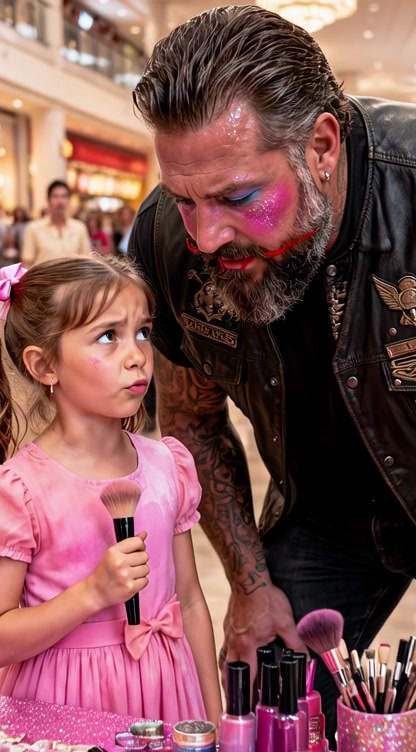
CHAPTER 1 – The Twelve Men at Lily’s Little Counter
The first thing the little girl noticed was that the biggest biker had pink glitter in his beard. The second thing she noticed was that he was crying. But that came later. For now, six-year-old Lily Mae Bennett was busy painting tiny purple flowers on the fingernails of a seven-year-old girl whose mother had finally agreed to let her sit in the little pink chair.
“Don’t move, sweetheart,” Lily instructed, concentrating hard. “Beauty takes patience.”
The girl giggled.
“I think my mommy’s going to like it.”
“Everybody likes flowers,” Lily replied confidently. “Even grumpy people.”
Across the food court, a woman in a cream-colored blazer stopped walking.
“Excuse me?”
Lily looked up. Vivian Cross, the shopping center’s management supervisor, approached the tiny beauty stand with a clipboard tucked beneath one arm. Her heels clicked sharply against the tiled floor.
“We’ve discussed this, Lily.”
Lily’s smile faded.
“Good morning, Miss Vivian.”
“Your stand is still here.”
“I know.”
“And you’re still operating it.”
Lily glanced at the little girl in her chair.
“I’m almost finished.”
Vivian sighed loudly enough for several nearby parents to hear.
“This is a commercial food court, not a playground. We’ve already explained that your little operation doesn’t meet our presentation standards.”
Lily looked down at her counter. It wasn’t much. A secondhand pink table. Three plastic chairs. A small hand-painted sign that read LITTLE LANTERN BEAUTY CORNER. A collection of inexpensive brushes, nail polish bottles, ribbons, and hair clips arranged in neat rows.
Everything had been cleaned twice that morning.
“I cleaned everything,” Lily said.
“That’s not the point.”
“Mommy said clean things make people feel safe.”
Vivian’s expression tightened.
“Your mother isn’t here to make the rules.”
The little girl in the chair stopped giggling. Her mother, sitting nearby with a paper cup of coffee, began gathering her daughter’s things. Vivian noticed.
“I’m simply trying to maintain standards,” she announced. “Parents come here expecting a certain environment.”
Lily’s fingers curled around a purple nail-polish bottle.
“Did I do something wrong?”
Vivian didn’t answer immediately. That silence hurt more than Lily expected. Then a deep voice spoke behind her.
“Looks pretty damn good to me.”
Lily turned. A broad-shouldered man stood several feet away, wearing a black leather vest over a faded gray shirt. His beard was thick, his arms covered in tattoos, and his expression suggested that smiling was something he did only when absolutely necessary.
He was holding a paper cup of coffee. Lily studied him.
“Would you like flowers on your nails?”
Vivian closed her eyes.
“Oh, for heaven’s sake.”
The man looked at his hands.
“Think they’d suit me?”
“Everybody looks nice with flowers.”
He considered that.
“Fair enough.”
His name was Gideon Mercer. Everyone who knew him called him Bear. At forty-two, he had spent most of his adult life learning how to make dangerous situations end quickly. He was president of the Iron Saints, a motorcycle club whose members were rarely welcomed anywhere before somebody had decided they were trouble.
He had broad shoulders, a scar across his left knuckle, and a reputation that usually made people reconsider their arguments. But the little girl in front of him seemed entirely unimpressed. She was examining his beard.
“Your hair is messy.”
Bear glanced down.
“Is it?”
“Yes. Very messy.”
“That’s unfortunate.”
“You need a makeover.”
For the first time that morning, something resembling a smile moved across his face.
“Guess I came to the right place.”
Vivian stepped forward.
“Sir, this child is not authorized to operate a beauty business here.”
Bear turned toward her.
“Then talk to her like a child, not like she’s stealing your building.”
Vivian stiffened.
“I’m enforcing the center’s policies.”
“And she’s painting flowers on a little girl’s fingernails.”
“It’s inappropriate.”
Bear looked at Lily’s tiny counter. Then at the little girl, who was now watching Vivian with wide eyes.
“Which part?”
Vivian’s cheeks reddened.
“I’m not going to argue with you.”
“Good. Neither am I.”
He returned his attention to Lily.
“What’s the damage, boss?”
Lily brightened.
“Five dollars.”
Bear placed a ten-dollar bill on the counter.
“Keep the change.”
Lily frowned.
“That’s too much.”
“Then put it toward your next customer.”
She considered this arrangement carefully.
“Okay. But I still have to do your nails.”
“Wouldn’t dream of stopping you.”
Bear lowered himself into the little pink chair. It creaked. A nearby father laughed before quickly pretending he hadn’t. Lily picked up a bottle of glitter polish.
“Pink or purple?”
Bear looked at his hands.
“Whatever makes me look respectable.”
“Pink.”
“Thought you’d say that.”
She began painting. And Bear let her. He had almost forgotten how it felt to sit still. Not because he was restless. Because stillness gave memories too much room. The little girl worked with extraordinary concentration, occasionally biting her lower lip as she tried to keep the brush steady.
Bear watched her hands. Small fingers. A faint purple stain near her thumb. A tiny silver bracelet that was clearly too large for her wrist. Something about the way she arranged her tools disturbed him. Not unpleasantly. It was simply familiar.
“What’s your name, sweetheart?”
“Lily.”
“I’m Bear.”
“I know.”
He raised an eyebrow.
“You know me?”
“Mommy had pictures of you.”
His hand stopped moving.
“Pictures?”
Lily nodded, carefully painting his thumbnail.
“She said you were very big and sometimes very grumpy.”
A rough laugh escaped him.
“Sounds accurate.”
“She said you were nice underneath.”
Bear looked away.
“Your mommy sounds like she knew me pretty well.”
“She did.”
Lily reached for a glitter bottle.
“Mommy used to sit in my chair.”
Bear glanced at the pink chair beneath him.
“Did she?”
“Uh-huh. She let me put flowers in her hair.”
The brush slipped slightly. Lily frowned at the tiny smudge.
“Oops.”
“It’s fine.”
“She always said the first chair was special.”
Bear’s eyes moved toward the little wooden sign behind her counter.
“What did she mean?”
Lily shrugged.
“Everybody gets a turn. Nobody has to be pretty before they sit down.”
He swallowed. There had been a woman who said things like that. A woman whose laughter could fill a room even when she was exhausted. A woman he hadn’t allowed himself to think about for two years. Mara Bennett. He stared at the purple flowers taking shape across his nails.
“That’s a good rule,” he said quietly.
Lily nodded.
“Mommy made the rules.”
Then she began humming. A soft little tune, barely louder than the food court’s ventilation system. Bear looked down. The melody struck something deep inside him. Before he could stop himself, he finished the next line.
“Little lights will lead you home.”
Lily’s brush paused. Her eyes widened.
“That’s it!”
Bear stared at her.
“What?”
“That’s Mommy’s song.”
He cleared his throat.
“Must’ve heard it somewhere.”
“I never sang it to you.”
He had no answer. Before Lily could ask anything else, the sound of heavy boots rolled across the tiled floor. One pair. Then another. Then several more. People turned. Twelve men in black leather vests entered the food court together.
They were enormous, tattooed, bearded, and completely out of place among the families eating breakfast and children carrying trays of chicken nuggets. Their boots struck the tile in a steady rhythm. A mother immediately pulled her son closer. Another woman gathered her two children and moved toward the opposite entrance.
A security employee stood near the escalators, staring. Bear slowly turned.
“Jesus Christ.”
At the front walked Ronan Voss. Rooster. Forty-five years old, built like a refrigerator, with a shaved head and a beard that reached his chest. He was carrying a battered brown leather salon case. Bear’s stomach tightened. He recognized it.
He had not seen that case since the day Mara died.
“Rooster,” he said, rising from the pink chair. “What the hell are you doing?”
Rooster didn’t answer. He walked straight toward Lily’s counter. The other eleven Iron Saints spread out behind him, surrounding the little beauty stand. Lily stared. Her mouth opened.
“Are you all getting makeovers?”
Nobody laughed. Rooster placed the case on the counter. The sound was heavy enough to rattle the nail-polish bottles.
“Morning, Lily.”
She looked at the case.
“What’s that?”
“Something that belongs here.”
Bear stepped forward.
“Pick it up.”
Rooster looked at him.
“No.”
“I said pick it up.”
“And I heard you.”
The food court had gone almost completely silent. Vivian hurried toward them, her clipboard clutched against her chest.
“This is completely unacceptable! You cannot surround a child’s business with—”
Rooster turned his head.
“Ma’am, we’re customers.”
“You’re frightening everyone!”
“Then perhaps they should stop staring at us.”
Bear moved between them.
“Enough.”
His voice carried. Even Rooster fell silent. Bear looked toward Lily. She had backed away from the counter. Her hands were pressed against her little pink apron. He hated that. He hated seeing her frightened in the place where she’d been happiest that morning.
“Hey, sweetheart.”
Lily looked up.
“Are they angry?”
“No.”
“Did I do something?”
Bear crouched in front of her.
“No, Lily. You didn’t do anything.”
She glanced at the men behind him.
“They look angry.”
“That’s just their faces.”
A few of the bikers shifted uncomfortably.
Brick, standing near the end of the counter, muttered, “He’s not wrong.”
Bear shot him a look. Brick shut his mouth. Rooster rested one enormous hand on the battered case.
“It’s time.”
Bear stood.
“No.”
“You’ve had two years.”
“I said no.”
“And Mara’s been waiting longer than that.”
The name struck Bear harder than the noise of a motorcycle engine. He looked at the case again. Its leather was cracked along the edges. One brass hinge had been replaced with a mismatched metal clasp. There was a tiny crescent-shaped scratch near the handle.
Bear’s eyes lingered on it. His right hand moved unconsciously toward the small metal charm he carried inside his wallet. He stopped himself. Rooster noticed.
“Still carrying that old thing?”
“Shut up.”
“That’s what I thought.”
Bear stepped closer.
“You had no right bringing this here.”
Rooster’s jaw tightened.
“Maybe I finally got tired of waiting for you to find the courage.”
The security employee approached with one hand raised.
“Gentlemen, I need you to step away from the stand.”
Bear turned.
“Give us a minute.”
“Sir, we’ve received complaints.”
“I heard you.”
“Then please move away from the child.”
Bear looked toward Lily. She was standing beside her chair now, gripping the edge of her apron.
“She’s staying with me.”
The employee hesitated. Vivian seized the opportunity.
“I’m calling the police. This entire situation is a liability.”
Bear’s expression hardened.
“Don’t use that word when you’re talking about a six-year-old.”
“Sir—”
“I’m going to speak with you in a minute.”
He pointed toward the corridor beside the food court.
“Rooster. Come with me.”
Rooster didn’t move. Bear leaned closer.
“Now.”
After a long moment, Rooster followed him. Brick came too. The three men entered the narrow service corridor. The noise of the food court faded behind them. Bear turned immediately.
“What are you doing?”
Rooster lowered his voice.
“Giving her something that should’ve been hers two years ago.”
“You promised me you’d leave it alone.”
“I promised Mara I’d keep it safe.”
“You promised me.”
Rooster’s eyes narrowed.
“And that’s exactly why I waited.”
Bear stepped closer.
“Do you have any idea what opening that thing does?”
“I know what’s inside.”
“No, you don’t.”
“Then tell me.”
Bear’s jaw worked. He couldn’t. Rooster looked down at the floor before speaking again.
“She made that case for Lily. Every brush. Every comb. Every little thing.”
“Then give it to Lily privately.”
“I tried.”
Bear stared at him.
“When?”
“Three times.”
“You never told me.”
“You wouldn’t have listened.”
Brick leaned against the wall.
“Bear, he’s right.”
Bear turned sharply.
“Stay out of this.”
Brick held his gaze.
“I’ve stayed out of it for two years. That’s been the problem.”
Rooster rubbed his beard.
“She deserves to know what her mother left her.”
Bear looked toward the food court entrance. He could hear Lily talking to somebody. Her small voice rose above the background noise.
“It’s okay. He doesn’t bite.”
A child’s laugh followed. Bear closed his eyes. When he opened them, the security employee had appeared at the corridor entrance.
“Sir, I need that case removed from the premises.”
Bear turned.
“No.”
“Management has requested—”
“Then management can speak to me.”
“I’m asking you to cooperate.”
Bear stepped closer, his voice dropping.
“You want to keep this place peaceful? Fine. But you don’t put your hands on that case, and you don’t touch that little girl’s counter.”
The employee swallowed.
“I’ll need to report this.”
“Do what you need to do.”
Bear walked past him. Rooster followed. Brick remained for a second, looking at the security employee.
“Bad morning to argue with either of them,” he said.
Then he followed the others. When they returned, Lily was sitting on the edge of her little pink chair. Vivian stood beside the counter, holding a printed notice.
“I’ve made my decision,” she announced.
Lily looked up.
“Miss Vivian?”
“This stand is being removed immediately. You are not permitted to continue operating here.”
The mother whose daughter had received the manicure stood nearby.
“She’s not hurting anybody.”
Vivian turned.
“Ma’am, this doesn’t concern you.”
“Actually, it does. My daughter was having a lovely morning.”
A second parent spoke up.
“So was mine last week.”
Vivian’s face tightened.
“I’m not discussing this with customers.”
Bear stepped forward.
“Then discuss it with me.”
“Sir, your presence here is already creating a disturbance.”
Bear glanced around. Twelve bikers. Several nervous parents. A security employee hovering near the escalator. A six-year-old girl whose little counter had suddenly become the center of a public argument. He understood how it looked. He also understood that Vivian was counting on him to lose his temper.
He wouldn’t give her that satisfaction. Instead, he turned toward Lily.
“Come here, boss.”
She approached cautiously. Bear lowered himself until they were eye to eye.
“Do you want to close your stand?”
Lily looked at the brushes. Then at the little girl who had been sitting in the chair.
“No.”
“Why not?”
“Because she hasn’t finished.”
Bear nodded.
“Then she gets finished.”
He turned toward Vivian.
“You can talk about your rules all day. You can tell me where you want me to stand. But you’re not going to humiliate this child in front of everybody because you don’t like the way her little table looks.”
Vivian lifted her chin.
“I’m not humiliating her.”
Bear pointed toward Lily.
“Look at her.”
Vivian said nothing.
“She came here this morning wanting to make people happy. That’s all she’s doing. If you have a problem with that, you can tell her mother.”
The words fell into the silence. Lily’s eyes lowered. Bear’s voice softened.
“Or you can tell me.”
For several seconds, nobody moved. Then the mother whose daughter had received the manicure stepped forward.
“My little girl has been talking about Lily all week,” she said. “She told me this was the only place where nobody laughed at her crooked hair.”
Another parent nodded.
“Mine likes coming here because Lily remembers her name.”
Vivian glanced around. The crowd was no longer watching the bikers. It was watching her. She lowered the notice slightly.
“This is not a popularity contest.”
“No,” Bear replied. “It’s a little girl’s beauty stand.”
Rooster stepped forward. He pulled out the small pink chair and placed it in front of the case.
“The first chair is mine,” he said.
Bear looked at him.
“What?”
Rooster sat down. The chair groaned beneath his enormous frame. He placed both hands on his knees and looked at Lily.
“I’m ready, sweetheart.”
Lily blinked.
“You want a makeover?”
“Been waiting a long time.”
She looked toward Bear. He gave her a small nod.
“Go ahead.”
Lily approached the counter. Her fear had not disappeared, but curiosity was beginning to win.
“What would you like?”
Rooster stroked his beard.
“Make me handsome.”
Lily examined him seriously.
“That’s going to take a lot of work.”
Brick burst out laughing. Even Bear couldn’t help himself. Rooster pointed at her.
“See? Honest customer service. That’s what I like.”
Lily selected a brush and began arranging the tools. Then Rooster reached for the brass clasps. Bear stiffened.
“Don’t.”
Rooster looked at him.
“It’s time.”
“I told you—”
“And I told you I was done waiting.”
Rooster opened the case. The leather hinges creaked. Inside lay a collection of carefully arranged brushes, combs, small glass bottles, and folded towels. There was a silver-handled hairbrush with a worn wooden back. A collection of colorful ribbons. A small hand mirror.
And beneath everything, wrapped in a pale cream cloth, lay a larger object. Lily leaned closer.
“Those are pretty.”
Rooster lifted the old mirror. Its frame was scratched and worn, but the glass remained clear. He placed it on the counter. Bear stared. He remembered that mirror. He remembered Mara standing in front of it, her hair twisted into a loose knot, laughing as she tried to teach him how to hold a brush.
He remembered the smell of shampoo and warm towels. He remembered a little shop with yellow walls and a bell above the door. And he remembered promising himself that he would never open this case. Not after the funeral. Not after the last time he’d seen Mara’s hands.
Not even when Rooster had asked him.
“Where did you get that?” Bear whispered.
Rooster didn’t look up.
“You know where.”
Bear’s throat tightened. The mirror was real. The brushes were real. Everything was exactly where it belonged. Except the case had never been meant to remain closed. Rooster placed the brushes in a neat row. Then he looked at Lily.
“Your mother used these.”
Lily touched the handle of the silver brush.
“Mommy had one like this.”
“She had this one.”
“Can I use it?”
Rooster nodded.
“That’s why it’s here.”
Bear moved closer.
“Rooster.”
“Not yet.”
“I mean it.”
“So do I.”
Rooster turned the mirror slightly toward Lily. She looked at her reflection, then at Bear.
“It’s like Mommy’s.”
Bear couldn’t speak. Lily picked up a brush and approached him.
“Do you want me to fix your hair?”
He looked at Rooster. Rooster gave him a long, steady stare. Bear exhaled.
“Yeah, sweetheart. I think I do.”
Ten minutes later, the president of the Iron Saints was sitting in a tiny pink chair with a purple flower painted on each fingernail, pink glitter in his beard, and two bright ribbons tied around his wrist. The entire food court was watching.
Brick had his phone out.
“Don’t even think about it,” Bear warned.
“Already sent it to the boys.”
“Brick.”
“Too late.”
The other bikers were trying not to laugh. Lily stepped back to admire her work.
“Perfect.”
Bear examined his reflection in the little mirror.
“I’m not sure about the ribbons.”
“You look beautiful.”
“That’s what I was afraid of.”
A few parents laughed. Even the security employee smiled before remembering he was supposed to remain serious. Vivian stood near the edge of the crowd, her notice still in her hand. Bear caught her eye.
“Anything else?”
She looked away. Rooster remained beside the open case. He hadn’t touched the last wrapped object. Bear noticed.
“What else is in there?”
Rooster’s expression changed.
“Something Mara wanted Lily to have.”
Bear stood.
“Give it to her.”
“Not until she finds it.”
Bear looked at him sharply.
“What does that mean?”
Rooster didn’t answer. Lily, meanwhile, had been examining the bottom of the case. She moved the brushes aside, lifted a folded towel, and discovered the pale cloth tucked underneath.
“What’s this?”
Rooster turned.
“Careful, sweetheart.”
Lily pulled the cloth free. A photograph slipped out and landed on the counter. Bear reached for it. Then stopped. The picture showed two small children standing in front of an old shop. A girl with dark hair stood beside a younger boy.
The photograph was faded at the edges. Bear couldn’t make out their faces clearly from where he stood, but something about the handwriting on the back caught his attention. He picked it up. There were only a few words. *For the first chair. Always.*
And beneath them, a single initial. M. Bear’s fingers tightened around the photograph. He looked at Rooster. The big man didn’t move.
“Don’t close it,” Rooster said quietly.
Bear’s jaw tightened.
“I’m not doing this here.”
“Then where?”
“Not here.”
Rooster held his gaze.
“It’s been two years, Bear.”
Bear looked down at the photograph again. The food court seemed to grow distant. Lily was still kneeling beside the case, her little hands searching beneath the folded cloth. Then she found something.
“Mr. Rooster?”
Rooster turned.
“What is it, sweetheart?”
Lily lifted a tiny silver comb into the light. It was old, delicate, and worn smooth along the edges. A small name had been engraved across its handle. She sounded out the letters slowly.
“G-a-b-r-i-e-l.”
Bear’s face went white. The photograph slipped from his fingers. He dropped to his knees in front of Lily.
“Gabriel.”
The name had barely left Lily’s lips when Bear reached for the little silver comb. His fingers stopped inches above it. Rooster stood beside the counter, watching him carefully. Brick had stopped smiling. Even the other Iron Saints seemed to understand that something had shifted, although none of them knew what.
Lily looked between the men.
“Is Gabriel somebody you know?”
Bear swallowed.
“It’s an old name, sweetheart.”
“Whose name?”
He looked at the comb.
“I don’t know.”
It was the first lie he’d told her that morning. And he hated how easily it came out. Rooster gently took the comb from Lily and returned it to the folded cloth.
“Let’s put this somewhere safe.”
“Can I keep it?” Lily asked.
“Not yet. We’ll make sure it doesn’t get lost.”
Bear rose slowly. His knees protested, but he barely noticed. Across the food court, Vivian was speaking urgently to the security employee. She kept glancing toward the bikers, clearly hoping somebody would give her a reason to remove them. Bear looked at Rooster.
“We’re leaving.”
Rooster frowned.
“Where?”
“To find Nora.”
“About time.”
Bear shot him a warning look.
“Don’t start.”
“I haven’t started anything.”
“You brought twelve men and a funeral case into a food court.”
Rooster glanced at Lily.
“Eleven men. You’re the twelfth.”
Brick coughed into his fist. Bear didn’t laugh. He reached for the photograph lying on the counter, folded it carefully, and slipped it into his inside pocket. Then he looked at Lily.
“Come on, boss. We’re going somewhere.”
She gathered her little brush and the pink bottle of polish.
“Are we going to see Mommy’s salon?”
Bear hesitated. Rooster answered before he could.
“Something like that, sweetheart.”
They had barely reached the other side of the food court when Darla Pike stepped into their path. She wore a fitted black jacket, expensive sunglasses, and a perfectly arranged hairstyle that looked as though it had never encountered an unexpected breeze.
A small display of children’s hair accessories stood behind her, decorated with pink ribbons and gold lettering. She looked at Lily’s counter. Then at the men surrounding it. Then she laughed.
“Seriously?”
Bear stopped. Darla removed her sunglasses.
“Vivian, I thought you said you were handling this.”
Vivian hurried over.
“I am.”
“Then why is this still here?”
She pointed directly at Lily. Lily instinctively moved closer to Bear. Darla noticed.
“Oh, don’t look so frightened. Nobody’s going to hurt you.”
Bear’s eyes narrowed.
“Watch your mouth.”
Darla looked him up and down.
“I’m talking to the child.”
“Then talk nicely.”
Vivian stepped between them.
“Darla has a legitimate business here. Her children’s makeover booth operates under the center’s approved standards.”
Darla folded her arms.
“Unlike this little imitation.”
Lily frowned.
“Imitation?”
Darla pointed toward the pink counter.
“You’ve copied my business. The ribbons, the nail polish, the little chairs. Everything.”
Lily looked at her own supplies.
“But Mommy had these.”
Darla gave a dismissive laugh.
“I’m sure she did.”
Bear took one step forward.
“What exactly are you accusing her of?”
“Using my concept without permission.”
“She’s six.”
“And somebody is clearly encouraging her.”
Darla looked toward Vivian.
“I’ve spent years building my children’s beauty brand. I won’t have an unauthorized competitor operating beside me.”
Bear glanced at the small display behind her.
“You’ve spent years building a table with ribbons on it?”
Darla’s mouth tightened.
“It’s more than that.”
“Then explain it.”
“I’m not required to justify my business to you.”
“No. But you’re required to explain why you’re accusing a little girl of stealing something her mother taught her.”
Darla looked toward the growing crowd. She lowered her voice, but not enough.
“This is exactly why I don’t want them here. These people intimidate customers.”
Brick stepped forward.
“Lady, we’ve been standing here quietly.”
“Your appearance is intimidating.”
Brick looked down at his vest. Then at Bear.
“Should I change shirts?”
Nobody laughed. Bear turned back to Darla.
“We’re not discussing our clothes. We’re discussing Lily.”
Vivian lifted the removal notice.
“The stand must be removed. That’s final.”
Bear shook his head.
“No.”
“Excuse me?”
“You heard me.”
Darla smiled coldly.
“Then perhaps security should remove it for you.”
Bear didn’t move.
“Nobody touches that counter until Lily has been treated fairly.”
The words carried across the food court. Lily looked up at him. For a moment, she seemed unsure whether she was allowed to believe him. Then she reached for his hand. He held it. Darla shook her head.
“This is ridiculous.”
“Then prove your accusation,” Bear replied.
“I have customers.”
“So does Lily.”
Darla glanced at the little girl sitting in the pink chair, waiting for her unfinished manicure. Her expression hardened.
“Fine. Let’s see how long this little performance lasts.”
She walked away. Vivian followed, still clutching the notice. Bear watched them go. Rooster approached from behind.
“You ready?”
Bear looked at Lily. She was staring at the pink chair.
“Can we finish her nails first?”
He crouched.
“Of course.”
Lily returned to her customer, picked up the polish, and carefully painted the last flower. The girl’s mother thanked her. Lily smiled. Then she looked at the empty space where Darla had been standing.
“Why does she think I copied her?”
Bear considered his answer.
“Sometimes people get so busy protecting what they have that they forget other people can make things too.”
Lily thought about that.
“Mommy said sharing makes more room.”
Bear looked toward the salon case.
“Your mommy was right.”
The old Little Lantern Salon stood several streets away from the shopping center. Its yellow-painted sign had faded in the sunlight. The front windows were dusty, and the little brass bell above the entrance hung slightly crooked. Bear hadn’t visited in months.
He stopped outside. Rooster carried the battered case in both hands. Lily held Bear’s fingers, her small steps matching his slower pace.
“Is this Mommy’s place?” she asked.
“Yeah.”
“It’s smaller than I remember.”
Bear glanced down.
“You remember it?”
She nodded.
“Mommy used to bring me here. There was a yellow chair.”
He looked through the window. There it was. Tucked near the back wall. A little yellow salon chair with a cracked vinyl seat. Bear pushed the door open. The bell rang. The sound sent a sharp memory through him. Mara laughing behind the counter.
Mara complaining about the old heating system. Mara telling him he held a comb like a man trying to repair a motorcycle. He stepped inside. The smell of old wood and faded shampoo lingered in the air.
“Hello?”
A voice came from the back.
“I’m coming.”
Nora Whitcomb emerged from the storage room carrying a cardboard box. At sixty-three, she had silver hair tied into a neat bun and the sharp eyes of someone who had spent decades noticing things people thought they had hidden. She stopped when she saw Rooster.
Then Lily. Then Bear. Her gaze settled on the battered case. The cardboard box slipped slightly in her hands.
“Oh,” she whispered.
Rooster set the case on the counter.
“Thought it was time.”
Nora approached slowly.
“Where did you get it?”
“You know where.”
She touched the leather handle. Her fingertips moved across the worn surface. Then she looked at Bear.
“You opened it?”
Bear shook his head.
“Rooster did.”
Nora nodded.
“Good.”
Bear studied her.
“You know what’s inside?”
“Of course.”
“Then tell me why there’s a comb with the name Gabriel engraved on it.”
Nora’s expression changed. For a fraction of a second, her eyes moved toward his wrist. Then she looked away.
“First, let me see the case.”
Rooster opened it. Nora’s hand went to her mouth.
“Oh, Mara.”
She lifted the old silver-handled brush and turned it over. Then she carefully removed a small collection of combs.
“These are the first ones,” she said.
Lily moved closer.
“First what?”
Nora knelt beside her.
“First combs.”
“Like the first comb Mommy bought?”
“Not exactly.”
Nora selected one from the collection.
“This one belonged to the first little girl your mother ever welcomed into this salon. She was scared to have her hair brushed. Your mother gave her a comb and let her hold it herself.”
Lily listened.
“What happened?”
“She came back the following week. Then she brought her little brother. After that, other children started coming.”
Nora smiled faintly.
“Your mother kept the first comb from every child she welcomed. She believed that everybody deserved a place where they didn’t have to be embarrassed about how they looked.”
Lily touched the wooden counter.
“That’s why she made the rules.”
Nora nodded.
“That’s exactly why.”
Bear looked at the collection.
“How many?”
“Twenty-seven.”
Rooster glanced at him.
“Twenty-seven children. Twenty-seven first combs.”
Nora returned the silver brush to its place.
“She never thought of them as customers. They were children who needed somebody to sit with them.”
Bear looked toward the yellow chair.
“And the case?”
Nora rested her hand on the lid.
“Your mother wanted everything kept together.”
“Why?”
Nora’s eyes met his.
“Because some things are easier to pass on when you keep them safe.”
Bear looked away.
“That’s not an answer.”
“No,” she said quietly. “It isn’t.”
He stepped closer.
“Nora, I need you to tell me about Gabriel.”
The older woman became still. Rooster lowered his eyes. Lily looked between them.
“Is Gabriel in the salon?”
Bear knelt beside her.
“No, sweetheart.”
“Then why is his name on the comb?”
Bear didn’t answer. Nora crouched on Lily’s other side.
“Sometimes names belong to stories that take a long time to understand.”
Lily considered this.
“Like fairy tales?”
“Sometimes.”
“Is it a happy story?”
Nora looked at Bear.
“I hope it will be.”
They spent the next hour examining the salon case. Nora recognized every brush and ribbon. She showed Lily how Mara used to arrange the combs by size and how she kept the small towels folded beneath the mirror. Lily was fascinated.
“She did it just like me.”
Nora smiled.
“Maybe you learned more from watching her than you realized.”
Bear stood near the front window, watching Lily run her fingers along the counter. Rooster approached.
“You see it now?”
Bear didn’t turn.
“See what?”
“What she was trying to give the girl.”
“A beauty stand?”
“A place.”
Bear looked at him.
“Then why didn’t you just tell me that?”
Rooster’s jaw tightened.
“Because every time I tried to talk about that case, you shut the conversation down.”
Bear looked toward the mirror.
“It’s not that simple.”
“I know.”
“No, you don’t.”
Rooster leaned against the counter.
“Maybe not. But I know what she wanted preserved.”
Bear lowered his voice.
“Then tell me what she meant by Gabriel.”
Rooster shook his head.
“Nora should answer that.”
From across the room, Nora called them.
“Bear, I need to ask you something.”
He approached. She held out a small photograph from the case.
“Do you recognize either of these children?”
Bear looked at it. The photograph showed the two children standing in front of the old shop. He studied the little boy. Something about the shape of his eyes bothered him.
“I don’t know.”
Nora watched his face.
“You’re certain?”
“It’s an old photograph.”
“Yes.”
She took it back.
“Sometimes old things are difficult to recognize.”
Bear looked at her sharply.
“What are you not telling me?”
Nora didn’t answer. Instead, she turned toward Lily.
“Sweetheart, would you help me put these combs back?”
Lily nodded enthusiastically. While she worked, Nora moved closer to Bear.
“You should come back when you’re ready to talk.”
“I’m here now.”
“I know.”
“Then talk.”
Nora’s gaze dropped to his left wrist. The scar there was narrow and pale, partly hidden beneath the edge of his watch. She reached toward it, then stopped herself. Bear noticed.
“What?”
“Nothing.”
“Nora.”
She stepped away.
“Let’s go back to the food court. There’s something that needs settling.”
Darla was standing beside her children’s makeover booth when they returned. Several parents had gathered around the display. A row of bright ribbons hung behind her, arranged in almost exactly the same pattern as the ones in Lily’s little counter.
She was demonstrating a children’s hairstyle to an imaginary audience, explaining how her brand encouraged confidence through personal grooming. Vivian stood beside her. When she spotted the Iron Saints entering, she immediately straightened.
“Not again.”
Bear walked past her. Rooster followed with the case. Lily stayed close to Nora. Darla smiled.
“Back already?”
Bear stopped in front of her.
“Got something to show you.”
“I’m not interested.”
“You should be.”
He stepped aside. Nora approached. Darla’s smile faded.
“Do I know you?”
Nora looked at the ribbons hanging behind the booth. Then at the display cards. Then at the pink chairs.
“I know your business,” she said.
Darla folded her arms.
“Good. Then you know what I do.”
“I know what you copied.”
A murmur moved through the parents. Darla laughed.
“Excuse me?”
Nora rested her hand on the old salon case.
“Little Lantern opened in 2018. Mara welcomed children who couldn’t afford salon appointments, children who were teased about their hair, and children whose parents simply wanted them to have somewhere kind to go.”
Darla rolled her eyes.
“That’s a lovely story.”
“It isn’t a story. I worked beside her.”
Nora opened the case. She lifted one of the original brushes.
“Those ribbons. Those little chairs. The idea of giving children their first makeover without charging them. Mara did all of it years before you started selling your version.”
Darla’s cheeks colored.
“You can’t prove that.”
Nora turned toward the parents.
“I don’t need to prove it to the people who remember coming here.”
A woman standing near the booth stepped forward.
“I remember Little Lantern.”
Darla turned. The woman looked at the old case.
“My daughter got her first haircut there. Mara gave her a yellow ribbon because she was afraid of the scissors.”
Another parent nodded.
“My son used to come after school. He loved that place.”
Darla looked around. Her confident smile had disappeared. Nora continued.
“Your business isn’t wrong because you offer children’s makeovers. But standing here and accusing Mara’s daughter of copying you is.”
Darla opened her mouth. No words came. Nora picked up one of the small combs.
“This is one of the original first combs. Mara saved them because she believed every child deserved to be welcomed.”
She placed it carefully beside the mirror.
“You didn’t invent kindness, Darla. And you certainly didn’t invent Little Lantern.”
The crowd fell silent. Vivian looked toward the display behind Darla. The ribbons were arranged in the same colors as the original salon’s. The little chairs had the same shape. Even the handwritten welcome sign used nearly identical wording. Darla reached for her sunglasses.
“I don’t have to stand here and listen to this.”
“No,” Nora replied. “But you do have to stop accusing a child of stealing from you.”
Darla picked up her bag and walked away. The parents parted to let her pass. Nobody followed. Lily watched her disappear into the crowd. Then she looked at Nora.
“Did Mommy make all those things first?”
Nora smiled.
“She made them because she loved children.”
Lily looked down at her little hands.
“Then I want to keep doing it.”
Nora knelt and straightened Lily’s apron.
“I think your mother would like that.”
Bear remained beside the counter long after Darla had disappeared. The crowd slowly returned to its usual rhythm. Rooster closed the salon case halfway, leaving the mirror visible. Nora stood across from Bear.
“You asked me about Gabriel.”
Bear nodded.
“I did.”
She studied him.
“Show me your wrist.”
He frowned.
“Why?”
“Please.”
Bear hesitated, then pushed his sleeve upward. The pale scar crossed his skin. Nora stared at it. Her lips parted. She reached out and traced the edge of the scar with one trembling finger. Bear pulled back slightly.
“What is it?”
Nora didn’t answer immediately. Her eyes filled. She looked toward Lily, who was arranging the brushes beside Rooster. Then she looked back at Bear.
“Where did you get that scar?”
“I don’t remember.”
Nora’s breathing changed.
“Of course you don’t.”
Bear stiffened.
“What does that mean?”
She shook her head, fighting to steady herself.
“Your mother used to say you had been home long before you knew where home was.”
Bear stared at her. He had heard those words before. Or something close to them. He couldn’t place where. Nora reached for his hand again. This time, he didn’t pull away. She held it between both of hers.
“Gabriel,” she whispered.
Bear looked at her. Nora’s voice broke.
“Your sister, Mara, spent years hoping you’d find your way back.”
Lily stopped arranging the brushes. She looked up at Nora, then at Bear.
“Mommy was his sister?”
Nora took Bear’s hand, called him by his childhood name, and Lily heard her mother mentioned as his sister.
“Mommy was his sister?”
Lily’s small voice cut through the food court. Bear looked down at her. Nora still held his hand, her fingers curled around his knuckles. The silver comb rested in Lily’s palm, its engraved name catching the overhead light. He tried to answer.
Nothing came. Lily studied his face, waiting. Her lower lip trembled, but she didn’t cry. She had learned too early that grown-ups sometimes went quiet when a question mattered.
“Is that why you knew Mommy’s song?” she asked.
Bear swallowed. “I don’t know, sweetheart.”
Nora released his hand.
“Not every answer comes all at once,” she said gently.
Vivian Cross stepped forward, clutching the removal notice against her chest. “This is a food court, not a family reunion. The child’s stand is still operating without authorization, and I’m not changing the rules because a dozen men in leather jackets have decided to make a scene.”
Brick shifted behind Bear. The movement was small, but the nearby tables fell quiet. Bear raised one hand. Brick stopped. Lily looked from Vivian to Bear. Then she climbed onto her little stool and reached for the brush she had dropped earlier.
“I’m not finished,” she said.
Vivian stared at her. “What?”
“My stand.” Lily set the brush beside the little bottles of polish. “I’m not finished making people pretty.”
“Lily,” Bear said softly.
She shook her head.
“My mommy said people should get to feel special even when they don’t have fancy clothes or shiny hair.” Her fingers tightened around the brush. “She said you never know who had a hard day.”
Vivian’s mouth pressed into a thin line. “Your mother’s opinions don’t determine how this property is managed.”
“She never said they did.”
Lily’s answer was so quiet that Vivian almost missed it.
“She just said I should be kind.”
The girl climbed down from the stool and picked up a little paper flower she had made from pink tissue. She walked toward Vivian, stopping a few feet away.
“You look angry,” Lily said. “You can have this if you want.”
Vivian glanced at the flower as if Lily had offered her something dirty.
“I don’t want it.”
Lily’s hand lowered. Bear felt something hard and hot settle behind his ribs. He stepped between them, not blocking Lily from view, but making certain Vivian understood that she would not get another chance to hurt her.
“She offered you kindness,” he said. “You could have accepted it.”
“I’m not here to be lectured by you.”
“Then stop giving me reasons.”
Vivian lifted the notice. “The stand will be removed if it’s still here tomorrow.”
“You’ve said that already.”
“And I mean it.”
Bear looked at the little counter, the crooked sign Lily had painted herself, and the paper flowers lined along its edge. The stand was small enough to fit between two tables. It was also the only place Lily had built for herself since losing her mother.
He would not let it become another thing taken away without a fight.
“We’ll have a public event,” he said.
Vivian frowned. “What?”
“A Little Lantern makeover day. At the community hall. Parents, neighborhood residents, children. Lily will have a proper place to work, and everyone will see what this is.”
“You don’t have permission to use the hall.”
“I’ll arrange it.”
“You think money and muscle make every door open?”
“No.” Bear glanced at the pink tissue flower still in Lily’s hand. “I think people open doors when they see what happens inside.”
Vivian gave a short, humorless laugh. “You’re making promises on behalf of a six-year-old.”
“I’m making one on my own behalf.”
He turned toward Lily. “You want to do it?”
Her eyes widened.
“At the big hall?”
“If you want.”
“With my chair?”
“We’ll bring your chair.”
“And my flowers?”
“All of them.”
Lily looked down at the tissue flower. After a moment, she placed it carefully on Vivian’s notice.
“Maybe you’ll want it later,” she said.
Then she returned to her counter. Vivian stood motionless, the flower resting against the printed warning in her hands. Bear did not wait for her response. The community hall smelled of floor polish and old wood. Its folding tables had been pushed against the walls, leaving a broad open space beneath the ceiling lights.
Rooster carried Lily’s pink chair through the doorway while Bear followed with the battered salon case. Brick had helped move the supplies, but he had stayed behind at the food court with the others. Lily walked between Bear and Rooster, carrying her paper flowers in a shoebox.
“Do you think people will come?” she asked.
“They will,” Rooster said.
“How many?”
“Enough to keep me busy.”
“That’s not a number.”
Rooster looked down at her. “Twenty-seven?”
Lily considered it. “That’s a lot of people.”
“Then I’d better start stretching.”
She giggled. Bear set the case on a table near the front. He watched Lily arrange her brushes and bottles with careful concentration. Every item had its own place. She had even brought the small hand-painted sign from the food court.
He crouched beside her.
“You don’t have to do every makeover yourself.”
“I know.”
“You can stop whenever you’re tired.”
“I know that too.”
“And if you don’t want to—”
“Bear.”
He stopped. Lily was looking at him with the serious expression she wore when she wanted him to understand something important.
“I want to do it.”
He nodded. “Then you will.”
Rooster unfolded another table. “We’ll call it Little Lantern Day. Same name as Mara’s salon.”
Lily touched the edge of her sign.
“Mommy’s name,” she murmured.
Bear looked toward the old salon case. He still hadn’t found the answer to why Mara had left it with him, or why Nora had called him Gabriel as though the name had been waiting somewhere beneath his skin. But the case had come here. Lily had come here.
For now, he could make sure neither was taken away. The doors opened. Darla Pike entered carrying a large display board under one arm. Her hair was perfectly arranged, and her smile was already in place. She glanced around the hall, taking in the tables, the chair, the case.
Then her eyes settled on Lily.
“Well,” Darla said. “This is ambitious.”
Bear straightened. Darla set her board against the nearest table. It displayed glossy photographs of children’s hairstyles and bright promotional lettering bearing her own beauty-booth branding.
“I heard there was going to be a makeover event,” she said. “I assumed someone had asked me to help organize it.”
“No one did,” Rooster replied.
Darla ignored him. “You can’t just put a children’s beauty event together without knowing how these things work. There are schedules, presentation standards, supplies. Someone needs to supervise.”
“I’m organizing it,” Bear said.
Darla’s gaze moved over his tattoos and broad shoulders. “You?”
“That’s what I said.”
She gave a small laugh. “This is a professional event, not a clubhouse gathering.”
Rooster leaned against the table. “Then you should be relieved. We brought a professional.”
He nodded toward Lily. Darla looked at the little girl’s bottles of polish and plastic combs.
“That’s exactly the problem. Children need proper presentation. Parents want quality. They don’t want to stand in line for a little girl playing salon.”
Lily’s hands stopped moving. Bear saw it. So did Rooster.
“Careful,” Bear said.
Darla lifted her palms. “I’m being honest. I can bring my equipment, my staff—”
“No,” Lily said.
The word was small.
Darla looked down at her. “Excuse me?”
“You can’t take my table.”
“I’m trying to help.”
“You said my haircuts weren’t good enough.”
Darla’s smile tightened. “I said your little booth was copying my work.”
“It’s not.”
“Lily,” Bear said, keeping his voice calm.
But Lily stepped out from behind her chair.
“My mommy had a salon before yours,” she said. “She helped people who didn’t have money. She made them feel pretty. You don’t get to say she copied you.”
Darla’s cheeks colored.
“Your mother isn’t here to defend herself.”
The hall went still. Bear moved before he realized he had moved. One step placed him beside Lily, his hand resting lightly on the back of her chair.
“She doesn’t need to defend her mother alone,” he said.
Darla glanced toward the doorway. “You’re turning this into a spectacle.”
“You brought your display board and tried to take over a child’s event.”
“I have experience.”
“Then use it somewhere else.”
Darla’s expression hardened. “You can’t keep her protected forever. People will see what this really is.”
“They already see what it is.”
Bear looked around the empty hall.
“It’s a place where children get treated like they matter. If you came to help, you could have asked Lily what she needed. Instead, you walked in and tried to take her chair.”
Darla grabbed her display board.
“This event will be a disaster.”
“Then you won’t have to stay,” Rooster said.
She turned toward the exit, but stopped beside Lily.
“You’ll understand eventually,” she said. “People don’t come to events like this for homemade flowers.”
Lily looked down at her shoebox.
“They came to Mommy’s salon.”
Darla had no answer. She carried her board out. Rooster waited until the door swung shut. Then he pulled a folding chair toward Lily’s table and sat down.
“Well,” he said, “I believe I’m first in line.”
Lily blinked. “For what?”
“A makeover. Unless you’ve decided I’m too handsome already.”
A tiny smile appeared on her face.
“You need help.”
“Terrible news.”
She picked up a comb. Bear watched her shoulders loosen as she began arranging Rooster’s hair. He let out a theatrical groan when she clipped a pink flower above his ear.
“Perfect,” Lily announced.
Rooster examined himself in a small mirror.
“I look dangerous.”
“You look pretty.”
“Even better.”
Bear laughed under his breath. For a few minutes, the hall felt almost ordinary. Then Lily glanced toward the doorway.
“Will you stay until everybody comes?”
Bear crouched beside her.
“Yes.”
“What about after?”
He hesitated. Her eyes dropped to the comb in her hand.
“People say they’ll stay,” she whispered. “Then they go.”
Bear felt the words strike somewhere deep. Rooster stopped pretending to inspect his reflection. Bear took Lily’s small hand between both of his.
“I can’t promise you that nothing will ever change,” he said. “But I can promise I won’t disappear without telling you. And I won’t leave you to face things alone.”
Lily searched his face.
“Even if I make your hair pink again?”
“Especially then.”
She leaned forward and pressed her forehead briefly against his shoulder. He held still until she pulled away. The old Little Lantern Salon was quiet when they reached it. The front room still carried the faded warmth of its former life: pale paint, worn shelves, and the old counter where Mara had once arranged brushes in neat rows. The mirrors had been covered to protect them from dust. A faint outline of the salon’s name remained above the doorway.
Lily stepped inside first.
“It’s smaller than I remember,” she said.
Bear looked at her. “You remember it?”
“A little.”
She wandered toward the far wall, where an old mirror stood wrapped in a protective cloth. Nora followed them into the room. She had brought the key and now held it in her palm.
“Your mother loved this place,” she told Lily.
“I know.”
“She wanted you to have something that belonged to her. Something you could use, not just look at.”
Lily approached the covered mirror. She reached for the cloth, but paused.
“Can I?”
Nora nodded. Lily pulled the cloth away. The mirror was tall, its wooden frame worn smooth at the corners. A small crescent-shaped scratch marked the lower edge. Lily stared at it.
“It’s our family mirror,” she said.
Bear looked at her.
“Why do you call it that?”
“Because Mommy used to stand here with me.” Lily touched the frame. “She would put me on the counter and brush my hair. She said everyone should have a mirror where they could see themselves being loved.”
Nora’s expression softened.
“She did say that.”
Lily leaned closer to the glass. Her reflection appeared beside Bear’s, the two of them standing shoulder to shoulder.
“Can we bring it to the hall?”
“We can,” Bear said.
Nora rested a hand against the frame. “Your mother wanted you to inherit it because this mirror was part of the salon she built. She wanted you to have a place to create something of your own, just as she had.”
Lily ran her fingertips along the wooden edge.
“Can I put my flowers around it?”
“You can do whatever you like with it,” Nora said. “It belongs to you.”
Bear studied the mirror. The frame was older than the salon itself, its corners repaired in two places. He could see the faint marks left by years of hands touching the wood.
“What was in the case?” he asked Nora. “I mean, what was Mara trying to give Lily?”
Nora looked toward the battered salon case sitting on a nearby stool.
“Not everything in that case was meant to be understood at once.”
“I’ve waited long enough.”
“Perhaps.” Nora glanced at Lily, who was busy inspecting the mirror’s lower shelf. “But Mara chose each piece carefully. She wanted Lily to know where the salon began, and why it mattered.”
Rooster came in carrying the remaining supplies. He set them down beside the wall.
Bear turned to him. “You keep calling the case something that belongs here.”
“Because it does.”
“Mara owned the salon.”
Rooster shook his head. “Not the way you mean it.”
Bear waited. Rooster looked at Lily, then at the mirror.
“It isn’t Mara’s property, Bear. It’s something that belongs to the family.”
The words settled between them. Bear looked at the case. Its battered leather corners, the old brass clasp, the scratches around the handle. He had spent two years refusing to open it. Now it sat in the same room as the mirror, and he could not shake the feeling that the two had been meant to meet.
Nora moved closer.
“Help me lift the mirror,” she said. “There’s a loose panel behind the backing. I want to make sure the wood hasn’t split.”
Bear took one side. Nora took the other. Together they eased the mirror away from the wall and lowered it onto a padded work surface. The back was secured with small metal tabs. Nora examined them, then carefully loosened the ones along the lower edge.
“Don’t force it,” she warned.
“I know.”
He eased the backing free. A narrow space appeared between the mirror glass and the wooden frame. Dust had collected in the corners. Something thin was tucked behind the lower support. Bear reached in and drew it out. A photograph.
Its edges had yellowed, and one corner was bent. He brushed away the dust with his thumb. Two children stood close together in front of a plain wall. The smaller one wore a bright crescent-shaped charm on a cord around the neck.
Bear stopped breathing. The child’s face was rounder, younger, but the eyes were unmistakable. So was the slight tilt of the head, the stubborn set of the mouth. He knew that face. He had seen it in old dreams, in the brief flashes that vanished whenever he tried to hold them.
His hand rose to the chain beneath his shirt. The crescent charm he had carried for decades rested against his chest. The same shape. The same worn curve.
“Bear?” Nora said.
He didn’t answer. The second child stood beside the first, one hand resting on the smaller child’s shoulder. Bear stared at the two figures until the room seemed to narrow around the photograph. Lily came close, peering at it.
“Who are they?”
Bear turned the photograph over. Beneath the two figures, in faded handwriting, was a single childhood nickname. Gabe.
“Gabe.”
Bear said the name without recognizing his own voice. The photograph trembled between his fingers. The two children stared back at him from another lifetime, one wearing the crescent charm that still rested against his chest. Nora stood on the other side of the worktable.
“Put it down,” she whispered.
Bear looked up. “You knew.”
Nora’s eyes filled. “Yes.”
“How long?”
She didn’t answer quickly enough.
“How long, Nora?”
“Since Mara found you again.”
Bear pushed away from the table. The old mirror rattled against its wooden supports.
“Found me?”
Nora reached toward him, then stopped when he stepped back.
“You said she recognized me when I came to repair the salon.”
“She did.”
“And you let me walk into that place year after year without saying a word?”
“I promised Mara I wouldn’t force the truth on you.”
Bear gave a short, bitter laugh. “You all seem to have made promises about my life.”
“That isn’t fair.”
“Neither is finding out my name from the back of a photograph.”
He held it up. The little boy’s face seemed to move in the weak light. He could almost feel the weight of the charm against his childhood shirt. Almost hear a voice calling him from somewhere beyond the walls. Then the memory slipped away.
“What happened to us?” he demanded.
Nora pulled out a chair, but Bear remained standing.
“You and Mara were children when your family broke apart. You were separated. She was old enough to remember you clearly. You were younger. Afterward, you lost the pieces of your childhood that might have led you back to her.”
“Where did I go?”
“I don’t know every detail of what happened to you after the separation. I know Mara searched. I know she never stopped remembering you.”
“Then how did she find me?”
Nora looked at the photograph.
“You came to Little Lantern in 2021 with the Iron Saints. The shop needed repairs. You were fixing a damaged shelf when Mara saw the crescent charm you wore.”
Bear’s hand moved to his chest.
“She recognized it?”
“She recognized you. Not just the charm. Your face. The way you stood. The little scar near your wrist.”
Bear looked down. A pale crescent of scar tissue curved along the inside of his wrist. He had never thought much about it. It had been there for as long as he could remember.
“She knew,” he said.
“Mara knew.”
“And she didn’t tell me.”
“She tried to give you time.”
“Time for what? To remember?”
Nora’s voice softened. “To feel safe enough to want to.”
Bear turned toward the mirror. His reflection looked like a stranger: broad shoulders, graying beard, tattoos crawling beneath his sleeves. The name Gabriel seemed impossibly small beside the man staring back.
“I built a life,” he said. “I had a club. Brothers. A place to belong. I thought I knew who I was.”
“You do know who you are.”
“Do I?”
“You’re still the man who repaired that shelf because Mara asked. You’re still the man who learned to braid hair because Lily wanted someone to show her. None of that disappears because you had another name first.”
Bear looked at her sharply.
“Why did Mara leave Lily with me?”
Nora lowered her eyes.
“Because she wanted Lily to know her family.”
The room seemed to grow quieter.
“She didn’t choose me because I had twelve men behind me?”
“No.”
“Because I could protect her?”
“You can protect her. Mara knew that. But it wasn’t the reason.”
Nora stepped closer.
“She wanted Lily to grow up knowing the people she came from. She wanted her daughter to have a connection to the family she had lost as a child. Mara had found her brother again. She wanted Lily to have him, even if you weren’t ready to understand what that meant.”
Bear stared at her.
“She arranged for me to become Lily’s guardian because she knew I was her uncle?”
“She wanted you in Lily’s life. She trusted you with her daughter because she knew the kind of man you were, and because you were family.”
Bear looked down at the photograph again.
“Why didn’t she tell me?”
“She did what she could without taking your choice away.”
He clenched his jaw. “You keep saying choice. Nobody gave me a choice. You let me stand beside my own sister and call her my friend.”
Nora flinched.
“Mara was afraid you’d run.”
“Maybe I would have.”
“I know.”
“And the case?”
Nora glanced at it.
“She wanted you to open it when you were ready.”
Bear looked at the battered leather handle. A tiny crescent-shaped scratch marked one corner, almost hidden beneath the worn leather. He touched it with his thumb. His oldest childhood possession had carried the same mark. He had kept it without knowing why, even after the memories attached to it had faded.
His hand began to shake.
“I couldn’t open it,” he said.
Nora waited.
“I told myself it was because Mara had asked me to keep it safe. That opening it would mean breaking something she wanted preserved.” He drew a breath that caught halfway. “But I knew there was something inside that I didn’t want to see.”
He remembered the first time Rooster had brought the case to him. The refusal had come too quickly. He had felt the old terror before he could name it.
“I was afraid,” Bear said. “Not of the case. Of what it might bring back.”
Nora nodded, tears running down her cheeks.
“I was afraid there would be a family inside it,” he continued. “A family I couldn’t remember. A little boy I had buried so deep I couldn’t even say his name.”
“Gabriel,” Nora whispered.
Bear shut his eyes. For one moment, the room filled with fragments. A small hand holding his. A child’s laughter. A voice singing a rhyme. A woman bending to his height, her dark hair falling forward as she smiled. Then nothing.
He opened his eyes.
“Did she know I might never remember?”
“Yes.”
“And she still left it to me?”
“She trusted that love could reach you even if memory couldn’t.”
Bear turned away.
“I need to talk to Rooster.”
Rooster was waiting beside Lily’s tiny counter when Bear returned to the food court. The old salon case sat beneath the table. Lily was arranging her paper flowers, carefully setting one beside each bottle of polish. She looked up as Bear approached.
“Did you find out who the children were?”
Bear stopped beside her.
“Not yet,” he said.
It wasn’t the whole truth. But it was all he could give her without breaking something open in front of the room. Lily studied his face.
“You look sad.”
“I’m all right.”
She reached for his hand. “You don’t have to be.”
Bear bent and kissed the top of her head. Rooster waited until Lily turned back to her flowers.
“Come with me,” Bear said.
They moved a short distance from the counter, near the edge of the food court. The noise of conversation and clattering dishes filled the silence between them. Bear held up the photograph.
“Tell me what you knew.”
Rooster stared at it. His jaw tightened.
“Nora told you.”
“She told me Mara recognized me when I came to repair the salon. She told me why Mara wanted me in Lily’s life.”
Rooster looked toward Lily.
“Then you know.”
“I want to hear it from you.”
Rooster took a breath.
“Mara told me you were her brother. She told me she wanted Lily to grow up knowing her mother’s family. She wanted you to have a chance to be part of that, whether you remembered or not.”
“And you knew when she made me Lily’s guardian?”
“Yes.”
Bear’s expression hardened.
“You knew why she chose me.”
“I did.”
“You let me believe she chose me because I could keep Lily safe.”
“She knew you could keep her safe.”
“That isn’t what I asked.”
Rooster looked down.
“No. She didn’t choose you because you had a club. She chose you because you were her brother.”
Bear’s fist closed around the photograph.
“Why didn’t you tell me?”
“Because Mara asked me not to force you.”
“You could have told me anyway.”
“I could have.”
Rooster’s voice was rough now.
“But I saw what happened whenever someone tried to push you toward your childhood. You shut down. You changed the subject. You made it clear that whatever was behind that door wasn’t welcome.”
Bear stared at him.
“You knew I was afraid?”
“I knew you were carrying something you couldn’t name.”
“And you let me keep carrying it.”
“I thought you deserved to open the case yourself.”
Bear stepped closer. “You don’t get to decide what I deserve.”
“No,” Rooster said. “I don’t.”
For a moment neither man moved. Then Rooster looked at the photograph again.
“I was there when Mara packed the case. I watched her choose what went inside. She held that little comb for a long time before putting it away. She told me she wanted Lily to have a place to begin. She told me she wanted you to have a way back, if you ever wanted it.”
Bear’s eyes burned.
“Did she ever say she was afraid I wouldn’t come back?”
Rooster nodded.
“She said she hoped you’d find your way home. But she didn’t want Lily waiting for you to become someone else before she could love you.”
Bear looked across the food court. Lily was standing on her stool, trying to reach a flower that had slipped behind a bottle. She pushed it back into place, then smiled at her small arrangement.
“She thinks everyone leaves,” Bear said.
Rooster followed his gaze.
“She has lost too much.”
“And now she knows her mother was my sister.”
“She knows enough to ask questions.”
“What if she thinks I have to choose between her and the club?”
Rooster looked him in the eye.
“Then show her she doesn’t have to lose one family to find another.”
Bear looked down at the photograph. For years, he had believed his life began when he became Gideon Mercer. He had built a name, a place, a brotherhood. He had never understood why a little girl’s voice could reach into him and pull out a song he couldn’t remember learning.
Now he knew there had been another name before the beard, the vest, and the club. And there had been a sister. The community event filled the food court the following afternoon. Lily’s little counter stood at the center of the open space, decorated with tissue flowers and the old mirror brought from Little Lantern. Families gathered around the tables. Children watched the brushes and combs with curiosity, while the Iron Saints stood nearby, keeping the walkway clear.
Bear stayed close to Lily. He had not told her everything yet. He had spent the morning trying to find words that would not frighten her. Each time he looked at her, he saw the little girl who had offered Vivian a paper flower after being threatened with losing her stand.
He also saw Mara. Darla arrived just as Lily finished arranging her bottles. She walked straight toward the counter, carrying her display board.
“This is not how the event was supposed to be run,” she announced.
Bear turned. Darla placed her board beside Lily’s sign, covering part of the hand-painted lettering.
“I’ve spoken to the management. My booth is taking the main position. We’ll have proper stations, and this little setup can move to the side.”
Lily stared at her sign disappearing beneath Darla’s display.
“But this is my counter.”
Darla didn’t look at her.
“It’s a public event. The person with the most experience should lead.”
“I organized it,” Bear said.
“And I have the equipment and the reputation to make it successful.”
“You weren’t invited to take over.”
Darla smiled toward the gathered families. “I’m trying to prevent an embarrassing mess. Surely everyone here wants the children to receive proper makeovers.”
Lily stepped forward.
“I can do makeovers.”
Darla glanced down at her. “You can play salon. That’s different.”
A few people shifted uncomfortably. Bear felt the familiar pull of the club behind him. The Iron Saints could make Darla retreat with a look. He could have raised his voice, let the weight of his reputation fill the food court, and made the confrontation about power.
But Lily was standing beside her counter. He looked at her. Her fingers were wrapped around the edge of the table. She was trying not to cry. Darla lifted Lily’s little sign and moved it aside.
“Children’s activities need supervision,” she said. “This isn’t a place for a little girl to pretend she’s running a business.”
Lily’s eyes dropped.
“Mommy said it was.”
Darla gave a dismissive shrug. “Your mother isn’t here.”
Bear stepped forward.
“Stop.”
Darla looked at him.
“You don’t get to use her mother’s death to silence her,” he said. “And you don’t get to humiliate her in front of the people she invited here.”
“I am trying to protect the quality of this event.”
“No. You’re trying to take the one thing she built for herself.”
Darla’s gaze moved toward the Iron Saints.
“Is this how you plan to run it? With your men standing around intimidating everyone who disagrees?”
Bear glanced back at his brothers. Then he looked at Lily. He could hide behind the vest. He could let the club speak for him. Instead, he moved beside his niece.
“I’m not asking anyone here to be afraid of me,” he said. “I’m asking them to see Lily.”
He crouched until they were eye to eye.
“There’s something I need to tell you.”
Lily looked at him, her eyes wet.
“Is it about the picture?”
“Yes.”
“Are those children our family?”
Bear nodded.
“The little boy was me.”
Lily’s mouth parted.
“Before I was Bear?”
“Before I was Bear.”
He took her hands.
“My name was Gabriel. Mara was my big sister.”
Lily stared at him.
“Mommy’s sister?”
“Her brother.”
“Your sister was my mommy?”
Bear nodded again. His voice nearly failed.
“Yes, sweetheart. Your mommy was my sister. I’m your uncle.”
Lily looked toward Nora, who stood beside the old mirror. Then toward Rooster. Both men watched without interrupting.
“Did Mommy know?”
“She knew.”
“Before she died?”
“Yes.”
“Did she want you to find me?”
Bear’s eyes filled.
“She wanted us to know each other. She wanted you to have your family.”
Lily’s fingers tightened around his.
“Then why didn’t you tell me?”
“Because I didn’t know. I couldn’t remember. I was afraid of what remembering might bring back.”
“Were you afraid of me?”
“No.” Bear shook his head. “Never of you.”
“Are you still my Bear?”
He pulled her close.
“I’m still Bear. I’m still the man who sits in your pink chair and lets you put glitter in his beard.” His voice broke. “And I’m Gabriel, your mother’s little brother. Both are me.”
Lily wrapped her arms around his neck. For a second, Bear could not move. Then he held her as tightly as he dared.
“I thought if I got another family, I’d lose you,” she whispered.
“You don’t have to lose anybody to have me.”
He pressed his cheek against her hair.
“I was your family before either of us knew it.”
Lily lifted her head.
“Uncle Gabriel?”
Bear closed his eyes.
“Yes.”
She touched his beard, just as she had the first day she gave him a makeover.
“You still need pink glitter.”
A broken laugh escaped him.
“Then I suppose I’ll have to sit in your chair again.”
Behind them, Nora wiped her cheeks. Rooster lowered his head. Brick stood among the Iron Saints, his expression unreadable, but his eyes fixed on Bear. Darla shifted impatiently.
“This is touching, but it doesn’t change the event arrangements.”
Bear rose.
“It changes what happens here.”
He turned toward the counter. Lily stood beside it, her small hand still holding his. Bear reached for the front of his Iron Saints vest. The leather was heavy with years of club patches, promises, and hard-won loyalty. He opened it, slid it from his shoulders, and folded it once.
The food court quieted. He placed the vest on Lily’s tiny counter, beside her hand-painted sign. Then he faced the families, the neighborhood residents, Vivian, Darla, Nora, Rooster, and the men who had stood beside him for years.
“Little Lantern belongs to the girl whose mother created it.”
He looked down at Lily.
“And nobody takes her chair.”
Bear rested one hand on the counter.
“My name is Gabriel Mercer. I’m Lily Bennett’s uncle. And this is her salon.”
For several seconds, nobody moved. Bear’s vest lay across Lily’s tiny counter. The patches that had once announced his authority now rested beside a hand-painted sign and a row of little bottles of nail polish. Darla Pike broke the silence first.
“You cannot simply declare that this belongs to her.”
Bear turned toward her.
“I just did.”
“You don’t own this food court. You don’t own the community event. And you certainly don’t own the right to decide who gets to operate here.”
“No,” Bear said. “But I know who built the idea you’re trying to sell.”
Darla folded her arms. “I built my own business.”
Nora stepped away from the old mirror.
“Then explain why your children’s makeover concept uses the same welcome ritual Mara created at Little Lantern.”
Darla gave a dismissive laugh. “A salon welcoming children isn’t an original idea.”
“Of course it isn’t,” Nora replied. “Neither is brushing someone’s hair or painting a child’s nails. But Mara did more than offer beauty services. She made a place for children who felt unwelcome elsewhere. She kept a little chair ready for anyone who couldn’t afford a makeover. She let children choose their own colors, even when those colors didn’t match anything.”
Nora pointed to Lily’s counter.
“And she made sure every child left feeling they belonged.”
Darla looked around at the families gathered nearby.
“That’s a sentimental story. It doesn’t prove anything.”
Bear reached beneath the counter and lifted the battered salon case onto the table.
“Then look.”
He opened it. The old brushes rested beside the tiny combs. The original welcome mirror stood nearby, its wooden frame worn smooth by years of hands. Nora approached it and touched the lower edge.
“This mirror stood in Little Lantern from the beginning,” she said. “Mara placed it where every child could see themselves before leaving. She called it the family mirror because no child who sat in front of it was supposed to feel like a stranger.”
Lily stepped closer.
“Our family mirror,” she corrected softly.
Nora smiled at her. Bear took one of the small combs from the case and held it up.
“Mara saved the first little comb from our childhood home. She kept it with the things she wanted Lily to inherit. These weren’t decorations for a marketing display. They were pieces of a life.”
Darla’s expression tightened.
“You’re using sentimental objects to make me look bad.”
“No,” Bear said. “I’m showing people what came before you.”
Nora turned toward the families.
“I trained Mara. I watched her open Little Lantern in 2018. I saw her welcome children who had been turned away because their clothes were dirty, their hair was tangled, or their parents couldn’t pay. She never asked them to prove they deserved a chair.”
A woman in the crowd shifted closer to the table, studying the mirror. Nora continued.
“Darla’s booth copied the language of welcome, the children’s makeover stations, and the idea of giving every child a special chair. But she removed the part that mattered. She made it about appearances and promotion. Mara made it about belonging.”
Darla’s cheeks flushed.
“You can’t prove I copied her.”
Nora met her eyes.
“I don’t need to prove that you invented nothing. You said Lily copied you. You tried to take her counter. You called her mother’s work imitation. But you know who was doing this first.”
Darla looked toward Lily. The little girl stood beside Bear’s vest, holding a pink paper flower.
“You said my mommy copied you,” Lily said.
Darla didn’t answer.
“My mommy had her salon before you had your booth.”
“Lily,” Bear said gently, but the girl kept going.
“She let people sit down even if they didn’t have money. She didn’t tell them their hair was too messy.”
The crowd had grown quiet. Darla reached for her display board, but Nora stepped between it and the table.
“Leave it there,” Nora said. “Let everyone see the difference.”
Darla’s hand stopped. Bear picked up Lily’s hand-painted sign and placed it beside the old mirror. The two pieces of work stood together: one polished and glossy, the other uneven, bright, and unmistakably made by a child.
“Your event is over, Darla,” he said. “You don’t get to control this one.”
Darla stared at him. “You can’t dismiss me.”
“I can refuse to let you take over.”
He turned toward the families.
“Little Lantern Day belongs to Lily. The event will go forward under her name, with Nora helping her preserve what Mara started. Anyone who came here to support that is welcome. Anyone who came to claim her work can leave.”
Darla looked around, waiting for someone to defend her. Nobody did. Her display board remained on the table. She picked it up at last, holding it against her side.
“This is a mistake,” she muttered.
“No,” Nora replied. “The mistake was telling a six-year-old that her mother’s kindness belonged to you.”
Darla walked away. Bear watched until she disappeared from the food court. Then he turned back to Lily.
“Your counter,” he said.
Lily looked at the sign, the mirror, and the little chair.
“My counter,” she repeated.
And this time, nobody tried to move it. Vivian Cross had stood near the edge of the gathering throughout the confrontation. She still held the removal notice. Its corners had bent in her grip. Bear noticed her watching Lily.
“There’s something you need to say,” he told her.
Vivian looked toward the families. “I don’t think this is the place.”
“It was the place when you threatened to take her stand away.”
Vivian’s eyes dropped. Lily stood behind the counter, lining up her brushes. She had heard every word, but she didn’t look up. Vivian approached slowly.
“Lily?”
The little girl glanced at her. Vivian held out the removal notice.
“I was wrong.”
Lily stared at the paper.
“I treated your stand as a problem instead of listening to you. I threatened to remove it. I spoke about your mother as if her work didn’t matter.”
Vivian’s voice faltered. She looked toward the gathered families.
“I also allowed people to believe you didn’t belong here. That was unfair, and I shouldn’t have done it.”
She tore the notice in half. Then she tore the halves again.
“You have the right to be here, Lily. Your stand belongs in this community.”
The food court remained silent. Lily looked at the pieces in Vivian’s hand.
“Does that mean I can stay?”
“Yes,” Vivian said. “It does.”
“Even if I use purple polish?”
Vivian gave a small, uncertain smile. “Even if you use purple polish.”
Lily considered her for a moment. Then she reached into her shoebox and pulled out a pink tissue flower.
“You can have this one.”
Vivian accepted it with both hands.
“Thank you.”
“You don’t have to be angry all the time,” Lily said.
Vivian swallowed. “I’ll try.”
Bear watched Lily turn back to her brushes. She had not been asked to forgive Vivian. She had simply offered what she had been taught to offer. Vivian stepped aside, holding the flower carefully. The families began talking again. Some approached the counter. Others looked at the old mirror, asking Nora about Mara’s salon.
Bear noticed Rooster watching him.
“What?” Bear asked.
Rooster shook his head. “Nothing.”
“You’re terrible at saying nothing.”
Rooster glanced at the vest still lying across the counter.
“Just looking at where you put it.”
Bear followed his gaze.
“I haven’t stopped being one of you.”
“I know.”
“I won’t pretend the club didn’t give me a life.”
Rooster nodded.
“But it isn’t the only family I have.”
“No,” Rooster said. “It isn’t.”
Bear picked up the vest and folded it carefully. He didn’t put it back on. The reopening of Little Lantern took place in the same food court, where Lily’s tiny counter had first appeared between two tables. The Iron Saints arrived early.
Brick carried the wooden panels they had prepared for the new beauty corner. Rooster brought the old salon case. Bear helped position the welcome mirror so that it faced the entrance. Nora arranged the saved combs in a small display beside it.
The counter was larger now, with enough room for Lily to work without knocking over her bottles. A low shelf held brushes, ribbons, and polish. The pink chair stood in front of the mirror. Lily inspected everything with her hands on her hips.
“This shelf is too high.”
Brick looked down at it. “Too high for you?”
“Too high for little kids.”
He glanced at Bear.
Bear shrugged. “She’s the boss.”
Brick lowered the shelf.
Lily tested it with a brush. “Better.”
Rooster placed a small wooden sign on the counter. LITTLE LANTERN — EVERY CHILD GETS A CHAIR. Lily traced the letters with one finger.
“Can I make the rules?”
Bear crouched beside her. “You should.”
She took a sheet of paper and a marker. Nora helped her spell the words, but Lily decided what went on it.
“First rule,” she announced. “Nobody gets laughed at for their hair.”
She wrote slowly, concentrating on each letter.
“Second rule. You can choose your own colors.”
Rooster leaned closer. “Even green?”
“Especially green.”
“Good choice.”
“Third rule. You don’t have to pay if you don’t have money.”
Bear looked at Nora.
Nora smiled. “That was your mother’s rule.”
Lily nodded. “Then it stays.”
She thought for a moment before adding one more.
“Fourth rule. Nobody has to sit in the chair if they don’t want to.”
Bear looked at her.
“That’s a good rule.”
“Because sometimes people are shy.”
She set down the marker. The little list wasn’t perfectly straight. One word was larger than the others, and a purple flower had been drawn in the corner. But Lily read every rule aloud before allowing Nora to place it on the wall.
The first child to approach was a boy with messy hair. He stood near the edge of the new beauty corner, looking at the pink chair. Lily recognized him from the earlier event, the boy Darla had rejected.
“Do you want to sit?” she asked.
He glanced at the chair.
“Will you cut my hair?”
“I don’t cut hair yet,” Lily said. “But I can brush it and make it look nice.”
He touched the side of his head. “It’s messy.”
“That’s okay.”
She pulled out the chair.
“You can choose a color for your hair clip.”
The boy sat down. Bear watched Lily work. She brushed carefully, pausing whenever the boy shifted. She chose a blue clip, then asked whether he liked it. He nodded. When she finished, she turned the chair toward the mirror. The boy looked at himself.
A smile spread across his face.
“Can I come back?”
“Whenever you want,” Lily said.
The families nearby began applauding. Lily looked startled. She turned toward Bear, as if checking whether she had done something wrong. He clapped with the others. Rooster joined in. Brick gave a loud whistle. Nora stood beside the mirror, her hands pressed together.
Lily’s smile grew. The boy hopped down and hurried toward the families, touching the blue clip as though it might disappear.
“Next!” Lily called.
Bear laughed. One by one, children approached. Lily brushed hair, chose ribbons, painted nails, and listened to stories. She never rushed anyone. She never asked whether a child could pay. At one point, Vivian approached the counter.
“Would you let me help arrange the flowers?” she asked.
Lily looked at her for a long moment.
“You can put them on the shelf.”
Vivian did as she was told. Darla did not return. The display board was gone, and the community event continued without her. Nora stayed beside the mirror, telling families about Mara’s original salon and the children who had once sat in its chairs. The families listened. Some remembered the old Little Lantern. Others were discovering it for the first time.
Bear stood near the counter, watching Lily work. He had imagined that accepting the truth about Mara would mean becoming responsible for everything she had left behind. He had thought being her brother meant carrying the whole weight of the past.
But Lily wasn’t asking him to recreate her mother’s life exactly. She was making something of her own. He looked at the vest folded beside the counter. Then at the little girl who had once been afraid that everyone would disappear.
He had promised not to leave her alone. He had not promised to make every decision for her. That distinction mattered. When the last child had finished, Lily climbed down from her stool and looked at the pink chair.
“Uncle Gabriel?”
Bear turned.
“Yes?”
“Will you sit?”
He glanced at the chair. It was small, with a painted wooden back and a cushion that barely accommodated his shoulders.
“I’m not sure it was made for me.”
“You sat in it before.”
“That was before I knew you were my niece.”
Lily frowned. “You’re still you.”
He smiled. She tugged his hand.
“Please.”
Bear lowered himself into the chair. His knees rose almost to his chest, and the cushion creaked beneath him. Lily stood in front of him with a brush.
“Your hair is messy,” she announced.
“I’ve been told.”
She carefully brushed his beard, then placed a pink flower near his ear. She stepped back to examine her work.
“Better.”
Bear looked at the mirror. His reflection appeared beside Lily’s. The old wooden frame held them both, just as it had held Mara and the children who had come through her doors. Lily climbed onto the low stool beside him.
“Is this our family mirror?”
Bear looked at her.
“Yes, sweetheart.”
“Will you come here when I’m bigger?”
“If you want me to.”
“What if I don’t need you to protect me anymore?”
He turned toward her.
“Then I’ll sit beside you anyway.”
She considered that.
“Even if I don’t need a makeover?”
“Even then.”
“Even if I don’t want pink glitter?”
“That’s a difficult condition,” he said. “But I’ll try.”
Lily giggled and leaned against his arm. Nora stood nearby, holding the old photograph. The two children in it were still smiling from a world Bear could not fully recover, but he no longer needed every memory to know they had been real.
He looked at the crescent charm resting against his chest. Then he looked at Lily.
“Your mother wanted you to have this place,” he said. “She wanted you to know where you came from. But she also wanted you to choose what came next.”
Lily touched the mirror frame.
“I think Mommy would like it.”
“I think so too.”
Rooster came over and rested a hand on Bear’s shoulder.
“First chair looks good on you.”
Bear glanced at the tiny pink seat.
“It’s uncomfortable.”
“Family tradition.”
Bear laughed. Lily picked up her little sign and placed it at the front of the counter. The words were uneven, but every letter was visible. She stood back and admired it.
“It’s open,” she announced.
Bear reached for her hand. Together, they faced the mirror. And for the first time, he did not see a man who had arrived too late to save a friend’s daughter. He saw Gabriel Bennett, Mara’s little brother, sitting beside the girl his sister had trusted him to love.
The first chair belonged to Lily. The place beside it belonged to him.