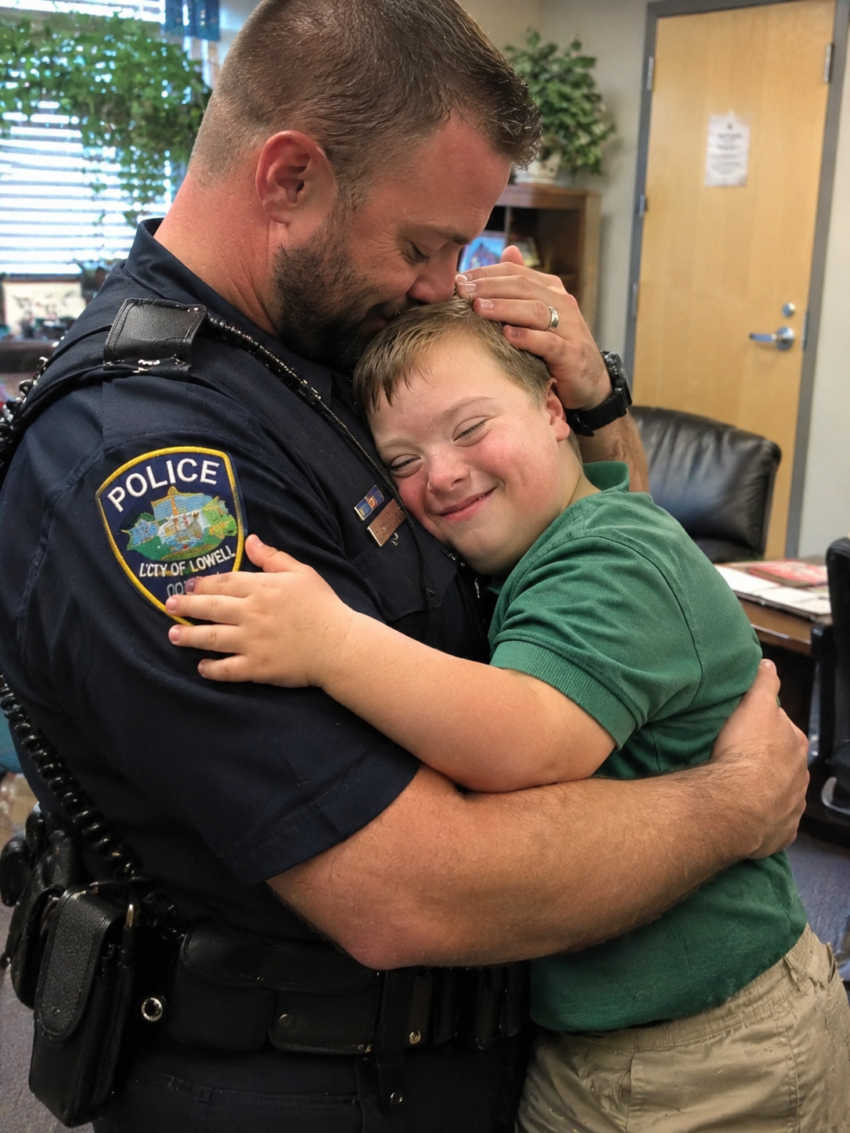
“Mrs. Parker, I need you and your husband to come to school. There are two police officers in my office.”
Those were the words our son’s principal said on the fifth day of first grade. Six-year-old Ethan had Down syndrome, and after years of homeschooling, we’d finally enrolled him in a regular elementary school. Every afternoon that week, he’d come home smiling, talking about his new friends and everything he’d learned.
I gripped the phone tighter.
“Is Ethan hurt?”
“He’s safe, Mrs. Parker. But there was an incident involving several students, and I’d rather explain it in person.”
Before I could ask another question, Principal Harris ended the call.
I stood in our kitchen, staring at Ethan’s unfinished drawing on the refrigerator. That morning, he’d left home wearing his favorite blue backpack, excited because his class was starting a science project.
Now two police officers were waiting at his school.
And nobody would tell me why.
THE SCHOOL HE’D WAITED YEARS TO ATTEND
My husband, Michael, answered on the second ring.
“Laura? What’s wrong?”
“Ethan’s principal just called. He says we need to come immediately. There are police officers in his office.”
Michael was quiet for a second.
“Did he say what happened?”
“No. Just that Ethan’s safe.”
“I’m leaving work. Meet me at the school.”
I grabbed my keys and hurried outside, trying not to imagine the worst.
For six years, Michael and I had done everything we could to give Ethan a happy, secure childhood. He was our only child, a curious little boy who loved dinosaurs, planets, and anything with wheels. He could spend an entire afternoon explaining why Saturn had rings, then ask whether astronauts were allowed to bring dogs into space.
Ethan also had Down syndrome. He learned some things differently, needed additional support with communication, and sometimes struggled to explain himself when he was upset. We’d homeschooled him during his early years while working with therapists and educators to develop his skills.
But as he grew older, he began asking questions we couldn’t ignore.
“Mommy, when can I ride the yellow school bus?”
“Why do other kids have classrooms?”
“Can I have a best friend?”
Those questions stayed with me.
After months of discussions with educators and specialists, we enrolled him at Brookfield Elementary. The school agreed to provide appropriate classroom accommodations, additional learning support, and regular communication about his progress.
Michael and I were nervous, but Ethan was thrilled.
On Monday, he came home practically bouncing.
“Mom! School is amazing! We have a big library!”
On Tuesday, he told us about a boy named Oliver who sat beside him.
“He likes dinosaurs too! But he likes the ones with the long necks.”
By Wednesday, Ethan announced that several boys had invited him to sit at their lunch table.
I remembered how proudly he’d said it.
“They asked me, Mommy. I didn’t even have to ask them!”
I’d kissed the top of his head and told him how wonderful that was.
Now, driving toward the school, I wondered whether we’d misunderstood something important.
Michael was waiting outside the main entrance when I arrived. His face looked strained, and he reached for my hand without speaking.
We walked into the building together.
THE BOY WITH THE BLUE BACKPACK
Principal Harris’s office was at the end of a quiet hallway.
When his secretary opened the door, I immediately saw Ethan sitting beside the window, clutching his blue backpack against his chest.
His eyes were red.
“Mommy!”
He jumped up and ran into my arms.
I knelt and held him tightly.
“Sweetheart, are you okay? Did somebody hurt you?”
He shook his head, but his fingers tightened around my sweater.
Then he whispered something I wasn’t prepared to hear.
“Please don’t make me leave school.”
I pulled back just enough to look at him.
“What do you mean, honey?”
He wouldn’t answer.
Michael crouched beside us.
“Buddy, we’re here. You’re not in trouble.”
Ethan looked toward the principal’s desk, where two uniformed officers were standing.
One stepped forward.
“I’m Officer Miller. Mr. and Mrs. Parker, I want to reassure you that your son isn’t being accused of anything.”
Michael straightened.
“Then why are the police here?”
Principal Harris gestured toward the chairs.
“There was a confrontation in the cafeteria involving several students. Our school resource officers responded because staff were concerned the situation might become physical.”
“A confrontation involving six-year-olds?” I asked.
“Unfortunately, yes. We have video footage, and I think you should see it.”
I sat down with Ethan beside me. Michael remained standing, one hand resting on the back of my chair.
Principal Harris turned his computer monitor toward us.
The recording showed the school cafeteria shortly after noon.
Ethan was sitting at a table with his lunchbox open. Three boys stood nearby, and one was holding up a phone.
“Ethan, tell us what you’re going to be when you grow up!” one boy said.
My son smiled.
“I’m going to be a famous scientist!”
The boys started laughing.
“Say it again! Louder!”
Ethan repeated himself.
Another boy imitated the way he spoke, exaggerating the sounds until the others laughed harder.
I felt my stomach tighten.
Ethan’s smile slowly disappeared.
He looked down at his lunch.
The boy holding the phone leaned closer.
“Come on, Ethan. Say the scientist thing again.”
My son shook his head.
Then another child stepped into the frame.
Oliver.
“Stop filming him,” Oliver said.
“Relax. We’re just joking.”
“He doesn’t think it’s funny.”
One of the boys pushed Oliver’s shoulder. Oliver moved the boy’s hand away, and a chair scraped across the floor.
An adult hurried toward the table.
The recording ended.
For several seconds, nobody spoke.
Michael finally broke the silence.
“How long has this been happening?”
Principal Harris folded his hands.
“We’re still establishing the timeline.”
“That wasn’t what I asked.”
“I understand. And I apologize. We should have more information shortly.”
I looked at Ethan.
He was twisting the strap of his backpack around his fingers.
“Sweetheart, have those boys been teasing you before today?”
He hesitated.
“Sometimes.”
“Since when?”
“Wednesday.”
Wednesday.
The day he’d come home so proud that other children had invited him to eat lunch with them.
THE REASON HE KEPT SMILING
I moved my chair closer.
“Ethan, why didn’t you tell us?”
He stared at his shoes.
“Because I like school.”
“We know you do, sweetheart.”
His lower lip trembled.
“You said if school was too hard, I could come home.”
I went still.
Before his first day, I’d promised Ethan that if he felt overwhelmed, we could reconsider his school arrangement. I’d meant it as reassurance. I wanted him to know he had options and that we would listen.
But he’d understood my words differently.
He thought telling us about the teasing would mean losing the school he loved.
“Oh, honey,” I whispered. “That’s not what I meant.”
He looked up.
“But if I’m sad, you might say school is too hard.”
I took both his hands.
“Someone being unkind to you doesn’t mean you’ve done anything wrong. And we’re not going to take away something you love because another child behaved badly.”
“Promise?”
“I promise we’ll listen to you and work with your teachers to keep you safe.”
Michael sat beside us.
“Buddy, you can tell us the good things and the bad things. You don’t have to make every day sound perfect.”
Ethan nodded slowly.
Then Michael asked about Oliver.
“Was Oliver sitting with you when those boys started teasing you?”
“Yes. He’s my friend.”
“Did he know they were being mean?”
“He told me.”
“Then why did you keep sitting with them?”
Ethan looked genuinely confused.
“Because they let me sit there.”
I turned my face away for a moment.
Our son had wanted friends so badly that he’d accepted being laughed at just to feel included.
And every afternoon, he’d come home smiling because he was afraid we’d take school away from him.
Principal Harris quietly passed me a box of tissues.
“Mrs. Parker, I want you to know we’re taking this seriously.”
I wiped my eyes.
“I appreciate that. But somebody needs to explain how this happened for three days without anyone telling us.”
He nodded.
“You’re right.”
THE FRIEND NOBODY NOTICED
While Principal Harris stepped outside to speak with a staff member, Ethan began telling us about Oliver.
Oliver had transferred to Brookfield that same week. On Monday, Ethan noticed him sitting alone during a classroom activity.
“He looked sad,” Ethan explained. “So I asked if he liked dinosaurs.”
Apparently, Oliver did.
The two boys spent their first recess discussing which dinosaurs were the biggest. On Tuesday, Ethan invited Oliver to sit with him at lunch.
Then, on Wednesday, three other boys called Ethan over to their table.
Ethan brought Oliver along.
“I wanted everybody to be friends,” he said.
“And were they nice to Oliver?” I asked.
“Not really.”
“Were they nice to you?”
He thought about that.
“They laughed when I talked. But I thought maybe they’d be nice tomorrow.”
Michael lowered his head.
I knew what he was thinking because I was thinking it too.
We’d spent so much time preparing Ethan for schoolwork, routines, and classroom expectations that we hadn’t fully prepared him to recognize when somebody was treating him unkindly.
But Oliver had recognized it.
And when Ethan couldn’t find the words to defend himself, Oliver had spoken for him.
Principal Harris returned with Officer Miller.
His expression was serious.
“We’ve learned something important. Oliver reported the teasing to a lunch supervisor yesterday.”
Michael looked up sharply.
“Yesterday?”
“Yes. He told her that the boys were filming Ethan and making fun of him.”
“And what did she do?”
“She spoke to the students. They claimed they were joking, and she reminded them to behave respectfully.”
“So she sent them right back to the same lunch table?”
The principal hesitated.
“Yes.”
Michael stood.
“A child reported that my son was being mocked and filmed, and nobody thought his parents needed to know?”
“Mr. Parker, you’re right to be upset. The report should have been documented and followed up. It wasn’t handled appropriately.”
I was angry too, but I needed answers more than an argument.
“What happens now?”
Principal Harris explained that the school would contact the families involved, document the incidents, increase lunch supervision, and put a clear reporting and support plan in place for Ethan.
Then he revealed something that surprised us.
Oliver had initially been sent to the office because a staff member believed he’d started the confrontation.
But when the cafeteria recording was reviewed, it became clear that he’d been trying to stop the teasing.
“He also refused to leave Ethan alone while we were investigating,” the principal said. “He kept asking us to listen to Ethan’s side.”
I looked at my son.
“Is that true?”
Ethan nodded.
“Oliver said friends don’t leave.”
Michael turned away and rubbed his eyes.
Officer Miller smiled gently.
“Neither Ethan nor Oliver has done anything requiring police action. The school will handle the matter from here.”
She looked at Ethan.
“You did the right thing by telling the truth.”
“Oliver did too,” he answered.
“Yes,” she said. “He did.”
The principal asked whether we wanted to take Ethan home for the afternoon.
My first instinct was to say yes.
I wanted to put him in the car, drive home, and keep him somewhere nobody could make him feel small.
But before I answered, I looked at my son.
“Ethan, what would you like to do?”
He didn’t hesitate.
“Go back to class.”
Michael and I exchanged glances.
“Are you sure, buddy?”
“We have science today.”
I smiled despite the tears still in my eyes.
After discussing teacher check-ins, additional lunchtime support, and a plan for reporting future problems, we agreed.
Before leaving, Ethan stopped beside the office door.
“Mom?”
“Yes, sweetheart?”
“Can I still be a scientist?”
My throat tightened.
“Of course you can.”
“Even if I talk different?”
Michael knelt in front of him.
“Your ideas matter, Ethan. Speaking differently doesn’t make them any less important.”
Our son smiled.
“Okay. Then I’m going to science class.”
He walked down the hallway with his blue backpack bouncing against his shoulders.
And I stood there watching him, knowing that the next few weeks would tell us whether we’d made the right decision.
PART 2: THE FRIEND WHO STAYED
That evening, Michael and I sat at the kitchen table after Ethan went to bed.
The house was quiet except for the dishwasher running in the next room. Ethan’s blue backpack hung beside the back door, ready for another school day.
Michael had barely touched his dinner.
“I keep thinking about that video,” he said. “He was sitting there smiling while those boys laughed at him.”
“I know.”
“What if Oliver hadn’t stepped in?”
I didn’t have an answer.
For years, Michael and I had worried that putting Ethan in a regular classroom might expose him to situations he wasn’t ready to navigate. We’d also worried that keeping him home too long might limit his opportunities to build friendships and independence.
Now both fears seemed painfully real.
“Maybe we rushed this,” Michael said.
I looked toward the backpack.
“Maybe. But did you see his face when he said he wanted to go back?”
Michael nodded reluctantly.
“He loves that school.”
“Then we need to make sure the adults do their jobs. We shouldn’t make him pay for somebody else’s behavior.”
We agreed to give the school an opportunity to follow through, while making it clear that we expected consistent communication and meaningful support.
The following morning, I drove Ethan to school myself.
Before he got out of the car, he turned toward me.
“Mommy, what if those boys laugh again?”
I unbuckled my seat belt so I could face him.
“Then you tell your teacher. You can also tell me and Dad. And if you need help finding the words, we’ll practice together.”
He thought about that.
“Can I say, ‘That’s not funny’?”
“Absolutely.”
“And can I sit with Oliver?”
“Of course.”
He smiled, grabbed his backpack, and hurried toward the entrance.
I watched until he disappeared inside.
Then I sat in the parking lot for another minute, trying to convince myself that letting him walk through those doors was the right thing to do.
THE CHANGES WE NEEDED TO SEE
Over the next several days, Principal Harris kept his word.
He arranged a meeting with Ethan’s classroom teacher, the special education coordinator, and the lunch supervisor. Together, we reviewed the incident and agreed on specific steps to help Ethan feel safe and included.
His teacher would check in with him each morning. A staff member would monitor the lunch area more closely, and Ethan would have a simple way to signal when he needed help.
The school also addressed the students involved and contacted their families.
I appreciated the plan, but I wasn’t interested in promises alone.
I wanted to know whether Ethan’s days were actually getting better.
On Friday afternoon, his teacher called.
“Mrs. Parker, I wanted to tell you about something Ethan did today.”
My stomach tightened automatically.
“Is everything okay?”
“More than okay. During reading time, he raised his hand and asked a question in front of the class.”
I smiled.
“He did?”
“Yes. And when he needed a little extra time to explain himself, the other children waited. Oliver even reminded one student not to interrupt.”
I laughed softly.
“That sounds like Oliver.”
“He’s a thoughtful little boy. But Ethan’s doing something important too. He’s becoming more comfortable speaking up for himself.”
After we hung up, I sat at the kitchen table and cried.
Not because everything was fixed.
Because, for the first time since the principal’s phone call, I could see that Ethan was learning something we’d hoped school would teach him.
He was discovering that his voice deserved to be heard.
That weekend, Michael and I practiced a few simple conversations with him.
We pretended to be classmates asking questions, interrupting, or making jokes that weren’t funny.
At first, Ethan giggled through the exercises.
Then Michael pretended to grab a toy dinosaur without asking.
Ethan put his hands on his hips.
“Excuse me, Daddy. You have to ask first.”
Michael immediately returned it.
“You’re right. I’m sorry.”
Ethan looked pleased.
“Good job, Daddy.”
I laughed so hard I nearly spilled my coffee.
It was a small moment, but it mattered.
For the first time, our son wasn’t just practicing how to make friends.
He was practicing how to set boundaries.
WHAT OLIVER’S MOTHER TOLD ME
Two weeks later, I received a message from a woman named Rachel Bennett.
She introduced herself as Oliver’s mother and asked whether Ethan would like to come over for a Saturday playdate.
I showed the message to Ethan.
He nearly dropped his cereal bowl.
“Oliver wants me at his house?”
“That’s what his mom says.”
“Can I go? Please?”
I smiled.
“We’ll work out the details.”
That Saturday, I drove Ethan across town to a modest house with a red front door.
Oliver opened it before I reached the porch.
“Ethan! I got the dinosaur game ready!”
The boys disappeared into the living room, talking so quickly that I could barely follow them.
Rachel invited me inside for coffee.
She was in her late thirties, with tired eyes and a warm smile. We sat at her kitchen table while the boys played nearby.
“I’ve been wanting to thank you,” she said.
I shook my head.
“Rachel, I should be thanking you. Your son stood up for Ethan when he needed somebody.”
She looked down at her coffee.
“Oliver told me what happened. I’m proud of him, but there’s something you might not know.”
I waited.
“We moved here after my divorce. Oliver had a hard time leaving his old school. He barely spoke for the first few days after we moved.”
She glanced toward the living room.
“On Monday, he came home and told me a boy had asked him about dinosaurs.”
I smiled.
“That sounds like Ethan.”
“He talked about it all evening. Then on Tuesday, he said Ethan invited him to lunch.”
Rachel’s voice grew unsteady.
“I hadn’t seen him that happy in months.”
I looked toward the doorway.
Ethan and Oliver were sitting on the carpet, arranging plastic dinosaurs around a cardboard volcano.
“He never told me Oliver had been having a hard time,” I said.
“Oliver didn’t want anyone to know. He thought being lonely meant there was something wrong with him.”
Rachel wiped her eyes.
“Your son made him feel welcome before anybody else did.”
For a moment, I couldn’t speak.
I’d spent days thinking about Oliver as the little boy who’d protected Ethan.
But now I understood that their friendship had started before the cafeteria incident.
Ethan had noticed a lonely child and invited him to sit beside him.
And when other children began treating Ethan unkindly, Oliver had refused to abandon the friend who’d welcomed him.
Neither boy had set out to do anything extraordinary.
They’d simply been kind to each other when kindness mattered.
When I picked Ethan up that afternoon, he was wearing a paper dinosaur crown Oliver had made.
“Mom, can Oliver come to our house next time?”
“I’d love that.”
He grinned.
“He says my dinosaur drawings are better than his.”
From behind him, Oliver protested.
“I said your T. rex was better! My triceratops is still the best!”
The boys started laughing.
Rachel and I exchanged smiles.
For the first time, I wasn’t wondering whether Ethan belonged at school.
I was beginning to see how much he had to offer.
THE SCIENCE EXHIBITION
A month after the cafeteria incident, Brookfield Elementary held its annual science exhibition.
Ethan had been talking about it for weeks.
His class was preparing simple projects about the solar system, and he’d volunteered to work with Oliver.
Every evening, our dining room table disappeared beneath construction paper, markers, glue sticks, and drawings of planets.
Michael helped the boys make a cardboard display stand. I printed pictures from educational websites and watched Ethan carefully arrange them in order.
One evening, Oliver pointed at a drawing.
“Ethan, you put Jupiter after Saturn.”
Ethan studied the paper.
“Oh! You’re right.”
He moved the picture.
“Thank you.”
Oliver shrugged.
“That’s what partners do.”
I smiled and returned to the kitchen.
The morning of the exhibition, Ethan woke before his alarm.
He came downstairs wearing a blue button-down shirt and carrying his backpack.
“Mom, do I look like a scientist?”
I straightened his collar.
“You look wonderful.”
“Scientists wear glasses sometimes.”
“Some do.”
He considered that.
“Maybe I’ll get glasses when I’m older.”
Michael laughed.
“Let’s see whether you need them first, buddy.”
At school, the cafeteria had been transformed into an exhibition hall. Tables displayed homemade volcanoes, plant experiments, weather charts, and models of the solar system.
Ethan and Oliver stood behind their project, wearing matching paper badges that read Junior Scientists.
When we approached, Oliver straightened.
“Welcome to our solar system!”
Ethan pointed proudly toward their display.
“This is Mercury. It’s the closest planet to the sun.”
He continued explaining the planets while Oliver helped turn the display.
At one point, Ethan struggled to pronounce a longer word.
He stopped.
A few months earlier, he might have lowered his head and given up.
Instead, he took a breath.
“I need a second,” he said.
Oliver waited.
Ethan tried again.
This time, he got the word out.
Michael squeezed my hand.
When the boys finished, we applauded.
Ethan’s smile was unforgettable.
His teacher approached us afterward.
“They’ve worked hard on this. Ethan knows more about the planets than most of us.”
Ethan looked delighted.
“I read three books!”
“And he made sure Oliver got to explain his favorite part too,” she added.
Oliver nodded enthusiastically.
“Because we’re a team.”
I looked at the two boys standing proudly behind their project.
Six weeks earlier, I’d sat in the principal’s office wondering whether school was the wrong place for my son.
Now he was standing in front of parents and teachers, sharing something he loved.
And he wasn’t standing there alone.
THE CONVERSATION THAT CHANGED ME
That evening, Ethan sat at the kitchen table, carefully removing his paper scientist badge.
“Mom, can I keep this?”
“Of course.”
“Can you put it somewhere safe?”
I took the badge and placed it beside his school photograph.
He watched me for a moment.
“Do you think I’ll make more friends someday?”
I turned toward him.
“I think you will, sweetheart.”
He considered my answer.
“But Oliver is my best friend.”
“I know.”
“He doesn’t laugh when I say things wrong.”
I sat beside him.
“A good friend gives you time to speak and listens to what you mean.”
Ethan nodded.
“And if he says something wrong, I help him too.”
I smiled.
“That’s right.”
He reached for his badge again.
“Mom?”
“Yes?”
“I like being at school. Even when some days are hard.”
I put my arm around him.
“I’m glad you told me.”
He leaned against my shoulder.
For years, Michael and I had tried to anticipate every difficulty Ethan might face. We arranged lessons, adjusted routines, researched educational programs, and worried about whether the world would be patient with him.
But we’d nearly overlooked something important.
Ethan wasn’t asking us to make every difficult moment disappear.
He wanted the chance to learn, make friends, solve problems, and be heard when something went wrong.
That didn’t mean we should ignore bullying or expect him to manage everything alone. It meant supporting him without making every decision for him.
The next morning, I found his blue backpack waiting beside the door.
He’d packed it himself.
His science badge was clipped to the front pocket.
When I asked whether he needed help, he shook his head.
“I’ve got it, Mom.”
I smiled and let him carry it.
FIVE WEEKS LATER
By the end of the following week, Ethan had settled into a routine that would once have seemed impossible to us.
He had favorite subjects, classroom responsibilities, and a friend who saved him a seat at lunch. His teacher continued checking in with him, and we stayed in regular contact with the school.
Not every day was easy.
Sometimes Ethan came home frustrated by an assignment. Occasionally, he needed help explaining something that had happened with another student.
But he no longer believed that telling us about a bad day would mean losing the good ones.
One Friday morning, I was helping him find his lunchbox when he stopped beside the front door.
“Mom?”
“Yes, sweetheart?”
“If somebody’s mean to me again, I’ll tell you.”
I knelt in front of him.
“I’m glad.”
“And you won’t make me leave?”
I brushed a strand of hair away from his forehead.
“We’ll listen to you and figure out what you need. Together.”
He smiled.
“Okay.”
Then he picked up his blue backpack and headed toward the car.
I watched him walk ahead of me, the little scientist badge bouncing against the front pocket.
Five weeks earlier, he’d carried that same backpack into school hoping somebody would want to be his friend.
He’d found someone who did.
And when the world became unkind, that friend had stayed.
I opened the car door and waited while Ethan climbed into his seat.
“Ready for school, buddy?”
He grinned.
“Ready, Mom!”
I closed the door, walked around to the driver’s side, and caught one last glimpse of the blue backpack through the window.
For the first time, it didn’t remind me of the frightened little boy sitting in the principal’s office.
It reminded me of the boy who’d asked a lonely classmate to sit with him, found the courage to speak up, and was still excited to discover what the next school day might bring.