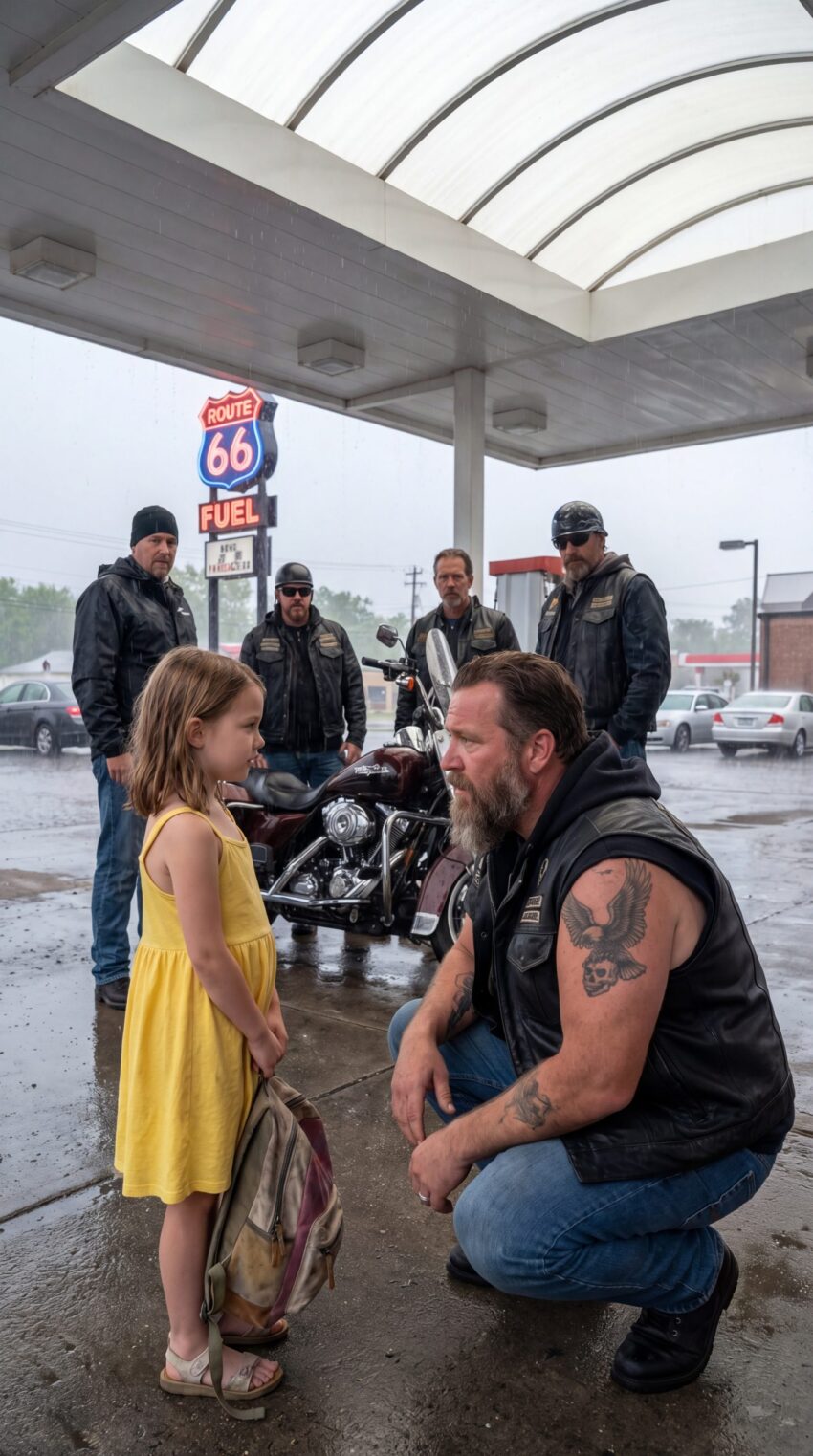
The Child in the Mustard Raincoat
Nolan Pierce had spent so many years on the road that he no longer measured time the way other people did. He measured it in sunrise miles, in gas station coffee, in motel windows that looked out on parking lots, and in the long quiet stretches between one small town and the next. He knew how to listen to weather. He knew how to sense when a room had gone too still. He knew the look on a stranger’s face when they were carrying something heavier than they could say out loud.
For a long time, he had believed that was enough. He had believed that if he stayed moving, if he let the miles keep speaking louder than memory, the sharpest parts of his past would eventually wear smooth.
But some losses do not fade. They simply wait.
On a wet Thursday afternoon along Highway 101, Nolan pulled into a roadside diner outside Coos Bay, Oregon, hoping only for warmth, black coffee, and an hour of silence before dark. The diner was called Marcy’s Table, the kind of place with hand-painted menus, old vinyl booths, and windows clouded by rain and steam. The parking lot was half-empty. Country music hummed softly from a radio behind the counter. The air smelled like fried potatoes, cinnamon, and coffee that had been sitting too long on the burner.
Nolan slid into a booth near the window, set his gloves beside his mug, and flexed his left hand as feeling slowly returned to his fingers. His leather vest was damp at the shoulders. His boots carried rainwater across the floor. He barely noticed. The road had taught him how to settle anywhere without fully arriving.
He was staring absentmindedly at the storm moving down the glass when he felt someone watching him.
He turned.
A little girl stood in the aisle a few feet away, wearing a mustard-yellow raincoat over pink leggings and white shoes that still shone with the confidence of being new. She looked to be around seven. Her brown hair was tied back in a loose ponytail, and one side had already fallen free. She did not look frightened or shy. She looked curious in the fearless way only children can.
She lifted one small hand and pointed toward his forearm.
“My big sister has that too,” she said, as if she were commenting on the weather.
Nolan froze.
The tattoo on his arm was old now, the black and gray softened by time. It showed a pair of spread wings wrapped around a weathered skull, an image chosen in youth when grief still looked romantic and promises still felt permanent. His younger sister had gotten the same tattoo on the same afternoon, both of them laughing outside a shop in Spokane, swearing they would never disappear from each other’s lives no matter where the world dragged them.
Her name had been Maren.
And she had been gone for fifteen years.
Nolan looked at the child, certain he had heard her wrong.
“What did you say?” he asked.
The girl came one step closer and pointed again, patient and sure of herself.
“My sister has the same picture. Wings and a skull. She said it means somebody kept a promise.”
For a moment, Nolan could not breathe properly. The coffee in front of him cooled untouched. The sounds in the diner seemed to move farther away, as if the room had shifted and left him sitting alone inside a memory he had never managed to bury.
He had spent years telling himself that Maren’s absence was a closed door. Painful, yes, but final. Yet one child’s voice had just cracked it open.
And suddenly the road ahead no longer felt empty.
It felt like it was trying to tell him something.
The Note Folded Into His Wales

Nolan rode back to his motel in the rain with the child’s words echoing through him. The storm had turned colder by evening, and the wind off the coast bit through his jacket, but he hardly felt any of it. His mind kept circling the same impossible thought. Not a similar tattoo. Not something close. The same one.
His motel room was narrow and plain, with a flickering lamp, beige curtains, and a bedspread patterned in tired blue shapes that had probably looked cheerful twenty years earlier. He shut the door behind him and stood still for a long moment, as if the room might offer an answer simply because it was quiet.
Then he reached into his back pocket and pulled out the old leather wallet he had carried for more than a decade.
Inside, behind his license and an expired insurance card, was a folded note so worn at the edges it felt more like fabric than paper. He had read it so many times he could have spoken every line from memory, but that night he unfolded it with hands that would not stay steady.
Maren’s handwriting greeted him at once, neat and careful, almost painfully familiar.
“Nolan, if you’re reading this, it means I had to leave before I was ready to explain.”
He sat on the edge of the bed and kept reading.
“Please don’t think this happened because of you. It didn’t. I made choices that placed me near people I should never have trusted, and I need distance before that reaches you too.”
His throat tightened the same way it always had.
When he first found the note, years ago, he had read it with anger, confusion, and the stubborn certainty that she would return in a day or two. Then a week. Then a month. Then after enough time had passed, he stopped counting because counting meant admitting she still had not come home.
But one line at the bottom had never stopped living in him.
“If the world ever softens, find me where the hawks circle and the river bends the wrong way.”
Back then it had sounded like heartbreak trying to dress itself up as poetry. That night, after hearing the girl in the diner, it sounded like direction.
He turned the envelope over, really looked at it for the first time in years, and saw what grief had hidden from him before: a faded postmark from Astoria, Oregon, dated three days after Maren vanished.
Astoria.
He said the town’s name out loud, and the sound of it changed the room.
At ten o’clock sharp, someone knocked on his door.
Nolan did not even ask who it was.
The Friend Who Knew When Not to Push
Elias Boone came in carrying the smell of rain and motor oil, his silver-threaded beard damp from the weather. He was one of the few people Nolan trusted enough to go quiet around. Elias was older by nearly fifteen years, steady in a way that never felt forced, and wise enough to know that some truths only surface when they are given space rather than pulled into the light.
He took one look at Nolan’s face and shut the door behind him.
“You look like the past found your address,” Elias said.
Nolan gave him the note without a word.
Elias read it slowly. Then he read the envelope. Then he looked up.
“Have you ever paid attention to the postmark?”
Nolan shook his head.
“Not really. I couldn’t.”
Elias sat in the chair by the window and tapped the paper gently.
“Astoria. Three days after she left. And this line here about hawks and a river bending wrong. That doesn’t sound random to me. It sounds like a place she thought you might understand later.”
Nolan leaned forward, elbows on his knees.
“A little girl at the diner said her sister has my tattoo,” he said. “Not one like it. The same one.”
Elias did not laugh. He did not tell him it was probably coincidence. He simply absorbed the words and let them settle.
“Then we don’t ignore it,” he said.
Nolan swallowed hard.
“What if Maren is alive?”
Elias’s voice softened.
“Then we move carefully enough not to break whatever she built to survive.”
That was what Nolan loved most about him. Elias never rushed toward emotion just because emotion was loud. He respected reality too much for that.
“I can’t lose her twice,” Nolan said.
Elias held his gaze.
“Then tomorrow morning we start with the diner.”
Breakfast, a Photograph, and a Name He Recognized
Elias Boone came in carrying the smell of rain and motor oil, his silver-threaded beard damp from the weather. He was one of the few people Nolan trusted enough to go quiet around. Elias was older by nearly fifteen years, steady in a way that never felt forced, and wise enough to know that some truths only surface when they are given space rather than pulled into the light.
He took one look at Nolan’s face and shut the door behind him.
“You look like the past found your address,” Elias said.
Nolan gave him the note without a word.
Elias read it slowly. Then he read the envelope. Then he looked up.
“Have you ever paid attention to the postmark?”
Nolan shook his head.
“Not really. I couldn’t.”
Elias sat in the chair by the window and tapped the paper gently.
“Astoria. Three days after she left. And this line here about hawks and a river bending wrong. That doesn’t sound random to me. It sounds like a place she thought you might understand later.”
Nolan leaned forward, elbows on his knees.
“A little girl at the diner said her sister has my tattoo,” he said. “Not one like it. The same one.”
Elias did not laugh. He did not tell him it was probably coincidence. He simply absorbed the words and let them settle.
“Then we don’t ignore it,” he said.
Nolan swallowed hard.
“What if Maren is alive?”
Elias’s voice softened.
“Then we move carefully enough not to break whatever she built to survive.”
That was what Nolan loved most about him. Elias never rushed toward emotion just because emotion was loud. He respected reality too much for that.
“I can’t lose her twice,” Nolan said.
Elias held his gaze.
“Then tomorrow morning we start with the diner.”
Breakfast, a Photograph, and a Name He Recognized

The next morning dawned bright and cold, the storm washed out of the sky. Nolan and Elias arrived at Marcy’s Table just after sunrise. The breakfast crowd was thin. A waitress moved between booths with a pot of coffee in one hand and a stack of plates in the other. Outside, the pavement still shone from the rain.
Nolan saw the yellow raincoat first.
The girl sat in a booth near the back with a man and woman in their forties. She was drawing on a paper placemat, humming softly to herself, entirely at peace with the world. When she noticed Nolan, her face lit up.
“That’s him,” she announced. “The tattoo man.”
The woman’s expression turned protective at once. The man straightened a little in his seat.
Elias stepped forward before Nolan could speak.
“Morning,” he said gently. “I’m Elias, and this is Nolan. Your daughter said something yesterday that may connect to a missing family member. We’re not here to cause trouble. We were hoping to ask a few careful questions.”
The man studied them for a second, then nodded toward the empty side of the booth.
“I’m Grant Rowan. This is my wife, Celise. And this chatterbox is Ivy.”
Ivy grinned proudly.
Celise kept one hand near her daughter’s shoulder.
“What kind of connection?” she asked.
Nolan tried to answer, but his voice came out rough. Elias stepped in and explained. A missing sister. Matching tattoos. A letter sent from Oregon long ago. A child’s unexpected recognition.
Celise’s face changed as he spoke. First caution, then surprise, then something deeper.
Grant reached for his phone.
“I think you should see something,” he said quietly.
He scrolled through a folder, stopped, and turned the screen toward Nolan.
The photo showed a toddler-aged Ivy sitting beside a young woman with dark hair and tired but gentle eyes. She was smiling, though there was a strain beneath it, as if peace had come to her only in borrowed moments.
Nolan’s world narrowed to that face.
Maren.
Older than the last time he had seen her. Thinner. Sadder around the eyes. But unmistakably Maren.
He pressed a hand over his mouth.
“That’s my sister,” he whispered.
Ivy looked between them as if she had been waiting for everyone else to catch up.
“She told me I had an uncle on a motorcycle,” the girl said. “She said I would know him because he kept his promises on his skin.”
Celise inhaled sharply.
Grant set the phone down.
“Ivy is adopted,” he said. “We were told her biological sister arranged everything herself to keep her safe. The details were sealed, but there were occasional updates through the agency for a while.”
Nolan stared at him.
“You mean Maren stayed in contact?”
Celise nodded.
“Very little. Just enough to make sure Ivy was okay. She loved her deeply. That much was always clear.”
In that moment, Nolan understood something that broke his heart and healed it at the same time. Maren had not disappeared because she had stopped loving people. She had disappeared because love had demanded more from her than staying near them safely allowed.
The Office Painted in Soft Colors
By afternoon, Grant and Celise had provided the name of the agency that handled Ivy’s adoption: Bright Harbor Family Services in Portland. Nolan and Elias rode north the same day, reaching the city under a pale evening sky streaked with silver clouds.
The office sat in a tidy building with soft blue walls, framed photos of smiling families, and potted plants placed where someone believed comfort could be arranged. A receptionist with careful eyes asked them to wait. Their riding gear drew quick glances from staff members moving through the hall, but Elias remained calm, which had a way of calming everyone else too.
Eventually the director, a woman named Lorraine Mercer, invited them into her office.
She read the authorization papers from Grant and Celise in silence, then folded her hands on the desk.
“I remember this case,” she said. “The older sister was determined, thoughtful, and very precise. She wanted the child placed far enough away to build a truly stable life.”
Nolan leaned forward.
“Was she afraid?”
Lorraine paused before answering.
“Yes,” she said at last. “She believed certain people from her past might try to use the child to reach her. She wanted distance, privacy, and the chance for her sister to grow up in a home untouched by that history.”
Nolan looked down, jaw tight.
Lorraine opened a thin folder.
Much of it was private and covered, but a few references remained visible. Astoria. Newport. Salem. Florence. Small points on a map that suddenly looked less like towns and more like traces left by someone trying not to be found too easily.
“The last update came about two years ago,” Lorraine said. “A birthday card routed through our office. No return address. Just enough information to reassure the adoptive family that she still cared.”
“Did she ever say where she worked?” Elias asked.
Lorraine hesitated.
“Not directly. But there was mention of community health outreach along the coast.”
Nolan’s hands tightened.
His sister had been close enough to be real and far enough to remain untouchable.
“If I find her,” he said, “I won’t do anything reckless. I just need her to know she was never forgotten.”
Lorraine’s expression softened.
“Then be gentle,” she said. “People who build hidden lives usually do so because being seen once cost them too much.”
The Woman Above the Water
The next name came from an old caseworker who had once helped coordinate Ivy’s placement. She directed them to a retired investigator living in a cottage above the Pacific near Cannon Beach. Her name was June Hollis, and according to the caseworker, if anyone still understood the edges of Maren’s story, it would be her.
Two days later, Nolan and Elias climbed the steps to June’s weathered home while gulls cried overhead and the wind pushed salt into the air. June opened the door before they had fully knocked, as if she had been expecting them for years rather than minutes.
Her hair was white, her posture straight, her gaze sharp enough to read more than faces.
She looked at Nolan for a long moment.
“You have your sister’s eyes,” she said. “Come in.”
Inside, her house smelled like cedar and tea. She led them to a wooden table and set down a small box filled with papers, photographs, and clipped notes. A life reduced to pieces, but still a life.
Then she slid one picture toward Nolan.
Maren stood outside a modest clinic wearing navy scrubs and a fleece jacket, her hair shorter now, her smile small but genuine. There was tiredness in her face, yes, but also strength. The kind that comes from carrying difficult years without letting them hollow you out.
Nolan’s chest ached.
“She’s alive,” he said softly, as if saying it too loudly might undo it.
June nodded.
“She has been for a long time. She made a life helping people who had nowhere else to go. She has been careful. Very careful.”
Elias spoke next.
“And the reason for all that caution?”
June folded her hands.
“Old trouble never fully stayed in the past,” she said. “Nothing theatrical. Just the kind of pressure that teaches a person to keep moving, keep names private, keep loved ones protected by distance if necessary.”
Then she reached into the box and brought out a ribbon-tied bundle of envelopes.
“These were written for you,” she said to Nolan. “She never mailed them. Maybe she feared they would lead someone back to her. Maybe she could not bear the risk. But she wrote them.”
Nolan untied the ribbon with trembling fingers and opened the top letter.
“Nolan,” it began. “If the road still calls to you, I hope it has been kinder than I deserved. I hope one day you understand that leaving was not the opposite of love. It was the most painful version of it I knew how to choose.”
He had to stop reading for a second because tears had blurred the words.
June gave him that silence without interrupting it.
Finally Nolan looked up.
“Does she want to see me?”
June considered the question carefully.
“I think a part of her always has,” she said. “But wanting something and feeling safe enough to reach for it are not the same.”
The Clinic Among the Pines
June agreed to help in the only way she trusted: carefully.
The clinic Maren worked at sat inland from the coast, tucked among tall pines in a quiet valley where the late afternoon light turned everything gold at the edges. Nolan and Elias parked far enough away not to draw attention and walked the rest of the distance through the trees.
From behind the cover of the woods, Nolan saw the building first. Simple. Clean. Modest. The sort of place built for healing rather than appearances.
Then he saw her.
Maren stepped into a hallway carrying a clipboard, speaking to an elderly patient with a calm expression and a tenderness Nolan recognized instantly. Time had changed her face, but not the heart inside it. She moved like someone who had learned to remain steady for other people even when life had not been steady for her.
Nolan forgot the air in his lungs.
Elias touched his arm.
“She’s real,” he said quietly.
Nolan nodded, unable to speak.
They stayed where they were, just watching. June had insisted on that. No sudden approach. No dramatic entrance. No scene. Real reunions, she told them, had to make room for real fear.
A black SUV sat beyond the far end of the lot, half-hidden under the trees. Elias noticed it too.
“You see that?” he murmured.
Nolan did.
A woman stepped out near the clinic’s side entrance a moment later, alert and professional, scanning the grounds with practiced awareness. Whether she was security, law enforcement, or simply someone tasked with looking after the place, Nolan could not tell. But he understood the message. Maren’s world was still built on caution.
They backed away without being seen.
Nolan stood beside his bike for a long time, staring toward the clinic through the trees.
His sister was alive. She had survived. She had built something good with the pieces that remained.
Now the question was not how fast he could reach her.
It was how gently.
When the Door Finally Opened
June carried the message for him.
Not a demand. Not an emotional flood. Just a few simple truths, offered through the safest path available. Nolan is here. He knows about Ivy. He is not angry. He only wants you to know you were loved the whole time.
The next morning, Nolan stood in a gravel lot behind the clinic with both hands visible at his sides, giving his body the shape of patience. Elias stayed back near the trees. The morning was cool and bright. Somewhere nearby, a wind chime rang softly against a porch rail.
A door opened.
Maren stepped out.
For one long second, neither of them moved.
Then her eyes met his, and he saw the exact moment recognition passed through her. It was not sudden or dramatic. It was deeper than that. It moved through years, through memory, through everything left unsaid.
Her mouth trembled.
“Nolan?” she whispered.
He swallowed hard.
“Hey, Mare.”
Tears filled her eyes at once.
She took one step forward, then another, as if she were crossing something fragile and holy at the same time.
“I didn’t know if I’d ever get this chance,” she said.
“Neither did I,” Nolan answered. “But I found Ivy. She’s safe. She’s loved. She knows you never stopped caring.”
Maren pressed a hand over her mouth and bowed her head for a moment. When she looked up again, tears had slipped free.
“I thought distance was the only way to keep her future clean,” she said. “And yours too.”
Nolan nodded slowly.
“I know that now.”
She looked at his forearm and saw the faded tattoo. A sad smile appeared through her tears.
“You kept it.”
He let out a broken laugh.
“I didn’t know how not to.”
That was what finally undid her.
Maren crossed the remaining distance and wrapped her arms around him, and Nolan held his sister for the first time in fifteen years. The embrace was not neat. It did not erase time. It did not explain everything. But it was real, and real was more than he had allowed himself to hope for.
Behind them, the trees moved softly in the wind.
Elias stayed where he was, head lowered, giving the moment the privacy it deserved.
When Maren finally stepped back, she touched Nolan’s shoulder like she still could not believe he was there.
“I wrote to you,” she said. “So many times.”
“I know,” he said. “June showed me.”
She let out a shaky breath.
“I wanted to come home. I just wanted to do it without bringing the wrong things with me.”
Nolan looked at her with more tenderness than pain now.
“You came the best way you could,” he said. “And I’m here now. We can take the rest one honest step at a time.”
Maren nodded, tears still on her cheeks, but peace beginning to reach her face.
And there, in the simple quiet of a gravel lot behind a small clinic, their family began again.
Healing rarely arrives all at once; more often it enters quietly, asking only for enough courage to keep the door open a little longer than fear wants you to.
Sometimes the people who seem to have disappeared were never running away from love; they were trying, in the only way they understood, to stand between danger and the people they could not bear to see harmed.
Family is not measured only by years spent together, but by the invisible thread that stays unbroken even through silence, distance, and all the unanswered questions time leaves behind.
A person can carry sorrow for a very long time and still remain gentle, and that kind of gentleness is one of the strongest things a human heart can offer the world.
Children may not understand the full shape of sacrifice, but they always remember the feeling of being protected, and that memory can steady them long after the hard season has passed.
Forgiveness does not ask us to pretend the lost years never mattered; it asks us to honor them by refusing to let pain become the final language of the people we love.
There are moments when rushing forward feels brave, but true courage is often quieter than that, choosing patience, restraint, and kindness so healing has room to happen without being forced.
Love is not always loud, and it is not always close; sometimes it survives as a promise kept in silence until the day it is finally safe enough to speak again.
When someone has lived through fear, the greatest gift we can offer is not pressure for perfect explanations, but a calm place where truth can arrive at its own honest pace.
Even after years of separation, one small sign, one remembered detail, or one faithful promise can become the bridge that leads two hearts back toward each other.
The road through grief does not truly end when we find what was lost; it becomes something better when we choose, day after day, to rebuild with tenderness, wisdom, and the kind of love that knows how to stay.