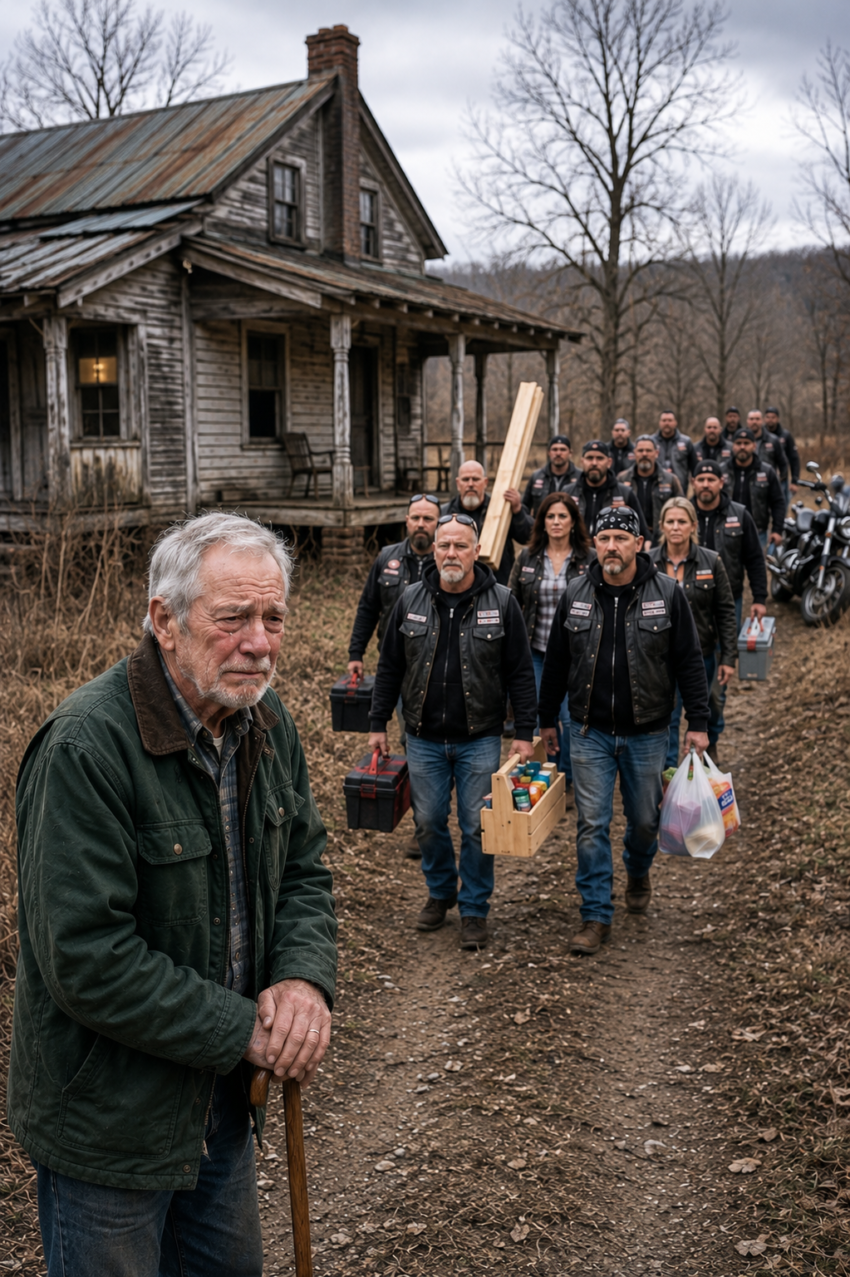
An Elderly Man Quietly Gave His Last $20 to a Hungry Biker Outside a Diner — But Days Later, the Entire Town Realized the Stranger Had Changed His Life Forever
The Last Twenty Dollars on Willow Creek Avenue
The cold wind in late November moved through the small town of Brookdale, Pennsylvania like it had nowhere else to go. It slipped under apartment doors, rattled old windows, and settled deep into the bones of people already carrying too much worry.
On Willow Creek Avenue, eighty-one-year-old Everett Dalton sat alone outside Parker’s Diner with both hands wrapped around his cane.
Inside his coat pocket was a single folded twenty-dollar bill.
It was the only money he had left until his retirement check arrived the following week.
Everett knew exactly what that meant.
It meant eating less than he should. It meant pretending coffee could replace a real meal. It meant carefully turning on the heater for only a few hours each night so the electricity bill would not become another problem waiting at the door.
He had survived harder years before.
He had survived factory shutdowns, hospital nights beside his wife Eleanor, and the quiet loneliness that followed after losing her three winters earlier.
Still, that last twenty dollars mattered.
He kept touching it through the fabric of his coat as if reassuring himself it was still there.
Across the street, a tall biker stood near the diner window staring at the menu inside.
The man looked tough in the way road-worn men often did. Heavy boots. Black leather vest. Broad shoulders. Thick beard touched with gray. Most people walking past avoided eye contact with him completely.
But Everett noticed something different.
He noticed the biker looking at the food longer than anyone casually browsing a menu would.
He noticed the stiffness in the man’s posture.
Pride.
Exhaustion.
Hunger.
Everett recognized it immediately because many years ago, he had worn that same expression himself.
For several minutes he tried to ignore it.
Life had become very good at teaching people not to notice each other anymore.
But Everett had never fully learned how to do that.
With a slow breath, he pushed himself up from the bench and crossed the sidewalk carefully, his cane tapping against the pavement.
The biker turned immediately, cautious but respectful.
“You alright, sir?” he asked.
Everett reached into his coat pocket and pulled out the folded twenty-dollar bill.
“Maybe you need this more than I do,” he said gently.
The biker stared at the money without moving.
“No, sir. I can’t take that.”
“Yes, you can.”
“Please keep it.”
Everett gave him a tired smile.
“I’m old, son. Not blind. I know the difference between someone waiting for food and someone trying to forget they’re hungry.”
For a moment, the biker’s face changed.
The tough expression cracked just enough for Everett to see embarrassment behind it.
The old man quietly placed the twenty-dollar bill into the biker’s hand and folded his fingers over it.
“Go get yourself something warm to eat.”
The biker opened his mouth like he wanted to argue again, but no words came.
Everett nodded once and slowly walked back toward the bench.
As he sat down, reality settled over him.
The money was gone.
The next several days would be harder now.
But somehow, deep underneath the worry, he still felt peace.
P ART 2:
Because despite everything life had taken from him, he had not lost the ability to care about another person.
Across the sidewalk, the biker stood frozen with the wrinkled twenty-dollar bill in his hand like it weighed far more than paper should.
The Meal He Couldn’t Eat Alone
The biker’s name was Travis Mercer, though most people in his motorcycle club called him Hawk.
At fifty-four years old, Hawk had spent most of his life being judged before he ever spoke.
People crossed streets when they saw him.
Store owners watched him carefully.
Parents pulled children a little closer.
He was used to that.
What he was not used to was kindness that came with sacrifice.
He knew immediately that the twenty dollars had not come from comfort.
The old coat Everett wore had seen too many winters. His gloves were thinning at the fingertips. Even the careful way he unfolded the bill told Hawk everything he needed to know.
That money mattered.
He walked into Parker’s Diner and sat at the counter.
The waitress approached carefully.
“Can I get you something?”
“Turkey dinner and coffee,” Hawk said quietly.
When the hot plate arrived, the smell alone made his stomach tighten painfully.
He had not eaten a proper meal all day after paying for unexpected repairs on his motorcycle outside Cleveland that morning.
He should have started eating immediately.
Instead, he looked out the window.
Everett was still sitting alone on the bench outside in the cold.
Hawk suddenly thought about his own father.
A proud man who used to skip meals quietly so his children could eat more during difficult years.
Back then, Hawk had been too young to understand what sacrifice looked like.
Now he understood it perfectly.
Slowly, he pushed the untouched plate away.
The waitress blinked in confusion.
“Everything okay?”
Hawk slid the twenty-dollar bill toward her.
“Can you box this up for me? And add another coffee to go.”
“Wait… you’re not eating?”
The Last Twenty Dollars on Willow Creek Avenue
The cold wind in late November moved through the small town of Brookdale, Pennsylvania like it had nowhere else to go. It slipped under apartment doors, rattled old windows, and settled deep into the bones of people already carrying too much worry.
On Willow Creek Avenue, eighty-one-year-old Everett Dalton sat alone outside Parker’s Diner with both hands wrapped around his cane.
Inside his coat pocket was a single folded twenty-dollar bill.
It was the only money he had left until his retirement check arrived the following week.
Everett knew exactly what that meant.
It meant eating less than he should. It meant pretending coffee could replace a real meal. It meant carefully turning on the heater for only a few hours each night so the electricity bill would not become another problem waiting at the door.
He had survived harder years before.
He had survived factory shutdowns, hospital nights beside his wife Eleanor, and the quiet loneliness that followed after losing her three winters earlier.
Still, that last twenty dollars mattered.
He kept touching it through the fabric of his coat as if reassuring himself it was still there.
Across the street, a tall biker stood near the diner window staring at the menu inside.
The man looked tough in the way road-worn men often did. Heavy boots. Black leather vest. Broad shoulders. Thick beard touched with gray. Most people walking past avoided eye contact with him completely.
But Everett noticed something different.
He noticed the biker looking at the food longer than anyone casually browsing a menu would.
He noticed the stiffness in the man’s posture.
Pride.
Exhaustion.
Hunger.
Everett recognized it immediately because many years ago, he had worn that same expression himself.
For several minutes he tried to ignore it.
Life had become very good at teaching people not to notice each other anymore.
But Everett had never fully learned how to do that.
With a slow breath, he pushed himself up from the bench and crossed the sidewalk carefully, his cane tapping against the pavement.
The biker turned immediately, cautious but respectful.
“You alright, sir?” he asked.
Everett reached into his coat pocket and pulled out the folded twenty-dollar bill.
“Maybe you need this more than I do,” he said gently.
The biker stared at the money without moving.
“No, sir. I can’t take that.”
“Yes, you can.”
“Please keep it.”
Everett gave him a tired smile.
“I’m old, son. Not blind. I know the difference between someone waiting for food and someone trying to forget they’re hungry.”
For a moment, the biker’s face changed.
The tough expression cracked just enough for Everett to see embarrassment behind it.
The old man quietly placed the twenty-dollar bill into the biker’s hand and folded his fingers over it.
“Go get yourself something warm to eat.”
The biker opened his mouth like he wanted to argue again, but no words came.
Everett nodded once and slowly walked back toward the bench.
As he sat down, reality settled over him.
The money was gone.
The next several days would be harder now.
But somehow, deep underneath the worry, he still felt peace.
Because despite everything life had taken from him, he had not lost the ability to care about another person.
Across the sidewalk, the biker stood frozen with the wrinkled twenty-dollar bill in his hand like it weighed far more than paper should.
The Meal He Couldn’t Eat Alone
The biker’s name was Travis Mercer, though most people in his motorcycle club called him Hawk.
At fifty-four years old, Hawk had spent most of his life being judged before he ever spoke.
People crossed streets when they saw him.
Store owners watched him carefully.
Parents pulled children a little closer.
He was used to that.
What he was not used to was kindness that came with sacrifice.
He knew immediately that the twenty dollars had not come from comfort.
The old coat Everett wore had seen too many winters. His gloves were thinning at the fingertips. Even the careful way he unfolded the bill told Hawk everything he needed to know.
That money mattered.
He walked into Parker’s Diner and sat at the counter.
The waitress approached carefully.
“Can I get you something?”
“Turkey dinner and coffee,” Hawk said quietly.
When the hot plate arrived, the smell alone made his stomach tighten painfully.
He had not eaten a proper meal all day after paying for unexpected repairs on his motorcycle outside Cleveland that morning.
He should have started eating immediately.
Instead, he looked out the window.
Everett was still sitting alone on the bench outside in the cold.
Hawk suddenly thought about his own father.
A proud man who used to skip meals quietly so his children could eat more during difficult years.
Back then, Hawk had been too young to understand what sacrifice looked like.
Now he understood it perfectly.
Slowly, he pushed the untouched plate away.
The waitress blinked in confusion.
“Everything okay?”
Hawk slid the twenty-dollar bill toward her.
“Can you box this up for me? And add another coffee to go.”
“Wait… you’re not eating?”
He looked back toward the window.
“Not alone.”
Apartment 3B
The bench outside the diner was empty by the time Hawk returned with the food.
For reasons he could not fully explain, panic hit him immediately.
He asked the newspaper vendor nearby if he had seen the older man with the cane.
The vendor pointed toward the aging apartment buildings behind Willow Creek Avenue.
That was enough.
Hawk spent nearly two hours searching before finally finding Apartment 3B.
By then, the boxed dinner had turned into something much larger.
He had stopped at a grocery store using borrowed cash from one of his club brothers.
Bread.
Soup.
Milk.
Eggs.
Fruit.
Chicken.
Coffee.
He also bought weather strips, lightbulbs, and a small electric heater after remembering how cold Everett’s hands looked outside.
When Everett opened the apartment door, surprise filled his face.
“You found me.”
Hawk lifted the grocery bags slightly.
“Felt wrong letting you spend your last money on a stranger and then disappear.”
Everett stared at the bags.
“You tracked me down over one dinner?”
“Not the dinner. What it cost you.”
For a long moment, the old man simply looked at him.Then he stepped aside quietly.
“Come in.”
The apartment was painfully modest.
Clean, but empty in all the ways that mattered.
One worn chair near the window.
A tiny kitchen.
An old heater making more noise than warmth.
Cupboards with barely enough food for two days.
Hawk slowly unloaded groceries onto the counter.
Everett watched silently.
“You didn’t need to do all this,” he said softly.
Hawk looked up.
“Yeah. I think I did.”
Then he lifted the boxed dinner slightly.
“And this is technically still yours anyway.”
Everett laughed for the first time that evening.
It was quiet and tired, but real.
“Well then, we shouldn’t let it get cold. Eleanor would haunt me for wasting food.”
They shared the turkey dinner using mismatched forks from the kitchen drawer.
The apartment remained quiet, but it was a comfortable silence.
The kind shared between people who already understood something important about each other.
While eating, Hawk noticed cold air moving the curtains near the window.
“That heater working at all?”
Everett snorted softly.
“Depends how generous your definition of ‘working’ is.”
Hawk looked around the apartment once more before pulling out his phone.
Everett narrowed his eyes immediately.
“I don’t trust that look.”
Hawk dialed anyway.
“Bring tools. Groceries too if possible. Apartment 3B on Willow Creek.”
Everett pointed his fork at him.
“Absolutely not.”
“Too late now.”
When the Motorcycles Arrived
An hour later, the quiet street outside Apartment 3B filled with motorcycles.
One engine became three.
Three became six.
Neighbors peeked through curtains immediately.
Children stopped playing on the sidewalk to stare openly.
Everett stood near the window in complete disbelief.
“Good Lord…”
Hawk shrugged.
“They sound meaner than they are.”
The first biker through the door was a woman named Cassidy Hale carrying grocery bags and a toolbox.
Behind her came a giant bald man everyone called Knox carrying a brand-new heater.
Then came more club members with canned food, blankets, extension cords, and repair tools.
Within minutes, Everett’s tiny apartment was filled with boots, jackets, laughter, and quiet kindness.
Nobody spoke to him with pity.
Nobody treated him like he was helpless.
They simply got to work.
Cassidy sealed the drafty windows.
Knox fixed the heater.
Another biker repaired the leaking sink.
Someone stocked the kitchen shelves.
Someone else changed every burnt-out lightbulb in the apartment.
Everett sat quietly in his chair watching them move around his home.
His eyes kept drifting toward Hawk.
Finally, he asked the question pressing against his chest.
“Why are all of you doing this for me?”
The room became quieter.
Hawk looked up from the window frame.
“Because you gave away your last twenty dollars to feed somebody else.”
Everett lowered his eyes.
“It wasn’t much.”
Hawk answered immediately.
“To you maybe. To me, it was everything that day.”
Nobody in the room spoke after that.
There was nothing left to add.
The Truth Hidden in His Bank Statements
Hawk started visiting regularly after that night.
Sometimes with groceries.
Sometimes with coffee.
Sometimes just to sit and talk.
Little by little, Everett shared pieces of his life.
He had worked nearly thirty-five years at a steel supply warehouse outside Pittsburgh.
He had loved one woman his entire life.
And after Eleanor passed away, his daughter Vanessa slowly took control of his finances under the excuse of “helping.”
At first it seemed harmless.
Paying bills online.
Managing paperwork.
Handling bank transfers.
But somehow Everett always seemed to run out of money earlier every month.
One afternoon, Cassidy noticed strange withdrawals while helping organize Everett’s mail.
Small transfers.
Scattered amounts.
Easy to miss individually.
But together, they painted a painful picture.
Hawk sat silently reading the statements while anger slowly built behind his eyes.
Everett stared down at the papers.
“When Vanessa was little, she used to climb into our bed during thunderstorms because she thought I could protect her from lightning.”
His voice cracked slightly.
“I never imagined someday I’d need protection from her.”
Hawk had no easy response to that.
Some pain sat too deep for quick comfort.
But he knew one thing clearly.
Nobody was going to quietly drain this old man’s life away anymore.
The Daughter Who Came Back Angry
Vanessa arrived three days later in a white luxury SUV that looked completely out of place on Willow Creek Avenue.
She stormed into the apartment already angry.
“Dad, what is going on here?”
Everett sat calmly at the kitchen table.
Hawk leaned against the wall nearby while Cassidy folded her arms silently beside the counter.
Vanessa’s eyes moved across the repaired apartment, the stocked shelves, and the bikers inside.
“You brought strangers into your life now?”
Hawk spoke before Everett could answer.
“Funny thing to say considering you’ve been taking money from him.”
She turned sharply.
“Stay out of family business.”
Everett finally spoke, calm and steady.
“No. Family business is exactly why we’re here.”
He slid copies of the bank statements across the table.
Vanessa looked at them for barely two seconds before looking away.
That reaction said enough.
“You were supposed to help me,” Everett said quietly.
“I WAS helping you,” she snapped back. “You couldn’t manage things anymore.”
Everett slowly shook his head.
“No. You just hoped I’d stop paying attention.”
Her face tightened.
“These people turned you against your own daughter.”
Everett met her eyes without fear.
“No. They showed up after my daughter stopped acting like family.”
The room fell silent.
Vanessa looked shocked for a moment.
Then embarrassed.
Then angry again.
She grabbed her purse and stormed toward the door.
Before leaving, she turned once more.
“You’re making a mistake.”
Everett answered softly.
“No. I think I’m finally correcting one.”
The door slammed behind her.
The apartment became quiet again.
Cassidy looked toward Everett gently.
“Are you okay?”
The old man sat silently for a long moment before nodding.
“I think I just remembered I still deserve respect.”
The Town That Refused to Look Away
The truth spread quickly through Brookdale.
Other elderly tenants in the building began speaking up too.
A mail carrier admitted he had seen Vanessa intercept Everett’s financial documents before.
Neighbors shared stories about landlords pressuring older residents to leave.
A local attorney volunteered to help Everett recover stolen funds.
Parker’s Diner started sending free meals to struggling seniors twice a week.
Then something even larger happened.
The diner owner launched a fundraiser called “The Last Twenty Dinner.”
Every meal sold after five o’clock helped provide heating, groceries, and emergency support for elderly residents in town.
Nobody expected many people to show up.
Over two hundred arrived the very first night.
Teachers.
Mechanics.
Church volunteers.
Construction workers.
Bikers.
Families.
Teenagers helped carry food trays.
Children colored handmade cards for seniors living alone.
Everett sat quietly near the center of the diner while Hawk sat nearby pretending not to be emotional even though his eyes gave him away completely.
Months later, an abandoned storage building behind Parker’s Diner was transformed into a small community kitchen.
Cassidy organized donations.
Knox handled repairs.
Hawk coordinated deliveries.
Everett greeted every visitor personally at the front door.
They eventually named it Dalton’s Table.
Everett argued against the name for nearly a week before finally giving up.
By spring, the kitchen served hot meals three evenings every week.
Nobody left hungry.
Nobody left feeling invisible.
And somehow, all of it had started because one old man sitting on a cold bench refused to ignore another person’s pain.
The Bench Outside Parker’s Diner
Several months later, Everett sat once again outside Parker’s Diner watching the evening sun fade over Willow Creek Avenue.
Hawk walked out carrying two coffees and handed one over.
They sat quietly together for several minutes.
Comfortable silence.
The kind earned over time.
Finally Hawk spoke.
“I used to think family was only blood and loyalty. I don’t believe that anymore.”
Everett smiled faintly.
“That’s because life finally taught you the difference between relatives and people who truly show up when it matters.”
Hawk laughed softly.
“You always talk like that?”
“Only when I’m trying to annoy younger people.”
Then Everett reached into his coat pocket and pulled out another folded twenty-dollar bill.
Hawk groaned immediately.
“No. Absolutely not.”
Everett tucked the bill beneath the diner’s sugar holder near the window.
“For the next hungry person who walks by.”
“You’re impossible.”
“And still smarter than you.”
Across the street, volunteers from Dalton’s Table loaded food containers into cars while Cassidy laughed loudly at one of Knox’s terrible jokes.
Hawk watched them quietly.
For the first time in years, something warm settled inside his chest.
Not guilt.
Not loneliness.
Peace.
Real kindness rarely comes from people with extra to spare. Sometimes it comes from those who understand struggle so deeply that they cannot ignore another person carrying the same pain.
A small act of compassion can travel farther than anyone expects, because one moment of mercy often inspires dozens of others to care again too.
Growing older should never mean becoming invisible, because every person deserves dignity, respect, and the freedom to live without fear of being used or forgotten.
Family is not always defined by blood alone, because sometimes the people who protect you most are the ones who choose to stand beside you without obligation.
The world often judges people by appearance first, yet true character is revealed by kindness, loyalty, and the way someone treats another human being when nobody is watching.
Betrayal hurts deeply when it comes from someone once trusted, but healing becomes possible the moment truth is no longer hidden in silence.
Accepting help does not make a person weak, because allowing others to care can sometimes restore hope that life nearly took away.
Communities become stronger when ordinary people decide they will no longer walk past hunger, loneliness, or suffering pretending not to see it.
Pain from the past can harden the heart or soften it, and the best people are often the ones who transform their own hardship into compassion for someone else.
In the end, life is often changed by simple things: a warm meal shared at the right moment, a stranger who truly notices your pain, and the decision to choose kindness even when the world has given you every reason not to.