The Sunday Everyone Thought They Knew the Truth
By the time Sunday morning settled over the town of Briar Glen, the streets near St. Matthew’s Chapel had already grown quiet in that familiar, respectful way they always did. Cars rolled in slowly. Doors closed with care. Families walked toward the church in pressed clothes and polished shoes, speaking softly as if peace lived there naturally and would be disturbed by anything louder than a whisper.
The building itself seemed to promise safety. Sunlight slipped through the stained-glass windows and spilled across the wooden pews in colored patches of red, blue, and gold. It touched hymn books, folded hands, and bowed heads, making the whole room feel orderly, clean, and certain. People liked that feeling. They trusted it. They believed they understood the kind of people who belonged in a place like that.
Then a stranger stepped inside.
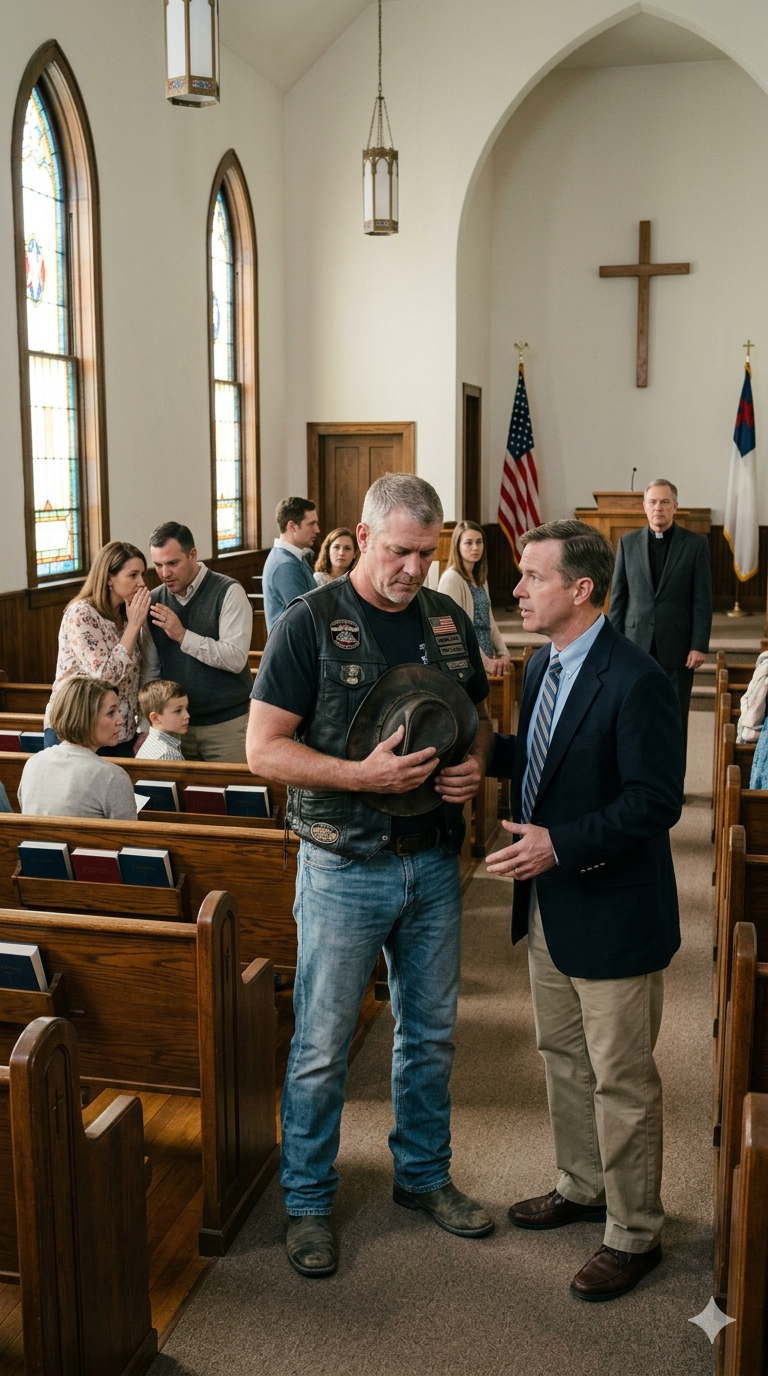
He did not make noise. He did not arrive in a rush. He did not look around like he wanted attention. He simply entered, removed his hat, and moved to the back of the chapel with the quiet care of a man trying to take up as little space as possible.
His name was Colter Vance.
He stood near the last row, holding his hat in both hands. His boots were worn but clean. His plain dark shirt was neatly buttoned. Over it, he wore a leather vest softened by years of weather and long roads. It looked old, not neglected. Used, not careless. But people did not see the difference. They only saw the vest.
At first, the congregation noticed him the way people notice an unfamiliar sound in a familiar room. Then someone looked longer. A woman leaned toward her husband. A man on the far side of the aisle narrowed his eyes. A mother drew her son a little closer, though she never said why.
The vest had not moved.
Still, it had become the loudest thing in the chapel.
The Fear That Spread Without Words
Colter had known this feeling before. He knew what happened when a room decided who you were before hearing your voice. He had lived long enough to recognize the small signs. The lingering stares. The stiff shoulders. The quiet exchange of glances meant to look polite. The way people acted like caution was wisdom, even when it was only fear wearing nicer clothes.
He kept his gaze low and his expression calm.
He had not come to argue with anyone.
He had not come to prove anything.
He had come because last year he could not.
That truth sat heavier on him than the vest ever had.
Near the front, the choir finished the opening hymn. The priest prepared to speak. But before the service could fully settle into its routine, one of the ushers noticed the growing tension in the room and started down the aisle.
He was a man in his fifties named Warren Bell, careful in his movements and proud of keeping things orderly. He adjusted his jacket as he walked, trying to look composed, though his face had already given away his concern.
When he reached the back, he stopped a respectful distance from Colter and lowered his voice.
“Sir,” he said, “this is a house of worship.”
Colter lifted his eyes and nodded once. “Yes, sir. I know.”
Warren glanced at the vest, then back at Colter’s face. “Some people are uncomfortable. I’m going to have to ask you to step outside.”
The words sounded gentle enough.
The meaning behind them did not.
Colter did not ask who had complained. He did not ask what exactly they feared. He already knew. He had seen it in the faces around him before Warren ever reached him.
So he simply dipped his head.
“If that’s what you want,” he said quietly, “I’ll go.”
A few pews away, someone released a breath in visible relief.
That small sound said more than any accusation could have.
The Reason He Came Too Late
As Colter turned toward the aisle, a memory pressed hard against his chest.
He saw his brother again.
Not as others had seen him, but as he truly was.
Nolan Vance had laughed with his whole body. He had spoken gently to older people and patiently to children. He had fixed engines with hands that somehow knew both strength and care. He had also worn a leather vest, ridden a loud motorcycle, and been judged within seconds by people who never asked a second question.
Nolan had told him once, years ago, “The world decides fast. Don’t let it teach you to do the same.”
Colter had not forgotten those words.
He had also not forgotten the phone call that came too late.
A year earlier, he had been two states away when Nolan passed. By the time he made it back, the burial was over, the casseroles were packed away, and the town had already moved on to ordinary life. Colter had stood outside a closed cemetery gate at dusk with rain on his shoulders and grief he did not know where to put.
Later, he learned something else.
Nolan had spent months helping repair this very chapel after a storm damaged part of the roof and side wall. He had come after long shifts, bringing friends from his club. They hauled lumber, replaced broken boards, sealed windows, and repaired what they could without asking for attention. They did it at night, after their own work was done. Most of the congregation never even knew their names.
Colter had come that Sunday because he needed to stand where his brother had stood.
He needed one honest moment near the place Nolan had quietly served.
But now, even that seemed too much to ask.
The Priest Who Looked Twice
Just as Colter took his first step toward the exit, a voice came from the front of the chapel.
“Please wait a moment.”
The priest had stopped mid-sentence.
Father Elias Mercer stood near the altar, one hand resting lightly on the edge of the lectern, his eyes fixed on the back of the room. The unfinished line of his sermon faded into silence as the entire chapel turned toward him.
Warren paused at once. Colter stopped too.
Father Mercer stepped down from the altar and started walking toward them, not hurried, not hesitant, but thoughtful. The room held its breath. Something in his face told the congregation that he was seeing more than they were.
As he came closer, he studied Colter carefully.
The silver at his temples.
The faint scar above one eyebrow.
The way his hands, though rough, held his hat with restraint rather than tension.
The priest stopped a few feet away.
“Are you here for someone?” he asked.
Colter hesitated. The question landed softly, and maybe that was what made it difficult to answer.
Finally he said, “Yes, Father. I’m here because of my brother.”
A murmur passed through the pews.
Father Mercer’s gaze sharpened, not with suspicion, but memory. “Your brother’s name?”
Colter swallowed once. “Nolan Vance.”
The priest’s entire expression changed.
Not dramatically. Not loudly. Just enough for anyone paying attention to see recognition arrive.
“Nolan,” he repeated, almost to himself.
Warren looked from one man to the other, uncertain now. “Father, we were only trying to be careful.”
Father Mercer did not answer him right away.
He looked at Colter again and said, “I remember that name.”
For the first time since entering the chapel, Colter’s face shifted. It was not relief exactly. More like pain mixed with gratitude.
“I couldn’t come last year,” he said. “I thought maybe I could come now. Just stand here for a little while. That’s all I wanted.”
From somewhere in the pews, a voice rose, tight and uneasy.
“There are children here.”
The words fell heavily in the room.
Colter did not react with anger. He only lowered his gaze for a second, as though he had heard that line before too many times to count.
Then he answered with quiet steadiness.
“I’m not here to trouble anyone.”
That should have calmed the room.
Instead, the gentleness in his voice seemed to unsettle some people even more.
The Moment Everyone Misunderstood
Warren stepped forward again, caught between obedience and doubt.
“Sir, maybe it would still be better if you waited outside,” he said.
Colter nodded faintly. “I understand.”
Then he reached into the inner pocket of his vest.
A sharp ripple moved through the room.
Someone gasped.
A woman pulled her daughter closer.
A man halfway down the aisle rose from his seat before he even realized he had done it.
But Colter only pulled out a phone.
He looked at the screen, typed slowly, and slipped it back into his pocket.
Warren exhaled, embarrassed by the fear he himself had briefly felt.
Father Mercer’s eyes never left Colter’s face. “Did you call someone?”
Colter shook his head. “I sent a message.”
“To whom?” Warren asked.
Colter answered without defensiveness.
“To people who knew my brother.”
The room grew still again.
Then Colter added, his voice soft enough that many had to lean forward to hear it, “I didn’t want to stand here alone if I wasn’t welcome.”
No one expected that sentence.
No one expected loneliness.
They had expected threat, attitude, pride, something hard enough to justify what they had already decided. Instead, they found grief.
And grief is harder to push out the door.
The Sound Outside the Chapel
A few moments later, before anyone could speak again, a low sound reached the building from outside.
Not shouting.
Not chaos.
Engines.
The steady, distant rumble rolled through the chapel walls and under the floorboards like approaching thunder that had no anger in it, only presence. Heads turned toward the stained-glass windows. The children looked curious rather than afraid. Adults looked at one another with new uncertainty.
Colter remained still.
He did not smile. He did not act pleased. He simply waited as though he had known this would happen.
The engines drew closer, then softened, then went quiet.
A beat later, the front doors opened.
Cool air slipped inside.
Four riders entered the chapel.
Two men. Two women. Different ages. Different faces. All wearing worn riding vests over clean shirts. None of them moved with aggression. None of them scanned the room like they meant to challenge anyone. They stepped in quietly and stood near the entrance with the calm discipline of people who understood how much space they carried simply by being seen.
One of them, a broad-shouldered woman with a silver braid and kind eyes, looked toward Colter and gave a small nod.
Nothing more.
Father Mercer turned toward the congregation and drew a slow breath.
Then he said, “Thank you for coming.”
Those four words changed the room.
The Truth That Could Not Be Ignored
Father Mercer faced the congregation fully now. His voice, when he spoke, was calm, but there was sorrow in it too.
“I think,” he said, “that this morning has shown us how quickly fear can pretend to be wisdom.”
No one moved.
No one interrupted.
He continued.
“A year and a half ago, after the winter storm damaged our roof and side hall, this chapel was in serious trouble. Insurance delays slowed everything. Funds came in too slowly. We prayed for help, and help arrived.”
He turned and gestured gently toward Colter.
“Not in a form many here would have expected.”
People began shifting in their pews.
Some looked embarrassed already, though the full story had not yet been spoken aloud.
Father Mercer’s gaze softened. “Nolan Vance and others from his riding club came here night after night. They brought tools. Lumber. Their own time. Their own labor. They repaired what was broken when this church could not afford to do it fast enough.”
A hush settled so completely that even the old wooden beams seemed to stop creaking.
The priest looked down at the polished floor for a moment, then back up “Nolan wore his vest every time he worked here. He once told me he kept it on because it reminded him that character should not change depending on who was watching.”
Colter’s jaw tightened. It was the only sign that his emotions had grown heavier.
Near the middle pews, an elderly woman covered her mouth with her hand.
A younger father lowered his eyes.
Warren stepped back as if suddenly aware of the space between his intentions and his actions.
Father Mercer was not finished.
“The man standing at the back of this chapel did not come here to disturb us. He came because he lost his brother and never had the chance to grieve in this room. And before any of us learned his name, many had already decided he did not belong.”
Silence answered him.
It was not the comfortable silence from earlier.
It was the kind that arrives when truth has taken away every easy excuse.
The Grace That Came Quietly
No one applauded.
That would have been too simple.
Instead, people sat with themselves.
One by one, shoulders lowered. Eyes turned away, then back again. The tension that had filled the room did not disappear in a dramatic burst. It dissolved slowly, almost painfully, as people recognized their own reflection in what had just happened.
Father Mercer walked back toward Colter and stopped beside him.
“You are welcome here,” he said clearly, so everyone could hear. “You always were.”
Colter looked at him for a long moment before answering.
“Thank you, Father.”
The priest nodded toward the pew beside him. “Would you stay?”
After a brief pause, Colter said, “Yes. I’d like that.”
One of the bikers near the door quietly removed her gloves and took a seat in the very last row. The others remained standing for a while, respectful and still, until Father Mercer motioned kindly for them to come further inside as well.
The service resumed, but it did not sound the same.
The words about grace, mercy, humility, and neighborly love no longer floated gently over people’s heads like familiar phrases they had heard too many times. That morning, those words had weight. They pressed against the heart. They asked something real.
And for many in that room, the hardest prayer of the day was not spoken aloud.
It was this:
Let me see better than I did before.
What Remained After the Final Hymn
When the service ended, the congregation stood slowly.
The final hymn lingered in the air. People did not rush toward the doors the way they usually did. Conversations began in hushed, uncertain tones. Some came toward Colter, then stopped, then came again.
An older man cleared his throat and said, “I’m sorry.”
A woman near the aisle, eyes damp with shame, whispered, “We judged too quickly.”
Warren stepped forward last. He looked older than he had an hour earlier.
“Mr. Vance,” he said, “I thought I was protecting people. But I see now I never even tried to know you. I’m sorry.”
Colter held his hat against his chest and answered with a gentleness Warren did not deserve, but perhaps needed.
“We all get taught to fear what we don’t understand,” he said. “The hard part is unlearning it.”
Warren nodded, unable to say much more.
Outside, the morning had grown brighter. The bikes waited in a neat line beneath the wide sky. Their chrome caught the sunlight. The town that had once seemed so certain now felt quieter, humbler.
Before Colter stepped through the chapel doors, Father Mercer touched his arm lightly.
“You don’t owe anyone proof,” the priest said.
Colter gave a small, tired smile. “I know. But I’m glad you stopped it.”
Father Mercer’s eyes warmed. “Your brother would be proud you came.”
For the first time that morning, Colter looked as though he might break.
But he didn’t.
He only nodded once and stepped outside.
The riders turned toward him.
“You good?” asked the woman with the silver braid.
Colter looked back at the chapel, then at the people standing in its doorway, many of them changed in ways they would not fully understand until later.
“Yeah,” he said softly. “I’m good.”
He put on his hat, swung a leg over his bike, and started the engine.
One by one, the others did the same.
They rode away without drama, without noise beyond what the road required, leaving behind not fear, but a silence full of thought.
And inside St. Matthew’s Chapel, in the stillness after judgment had been exposed and grace had finally been allowed to speak, people stood face to face with a truth they would not easily forget:
Sometimes the clearest sign of faith is not how warmly we welcome the familiar, but whether we can recognize goodness when it arrives wearing a form we never expected.
A kind heart does not always come dressed in a way the world immediately trusts, and that is why wisdom asks us to look twice before we decide who belongs.
It is easy to feel righteous when we are surrounded by people who look like us, speak like us, and fit the picture we have already accepted in our minds.
But real compassion begins where comfort ends, because love that only reaches the familiar has not yet learned how wide mercy is meant to be.
Many people believe they can sense danger just by appearance, yet some of the gentlest souls carry rough hands, old scars, heavy boots, and quiet sorrow that no one bothered to ask about.
The deepest failures of the heart often begin with assumptions, because once we decide someone’s story without hearing it, we stop seeing a person and start seeing only our fear.
Grace rarely announces itself in a way that flatters our expectations, and sometimes it waits patiently at the back of the room until someone brave enough chooses understanding over suspicion.
There are people who have carried kindness into broken places for years without applause, without recognition, and without ever correcting the false opinions others held about them.
The world becomes colder each time a person is pushed aside for looking different, but it becomes gentler every time someone pauses long enough to ask, listen, and truly see.
Not every act of service is witnessed, not every good deed is recorded, and not every helper arrives wearing clothing that makes others feel comfortable right away.
If we want to call ourselves people of decency, faith, or compassion, then we must learn to measure others by their character, their actions, and their quiet faithfulness rather than by the image we create in our own minds first.
And sometimes the most important moment in a person’s life is the moment someone finally chooses not to fear them, not to dismiss them, but to see the human being standing there with dignity, memory, grief, and a heart that deserved welcome all along.