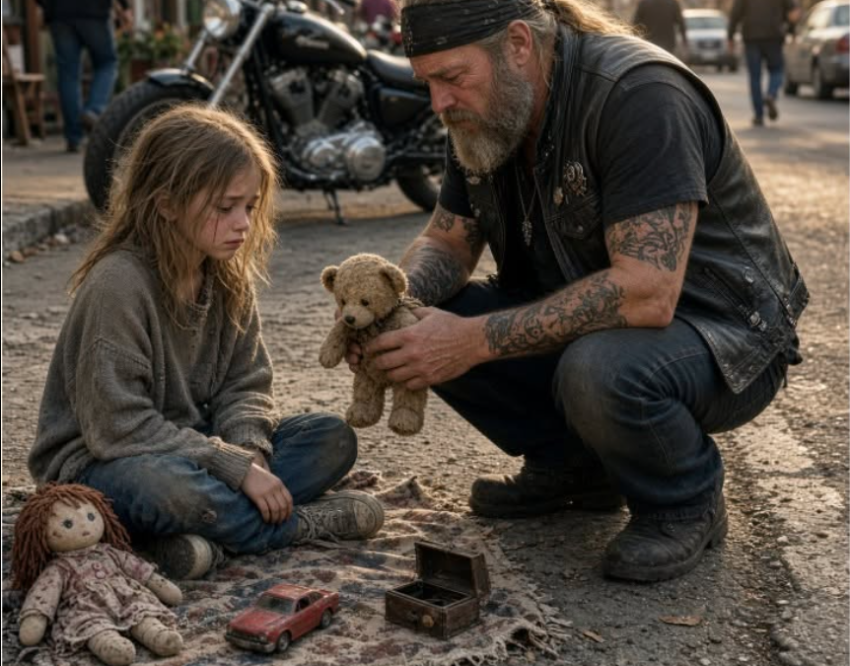
ALittle Girl Sold Every Toy She Owned Beside a Busy Road—Then a Tattooed Biker Picked Up Her Worn Stuffed Bear and Asked Why She Needed the Money.
The little girl sat beside the road with every toy she owned spread across an old blanket, trying to sell the last pieces of her childhood to strangers who would not even slow down.
When I asked how much she wanted for a worn stuffed bear, she gave me the price and then quietly offered me another toy for free, as if kindness was the only thing she still had enough of.
I thought I was stopping to help a child with a roadside sale, but before the day ended, I would learn she was trying to save her mother—and that one little girl’s sacrifice would bring an entire brotherhood of bikers to her front door.
My name is Caleb Mercer, though almost everyone who knew me on the road called me Bear.
I earned the name honestly.
I was six-foot-four, broad through the chest, with a gray beard, scarred knuckles, and arms covered in tattoos from a life that had taken me through wars, garages, funerals, highways, and a few dark places I did not talk about unless the night was long and the coffee was strong.
Children sometimes stared at me.
Mothers sometimes pulled their children closer.
Men who thought they were tough sometimes looked away first.
I understood.
A black leather vest covered in patches makes people decide things about you before you ever open your mouth. Add a motorcycle loud enough to rattle windows, a face weathered by too many years outside, and hands that looked better suited for breaking things than holding them, and most strangers built a story before I could say hello.
Dangerous.
Rough.
Trouble.
Biker.
People liked simple labels.
They made the world easier to sort.
What they did not see was the old grocery list folded in my wallet in my daughter’s handwriting. They did not see the little purple hair tie tied around my rearview mirror. They did not know I still avoided the toy aisle at Walmart because one squeaky stuffed rabbit could undo ten years of pretending I was fine.
My daughter, Lily, had died when she was eight.
Leukemia.
There are words that split a life into before and after.
For me, that was one of them.
Before Lily got sick, I owned a small motorcycle repair shop, coached tee-ball badly, burned pancakes on Saturdays, and believed exhaustion was something a man earned honestly by working hard.
After Lily got sick, I learned a hospital chair can become a bed if your body stops caring about comfort. I learned the sound of machines. I learned how quickly insurance letters could turn mercy into math. I learned that a child could smile with poison running into her veins because she did not want her father to be scared.
And after she died, I learned the road was easier than home.
So I rode.
For years, I rode because stopping meant remembering.
Then, slowly, the men and women I rode with became the only reason I did not disappear completely.
We called ourselves the Iron Hearts Motorcycle Club.
Outsiders assumed that meant noise, trouble, and bar fights.
Sometimes, in the early days, they were not entirely wrong.
But by the time I became road captain, most of us were just people with old wounds and loud engines, trying to do enough good to quiet whatever followed us home at night.
We raised money for burn victims, delivered Christmas toys, escorted funeral processions for veterans who had outlived everyone who might have attended, and fixed cars for single mothers who needed them to keep jobs nobody paid enough for.
We did not advertise much.
Good work that needs applause always made me suspicious.
That Saturday, I was not looking for anyone to save.
I was heading back from a parts run in Redfield County, two hours from home, with a new clutch cable strapped into my saddlebag and a storm building somewhere west of the hills. The road into Fairview bent past a row of small shops—a laundromat, a bait store, a closed barber shop, a little grocery with faded green awnings, and a church thrift store with a sign that read OPEN WED–SAT even though it was clearly closed.
The afternoon sun hung low, turning the pavement gold.
Traffic moved fast through that stretch.
Too fast.
Most drivers did not notice anything that was not directly in their lane.
I almost missed her too.
She was sitting on a worn blanket near the edge of the sidewalk, half in the shade of a leaning maple tree, half in the dust kicked up by passing cars.
A little girl.
Maybe nine years old.
Small for her age, with brown hair tied back in a crooked ponytail and a pink shirt that had faded from too many washes. Her jeans were too short at the ankles, and one sneaker had a piece of silver tape wrapped around the toe.
Spread out in front of her were toys.
Not yard-sale toys from an attic.
Not a box of things a parent had decided to clean out.
These were loved toys.
You can tell the difference.
A stuffed bear with one button eye slightly loose.
A cloth rabbit with a blue ribbon around its neck.
An old doll wearing a dress that had been washed pale.
A small red toy car with chipped paint.
A plastic dinosaur missing half its tail.
A music box with a broken lid.
A few crayons tied together with string.
A puzzle in a bag with a handwritten note taped to it:
MISSING ONE PIECE BUT STILL FUN.
That last one got me.
I slowed before I realized I was doing it.
PART2:
The girl looked up when she heard the motorcycle.
For a moment, our eyes met.
Then she quickly looked down, as if she expected me to ride past like everyone else.
I should have kept going.
That is what I told myself for the length of one heartbeat.
I had parts to deliver. A storm coming. Men waiting at the shop. A dog at home who needed feeding. A hundred excuses, all small and reasonable.
Then the little girl reached out and straightened the stuffed bear so it faced the road better.
A child trying to merchandise her own memories.
I pulled over.
The Harley rolled to a stop beside the curb, engine rumbling low before I cut it off. The sudden silence made her flinch.
I took off my helmet slowly.
No sudden movements.
I had learned that around frightened children, frightened animals, and frightened adults pretending not to be either.
“Afternoon,” I said.
She looked up.
Her eyes were hazel, too serious for her face.
“Hi.”
Her voice was small, but polite.
Always watch for that.
Children in trouble are often painfully polite. They think manners will keep the world gentle.
I stepped closer but left enough space between us that she could breathe.
“You selling these?”
She nodded.
“Yes, sir.”
Sir.
That hurt more than it should have.
I crouched carefully, my knees cracking like an old porch.
“What’s your name?”
She hesitated.
“Maddie.”
“Maddie what?”
“Maddie Parker.”
“I’m Caleb. Folks call me Bear.”
Her eyes widened slightly.
“Bear?”
PART3:
“Yeah. Long story. Mostly because I look like one before coffee.”
For half a second, her mouth twitched.
Almost a smile.
Then it disappeared.
I looked down at the toys.
“How much for the bear?”
She picked it up with both hands, brushing dust from its worn fur.
“That one is two dollars.”
“Two dollars?”
She nodded quickly, maybe afraid I would think it was too much.
“He’s soft. And he doesn’t have any holes. His eye is loose, but my mom can sew it.”
She stopped.
The pause after mom told me more than the sentence.
“Two dollars sounds fair,” I said.
I reached into my pocket and pulled out a five.
Her eyes moved to the bill.
“I can’t make change.”
“That’s okay.”
“No, sir. I don’t want to cheat you.”
“You’re not cheating me.”
“The bear is two dollars.”
“Then I’ll take another toy too.”
Her shoulders loosened a little.
She picked up the plastic dinosaur.
“This one is fifty cents because his tail is broken.”
I took the dinosaur in my other hand.
“Looks tough.”
“He is. He fought a dragon.”
“I can tell.”
She gave the smallest real smile then.
But when I handed her the five, she did not take it right away.
“You can take another one too,” she said.
I looked at her.
“For free?”
She nodded.
“You gave too much.”
That answer stayed with me.
Not because it was cute.
Because it was dignity.
The kind poverty tries to beat out of people and somehow fails when the soul is stubborn.
I sat down on the curb across from her blanket.
People driving past slowed slightly now, probably more interested in the sight of me than the little girl.
That angered me.
Nobody had stopped when a child sat alone trying to sell her toys.
But a biker on the curb?
That was worth looking at.
“So,” I said, keeping my voice gentle, “why are you selling all your stuff, Maddie?”
Her eyes dropped immediately.
There it was.
The wall.
Children learn walls fast.
“I just am.”
“That’s a reason, I guess.”
She folded her hands in her lap.
“I don’t play with them much anymore.”
I looked at the bear.
Its fur was worn down on one side from years of being held. The cloth rabbit’s ribbon had been retied so many times it had grooves in the fabric. The doll’s hair was brushed carefully. The toy car had scratches from a floor, not a storage box.
These were not forgotten toys.
These were companions.
I turned the bear over and saw faint letters written on the tag in purple marker.
MADDIE.
“You sure about that?” I asked.
Her chin trembled once.
She fought it hard.
I pretended not to see.
“My mom is sick,” she whispered.
The words came so quietly that the passing cars nearly swallowed them.
My body went still.
“What kind of sick?”
She shook her head.
“I don’t know. She coughs a lot. And she sleeps all the time. And sometimes she gets dizzy and has to hold onto the wall.”
“How long?”
“A while.”
“Is she seeing a doctor?”
Maddie pressed her lips together.
That answer was louder than any no.
“She went once,” she said. “But the medicine cost a lot. And she has to go back, but she said maybe later.”
“Where’s your dad?”
Her face changed.
Not tears this time.
Something older.
“He left.”
Two words.
A whole history.
I looked at the toys again.
“And you’re selling these for her medicine?”
Maddie nodded.
“I heard her talking on the phone. She said treatment. She said she didn’t have enough. She thought I was asleep.”
She rubbed one thumb over the edge of the blanket.
“I have some money in my jar. And I thought if I sold all my toys, maybe it would help.”
“How much do you need?”
“I don’t know.”
“Did your mom ask you to do this?”
Maddie looked horrified.
“No.”
Good.
That mattered.
“She doesn’t know?”
The horrified look deepened.
“No. She’d make me stop.”
“Because she loves you.”
“She needs medicine.”
“Both can be true.”
She looked down at the bear in my hand.
“I don’t want your money,” she said suddenly.
I blinked.
“I didn’t offer any.”
“You were going to.”
I almost smiled.
“You read minds?”
“No. Grown-ups get that face.”
“What face?”
“The sorry face.”
That hit harder than expected.
I knew the face.
I hated being on the receiving end of it.
The pity face.
The careful voice.
The look people gave me after Lily died, as if grief were contagious and they could catch it by standing too close.
“I don’t want charity,” Maddie said, trying to make her voice firm. “I just want someone to buy my toys.”
There are moments when a person’s character stands in front of you so clearly that you feel ashamed of every lazy assumption you have ever made.
A little girl, sitting beside the road, selling her childhood one toy at a time, and still trying to make sure the exchange was fair.
I nodded slowly.
“All right.”
She looked surprised.
“All right?”
“No charity.”
“Okay.”
“I’ll buy the toys.”
Her eyes moved over the blanket.
“All of them?”
“All of them.”
Her mouth opened slightly.
“But that’s a lot.”
“I’ve got a clubhouse full of grown men who could use emotional support dinosaurs.”
She stared at me.
I held up the broken-tailed dinosaur.
“This one looks like he’d keep Tank in line.”
“Who’s Tank?”
“A friend of mine. Big guy. Afraid of spiders. Don’t tell him I said that.”
This time she smiled fully.
Small.
Brief.
Beautiful.
Then it vanished again, as if she remembered why we were there.
“I don’t know how much all of them cost.”
I looked over the blanket.
“Let’s count.”
We counted together.
Two dollars for the bear.
One dollar for the rabbit.
Three dollars for the doll because the dress had buttons and “buttons are hard.”
Fifty cents for the dinosaur.
One dollar for the car.
Two dollars for the music box, even though the lid was broken, because “it still plays if you hold it right.”
A quarter for each crayon because they were short.
The puzzle was one dollar because of the missing piece.
A tiny plastic horse was seventy-five cents.
A wooden block with the letter M was free because “nobody buys one block.”
I bought it anyway.
When we were done, the total was fifteen dollars and twenty-five cents.
Maddie wrote it carefully on a piece of paper with a pencil so short it nearly disappeared between her fingers.
I pulled out a twenty.
She shook her head immediately.
“No.”
“Maddie.”
“It’s too much.”
“It’s close enough.”
“No. I can’t make change.”
“Keep the change.”
“That’s charity.”
“It’s tax.”
Her eyebrows pulled together.
“What?”
“Motorcycle toy tax.”
“That’s not real.”
“Not with that attitude.”
She almost laughed.
Almost.
But she held firm.
“I can’t.”
I looked around.
The grocery store was closed, but across the street was a small diner with its lights on. I pointed.
“I’ll get change.”
She looked panicked.
“You don’t have to.”
“I know.”
“What if you don’t come back?”
That question was a knife.
I lowered the twenty and looked at her carefully.
“I’ll come back.”
“People say that.”
“Yes,” I said. “They do.”
She studied my face.
I do not know what she saw there.
A scary biker.
An old man.
A stranger.
A father-shaped wound.
Maybe all of it.
“Okay,” she whispered.
I walked across to the diner and got change from a waitress who kept glancing out the window at Maddie with worry she had not acted on until I asked.
“How long has she been there?” I asked.
The waitress looked ashamed before she answered.
“Couple hours.”
“You know her?”
“Seen her around. Her mom used to clean houses in the area. Sweet woman.”
“Used to?”
“Haven’t seen her much lately.”
I took the change.
“Thanks.”
When I came back, Maddie’s shoulders dropped with relief.
I paid her exact total.
Fifteen dollars and twenty-five cents.
She counted it twice, then folded the bills carefully and put them into a zippered pouch with cartoon stars on it.
Then she looked at the empty blanket.
And for the first time, she seemed to realize what selling everything meant.
Her hands hovered over the space where the bear had been.
My throat tightened.
“You want to say goodbye to them?” I asked.
She shook her head too quickly.
“No.”
“You sure?”
“If I do, I’ll want to keep them.”
I looked down at the toys now in my arms.
A grown man holding a bear, a doll, a broken dinosaur, a toy car, a music box, crayons, a puzzle, a horse, and one wooden block.
I had carried heavier things.
Few had weighed more.
“Where do you live, Maddie?”
She froze.
I raised one hand.
“You don’t have to tell me. But if your mom is sick, somebody should check on her.”
“She doesn’t like people knowing.”
“Most people don’t.”
“She’ll be mad.”
“Maybe.”
“She’ll make me give the money back.”
“Maybe.”
“She needs it.”
“I know.”
Maddie looked at the street.
Cars passed.
Nobody stopped.
A little girl had sat there for hours selling pieces of herself, and the world had kept driving.
Finally she whispered, “It’s not far.”
“I can follow on my bike, but only if you’re comfortable. Or we can ask the waitress to come with us. Or I can call someone.”
She blinked.
“You’d call someone?”
“I ride with some people who help families sometimes. One of them is a nurse.”
“A real nurse?”
“Very real. Bossy too.”
“Would she be nice?”
“She scares grown men into taking medicine. But yes.”
Maddie thought about it.
Then she nodded.
“Can the nurse come?”
That told me two things.
She trusted me enough to ask.
And she was more scared for her mother than she was of strangers.
I made the calls.
First to Rosa, our club nurse.
Then to Ghost, our president.
Then to Marie, Ghost’s wife, because if there is one thing I have learned in life, it is that a crisis with a sick mother and frightened child needs women in the room who know how to turn help into dignity.
While we waited, I helped Maddie fold the blanket.
She insisted on carrying the money pouch herself.
I carried the toys.
Rosa arrived first in her old red pickup, medical bag in the passenger seat. She was a compact woman with silver-streaked hair, tattooed wrists, and the kind of eyes that could spot fever from across a parking lot.
Maddie shrank slightly when Rosa approached.
Rosa crouched immediately.
“Hi, sweetheart. I’m Rosa. Bear told me your mom isn’t feeling well.”
Maddie nodded.
“Are you a nurse?”
“Emergency room nurse for twenty-three years.”
“Do you give shots?”
“Only when people really need them.”
“My mom doesn’t like shots.”
“Most smart people don’t.”
That earned Rosa a tiny smile.
Ghost arrived with Marie and two other riders five minutes later. They parked across the street to avoid crowding the girl. Ghost was a huge man with a shaved head and a beard down to his chest, but he stayed back until I waved him closer.
“This is Marcus,” I told Maddie. “Folks call him Ghost.”
“Why?”
Ghost leaned down slightly.
“Because I’m pale and dramatic.”
Marie snorted.
“You are neither.”
“I am emotionally pale.”
Maddie looked confused enough to forget to be afraid for three seconds.
Marie stepped forward with gentle confidence.
“And I’m Marie. I brought a few groceries in case your mom hasn’t been able to get out much.”
Maddie’s eyes moved to the bags.
“Is that charity?”
Marie looked at me.
I looked away.
Smart kid.
Marie knelt.
“No, honey. This is what neighbors should have done sooner.”
Maddie did not know what to do with that.
Neither did I.
We followed her six blocks through a neighborhood that told its story without speaking.
Small houses.
Chain-link fences.
Porches with sagging steps.
Kids’ bikes left in yards.
A few windows covered from inside with blankets.
A place where people worked hard and still got called lazy by those who never had to choose between medicine and rent.
Maddie’s house sat near the end of a narrow street.
It had yellow siding faded almost white, a cracked walkway, and a small pot of dead flowers on the porch. The front window had clean curtains. The yard was cut short, though unevenly, as if someone weak had tried to do it in stages.
Maddie stopped at the bottom of the porch.
“She’s going to be embarrassed.”
Rosa touched her shoulder lightly.
“We’ll go slow.”
Maddie opened the door.
“Mom?”
A woman’s voice answered from inside.
“Maddie? Baby, where were you?”
The fear in that voice brought all of us to a stop.
Maddie hurried in.
I stayed on the porch with the toys in my arms, suddenly aware of how strange this looked.
A biker at the door.
A child’s belongings in his hands.
Groceries behind him.
A nurse with a medical bag.
This was how help could feel like an invasion if done wrong.
Marie stepped past me.
“Let me.”
She knocked gently on the open doorframe.
“Ms. Parker? My name is Marie. I’m with Maddie. She’s safe. May we come in?”
A cough answered first.
Deep.
Wet.
Painful.
Then, “Maddie?”
“I’m here, Mom.”
We entered slowly.
The house was clean.
That was the first thing I noticed.
Not fancy.
Not full.
But clean.
A couch covered with a faded quilt. A small table stacked with mail. Dishes washed and drying beside the sink. A laundry basket half full near the hallway. A framed photo on the wall of Maddie as a toddler sitting on a man’s shoulders, both of them laughing.
Her father, I guessed.
Gone now, by choice or circumstance.
Either way, gone.
Maddie’s mother sat in a recliner near the window, wrapped in a blanket despite the warm evening. She looked far too young to look that tired. Early thirties maybe, with dark hair pulled back loosely and skin pale beneath the flush of fever. Her eyes went straight to the toys in my arms.
Then to Maddie.
Her face changed.
“Maddie Grace Parker,” she whispered.
Maddie burst into tears.
“I’m sorry.”
Her mother tried to stand.
Rosa moved quickly.
“Please don’t get up.”
The woman looked at her, startled.
“Who are you?”
“I’m Rosa. I’m a nurse. Your daughter was worried about you.”
“I’m fine.”
Every sick mother in the history of the world has said those words.
Rosa gave her a look that made even Ghost straighten.
“No, ma’am. You’re not.”
Maddie held out the money pouch with shaking hands.
“I sold them, Mom. I sold the toys. I got fifteen dollars and twenty-five cents.”
Her mother’s face crumpled.
“Oh, baby.”
“I didn’t want charity. He bought them. All of them. He paid exact.”
She pointed at me like my honesty was the important detail.
I stood there holding a doll and a dinosaur, feeling like I had been caught carrying evidence.
Her mother looked at me.
I expected anger.
Maybe fear.
Instead, I saw humiliation so deep it made my chest hurt.
“I’m sorry,” she said.
That was what she said.
Not thank you.
Not who are you?
Sorry.
As if being sick and poor in front of strangers was something she had done wrong.
“My name is Caleb,” I said. “People call me Bear.”
She pulled the blanket higher.
“Anna Parker.”
“Your daughter is something else, Ms. Parker.”
Anna looked at Maddie, and tears spilled over.
“I know.”
Then she began coughing.
The sound filled the room.
Rosa took over.
Temperature. Pulse. Oxygen level from the little finger monitor she carried. Questions. How long sick? Any diagnosis? What treatment? What medicine? Eating? Drinking? Dizziness? Chest pain? Insurance? Work?
Anna resisted at first.
Pride does not leave just because fever enters.
But Rosa had spent twenty-three years convincing stubborn people to stay alive.
Slowly, the story came out.
Anna cleaned houses and worked part-time at a daycare until she got sick.
At first, she thought it was bronchitis.
Then pneumonia.
Then something more complicated after a clinic doctor found shadows on imaging and told her she needed further testing. She missed work. Lost hours. Fell behind on bills. Skipped follow-up appointments because every visit cost money she did not have.
She had applied for assistance but was waiting.
Waiting is a dangerous word when illness is moving faster than paperwork.
Maddie sat beside her mother’s chair, crying silently into the sleeve of her faded pink shirt.
Anna saw and tried to stop talking.
Rosa noticed.
“Maddie already knows enough to be scared,” she said gently. “Secrets won’t make her less afraid. They’ll only make her carry it alone.”
Anna closed her eyes.
That landed.
Marie moved around the kitchen quietly, putting away groceries without making a production of it. Ghost and the others stayed mostly outside, carrying in supplies only when asked. Nobody crowded Anna. Nobody asked nosy questions. Nobody took out a phone.
That mattered.
People in trouble should not have to become content before they receive help.
Rosa finally stepped into the hallway with me.
“She needs a hospital,” she said.
“How bad?”
“Bad enough.”
“Tonight?”
“Tonight.”
I looked toward the living room.
“She won’t go.”
“She has to.”
We were both right.
Anna refused at first.
Too expensive.
Too much trouble.
No one to watch Maddie.
No ride.
No insurance.
No.
No.
No.
Each no was not stubbornness.
It was fear wearing armor.
Then Maddie climbed into her lap.
Too big for it maybe.
But still small enough.
“Please, Mommy.”
Anna broke.
Not loudly.
She bowed her head over Maddie’s hair and whispered, “I’m so sorry.”
Within thirty minutes, we had a plan.
Rosa would drive Anna to the hospital.
Marie would ride along.
I would follow with Maddie if Anna agreed.
Ghost would stay back with two riders to secure the house, clean up anything needed, and make sure no one bothered the place.
Anna looked overwhelmed by the logistics.
“Why are you doing this?” she asked.
The room went still.
It was the question everyone in pain eventually asks.
Why help me?
As if suffering requires a person to prove they are worth mercy.
I looked at Maddie’s empty blanket folded on the couch.
“Because your daughter sat by the road trying to sell her childhood to save you,” I said. “And nobody should have to do that alone.”
Anna covered her mouth.
We went to the hospital.
It became a long night.
Hospitals always are.
Fluorescent lights. Plastic chairs. Machines beeping behind curtains. Nurses moving fast. Forms. Questions. Waiting.
Maddie sat beside me in the waiting room, leaning against my arm though I do not think she realized it.
Her money pouch was still clutched in her lap.
I had the toys in a canvas bag at my feet.
“You bought them,” she said after a while.
“I did.”
“So they’re yours.”
“I guess.”
“Are you going to keep them?”
I looked down at the bag.
“I haven’t decided.”
She nodded.
A few minutes later, she asked, “Did you have kids?”
That question always came eventually with children.
They sensed the empty place.
“Yes,” I said.
“A boy or girl?”
“A girl.”
“What’s her name?”
“Lily.”
“Is she grown up?”
I swallowed.
“No. She died when she was eight.”
Maddie became very still.
“I’m sorry.”
“Me too.”
“What did she like?”
The question surprised me.
Most adults asked how she died, then regretted asking.
Children, sometimes, asked better questions.
“She liked purple. Pancakes. Dinosaurs. Drawing stars on everything. She had a stuffed rabbit she took everywhere.”
Maddie looked at the canvas bag.
“I had a rabbit too.”
“I know.”
“Did Lily’s rabbit have a name?”
“Captain Hops.”
Maddie’s mouth opened.
“That’s a silly name.”
“She was a silly kid.”
For the first time that night, I smiled without pain being the first thing behind it.
Maddie leaned her head against my arm.
“My mom can’t die,” she whispered.
There was no answer that would not be a lie.
So I gave her the truth carefully.
“We’re going to do everything we can to help her.”
“But you don’t know.”
“No,” I said. “I don’t know.”
She cried then.
Quietly.
Into my sleeve.
And I sat in that hospital waiting room with a little girl who had sold her toys to save her mother, and for the first time in years, I did not feel like my grief was a locked room.
It had become a place where someone else could sit and not be alone.
Anna was admitted before sunrise.
Severe pneumonia.
Complications from an untreated infection.
Dangerous dehydration.
The other concerns would need testing once she stabilized.
Rosa said we had gotten her there in time.
Maybe not early.
But in time.
Those words became the first brick of hope.
In time.
The next three days changed everything.
Ghost contacted the club.
By noon the next day, the Iron Hearts had a plan.
Not a flashy one.
Not at first.
Rent paid for two months through the landlord, who suddenly became much easier to reach when Ghost introduced himself politely.
Utilities caught up.
Hospital social worker contacted.
Assistance paperwork pushed forward.
A community clinic appointment arranged for follow-up.
Daycare director called; Anna had not been fired yet, just “not scheduled,” which Marie addressed with the kind of calm tone that made people agree before they realized they had been cornered.
Food stocked.
House cleaned.
Lawn mowed.
Broken porch light fixed.
Car battery replaced, because of course the car had a dead battery too.
Poverty is rarely one problem.
It is a pileup.
While Anna recovered, Maddie stayed with Marie and Ghost at night because Anna refused at first to let her stay with me, which I respected completely.
“I’m not sending my daughter home with a man I met yesterday,” she said weakly from the hospital bed.
“Good,” I said. “That means your fever hasn’t ruined your judgment.”
She almost smiled.
During the day, I visited with Marie.
Maddie brought homework to the hospital cafeteria. She did math worksheets, read library books, and drew pictures in the margins of napkins. She drew a motorcycle with a bear riding it, which was not flattering but was accurate in spirit.
On the fourth day, Anna asked me to sit with her while Maddie went with Rosa to get hot chocolate.
I pulled the chair closer.
Anna looked better.
Still weak.
Still pale.
But present in her own body again.
“She told me what she did,” Anna said.
I nodded.
“The toys.”
“Yes.”
Anna’s eyes filled.
“I should have noticed.”
“You were sick.”
“I’m her mother.”
“You’re human.”
She looked toward the door.
“She loved that bear.”
“I know.”
“She slept with it every night after her father left.”
There it was.
Left.
Not died.
Left.
“I didn’t know she heard the phone calls,” Anna said.
“They always hear more than we think.”
“I tried to keep it from her.”
“I know.”
“I didn’t want her carrying this.”
“But she was.”
Anna closed her eyes.
“I hate that.”
“Good.”
She looked at me.
“Hating it means you’re still fighting.”
A tear slid into her hairline.
“I don’t know how to pay any of you back.”
“You don’t.”
“I can’t accept that.”
“Then don’t pay us back. Pay it forward when you can.”
She looked at me for a long time.
“Is that what someone told you once?”
“No,” I said. “It’s what I wish someone had told me.”
When Anna came home a week later, the house smelled like chicken soup, lemon cleaner, and fresh air.
Maddie walked in first, then stopped.
The living room had changed.
Not fancy.
Not charity-show changed.
Just repaired.
The broken curtain rod was fixed. The porch light worked. The refrigerator had food. The stack of threatening mail on the table had been sorted into folders by Marie. A new inhaler and medications sat on the counter with instructions written clearly. A soft blanket lay folded over Anna’s chair.
And on the couch sat the toys.
All of them.
The bear.
The rabbit.
The doll.
The car.
The dinosaur.
The music box.
The crayons.
The puzzle.
The wooden block.
Maddie froze.
She looked at me.
“You bought them.”
“I did.”
“So they’re yours.”
“They were.”
Her brow wrinkled.
“I don’t understand.”
I picked up the bear and held it out.
“I’m giving them to Anna.”
Maddie looked even more confused.
“To Mom?”
I turned to Anna.
“These are yours now. Officially. Paid for. Fair and square. No charity.”
Anna caught on before Maddie did.
Her face softened with tears.
“And I want Maddie to borrow them,” I continued, “for as long as she wants. But legally, if anyone asks, they belong to you.”
Maddie stared.
“So I can keep them?”
Anna took the bear with trembling hands.
“You can keep them, baby.”
Maddie made a sound I will never forget.
Not quite a sob.
Not quite a laugh.
Something from the deepest part of a child who had been trying to be brave too long.
She grabbed the bear and held it to her chest.
The same way she had held the paper bag of money.
Only this time, she did not look scared.
She looked like a little girl again.
That was the moment I had to step outside.
I stood on the porch, turned toward the street, and tried to breathe through a grief that had suddenly become too large and too clean.
Ghost came out behind me.
“You all right?”
“No.”
He leaned on the railing beside me.
“Good.”
I looked at him.
He shrugged.
“Means you’re alive.”
I almost laughed.
Instead, I wiped my face with my palm.
“I can’t lose another kid.”
Ghost was quiet.
“You don’t own whether you lose people, Bear.”
“I know.”
“You own whether you show up while they’re here.”
I hated him a little for being right.
Life settled into something that looked almost normal.
Anna recovered slowly.
Not perfectly.
There were follow-up appointments, tests, bills, paperwork, setbacks, fatigue. Real life does not resolve in one generous afternoon.
But now she had help.
Marie drove her to appointments when needed. Rosa checked on medications. The club arranged a small fundraiser quietly, not in Anna’s name publicly, but under the Iron Hearts emergency family fund. The landlord, after meeting Ghost twice, suddenly discovered great flexibility in his policies.
Maddie went back to school.
Her teacher, Mrs. Lane, noticed she was less tired and called Anna to say so.
That call made Anna cry for twenty minutes.
The first time Maddie invited me to her school art show, I almost said no.
Crowds of parents were not my natural environment.
Then she said, “You can stand in the back if you want.”
So I went.
Her painting hung on a cafeteria wall between a watercolor pumpkin and a collage of fall leaves.
It showed a little girl sitting on a blanket beside a road.
A huge motorcycle beside her.
A bear in the biker’s arms.
Above them, in careful marker, she had written:
THE DAY HELP STOPPED.
I had to leave the cafeteria for a minute.
When I came back, Maddie pretended not to notice my red eyes.
That was kind of her.
Three months after the sidewalk sale, Anna was strong enough to return to work part-time.
The daycare took her back.
The first paycheck was small, but she held it like victory.
She insisted on bringing homemade cookies to the clubhouse to thank everyone.
That was how Maddie met Tank.
Tank was six-foot-seven, bald, tattooed, and built like someone had stacked refrigerators together.
Maddie looked up at him and said, “Are you the one afraid of spiders?”
Tank turned slowly toward me.
I looked away.
“Bear.”
“I didn’t say anything.”
“You absolutely did.”
Maddie handed him a cookie.
“It’s okay. I’m afraid of basements.”
Tank accepted the cookie solemnly.
“Fair trade. I’ll handle basements. You handle spiders.”
“Deal.”
After that, Tank became one of her favorite people.
He once let her put glitter stickers on his helmet.
He claimed he did not notice for two weeks.
Nobody believed him.
The Iron Hearts began calling Maddie “Buttons” because the doll’s button dress had somehow become famous in the clubhouse story. Maddie hated the nickname for exactly one day, then demanded a patch.
Marie made her one.
Not an official club patch.
We were not insane.
A small denim patch that said BUTTONS in purple thread.
Maddie wore it on her backpack.
Anna pretended to object.
She did not.
The next spring, Maddie asked if we could do a toy drive.
Not a Christmas toy drive.
A “kids shouldn’t have to sell their toys” drive.
Her words.
She wanted donated toys for children whose families were going through illness, job loss, eviction, or “other scary grown-up stuff.”
I told her we could try.
Ghost heard and turned it into a full operation in forty-eight hours.
The first year, we collected two hundred toys.
Maddie helped sort them.
She was very strict.
“No broken toys unless they’re still fun.”
I raised an eyebrow.
“Like missing-tail dinosaurs?”
“Exactly.”
“No creepy dolls.”
“Define creepy.”
“If Tank screams, it’s creepy.”
Fair rule.
We delivered toys to shelters, hospitals, family support centers, and one motel where five families were living week to week. Maddie insisted each bag include a handwritten note:
This is yours. You don’t have to sell it.
That note broke more adults than the toys did.
The drive became annual.
Maddie’s Toy Run.
She hated the name at first.
Then she saw the first little boy hug a stuffed dog like it had found him personally, and she stopped arguing.
Years passed.
Not in a montage.
In ordinary days.
Anna got healthier.
Maddie got taller.
The bear got repaired twice.
The music box finally stopped playing, then a retired rider named Walt fixed it using parts from three different broken music boxes and language unfit for children.
Maddie learned to ride a bicycle, then a bigger one, then eventually, much to Anna’s horror, she learned to ride on the back of my motorcycle.
Helmet.
Jacket.
Gloves.
Every safety rule obeyed.
Anna still stood on the porch the first time like she was sending her daughter into battle.
“Slow,” she warned me.
“I know.”
“No highways.”
“I know.”
“No showing off.”
“I am a mature adult.”
Anna stared.
Maddie giggled.
I took her around the block at twenty miles an hour.
She came back grinning like she had outrun gravity.
Anna cried afterward, but only a little.
By the time Maddie turned thirteen, she understood more about what had happened than we wanted her to.
Children grow into the truth.
One day they believe their mother was “sick,” and then slowly, details gather. Pneumonia. Untreated infection. Medical bills. Missed appointments. Fear. Poverty. The way a child had tried to solve all of it with a blanket full of toys.
On her thirteenth birthday, she asked to visit Lily’s grave with me.
The request came out of nowhere.
We were sitting on the clubhouse steps, eating cupcakes Anna had made.
“Bear?”
“Yeah?”
“Can I meet Lily?”
I went still.
Maddie looked at her shoes.
“I mean, I know I can’t really meet her. But can I visit where she is?”
The cupcake in my hand became impossible to swallow.
“Why?”
She shrugged.
“I think she should know you helped me.”
I looked away.
The clubhouse noise faded behind me.
Men laughing.
Engines.
Music.
Life.
Lily had been gone for so long, and still a child’s kindness could open that door like no time had passed at all.
“Yeah,” I said finally. “We can go.”
The cemetery was quiet that afternoon.
Maddie brought the stuffed rabbit.
Her rabbit.
Not to leave.
Just to show.
She stood in front of Lily’s stone, reading the name carefully.
LILY ANNE MERCER
Beloved Daughter
Forever Eight
Maddie touched the rabbit’s blue ribbon.
“Hi, Lily,” she said softly. “I’m Maddie. Your dad is my friend. He looks scary, but he’s not.”
I choked out something between a laugh and a sob.
Maddie continued.
“He bought my toys when my mom was sick. But then he gave them back. Kind of. In a complicated grown-up way.”
She placed the rabbit on the grass for a moment.
“I think you would have liked him. I mean, you probably did. He’s your dad.”
Then she looked at me.
“Do you want to say something?”
I had avoided talking at Lily’s grave for years. I cleaned it. Left flowers. Stood there. Suffered.
But speaking felt too much like admitting she was listening and not answering.
That day, with Maddie beside me, I said, “Hey, bug.”
My voice broke immediately.
Maddie slipped her hand into mine.
“I miss you,” I said. “I met somebody I think you would’ve liked.”
Maddie squeezed my fingers.
“She’s bossy,” I added.
Maddie gasped.
“I am not.”
I laughed through tears.
For the first time in years, leaving the cemetery did not feel like abandoning Lily.
It felt like carrying her forward.
When Maddie was sixteen, Anna got sick again.
Not like before.
This time they caught it early.
Because now Anna went to appointments.
Because now she had people who drove her, argued with billing departments, watched Maddie, filled prescriptions, and refused to let fear make decisions alone.
The treatment was difficult.
There were long weeks.
But Anna survived.
Afterward, she began volunteering with Rosa at health outreach events, helping families apply for assistance, schedule appointments, and understand paperwork that seemed designed to exhaust people into giving up.
Anna had a gift for spotting shame.
She would sit beside another mother and say, “I know. I’ve been there.”
Those three words did what brochures could not.
Maddie watched her mother become the person she once needed.
That changed her too.
By senior year, Maddie had decided she wanted to become a pediatric oncology nurse.
I tried to speak when she told me.
Failed.
She smiled gently.
“I know it’s because of Lily,” she said. “And Mom. And Rosa. And you.”
“You sure?”
“No,” she said honestly. “But I think so.”
I appreciated that answer.
Certainty at eighteen is overrated.
The day Maddie graduated high school, the Iron Hearts showed up in full.
Not with engines roaring during the ceremony.
We had manners, despite rumors.
But afterward, in the parking lot, a line of motorcycles stretched along the curb, chrome shining in the sun. Maddie came out in her cap and gown, saw us, and burst into tears before anyone said a word.
Tank wore a tie over his leather vest.
It was bright purple and had dinosaurs on it.
Maddie laughed so hard she dropped her diploma folder.
Anna stood beside me, crying openly.
“You know,” she said, “I used to be terrified when I saw bikers.”
“I know.”
“Now I worry when I don’t.”
“That’s growth.”
She smiled.
Maddie walked over carrying something under her gown.
A bundle wrapped in tissue paper.
She handed it to me.
“This is for you.”
Inside was the stuffed bear.
Her bear.
Repaired again, clean, soft, one button eye still slightly uneven.
I looked at her.
“No.”
“Yes.”
“Maddie—”
“I’m not selling him,” she said. “I’m giving him to you.”
I could not speak.
“He helped save my mom,” she said. “And you gave him back when I needed him. Now I’m okay. So maybe Lily can have him for a while.”
The world blurred.
“I can’t take this.”
“You can.”
“I know what he means to you.”
“That’s why I want you to have him.”
Anna touched Maddie’s shoulder, crying harder now.
Maddie smiled through tears.
“Besides, he’s technically Mom’s property. You gave him to her.”
Anna laughed.
“That is legally true.”
I held the bear to my chest and cried in a high school parking lot surrounded by bikers, parents, teenagers, and one man in a purple dinosaur tie.
Nobody made fun of me.
Not once.
The next day, I took the bear to Lily’s grave.
I did not leave him in the weather.
I brought him in a small clear memory box Walt built, sealed carefully, with a note inside from Maddie.
Dear Lily,
Your dad stopped for me when I needed help.
I hope this bear keeps you company the way he kept me company.
Love,
Maddie
I sat there a long time.
Then I told Lily the whole story.
The blanket.
The toys.
The hospital.
The toy drive.
The graduation.
All of it.
The grief did not leave.
It never does.
But it moved differently.
Less like a locked room.
More like a road I could walk without being destroyed every time.
Maddie went to nursing school two hours away.
The first semester was hard.
She called Anna crying twice.
Called Rosa with medical questions.
Called me once because her car made a sound “like a dying lawnmower full of rocks.”
I drove out with tools.
It was a belt issue.
Also, she needed oil.
Also, she had been surviving on noodles and campus coffee.
I called Anna.
Maddie yelled, “Traitor!”
I said, “Maintenance includes nutrition.”
She threw a sock at me.
College did not make her forget where she came from.
Every winter break, she helped with the Toy Run. Every summer, she volunteered at Rosa’s clinic events. She spoke to families with the same seriousness she had carried as a child, but now it had a purpose instead of a burden.
At twenty-two, Maddie became a nurse.
Pediatric oncology, exactly as she had said.
The first time I saw her in scrubs, I had to sit down.
She looked like every prayer I had never known how to say.
She worked at the same hospital where Lily had once been treated.
That was hard for me at first.
She knew.
She did not ask me to visit immediately.
Then one day she called.
“There’s someone I want you to meet.”
I drove there with my chest tight.
The pediatric wing smelled the same.
Cleaners.
Plastic.
Fear.
Hope.
Memory slammed into me so hard I almost turned around.
Maddie met me near the elevator.
“You okay?”
“No.”
“Want to leave?”
I looked at her face.
The little girl from the blanket was still there somewhere, but now she wore an ID badge, comfortable shoes, and the steady eyes of someone who had chosen to walk toward pain on purpose.
“No,” I said. “I’m okay enough.”
She led me to a playroom where a little boy sat building a tower out of foam blocks.
Bald head.
Thin wrists.
Fierce concentration.
“This is Noah,” Maddie said. “He likes motorcycles.”
Noah looked up.
“You got one?”
“I do.”
“Is it loud?”
“Very.”
“Good.”
Maddie smiled.
“Bear helps us with the toy drive I told you about.”
Noah pointed to a shelf.
The shelf was full of donated toys.
Each bag had a note.
This is yours. You don’t have to sell it.
I turned to Maddie.
She looked away, blinking fast.
Later, in the parking garage, I broke down.
Not because I was sad exactly.
Because grief and healing had collided so completely that I could not separate them.
Maddie hugged me.
The same little girl who once stood beside the road with nothing left to sell now held me up outside the hospital where my daughter had died, wearing scrubs and carrying forward the kind of mercy that had saved her own childhood from disappearing piece by piece.
“You stopped,” she whispered.
I shook my head.
“You kept going.”
Both were true.
Years have passed since the day I first saw her on that blanket.
The road has been widened now. The grocery store changed owners twice. The maple tree was cut down after a storm. The spot where Maddie sat is just sidewalk to most people.
To me, it is holy ground.
Every year before the Toy Run, I ride there alone.
I cut the engine.
I sit on the curb.
I remember the little girl with the crooked ponytail, the taped sneaker, the bear, the doll, the broken music box, the determined voice saying, “I don’t want your money. I just want someone to buy my toys.”
I think about how easy it would have been to keep riding.
How many people had already passed her.
How many times in life we tell ourselves someone else will stop.
Someone else will help.
Someone else will notice.
But sometimes there is no one else.
Sometimes there is only you, a motorcycle, a child, and a choice that does not feel big until years later when you see everything that grew from it.
Maddie is twenty-six now.
Anna is healthy.
The Toy Run serves hundreds of children every year.
The Iron Hearts have more stuffed animals in the clubhouse than any motorcycle club should legally possess.
Tank still has the purple dinosaur tie.
The music box still works if you hold it right.
And in the clubhouse office, on a shelf beside photos of fallen riders, charity rides, and children we have helped, sits the wooden block with the letter M.
The one Maddie said nobody would buy.
The one I bought anyway.
People ask me sometimes what the M stands for.
Maddie, of course.
Mercy.
Memory.
Maybe.
Miracle, if you believe in that kind of word.
I do now more than I used to.
Not the kind with bright lights and easy endings.
The quieter kind.
A biker stopping.
A child trusting.
A mother surviving.
A toy returned.
A grief repurposed.
A life changed because one person did not ride past.
The day I bought Maddie’s toys, I thought I was helping a little girl keep her dignity while she tried to save her mother.
I did not know she would help me find mine again.
I did not know a worn stuffed bear could carry two daughters’ names without breaking.
I did not know that a broken music box, a missing puzzle piece, and a dinosaur with half a tail could become the foundation of a charity run.
I did not know that love, once given, rarely stays where you leave it.
It moves.
From a blanket beside the road to a hospital room.
From a sick mother to a clubhouse full of riders.
From one child’s toys to hundreds of children’s hands.
From my lost daughter to a girl who refused to let pain make her hard.
And every time Maddie comes back for the Toy Run, wearing her nurse badge and that same serious look she had as a child, she finds me before the engines start.
She hugs me.
She always says the same thing.
“You stopped.”
And I always answer the same way.
“You were worth stopping for.”
That is the truth.
The whole truth.
A little girl sat quietly by the road, selling everything she loved because she thought love meant giving up whatever you had left.
But love, real love, did not let her lose those things forever.
It bought them.
Protected them.
Gave them back.
And then sent them out into the world as proof that even the smallest act of sacrifice can become something larger than pain.
Sometimes a toy is not just a toy.
Sometimes it is a child’s last attempt to help.
Sometimes it is a father’s grief finding a new purpose.