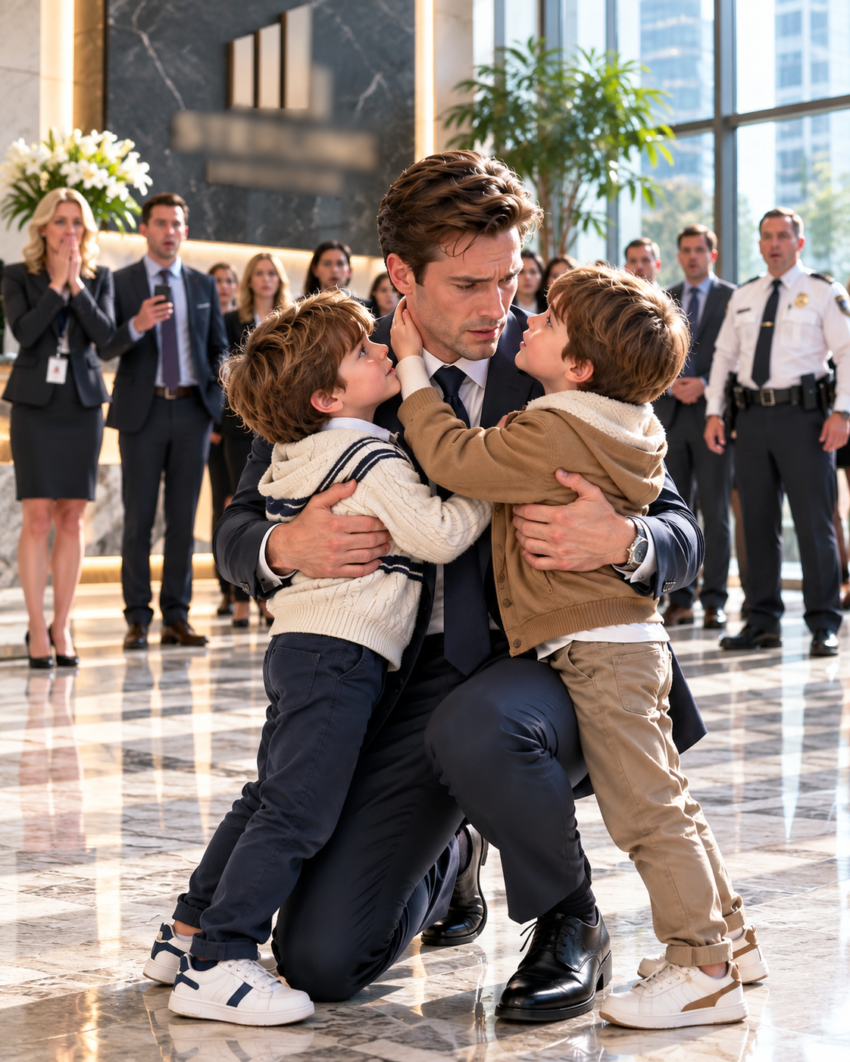
Two Little Boys Ran Into My Billion-Dollar Headquarters and Called Me “Daddy”—But Doctors Had Told Me I Could Never Have Children. Then They Handed Me a Photograph of a Woman I Had Buried Seven Years Ago.
The Morning Two Strangers Called Me Dad
The first boy grabbed my right hand. His brother wrapped both arms around my waist.
“Daddy, we finally found you!”
Their voices echoed through the marble lobby of my corporate headquarters in Manhattan.
Nearly two hundred employees turned to stare.
I was thirty-six years old, the founder of a technology company worth more than a billion dollars, and I had just been called Daddy by two children I had never met.
There was only one problem.
Eight years earlier, a specialist had told me that becoming a biological father was almost impossible.
My name is Bennett Whitmore, and until that morning, I believed there were two things money could never return to me: the parents I had lost and the family I had never been able to create.
Then two little boys appeared and changed everything.
One had a faded blue backpack. The other held a photograph inside a plastic sleeve.
They looked about seven years old, with dark brown hair, pale skin, and blue eyes that seemed painfully familiar.
I crouched in front of them.
“Hey, guys. I think you might have the wrong person.”
The taller boy shook his head.
“No, we don’t. You’re Bennett Whitmore. You have a scar near your ribs, and you don’t like thunderstorms because of what happened to your parents.”
My mouth went dry.
Those details weren’t available on the internet.
“Who told you that?”
“Mom,” he answered.
His brother reached into the backpack.
“She said if we ever got separated, we should find you. She said you’d help us.”
“What’s your mother’s name?”
The boys exchanged uncertain looks.
Then the younger one handed me the photograph.
I recognized the woman immediately.
Her brown hair fell across one shoulder, and she was smiling beside a lake in Connecticut.
I remembered taking that photograph myself.
Her name was Claire.
And seven years earlier, I had attended a memorial service believing she was gone forever.
The Woman I Never Stopped Loving
I met Claire Waverly when I was twenty-six.
At the time, I was a struggling software developer living in a rented apartment in New Haven. My parents had recently passed away following a highway accident, and I had spent months recovering from injuries of my own.
Claire was a graduate researcher working on medical data systems.
She had an extraordinary mind and a habit of asking questions that made people uncomfortable.
We met at a technology conference where I accidentally spilled coffee on her notes.
Instead of getting angry, she laughed.
“Well, now you’ll have to buy me another coffee so I can rewrite everything.”
That was how our story began.
We spent evenings walking through the city, discussing books, technology, and the ordinary lives we hoped to build.
I eventually told her about my accident and the doctor’s assessment.
“I probably won’t be able to give you children,” I admitted one evening.
Claire took my hand.
“Bennett, a family isn’t defined by a medical report. It’s defined by the people who choose to love each other.”
For the first time since losing my parents, I believed happiness might still be possible.
Then Claire received an opportunity to work at a private biomedical research company called Meridian Health Systems.
At first, she was excited.
But several months later, her behavior changed.
She began coming home exhausted. She stopped discussing her work and sometimes checked the windows before going to bed.
One evening, she told me she had discovered something troubling.
“Bennett, if anything strange happens, promise me you’ll look beyond what people tell you.”
I asked what she meant.
She kissed my forehead.
“I hope you’ll never have to find out.”
Three weeks later, Claire disappeared during a business trip.
Authorities informed me that a vehicle registered to her had been discovered after an accident near a remote stretch of road.
Personal belongings were recovered, but no positive identification was possible.
A memorial service followed.
I accepted the official explanation because I couldn’t imagine another possibility.
And for seven years, I carried the grief of losing her.
A Letter That Changed Everything
I took the boys upstairs to my private office.
My executive assistant, Natalie Pierce, brought them sandwiches, juice, and warm blankets.
The older boy introduced himself as Owen.
His brother was Caleb.
While they ate, I examined the photograph more closely.
On the back, Claire had written a message in her familiar handwriting.
Bennett, if you’re reading this, please listen to our sons before you listen to anyone else.
Beneath it was a date and an address in northern New Jersey.
I felt my hands trembling.
“Where is your mother now?” I asked.
Owen stopped eating.
“She told us to stay in the apartment while she went to meet someone. But she didn’t come back.”
Caleb lowered his eyes.
“Then a man knocked on the door and said we had to go with him. Mom told us never to leave with strangers.”
“How did you get here?”
“We took the train,” Owen explained. “Mom showed us the way to your building a long time ago, just in case.”
I looked at Natalie.
“Call my attorney. And find Daniel Mercer.”
Daniel was a former federal investigator who had managed my company’s security for four years.
I trusted him more than almost anyone.
When he arrived, I handed him the photograph and explained everything.
He studied the boys carefully.
“Bennett, before we do anything else, we need to make sure they’re safe.”
Then he noticed a small symbol printed in the corner of the photograph.
His expression changed.
“Where did you get this?”
“Claire gave it to the boys.”
Daniel looked at me.
“That symbol belongs to Meridian’s former research division. I’ve seen it before.”
“Where?”
He hesitated.
“In a sealed investigation involving unauthorized medical records.”
Suddenly, the possibility that Claire was alive no longer seemed impossible.
It seemed frighteningly real.
The Doctor Who Had Lied to Me
Daniel arranged for a confidential genetic relationship test through an accredited laboratory.
While we waited for the results, he began examining the medical records from my accident.
One name appeared repeatedly.
Dr. Conrad Bellamy.
He was the specialist who had explained my injuries and told me fatherhood was unlikely.
Daniel discovered that Bellamy had also served as a consultant for Meridian Health Systems.
The coincidence was difficult to ignore.
We requested copies of my original medical reports.
Several pages were missing.
More troubling, a later assessment showed that my reproductive injuries had been less extensive than Bellamy had suggested.
His original conclusion had never been as certain as I remembered.
When the genetic test results arrived, I sat alone in my office for nearly ten minutes before opening them.
The laboratory confirmed that I was the biological father of both boys.
I read the report three times.
Then I looked through the glass wall at Owen and Caleb playing with toy cars Natalie had purchased.
They were my sons.
For seven years, they had been growing up somewhere in the world while I believed I would never become a father.
I walked into the room and sat beside them.
“Boys, can I tell you something?”
Owen nodded.
“The test says I’m really your dad.”
Caleb stared at me.
“We already knew.”
I laughed, although tears were gathering in my eyes.
“Well, I didn’t. But I’m very glad you found me.”
Both boys climbed into my arms.
For the first time in years, the enormous office no longer felt empty.
But the happiness lasted only a few minutes.
Daniel called from downstairs.
“Bennett, we found Claire’s apartment. Someone has been through it, and there’s a message addressed to you.”
The Apartment With the Blue Door
The apartment was on the third floor of a modest building in Hoboken.
Claire had lived there under the name Caroline Wells.
Inside, the rooms were small but carefully maintained.
Children’s drawings covered the refrigerator.
Two school backpacks hung beside the kitchen door.
A framed photograph showed Claire holding two newborn boys.
I touched the glass.
She had been a mother all these years.
And I had missed every birthday, every first word, every ordinary morning.
On the kitchen table, Daniel found a sealed envelope.
My name was written across the front.
Inside was a letter.
Bennett, I never stopped loving you. I wanted to tell you about the boys, but the people I worked for made it impossible. They controlled information about my pregnancy and threatened to separate us if I contacted you.
I discovered that Meridian had collected genetic information without proper consent. Your medical records were among those they accessed.
I have spent years gathering proof. If something happens before I can explain everything, please protect Owen and Caleb.
At the bottom was one final sentence.
The answers are hidden where the children learned to count.
Owen had once mentioned that his mother taught him numbers using a blue door.
Daniel searched the apartment and found a small storage closet painted pale blue.
Inside was a children’s counting chart.
Behind it, taped to the wall, was a flash drive.
The files contained research contracts, financial transfers, internal correspondence, and records connecting Meridian to several questionable medical programs.
One document mentioned me.
Another listed Claire as a former employee who had raised concerns about the company’s practices.
The final file was a recent photograph of her entering an office building in Manhattan.
She was alive.
And someone had been watching her.
The Man Behind the Secret
The name appearing throughout the records was Warren Kessick, Meridian’s chairman.
Kessick was a wealthy businessman known for funding advanced medical research.
He had also invested in my technology company during its early years.
I remembered him as charming, confident, and unusually interested in our family-management software.
Now I understood why Daniel was concerned.
Our platform stored sensitive information that families trusted us to protect.
If Meridian had secretly gained access to that information, the consequences could affect thousands of people.
Daniel immediately contacted independent cybersecurity specialists and the appropriate authorities.
Meanwhile, I received a call from an unfamiliar number.
“Mr. Whitmore, I believe you have something that belongs to my company.”
I recognized Kessick’s voice.
“Where is Claire?”
“She’s safe as long as everyone behaves reasonably.”
“I want to speak with her.”
“Then stop examining those files.”
The call ended.
I stared at the phone.
For years, I had believed success meant having enough money and influence to control my circumstances.
But none of it mattered when someone I loved needed help.
Daniel entered the room.
“We traced the call to a Meridian-owned facility outside Stamford.”
“Then that’s where we’re going.”
“Not alone,” he replied. “We’ve already contacted investigators. Let them handle the facility while we protect the boys.”
I wanted to argue.
Instead, I looked at the photograph of Claire holding our newborn sons.
Daniel was right.
Being their father meant making careful decisions, even when fear was pushing me in another direction.
The Reunion I Had Waited Seven Years For
The following afternoon, investigators located Claire at the Stamford facility.
She had been confined to a restricted office while Meridian executives attempted to recover the documents she had collected.
After she was brought to safety, Daniel drove me to a nearby medical center where she was receiving an examination.
I stood outside her room, suddenly unable to move.
Seven years of grief had prepared me for almost anything except seeing her alive.
Then the door opened.
Claire stood beside the window.
She looked older than I remembered, with faint lines around her eyes and shorter hair.
But when she turned toward me, I recognized her expression immediately.
“Bennett?”
I crossed the room.
She stepped into my arms, and neither of us spoke for a long time.
Finally, she whispered:
“I’m sorry. I wanted to come home.”
“You don’t have to explain everything today.”
She pulled back.
“The boys. Are they safe?”
“They’re waiting for you.”
Her face crumpled with relief.
“They found you?”
I nodded.
“They marched straight into my headquarters and announced to everyone that I was their father.”
Claire laughed through her tears.
“That sounds like Owen.”
A few minutes later, Natalie brought the boys into the room.
“Mommy!”
They ran toward her.
Claire knelt and held them tightly.
I watched my family embrace, realizing that the future I had stopped imagining was standing right in front of me.
The Secret Hidden Inside My Own Company
Claire’s evidence helped investigators uncover an unauthorized data-sharing arrangement between Meridian and a small group of contractors working with my company.
The arrangement had been concealed through misleading contracts and internal access privileges.
Natalie discovered that one of our senior technology executives had approved suspicious transfers without informing me or our compliance team.
We suspended the affected systems, preserved evidence, and began notifying the appropriate parties.
It was the hardest business decision I had ever made.
The company I had spent years building faced enormous financial losses.
Investors demanded explanations.
Board members questioned my judgment.
But when one director suggested delaying disclosure to protect our valuation, I refused.
“Families trusted us with their information,” I told the board. “If we’ve failed them, we have a responsibility to make it right.”
Kessick’s organization became the subject of a major investigation.
Dr. Bellamy was also questioned about the medical conclusions he had provided years earlier.
The records revealed that he had knowingly withheld relevant information while working with Meridian.
His professional reputation collapsed under the scrutiny.
I no longer cared about revenge.
I wanted accountability, privacy for the affected families, and an ordinary life for my children.
Then Natalie uncovered one final record.
It concerned a girl named Harper.
She was nine years old.
And her genetic information showed an unexpected connection to mine.
The Little Girl Nobody Had Told Me About
Harper Pierce was Natalie’s daughter.
I had met her several times during company family events.
She was bright, curious, and loved playing the violin.
Natalie had become a mother through a fertility clinic, believing the donor information she received was accurate.
The Meridian records suggested otherwise.
A separate accredited test, performed with the appropriate consent, confirmed that Harper was also my biological daughter.
Natalie sat across from me in complete silence when the results arrived.
“I don’t understand,” she finally whispered. “How could they make such a decision without telling either of us?”
I had no answer.
We agreed that Harper deserved honesty, but also time and emotional support.
Neither of us wanted her to feel that the family she knew had suddenly disappeared.
A counselor helped us plan the conversation.
When Natalie explained the situation, Harper listened quietly.
Then she looked at me.
“Does this mean you’re my dad too?”
I nodded.
“Biologically, yes. But you don’t have to change anything about your life just because we’ve learned something new.”
She considered that.
“Can I still call you Mr. Bennett?”
I smiled.
“Of course.”
“And can I meet my brothers?”
“They’ve been asking about you.”
Her face brightened.
“Do they like music?”
I laughed.
“One of them likes almost everything. The other likes making lists.”
Harper grinned.
“Then I think we’ll get along.”
A Home That Finally Felt Alive
The months that followed were complicated.
There were legal proceedings, counseling appointments, difficult conversations, and days when Claire and I struggled to understand everything we had lost.
Seven years could not be repaired with one reunion.
We had both changed.
She had learned to survive without depending on anyone.
I had spent years believing that work was safer than loving someone.
But we wanted to try again.
Not because our story was suddenly perfect, but because we still cared about each other.
Eventually, I stepped away from the company’s daily operations and established a foundation supporting family privacy and responsible medical data practices.
I also purchased a house in Connecticut.
It wasn’t particularly grand.
It had a wide front porch, a large kitchen, and a backyard filled with old maple trees.
Owen loved the garage because it had space for his projects.
Caleb wanted a treehouse.
Harper visited regularly with Natalie and insisted that the living room needed a piano.
Claire planted flowers near the front steps.
And I discovered that being a father involved far more than I had ever imagined.
There were school lunches to prepare, missing shoes to locate, bedtime stories to read, and endless disagreements about whose turn it was to choose a movie.
One Saturday morning, I woke to shouting downstairs.
“Dad! Caleb put orange juice in the pancake batter!”
“Because Owen said we needed more flavor!”
“I said cinnamon, not orange juice!”
I entered the kitchen to find flour across the counter and Claire laughing beside the stove.
Harper was sitting at the table, writing a song about the argument.
I leaned against the doorway.
For years, I had woken in silent apartments overlooking Manhattan, surrounded by expensive furniture and beautiful views.
Now I was standing in a kitchen that looked as though a small bakery had experienced a terrible morning.
And I had never been happier.
Claire caught my eye.
“You’re smiling.”
“I know.”
“What are you thinking about?”
I looked at our children.
“How close I came to missing all of this.”
She reached for my hand.
“But you’re here now.”
That evening, after the children had gone to bed, I stood outside their rooms.
Owen was asleep with a book beside his pillow.
Caleb had kicked off his blanket.
Harper’s violin case rested near the guest-room window.
Claire joined me in the hallway.
“Do you ever wish you could change what happened?” she asked.
I thought about the years we had lost.
“Of course. But I don’t want to spend the rest of our lives looking backward.”
She rested her head against my shoulder.
Outside, rain began falling softly against the windows.
For a long time, that sound had reminded me of the highway accident that changed my life.
Now it reminded me of something else.
A warm house.
Children sleeping safely.
And a family that had found its way back together.
Eight years earlier, a doctor had told me that becoming a father was almost impossible.
For years, I believed that meant I would never hear a child call me Dad.
Then two little boys walked into my headquarters and changed everything.
I had built a company worth billions, but the greatest thing I would ever build wasn’t a business.
It was a home where my children knew they were loved.
And when Caleb called out from his bedroom that night, asking for another glass of water, I didn’t ask someone else to take care of it.
I went myself.
Because after missing seven years of his life, I wanted him to know one simple thing.
“I’m here, buddy. And I’m not going anywhere.”
Ten Lessons About Family, Love, and Second Chances
1. The greatest wealth a person can possess is not measured by the size of a bank account or the success of a business, but by the love waiting at home and the people who feel safe enough to call that place their own.
2. Sometimes life gives us answers we never expected, and although those answers may arrive after years of disappointment, they can still open the door to a future more meaningful than anything we once imagined.
3. Being a parent is not simply about sharing a biological connection with a child, because real parenthood is demonstrated through patience, responsibility, kindness, and the willingness to show up every single day.
4. When people we love are separated from us by circumstances beyond our control, the years we lose may never return, but the moments we still have deserve to be filled with understanding rather than bitterness.
5. Success can provide comfort, opportunity, and security, but it cannot replace the warmth of a child’s embrace, the sound of laughter around a dinner table, or the peace of knowing that we belong somewhere.
6. The truth sometimes takes years to reach the surface, yet choosing honesty and accountability remains essential because protecting appearances should never become more important than protecting people.
7. Children deserve to understand that their worth does not depend on where they came from, what others expect of them, or the circumstances surrounding their birth, but on the unique individuals they are becoming.
8. Forgiveness and reconciliation are not always immediate, because rebuilding trust often requires difficult conversations, consistent actions, and the courage to accept that healing happens gradually.
9. A family does not have to look conventional or follow a perfect plan to be filled with love, because what matters most is whether the people within it treat one another with respect, care, and genuine commitment.
10. If life offers you an unexpected second chance to love someone, protect a child, or rebuild a relationship, remember that you cannot rewrite yesterday, but you can choose to make every tomorrow a place where love is present.