PART2:
That was not something men discussed with Warren unless they wanted the room to go cold.
He sat with a mug of black coffee in front of him while Curtis Draper, the club vice president, reviewed the memorial route. Curtis had maps spread across the table, one thick finger tracing the roads.
“We’ll take Highway 160 west, then climb north before the pass,” Curtis said. “Weather looks clean. Two fuel stops. No hero riding. No passing on the switchbacks.”
Warren grunted.
That was agreement.
Don Worley stood behind the bar wiping a glass that had been dry for ten minutes. Big Walt from the Cortez chapter argued with a rider from Wyoming about whether a Sportster counted as “a real long-haul machine.” Somewhere in the back, three men laughed too loudly at an old story that had probably been funnier in 1998.
Then the front door opened.
Nobody noticed at first.
Doors open in bars.
That is what doors do.
But something shifted near the entrance.
A conversation stopped.
Then another.
Then another.
Silence spread across the Buckhorn table by table, booth by booth, like a campfire dying from the edges inward.
Warren felt it before he saw the cause.
Nineteen years of leading riders had taught him to read a room by pressure. He set his coffee down and turned.
The crowd near the entrance had parted.
Not deliberately.
Instinctively.
The way people pull back from something they do not understand and are afraid to touch.
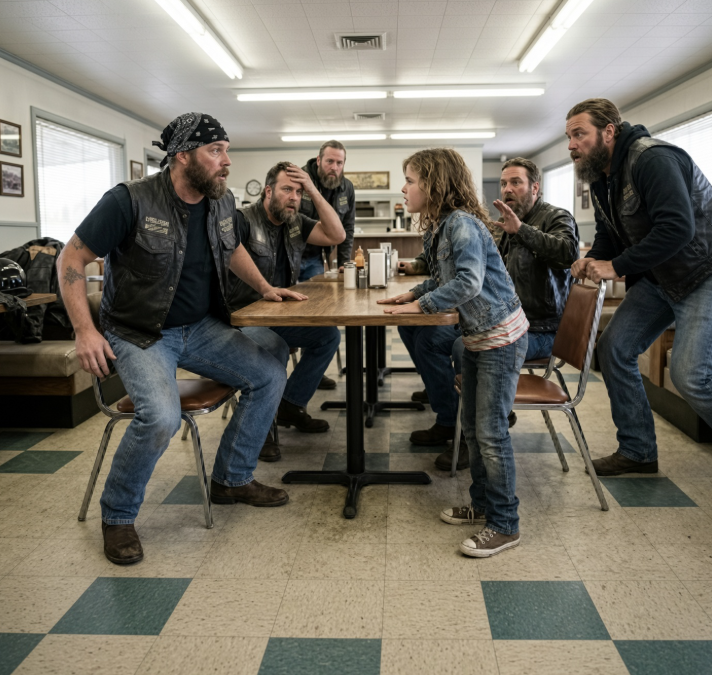
A little girl stood in the doorway.
She was seven.
Maybe eight.
Small in the painful way children become small when food and sleep and safety have all become uncertain. Her brown hair hung in tangled curls around her dirty face. She wore a pale yellow pajama shirt printed with tiny moons, torn at the shoulder, and pajama pants soaked from the knees down with mud and dew.
Her feet were bare.
The soles were black with road grime and scored with thin red cuts from gravel.
But that was not what froze five hundred bikers in place.
It was what she held.
In one hand, wrapped around her wrist, was a red nylon dog leash.
At the end of it hung a brown leather collar.
No dog.
Just the empty collar, swinging gently in the still air.
Five hundred riders stared at a barefoot child holding a leash attached to nothing.
No one moved.
No one spoke.
The girl’s blue eyes scanned the room, enormous in her thin face, ringed with exhaustion. She looked at the patches. The leather vests. The beards. The boots. The walls. The bar. The antlers over the door.
Recognition flickered through her terror.
She had been told to come here.
Not recently.
Not properly.
Not by someone who thought the instruction would ever matter.
But she had been told.
And she remembered.
The girl took one step inside.
Then another.
Her legs shook so badly it seemed impossible she had walked anywhere at all.
She did not look left or right after that.
She walked straight toward Warren Cope’s table.
The crowd parted around her.
Curtis stood halfway.
Warren lifted one hand, stopping him.
The girl reached the table.
She was barely tall enough to see over it.
For one second, she looked at Warren’s face—the silver beard, the Black Ridge patch, the hard eyes that had made grown men apologize before they understood why.
Then she slammed both hands on the wooden table.
The red leash cracked against the surface.
The empty collar bounced once.
The room flinched.
The little girl opened her mouth.
Only one word came out.
“Mama.”
That was all.
One word.
Barely louder than a breath.
But it hit the Buckhorn like a gunshot.
Warren was out of his chair before his mind finished catching up.
He dropped to one knee in front of her, bringing himself down from mountain to man.
“Easy, sweetheart,” he said.
His voice changed in a way most men in that room had never heard. Low. Steady. Careful. The voice of someone approaching a wounded animal or a child too frightened to trust movement.
The girl swayed.
Curtis stepped behind her, ready to catch her if she fell.
Don came around the bar with water.
Warren looked at the leash.
Then at her bare feet.
Then at her face.
“What’s your name?”
Her lips trembled.
“Emma.”
“Emma what?”
She swallowed, and even that seemed to hurt.
“Emma Langford.”
Warren felt the name strike him in the chest.
Behind him, Curtis went still.
Don’s hand froze around the glass of water.
Langford.
The name moved through the room like a tremor beneath the floor.
Ben Langford had been sergeant-at-arms of the Black Ridge Durango chapter from 2016 until the night a blown rear tire on Highway 550 sent his Harley into a guardrail at sixty-two miles an hour.
Ben “Anchor” Langford.
The man who never missed a ride.
The man who drove four hundred miles in one night to sit with a brother whose wife had left because, as Ben said, “No man should drink alone when his heart is bleeding.”
The man who could make a room laugh by raising one eyebrow.
The man who had once stood on this same floor with his little daughter balanced on his boot, teaching her to dance badly while the entire club cheered.
Two years ago, five hundred riders had followed his coffin.
Two years ago, Warren Cope had stood at Ben’s grave, one hand on his own daughter’s memory, and promised Ben’s widow that the Black Ridge would take care of his family.
Two years.
And Warren had not stepped foot inside that family’s house once.
“Emma,” Warren said carefully, though his throat had gone tight. “Is that Ranger’s leash?”
The girl looked down at the red nylon wrapped around her wrist.
Her chin trembled.
She nodded.
“Where’s Ranger?”
The question broke whatever strength had carried her this far.
“He fell down.”
Her voice cracked.
“We were walking, and he got slow. Then he lay down by the road and he wouldn’t get up. I tried to pull him, but he was too heavy. I unclipped the leash because I thought maybe he’d follow me if I kept going, but he didn’t.”
The words spilled faster now, pushed by panic.
“He looked at me like he was sorry. I told him I’d come back. I promised. But Mama wouldn’t wake up and the phone didn’t work and Daddy said if anything bad ever happened, I should find the bar with the antlers on the roof. He showed me one time. He said the men there were family.”
Her knees buckled.
Warren caught her before she hit the floor.
The room inhaled.
Five hundred riders, all at once.
A sound too soft to be called noise and too heavy to be called silence.
Emma clutched the leash to her chest.
“Mama,” she whispered again.
Warren lifted her carefully and sat on the floor with his back against the bar, holding her not like property, not like a rescued object, but like something sacred he had almost been too late to deserve.
“Curtis,” he said.
Curtis was already moving.
“Take Hank Tobin and Pete Westbrook. Mil Creek Road. Blue house past the bridge. Call 911 on the way.”
Curtis nodded once.
“Go.”
Three men broke from the crowd and ran for the door.
Warren looked toward the back wall.
“Jimmy Flynn.”
A man six foot four and built like a shed stepped forward.
“Yeah.”
“Take riders. Find Ranger. County Road 124, after the big curve, fence with a broken post.”
Jimmy looked at the girl.
Then at the leash.
His face hardened.
“We’ll bring him back.”
“Alive,” Emma whispered.
Jimmy’s eyes softened.
“Alive if God gives us one inch to work with, sweetheart.”
He turned and left with six riders behind him.
Within two minutes, motorcycles roared out of the Buckhorn lot, headlights cutting through the mountain dark.
Inside, the remaining riders did not move.
Warren looked around the room.
Five hundred faces stared back at him.
Some old. Some young. Some scarred. Some tattooed. Some drunk enough an hour earlier to sing badly. All sober now in the way guilt makes a man sober.
Warren stood slowly, Emma still tucked against one arm, wrapped in Don’s flannel jacket.
His voice carried through the tavern.
“This is Emma Langford.”
No one breathed.
“Ben Langford’s daughter.”
A few men looked down.
Others closed their eyes.
“Her mother is unconscious in their house. Their phone is disconnected. The dog Ben left them collapsed on the road. And this child walked six miles barefoot in the dark because her father told her once that if the world fell apart, she should come here.”
He looked at the leash.
Then at the room.
“She remembered.”
The words grew rough in his throat.
“She remembered what we forgot.”
No one answered.
The silence answered for them.
Warren looked toward the framed photo of Ben Langford hanging near the bar, taken during a rally years earlier. Ben was grinning, one arm around Curtis, one boot on his bike, his little daughter sitting on the gas tank with Ranger beside them, tongue out, eyes bright.
“I stood at Ben’s grave,” Warren said. “So did most of you. I told Holly Langford we would look after her and Emma. I gave her my word.”
He paused.
“Then I went home.”
The words hurt more because they were plain.
“I got busy. I told myself she would call if she needed help. I told myself some distance was respectful. I told myself a grieving woman needed space. And I let two years pass while that family sank so low a seven-year-old girl had to walk through mountain dark holding an empty leash to find us.”
His jaw tightened.
“That’s on me.”
Curtis’s empty chair seemed to accuse the room.
“But it’s not only on me. Every man here who wore a patch at Ben’s funeral said the same thing. Every one of us meant it. And meaning it did nothing.”
Emma’s head rested against Warren’s shoulder.
She was fighting sleep and losing.
Warren lowered his voice, but somehow it carried farther.
“That changes now.”
A sound rolled through the Buckhorn.
Not a cheer.
A growl.
Deep.
Unanimous.
Five hundred riders agreeing without a vote that a promise had become a debt and the debt had come due.
Don brought warm water, a towel, scrambled eggs, toast, and honey. He placed the plate in front of Emma at a booth near the back wall. She ate slowly, mechanically, like a child whose body had learned not to trust abundance.
Warren sat across from her.
The leash lay between them on the table.
Red nylon.
Brown leather collar.
A small metal tag engraved with two words:
RANGER LANGFORD.
“Tell me about Ranger,” Warren said.
Emma swallowed a bite of toast.
“He’s old,” she said. “His face is gray now. He can’t run anymore, but he walks with me to the bus stop every morning. Then he sits on the porch until I come home.”
“Your daddy’s dog?”
She nodded.
“Daddy got him when Ranger was a puppy. Before me. Mama says Ranger knew I was coming before anybody told him because he slept beside her belly.”
Warren’s throat tightened.
“He sleeps on Daddy’s pillow,” Emma said.
She looked down at the leash.
“Mama lets him. She says it still smells like Daddy if you press your face close.”
A man near the bar turned away and wiped his eyes.
Emma continued.
“When Mama fell down, I shook her. She wouldn’t open her eyes. Her medicine bottles were on the counter, but she always says never touch medicine. I tried to call 911, but the phone didn’t work.”
“Phone was dead?”
She nodded.
“Mama said the bill was too much this month.”
She said it without self-pity.
A child reporting weather.
The bill was too much.
The phone did not work.
Mama would not wake up.
The dog fell down.
So she walked.
Warren looked around the room and saw every man listening now. No one pretended otherwise.
“I remembered Daddy,” Emma said. “He told me if bad things happen, go to the bar with the antlers. He said, ‘You tell Warren Cope your name, and he’ll know.’”
Warren closed his eyes.
Ben’s voice came back to him as if the man stood beside the booth.
If anything happens to me, Cope, look in on my girls.
“I did know,” Warren said quietly. “I should have known sooner.”
Emma looked at him with tired confusion.
Adults always made grief complicated.
Children understood only presence or absence.
“You came when I said Mama,” she whispered.
Warren reached across the table but did not touch her hand until she nodded.
Then he laid his scarred fingers lightly over hers.
“From now on, sweetheart, we come before you have to walk.”
At 4:22 a.m., Curtis Draper reached the Langford house.
Mil Creek Road wound south of town along the river valley, where the mountains pressed close and the trees leaned over the asphalt. The house was small, single-story, clapboard, once painted bright blue but faded now to the color of a winter sky. The porch sagged on the left. Ben’s old Ford F-150 sat in the driveway with two low tires and an expired registration sticker.
Curtis stopped his bike and stared at it.
The last time he had been here was one week after the funeral.
He had brought a store-bought casserole because men who did not know how to comfort widows bought casseroles and hoped starch could stand in for loyalty. He stayed twenty minutes. Told Holly to call if she needed anything. She said she would.
She never called.
Curtis never came back.
Twenty minutes and a casserole.
That was the full weight of the promise he had made to a dead brother.
Hank Tobin and Pete Westbrook stopped behind him. Pete was a firefighter and carried trauma gear on his bike the way other men carried sunglasses.
Curtis knocked.
“Holly?”
No answer.
He knocked harder.
“Holly, it’s Curtis Draper from the club. Emma’s safe. She’s at the Buckhorn. We’re here to help.”
Nothing.
Pete tried the door.
Unlocked.
They entered.
The house was quiet in the terrible way homes become quiet when something is wrong.
They found Holly Langford on the kitchen floor.
She lay on her left side, one arm stretched toward the counter, as if she had tried to reach the phone or steady herself before going down. Her skin was pale. Her breathing was shallow but present. A glass of water had shattered beside her.
Pete dropped to his knees.
“Pulse weak. Breathing shallow. Skin cool. No visible trauma.”
Curtis called 911.
His voice stayed steady until the dispatcher asked his relation to the patient.
He looked around the kitchen.
At the nearly empty refrigerator.
Half a gallon of milk.
A block of cheese.
A jar of peanut butter.
Three eggs.
That was all.
Three eggs.
A mother on the floor.
A seven-year-old walking six miles barefoot.
A dog collapsing on the road.
A club full of men who had promised family and delivered memory.
“Friend,” Curtis said into the phone.
The word tasted like a lie.
While they waited for the ambulance, Curtis noticed the photograph on the refrigerator.
Ben in the Buckhorn parking lot, grinning on his Harley. Little Emma perched on the gas tank, laughing like she believed nothing bad could ever happen. Ranger sitting beside the bike, blue-ticked coat bright in the sun, ears long, eyes proud.
Curtis removed the photo from the fridge and slipped it inside his vest.
He would bring it back.
But right then, he needed to carry proof.
The ambulance arrived twelve minutes later.
Holly’s eyelids fluttered once as paramedics lifted her.
Her lips moved.
One word escaped.
“Emma.”
Curtis leaned close.
“She’s safe,” he said, though he did not know if she could hear him. “She found us. She’s safe.”
The paramedic looked up.
“Does she have lupus?”
Curtis swallowed.
“I don’t know.”
The words hurt.
He should have known.
He should have known about her illness, her medicine, her phone, her empty fridge, her broken porch, her little girl walking in the dark.
He should have known all of it.
But guilt, he was learning, did not become useful until it became action.
His phone buzzed.
Message from Jimmy.
FOUND RANGER. ALIVE. DEHYDRATED. BRINGING HIM IN.
Curtis closed his eyes.
For the first time that night, he breathed.
Back at the Buckhorn, Emma had fallen asleep with her cheek on the table and one hand still wrapped around the leash.
Warren sat beside her, one arm around her shoulders so she would not slump off the bench. Don placed a blanket over her. Nobody spoke above a whisper.
At 5:31, the front door opened.
Jimmy Flynn came in first.
His face was drawn with exhaustion.
Behind him, carried in the arms of Owen Stull, came Ranger.
The dog was alive.
Old, dusty, and limp with fatigue, but alive.
He was an eleven-year-old bluetick coonhound with a gray muzzle, long ears, cloudy eyes, and the kind of body that had once been powerful but now carried every year in his joints. His blue-mottled coat was matted with dirt. His paws were raw. His breathing was rough.
But when Owen set him gently on the floor, Ranger lifted his head.
Emma woke as if pulled by a string.
She saw him.
For one half second she did not move.
Then she launched herself from the booth so fast the blanket fell to the floor.
“Ranger!”
She dropped to her knees and wrapped both arms around his neck, burying her face in his dusty fur.
The sound she made was not crying.
It was deeper than crying.
It was the sound of a child reuniting with the last living piece of a world that had been taken from her one piece at a time.
Her father.
Her mother’s health.
The phone.
The food.
The feeling that grown-ups knew what they were doing.
And now this one piece had come back.
Ranger’s tail moved.
Once.
Twice.
A slow, arthritic wag that took visible effort but contained an entire language of loyalty.
Warren stood.
The room rose with him.
Five hundred riders stood in silence while a barefoot child held an old dog on the sawdust floor.
“No speeches,” Warren said.
His voice was rough.
“Not yet. We’ve talked enough in this club. Today we move.”
Curtis returned at dawn.
He walked into the Buckhorn carrying the refrigerator photograph.
He placed it on the bar.
Ben’s grin caught the first light through the window.
“Holly’s alive,” Curtis said. “Hospital says lupus flare, dehydration, exhaustion, missed medication. She’ll make it if she gets stable care.”
Emma lifted her head from Ranger’s neck.
“Mama’s awake?”
“Not yet,” Curtis said gently. “But she’s getting help.”
The little girl nodded as if accepting that answer required all her strength.
Curtis turned to the room.
“The house has almost no food. Phone was disconnected. Medication overdue. Porch is falling in. Truck registration expired. Holly’s been drowning quietly for two years while we congratulated ourselves for being family.”
No one looked away.
Good.
Shame had to be faced or it became another excuse.
Warren picked up the photo.
“This was on their fridge.”
He held it high enough for the room to see.
“This is what they saw every morning. Ben. Emma. Ranger. This bar. This club. This promise.”
He set it down carefully.
“Not anymore.”
At 7:00 a.m., five hundred motorcycles pulled out of the Buckhorn gravel lot.
But they did not ride the memorial route.
Not yet.
They rode to Mil Creek Road.
To the blue house with the sagging porch.
To the home of the brother who had asked them for one thing.
The first thing five hundred riders did was fix the porch.
It took forty-three minutes.
A contractor from the Cortez chapter leveled the sagging support post, replaced two cracked boards, and bolted the frame properly while four others helped, not because four were necessary, but because standing still felt impossible.
Another group went to City Market with a two-page grocery list.
Another went to the pharmacy.
Another called the utility company and paid the overdue phone bill, then paid three months ahead.
Doc Karen Price from Animas Valley Animal Clinic arrived before eight and examined Ranger on the front lawn. Severe dehydration. Arthritis aggravated by the walk. Paw abrasions. Exhaustion. But no heart failure. No organ collapse.
“He’s old,” she said, scratching behind Ranger’s ear, “but he’s stubborn.”
Emma sat beside him with the red leash in both hands.
“Daddy said Ranger was stubborn because he loved us.”
Doc Karen swallowed.
“Your daddy was right.”
By noon, the refrigerator that had held three eggs was full.
By one, the porch was safe.
By two, the phone worked.
By three, the truck tires were inflated, registration fees covered, oil changed, and the battery replaced.
By four, the house had been cleaned, laundry washed, bills sorted, and a rotation schedule written on yellow legal paper and taped to the refrigerator.
Weekly grocery delivery.
Daily medication check until Holly stabilized.
School drop-off backup.
Veterinary care for Ranger.
House repairs.
Emergency fund.
No vague promises.
Names.
Numbers.
Dates.
Warren insisted on that.
A promise without a plan was just guilt dressed nicely.
At 5:00, Warren drove Emma to Mercy Medical Center.
Ranger could not come inside, but Owen stayed with him in the truck, engine running, AC on, one hand resting gently on the dog’s back.
Emma held Warren’s hand as they walked down the hospital hallway.
She looked tiny under the fluorescent lights.
Too tiny for the night she had survived.
Too tiny for the weight she had carried.
Holly Langford was awake when they entered.
She lay propped against pillows, IV in her arm, face thin and tired, brown hair pulled back, dark circles under her eyes. But her gaze sharpened the moment she saw her daughter.
“Emma.”
The little girl ran to the bed.
A nurse started to object, then saw Warren’s face and decided wisely that this was not the moment.
Emma climbed onto the bed and curled against her mother’s side.
Holly wrapped one arm around her with the fierce strength of a woman who had heard a door close and spent every trapped second praying it would open again.
“I remembered,” Emma whispered. “I remembered the antlers.”
Holly closed her eyes and cried into her daughter’s hair.
Warren stood at the foot of the bed, hat in his hands.
For once, he did not know how to begin.
Holly looked at him.
“You’re Warren.”
“Yes, ma’am.”
“Ben said you were the most stubborn man he ever met.”
Warren’s mouth twitched.
“He was being polite.”
“He said if anything happened, you’d come.”
There it was.
No accusation in her voice.
That made it worse.
Warren looked down.
“I didn’t.”
Holly held Emma closer.
“No.”
“I failed him. I failed you. I failed her.”
Holly’s eyes filled, but she said nothing.
Warren stepped closer.
“I can’t undo two years. I won’t insult you by pretending I can. But your house is safe tonight. Your fridge is full. Your phone is on. Ranger is alive. Your medicine is covered. And from this day forward, no one in that house carries anything alone unless they choose to throw us out.”
Holly searched his face.
She was looking for pity.
She did not find it.
She found guilt.
Accountability.
And the quiet presence of a man who meant what he said because he had already learned what it cost not to.
“I didn’t call,” she whispered.
Warren shook his head.
“You shouldn’t have had to.”
Her mouth trembled.
“The bills kept coming. Then the medicine. Then the truck. Then the phone. I thought I could catch up. I kept thinking next week. Just next week. And Emma was so brave, I forgot she was little.”
“She’s still little,” Warren said.
Holly looked at her daughter, already asleep against her side.
“Yes,” she whispered. “She is.”
Warren’s left hand tightened around his hat.
Holly saw the tattoo on his wrist.
ANNA.
“Ben told me,” she said softly. “About your daughter.”
Warren looked away.
“Eleven years.”
“I’m sorry.”
“So am I.”
For a moment, they were not a biker president and a dead brother’s widow. They were only two people who knew what it meant to keep breathing after the shape of your life had been torn out.
Holly reached out her free hand.
Warren took it.
Outside the hospital window, the sun dropped behind the La Plata Mountains, turning the sky the color of embers.
Three weeks later, the Black Ridge rode back to Mil Creek Road.
Not because of a crisis this time.
Because of a promise.
The blue house looked different.
Not new.
Better than new.
Cared for.
The porch was level. The railing painted white. The house had a fresh coat of blue, the same color but brighter now, like a summer sky remembered after a hard winter. A new fence bordered the front yard. A carved wooden sign hung beside the front door.
LANGFORD
Below it, smaller letters:
NO ONE LEFT BEHIND
Holly stood on the porch.
She was not cured. Lupus did not offer that kind of mercy. But she was stable, medicated, rested, and surrounded by a schedule of help she had finally stopped apologizing for.
Emma sat on the porch steps.
Beside her, pressed against her leg with the full weight of an animal who had no intention of missing anything important, sat Ranger.
The old dog was thinner, grayer, slower.
But his eyes were open.
His tail moved when he heard the motorcycles.
A slow, steady wag.
He knew that sound.
Five hundred motorcycles lined Mil Creek Road, engines idling softly like a heartbeat.
Warren walked up the path.
Emma stood.
Ranger tried to stand too, but Warren pointed at him.
“You stay right there, old man.”
Ranger blinked.
Emma smiled.
It was the first time Warren had seen her smile fully.
It hurt and healed him at the same time.
“How’s he doing?” Warren asked.
“He walks to the bus stop again,” Emma said. “Slow. But he walks.”
“And your mama?”
“She takes her medicine every day because six people call and ask.”
Holly laughed from the porch.
“It is harassment.”
“It is accountability,” Curtis called from his bike.
Warren reached into his vest pocket and pulled out a small box.
He knelt in front of Emma.
“This is for Ranger.”
She opened it.
Inside was a polished metal tag stamped with the Black Ridge emblem, small enough to hang from a dog collar.
Emma turned it over in her hands.
On the back were engraved the words:
RANGER LANGFORD
BLACK RIDGE
LOYALTY EARNED
Her eyes widened.
“Does this mean Ranger is in the club?”
A ripple moved through the riders.
Warren looked at the old dog.
Ranger looked back with patient dignity, gray muzzle lifted, long ears hanging, eyes calm in the morning light.
“Sweetheart,” Warren said, “Ranger’s been in the club since the night he tried to walk six miles on bad legs so you wouldn’t be alone. He just didn’t have the paperwork.”
Emma clipped the tag onto his collar.
It hung beside the old tag that said RANGER LANGFORD and caught the sun, throwing tiny sparks of light across the porch.
Then Emma picked up the red leash.
The same leash she had carried through six miles of mountain dark.
The same leash she had slammed onto Warren’s table.
The same leash that had once led to nothing.
She clipped it to Ranger’s collar.
This time, the leash was not empty.
This time, there was a dog at the end of it.
Old.
Slow.
Stubborn.
Present.
Five hundred engines revved.
Not wild.
Not reckless.
A rolling thunder of respect.
The sound moved through the valley and up into the mountains, where pine trees trembled and sunlight broke over the ridge.
Holly stood on her new porch with one hand over her mouth.
Emma stood on the steps holding Ranger’s leash.
Warren Cope looked at the girl, the dog, the house, the riders, and the road beyond.
He thought of Ben Langford.
Anchor.
Brother.
Father.
He thought of a promise made beside a grave and forgotten until a barefoot child remembered it for them.
Then he lifted his fist.
Five hundred riders lifted theirs with him.
No speech could have matched that moment.
No apology could have erased the past.
But some failures can become beginnings if people are brave enough to stop explaining and start showing up.
From that Sunday on, the Black Ridge schedule stayed on Holly’s refrigerator.
Not for a week.
Not for a month.
For years.
Riders came every Tuesday and Friday with groceries, medicine checks, repairs, rides to doctor appointments, school pickups, homework help, and sometimes just coffee on the porch so Holly remembered another adult existed in the world.
Emma grew taller.
Ranger grew slower.
The red leash hung by the door when not in use.
At every annual rally after that, the first ride was no longer only for fallen brothers.
It began at the Buckhorn.
It passed Mil Creek Road.
It slowed in front of the blue house.
And every year, Emma stood on the porch with Ranger beside her until the old dog could no longer make the steps and had to be carried out wrapped in Ben’s old jacket.
When Ranger finally died at thirteen, he died on the porch at sunset, Emma’s hand on his head, Holly beside her, Warren sitting on the steps, and three Black Ridge riders in the yard pretending not to cry.
They buried him beneath the cottonwood behind the house.
On his marker, Warren had a small metal plate fixed into the wood.
RANGER LANGFORD
HE WALKED UNTIL HE COULDN’T
AND LOVED AFTER THAT
Emma kept the red leash.
Years later, when she was sixteen, she brought it to the Buckhorn on rally night. The tavern was full again, loud again, alive again. Warren was older now, his beard whiter, his shoulders slower but still strong.
Emma walked to his table.
This time she wore boots.
This time she was not afraid.
She placed the leash on the wood gently.
Not as a plea.
As a reminder.
The room quieted.
Warren looked at it.
Then at her.
“You okay, kid?”
Emma smiled.
“I’m okay.”
He nodded.
That was all either of them needed.
Outside, motorcycles waited beneath the stars.
Inside, above the bar, beside Ben Langford’s photograph, hung a framed picture taken years earlier on Mil Creek Road: Emma on the porch, Holly behind her, Ranger at the end of the red leash, five hundred bikers lined across the road like a wall of thunder.
Under it, Don had placed a small brass plaque.
A CHILD REMEMBERED THE PROMISE.
SO WE LEARNED TO KEEP IT.
And somewhere in the mountains above Durango, where the air thinned and the pines leaned toward the sky, it felt as if Ben Langford was no longer waiting for the men he had trusted to become family.
They had finally arrived.
Late.
Ashamed.
But present.
The leash had a dog again.
The child had a village again.
And five hundred angels—the loud, leather-wearing, engine-roaring kind—had learned what one little girl already knew: