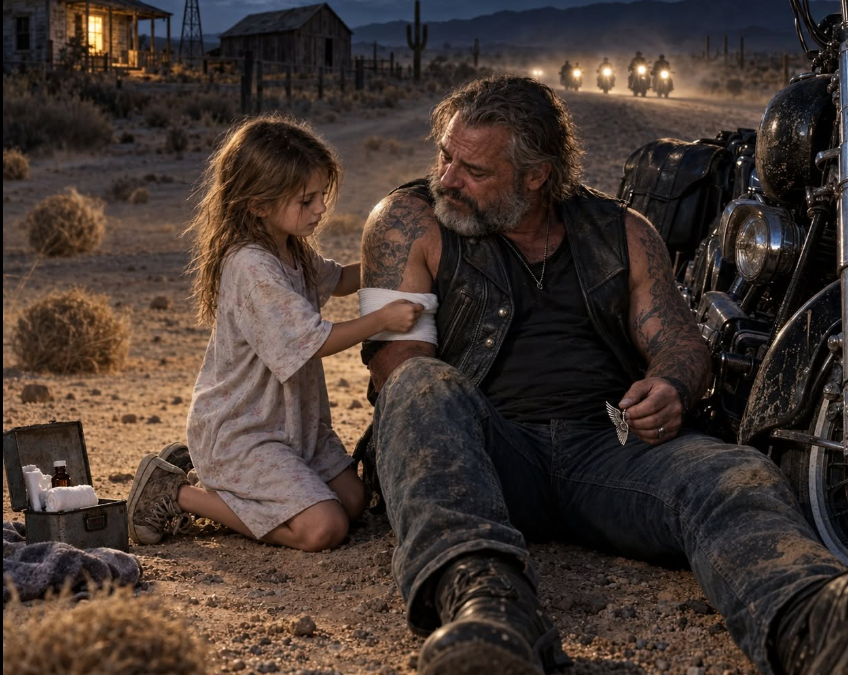
IWas Eight When I Found a Dying Biker Beside a Desert Road—By Sunrise I Was Locked in a Basement, and the Silver Token Under My Shirt Was Bringing Dozens of Motorcycles Back for Me.
I was eight years old when I found a huge, tattooed biker bleeding beside a desert road, and every adult in town would have told me to run from him even though the woman inside my foster home frightened me far more.
Before sunrise I had stolen bandages, stopped enough of his bleeding to keep him alive, and hidden a silver token beneath my shirt while he promised me he never forgot the people who saved him.
By breakfast my foster mother had locked me in the basement for refusing to betray him, but then the floor began to shake, motorcycle engines surrounded the farmhouse, and the dying stranger I had helped in the dark came back with enough witnesses to expose what respectable adults had ignored for years.
My name is Grace Miller.
That was not always the name printed on my school papers.
For a while I had another last name.
Then another.
Then another.
By the time I was eight, I understood that adults liked to tell children that names mattered while changing ours every time our lives became inconvenient.
I had lived in four foster homes.
Three schools.
Two emergency placements.
One group home for eleven days.
And by then, I had become very good at carrying everything I considered mine inside a pink backpack with one broken zipper.
Two shirts.
One pair of jeans.
A plastic hairbrush.
A library card.
A photograph of my mother taken before I was old enough to remember her.
And a stuffed rabbit named Blue whose ears were no longer the same color because I slept holding one of them.
Children in foster care learn strange skills.
We learn how to judge a house by the sound of the front door.
We learn which adults slam cabinets when angry.
We learn whether dinner portions depend on mood.
We learn not to unpack completely.
We learn that “temporary” can mean three days or three years.
We learn that there are adults who smile beautifully when social workers are watching.
Most of all, we learn to study rooms.
Doors.
Windows.
Voices.
Escape routes.
At eight years old, I could tell whether a grown-up was truly angry or merely performing anger before she had finished saying my name.
That ability kept me safe in Marlene Pike’s house.
Or as safe as a child like me knew how to be.
The state called Marlene’s property a licensed therapeutic foster home.
It stood about fifteen miles outside Kingman, Arizona, at the end of a dirt road where the desert opened so wide that the sky seemed bigger than the world beneath it.
From a distance, the farmhouse looked almost beautiful.
White paint.
Green shutters.
A red barn behind it.
Windmill.
Two cottonwood trees.
Marlene planted flowers beside the porch whenever the licensing inspector was scheduled to visit.
Petunias.
Always purple.
I hated purple petunias for years.
PART2:
The photographs in county files probably showed a cheerful house filled with sunlight.
They did not show the basement.
They did not show the refrigerator after Marlene locked the good food in the garage freezer.
They did not show five children dividing two chicken breasts six ways.
They did not show the punishment chart taped inside the pantry.
No television.
No dinner.
No outside time.
No mattress.
No speaking.
And at the bottom:
REFLECTION ROOM.
That was what Marlene called the storage room beneath the stairs.
Reflection room.
Adults can make almost anything sound respectable if they choose the right words.
It was a six-foot-by-eight-foot room with no window, bare concrete, a light fixture Marlene controlled from outside, and a steel hook where a previous owner must have hung tools.
There was no furniture.
When Marlene decided we needed to “think about gratitude,” she put us there.
Sometimes twenty minutes.
Sometimes hours.
Once Tommy, who was ten, stayed overnight.
He wet himself.
Marlene made him scrub the floor the next morning.
Nobody at school asked why he fell asleep at his desk.
Or maybe someone asked.
Maybe he lied.
We all lied.
Not because Marlene trained us with some sophisticated system.
Because children already understand the most dangerous truth about adults:
Sometimes telling the truth makes things worse.
Marlene never hit our faces.
That was important to her.
“Faces get noticed,” she once told another foster girl when she thought I was asleep.
Arms were easier.
Upper legs.
Back.
Places clothing covered.
PART3:
The foster checks were scheduled.
The house transformed before each one.
Fresh fruit appeared.
The basement door stayed open.
Marlene washed our hair.
She used a voice we almost never heard otherwise.
“Sweetheart.”
“Baby.”
“My little family.”
She would place one hand gently on my shoulder while speaking to the caseworker.
That hand frightened me more than yelling.
The day after the caseworker left, everything returned to normal.
The other children living there that autumn were Tommy, ten; Marcus, twelve; Elena, nine; Cody, six; and a quiet five-year-old girl named Hannah who slept with her shoes on because she had once been moved at midnight and never forgot it.
I was neither the oldest nor the youngest.
That meant invisibility was easier.
Marlene liked invisible.
My favorite place was the barn.
Nobody used it anymore because the livestock had been sold years earlier.
The roof leaked.
Owls lived in the rafters.
One wall leaned enough that I sometimes imagined a strong wind might finally push it down.
But the barn had something the house did not.
A door I controlled.
Whenever Marlene’s voice took on that sharp edge I recognized, I slipped outside and hid among old hay bales.
Sometimes Marcus joined me.
Usually I preferred being alone.
The desert looked different from the barn doorway at night.
Not empty.
Alive.
Coyotes.
Wind.
Stars.
Distant headlights.
The occasional long-haul truck glowing on Route 66.
That October night, Marlene had become angry because someone had taken peanut butter from the pantry.
It was Cody.
I knew because I saw him eating it with his finger behind the shed.
He was six.
Hungry.
I said nothing.
Marlene lined us against the kitchen wall.
“Who stole from me?”
Nobody answered.
She looked at Marcus first.
Then Tommy.
Then me.
Her eyes stopped.
“You know something.”
I shook my head.
“Grace.”
“No.”
The lie sounded weak.
She took my arm above the elbow.
Hard.
“Try again.”
“I don’t know.”
Her fingers tightened.
“Ungrateful children lie.”
I stared at the floor.
Eventually Cody started crying.
Marlene released me and turned toward him.
That was when I slipped outside.
Cowardly?
Maybe.
I carried guilt about that for years.
Therapy taught me later that eight-year-olds are not supposed to protect six-year-olds from abusive adults.
At eight, I believed I had failed him.
I hid in the barn.
Wrapped myself in an old moving blanket.
And listened to the wind hammer loose metal along the roof.
I might have stayed there all night.
Then I heard the motorcycle.
At first it sounded like every other engine passing somewhere beyond the property.
Then louder.
Much louder.
Fast.
I crawled from beneath the blanket.
Headlights moved between gaps in the barn wall.
A single motorcycle.
It came down the service road too quickly.
Then the engine revved wildly.
A tire hit gravel.
Metal scraped.
The sound tore through the night.
Then came a heavy crash.
Silence.
I stood frozen.
Everything Marlene had taught me screamed one command.
Stay hidden.
Trouble belongs to the person it happens to.
People who interfere become part of trouble.
I almost obeyed.
Then I heard him groan.
Low.
Weak.
Human.
I opened the barn door.
Cold desert air hit my bare legs.
I wore an oversized T-shirt that had belonged to another foster child and sneakers two sizes too big because Marlene claimed my old shoes still had “life in them” despite a hole in one sole.
I walked toward the road.
The motorcycle lay in a drainage ditch.
Chrome scratched.
Front wheel twisted.
Headlight still shining sideways across brush.
The man lay several yards beyond it.
At eight, all grown men looked large.
This one looked enormous.
Broad shoulders.
Thick arms.
Gray threaded through a dark beard.
Tattoos covered both forearms.
Black leather vest.
On the back was a gold crown over desert mountains.
DESERT KINGS MC.
I knew the name.
Everybody around Kingman did.
Adults talked about motorcycle clubs in the tone they used for rattlesnakes.
Dangerous if disturbed.
“Those men are trouble.”
“Don’t ever get near one.”
“They have their own rules.”
I moved closer anyway.
The man’s right hand pressed against his side.
Blood covered his fingers.
His breathing was wrong.
Fast, shallow, interrupted.
His eyes opened.
He looked at me.
“Kid.”
His voice sounded like gravel.
I stopped.
“Go home.”
“You crashed.”
“No kidding.”
Blood seeped between his fingers.
“You’re leaking.”
For half a second, the corner of his mouth moved.
“Good diagnosis.”
Then pain folded him.
He made a sound through clenched teeth.
I stepped closer.
“Are you dying?”
“Trying not to.”
“Should I call 911?”
“No.”
That answer scared me.
“Why?”
His gaze moved toward the road.
“Bad people might be looking for me.”
I considered this.
“I’m good at hiding.”
His eyes came back to me.
Really looked.
Not the glance adults usually gave children before deciding what they wanted us to say.
He noticed.
The shirt.
Shoes.
Bruise around my arm where Marlene had gripped me.
Another yellowing mark near my wrist.
His face changed.
Not pity.
Something harder.
“Where are your parents?”
“I don’t have any.”
His jaw tightened.
“Who do you live with?”
“Marlene.”
“Your mom?”
“No.”
I looked at his wound.
“I have bandages.”
“Kid—”
I ran.
I knew where Marlene kept the first-aid box.
Bathroom cabinet.
Top shelf.
Locked only with a childproof latch because she assumed we were too afraid to steal medicine.
Usually she was right.
I crossed the yard.
The kitchen window never latched properly.
Marcus had shown me.
I pushed it open.
Climbed over the sink.
The house was quiet.
Too quiet.
Marlene must have gone to bed.
I moved through the hallway without turning on lights.
The bathroom cabinet clicked open.
First-aid box.
I took gauze.
Tape.
Scissors.
Antiseptic wipes.
A roll of elastic bandage.
Two hand towels.
Then I saw a bottle of aspirin.
I nearly took it, but remembered our school nurse saying never give people medicine if you don’t know what is wrong.
That decision mattered more than I understood then.
I replaced the box.
Closed the cabinet.
Climbed back through the window.
My heart pounded harder stealing those supplies than walking toward a bleeding biker.
Marlene frightened me more than blood.
That fact should have told someone everything.
Cole was barely conscious when I returned.
I knelt.
His hand shot out.
Caught my wrist.
I gasped.
For one second his eyes were wild.
Then he recognized me.
His grip vanished.
“Sorry.”
I backed up.
“Thought you were someone else.”
I swallowed.
“Are those bad people coming?”
“I hope not.”
I opened the supplies.
“My school nurse says pressure stops bleeding.”
He looked at me.
“You’re eight?”
“Yes.”
“You’ve done this before?”
“No.”
He stared.
“That answer is not comforting.”
“Then stop asking questions.”
A tiny laugh escaped him.
Then he winced.
“What’s your name?”
“Grace.”
“I’m Cole.”
“Okay, Cole.”
I folded the towels.
Pressed them against his side.
He groaned.
“Harder.”
“What?”
“You need more pressure.”
I pushed.
His whole body tensed.
“Sorry.”
“Don’t be.”
I wrapped gauze around him.
My hands shook so badly I dropped the tape twice.
Cole’s hands remained strangely calm.
He guided me.
“Under the arm.”
I pulled the bandage.
“Across.”
I wrapped.
“Again.”
Around his torso.
Again.
Again.
It was ugly.
Uneven.
Probably wrong in twelve ways.
But the bleeding slowed.
I could see that.
Cole could too.
“You’re doing good, little one.”
Nobody praised me much.
I didn’t know where to put the feeling.
So I concentrated on tape.
His eyes dropped to my arm.
My sleeve had slipped.
The bruise showed.
His voice changed.
“Who did that?”
I pulled the sleeve down.
“I fell.”
“Grace.”
I looked away.
He waited.
Adults usually demanded answers.
Cole waited.
That made silence harder.
Finally I whispered:
“If Marlene knows I took this, she’ll be mad.”
“How mad?”
I shrugged.
“Grace.”
I hated the way he said my name.
Gentle.
Gentleness made truth dangerous.
“She’ll put me downstairs.”
Cole became still.
“What’s downstairs?”
“Nothing.”
“What’s downstairs?”
“The dark room.”
He stared at me.
“What dark room?”
“It’s just where we go when we’re bad.”
“We?”
“The kids.”
“How many?”
“Six.”
Cole’s face changed again.
The wounded man disappeared for a moment.
Something protective replaced him.
“How long does she put you there?”
“Depends.”
“On what?”
“If we’re grateful.”
His eyes closed.
For one second I thought he passed out.
Then he opened them.
“Grace.”
“Yes?”
“Listen to me.”
His voice was weak but firm.
“What happens in that house is not normal.”
I immediately defended Marlene.
“She gives us food.”
That sentence breaks my heart now.
At eight, it seemed important evidence.
Cole looked devastated.
“She’s supposed to give you food.”
“We have beds.”
“She’s supposed to give you beds.”
“She takes us to school.”
“Grace.”
He stopped.
Maybe he realized arguing would make me shut down.
Instead, he reached beneath his torn shirt.
Around his neck hung a chain.
He pulled it free.
A silver coin.
About the size of a half dollar.
One side had wings.
The other had a crown and the letters DKMC.
He removed the chain.
Placed it in my palm.
“Hide this.”
I stared.
“Is it money?”
“No.”
“What is it?”
“A challenge coin.”
“What does it do?”
“Usually?”
He breathed carefully.
“Nothing.”
“That’s dumb.”
He laughed again.
“You’re not wrong.”
Then he closed my fingers around it.
“But this one is a promise.”
“What promise?”
He looked directly at me.
“I don’t forget people who save me.”
“I didn’t save you.”
“You’re the reason I’m still awake.”
He squeezed my hand.
“You saved my life tonight, little bird.”
Little bird.
Nobody had ever called me anything gentle before.
Sweetheart didn’t count.
Marlene said sweetheart when social workers were present.
Little bird had no audience.
My throat hurt.
“You need a doctor.”
“I’ve got brothers.”
“Real brothers?”
“Not blood.”
“That doesn’t make sense.”
“One day it might.”
He tried to stand.
Failed.
I caught his arm instinctively.
His weight nearly knocked me down.
He sat again.
“Okay.”
“Stay here.”
“No.”
“Why?”
“Because if whoever ran me off that road comes back, I don’t want you near me.”
Someone had caused the crash.
I hadn’t understood that.
“Who?”
Cole looked toward the highway.
“Doesn’t matter.”
“It matters to me.”
He almost smiled at hearing his own words returned.
Then he took a small phone from his pocket.
Screen cracked.
Still working.
One call.
He gave someone directions.
“Old service road near Pike place.”
Pause.
“Yeah.”
Pause.
“No cops yet.”
Then:
“There’s a kid.”
He looked at me.
“Bring Rachel.”
He ended the call.
“Go inside.”
“I don’t want to.”
“You have to.”
I shook my head.
“I can hide here.”
“If my people come and find you with me, Marlene will know.”
That made sense.
Fear won.
I stood.
Cole caught my hand.
“Grace.”
I looked down.
“Keep the coin hidden.”
I tucked it beneath my shirt.
Chain cold against my skin.
He whispered:
“I’ll come back.”
Adults had promised that before.
Social workers.
Foster parents.
My mother.
“People say that.”
Cole’s face changed.
“I know.”
He released my hand.
“I’m still saying it.”
I returned to the barn.
From behind hay bales, I saw headlights arrive twenty minutes later.
A pickup.
Then three motorcycles.
Men loaded Cole carefully.
One woman moved around him quickly.
She wore jeans and a sweatshirt.
Curly hair.
Later I would know her as Rachel.
At the time, she was only the woman who pressed both hands over my terrible bandage while someone opened the truck door.
They drove away.
I buried the bloody towels beneath loose dirt behind the barn.
Put the remaining gauze inside a rusted coffee can.
Then climbed back through the kitchen window.
Cody was awake.
Standing in the hallway.
“Where were you?”
“Bathroom.”
He stared at my dirty knees.
I put one finger over my lips.
He nodded.
Foster children understand secrets.
I slept maybe an hour.
At seven the next morning, Marlene started screaming.
Every child came awake.
Cabinet doors slammed.
Footsteps.
“Who went into my medical supplies?”
Nobody answered.
I touched the token beneath my shirt.
Marlene went room to room.
She found dirt on my shoes.
Then the missing tape wrapper in my pocket.
Stupid.
Children are terrible criminals.
She pulled me into the hallway.
“What did you take?”
“Nothing.”
She slapped the wall beside my head.
I flinched.
“Do not lie to me.”
“I didn’t.”
Her hand grabbed my collar.
The chain appeared.
Silver coin.
Her eyes narrowed.
“What is this?”
I grabbed for it.
She caught the coin first.
“Give it back!”
The other children watched.
Marlene turned the coin over.
DESERT KINGS.
Her face changed.
Fear.
Then anger.
“Where did you get this?”
“It’s mine.”
“Who gave it to you?”
I said nothing.
She shook me.
“Grace.”
Nothing.
“Who were you with?”
Nothing.
That made it worse.
She dragged me toward the stairs.
Cody cried.
Marcus moved forward.
“Leave her alone.”
Marlene spun.
“You want to join her?”
Marcus stopped.
I don’t blame him.
She opened the basement door.
I fought then.
Not much.
Eight-year-old fight.
I grabbed the frame.
Kicked.
Begged.
“No, please.”
“Maybe darkness will help you remember honesty.”
She forced me down the first steps.
I fell.
Hit my knee.
Then the door slammed.
Lock clicked.
Darkness.
I held the silver token in my fist.
I had snatched it back during the struggle without realizing it.
My whole body shook.
At first I cried.
Then stopped.
Crying used air.
I sat on the cold step.
Cole had promised.
I hated myself for believing him.
Minutes passed.
Maybe an hour.
Basements erase time.
Then I felt vibration beneath my shoes.
At first I thought a truck passed on the road.
Then another.
Longer.
Deeper.
The concrete itself seemed to hum.
The sound grew.
Engines.
Many.
Marlene’s footsteps pounded overhead.
Then Cody yelled something.
A curtain moved.
Someone shouted outside.
The engines stopped one after another.
Silence.
Then Marlene’s voice from the porch:
“What are you people doing on my property?”
A man’s voice answered.
Calm.
“We’re looking for a little girl.”
My heart stopped.
Another voice.
Older.
“Grace Miller.”
Marlene said, “There is no reason for you to be here.”
“We disagree.”
“I’m calling the sheriff.”
“Please do.”
That voice was not Cole.
“We already did.”
I climbed the basement steps.
Pressed my ear against the door.
Marlene shouted:
“These are foster children. You cannot come onto my property and harass them.”
Then Cole.
Weak.
But unmistakable.
“Where’s Grace?”
My knees almost gave out.
Marlene lied immediately.
“At school.”
It was Saturday.
Another voice said:
“Interesting.”
Marlene went quiet.
Cole spoke again.
“Grace!”
I hit the door.
“COLE!”
Everything changed upstairs.
Footsteps.
Someone yelled:
“Basement!”
Marlene started shouting.
“You can’t go down there!”
Another woman:
“Ma’am, step away from that door.”
“I am the licensed guardian in this home!”
“Step away.”
“Those criminals are trespassing!”
Then a new voice.
Male.
Official.
“Mrs. Pike, I am Deputy Samuel Ortiz with the Mohave County Sheriff’s Office.”
Relief nearly made me fall.
“Unlock the door.”
“It’s a storage room.”
Something inside me broke.
I slammed both hands against it.
“I’m here!”
Silence.
Then chaos.
“Unlock it now.”
Marlene protested.
The deputy repeated himself.
A key moved.
The door opened.
Light exploded down the stairs.
I covered my eyes.
A shape filled the doorway.
Big.
One hand against his bandaged side.
Cole.
He wore a clean flannel shirt beneath his vest.
His face was pale.
He should have been in a hospital bed.
He came anyway.
“You came back.”
My voice barely existed.
His face crumpled.
“Told you.”
He descended slowly.
Behind him stood Rachel.
The curly-haired woman from the night before.
She had a medical bag.
Cole reached the bottom.
I opened my hand.
The coin.
“I kept it.”
His eyes filled.
“I knew you would.”
Then he knelt.
That must have hurt.
He opened his arms.
I hesitated half a second.
Then ran into them.
I remember the smell.
Leather.
Antiseptic.
Dust.
Hospital soap.
Cole held me carefully because of his side.
One hand against the back of my head.
“You’re okay.”
I began sobbing.
“No more dark room.”
I gripped his shirt.
“Promise?”
His voice broke.
“Promise.”
The farmhouse yard held forty-seven motorcycles.
I counted later from photographs.
Forty-seven.
Men and women wearing Desert Kings colors.
But they were not alone.
Deputy Ortiz.
A second patrol car.
Two emergency child-welfare workers.
A county investigator.
Rachel.
Another woman from a children’s advocacy center.
Cole’s club had not ridden there to threaten Marlene.
They had spent half the night making phone calls.
That detail became important later.
One Desert King named Arthur Hale was an attorney.
Another, Mitch Delgado, worked county road construction and knew Deputy Ortiz.
Rachel was an elementary-school counselor and mandatory reporter.
The moment Cole reached the emergency room, he told her everything I had said.
Not just the bruise.
The room.
Six children.
Food.
Fear.
Rachel called Arizona child protection.
Arthur called the sheriff’s department.
Mitch called Ortiz personally because they had gone to high school together.
Nobody waited until morning assuming someone else would handle it.
That was the difference.
Marlene had survived for years because everyone assumed someone else had checked.
Cole’s people called until someone actually came.
Deputy Ortiz crouched in front of me upstairs.
Marlene stood across the kitchen furious.
“Grace?”
I hid partly behind Cole.
“Yes.”
“You’re not in trouble.”
Four words.
I started crying again.
Because in Marlene’s house, I was always in trouble.
Even when another child stole peanut butter.
Even when a glass broke by accident.
Even when I was sick.
Even when I said nothing.
Especially when I said nothing.
Ortiz repeated:
“You are not in trouble.”
The other children watched.
Marcus stared at the floor.
Tommy looked terrified.
Hannah stood barefoot in the hallway despite normally sleeping in shoes.
Rachel sat beside her.
“Can I hold your hand?”
Hannah nodded.
That was the first thing I noticed about Rachel.
She asked.
Adults rarely asked us before touching.
Everything after that became pieces.
Police photographs.
The basement.
Lock.
Bare concrete.
Marks on walls.
The punishment chart.
The nearly empty refrigerator.
Prescription bottles with names none of us recognized.
Financial records.
Our rooms.
Mattresses.
Locked pantry.
Marlene insisted we were lying.
Then she changed strategies.
“Children from trauma backgrounds are manipulative.”
I heard her say that to the investigator.
“These kids come with behaviors.”
Marcus stiffened beside me.
Marlene continued.
“They steal.”
Cody started crying.
“They lie.”
I felt my stomach twist.
“They hurt themselves and blame caregivers.”
Deputy Ortiz looked at the basement door.
Then at us.
He said nothing.
Marlene raised her voice.
“Ask their caseworkers!”
That was the sentence that widened the investigation.
Because somebody did.
By noon, all six children had been transported to the county children’s advocacy center.
Separate interviews.
Medical examinations.
Food.
Actual food.
Sandwiches.
Apples.
Milk.
Cody ate so fast a nurse gently asked him to slow down.
He panicked and tried to hide half his sandwich in his pocket.
The nurse looked away while he did it.
That kindness stayed with me.
Doctors documented old injuries.
Malnutrition in two children.
Bruising inconsistent with ordinary play.
Sleep problems.
Anxiety.
The basement itself mattered.
But so did the records.
Marlene’s foster license showed monthly reimbursement for six children.
Additional therapeutic-care supplements for three of us.
Clothing allowances.
Food reimbursement.
Transportation funds.
Behavioral support.
Respite money.
On paper, we were expensive children receiving intensive care.
In reality, Marlene bought secondhand clothes by the bag.
Fed us the cheapest food she could.
Skipped therapy appointments.
Used punishments instead of behavioral services.
And submitted invoices anyway.
The criminal investigation would eventually reveal something worse.
For nearly three years, the same licensing caseworker had approved Marlene’s home.
Donna Reeves.
Every inspection report described the house as clean.
Food adequate.
Children appropriately dressed.
No concerns.
Interviews later showed several of us had tried to tell Donna pieces of the truth.
Marcus once said Marlene locked him downstairs.
Donna wrote:
“Child exaggerates consequences following behavioral episode.”
Tommy told a teacher he sometimes lost dinner.
Donna’s follow-up report said:
“Caregiver denies food restriction; likely misunderstanding regarding dessert privileges.”
I once told Donna I did not like being alone in the dark.
She smiled and said:
“All kids have consequences, honey.”
Then Marlene stood behind her.
Hand on my shoulder.
I never tried again.
Donna was not accused of physically abusing us.
She never locked the basement.
She never bruised my arm.
But the later investigation found she had skipped at least four required private child interviews.
She copied language from previous inspection reports.
She signed home visits that GPS records suggested lasted less than fifteen minutes.
And Marlene had given her gifts.
Not huge bribes.
That’s what made it uglier.
Restaurant gift cards.
A weekend stay at a cabin owned by Marlene’s brother.
Free landscaping from Marlene’s boyfriend.
Little compromises.
Small enough to explain.
Enough to stop asking questions.
Donna would eventually lose her job and license.
At eight, I knew none of that.
I only knew I was sitting on a couch in a children’s center wearing donated sweatpants while Cole sat across the room looking like he might pass out.
A nurse had already yelled at him twice.
“You left the hospital against advice?”
Cole shrugged.
“I came back.”
“You have stitches.”
“Still got them.”
“You could reopen the wound.”
He looked at me.
“Worth it.”
The nurse was not impressed.
Rachel was.
She tried to hide it.
I remember staring at both of them.
“Are you married?”
Rachel laughed.
“Yes.”
I looked at Cole.
“You have a wife?”
His eyebrows rose.
“Why does everyone sound surprised?”
Rachel smiled.
“I ask myself every morning.”
That was the first time I laughed after leaving Marlene’s house.
A tiny sound.
Still.
Cole heard.
His entire face softened.
That afternoon, he finally told me why he had crashed.
A drunk driver had drifted into his lane on the service road.
Cole swerved.
The truck clipped his back wheel.
The driver panicked and left.
Not gang enemies.
Not assassins.
No dramatic motorcycle war.
Cole had assumed whoever hit him might return and feared the worst because he had been disoriented.
Police found the truck two days later.
The driver turned himself in after seeing news coverage.
Cole was almost disappointed by how ordinary the explanation was.
“Spent twenty years imagining enemies,” he told me later. “Got taken out by a scared accountant named Dennis.”
Dennis pleaded to leaving the scene of an injury crash.
Cole refused to make him a villain larger than what he had done.
“He screwed up,” Cole said. “Badly. Let the court handle him.”
That became another thing I learned from him.
Anger does not need mythology.
Bad acts are bad enough.
Marlene’s case was different.
She had years of evidence.
Six children.
Former placements came forward.
One girl named Savannah, now sixteen, told investigators Marlene had locked her in the basement overnight repeatedly.
A boy living with an adoptive family said Marlene made him sleep without a mattress for wetting the bed.
Another former foster child described being forced to kneel on dried beans as punishment.
The state reopened old complaints.
Teachers were interviewed.
Neighbors.
Doctors.
Former respite workers.
One neighbor said she heard children crying sometimes but assumed foster children “had issues.”
Another said Marlene seemed strict but respectable.
Respectable.
I grew suspicious of that word.
Cole terrified people on sight.
Leather.
Tattoos.
Motorcycle.
Marlene wore cardigans and brought casseroles to church.
One of them returned for a frightened child before his own stitches had sealed.
The other locked children underground.
Appearance had almost nothing to do with danger.
That lesson followed me into adulthood.
Marlene lost her foster license immediately.
Criminal charges followed later.
Child abuse.
Unlawful imprisonment.
Neglect.
Fraud involving foster-care reimbursements.
Some charges were stronger than others.
Some allegations were difficult to prove because children make terrible witnesses in systems built around exact dates and adult language.
We remembered fear.
Not calendars.
We knew winter.
Not Tuesday.
We remembered the red sweater Marlene wore.
Not whether the date was October 11 or October 18.
Her attorney used that.
“Grace cannot reliably state how long she was in the room.”
True.
I was eight.
“Marcus cannot identify specific dates meals were withheld.”
True.
He was twelve and hungry.
“Hannah’s statements are inconsistent.”
She was five.
For a while, I thought inconsistency meant we would lose.
Then a prosecutor named Ellen Mayfield explained something to me.
“Truth from children doesn’t always arrive in adult order.”
I remembered that forever.
The physical evidence mattered.
The lock.
Photographs.
Medical records.
Financial documents.
Other children.
Marlene’s own punishment chart.
And then investigators found a notebook.
She kept it inside a locked desk.
Every child’s initials.
Infractions.
Punishments.
GM – lying – reflection 3 hrs.
TR – disrespect – no dinner.
MJ – theft – reflection overnight.
That notebook removed doubt.
Adults often believe paperwork more than children.
In this case, Marlene had documented herself.
She eventually accepted a plea agreement that included prison time, permanent prohibition from foster care, restitution, and multiple felony convictions.
Some people later told me the sentence was not enough.
Maybe.
I do not remember the number as clearly as people expect.
What mattered to me was simpler.
She never controlled another foster child again.
Donna Reeves was not sent to prison.
Her failures did not meet the criminal threshold prosecutors pursued.
That angered Cole more than Marlene’s sentence.
“She knew.”
Rachel corrected him gently.
“She knew pieces.”
“She should’ve known enough.”
“Yes.”
Donna lost her position.
Lost her professional license.
The agency faced civil claims.
Arizona reviewed dozens of homes she had supervised.
New private-interview requirements were implemented in the county office.
Caseworkers could no longer conduct every child interview with the caregiver nearby.
Unannounced visits increased.
No reform fixed foster care.
Systems do not transform because one story gets attention.
But some doors became harder to keep closed.
For the first two weeks after Marlene’s house, I lived in an emergency children’s center.
I expected another foster placement.
That was how life worked.
Bag packed.
New room.
New rules.
Then Cole visited.
He looked ridiculous at the child-sized table.
His knees barely fit underneath.
His side was healing.
No leather vest that day.
Blue T-shirt.
Jeans.
He looked less frightening without the vest.
Also somehow more vulnerable.
“You okay?”
I shrugged.
Adults ask children that when they have no idea what else to ask.
“Where am I going?”
He looked at Rachel.
She sat beside him.
That was my first real conversation with her.
Curly brown hair.
Warm eyes.
Elementary-school counselor.
She knew how to wait.
Cole cleared his throat.
“We’re trying something.”
“What?”
“Maybe you stay with us.”
I stared.
“For how long?”
Neither answered immediately.
That scared me.
Rachel leaned forward.
“As long as the court allows.”
“Then where?”
“If it works?”
She looked at Cole.
Then me.
“Maybe nowhere else.”
I did not believe them.
Not because they sounded dishonest.
Because permanency was a language I did not speak.
“Why?”
Cole frowned.
“Why what?”
“Why me?”
His expression changed.
I had asked the question children like me ask constantly.
Why me?
Why leave me?
Why take me?
Why move me?
Why keep someone else?
Why am I the child being discussed in another office?
Cole answered immediately.
“Because you’re Grace.”
“That isn’t a reason.”
“Seems like one.”
Rachel reached toward me, then stopped before touching.
“Can I tell you something?”
I nodded.
“When Cole came out of surgery, he was barely awake.”
She smiled.
“He had a tube in his throat and enough medication in him to tranquilize a horse.”
Cole looked offended.
“I handle medication well.”
“No.”
Rachel continued.
“The first thing he tried to say was your name.”
I stared at him.
“He couldn’t even speak. He kept writing G on his hand.”
Cole looked embarrassed.
Rachel’s eyes filled.
“He wouldn’t stop until someone promised we were looking for you.”
My throat tightened.
“Why?”
Cole leaned forward.
“Little bird.”
I hated that the nickname almost made me cry.
“You stayed with me when every smart thing to do was run.”
He pointed gently toward my chest, where the silver coin still hung beneath my shirt.
“Now I’m staying.”
I looked at Rachel.
“What if I’m bad?”
She did not say:
You aren’t bad.
I respected her forever for that.
Instead she said:
“Then we deal with the bad thing.”
“What if I lie?”
“We talk about the lie.”
“What if I steal food?”
“We make sure you’re not hungry.”
I looked down.
“What if I break something?”
Cole said, “Depends.”
Rachel glared at him.
“What?”
“If she breaks my bike, there will be emotional consequences.”
I laughed despite myself.
Rachel shook her head.
“We fix what can be fixed.”
“And if it can’t?”
“Then it was a thing.”
Her voice softened.
“You are not a thing.”
Six months of inspections followed.
Background checks.
Training.
Home visits.
Court hearings.
Cole complained constantly.
“Why does the government need fingerprints again?”
“Because,” Rachel said, “you’ve spent twenty years looking like someone who requires fingerprints.”
The Desert Kings helped.
Not by intimidating anyone.
By writing letters.
Providing references.
Showing records from charity work.
Cole had a juvenile arrest from when he was eighteen.
Nothing serious.
Still scrutinized.
Rachel had a spotless record.
Stable income.
Three-bedroom house.
No biological children.
Their marriage was solid.
I visited for weekends first.
The first weekend, Rachel showed me the kitchen.
“This shelf is yours.”
I stared.
“What?”
“Snacks.”
Granola bars.
Crackers.
Peanut butter.
Applesauce.
“No asking?”
“No.”
“All of it?”
She smiled.
“We’ll refill it.”
I did not touch anything for two days.
Sunday morning, Rachel found six granola bars hidden beneath my pillow.
I expected punishment.
She sat on the bed.
“Grace?”
I froze.
She held one bar.
“Can we keep food out of the bedroom?”
My heart pounded.
“Sorry.”
“You’re not in trouble.”
There were those words again.
I started crying.
Rachel understood.
She brought a plastic basket.
“Okay.”
She put granola bars inside.
“This goes beside the bed.”
I stared.
“If you need food near you while you sleep, we do that.”
“You’re not mad?”
“No.”
“It’s stealing.”
“It isn’t stealing if it’s yours.”
That sentence was almost impossible for me to understand.
For months, I hid food.
Under my bed.
Inside backpacks.
Behind books.
Rachel never shamed me.
Eventually my body learned the pantry would still contain food tomorrow.
That was how healing happened.
Not through speeches.
Repetition.
Breakfast again.
Dinner again.
Door unlocked again.
Same adults again.
Cole knocked before entering my room.
Every time.
At first I thought it was strange.
Adults had never asked permission.
“Why do you knock?”
“Because it’s your room.”
“But it’s your house.”
“So?”
I had no answer.
Nighttime was worse.
I could not sleep with the bedroom door closed.
Rachel bought a nightlight.
Then another.
Cole installed a small lamp in the hallway that stayed on all night.
For months, I woke screaming whenever footsteps stopped outside my room.
Cole would sit on the floor in the hallway.
Not enter.
Just sit.
“Want company?”
Sometimes yes.
Sometimes no.
He accepted both.
Once I woke and found him asleep against the wall because I had asked him to stay but refused to let him inside.
I covered him with a blanket.
In the morning, he pretended not to know.
Desert Kings members slowly became part of my life.
Arthur Hale, the attorney, helped with the foster case.
Mitch Delgado taught me to ride a bicycle.
A giant man called Tank baked cakes.
Nobody believed me until they tasted them.
Another member named Luis had three daughters and understood hair better than Cole, who once tried to fix my ponytail with a zip tie.
Rachel nearly divorced him on principle.
They were not saints.
That mattered.
One member drank too much and was told not to come around children until he got help.
Another had a temper and was banned from club events for six months after a bar fight.
Cole never asked me to believe bikers were secretly perfect.
He taught me something more useful.
Good people can look frightening.
Bad people can look respectable.
And every group contains people responsible for the choices they make.
Two years after I moved in, we went to court.
I thought it was another review hearing.
Rachel dressed me in a blue dress.
Cole wore a suit.
He hated suits.
The Desert Kings filled two rows.
I whispered:
“Why is everyone here?”
Cole said:
“Free air conditioning.”
I knew he was lying.
The judge asked me questions.
Did I understand adoption?
Mostly.
Did I want Cole and Rachel Anderson to become my legal parents?
I looked at them.
Rachel crying.
Cole pretending not to.
“Yes.”
The judge smiled.
“Why?”
I thought carefully.
Because I had learned adults liked reasons.
Then I said:
“They keep coming back.”
The courtroom went silent.
I worried that was wrong.
The judge’s eyes filled.
“That sounds like a very good reason.”
The gavel came down.
Grace Miller became Grace Anderson.
The first thing Cole did after court was lift me off the ground.
I was ten.
Too big to be lifted, according to me.
Not according to him.
“Dad!”
The word came out accidentally.
Everything stopped.
Cole froze.
I froze.
Rachel covered her mouth.
I had never called him that.
I tried to correct it.
“Cole—”
His face collapsed.
He hugged me harder.
“Dad works.”
That afternoon, forty motorcycles escorted us home.
Not because adoption needed a motorcycle escort.
Because those idiots loved an excuse to ride.
At twelve, I asked for the full story of the night we met.
Cole had avoided details.
I knew he crashed.
Knew my bandage helped.
But not how close he had been.
Rachel showed me the emergency department report.
Major laceration near his right flank.
Blood loss.
Broken ribs.
Concussion.
The physician’s note included:
“Prehospital pressure dressing, though improvised, appears to have reduced hemorrhage.”
I read it three times.
“That’s me?”
Rachel nodded.
Cole stood in the doorway.
“Worst bandage I’ve ever seen.”
I threw a pillow at him.
“You were bleeding in a ditch.”
“Doesn’t excuse craftsmanship.”
I smiled.
Then saw his face.
He was crying.
“You okay?”
He sat beside me.
“I owe you every day after that.”
I shook my head.
“No.”
“Yes.”
I touched the silver coin around my neck.
“You came back.”
He looked at me.
“So?”
“So we’re even.”
Cole laughed softly.
“Not how it works.”
It took me years to understand what he meant.
Love is not repayment.
At fourteen, I started getting angry.
Not ordinary teenage anger alone.
Though there was plenty of that.
I began remembering more.
Marlene.
Basement.
Other homes.
My birth mother.
Why nobody came sooner.
Anger found everyone.
Rachel.
Cole.
Teachers.
My social worker.
God.
One night I screamed at Cole:
“You only wanted me because I saved you!”
The second I said it, I regretted it.
Cole went still.
I expected him to shout.
Instead he nodded.
“That makes sense.”
“What?”
“That you’d worry about that.”
I stared.
He sat at the kitchen table.
“Come here.”
“No.”
“Okay.”
He stayed seated.
I stood across the room.
He said:
“The night I met you made me notice you.”
I swallowed.
“But that’s not why you’re my daughter.”
“How do I know?”
“You don’t.”
That answer stunned me.
He continued.
“You can’t know what another person will do forever.”
My chest tightened.
“That’s terrible.”
“It’s honest.”
Rachel entered quietly but did not interrupt.
Cole looked at me.
“All I can do is keep choosing the answer.”
“What answer?”
“You.”
I started crying.
“Tomorrow?”
“You.”
“Next year?”
“You.”
“If I’m awful?”
“You.”
“If I hate you?”
“You.”
“What if I run away?”
“I’ll be mad.”
Despite myself:
“Then what?”
“Then I’ll come get you if you want me to.”
“What if I don’t?”
“I’ll make sure you’re safe and wait.”
I hated how much I needed that.
“Why?”
Cole smiled sadly.
“Because being your dad isn’t a reward you can lose for bad behavior.”
That sentence repaired something no court order could.
At sixteen, I visited Marlene’s old farmhouse.
Not inside.
The property had been sold.
New owners.
The barn remained.
Cole parked at the road.
“Sure?”
“No.”
“Want to leave?”
“No.”
We walked to the barn.
Smaller than I remembered.
Everything from childhood becomes smaller when you revisit it.
Except fear.
Fear waits at full size.
I touched the wall.
The gap where I had watched headlights.
The place I had slept.
Cole stood several feet away.
Let me have the space.
“I thought you were scarier than her.”
“What?”
“The first time I saw you.”
“That hurts.”
“You were covered in blood.”
“Fair.”
“I’d heard about the Desert Kings.”
“We have excellent branding.”
I looked at him.
“Everybody said men like you were dangerous.”
He nodded.
“Some are.”
“But nobody warned me about women like Marlene.”
His face hardened.
“No.”
We stood there.
Then I said:
“Do you ever think about what would have happened if you hadn’t crashed here?”
“Yes.”
“Me too.”
He looked toward the house.
“You would’ve survived.”
“You don’t know that.”
“No.”
He swallowed.
“But you were already surviving before me.”
That mattered.
Cole never let himself become the hero of my whole childhood.
He was part of it.
Important.
Life-changing.
But I had survived before him too.
By being quiet.
By finding the barn.
By protecting food.
By learning escape routes.
Those strategies became problems later.
But once, they kept a small child alive.
Healing meant thanking that child for surviving and teaching her she no longer needed every old defense.
At seventeen, I gave testimony before a state child-welfare oversight panel.
I almost refused.
Cole said:
“You don’t owe anyone your story.”
Rachel agreed.
That made me decide to tell it.
Not because I owed them.
Because I wanted the record to contain something more than inspection forms.
I sat beneath bright lights.
Nameplate:
GRACE ANDERSON.
I described the basement.
Scheduled inspections.
Food.
Bruises.
Donna Reeves.
Then a legislator asked:
“Why didn’t you tell anyone more clearly?”
I stared at him.
He realized too late how bad the question sounded.
Still, I answered.
“I did.”
The room quieted.
“I said I didn’t like the dark room.”
“I said we were hungry.”
“Marcus said he got locked downstairs.”
“Tommy told school he lost dinner.”
I gripped the microphone.
“The problem wasn’t that children never said anything.”
“The problem was adults kept translating what we said into something easier to ignore.”
Nobody spoke.
That quote appeared in newspapers.
I hated the attention.
Cole framed the article.
I made him take it down.
He put it in the garage instead.
At eighteen, I graduated high school.
The Desert Kings occupied half the bleachers.
The principal asked them twice not to rev motorcycles during the ceremony.
They promised.
They lied.
When my name was called, forty men stood.
Cole cried harder than Rachel.
I crossed the stage.
Saw him.
Not the biker from the ditch.
Dad.
At dinner, he handed me a small box.
Inside was the silver token.
I stared.
“You kept it?”
“Evidence people kept it for a while.”
“Then?”
“I kept it safe.”
“Why give it back now?”
He took the coin.
Placed it in my hand.
Closed my fingers around it exactly as he had in the desert.
“Because you thought you were saving a stranger with stolen gauze.”
I smiled.
“You complain about that gauze constantly.”
“It was terrible.”
“Dad.”
He laughed.
Then serious:
“But you were already becoming who you were meant to be.”
“What does that mean?”
“You ran toward someone hurt.”
I looked down.
“You stayed.”
His eyes filled.
“You knew more about mercy at eight than plenty of adults know at eighty.”
I wore the token to nursing school.
Not because Cole wanted me to become a nurse.
He didn’t.
“Healthcare will ruin your sleep schedule.”
He suggested welding.
Rachel suggested I choose for myself.
I chose emergency nursing.
Because emergency rooms are full of people during the worst minutes of their lives.
And I understood worst minutes.
Nursing school was brutal.
Anatomy.
Pharmacology.
Clinical rotations.
Twelve-hour shifts.
I nearly quit my second year.
Cole drove three hours to my apartment after I called Rachel crying.
He arrived with tacos.
No advice.
We ate on the floor.
Finally he said:
“You quitting?”
“I don’t know.”
“Okay.”
“You’re supposed to tell me not to.”
“Why?”
“Because parents do that.”
He shrugged.
“You want permission to quit or courage to continue?”
I glared.
“That’s annoyingly good.”
“Rachel wrote it down for me.”
I laughed.
Then finished the semester.
I graduated at twenty-three.
Cole wore a suit again.
Still hated it.
Rachel gave me my first real stethoscope.
Inside the bell, engraved:
LISTEN TWICE.
That was her lesson.
Cole’s had always been:
COME BACK.
I became an ER nurse in Arizona.
And the first year nearly broke my heart.
People arrived drunk.
Homeless.
Angry.
Filthy.
Handcuffed.
Terrified.
Entitled.
Confused.
Some smelled so badly staff complained afterward.
Some cursed at me.
Some had swastika tattoos.
Some wore expensive watches and treated nurses like servants.
Some were children wearing sleeves too long for the weather.
Those were the patients I feared most.
Not because of them.
Because I saw myself.
During orientation, a seven-year-old boy arrived with abdominal pain.
His foster father answered every question.
Too quickly.
The boy kept looking at him before speaking.
I noticed.
The attending physician didn’t.
Maybe would have later.
Maybe not.
I asked the foster father to step outside for part of the examination.
He objected.
Hospital policy backed me.
When the door closed, I sat beside the boy.
“Are you safe at home?”
He shrugged.
“Anyone hurt you?”
“No.”
I waited.
“Anyone scare you?”
Silence.
Then:
“I don’t like the laundry room.”
My skin went cold.
Not basement.
Laundry room.
Different child.
Different house.
Same pattern.
We followed protocol.
Social work.
Child-protection team.
Police.
Investigation.
I never learned every outcome because nurses often do not.
But I knew one thing.
That child said something small.
We did not translate it into easier language.
We listened.
After shift, I sat in my car and cried.
Then called Cole.
He answered:
“Little bird?”
Nobody else called me that.
“Rough night.”
“Want to tell me?”
“Yes.”
So I did.
Years passed.
Cole’s hair turned mostly gray.
Rachel retired from the school system and began training foster parents.
The Desert Kings changed too.
Older.
Slower.
A few died.
Tank’s cake business became legitimate enough that his bakery sponsored charity rides.
Arthur Hale, the attorney, developed a specialty in representing foster youth pro bono.
The club started a small fund.
Not named after me.
I refused.
They called it the Open Door Fund.
Emergency legal fees.
Clothing.
Hotel rooms for siblings waiting on placement.
Transportation for kids moved across counties.
Nothing glamorous.
Practical help.
On the fund’s paperwork, the mission statement contained one sentence:
NO CHILD SHOULD HAVE TO SCREAM THROUGH A LOCKED DOOR BEFORE AN ADULT LISTENS.
Cole claimed Arthur wrote it.
Arthur claimed Rachel did.
Rachel blamed me.
I never found out.
At twenty-eight, I married.
Cole walked me down the aisle.
He whispered:
“If he hurts you, I know forty motorcycles.”
“Dad.”
“Just making resources clear.”
My husband Daniel heard him.
“I assumed at least sixty.”
Cole immediately liked him.
At thirty-one, I had a daughter.
We named her Hope.
The first time Cole held her, he cried so hard he had to sit.
Rachel took pictures.
“Dad.”
He wiped his face.
“She’s tiny.”
“So was I.”
He looked at me.
“No.”
“What?”
“You were never tiny.”
I laughed.
“You were eight years old standing over a bleeding biker ordering him to stop talking.”
He held Hope against his chest.
“You were terrifying.”
I looked at his giant hands around my newborn.
“Who saved who?”
Cole’s eyes met mine.
“We agreed not to keep score.”
He remembered.
So did I.
Marlene Pike died while I was in my thirties.
A stroke.
Prison medical unit.
Someone from the state notified former victims because of our case status.
I expected something.
Relief.
Victory.
Anger.
Nothing came at first.
Then sadness.
That surprised me.
Not sadness that she was dead.
Sadness that a whole human life had been spent becoming someone children feared.
Therapy helped me hold two truths.
What she did was cruel.
Her humanity did not excuse it.
Hatred was not required to maintain accountability.
I did not forgive her in some dramatic movie sense.
Forgiveness is personal.
Messy.
Sometimes irrelevant.
I simply stopped allowing her to live in every dark room of my adult life.
Donna Reeves once wrote me a letter.
Years after losing her license.
I almost threw it away.
Rachel said I did not have to read it.
Cole offered to burn it.
“I own a grill.”
I read it.
Donna apologized.
Not perfectly.
There were explanations.
Workload.
Case ratios.
Pressure.
Marlene’s manipulation.
Her own divorce.
Exhaustion.
Then one sentence:
“I think I needed you children to be fine because admitting you weren’t would have required me to admit I had failed to protect you.”
That was the first line that felt true.
I wrote back only once.
“You were the adult. We were children. I hope you spend the rest of your life remembering the difference.”
I never heard from her again.
That was enough.
Cole lived a long time after the crash.
Long enough to complain about knee replacement.
Long enough to become a grandfather to Hope.
Long enough for motorcycles to get “too computerized” according to him.
Long enough to teach Hope to say “carburetor” before she could spell her own last name.
At seventy-one, cancer found him.
Pancreatic.
No fairness.
No cosmic logic.
The man who survived motorcycle crashes, fights, bad decisions, desert bleeding, and decades of riding was taken by cells too small to see.
His final months were at home.
Rachel beside him.
Me visiting between shifts.
Desert Kings rotating through the porch.
The house smelled like coffee, medication, and leather.
One evening I sat beside his bed.
He was thin.
Still huge in my mind.
The silver token hung around my neck.
Cole noticed.
“You still carry that dumb thing?”
“Yes.”
“Sentimental.”
“Your fault.”
He smiled.
I held his hand.
Those hands were older.
Veins raised.
Knuckles swollen.
I remembered them covered in blood beside the desert road.
“Are you scared?”
I asked.
He thought.
“Yeah.”
I appreciated the truth.
“Me too.”
“Good.”
I laughed.
“Why good?”
“Means we’re not pretending.”
We sat quietly.
Then I said:
“I never thanked you right.”
He looked annoyed.
“Grace.”
“You came back.”
“Obviously.”
“You were injured.”
“I had Rachel.”
“You had just had surgery.”
“Minor detail.”
“You changed everything.”
He closed his eyes.
“Little bird.”
My throat tightened.
“You changed mine first.”
I shook my head.
“No keeping score.”
“There you go.”
He opened his eyes.
“You know what I remember?”
“What?”
“Not the blood.”
I waited.
“Your shoes.”
I laughed through tears.
“They were huge.”
“You looked like a baby clown.”
“Dad.”
“I remember thinking, somebody needs to buy that kid shoes.”
His voice weakened.
“Then I saw your arm.”
Silence.
“I knew.”
“You didn’t know everything.”
“Didn’t need everything.”
That sentence became part of me.
You do not need the full case file before noticing something is wrong.
You need enough to ask again.
Enough to stay.
Enough to call someone.
Enough not to explain fear away.
Cole squeezed my hand.
“Promise me something.”
“Anything.”
“When somebody looks dangerous, look twice.”
I nodded.
“When somebody looks respectable…”
He smiled faintly.
“Look twice.”
“I promise.”
“And don’t let Hope date bikers.”
I laughed so hard I cried.
He died nine days later.
At home.
Rachel holding one hand.
Me holding the other.
Desert Kings motorcycles lined the road outside, engines silent.
At his funeral, people expected a biker spectacle.
There were motorcycles.
Hundreds.
But the loudest thing was the silence when Arthur Hale carried Cole’s old vest to the front.
Rachel spoke.
Then me.
I did not tell the famous story the way newspapers had.
Eight-year-old foster girl saves biker.
Biker army saves foster girl.
Too simple.
I stood behind the microphone.
Touched the token beneath my black dress.
Then said:
“When I met Cole Anderson, I thought heroes were people who came through doors at the right moment.”
I looked at Rachel.
“At eight, that was enough.”
I looked toward the Desert Kings.
“But growing up taught me something else.”
“Heroes are people who keep coming through the door after the emergency is over.”
The room went still.
“Cole came back the next morning.”
“He came back for court.”
“For school meetings.”
“For nightmares.”
“For bad report cards.”
“For graduation.”
“For nursing school.”
“For my wedding.”
“For my daughter’s birth.”
My voice broke.
“The rescue was not the motorcycles.”
“The rescue was repetition.”
I could barely see.
“He kept coming back until the frightened child inside me finally believed he would.”
Rachel covered her mouth.
Dozens of bikers cried openly.
I finished:
“That is what he gave me.”
“Not one dramatic rescue.”
“A lifetime of returns.”
Today I am forty-two.
Hope is eleven.
Rachel is still alive, still bossy, still correcting everybody’s grammar.
The Open Door Fund operates in three Arizona counties.
We have helped hundreds of children with legal advocacy, emergency placement supplies, sibling visits, and transportation.
Not every story ends in adoption.
Not every abusive adult goes to prison.
Not every report gets handled correctly.
Foster care remains complicated.
Underfunded.
Overworked.
Full of wonderful people.
And some people who should never be near vulnerable children.
Reality resists simple villains and heroes.
But some truths remain uncomplicated.
Children should be believed enough to investigate.
Food should never be punishment.
Dark rooms are not therapy.
A licensed adult is not automatically a safe adult.
Tattoos are not evidence of danger.
Cardigans are not evidence of kindness.
And a frightened child should not have to perform perfect testimony before someone decides to look closer.
I still work emergency medicine.
Some nights I treat motorcycle riders.
Every time one comes in wearing leather, I think of Cole.
Some are kind.
Some obnoxious.
Some reckless.
Some terrified.
Human.
Sometimes homeless patients arrive.
Staff get impatient.
We are tired too.
Emergency rooms can harden good people if we are not careful.
When I feel that hardening inside myself, I touch the silver token.
Wings on one side.
Desert Kings crown on the other.
I remember the ditch.
I remember blood.
I remember the first frightening-looking adult who saw the bruises on my arm and asked the right question.
And I remember something else.
That night I believed I was helping the dangerous stranger.
The next morning, respectable systems finally arrived because the dangerous stranger refused to forget me.
People still tell our story online.
They embellish.
Seventy bikers become two hundred.
Cole becomes a gang leader hunted by assassins.
Marlene becomes part of some enormous criminal conspiracy.
The basement becomes a dungeon.
The truth never needed any of that.
The truth was strong enough.
A man crashed.
A child helped.
He noticed.
He called people.
Those people did their jobs.
An abusive home was exposed.
Six children left.
One frightened girl eventually found parents.
That is dramatic enough for me.
The silver token itself has no magic.
I tell Hope that.
She likes holding it.
“Grandpa Cole gave this to you when you saved him?”
“Yes.”
“Then he saved you?”
“Yes.”
“So you were even?”
I smile.
“Your grandpa hated that question.”
“Why?”
“Because love isn’t a bill.”
She thinks.
Then asks:
“Who went first?”
“Me.”
That makes her proud.
I correct her gently.
“Only by a few hours.”
The truth is, neither of us knew what came next.
That might be the most beautiful part.
I was not brave because I knew he would return.
I did not.
Cole was not brave because he knew the system would listen.
He did not.
I pressed towels against a stranger because he was bleeding.
He came back because a child was afraid.
Everything after that grew from those two decisions.
No guarantees.
Just choices.
I sometimes drive past the old Pike property.
The farmhouse was torn down years ago.
The barn too.
A newer house stands there now.
Different family.
Children’s bicycles near the porch.
Purple flowers once appeared beside the driveway.
Petunias.
For a moment, seeing them made me sick.
Then I laughed.
Flowers had done nothing wrong.
I was finally free enough to know that.
The basement is gone.
The lock is gone.
Marlene is gone.
Cole is gone too.
But not in the same way.
Some people disappear because they made the world smaller.
Others leave behind so many acts of love that the world keeps moving in their shape.
Cole lives in the way I knock before entering Hope’s room.
In the way Rachel asks before hugging frightened children she counsels as a volunteer.
In Arthur’s legal work.
In the Open Door Fund.
In every nurse I train when I tell them:
“Ask the child when the adult is out of the room.”
He lives in the phrase I still use when scared patients apologize for needing help.
“You’re not in trouble.”
Four words.
Deputy Ortiz gave them to me first.
I have given them to hundreds of people since.
Victims.
Runaways.
Overdose patients.
Teenagers.
Old men.
People who arrive handcuffed.
People who think hospitals will judge them before treating them.
You’re not in trouble.
You are here.
Let’s figure out what happened.
That is another kind of inheritance.
Not money.
Language.
Ways of seeing.
Ways of staying.
Once, a new nurse asked why I wear an old biker coin beneath my scrubs.
I told her a short version.
She smiled.
“So he was your guardian angel?”
I almost agreed.
Then thought of how much Cole would hate that.
“No.”
“What then?”
I touched the coin.
“He was a guy who kept his promise.”
That was bigger.
Angels can disappear into symbolism.
Promises require action.
Cole returned while stitches held his side together.
Then returned for years.
That is what saved me.
Not leather.
Not forty-seven motorcycles.
Not a dramatic basement door opening.
Those things started the story.
The real rescue happened afterward.
Breakfast available tomorrow.
Bedroom door unlocked tonight.
Same school next semester.
Same two adults after I lied.
Same home after I slammed a door.
Same father waiting outside my room after nightmares.
Same mother saying:
“Can I hug you?”
Again.
Again.
Again.
Until temporary finally lost its meaning.
When I was eight, I thought safety was a moment.
A lock opening.
Sunlight on basement stairs.
Cole appearing at the top.
Now I know safety is repetition.
A thousand ordinary days where nobody hurts you.
A thousand dinners.
A thousand unlocked doors.
A thousand times someone gets angry and still doesn’t become dangerous.
That is what children like me need most.
Not rescuers who arrive once.
Adults who remain predictable after the cameras leave.
I wish every foster child got that.
They do not.
That truth is why I keep working.
Why Rachel keeps volunteering.
Why the fund exists.
Why I tell this story even though part of me will always be eight years old whenever I describe the lock clicking.
People like the motorcycles.
They like the basement rescue.
They like Cole’s silver token.
I understand.
Those are the cinematic parts.
But if you remember only one thing, remember this:
The most frightening adult in my childhood looked respectable.
The first adult who truly protected me looked dangerous.
Neither appearance told the truth.
Attention did.
Cole paid attention.
Rachel paid attention.
Deputy Ortiz paid attention.
Arthur paid attention.
The investigators finally paid attention.
The system changed only after enough people stopped explaining away what was in front of them.
So look twice.
At the bruised child who says she fell.
At the foster kid who hides food.
At the teenager who sleeps with shoes on.
At the patient who flinches when someone closes a door.
At the homeless man everybody assumes is drunk.
At the tattooed stranger somebody already decided is dangerous.
Look twice.
Not because every suspicion is abuse.
Not because every frightened person has a secret.
Because human beings are complicated, and first impressions are lazy.
Cole taught me that before I knew his last name.
He lay bleeding in Arizona dirt wearing a vest I had been told to fear.
I walked toward him anyway.
He saw marks on my arm.
He looked closer.
That mutual second look changed two lives.
I stopped his bleeding long enough for him to reach a hospital.
He stopped my disappearing long enough for the world to finally see me.
People used to ask me which one of us was the hero.
I no longer answer.
The question is too small.
That night, heroism looked like an eight-year-old child stealing gauze.
The next morning, it looked like forty-seven motorcycles arriving peacefully with social workers already called.
Later it looked like prosecutors reading notebooks.
Judges reviewing evidence.
Foster parents completing forms.
Rachel stocking a snack shelf.
Cole sitting outside a bedroom door.
Me returning to nursing school after wanting to quit.
Hope learning she never has to hide food.
Heroism changes clothes.
Sometimes leather.
Sometimes scrubs.
Sometimes a child’s oversized T-shirt.
But the part that matters is almost always the same.
Someone is hurting.
Someone notices.
Someone stays.
I still wear Cole’s silver token every shift.
Not because I think it protects me.
Because it reminds me of the promise hidden inside it.
Not his promise to return.
Mine.
The one I made later.
I will notice.
I will ask again.
I will not confuse fear with bad behavior.
I will not assume a respectable home is safe because the paperwork says so.
I will not assume a rough-looking stranger is dangerous because gossip says so.
And when someone tells me there is a dark room somewhere in their life, I will not explain it away because listening is inconvenient.
I was eight years old when I found a dying biker beside a desert road.
I thought stolen gauze might save only his life.
By sunrise I was locked beneath a staircase holding a silver coin in my fist while engines shook the farmhouse above me.
Then Cole called my name.
I answered.
The door opened.
And what came through that doorway was not just a wounded biker keeping a promise.
It was the first evidence I had ever been given that an adult could hear I was afraid and decide that my fear mattered.
I gave Cole enough time to see another sunrise.
He gave me enough safety to grow into thousands of them.
And all these years later, whenever somebody asks what that silver token really means, I tell them the truth.
It means come back.
It means look again.
It means keep the door unlocked.
It means the person who saved you once should never have to save you before you decide they are worth seeing.
And it means that sometimes two frightened strangers meet in the dark for only a few minutes—
View more