PART2:
She was forty-four, soft-voiced, dark-eyed, careful in the way she moved and spoke. She had the kind of smile that made people feel singled out, like whatever you said mattered more to her than the noise around it.
I met her the previous November at a fundraiser at our Vineville Avenue clubhouse. She had come with a colleague who volunteered with the food. She wore a simple blouse, carried two trays of cornbread without dropping either, and laughed at something Earl said, which earned her more credit with me than she knew.
She was a widow.
Twice.
Her first husband, Raymond Pendley, had died in 2014.
Cardiac event, she told me.
Sudden.
Unfair.
A man with cholesterol and bad timing.
Her second husband, Gerald Vance, had died in 2017.
Acute organ failure.
Fast.
Confusing.
One of those medical stories where everyone ends up saying things like sometimes the body just shuts down, because the alternative is admitting nobody really knows.
She spoke of both men quietly.
Respectfully.
Never too much.
Never in a way that asked for pity.
I found that dignity moving.
Maybe because I had known too many people who turned grief into a stage.
Maybe because she never seemed to need anything from me except my company.
Maybe because, at forty-eight, after three failed engagements and more years on the road than in any house, I wanted to believe someone could look at me without flinching and simply decide to stay.
Kathleen did that.
At least, I thought she did.
She came to Benny’s with me on Saturday mornings. She listened when Earl talked, which was rare enough to impress him even if he pretended otherwise. She remembered that I drank coffee black before noon and with cream after dinner. She asked about my mother in Roswell, who had arthritis in both hands and still insisted on mailing handwritten birthday cards to every man in my chapter because she said “large scary men never get enough proper mail.”
Kathleen laughed when I told her that.
Not too hard.
Never performed.
Just enough.
She asked about the club without making it sound like she was interviewing a criminal. She wanted to know why men joined, why they stayed, why they rode hundreds of miles for people they barely knew. I told her the truth as well as I could.
“Some men need somewhere to put loyalty,” I said once.
She looked at me across the diner booth.
“And you?”
I shrugged.
“I needed a place where nobody asked me to be small.”
She reached across the table and touched two fingers to the back of my hand.
That was all.
No grand speech.
No dramatic sympathy.
Just contact.
It had been years since a woman touched me without either wanting something or being afraid of what she might find.
I proposed in March.
Not in some fancy place. Not with a string quartet. Not on a mountain overlook.
I proposed behind Benny’s after closing, under the flickering light near the back door, because Kathleen had helped Earl carry trash out after a dinner rush even though she was wearing good shoes and could have let younger people do it. She stood there laughing at a raccoon that had climbed into the dumpster like it owned the place, and I looked at her and thought, I want this ordinary thing forever.
That should have warned me.
Men like me are sometimes most vulnerable when ordinary things appear.
I told three people first.
My road captain, Wade Mercer, who said, “About time,” and then immediately asked if I needed help with parking because Wade believed every emotional milestone eventually became a logistics problem.
My mother, who was seventy-two, living in Roswell, and cried in a way that sounded like relief and fear had arrived together.
And Earl.
Earl did not congratulate me right away.
He was standing behind the counter at Benny’s, wiping the same clean spot with a towel, when I told him. The diner was nearly empty. Merle Haggard was playing low from the old jukebox near the restrooms. Outside, rain ran down the windows in silver threads.
Earl listened.
Then said, “I hope she’s good to you.”
That was all.
I laughed because I thought he was being Earl.
“What kind of blessing is that?”
“The honest kind.”
“You don’t like her?”
“I didn’t say that.”
“You never say things.”
“I say plenty. Folks just dislike hearing most of it.”
I should have asked more.
I did not.
A man in love is not blind exactly.
Blind is too easy.
A man in love sees things and gives them better explanations.
He takes the sharp edge and wraps it in cloth.
He hears hesitation from an old friend and calls it age.
He hears a strange fact and calls it coincidence.
He feels unease and calls it fear of happiness.
I told myself Earl was old and widowed and tired.
I told myself he had watched too many people disappoint each other across diner tables.
I told myself Kathleen was steady, patient, good.
So I planned the wedding.
Forty-eight feet of white tent in a borrowed field off Gray Highway south of Macon.
Catered barbecue.
A DJ from Atlanta.
A retired Bibb County judge to perform the ceremony.
Seven hundred and twelve guests on the list, most of them wearing patches.
If that sounds excessive, you have never belonged to a chapter.
When one of ours marries, buries, builds, loses, moves, or breaks, men appear with tools, trucks, trailers, coolers, coffee, and opinions nobody requested. That is how brotherhood works when it is real. It is not poetic. It is logistical.
The field had to be mowed.
A gravel road had to be laid over the washed-out access.
A stage had to be built.
Tables rented.
Electrical run.
Food coordinated.
Parking planned.
Sheriff Frank Tilman had to be managed, which was its own job.
Tilman had been sheriff in Bibb County long enough to believe he had seen every category of trouble the world produced. He was fifty-five, careful, never openly hostile, too smart for that. But whenever the chapter gathered in numbers, he appeared like a thumb pressing against an old bruise.
His theory was simple.
Seven hundred motorcycle club members equaled a situation.
Did not matter if we were raising money for Hemlock Street Children’s Hospital. Did not matter that every August the local paper printed the same photograph of a large man in leather handing a large check to a woman in scrubs who tried very hard not to look nervous.
We were always watched.
I had learned to ignore it.
You can get used to being watched the way people get used to cicadas in summer. The noise becomes part of the season.
What I had not learned to ignore, though I did not understand it at the time, were the children.
The first one appeared outside Benny’s ten days before the wedding.
A little girl, maybe eight, came around the corner of the building all at once, the way children do, sneakers slapping concrete, brown hair flying behind her. She stopped when she saw me sitting on the ledge beside the diner window with a coffee mug in both hands.
She froze.
Most adults either crossed the street or found something very interesting to examine in the opposite direction.
Children were different.
Half copied the adults.
Half stared at me the way children stare at bears in zoo enclosures—uncertain whether they are frightened, fascinated, or both.
This one stared.
I looked back.
The neon sign buzzed behind the glass. Inside, two waitresses refilled coffee cups. The jukebox switched from Merle Haggard to Johnny Cash. Nobody inside was watching us.
After a moment, the girl raised one arm and pointed at the gravel lot where a dozen Harleys sat in a row.
“Is that one yours?”
I turned.
“The one with the eagle tank?”
She nodded.
“Yeah. That one’s mine.”
She studied it with full seriousness.
Then said, “It’s beautiful.”
Not flattering.
Not performing.
Just pure observation.
The way she might have said a mountain was tall or a horse was fast.
“Thank you,” I said.
She seemed satisfied with that and disappeared around the corner.
I sat there holding my coffee after she left, more moved than I had any reason to be.
A child had looked at my bike and seen beauty before danger.
That was rarer than people think.
The boy appeared the next morning.
Older than the girl. Ten, maybe. Same brown hair. Same watchful stillness. He stopped at the edge of the gravel lot behind Benny’s while I was having early coffee before another day of wedding logistics.
The little girl stood near the building corner, half-hidden.
The boy came forward.
He was thin, serious-faced, close-cut hair, eyes that moved like they were used to taking inventory of rooms where adults thought children were not paying attention.
“You’re the one getting married Saturday,” he said.
Not a question.
“That’s right.”
“Do you know Kathleen Vance?”
“She’s my fiancée.”
He nodded slowly, filing the answer.
“How long have you known her?”
“About nine months.”
Another nod.
“Okay.”
Then he turned and walked back to the girl.
No explanation.
No goodbye.
Just okay.
I watched them go.
It should have been nothing.
Children are odd. They ask odd questions. Especially children who grow up too close to adult problems.
Still, something tugged at the edge of me.
I mentioned them to Earl that afternoon in the kitchen while he made his private coffee—the New Orleans kind he claimed had to be brewed correctly or not at all.
“Deborah Merritt’s kids,” he said. “Connor and Sadie.”
“Merritt?”
“Deborah rents two blocks up Foresight. Waitresses here three nights a week. Recently divorced. Works too much. Kids spend time around the diner because the alternative is being alone.”
I looked toward the dining room.
“Boy asked me about Kathleen.”
Earl’s hand paused on the coffee pot.
“What did he ask?”
“How long I’d known her.”
Earl resumed pouring.
“Connor is sharp.”
“What kind of sharp?”
“The kind adults call nosy when they’d rather not be noticed.”
He set a cup in front of me.
I waited.
Earl leaned back against the counter.
“Kathleen Vance,” he said. “Before Vance, she was Kathleen Pendley. Before Pendley, Kathleen Kates.”
“I know.”
“You know how the husbands died?”
“She told me.”
“Cardiac event. Organ failure.”
I wrapped both hands around the cup.
“I know.”
Earl looked down into his own coffee.
“Both times she was the one who cooked for them.”
The kitchen went still.
Out in the diner, someone laughed.
Oil hissed in a fryer.
The old ceiling fan clicked each time it turned.
“Lots of wives cook for their husbands,” I said.
“Yes.”
“You got something you’re saying, Earl?”
“I don’t know anything.”
“That’s not an answer.”
“It’s the only true one I’ve got.”
He lifted his eyes to mine.
“Two or three weeks ago, Deborah mentioned Kathleen came in during a quiet shift. Sat in her section. They talked some. Kathleen said something Deborah passed along to me because it sat wrong with her.”
“What?”
Earl’s face held no drama.
That was what made it worse.
“She said the thing about her first husband was that she had done everything for him and he never once appreciated it. Everything, she said. Everything I gave him, and he never once knew.”
I stared at him.
“That could mean anything.”
“Yes,” Earl said. “It could.”
“You think she killed two husbands?”
“I think I’m an old man who runs a diner and hears things. I think loneliness can make men call concern paranoia if concern threatens the thing they want. I think your wedding is in two days. And I think Connor Merritt asked how long you’ve known her for a reason, even if he doesn’t know the whole of it himself.”
I stood.
The chair scraped hard against the tile.
“I’m not doing this.”
Earl did not flinch.
“No. I expect you’re not.”
“You should have said something earlier.”
“I did.”
“When?”
“I told you I hoped she was good to you.”
I left without finishing the coffee.
That is one of the things I regret.
Not leaving.
The coffee.
Earl only made that pot for people he loved.
The next two days had the quality of a controlled flood.
Everything moved fast.
The tent went up on the fourteenth. I watched from the cab of my pickup on the shoulder of Gray Highway as men hauled poles, tied lines, checked anchors, ran extension cords, carried tables, argued about the DJ stage, and drank too much bottled water too late.
Kathleen came out of the farmhouse that afternoon in a sundress and a wide-brimmed hat.
She stood at the tent entrance and looked at what was being built for her.
For us.
Then she smiled across the field and waved.
That smile.
Careful.
Patient.
Attentive.
The kind that made a man feel found.
I waved back.
And because I wanted peace more than truth, I pushed Earl’s words into a room in my mind and shut the door.
On August 17, Georgia woke up angry.
By seven in the morning, the heat was already in the nineties. The air settled in the lungs like warm water. The sky looked bleached flat by noon. Every shirt stuck. Every metal surface burned. The field off Gray Highway shimmered at the edges.
By midday, motorcycles came from every direction.
Down US 41 from Atlanta.
Up from Valdosta.
In from Columbus on US 80.
They arrived in long orderly rows, engines cutting off in sequence, the sound diminishing like slow thunder moving away. Bikes lined the field, spilled toward the tree line, and filled the shoulder so completely that traffic slowed just to stare.
Sheriff Tilman had two deputies posted at the entrance by eleven.
By two, he was there himself in his cruiser with the engine running, face blank, eyes working.
Let him watch, I thought.
Everyone watched us.
I got married at four.
The ceremony lasted twelve minutes because I had asked Judge Arthur Haynes to keep it short and he was old enough not to mistake brevity for disrespect.
Kathleen wore white.
Simple.
Elegant.
She said her vows in that soft, careful voice. When she looked at me, she wore the expression of a woman exactly where she had intended to be.
That should have comforted me.
Instead, Earl’s words moved behind my ribs like something trapped.
I said my vows and meant them.
Or tried to.
That is the closest truth I can give.
I wanted to mean them without shadow. I wanted love to be simple because I had come late to it and thought maybe lateness should earn a man some mercy.
Afterward, the reception began.
The tent filled with heat, laughter, music, barbecue smoke, perfume, beer, gasoline, old leather, fresh flowers, and the strange tenderness of men who looked frightening holding paper plates too small for their hands.
Seven hundred people gave themselves permission to be happy.
For a while, I did too.
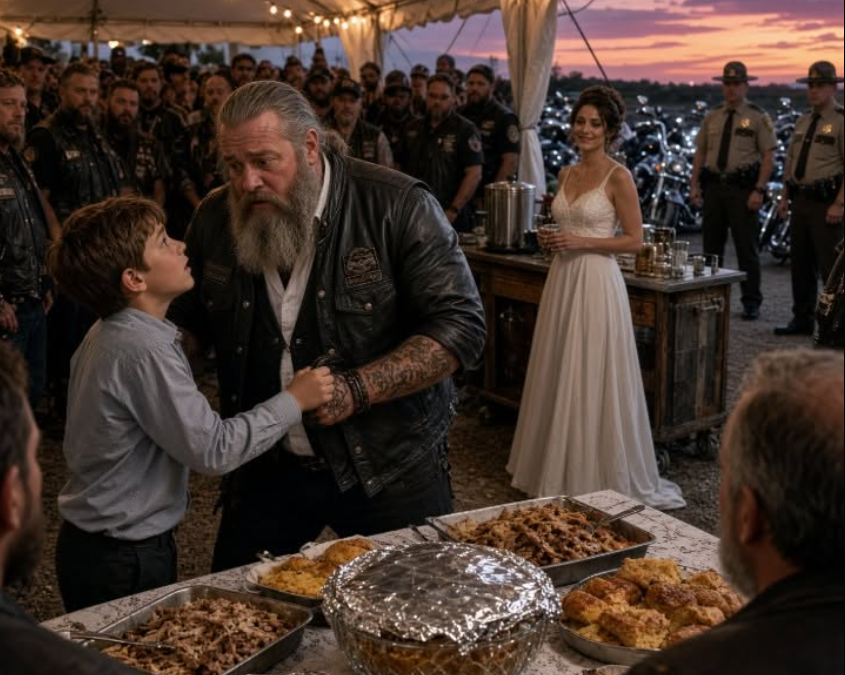
At 6:45, I saw Connor Merritt moving along the outside edge of the tent.
He did not enter through the main flap.
He followed the canvas wall, keeping to the side where the tables were closest to the outside. He wore a pressed button-down shirt and dark pants a little too formal for him. His hair was combed. His face was pale.
Sadie was not with him.
I was standing near the head table talking to my road captain when I felt a small tug on my vest.
I looked down.
Connor stood at my elbow.
His face held something that was not quite fear and not quite courage, but whatever lives between them in children who have already decided the moment requires both.
“I need to tell you something,” he said.
Low enough that no one else heard.
I stepped away from the table and crouched until my knees complained. I looked him in the eye.
“Say it.”
He swallowed.
“Don’t eat anything she cooks tonight.”
The music kept playing.
Someone nearby laughed at something.
A server passed behind us carrying a tray of rolls.
The ordinary world did not know it had just cracked open.
“Who are you talking about?”
I already knew.
“Kathleen,” he said. “Your wife.”
He said wife carefully, like the newness of it mattered.
“She brought her own food. She made something this morning in her kitchen and carried it here in a covered dish. She put it beside the catering food and told my mom it was her grandmother’s recipe. She said you should have some because it was your wedding and you should eat something she made herself.”
Everything in me went quiet.
“How do you know that?”
“My mom works here. She knows the catering people. She helped with the approval list. She said there wasn’t supposed to be extra food unless Helen said okay.”
“Where is your mother?”
Connor’s jaw tightened.
“She told me not to come.”
“Why?”
“She said I was making things up.”
“What did you hear, Connor?”
He looked down for half a second.
Then back at me.
“My mom was talking to Earl. She said maybe Kathleen’s other husbands got sick after eating food she made. Both of them. She said maybe people were saying things because they like gossip, but she sounded scared. Then Kathleen came by our house this morning because my mom had some tablecloths, and I was in the hallway, and Kathleen was on the phone in the kitchen. She said, ‘It has to be tonight. After tonight, nobody will question it.’”
My hands felt cold despite the heat.
“Did she say what had to be tonight?”
“No.”
“What else?”
“She said, ‘He trusts me. They all think I’m harmless.’”
Connor’s eyes shone but did not spill.
“I know you don’t know me. I know I’m just a kid. But I don’t want you to get sick.”
The tent moved around us in color and noise.
Kathleen stood near the bar cart with a group of women, one hand resting lightly on someone’s arm, head tilted toward whoever was speaking. She smiled at the right moment.
Careful.
Patient.
Attentive.
Connor whispered, “I thought about not coming. But I kept thinking, what if nobody says anything?”
That sentence saved my life.
I know that now.
At the time, it simply reached the part of me that had been trying to stay asleep.
I put one hand on his shoulder.
Not hard.
Grounding.
“You’re not making it up.”
His body changed under my hand. Some tension released. Not all. Enough that I saw the weight he had carried for three days shift.
“I need you to stay near Earl,” I said. “Do not go near the food. Do not talk to Kathleen. Do not leave with anybody unless it’s your mother, Earl, or me. Understand?”
He nodded.
I stood.
I did not go to the food.
I went to find Earl.
He was in the kitchen staging area behind the tent, the temporary setup the caterers had built under string lights and canvas. Helen, wife of my road captain and queen of every list she had ever touched, stood beside him, arms folded, face fixed on a serving table.
She looked up when I entered.
Before I spoke, she said, “I pulled it.”
“What?”
“The dish. Kathleen’s dish. It wasn’t on the manifest.”
Earl’s eyes were on my face.
“Connor came to you.”
“Yes.”
Helen pointed to the back table.
“Covered casserole. She placed it beside the pulled pork and told one of the servers it was approved. I saw it after the first round went out. We don’t serve anything that didn’t come through the approved kitchen.”
I looked at the covered dish.
It was ordinary.
That is what I remember most.
Blue ceramic.
White lid.
Floral pattern around the handles.
The kind of thing you might see at a church potluck or a neighbor’s porch after a funeral.
Ordinary is the costume danger wears best.
“Do not touch it,” I said.
Helen’s face tightened.
“I haven’t.”
“Don’t let anyone touch it.”
Earl already had his phone out.
“Tommy Reeves?”
“Call him.”
Detective Tommy Reeves worked Bibb County. Over two decades of jurisdictional overlap had created something almost like a relationship between us. Not friendship. Not warmth. But a mutual acknowledgment that some information moves better when men stop performing dislike.
Earl called him.
I went back into the tent.
Sheriff Frank Tilman stood at the entrance where he had positioned himself to see both the crowd and the road. Tactically sound. Emotionally irritating.
He looked up as I approached and arranged his face into the blank expression he used around me.
“I need your forensic people at the food staging area,” I said.
He stared.
“Excuse me?”
“There is a dish back there my wife brought separately outside the catering manifest. I need it tested before anyone eats it.”
His eyes narrowed.
“That is a serious thing to say at your own wedding.”
“I haven’t accused anyone of anything. I asked you to test a dish.”
“What’s the basis?”
“A ten-year-old boy who paid closer attention than any adult at this event,” I said. “Including me.”
For three seconds, Tilman stood still.
Behind me, music pulsed. Someone shouted happily near the dance area. The reception had not yet realized anything was wrong.
Tilman reached for his radio.
That was the first time I respected him that night.
Not liked him.
Respected.
A man can be full of assumptions and still do the right thing when the right thing becomes clear enough.
What happened next moved fast.
Important things often do, once the long hesitation ends.
Tilman’s deputy confirmed the dish had not been submitted through approved food service. Helen produced the manifest. The caterer produced theirs. The dish appeared on neither.
Detective Tommy Reeves arrived within fifteen minutes, because Earl had phrased the call in a way that made delay difficult.
A forensic technician from the Bibb County on-call lab arrived at 8:03 p.m. The sample was collected. Chain of custody began. Two deputies moved quietly through the tent under the cover of parking management, which was plausible enough that most guests kept eating, talking, and sweating under the lights.
Kathleen noticed.
I watched her notice.
I was standing near the bar with a glass of water in my hand when her eyes moved toward the staging area. Then to the deputies. Then to Tilman. Then to me.
A calculation passed behind her face.
Small.
Quick.
Gone.
Then she smiled.
The same smile.
The one that had made me feel seen.
For the first time, I understood that the smile might have been real and still not kind.
That is hard to explain.
People want evil to look fake in retrospect. They want to say the affection was always a mask, the tenderness always an act, the patience always false.
Sometimes the terrible truth is worse.
Sometimes the attention was real.
The warmth was real.
The humor was real.
The hand on your arm, the remembered coffee order, the way she asked about your mother, the nights she sat beside you in silence—all real.
And so was the other thing.
The thing under it.
The thing that could set a covered dish beside the wedding food and smile.
At 8:47 p.m., the preliminary field result came back.
Sheriff Tilman delivered the information himself.
He stood in front of me outside the tent near the generator cables, his hat in one hand, face professional because procedure was all he had to hold onto.
“The sample tested positive for a compound consistent with a class of heavy metal toxins. Final lab confirmation will take time. But based on the preliminary result, nobody should consume that dish. Nobody should handle it further.”
He stopped.
The generator hummed behind him.
Crickets called from the tree line.
Inside the tent, the music switched to something slow.
Tilman looked toward the tent.
“Mr. Whitmore, I need to ask where your wife is.”
My wife.
Those words had existed for less than five hours.
“By the bar.”
He nodded to his deputies.
Then he paused.
“The boy. His name is Connor Merritt?”
“He’s ten. His mother works at Benny’s.”
Tilman’s jaw shifted.
“He came here alone?”
“Because nobody else was going to.”
Tilman absorbed that.
Outside the tent, seven hundred motorcycles stood in long rows along the field and shoulder of Gray Highway, chrome holding the glow of string lights. They had been watched all day as if they were the danger. Filed and categorized. Measured from a distance.
While the thing that was actually dangerous stood in white beside the bar cart with a patient smile.
Kathleen was escorted from the tent at 9:02 p.m.
She went quietly.
Of course she did.
No screaming.
No clawing.
No dramatic collapse.
She placed her drink on the table, folded her hands once in front of her dress, and walked between two deputies as if leaving a dinner party early.
For one moment, she looked at me.
Not pleading.
Not apologizing.
Not even angry.
Curious.
As if she wanted to see what I had become now that I knew.
I had no words for her.
I still don’t.
People think betrayal demands a speech.
Most of the time, betrayal leaves you with a silence so large no speech can cross it.
I watched her disappear past the tent flap into the humid Georgia dark.
For a long time after she was gone, I stood near the front of the tent while the reception slowly understood it was no longer a reception. Conversations fell apart table by table. Music stopped. The DJ stood frozen with one hand over the controls. Men who had faced knives, guns, wrecks, prison yards, and funerals sat with paper plates in front of them and did not know where to put their eyes.
Earl appeared beside me.
He said, “You know what your problem is, Dale?”
I almost laughed.
The absurdity of the question nearly broke something in me.
“No, Earl. Tell me my problem.”
“Your whole life, people have looked at you and decided what you were before you opened your mouth. Leather and patches and the name on your back. They looked at all of it and made up their minds, and most never came back to revisit the question.”
I looked at him.
“She counted on that,” he said.
His voice was soft, but it carried.
“She counted on people doing the same thing to her in reverse. Sweet voice. White dress. Widow twice. Patient smile. She counted on nobody looking at her the way they looked at you.”
The words entered slowly.
“She counted on attention going the wrong direction,” Earl said. “The boy looked.”
I swallowed.
“The boy listened to what he heard, and he came and said it.”
Inside the tent, Connor Merritt stood near his mother with his shoulders up around his ears like he expected the world to punish him now that it had used him.
I crossed the tent.
People moved out of my way.
Not because I pushed.
Because something in my face must have told them that space would be wise.
Deborah Merritt saw me coming and put one arm in front of Connor instinctively.
I stopped several feet away.
“I’m not going to scare him.”
She flushed.
“I know.”
But she didn’t.
Not fully.
How could she?
A mother protecting her son does not owe politeness to a large man in leather on the worst night of his life.
I crouched in front of Connor again.
His eyes were red now.
Not crying exactly.
Close.
“You did right,” I said.
He stared at me.
“I need you to hear that from me. You did exactly right.”
“My mom didn’t believe me.”
Deborah made a small sound.
Connor looked down.
“She thought I was being dramatic.”
“I’ve had adults think worse about me,” I said. “Doesn’t make them right.”
That made his eyes lift.
“I was scared.”
“I know.”
“I almost didn’t come.”
“I know.”
“What if I was wrong?”
“You weren’t.”
“But what if I was?”
That question mattered.
Maybe more than the others.
Because the world trains children to doubt themselves when adults are uncomfortable. It tells them certainty belongs to age and authority. It teaches them to apologize for noticing too much.
“If you had been wrong,” I said, “we would have tested the dish, found nothing, and I would still thank you for caring enough to warn me.”
Connor blinked.
“Really?”
“Yes.”
“Even if everyone got mad?”
“Especially then.”
His face worked hard not to collapse.
I took off the silver ring I wore on my right hand. Not my wedding band. That had been removed by then, though I do not remember doing it. This was an old ring, thick, worn, nothing expensive. It had a small eagle stamped into it, the same eagle painted on my tank.
I placed it in his palm.
Deborah inhaled.
Connor stared down at it.
“You don’t have to keep it forever,” I said. “But I want you to have it tonight. So when your head starts telling you maybe you should have stayed quiet, you look at that and remember you didn’t.”
His hand closed around the ring.
Deborah whispered, “Mr. Whitmore—”
“Dale.”
“Dale. He can’t take that.”
“He can give it back when he doesn’t need it.”
Connor held the ring like it weighed more than metal.
That night, the tent stayed up.
No one made a formal decision.
It simply remained because the field was still full of motorcycles and people attached to those motorcycles had not yet figured out what to do with an evening that had taken the shape it had.
By midnight, someone found a guitar.
By one in the morning, someone carried coffee from Benny’s in paper cups, twenty-four at a time in cardboard trays, passed hand to hand through a crowd sitting on folding chairs, pickup tailgates, coolers, and dry grass.
The heat finally dropped below eighty.
The air smelled like pine, red Georgia clay, spilled beer drying on gravel, barbecue smoke gone stale, and the faint sweetness of flowers wilting in the tent.
Nobody got drunk.
That surprised outsiders later.
It did not surprise me.
Drinking would have made the thing too shapeless.
We needed to stay with it.
Connor fell asleep in the backseat of Deborah’s car on the shoulder of Gray Highway. Sadie slept beside him, head against his shoulder, sneakers still on. Deborah sat in the driver’s seat with the windows down and a cup of cold coffee in her hand, listening to the low voices of seven hundred people.
I went to the car at 2:17 in the morning.
I remember because the dashboard clock glowed blue when she opened the window.
I knocked gently on the frame with two knuckles.
“I wanted to thank him,” I said quietly.
Deborah looked back at her sleeping son.
“He was scared.”
“I know.”
“I told him he was wrong.”
She said it like a confession.
“I’m his mother, and I told him he was making something out of nothing.”
“He didn’t listen to you,” I said. “He listened to what he knew.”
Her eyes filled.
“What happens now?”
“They’ll do a full investigation. The other deaths. It will take time.”
She looked toward the tent.
“And you?”
I did not know how to answer that.
Less than twelve hours earlier, I had been a groom.
Now I was something else.
Almost a victim.
Almost a dead man.
Almost a fool.
Still a man in leather standing beside a mother’s car at two in the morning because her son had saved his life.
“I keep breathing,” I said finally.
She nodded like that was enough.
Maybe it was.
“Tell Connor when he wakes that I said he did the right thing.”
“I will.”
“And tell Sadie I still think my bike is beautiful because she said so.”
Despite everything, Deborah almost smiled.
“I’ll tell her.”
I walked back toward the tent.
The motorcycles stood in their rows like something faithful and misunderstood.
That is still the best description I know for most things if you take time to look.
The investigation that followed was neither quick nor clean.
Real justice rarely moves the way people want it to.
People like the dramatic moment: warning, test, arrest, truth.
They do not like the fourteen months afterward.
The interviews.
The subpoenas.
The records.
The second autopsies.
The toxicology specialists.
The pharmacists.
The physicians.
The garden supply store owner in Columbus who remembered a woman asking precise questions she should not have been asking.
They do not like that grief becomes paperwork.
They do not like that suspicion needs chain of custody.
They do not like that a dead man’s blood has to speak through lab reports because nobody listened while he was alive.
Kathleen Vance was charged in February 2021.
By then, the world had changed in ways none of us predicted. Courts were delayed. Life was delayed. People wore masks into rooms where they had to discuss death. Her trial began that October.
She was convicted in December on two counts of homicide and one count of attempted homicide.
The attempted homicide was the dish at our wedding reception.
My wedding reception.
I attended one day of the trial.
Only one.
I sat in the back row for four hours and watched lawyers turn my life into questions.
When did you meet Kathleen Vance?
How would you characterize your relationship?
Did she prepare food for you during your courtship?
Were you aware of any concerns about her previous husbands prior to August 17?
Did a minor child approach you during the reception?
What did he say?
How did you respond?
I answered what I needed to answer.
Then I left.
The rest belonged to lawyers and jurors. I have never found my answers in courtrooms.
Sheriff Tilman testified for three days.
On the final day, the defense attorney asked him to characterize the conduct of the motorcycle club members at the wedding after law enforcement became involved.
I read this part in the transcript later because Earl insisted.
Tilman paused before answering.
I could picture it.
That careful pause of his, selecting among several true things the one that would sit most precisely under oath.
“Orderly,” he said. “They were orderly and cooperative. Every single one of them.”
Then another pause.
“I’ve been doing this job for twenty-two years. I’ve responded to a lot of events with a lot of different groups. That crowd that night, they were the ones who stayed calm.”
The defense attorney had nothing further.
I never asked Tilman if that testimony cost him something.
Some truths do.
Connor was eleven by the time most of the investigation resolved, twelve when the verdict came in. He did not understand all of it, which was right. Children should not have to understand the full architecture of adult darkness.
He understood the part that mattered.
He had heard something.
He had told adults.
Most had doubted him.
One had believed him.
That is not a small thing.
It will never be a small thing.
Believing a child quickly can change the shape of his life.
Not because every child is always right about every detail. They are not. Neither are adults.
But because when a child brings you fear wrapped in courage, the first response should not be dismissal.
The first response should be attention.
Connor grew up two blocks from Benny’s.
He and Sadie still came in for Saturday breakfast sometimes with Deborah. At first, when I entered, Connor sat straighter, as if part of him returned to that tent every time he saw me.
So I did not crowd him.
I took my place at the counter.
Earl poured coffee.
Sometimes Connor nodded.
I nodded back.
That was all for a long time.
Men think boys need speeches.
Mostly, they need proof that the world after a hard thing can become ordinary again.
One December morning, cold enough that the diner windows fogged, I came in and found Deborah, Connor, and Sadie in a booth near the back.
Sadie was nine by then, eating toast with both hands and kicking one foot lightly against the vinyl seat. Connor had grown half an inch and was pretending not to look at me.
I sat at the counter.
Earl poured coffee without asking.
After a minute, I turned on the stool and nodded at Connor.
He nodded back.
Sadie looked up from her toast.
“Your motorcycle still has the eagle?”
“Yes.”
“Good.”
Then she went back to eating.
That was the whole conversation.
It was perfect.
Earl eventually sold Benny’s to his former night cook when he was seventy-nine. He still came in every morning, sat at the counter, drank his private coffee, and said very little. The only difference was that now he did it seated instead of standing, and the stool had a cushion someone had added for him. He pretended to find this annoying.
He absolutely did not.
I rode to Benny’s every Saturday morning through the fall of 2019, the winter of 2020, and the years after.
Some mornings, I said nothing.
Some mornings, I said too much.
Earl accepted both.
That is what old diners and old friends are for.
I continued organizing the Hemlock Street Children’s Hospital benefit ride every August.
The Macon Telegraph still took the same photograph every year: a large man in leather handing a large check to a woman in scrubs. The caption carried the club name, the donation amount, and nothing else.
That was enough.
People could decide the rest for themselves.
But the ride changed after 2019.
Not publicly.
Inside.
We added a scholarship fund for children of single parents working service jobs. Earl called it “too specific,” then wrote the first check. Deborah cried when she found out and then got angry that we had made her cry at work.
We added food safety rules to every club event. Helen became a tyrant about manifests, and God help the person who brought unapproved potato salad into her jurisdiction.
We also started listening differently when children spoke.
That may sound too simple.
It isn’t.
Simple things become culture when repeated often enough.
A kid says something feels wrong?
Someone listens.
A child points?
Someone looks.
A boy asks a question that seems too serious for him?
No one laughs.
Connor did not become a hero in some dramatic way. He became a boy who had once done a brave thing and then still had to do homework, take out trash, argue with Sadie, grow awkwardly into his own legs, and learn what kind of man he wanted to become.
Years later, he returned the ring.
He was sixteen.
I was at Benny’s, drinking coffee in Earl’s old seat because Earl had passed the previous winter and the stool had become both a comfort and an accusation.
Connor came in alone.
Tall by then.
Still serious around the eyes.
He sat beside me and placed the silver eagle ring on the counter.
“I think I don’t need it anymore,” he said.
I looked at the ring.
Then at him.
“You sure?”
He nodded.
“I still remember.”
“That wasn’t the deal.”
“What was the deal?”
“You keep it until you don’t need it.”
“I don’t need the ring to remember I was right.”
That got behind my ribs.
I picked it up.
The metal was warmer than I expected.
“You were right,” I said.
“I know.”
There it was.
Not arrogance.
Not bravado.
A hard-won certainty the world had tried to take from him and failed.
“What are you doing after graduation?” I asked.
“Maybe social work. Maybe forensic psychology. Maybe something with kids.”
“Hard work.”
“I know.”
“Breaks people sometimes.”
He looked at me.
“Not always.”
No.
Not always.
Sometimes it saves them too.
Sometimes the work that hurts you is the work that waits for you to return in another form.
Connor left after breakfast.
I sat with the ring in my palm for a long time.
Then I put it back on.
It felt different.
Not like armor now.
Like a reminder.
Kathleen wrote me once from prison.
I did not read the letter.
People have strong opinions about that.
Some say I should have read it for closure. Some say forgiveness requires hearing. Some say curiosity alone should have won.
Maybe for them.
Not for me.
There are doors a man does not have to reopen to prove he survived the room.
I gave the letter to my lawyer and told him to store it or burn it.
I never asked which.
The truth I needed had already come from a child, an old diner owner, a forensic report, and a jury.
Whatever story Kathleen wanted to tell herself could stay with her.
I still think about her.
Not every day.
But sometimes.
The mind returns to the cliff edge long after the fall has been avoided.
I think about what Earl said that night: that she counted on attention going the wrong direction.
That may be the cleanest explanation for half the harm in the world.
Attention going the wrong direction.
People watching the men in leather while the woman in white sets down the dish.
People watching the loud person while the quiet one bleeds.
People watching the person who looks dangerous while danger smiles softly and asks if you want another serving.
That is what changed in me.
Not that I stopped knowing how people saw me.
I still know.
I can feel a restaurant change when I enter. I can see mothers pull children closer in parking lots. I can watch a deputy’s hand drift half an inch toward his belt when a line of bikes pulls in.
But now, when I feel watched, I ask myself what nobody is watching.
That question matters.
At charity runs.
At diners.
At weddings.
In courtrooms.
In families.
In yourself.
What are you not watching because the obvious thing is taking up too much space?
On the fifth anniversary of the wedding, which is not a phrase a man should have to use for an attempted murder, I rode out to the field off Gray Highway.
The farmhouse had changed owners. The tent was long gone. Grass had grown over the gravel in places. The tree line stood dark and thick. Cicadas screamed from somewhere unseen.
I parked near where the head table had been.
For a while, I stood in the heat and let the place be both empty and full.
I could almost see it.
The white tent.
The string lights.
The bar cart.
Kathleen smiling.
Connor at my elbow.
Seven hundred riders going silent.
Earl beside me saying the boy looked.
I expected pain.
I found something else.
Not peace exactly.
Something steadier.
Gratitude feels strange when it grows from betrayal, but there it was.
Gratitude for Connor.
For Earl.
For Helen and her manifests.
For Tilman doing his job despite what he thought of us.
For seven hundred riders who did not turn a nightmare into a riot.
For the fact that my life had not ended because one boy refused to stay quiet.
I took the silver ring from my finger and held it in my palm.
Then put it back on.
Some things are meant to return.
Some things are meant to stay.
That evening, I rode to Benny’s.
The former night cook, now owner, had kept Earl’s coffee on the menu under the name Old Man’s Private Pot. Earl would have hated that and secretly loved it.
Deborah was there with Sadie.
Connor was away at school by then.
Sadie was older, nearly grown, but when I walked in, she looked up and smiled.
“Still got the eagle bike?” she asked.
“Yes.”
“Still beautiful?”
“Still beautiful.”
She nodded, satisfied, and went back to her meal.
Outside on Foresight Street, a truck passed.
Then a car.
Then a single motorcycle heading north, engine low and fading into the warm evening.
No one looked up.
There was nothing to look at.
Just someone going somewhere.
Same as always.
Same as it would be the next week and the week after that.
That is what survival becomes if you are lucky.
Not triumph.
Not applause.
Not the world finally understanding you.
Just ordinary sound returning to ordinary streets.
A cup of coffee.
A booth by the window.
A boy growing into a man who trusts what he knows.
A girl remembering beauty before fear.
A diner door opening.
A motorcycle passing.
A life continuing because somebody spoke in time.
People ask me sometimes if I ever want to get married again.
I usually say no.
Not because I stopped believing in love.
Because love is not the thing I distrust.
I distrust the part of myself that wanted so badly to be chosen that it stopped asking better questions.
That part of me is quieter now.
Not gone.
Men do not outgrow their hungers just because they survive them.
But quieter.
And when I sit at Benny’s on Saturday mornings, when Connor comes home on breaks and sits two stools down, when Deborah refills my coffee even though she no longer works there, when Sadie taps the window and points at my bike like she did the first evening, I understand that being chosen takes more forms than marriage.
A chapter can choose you.
An old man can choose to tell you the truth even when you do not want it.
A child can choose to trust you with a warning.
A whole crowd can choose calm when chaos would be easier.
Those choices saved me.
Not one grand love.
Many smaller loyalties, braided together.
That is stronger than romance in the end.
At least for me.
I keep the ring on my right hand.
Sometimes people ask about it.
I tell them a boy gave it back to me.
They do not understand.
That is fine.
Not every story needs to be handed to strangers.
But sometimes, when the August heat settles over Georgia and the hospital benefit ride comes around again, I see Connor in my mind at ten years old, standing in a pressed shirt at the edge of a wedding reception no child should have had to enter, carrying a truth adults had mishandled.
I see him tug my vest.
I hear the music.
I smell barbecue and pine and hot canvas.
I see Kathleen in white across the tent.
And I hear the sentence that split my life cleanly into before and after.
“Don’t eat anything she cooks tonight.”
There are warnings that sound small when they arrive.
A child’s voice.
A tug on a sleeve.
A strange question in a parking lot.
A dish not on a manifest.
An old man saying, “I hope she’s good to you.”
Ignore enough small warnings, and the world eventually becomes loud in a way you cannot survive.
Listen early, and sometimes you get to keep breathing.
That is what I learned.
Not from the sheriff.
Not from the trial.
Not from the woman I almost married.
From a ten-year-old boy who decided fear was less important than saying what he knew.
So if there is anything worth taking from the night my wedding became a crime scene, it is this:
Do not decide too quickly where danger lives.
Do not assume sweetness means safety.
Do not assume leather means violence.
Do not dismiss a child because his voice shakes.