PART2:
That made him pause for half a second. Not long enough.
He shook his head and reached for his helmet.
“Everybody saddle up,” he said. “We’re late.”
Engines answered him one by one.
The sound swallowed me.
For a second, I was back under Cedar Bridge at three in the morning, pressed behind a concrete footing with cold creek water soaking my jeans, watching sparks fall from the belly of the bridge while Dale Hensley said, “Fifteen bikes, same memorial run as last year. They’ll come through after breakfast.”
The grinder had screamed against steel. One of the men had cursed because his gloves were slipping. Another had laughed and said, “You sure this won’t bring the whole thing down before they get here?”
Dale had answered, “Not if you do it where I told you. We don’t need it down now. We need it weak.”
Then a third voice, lower and colder, had said, “And the girl?”
My whole body had gone still.
Dale said, “Pike said she moved on.”
I had pressed both fists against my mouth so hard my teeth cut the inside of my lip.
The girl.
Not Nora.
Not Ruth Whitaker’s granddaughter.
Not somebody’s child.
Just the girl.
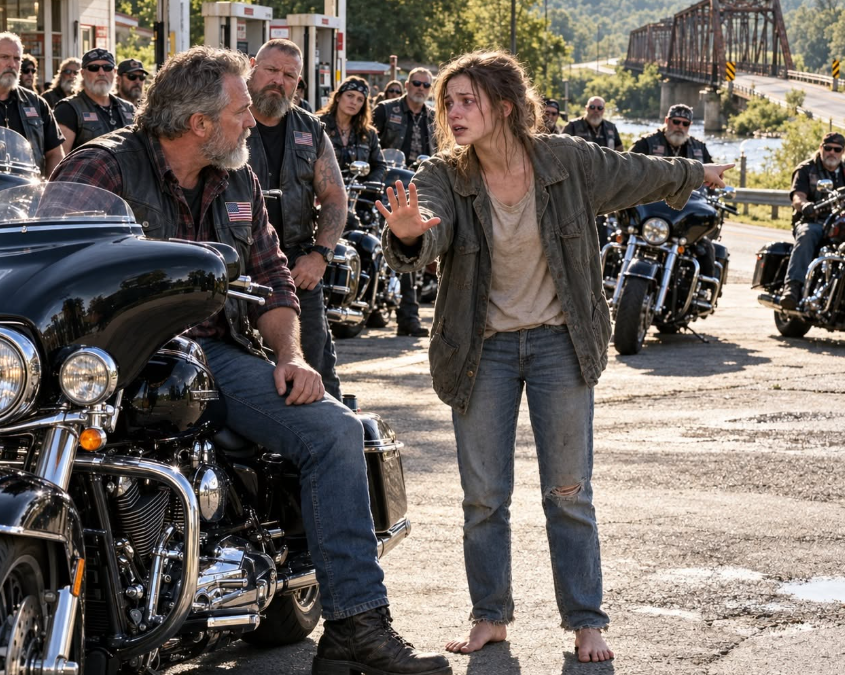
The engines in the gas station parking lot roared louder, pulling me back to morning. Rick’s front tire jerked forward.
I stepped in front of it.
He braked hard.
Several men shouted.
“What the hell is wrong with you?” Rick snapped.
“You can hate me after,” I said, tears burning behind my eyes. “You can call me crazy all day after. Just look before you cross.”
Rick stared at me like he could move me with anger alone.
Then, from the very back of the group, a different voice said, “Kill the engines.”
Nobody moved at first.
The voice came again, calm and hard. “I said kill the engines.”
One by one, the rumble died.
The silence that followed was almost worse.
A man swung one leg over his motorcycle and took off his helmet. He was older than Rick, maybe late fifties, with a gray beard trimmed close and sun-browned skin cut by deep lines at the corners of his eyes. His vest had the name BEN sewn over the heart, and just above it was a small American flag patch faded from years of weather.
Rick turned in his seat. “Ben, come on.”
Ben looked at me, not through me. That was the first miracle.
“We have time to check,” he said.
Rick scoffed. “We’ve got people waiting in Knoxville.”
“And we’ll get there alive or not at all,” Ben said.
Nobody laughed that time.
Ben walked toward me slowly, hands visible, like I was a scared animal he didn’t want to spook.
“What’s your name?” he asked.
My throat tightened.
It had been so long since a stranger asked me that before asking what I wanted.
“Nora,” I said.
“All right, Nora. Tell me where you were standing when you saw them.”
I pointed past the gas station, toward the narrow service road and the line of trees that hid the creek. “Under the east side. Near the old footing. There’s a slope down from the road.”
“Can you show us?”
I nodded before he finished asking.
Rick cursed under his breath, but he got off his bike. Another rider joined us, a tall Black man named Owen who pulled a flashlight from one saddlebag and a phone from another. “Retired civil engineer,” he said when Rick gave him a look. “Not bridges mostly, but enough to know when not to be stupid.”
We walked down the side path with two more riders trailing behind. Gravel bit into my feet, but I barely felt it. I was too busy watching Ben’s face, waiting for the moment his patience turned into pity, then suspicion, then annoyance like everyone else’s.
The bridge looked normal from above. That was the worst part. From the road, Cedar Bridge was just an old county bridge with rust stains, faded guardrails, and weeds growing through cracks in the shoulder. People crossed it every day without thinking. Trucks, school buses, delivery vans, families on their way to softball practice. It had always groaned when heavy vehicles passed, but old things made noises. That was what people told themselves.
Underneath, it was different.
Underneath, where I had learned the language of dripping water and loose gravel and passing tires, the bridge had secrets.
I led them down the bank, past the sycamore roots, past the place where I usually kept my sleeping bag rolled tight during the day. Police tape wasn’t there yet. Barriers weren’t there. The only thing waiting under Cedar Bridge was the evidence nobody had expected a homeless girl to survive long enough to describe.
Owen reached the first support beam and stopped.
His smile disappeared.
“Jesus,” he whispered.
Bright silver grooves cut across the rusted steel. Fresh. Violent. Wrong.
Ben stepped closer. “That what you saw?”
I nodded. “There are more on the other side. They moved around with the light.”
Owen crouched, angled his flashlight, and took pictures. Then he stood and backed away like the bridge itself had become a sleeping animal.
“Nobody goes on the deck,” he said.
Rick looked up. His face changed in a way that almost hurt to watch. The arrogance drained first. Then the irritation. Then something heavier settled over him as he realized the girl he had nearly ridden past had been standing between him and a coffin.
“How bad?” Ben asked.
Owen didn’t answer right away. He walked ten feet, examined another beam, and swore softly.
“How bad, Owen?” Rick demanded.
“Bad enough that I’m not guessing,” Owen said. “Bad enough that I want a county bridge engineer here before anything heavier than a squirrel crosses it.”
Ben pulled out his phone and called 911.
Rick stared at the cut steel, then at me.
He opened his mouth.
Closed it.
For once, he had nothing to say.
By the time we climbed back to the road, two riders had parked their motorcycles across the approaches to stop traffic. A pickup truck driver leaned on his horn and yelled that he had to get to work. A woman in scrubs tried to argue until Owen showed her the photos. Then she got pale and reversed slowly.
The 911 dispatcher must have called Chief Vernon Pike first, because his cruiser came roaring up twenty minutes later with no siren, just lights flashing like he was arriving to control a nuisance, not investigate an attempted murder.
Chief Pike had been chief in Briar Falls for eleven years. He had a square head, a stiff brown mustache, and eyes that always seemed to be measuring how much trouble you were worth. When I was little, he gave out candy canes at the Christmas parade. When Grandma Ruth died, he took off his hat at the funeral and told me she had been “a fine woman.” Three months later, he found me warming my hands behind the laundromat and told me if I kept making customers uncomfortable, he’d run me in for loitering.
He stepped out of his cruiser that morning, thumbs hooked in his belt, and looked at the motorcycles first.
“What’s all this?” he asked.
Ben approached him. “Chief, this bridge needs to be shut down. We found fresh cuts underneath.”
Pike barely glanced toward the railing. “This old bridge has been deteriorating for years.”
Owen held up his phone. “These are not deterioration marks.”
Pike didn’t take the phone.
“We’ll get somebody out next week,” he said.
“No,” Owen said. “You’ll get somebody out now.”
Pike’s eyes narrowed. Men like him didn’t enjoy being corrected, especially in public.
Then he saw me.
It happened fast, but I caught it. The tiny hitch in his face. The flash of recognition, then anger, then calculation.
“You,” he said.
My stomach dropped.
“I watched them do it,” I said before fear could steal my voice. “Dale Hensley was one of them.”
Pike came toward me so quickly I stepped back. He caught my elbow hard and pulled me several steps away from the riders.
His fingers dug into my skin.
“I told Dale that space was empty,” he whispered. “What were you doing down there?”
The world went very quiet around that sentence.
Not because there was no sound. There were birds in the trees. A truck idling. A motorcycle ticking as it cooled. But all of it moved far away.
I looked at the chief’s hand on my arm.
Then I looked up at his face.
“Living,” I said.
His fingers tightened.
For a second, I thought he might hit me right there beside the road.
Then Ben stepped beside us.
“Let go of her.”
Pike released me, but he didn’t move away.
“We’re having a private conversation,” he said.
“She didn’t agree to one.”
There was a kind of stillness that passes between men who have both seen violence and know exactly how fast it can become real. Pike was used to people shrinking when he squared his shoulders. Ben didn’t shrink. He just stood there, eyes steady, one hand loose at his side.
Pike looked past him and realized, maybe for the first time, that fifteen bikers were watching.
Phones were out.
Owen’s camera was still recording.
Pike straightened his uniform shirt.
“All of you need to clear this area,” he said. “You’re interfering with a police matter.”
Rick gave a short, humorless laugh. “Funny. Looked like you were trying to make it not one.”
Pike pointed at him. “You want obstruction charges?”
Ben said, “We’ll remain behind the barriers until state police arrive.”
“There is no state police coming.”
Owen lifted his phone. “The dispatcher says otherwise.”
Pike’s jaw shifted.
I had seen him angry before. I had seen him annoyed, smug, bored, impatient. But I had never seen him cornered. His eyes flicked toward me, then the bridge, then his cruiser. He walked away without another word, making a call before he reached the driver’s door.
My legs started shaking after he drove off.
I hated that too.
I wanted to stand there like someone brave and unbreakable, but the truth was, I was cold even in the sun. I was hungry. I was exhausted. I had spent the night afraid to breathe while men cut apart a bridge above my head, and now the police chief had just admitted in a whisper that he had told one of them I wasn’t there.
Rick came toward me slowly.
He took off his leather jacket and held it out.
“I’m sorry,” he said.
I looked at the jacket without taking it.
“You were going to ride past me,” I said.
His face tightened. “I know.”
“You thought sleeping under a bridge meant I couldn’t know anything.”
Rick swallowed. It took him a long time to answer.
“I did.”
That answer hurt.
But it was the truth, and after a year of people lying kindly, cruelly, casually, the truth felt almost respectful.
I took the jacket.
It smelled like leather, highway dust, and smoke. It was heavy on my shoulders. It made me feel smaller and safer at the same time.
A younger rider with sandy hair and kind eyes crouched near my feet with a first-aid kit.
“I’m Caleb,” he said. “Can I clean those cuts?”
My first instinct was to pull away. People touched you differently when you were poor. Some grabbed. Some patted like you were a dog. Some helped in a way that made sure everybody saw them helping.
Caleb waited.
He didn’t reach.
“Okay,” I said.
He poured water gently over the cuts in my soles. The sting made me clench my teeth. Gravel and dirt washed into the grass. He dabbed carefully with gauze.
“We’ve got extra socks,” he said. “Shoes will take a little longer.”
I cried then.
Not when Pike grabbed me.
Not when the riders laughed.
Not even when I thought of Dale standing under the bridge, deciding strangers could die so his problems might get smaller.
I cried over socks.
Caleb looked panicked for half a second, like maybe he had hurt me.
“I’m sorry,” he said quickly.
I shook my head and covered my mouth with the sleeve of Rick’s jacket.
“No,” I said. “It’s just… socks.”
He didn’t understand, not fully. How could he? He had probably never washed the same pair in creek water and slept with them tucked under his shirt so they might dry by morning. He had probably never had to decide whether to wear wet shoes and risk blisters or go barefoot over gravel and glass.
But he nodded anyway.
Sometimes kindness did not need to understand everything to matter.
The state troopers arrived forty minutes later, followed by a county engineer named Marisol Keene, who climbed down under the bridge in work boots and a hard hat, then came back up with a face that made everyone stop talking.
“This bridge is closed immediately,” she said.
Pike was not there to hear it.
That alone told me something.
Troopers placed cones and tape. The county sent barricades. Drivers complained until they heard the words “structural sabotage,” and then complaints turned into whispers.
A trooper interviewed me in the front seat of his cruiser with the passenger door open. His name was Sergeant Lowell. He had a careful voice and wrote slowly, as if each word mattered.
Ben waited outside the open door, far enough away that my answers belonged to me.
“Start from the beginning,” Sergeant Lowell said.
So I did.
I told him about the light waking me. The grinder. The three men. Dale Hensley’s voice. The phrase “same memorial run as last year.” The other man asking about “the girl.” Pike’s whisper beside the road.
Sergeant Lowell’s pen paused at that part.
“He said, ‘I told Dale that space was empty’?”
“Yes.”
“You’re certain?”
“I’ve had people tell me I imagined a lot of things this year,” I said. “I didn’t imagine that.”
His expression changed, not with pity but with focus.
“Did anyone tell you what to say today?”
“No,” I said. “Mostly they told me to stop saying it.”
He set his pen down for a moment.
“We’re listening now.”
Those words almost undid me.
We’re listening now.
They were so small. They were too late for some things. They did not bring back Grandma Ruth or the house or the nights I had lain awake under the bridge while rain hit the roofing tin above me so loud I couldn’t tell if I was crying. But they opened a door inside me that had been nailed shut from the outside.
I looked past him at the riders gathered near the gas station, their dark vests standing out against the bright morning. Rick was pacing, one hand on his hip, face hard with shame. Owen was showing photos to Marisol Keene. Ben stood still, watching the road like he had appointed himself guard over the rest of my life.
For the first time in months, I did not feel invisible.
That feeling scared me more than hunger ever had.
Before Cedar Bridge, before foreclosure notices and shelter waiting lists and waking up with spiders near my hair, I had belonged to a house on Maple Street.
It was small and white with blue shutters Grandma repainted every other spring even after her knees got bad. There was a porch swing that squeaked on the left chain no matter how many times Leon Price offered to fix it. Grandma always refused.
“Leave it,” she’d say. “A house ought to announce joy when it moves.”
Grandma Ruth was not soft in the way people expected grandmothers to be. She had raised me with iron skillets, library cards, and a stare that could make grown men apologize to houseplants. She worked thirty-two years in the school cafeteria and knew which children had no breakfast because they ate lunch too fast. She packed extra biscuits in napkins and pretended not to notice when they disappeared.
My mother, Alicia, left when I was three. Grandma never called her selfish in front of me. She said, “Some people are storms, baby. You can love the rain and still lock the windows.”
My father was a name on a birth certificate and a blurry photograph in a shoebox.
So it was Grandma and me.
She taught me how to make cornbread without measuring. She taught me that cheap shoes cost more in the long run because they punished your feet. She taught me to say no clearly and yes carefully. She also taught me stories mattered.
Every Thursday, we went to the Briar Falls Public Library. I read everything. Mysteries, adventure novels, biographies, field guides, poetry I didn’t understand but liked the sound of. Grandma’s eyesight got worse when I was sixteen, so I started reading aloud to her at night.
Sometimes she fell asleep halfway through.
I kept going.
I told myself maybe some part of her could still hear it.
When she got sick, the whole world shrank to appointment cards, pill bottles, folded bills, and the sound of her breathing from the next room. I missed school because somebody had to drive her to Knoxville for treatments. I picked up extra shifts at Miller’s Grocery bagging vegetables and stocking shelves. Grandma kept telling me the house payments were handled.
“Don’t you carry grown folks’ worries,” she said.
But I saw the envelopes.
Not at first. She was clever about hiding them. Behind the flour canister. Inside an old cookbook. Under the lining of a Christmas tin filled with buttons. Past due. Final notice. Intent to accelerate. Foreclosure proceedings.
By the time I understood, it was already too late.
After her funeral, I sat on the kitchen floor with those envelopes spread around me like a paper storm. The house smelled like flowers from the service and chicken casserole neighbors had brought in disposable pans. Everyone had hugged me that day. Everyone had said, “Call if you need anything.”
I called.
A few answered.
Most didn’t.
The bank man sounded bored. The legal aid woman sounded sorry. The county office transferred me three times and disconnected twice. I was seventeen, then eighteen, then suddenly a legal adult in all the ways that let people stop feeling responsible.
By February, the locks belonged to someone else.
I watched two men carry Grandma’s porch swing to the curb.
That was the day Leon Price found me sitting on the sidewalk with a trash bag of clothes and a plastic crate of books.
Leon ran the mechanic shop near the bypass. He was in his sixties, with silver hair always tucked under a ball cap and hands permanently stained with grease. Grandma had known him forever. People said he had loved her once, before Grandpa Whitaker, before me, before all the years made old stories private.
He loaded my books into his truck without asking.
“Where are you staying?” he said.
“I’ve got somewhere.”
It was half true. A girl I knew from school, Tessa, let me sleep on her couch for two weeks. Then her landlord threatened eviction. The shelter in Morristown had a waiting list. A church in Knoxville offered three nights if I could get there before six, but I had no car, no money, and no way back to the part-time jobs I was trying to keep.
I tried sleeping behind the laundromat first. Chief Pike found me there.
“You can’t camp on private property,” he said.
“I’m not camping.”
“Then don’t make me say trespassing.”
I tried the park pavilion. He found me there too.
“Parents bring kids here,” he said, like I was something children should be protected from.
I tried behind the old feed store. Dale Hensley came out with a shotgun and told me he didn’t care whose granddaughter I used to be.
Finally, I found the space beneath Cedar Bridge.
It was ugly, damp, and loud. It was also out of the wind. There was a flat place between the embankment and an old concrete footing where I could unroll my sleeping bag. I propped roofing tin above it and tied one corner with rope so rainwater ran down the side instead of onto my face. I kept my books in a milk crate. I learned the traffic patterns overhead. School buses at 6:50 and 3:15. Logging trucks around dawn. Drunk drivers after Dale’s tavern closed.
At night, I read with the flashlight Leon left me.
For when your chapter isn’t finished, his note said.
He brought sandwiches in brown paper bags. Once, a thermos of soup. Once, a pair of gloves. He never stayed long. He never forced conversation. That was why I trusted him and also why I resented him. Sometimes the people who came close enough to help but not close enough to save you were the hardest to forgive.
The town knew.
Darryl at the gas station knew. The grocery manager knew when she fired me because customers complained that I smelled like smoke and creek water. Chief Pike knew because he kept telling me where not to exist. Dale Hensley knew because he owned half the worst places in Briar Falls and seemed personally offended by anyone poor enough not to spend money in them.
And then there were the bikers.
The Iron Saints had come through the previous year on a memorial ride for a man named Marcus Bell, who had grown up in Briar Falls and died in Afghanistan. I remembered them vaguely: loud engines, flags, leather vests, the whole town waving as they passed. Grandma had been alive then, sitting in her porch swing with a blanket over her knees.
“People make families all kinds of ways,” she had said as the motorcycles rolled past. “Blood is only one of them.”
I had not understood how much I would need that sentence later.
By noon on the day of the bridge, the whole town knew something had happened.
That was how Briar Falls worked. Trouble moved faster than weather.
People arrived in little clusters, parking near the gas station and pretending they needed fuel or coffee. They watched the bridge closure from a distance. They watched the bikers. They watched me in Rick’s jacket and Caleb’s spare socks, sitting on the curb with a bottle of water I couldn’t stop turning in my hands.
Mrs. Larkin, who sang alto at church and once brought Grandma a pound cake, looked at me and whispered to another woman.
The other woman said, “That’s Ruth’s granddaughter?”
As if I had become unrecognizable only after I became inconvenient.
Rick heard her.
He turned, and I saw something dangerous move across his face.
Ben touched his arm. “Don’t.”
Rick clenched his jaw. “They just left her out here?”
Ben didn’t answer.
Neither did I.
Because yes, they had.
But people rarely like hearing the truth in the plain shape they made it.
Around one o’clock, Dale Hensley arrived.
He parked his black pickup near the far side of the gas station and stepped out wearing jeans, polished boots, and a tan button-down shirt like he was on his way to a business lunch. Dale was in his forties, handsome in the way mean men can be when life has never made them question their right to take up space. He owned Hensley’s Tavern, two rental houses, a storage yard, and, if gossip was true, debts that kept him smiling too hard at the wrong people.
He looked at the bridge closure. Then at the troopers. Then at me.
For half a second, pure hatred showed on his face.
Then he covered it with concern.
“Nora,” he called, walking toward us. “Honey, what in the world have you gotten yourself mixed up in?”
Ben shifted beside me.
Rick turned fully around.
Dale slowed, noticing the attention.
“I heard there was some kind of accident,” Dale said. “You okay?”
I stood.
My knees wobbled, but I stood.
“You were under the bridge last night,” I said.
Dale’s smile didn’t move, but his eyes sharpened.
“Now, sweetheart, you know I wasn’t.”
“Don’t call me sweetheart.”
A few people nearby heard that. Heads turned.
Dale gave a soft laugh meant for the crowd.
“Poor thing,” he said. “She’s been sleeping rough too long. Chief Pike and I have tried to get her help, but she runs off.”
“That’s not true,” I said.
“It’s all right.” Dale lifted his hands. “Nobody blames you. But accusing people of crimes is serious.”
Rick took one step forward. “So is cutting a bridge.”
Dale looked at him with polished confusion. “And you are?”
“One of the men you tried to kill.”
The crowd’s whisper became a wave.
Dale’s face hardened.
“I don’t know what she told you,” he said, “but I’d be careful taking the word of a homeless girl who’s been causing problems around here for months.”
There it was.
The sentence people had been building toward all day but were too polite to say out loud.
Homeless.
Not witness.
Not victim.
Not young woman.
Homeless, as if that one word could swallow every other truth about me.
My cheeks burned. My heart kicked hard against my ribs. A year earlier, I might have cried and looked down.
That morning had burned something out of me.
“She knew details we hadn’t seen yet,” Owen said. “She described the location of the cuts before any of us went under.”
Dale ignored him and looked toward Sergeant Lowell. “Are you really letting this circus happen?”
The sergeant walked over calmly. “Mr. Hensley, we’ll need to ask you some questions.”
Dale laughed once. “Based on what? Her?”
“Yes,” Sergeant Lowell said. “And the bridge.”
Dale’s smile twitched.
“I have a business to run.”
“You can answer here or at the station.”
That was the first time I saw fear in Dale Hensley.
It didn’t last. Men like Dale knew how to turn fear into outrage.
“This is harassment,” he said loudly, making sure the crowd heard. “A respected local business owner gets accused by some unstable vagrant, and suddenly I’m the criminal?”
Ben’s voice cut through the murmurs.
“Her name is Nora.”
Dale looked at him.
Ben stepped closer, not threatening, not loud, just immovable.
“Say her name.”
Dale’s jaw tightened.
For one long second, nobody breathed.
Then Dale said, “Nora.”
It was the first time I had heard my name from his mouth without contempt wrapped around it.
It did not feel like a victory.
But it felt like a beginning.
The investigation did not become clear all at once.
Real life is not like the movies in that way. Nobody found a single envelope labeled “Bridge Murder Plan.” Nobody confessed under a swinging lamp while dramatic music played. The truth came in pieces, sharp and ugly, and every piece cut somebody.
First came the rental yard footage.
Owen had taken photos of the tool marks under the bridge. Marisol Keene identified the likely equipment. Sergeant Lowell sent troopers to a rental place outside county lines. A camera showed Dale’s truck leaving there at 11:42 p.m. with a portable generator, industrial lights, and cutting equipment in the bed.
Then came the phone records.
One of Dale’s men, a nervous bartender named Travis, broke after six hours of questioning. He said Dale told him they were “just scaring the bikers off the old route” so Dale could stage a robbery after a controlled collapse. Travis didn’t seem to understand that controlled and collapse didn’t belong anywhere near a bridge full of people.
“He said nobody was supposed to die,” Travis told investigators.
But he had still held the work light.
He had still listened to steel scream in the dark.
He had still walked away.
Then came the messages.
Dale owed money. Not a little. He had borrowed from men who did not use banks, and he had lost more trying to win it back. The Iron Saints memorial ride had become his answer because last year, they had stopped at his tavern after the ceremony. Fifteen motorcycles. Donated cash for the veteran’s memorial fund. Saddlebags with tools, phones, wallets, and personal items. People traveling together, mostly older, some retired, some carrying expensive gear.
Dale’s plan was insane enough that people at first resisted believing it.
But evil often survives by counting on decent people to say, No one would do that.
Dale would.
He wanted the bridge weakened just enough to create panic when the group crossed. He planned for one of his men to report that the bridge had collapsed after the bikers passed or partially while they were on it. In the confusion, with the road blocked and cell service spotty near the creek, he meant to send men dressed like county workers to “secure” the scene and strip what they could. He had even rented a storage unit under a false name.
And Chief Pike?
Chief Pike had not just known.
He had helped.
The route for the memorial ride had been public. Pike had confirmed when the group usually passed through. He had agreed to delay the official response by calling any warning “old bridge deterioration” and keeping county engineers away until Dale had time to muddy the scene. He had also told Dale, according to a message recovered from Travis’s phone, that “the bridge girl cleared out after last warning.”
The bridge girl.
That was what I was in their messages.
Not Nora.
Never Nora.
The bridge girl.
I learned most of this later, but pieces leaked into town fast enough. Briar Falls went from whispering about me to whispering about Dale and Pike. People who had crossed the street to avoid me suddenly wanted to say they always knew something was wrong with that man. People who had watched Pike harass me suddenly remembered being “concerned.”
The first news van arrived that evening.
Then another.
By sunset, Cedar Bridge was closed behind barricades, Chief Pike was suspended, and Dale Hensley had been taken into custody after trying to leave through the back road behind his tavern.
I watched none of that from a safe place.
I watched it from the gas station curb, because the bridge where I slept was now evidence wrapped in yellow tape.
My entire life, small as it had become, sat beneath that bridge: sleeping bag, books, Grandma’s old sweater, flashlight, a cracked mug I used for water, the envelope with her obituary folded inside.
I had saved fifteen strangers from crossing.
But I had also lost the only place I had left to go.
That realization hit as the sun dipped low and the riders began making calls. They had missed the ceremony in Knoxville. They called the families waiting for them. Some cried quietly. Some walked away for privacy. One man stood by his bike and pressed his forehead to the handlebars for a long time.
I heard the story then.
Marcus Bell, the man they rode for, had been a Marine. Ben had served with him. So had two others. Marcus had grown up in Briar Falls, left at eighteen, and sent money home to his mother until the day he died. Every year, the Iron Saints rode through his hometown on their way to the veterans cemetery outside Knoxville, carrying a flag that had once flown over his outpost.
The flag was folded in Ben’s saddlebag.
Dale had known that.
So had Pike.
They hadn’t just picked bikers.
They had picked mourners.
When I understood that, I felt sick.
Ben found me near the ice machine with my knees drawn to my chest.
“Where can we take you?” he asked.
I looked at him.
“You don’t have to take me anywhere.”
“That isn’t what I asked.”
I stared at the asphalt. A crushed cigarette butt lay near my foot. Somebody had spilled soda earlier, and ants had found it.
“I don’t have an answer,” I said.
Ben sat down on the curb beside me, lowering himself slowly like his knees complained. For a while, he said nothing.
That was another kindness.
Silence without abandonment.
Finally, I said, “My grandmother used to say a person should always know where they’re sleeping before dark.”
Ben folded his hands between his knees.
“Smart woman.”
“She was.” My voice went thin. “She would be so mad at me.”
“For what?”
I laughed once, but it broke. “For ending up here.”
Ben turned his head. “You think she’d blame you?”
I didn’t answer.
Because grief is not always reasonable. Sometimes it wears the voice of the person you lost and says cruel things they never would have said alive.
I told him about Grandma Ruth. Not everything. Just enough. The porch swing. Her reading glasses. How she called me baby even when I was taller than her. How she hid the foreclosure notices because she thought she was protecting me. How I read to her when her eyesight got bad.
“Sometimes she’d fall asleep halfway through,” I said. “I’d keep going. I thought maybe she could still hear it.”
Ben rubbed his hands together.
“My wife used to read to me after I came back,” he said.
I looked at him.
He stared across the lot at nothing.
“I had nightmares. Wouldn’t sleep. Wouldn’t talk. Thought I was doing everyone a favor by carrying it alone.” His mouth twisted. “That’s the lie, by the way. Pain tells you being alone is noble. It’s usually just pain trying to keep itself alive.”
“What happened?”
“She stayed,” he said. “Longer than I deserved sometimes. Then cancer took her six years ago, and I found out grief is the one war nobody trains you for.”
I watched his hands. They were scarred, broad, steady.
“Why did you believe me?” I asked.
He didn’t answer quickly.
“Because you were afraid,” he said.
“Everybody thought that meant I was lying.”
“No,” Ben said. “You were afraid for us. There’s a difference.”
That sentence stayed with me.
You were afraid for us.
Not of us.
For us.
All year, people had treated my fear like proof I was unstable, inconvenient, less credible. Ben saw it as evidence that I still cared about the lives of strangers who had given me no reason to care.
Maybe that was what saved me as much as it saved them.
Leon arrived just after dusk.
His old blue pickup rattled into the gas station lot with one headlight dimmer than the other. He stepped out wearing his mechanic shirt, grease on his forearms, face drawn tight with worry.
The moment he saw me, his shoulders dropped like he had been holding his breath all day.
“There you are,” he said.
I stood. “Did they let you get my things?”
He nodded toward the truck bed.
My milk crate of books sat there. My sleeping bag. My flashlight. Grandma’s sweater folded on top. Everything had been tagged, photographed, and released because Sergeant Lowell said none of it was evidence of the sabotage.
Leon walked to the tailgate and picked up the crate.
“You could’ve asked to stay at my place,” he said quietly.
The words hit wrong.
Maybe on another day they would have sounded kind. That evening, after everything, they sounded like one more person telling me the door had always been there and I was the foolish one for not opening it.
I looked at him.
“You could’ve asked if I needed to.”
Leon flinched.
I had never spoken to him like that. Not once.
He looked down at the crate of books in his hands. For a second, he seemed much older.
“You’re right,” he said.
That stopped me.
I expected excuses. People always had excuses. They were busy. They didn’t know. They thought somebody else had it handled. They didn’t want to embarrass me. They didn’t want to interfere.
Leon gave me none.
“You’re right,” he said again. “I should’ve asked. Ruth would have skinned me alive for leaving you under there with sandwiches and thinking that counted.”
My throat closed.
“She liked you,” I said.
A sad smile moved across his face.
“I liked her first.”
I knew it.
I had always known it in the way children know things adults think they hide.
Leon set the crate down and pulled a folded paper from his shirt pocket.
“I’ve got a spare room,” he said. “It’s messy. I’ve been using it for parts and boxes and things I didn’t want to sort after my sister passed. But we can clear it tonight. You don’t owe me anything. You don’t have to stay if you don’t want. But the offer is real.”
Before I could answer, Ben came up beside us.
“The motel by the interstate has rooms,” he said. “I got one for tonight.”
I stiffened.
Ben seemed to understand before I spoke.
“It’s not charity,” he said. “It’s logistics.”
I almost laughed. “That’s charity wearing boots.”
“Maybe,” he said. “But nobody sleeps under police tape.”
Leon nodded. “He’s right.”
I looked between them: the mechanic who had helped but not enough, and the biker who had almost ignored me but didn’t. Two imperfect men standing in a gas station parking lot trying to build a bridge back to the world with whatever they had in their hands.
“What happens when the attention stops?” I asked.
That was the question nobody liked.
People loved rescue stories when they had clean endings. A lost dog returned home. A child pulled from a well. A girl saves bikers, bikers save girl, everyone cries and goes back to dinner. But life after the headline was harder. Food ran out. Motel rooms cost money. Shame came back after the cameras left.
Ben looked at me steadily.
“I don’t know every part yet,” he said. “But you’ll have our numbers.”
“I don’t have a phone.”
“Then we’ll start with paper.”
He took a receipt from his pocket and wrote three phone numbers on the back. His. Rick’s. Owen’s. Then he added Caleb’s because Caleb was apparently the kind of person who knew how to “make things happen with forms.”
He handed it to me like it mattered.
I took it with both hands.
The riders stayed in Briar Falls four days.
That was not the plan. They had families, jobs, appointments, lives. One owned a plumbing company. One coached Little League. One cared for his elderly father. Ben was supposed to be back in Kentucky by Monday. Rick had a granddaughter’s birthday. Caleb had a dental appointment he was weirdly upset about missing.
They stayed anyway.
They did not move as a perfect army of saviors. They argued. They got things wrong. Rick tried to buy me six pairs of shoes without asking my size, then looked offended when I said I didn’t want boots that made me look like a middle-school boy. Owen was too blunt with everyone and made a housing outreach worker cry by telling her the county’s intake forms were “designed by drunk raccoons.” Caleb kept apologizing for things he had not done. Ben had to remind them more than once that I was not a project.
“She gets a say,” he said in the motel parking lot after Rick announced they had found “a place for her.”
I had been standing five feet away.
Rick looked embarrassed. “I meant—”
“I know what you meant,” Ben said. “Say it better.”
Rick turned to me.
“We found an option,” he said carefully. “You can say no.”
I did say no to that one. It was a women’s shelter three counties away with strict curfew rules that would have made it impossible to attend classes if I managed to enroll. The old Nora might have accepted just because people had worked hard to find it. The new Nora, the one who had stood in front of motorcycles and told the police chief she was living, said, “No. That won’t work.”
Nobody punished me for it.
That felt strange.
Leon and the riders cleared his spare room. I went with them because I didn’t want to arrive later and feel like they had built a cage. The room smelled like dust, cardboard, and old oil. They carried out engine parts, Christmas decorations, a broken lamp, three boxes of magazines, and a cracked aquarium. Under all that, the room had pale yellow walls and a window that looked toward Leon’s backyard.
There was a bed by the second night, donated by a church member who arrived with her husband and avoided looking me in the eye.
“Thank you,” I said.
She burst into tears.
“I’m sorry,” she said. “I saw you at the laundromat in March. I should have done something.”
I didn’t know what to do with that.
Apologies began arriving like late mail.
The grocery manager came first, carrying two bags of sandwiches and fruit. Her name was Marsha Bell, no relation to Marcus. She had been the one to fire me after customers complained.
I was sorting bottled water at the church fellowship hall when she found me.
“Nora,” she said softly.
I looked up.
She seemed smaller without her manager vest. Nervous. Her hands tightened around the paper bags.
“I treated you terribly,” she said.
“Yes,” I said.
Her eyes widened.
I had spent a year sanding down my words so other people didn’t have to feel the rough edges of what they had done. I was tired.
Marsha swallowed. “I want to apologize.”
“You can.”
“I’m sorry.”
I nodded.
She waited, maybe for forgiveness to arrive on schedule.
I said, “There are people who still need somewhere warm, and they haven’t saved anybody.”
Her face changed.
Not offended. Struck.
“You’re right,” she said slowly.
The next week, Miller’s Grocery donated food to the church meal program. Then Marsha helped arrange rotating shifts so people without transportation could get rides to appointments with a housing outreach worker. She did not become my favorite person. She did become useful.
That mattered more than another apology.
Mrs. Larkin from church came with a quilt.
“I didn’t know it was so bad,” she said.
I looked at her for a long moment.
“You knew I was under the bridge.”
Her mouth trembled. “I suppose I told myself someone was handling it.”
“Who?”
She had no answer.
The quilt was beautiful. Blue and white stars, hand-stitched, warm enough for winter.
I took it.
I did not absolve her.
Both things could be true.
The town changed slowly and defensively. People wanted redemption without confession. They wanted to help now without looking too hard at why now took so long. But some did look.
A week after the bridge closure, the church opened its fellowship hall three evenings a week for meals, showers, phone calls, and meetings with housing workers. At first, people framed it as a response to “the Cedar Bridge incident.” Ben hated that phrase.
“Incident sounds like a pothole,” he said.
So at the next town meeting, when the mayor tried to praise the community’s “swift response to a troubling incident,” Ben stood up.
The room quieted.
The riders had become local legends by then, but Ben did not look like a legend. He looked tired.
“It wasn’t swift,” he said. “And the trouble didn’t start when somebody cut the bridge. It started when a nineteen-year-old girl slept underneath it long enough for the whole town to know and still leave her there.”
No one spoke.