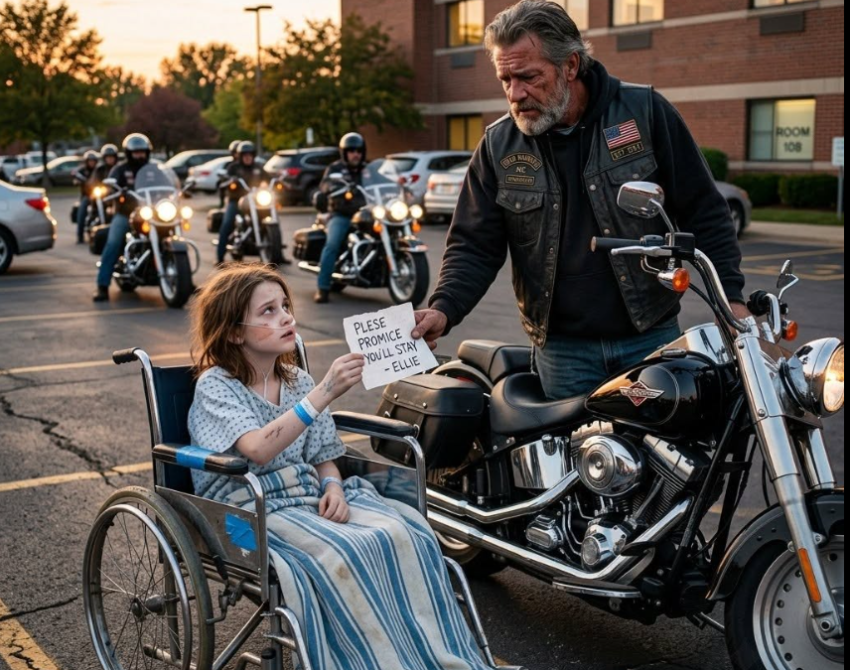
An 11-Year-Old Girl Rolled Up to My Harley With Oxygen Taped to Her Cheek and Whispered, “If You Leave, My Grandmother Dies to Silence”—Then She Handed Me a Note With Four Words I Hadn’t Seen in Decades.
At sunset, an eleven-year-old girl with oxygen taped to her cheek rolled between motorcycles, begging grown men to make enough noise for her dying grandmother to stop being afraid.
Every rider she asked started his engine and left, because grief is easiest to ignore when it belongs to a stranger.
Then she stopped beside my Harley, lifted a crumpled note like a white flag, and whispered, “If you leave, my grandmother dies to silence.”
I had one hand on the throttle and the other on a mind that liked to run.
That was how I had survived most of my life.
Keep moving.
Keep the engine warm.
Do not stay anywhere long enough for memory to catch up.
The sun was sliding toward the western ridge in that hard orange way it does when a day has already made up its mind. The parking lot outside Murphy’s Fuel & Diner was full of heat, exhaust, dust, and the kind of tired noise men make when they are pretending they are not lonely.
Bikes idled in uneven rows.
Chrome flashed.
Leather creaked.
Someone laughed too loudly near the pumps.
Someone else argued with the card reader like it had insulted his mother.
I had places to be.
I had already told myself that twice.
First, when I came out of the diner with bad coffee in one hand and saw the girl rolling toward the line of motorcycles.
Second, when she stopped beside a blue Road King and the rider looked away before she finished speaking.
I watched because old habits die harder than good intentions.
She was eleven, maybe twelve if life had made her small.
Her wheelchair squeaked every time she pushed the right wheel. The left one had a wobble in it, a tired little shiver that made the chair pull slightly to the side. Duct tape wrapped the armrest. The seat cushion had been patched with careful stitches, the kind sewn by someone who had more love than money.
A portable oxygen tank sat strapped behind her, and a clear tube ran beneath her nose, taped to one cheek with medical tape that had begun curling at the edges from sweat.
She moved from bike to bike.
Chrome to chrome.
Man to man.
Hope to rejection.
Some riders did not hear her because they did not want to.
Some heard and pretended not to.
A few shook their heads.
One said something with a smile that looked kind from a distance but made her shoulders sink.
Helmets went on.
Visors came down.
Engines barked and fled.
There are few sounds colder than a motorcycle leaving someone behind.
I told myself it was none of my business.
A man gets good at that sentence when he has used it often enough.
I had used it at wrecks I could not undo, hospital rooms I did not enter, funerals where I stood in the back and left before the food, birthdays I forgot on purpose because remembering hurt the wrong people.
I had used it in two marriages, three jobs, and more motel rooms than I cared to count.
None of my business had carried me across thirty-seven states.
It had not carried me well.
But it had carried me.
My bike was a black 1998 Harley-Davidson Road King with more miles than some men’s marriages. I had rebuilt the carburetor twice, replaced the clutch cable in a motel parking lot in Cheyenne, and kept the old fishtail pipes because I liked the way they sounded at half throttle on empty roads.
Real pipes.
Not loud for showing off.
Deep.
Steady.
A sound you felt in your ribs before you heard it with your ears.
The girl rolled toward me.
PART2:
I should have left before she reached my front tire.
I did not.
That failure to leave changed everything.
She stopped beside my Harley and looked up at me.
Not at the bike first.
At me.
That was the first thing I respected.
Most people see the machine before they see the man. Kids see the noise, the chrome, the size, the leather. Adults see whatever story they brought with them: danger, freedom, midlife crisis, trouble, grief, rebellion, stupidity, America, depending on who is doing the looking.
This child looked straight into my face.
Her eyes were dark and too tired for eleven.
Under them were gray half-moons. Her lips were pale. She had the stubborn set of jaw I had seen in old soldiers and sick children, the look of somebody whose body was losing arguments her spirit refused to concede.
In one hand, she held a crumpled note.
It shook like a white flag.
“My name is Ellie,” she said.
Her voice was quiet.
Not shy.
Quiet because breath was expensive.
“My grandma says the road is closing tonight. She wants to hear it one last time.”
I killed the engine.
The sudden quiet felt indecent.
Around us, the parking lot kept moving. A trucker slammed a door. A waitress stepped outside for a smoke. A rider at the far pump revved twice and rolled toward the exit. Somewhere inside the diner, a bell rang as somebody’s order came up.
But between the girl and me, the world narrowed.
“Who’s your grandma?” I asked.
Ellie unfolded the paper with both hands.
It took effort.
The note had been folded and unfolded so many times the creases had begun to tear. There was an address scrawled across the top, then four words written beneath in a neat, deliberate hand and underlined twice.
REDHAWK KEEPS HER PROMISE.
Beneath the words was a name I had not seen in print since the Carter administration.
Rose Morales.
I whistled before I could stop myself.
“Redhawk.”
Ellie nodded.
“You know her?”
PART3:
“Everybody who’s been out here long enough knows Redhawk,” I said. “Some of us because she saved us. Some because she pulled us out of messes we made. Some because we were smart enough to get out of her way.”
Her mouth trembled.
“She’s dying.”
The word landed flat in the warm air.
No decoration.
No softening.
No hospital phrase.
Dying.
“They said maybe tonight,” Ellie continued. “Maybe tomorrow. Her window faces the parking lot. Room 108. She told me, ‘Find someone with a real bike. Not a loud stereo. A real bike.’ She told me to find one of the old ones. She said they’d understand.”
I looked toward the intersection.
The riders who had left were red taillights now, gathering at the light before the highway.
Ten bikes.
Maybe eleven.
Men I knew by patch, by road, by reputation, or by the shape of their mistakes.
“Where’s your mother?” I asked.
Ellie looked down.
“Working a double.”
“In the hospital?”
“At the care home. Grandma was there before the hospital. Mom works laundry and kitchen both. She doesn’t know I left.”
I closed my eyes for half a second.
Great.
A sick child had escaped adult supervision to recruit motorcycles for a dying woman.
My life was already complicated, and the universe had apparently decided that was insufficient.
“She doesn’t want me around the bikes,” Ellie said.
“Your mother?”
She nodded, tugging lightly at the oxygen tube where it looped behind her ear.
“She says the sound is what wrecked our family. But it wasn’t the sound. It was a driver who ran a light.”
I looked at her then.
Really looked.
The patched chair.
The hospital band around her wrist.
The oxygen.
The note.
The way she sat with one hand pressed lightly against her ribs, as if holding pain in place.
“What happened?” I asked.
Her fingers tightened around the paper.
“My dad.”
The words came carefully, like she had learned each one had edges.
“He was the one in the accident. Grandma’s son. He was riding home. He… he never made it.”
I kept quiet.
Sometimes silence is the only tool you have that does not make damage worse.
“Grandma was the one who found him,” Ellie whispered.
Her eyes filled.
“She sat with him on the road until the ambulance came. Until the end. And she promised him.”
A semi rolled past on the frontage road, wind pushing dust through the parking lot.
Ellie blinked hard.
“She promised him she’d listen for his bike, so he’d know she was okay. And now…”
Her voice broke, a ragged little sound that made my hand tighten on the throttle grip.
“Now she’s scared. She told me she can’t go until she hears him coming for her. She’s waiting for his bike. She’s waiting to hear that sound. Please.”
She lifted the note higher.
“She just needs to hear the sound so she knows he found her.”
I looked at the paper again.
REDHAWK KEEPS HER PROMISE.
It was not a request.
It was a debt.
Redhawk was not asking for a promise to be kept.
She was keeping hers.
To her son.
I swung my leg off the bike and stood.
My knees reminded me I was not thirty, which was rude but accurate.
The girl tilted her head back to look at me.
“My grandma doesn’t need just one bike, Ellie,” I said.
Confusion passed across her face.
“But everyone else left.”
“They forgot what they were listening for.”
I put my helmet back on but left the visor up.
“You go to that window. Room 108. You tell her we’re coming.”
Ellie stared at me.
“We?”
I looked toward the red light.
The riders were still there, waiting to turn.
“They owe her too. Some just don’t remember yet.”
I did not wait for her reply.
I fired the engine.
This time, the sound was not escape.
It was a call.
I spun the Harley around, gravel kicking beneath the rear tire, and shot out of Murphy’s lot toward the intersection.
The light was still red when I caught them.
Ten bikes lined up in staggered formation.
Preacher was at the front, riding a midnight-blue Street Glide with a dented saddlebag he refused to replace because, according to him, “ugly teaches humility.” He was sixty, maybe sixty-two, though nobody knew for sure because he lied about his age differently depending on who asked. Tall, lean, gray ponytail, old Army tattoo on his neck, hands scarred from welding and bar fights he now claimed were youth ministry.
He saw me pull alongside him and frowned.
I flipped up my visor.
His annoyance disappeared before I spoke.
“What’s wrong, Mac?”
That was my name on the road.
Mac.
Short for Mackenzie Callahan, though almost nobody used the full thing unless they were holding legal paperwork or planning to disappoint me.
I did not yell.
I did not have to.
“Redhawk is dying,” I said. “Mercy Hospital. Room 108.”
The name traveled through the line like current through wire.
Helmets turned.
Shoulders shifted.
Engines seemed to quiet though none of them had changed speed.
Preacher stared at me.
“Rose Morales?”
I nodded.
“She’s waiting to hear her son’s bike.”
His face changed.
Not dramatically.
Men like Preacher do not let pain perform in public if they can help it.
But it moved through his eyes, old and immediate.
“Gabriel,” he said softly.
“Her granddaughter came to the lot. Oxygen tube. Wheelchair. Note in Redhawk’s hand.”
Preacher looked at the red light.
Then at the road leading out of town.
Then back toward the hospital district.
“She’s scared to go alone,” I said.
Preacher did not ask what that meant.
He knew.
We all knew, somewhere under the leather and gray hair and practiced disinterest, that dying alone was the thing every road person feared even if he joked about it. Out there, on a dark highway, in a motel room with bad carpet, in an ambulance before anyone knew your real name, in a hospital bed while the world kept traffic.
Nobody said anything for two seconds.
Then Preacher lifted one hand and pointed left.
Not toward the highway.
Toward Mercy.
The line turned as the light changed.
We did not go fast.
We did not split traffic.
We did not show off.
We rolled through Ridgeway’s edge streets like a funeral procession that had not yet admitted who it was carrying.
Ten Harleys.
Old iron.
Road wear.
Scratches.
Leather.
Men who had almost left because leaving was easier.
The sun slid lower, turning windows gold and power lines black. We passed the strip mall, the shuttered feed store, the laundromat with blue chairs visible through the glass, the little Pentecostal church where my second wife once dragged me for exactly three Sundays before deciding both God and I were too stubborn for that marriage to work.
I had known Rose Morales before she became Redhawk.
Not well.
Not enough.
But enough to understand why the note had hit Preacher like a hand around the throat.
Back in the seventies, Rose rode a red-and-black Shovelhead with feathers painted along the tank. Her hair was long and black then, usually braided down her back, her shoulders straight, her face serious until she laughed, and then everything softened except the eyes.
She wore a denim vest before women were common in most riding groups around here, and when men gave her trouble, she handled it with such cold precision they either apologized or learned to bleed quietly.
She earned the name Redhawk after a spring run through the canyon when a drunk rider clipped a guardrail and went over the side. It was Rose who climbed down first, cutting her hands raw on rock, keeping him awake until help arrived. She told him stories about hawks because she said scared men needed something better than sirens to listen for.
A few years later, she pulled Preacher out of a ditch after he dumped his bike drunk outside Livingston.
He told people he had chosen sobriety after a spiritual awakening.
Rose said the awakening was her slapping him until he vomited whiskey and shame.
Both versions were probably true.
She had a son named Gabriel.
Everyone called him Gabe.
Skinny kid.
Big grin.
Always wanting to sit on bikes when he was little, then always wanting to fix them when he got tall enough to reach things. He grew up around the old riders the way some kids grow up around uncles. Half the men in three counties taught him something they should not have: how to change oil, how to curse at stripped bolts, how to avoid cops, how to identify bad poker hands, how to drink coffee black before he was fifteen.
Rose pretended to hate it.
She was proud.
Gabe became a good rider.
Not flashy.
Smooth.
Respectful of road and machine.
The kind of rider who looked where he wanted to go and trusted the bike because he had earned its trust first.
He had a daughter young.
Ellie, apparently.
I had been gone by then.
That was my pattern.
In and out.
Disappear for years.
Return when the road bent me back.
I heard Gabe had died.
A red-light runner.
A pickup.
A wet intersection.
His mother found him before the ambulance.
I did not go to the funeral.
I told myself I was in Arizona.
That was true.
I told myself funerals were for close people.
That was cowardice.
Now Redhawk was dying, and an eleven-year-old child had rolled through a parking lot begging strangers to repair a silence people like me had helped create.
We reached Mercy Hospital at 7:18.
Mercy was a low brick building added onto so many times it looked like four different architects had lost arguments in different decades. The front entrance had a glass canopy and a circle drive where people cried in cars pretending they were checking phones. Behind the main wing sat the older south parking lot, closest to hospice rooms and overflow wards.
Room 108 faced that lot.
I knew because Ellie had told me.
We did not crowd the entrance.
We rolled to the far side and lined up directly beneath the first-floor windows. Preacher stopped first, angled his bike toward the building, and put it in neutral. The engine settled into that deep, rhythmic idle people describe badly as potato-potato because language has never done justice to an old Harley breathing.
The next bike pulled beside him.
Then the next.
Then all ten of us formed a long, shining, vibrating line under the windows.
No revving.
No shouting.
No spectacle.
Just engines.
Steady.
Alive.
A mechanical heartbeat in the twilight.
I was last.
I pulled up, shifted to neutral, and looked toward the window marked 108.
The curtains were open.
Inside, the light was dim.
Ellie was there, small silhouette in her chair, one hand pressed to the glass.
When she saw us, both hands flew up.
She turned back into the room, pointing, crying, smiling so wide I could see it from the lot.
I could not see Redhawk.
Not at first.
Just the edge of a hospital bed.
The shape of a nurse moving.
A wall lamp.
A vase with tired flowers.
A small framed picture on the window ledge.
I gave the throttle two sharp, respectful twists.
THROMP.
THROMP.
Not loud enough to be rude.
Loud enough to say:
We are here.
A nurse came to the window fast.
She had the face of a woman already tired of everyone’s foolishness and prepared to add motorcycles to the list. Her hair was pulled back tightly. Her badge swung against navy scrubs. She looked down at the line of bikes, irritation ready.
Then she saw Ellie.
Saw the girl crying with relief.
Saw the engines idling, not roaring.
Saw Preacher bow his head.
Saw me lift two fingers from the handlebar.
The nurse’s anger melted.
She turned back into the room.
Someone inside must have spoken.
The nurse looked down again, and her expression changed into something I have only seen on hospice workers and combat medics: sorrow disciplined by service.
She placed one hand on Ellie’s shoulder.
Then she nodded.
Once.
Permission.
Blessing.
Witness.
We sat there for five minutes.
Maybe ten.
Time moved strangely.
The sun dropped behind the ridge. Orange faded into violet. Hospital windows reflected the last light. A security guard stepped outside near the ER entrance, saw us, put one hand on his radio, then lowered it. A woman getting into a minivan stopped and covered her mouth. Somewhere in the distance, a siren rose and faded.
Our engines idled.
Ten Harleys breathing beneath a dying woman’s window.
No music could have done what that sound did.
Music belongs to everyone.
A motorcycle belongs to the person you are waiting for.
To Rose Morales, that sound was Gabe coming home.
Her son’s promise crossing the last stretch of road.
Her own promise answering it.
I looked at the darkening glass and thought about all the people I had left before they could ask me to stay.
My father, who died while I was on a run in Nevada.
My first wife, Karen, who said she was tired of being married to a man already halfway gone.
My second wife, Denise, who said I loved highways because they never expected me to apologize.
A friend named Lucas, who called me the night before he put a bullet in his garage wall and then himself, and I did not answer because I was tired and figured I would call back in the morning.
The road teaches freedom.
It also teaches avoidance if you let it.
A curtain moved in Room 108.
The nurse leaned over the bed.
Ellie turned toward us and pressed both hands to her heart.
Then the nurse reached up slowly and pulled the curtain closed.
Preacher killed his engine.
One by one, the bikes went silent.
This quiet was different from the one at Murphy’s.
That quiet had felt indecent.
This one felt peaceful.
Finished.
Not empty.
Full.
Ellie remained behind the curtain.
We all knew.
Redhawk was not scared anymore.
Her son had found her.
For a long time, none of us moved.
Then Preacher took off his helmet.
The others did too.
Faces emerged in the dim lot.
Hard faces.
Weathered faces.
Wet eyes hidden too late.
Preacher wiped his nose with the back of his glove and said, “She deserved more than ten bikes.”
“She asked for sound,” I said. “We brought what we remembered in time.”
He looked at me.
“I left the lot.”
“Yeah.”
“So did you almost.”
I nodded.
That was fair.
The hospital side door opened.
The nurse stepped out.
She looked smaller outside the window.
Tired.
Human.
She walked toward us across the lot.
Preacher straightened.
“Evening, ma’am,” he said.
The nurse looked at the line of bikes, then at us.
“Who organized this?”
I raised a hand slightly.
“Wasn’t exactly organized.”
She studied me.
Then nodded like that answer fit.
“Her name was Rose Morales?”
“Redhawk,” Preacher said softly.
The nurse smiled faintly.
“She heard you.”
Something in my chest tightened.
“Good.”
“She knew.”
The nurse looked toward the window.
“Her granddaughter told her you were coming. Rose kept asking, ‘Are they here yet?’ She was very weak, but when the engines started…”
The nurse paused.
“She smiled.”
Preacher looked away.
The nurse continued.
“She said, ‘That’s my boy.’ Then she said, ‘Tell them I kept it.’”
I closed my eyes.
Redhawk keeps her promise.
“She passed a few minutes later,” the nurse said. “Peacefully.”
The word did not feel like a lie that time.
Then her face hardened slightly.
“Now, the child.”
I opened my eyes.
“Ellie?”
“She should not have left the ward alone. She is medically fragile. Her mother is being contacted.”
That brought the real world back like cold water.
“What ward?” I asked.
The nurse hesitated.
“Pediatric observation. She was discharged from emergency earlier today but kept for monitoring while family arrangements were sorted. She left without permission.”
“She rolled herself all the way to Murphy’s?”
“It appears so.”
Murphy’s was nearly half a mile away.
Not far for a healthy adult.
Far for an eleven-year-old with oxygen and a bad wheelchair.
I looked toward the window.
“Can we see her?”
The nurse’s expression was complicated.
“You are strangers.”
Preacher said, “Not anymore.”
The nurse almost smiled.
“Hospital policy disagrees.”
“Hospital policy ride a bike?”
“No.”
“Then it’s not qualified.”
She gave him a look that had shut down better men.
Preacher wisely closed his mouth.
“I’ll ask,” she said.
Then she added, “One of you. Maybe two. Quietly.”
Everyone looked at me.
Of course they did.
I hated that.
“I’ll go,” I said.
Preacher stepped forward.
“And me.”
The nurse looked at him.
“Fine. But if either of you scares her mother, I will have security remove you.”
Preacher nodded solemnly.
“I am universally comforting.”
I coughed.
The nurse looked unimpressed.
“Try not to prove otherwise.”
She led us through the side entrance.
Hospitals smell the same everywhere.
Disinfectant.
Coffee.
Plastic tubing.
Fear.
We followed her down a pale hallway past a supply room, a nurses’ station, and a family waiting area where a man slept with his face in his hands.
Room 108’s door was partly open.
Inside, the bed was still occupied.
The curtain had been drawn.
Ellie sat near the window in her patched wheelchair, oxygen tube in place, shoulders shaking silently. A second nurse stood beside her. On the bed beyond the curtain, forms were being handled gently, machinery quieted, a life transitioned from person to paperwork.
The nurse who led us in said softly, “Ellie.”
The girl turned.
When she saw us, her face crumpled with relief and grief all at once.
“You came,” she whispered.
I crouched in front of her chair.
“Yeah.”
“Did she hear?”
Preacher’s voice was rough.
“She heard, sweetheart.”
Ellie pressed both hands over her mouth.
“She said he came?”
I looked at the curtain.
The nurse nodded.
“She said, ‘That’s my boy.’”
A sound tore out of Ellie that was too old for her body.
I did not know what to do with my hands.
Preacher did.
He took off one glove and held out his big scarred hand, palm up, giving her a choice.
Ellie stared at it.
Then she placed her small hand in his.
He closed his fingers gently around hers.
For a while, that was all.
Then footsteps rushed in the hall.
A woman appeared in the doorway wearing a faded green work uniform, hair coming loose from a bun, face pale with panic and exhaustion.
She looked at Ellie.
Then at us.
Then at the bed.
Her whole body stopped.
“Mamá?” she whispered.
The nurse moved to her quickly.
“Maria.”
Ellie began crying harder.
“Mom, I’m sorry.”
Maria Morales stood as if the room had tilted under her.
She was in her early thirties, maybe, though exhaustion made age meaningless. Dark hair. Sharp cheekbones. Eyes like Ellie’s but red-rimmed and furious with fear. She had the worn posture of someone who worked too many hours and slept in pieces. Her shoes were kitchen-safe black clogs. Her hands were chapped from laundry chemicals.
She looked from her daughter to Preacher and me.
“Who are they?”
Ellie tried to answer and coughed.
The nurse stepped in.
“Ellie went to find riders. Rose asked her to.”
Maria’s face twisted.
“You left the hospital?”
Ellie cried.
“I had to. Grandma said—”
“You could have died.”
“She was scared.”
“So was I!” Maria shouted.
The word cracked the room.
Then she covered her mouth, horrified by her own voice.
Ellie shrank.
I stood slowly.
“Ma’am,” I said, “it’s my fault.”
Maria turned on me.
“Your fault?”
“I should have brought her back first.”
“You should not have talked to her at all.”
“That’s probably true.”
Preacher looked at me, surprised I was accepting blame without sarcasm.
I ignored him.
Maria’s eyes flashed.
“My daughter has a heart-lung condition. She is on oxygen. She cannot just roll around town chasing motorcycles because my mother—”
Her voice broke.
Because my mother.
That was when grief reached her fully.
Not only fear for Ellie.
Not only anger at us.
Her mother was gone.
Maria turned toward the curtain.
The nurse took her arm.
For a moment, Maria resisted.
Then she folded.
Not collapsed exactly.
Folded inward, one hand over her mouth, shoulders shaking.
Ellie reached for her.
“Mommy.”
Maria went to her knees beside the wheelchair and pulled her daughter carefully against her.
They cried together.
Preacher and I stood in the corner like two useless fence posts.
After a while, Maria looked up at us.
Her anger had not disappeared.
It had been joined by something more complicated.
“She hated motorcycles after Gabe died,” she said.
Ellie sniffed.
“No, Mom. You did.”
Maria closed her eyes.
The truth had landed in a place both of them knew.
“My husband died on one,” she said to me.
“No,” Ellie said, small but fierce. “A truck killed him.”
Maria looked at her daughter.
Ellie’s chin trembled, but she did not look away.
“Grandma said that too,” Ellie whispered. “She said we blamed the sound because we couldn’t punish the silence after he was gone.”
The room went still.
Redhawk had saved her sharpest truth for a child.
Maria bowed her head against Ellie’s knees.
“I couldn’t listen to them,” she whispered. “Every engine sounded like the call that told me he wasn’t coming home.”
Preacher’s voice was soft.
“We understand.”
Maria looked up bitterly.
“Do you?”
I thought about Lucas.
About unanswered calls.
About running.
“Some of us do,” I said. “Some of us are still learning.”
Maria looked at me for a long second.
Then turned toward the closed curtain.
“My mother asked for you?”
“Your daughter found us,” I said.
“No.”
Maria wiped her face.
“Rose asked.”
“She wrote a note.”
Ellie lifted the crumpled paper.
Maria took it carefully.
Her hands shook when she saw the handwriting.
REDHAWK KEEPS HER PROMISE.
Maria made a sound almost like a laugh, but broken.
“She used to write everything like a threat.”
“She meant most of it that way,” Preacher said.
Maria looked at him then.
“You knew her?”
Preacher nodded.
“She pulled me out of a ditch and slapped me sober in 1984.”
Despite everything, Maria smiled faintly.
“That sounds like her.”
“She saved my life.”
“She saved a lot of men who didn’t deserve it,” Maria said.
Preacher bowed his head.
“Yes, ma’am.”
The nurse cleared her throat gently.
“Maria, we need to move Ellie back to observation soon.”
Maria nodded.
Ellie clutched the note.
“Can they come?”
Maria’s first instinct was no.
I saw it.
Fear rose in her face like a wall.
Motorcycles had taken her husband in her mind, whether she admitted it or not. Men like us carried that sound. That shadow. That risk. And her daughter, fragile and grieving, had just crossed town because an old woman had trusted that sound more than hospital quiet.
Maria looked at me.
“What’s your name?”
“Mac.”
“Real name.”
“Mackenzie Callahan.”
“Do you have children?”
“No.”
That answer came too fast.
It was true, mostly.
No children living in my house.
No one calling me Dad.
No one expecting me on birthdays.
But life is rarely that clean.
Maria heard something in my answer and did not press.
She looked at Preacher.
“You?”
“Three. Two still speak to me.”
That almost made her smile again.
She looked back at Ellie.
Then sighed.
“Five minutes in the hallway. No engines. No stories that make motorcycles sound magical.”
Ellie opened her mouth.
Maria raised one finger.
“I mean it.”
Preacher placed one hand over his heart.
“I will make motorcycles sound deeply practical.”
Maria’s eyebrow lifted.
I said, “He won’t.”
She looked at me, and for the first time, I saw the faintest trace of Redhawk in her face.
“Five minutes,” she repeated.
Five minutes became twenty.
Not because we ignored her.
Because Maria stayed.
We sat in the family waiting room outside the ward while nurses handled what they had to handle in Room 108. Ellie sat beside her mother, blanket around her shoulders, oxygen machine humming softly.
Preacher told a story about Rose fixing a broken throttle cable with a shoelace and a hairpin.
Maria tried not to listen.
Failed.
Ellie’s eyes widened.
“She really did that?”
“She also called me an idiot in three languages,” Preacher said.
“Grandma spoke three languages?”
“Two and a half. The third was profanity.”
Maria laughed then.
A real laugh.
Small.
Startled.
Immediately followed by tears.
Ellie leaned against her.
“Tell me about Dad,” she whispered.
Maria stiffened.
Every adult in the little waiting room felt the shift.
This was not a question about motorcycles.
It was the question underneath all of them.
Maria looked at us, as if deciding whether to remove witnesses.
Then maybe she understood that witnesses were why Ellie had survived the night.
“Your dad,” Maria said slowly, “used to sneak out to the garage when he was supposed to be doing homework.”
Ellie’s face softened.
“He did?”
“Yes. Your grandma would yell, ‘Gabriel Morales, that engine better not be in pieces before dinner.’”
Preacher nodded.
“Usually was.”
Maria pointed at him.
“You are not helping.”
“Yes, ma’am.”
Maria continued.
“He loved machines because they made sense to him. People were harder. Engines told him what was wrong if he listened closely.”
That sentence hit me in a place I did not expect.
Engines tell you what is wrong if you listen.
People do too.
I had just spent most of my life keeping my helmet on.
Ellie looked at me.
“Did you know my dad?”
“Not well,” I said.
That was honest.
“I remember him as a kid around the garages. Skinny. Always asking questions.”
“Was he nice?”
I thought.
“Curious.”
Maria smiled faintly.
“That’s true.”
“Being curious can become nice if a person grows into it.”
“He did,” she said.
Then she told Ellie more.
How Gabe once rode twenty miles in rain to bring her soup when she had the flu, only to spill half of it in his saddlebag. How he cried when Ellie was born because he said babies looked too breakable. How he used to put tiny ear protectors on her when she was a toddler and start his bike just so she could feel the vibration from the porch.
Maria’s voice shook, but she kept going.
Ellie drank every word like medicine.
I understood then that Redhawk had not only asked for engines because she was afraid to die.
She had asked because her family had buried Gabe under silence.
And silence had begun killing more than memory.
At 9:02, the nurse told us Ellie needed rest.
Maria stood.
The night had aged her.
Or maybe grief had simply removed the uniform of urgency, revealing the exhaustion underneath.
She looked at me.
“I don’t know whether to thank you or be angry.”
“Both is fair.”
She nodded.
“I am both.”
“Also fair.”
“Did my mother suffer?”
The question came suddenly.
The nurse was still nearby, but Maria asked me.
Maybe because I had been outside the window.
Maybe because she needed the answer from the sound.
“No,” I said. “Not at the end.”
“You don’t know that.”
“No,” I admitted. “But I know what her face did to the nurse.”
Maria stared.
“What do you mean?”
“The nurse came out ready to yell at us. Afterward, she looked peaceful. That tells me something.”
Maria swallowed.
Ellie reached for me.
I hesitated.
Then bent down.
She hugged me around the neck with thin arms and careful strength.
Her oxygen tube brushed my cheek.
“Thank you, Mac,” she whispered.
I froze.
I had been hugged by women, brothers, drunk strangers, dying friends, men coming home from prison, dogs if you count enthusiasm. But an eleven-year-old child thanking me for bringing motorcycles to a deathbed undid something I had long considered permanent.
I patted her back awkwardly.
“You did the hard part,” I said.
“What?”
“You asked.”
She pulled back.
“That was scary.”
“Most important things are.”
Maria watched us.
Her face was unreadable.
Then she said, “Good night.”
It was dismissal and permission both.
Preacher and I returned to the parking lot.
The other riders were still there.
Nobody had left.
They stood beside their bikes in small groups, smoking, leaning, staring at the hospital windows. When we approached, they straightened.
Preacher told them.
Rose was gone.
She heard.
She smiled.
She said, “That’s my boy.”
No one spoke for a long while.
Then Preacher said, “Funeral?”
“I’ll ask,” I said.
He looked at me.
“You?”
“Yeah.”
That surprised both of us.
I rode home alone after midnight.
The road out of Ridgeway was dark, the kind of dark where the headlight becomes a narrow truth and everything outside it belongs to deer, ghosts, and bad decisions. Cool air moved under my jacket. The engine settled into rhythm.
The places I had to be no longer mattered.
Truth was, they never had.
A bar two towns over.
A couch at a friend’s shop.
A motel if I felt like being private.
I had built my whole evening around avoiding the empty apartment above Barker’s Garage where I rented two rooms because owning a house felt too much like admitting I intended to stay alive.
I rode past the turn to the bar.
Past the highway ramp.
Past the motel.
I ended up at the overlook above Ridgeway, where the town lights spread below like fallen stars.
I shut off the bike.
The silence rolled in.
This time, it did not feel peaceful.
It felt like waiting.
I took out my phone.
There was one missed call from my sister, Angie.
Three weeks old.
I had not called back.
There was a message from Preacher in the group thread.
Rose Morales funeral details pending. Family may need help. Stand by.
There was an old voicemail saved under Lucas’s name.
I had not played it in eleven years.
I almost did.
Then I did not.
Cowardice does not vanish in one good act.
But it weakens if you keep looking at it.
The next morning, I went back to Mercy.
Not on purpose, I told myself.
I needed coffee from the cafeteria because Murphy’s was out of the way.
That was a lie.
Maria was in the lobby arguing with a billing clerk.
I recognized her voice before I saw her.
“No, I understand the balance. I’m asking why hospice transfer charges are showing twice.”
The clerk looked exhausted.
Maria looked past exhausted into the wild-eyed place where grief, poverty, and bureaucracy form a three-headed dog.
Ellie sat nearby in her chair, bundled in a sweater too warm for the lobby, oxygen beside her, watching her mother try not to fall apart.
I stood near the vending machines for a moment, deciding whether to interfere.
Then Ellie saw me.
“Mac!”
Maria turned.
Her expression immediately became complicated.
“Morning,” I said.
Maria looked at the papers in her hand.
Then at me.
“Are you following us?”
“No.”
Ellie raised an eyebrow.
I sighed.
“A little.”
Maria surprised me by laughing once.
It came out tired.
“Of course.”
The billing clerk took the papers and disappeared through a side door, probably grateful for escape.
Ellie rolled closer.
“We’re planning Grandma’s funeral,” she said.
Maria closed her eyes.
“Ellie.”
“What? We are.”
Children name things because adults make them heavier by hiding them.
I crouched.
“Do you need bikes?”
Maria answered immediately.
“No.”
Ellie said, “Yes.”
They looked at each other.
Old war.
Fresh battlefield.
Maria folded her arms.
“My mother wanted engines at the end. She got them. The funeral can be normal.”
Ellie’s face hardened in the same stubborn line I had seen at the gas station.
“Grandma wasn’t normal.”
Maria flinched.
“She was my mother.”
“She was Redhawk.”
“She was both,” I said.
They turned to me.
I regretted speaking and continued anyway.
“She was both,” I repeated. “Maybe the funeral should be both too.”
Maria stared at me.
“You know, for a man who says very little, you choose inconvenient moments.”
“That has been mentioned.”
Ellie smiled.
Maria did not, but some anger drained from her shoulders.
“I don’t want a circus,” she said.
“Then don’t have one.”
“I don’t want men revving engines like they’re at a rally.”
“They won’t.”
“I don’t want Ellie overwhelmed.”
“Fair.”
“I don’t want to feel like the thing that killed Gabe is standing over my mother’s grave.”
There it was.
The truth with its skin off.
I looked at Maria.
“A truck killed Gabe.”
Her eyes flashed.
“Don’t.”
“Ellie said it. Rose said it. You know it.”
“You don’t get to tell me what killed my husband.”
“No,” I said. “I don’t.”
We stood there in the hospital lobby, people moving around us with coffee, forms, flowers, fear.
“I don’t,” I repeated. “But I can tell you what didn’t. The sound didn’t. The machine didn’t. The road didn’t decide to take him. A man ran a red light.”
Maria looked away.
Her jaw trembled.
I softened my voice.
“I’m not saying that makes it hurt less.”
“It doesn’t.”
“I know.”
“No, you don’t.”
Maybe she was right.
Maybe each grief remains its own country, and nobody gets citizenship through comparison.
But I had a passport stamped with enough loss to recognize the border.
“My friend Lucas called me the night before he died,” I said.
I did not know I was going to say it until the words were already in the lobby.
Preacher would have called that God.
I called it poor impulse control.
Maria looked back.
Ellie became very still.
“I didn’t answer,” I continued. “I was tired. I figured I’d call him in the morning. In the morning, he was gone.”
The hospital seemed to quiet around us.
“For years, I hated phones,” I said. “Like the phone killed him. Like the ringing was the problem. But it wasn’t the phone.”
Maria’s eyes filled slowly.
“It was the silence after,” she whispered.
I nodded.
She understood.
Of course she did.
We stood there with that between us.
Not fixed.
Never fixed.
But named.
Finally, Maria looked at Ellie.
“No circus,” she said.
Ellie’s face lit.
Maria pointed at her.
“No arguing. I said no circus.”
Ellie nodded too fast.
“Just a few?”
Maria looked at me.
“How many is a few?”
I thought of Preacher’s group thread already filling with names.
“Depends who counts.”
Her eyes narrowed.
“Mac.”
“We can keep it respectful.”
“How many?”
I did not answer.
Ellie smiled.
Maria groaned.
Rose Morales was buried three days later under a sky the color of old denim.
The church was small, white, and leaned slightly to the left, which Preacher said showed character and a lack of building permits. Maria chose simple flowers. Ellie chose a framed photograph of Rose on her red-and-black Shovelhead from 1978, braid over one shoulder, one boot on the ground, eyes daring the photographer to become a problem.
The funeral home expected maybe thirty people.
Maybe fifty.
By ten in the morning, motorcycles lined three blocks.
Not loud.
Not chaotic.
Parked with care.
Old riders came from towns I had forgotten existed.
Women with gray braids and leather vests.
Vietnam vets.
Younger riders whose fathers had told them Redhawk stories.
Mechanics.
Retired cops.
Former drunks.
Club riders.
Independent riders.
Men who had been slapped sober, hauled out of ditches, defended in bars, fed after funerals, and forgiven for things they still did not forgive themselves for.
Maria stood in the church doorway, frozen.
Ellie sat beside her in the wheelchair wearing a black dress and a tiny red hawk pin someone had found overnight.
She whispered, “No circus.”
Maria looked down the street.
At bikes.
At bowed heads.
At men and women standing quietly with helmets in hand.
At a community she had spent years avoiding because grief had made the sound unbearable.
“No,” Maria said softly. “Not a circus.”
Preacher walked up carrying a small folded flag.
Not an American flag.
A red bandana with a black hawk embroidered on it.
“Rose’s,” he said.
Maria touched it.
“She still had this?”
“She gave it to me in 1984 after I got sober. Told me to keep it until I became someone useful.”
Maria looked at him.
“Did you?”
Preacher smiled sadly.
“Some days.”
Maria took the bandana.
At the graveside, we did not rev.
We did not roar.
We stood in silence while the priest spoke about Rose Morales, mother, grandmother, friend, woman of courage.
Nice words.
Too small.
Funerals are full of too-small words.
Then Maria stepped forward.
She had not planned to speak. I could tell by the way she held the paper folded but never looked at it.
“My mother loved the road before I understood what that meant,” she said.
Her voice shook.
“She raised my brother and me with more strength than softness, though I think now maybe strength was how she hid softness. She loved my husband Gabe like a son, then buried him like one. After he died, I thought motorcycles stole him from us.”
She paused.
Ellie reached for her hand.
Maria took it.
“But my mother knew better. She knew the sound I hated was also the sound my husband loved. The sound of people coming home. The sound of people showing up. In her last moments, she asked for that sound, and it came.”
She looked toward the riders.
“Thank you for bringing him to her.”
Several men bowed their heads.
I looked at the ground.
Then Ellie spoke.
Nobody expected it.
She rolled forward slightly, oxygen tank humming behind her.
“My grandma told me Redhawk keeps her promise,” she said.
The wind moved through the cemetery trees.
“She kept it. So now we have to keep ours.”
Maria blinked.
“What promise, honey?”
Ellie lifted her chin.
“To not let the sound die.”
Nobody moved.
That little girl had a way of handing adults responsibilities without asking whether their hands were free.
After the burial, the riders formed an escort.
Maria had agreed to ten bikes.
She got eighty-six.
Preacher called that a rounding error.
But we did it right.
Slow.
Controlled.
No throttle games.
No show.
Rose’s casket had been carried by family and old riders, including Preacher and two women who had ridden with her decades ago. After the service, the bikes escorted Maria and Ellie back to the church hall.
For the first time since Gabe’s death, Maria did not cover her ears when the engines started.
She flinched.
But she stood there.
Ellie reached up and took her hand.
Together, they listened.
That should have been the end of my involvement.
A good deed.
A funeral.
A memory.
Back to the road.
Back to my apartment above Barker’s Garage, where the sink leaked and the refrigerator made a sound like a distant argument.
But grief has a way of assigning work without consulting schedules.
The following week, Ellie called me.
I did not know how she got my number.
Then I remembered Preacher believed privacy was a suggestion when families needed help.
“Mac?”
“Yeah.”
“It’s Ellie.”
“I guessed.”
“Mom is mad.”
“That narrows nothing.”
“She says I can’t go to the garage.”
“What garage?”
“The one Grandma used to go to. Redhawk Garage. It’s closed now, mostly. Uncle Mateo used to run it before he moved. Grandma still had keys. She said Dad’s bike parts were there.”
I rubbed my forehead.
“Ellie.”
“I want to see them.”
“Your mother said no.”
“She says no because she’s scared.”
“She’s your mother. Scared counts.”
“She works until six.”
“Ellie.”
“I’m not asking you to sneak me.”
“That is exactly what this feels like.”
“I’m asking you to come with me so it’s not sneaking.”
That was child logic.
Dangerous because it contained one clean line of truth.
“Ask your mother.”
“She’ll say no.”
“Then the answer is no.”
Silence.
Then Ellie said, “You said most important things are scary.”
I closed my eyes.
“I hate being quoted.”
“Is that a yes?”
“No. It’s me hating being quoted.”
She coughed.
Not dramatic.
Not manipulative.
Just a real, chest-deep cough that went on too long.
“Are you okay?” I asked.
“Mostly.”
“Where are you?”
“Home.”
“Is your oxygen on?”
“Yes.”
“Where’s your mom?”
“Work.”
Of course.
I looked around the garage office where Barker, my landlord, was asleep in a chair with a parts catalog open on his chest. Outside, rain hit the metal roof.
“Give me your address,” I said.
“I thought you said no.”
“I said give me your address. Those are different sentences.”
I went to Maria first.
Her double shift ended at the care home at 6:20. I waited outside near the employee entrance feeling like a man about to be scolded by a woman half his size and twice as tired.
She came out carrying a canvas bag, hair pulled back, shoulders sagging.
When she saw me, her expression hardened.
“No.”
“I haven’t said anything.”
“You are standing near my job with that face.”
“What face?”
“The face of a man who got talked into something by my daughter.”
I respected her more every time she spoke.
“She wants to see Redhawk Garage.”
Maria looked away.
“No.”
“Okay.”
That surprised her.
“Okay?”
“You’re her mother.”
She studied me.
“Why are you here then?”
“Because she’s going to try somehow. Better to make it safe or explain it together.”
Maria’s eyes closed.
“She is exactly like Gabe.”
“That sounds exhausting.”
“It is.”
She leaned against the brick wall.
“I can’t go there.”
“To the garage?”
“No.”
“Since the accident?”
Her jaw tightened.
“Yes.”
Rain fell harder.
Cars hissed past on the street.
Maria spoke without looking at me.
“Gabe worked there with my mother. After he died, I went once to pick up paperwork. His gloves were on the bench. His coffee mug. A grease mark on the wall where he leaned. I couldn’t breathe.”
I knew that kind of room.
A room where absence waits with objects in its hands.
“Ellie deserves to know him,” I said quietly.
Maria turned on me.
“She deserves to live.”
“She’s trying.”
“She doesn’t know what it costs.”
“Yes,” I said. “She does.”
Maria flinched.
I regretted the sharpness but not the truth.
The child had an oxygen tube taped to her cheek. She knew more about cost than some adults learn in seventy years.
Maria looked toward the rain.
“If I take her there, she will want the bike.”
“Gabe’s?”
Maria nodded.
“It’s still there?”
“As far as I know. My mother kept it. Wouldn’t sell. Wouldn’t move it. Said it was waiting.”
“For what?”
Maria laughed once, bitter and broken.
“Apparently for all of us to stop being cowards.”
The next evening, we went to Redhawk Garage.
Together.
Maria drove Ellie in an old minivan with a wheelchair ramp that groaned like an animal in pain. I followed on my Harley. Preacher came too, uninvited and therefore right on time.
The garage sat on the edge of town near the old rail spur.
Red brick.
Faded sign.
REDHAWK GARAGE & CYCLE REPAIR.
The painted hawk on the sign had peeled at the wings but still looked mean enough to defend the place. Weeds had pushed through cracks in the lot. A chain hung across one bay door, but the side door lock was new enough that someone had maintained it.
Maria stood with the key in her hand for a long time.
Ellie waited in her chair, silent.
Preacher leaned against his bike, unusually quiet.
Finally, Maria unlocked the door.
The smell came first.
Oil.
Rubber.
Dust.
Metal.
Old coffee.
Memory.
The lights flickered when Maria found the switch.
Inside, the garage looked like time had paused mid-sentence.
Tools on pegboards.
A hydraulic lift.
A calendar from the year Gabe died.
Parts bins labeled in Rose’s handwriting.
A red bandana tied around the handle of a rolling toolbox.
And under a gray cover near the back wall, a motorcycle.
Ellie made a small sound.
Maria did not move.
I walked to the covered bike and looked back.
“May I?”
Maria’s throat moved.
She nodded.
I pulled the cover slowly.
Gabe’s bike was a 2003 Harley-Davidson Dyna Super Glide.
Deep burgundy paint.
Black leather seat.
Chrome dulled by years under cover.
A small scratch across the tank.
A tiny sticker on the rear fender:
ELLIE RIDES SHOTGUN SOMEDAY.
Ellie saw it.
Her hand flew to her mouth.
Maria turned away.
Preacher bowed his head.
I checked the tires.
Flat.
Battery dead.
Fuel old.
Dust everywhere.
But the bike was whole.
Waiting.
Ellie whispered, “He wrote my name.”
Maria answered without turning around.
“He put that there when you were two.”
“Did I ride?”
“No.”
“Why?”
“Because I said absolutely not.”
A small smile pulled at Ellie’s mouth.
“Good job, Mom.”
Maria laughed through tears.
Then cried fully.
Ellie rolled toward her mother and pressed against her legs. Maria sank to the floor beside the wheelchair and pulled her close.
“I’m sorry,” Maria whispered. “I’m sorry I locked him away from you.”
Ellie touched her mother’s hair.
“I’m sorry I left the hospital.”
“That was terrifying.”
“I know.”
“Don’t ever do it again.”
“I probably won’t.”
“Ellie.”
“I won’t.”
Preacher walked around the garage pretending to inspect sockets.
I stood beside Gabe’s bike and felt the old machinery of my own avoidance grinding inside me.
Maybe every garage holds the same question.
What are you keeping alive?
What are you burying standing up?
Over the next month, we cleaned Redhawk Garage.
Not as a plan.
Plans make things easy to quit.
We just kept showing up.
At first, Maria came only when Ellie begged.
Then she came because there were boxes to sort.
Then because coffee appeared.
Then because Rose’s life was in those drawers and cabinets, and grief is less impossible when it can be labeled.
Preacher found old photos.
Rose at twenty-five with her Shovelhead.
Gabe at sixteen with grease on his nose.
Maria and Gabe on their wedding day, standing beside the burgundy Dyna with cans tied to the back because Rose said no son of hers was leaving a reception in a rental sedan.
Ellie kept that photo.
I rebuilt the wheelchair ramp outside the side door because the old one was steep enough to qualify as a threat.
Mateo came one Saturday, broad and quiet, carrying three boxes of parts and five years of guilt for staying away. He hugged Maria like both of them were apologizing without choosing words.
Barker donated a battery.
A parts hoarder named Hank Bell found tires for the Dyna.
Preacher rebuilt the brakes.
I cleaned the carburetor.
Maria refused to watch at first.
Then stood by the door.
Then inside with her arms folded.
One evening, Ellie sat beside Gabe’s bike and said, “Can it run again?”
Maria inhaled.
I looked at her.
She looked at the bike.
Then at Ellie.
Then at me.
“Can it?” she asked.
“Yes,” I said. “Not today. But yes.”
Ellie’s eyes shone.
Maria closed hers.
“Then make it safe first.”
That was as close to permission as we were going to get.
We made it safe.
Painstakingly.
No shortcuts.
New tires.
New brake lines.
Fluid flushed.
Fuel drained.
Tank inspected.
Carb rebuilt.
Cables checked.
Battery replaced.
Electrical tested.
Fork seals replaced.
Every bolt touched.
Every system reviewed.
Gabe’s bike became a bridge.
Not just between father and daughter.
Between Maria and the sound.
At first, when we started engines in the garage, Maria stepped outside.
Then she stood by the door.
Then inside with her arms folded.
The first time Gabe’s Dyna turned over, it coughed, sputtered, backfired loud enough to make Ellie squeal, then died.
Maria laughed before she could stop herself.
The second time, it caught.
The sound filled Redhawk Garage.
Deep.
Uneven for a moment.
Then steady.
Maria covered her mouth.
Ellie cried.
Preacher looked away.
I stood with one hand on the throttle and felt the floor vibrate beneath my boots.
Not Gabe.
Not replacement.
Not resurrection.
But memory with combustion.
Maria walked slowly toward the bike.
I stepped back.
She placed one hand on the tank.
Her fingers trembled.
“I hated you,” she whispered to the machine.
No one spoke.
“I hated you because he loved you and because you came back without him. But that wasn’t fair, was it?”
The engine idled.
Maria wiped her face.
“No,” she said softly. “It wasn’t.”
From then on, the garage became a place people came.
Old riders at first.
Then neighborhood kids curious about tools.
Then veterans needing somewhere to drink coffee without explaining why they were quiet.
Then families connected through hospice.
The nurse from Mercy, Angela Brooks, stopped by one afternoon with a tray of cookies and said, “I figured if motorcycles could serve as palliative care, I should inspect the facility.”
Preacher loved that phrase.
Palliative care with horsepower.
Angela became a regular.
So did Ellie.
Her health remained fragile.
That was the truth nobody romanticized.
Some days she was bright, bossy, and full of questions about torque, pistons, road trips, and whether oxygen tanks could be mounted on sidecars.
Other days, she could not leave bed.
There were hospital visits.
Scares.
Medication changes.
Insurance problems.
Maria’s work schedule was brutal, and grief did not pay bills.
The riders helped.
Not in big dramatic ways at first.
Gas cards.
Grocery deliveries.
Fixing the van ramp.
Covering a utility bill quietly through the church office.
Driving Maria when her car failed.
Installing a proper wheelchair ramp at their apartment.
Replacing Ellie’s duct-taped chair through a veterans charity Preacher knew.
Maria fought help hard.
Of course she did.
Pride is often the last possession people have not pawned.
One night in Redhawk Garage, she found out someone had paid the overdue electric bill.
She stood in the doorway holding the receipt.
“Who did this?”
Everyone became extremely interested in tools.
“Mac.”
I looked up from Gabe’s bike.
“What?”
“Did you do this?”
“No.”
Technically true.
I had given the money to Preacher, who gave it to Angela, who arranged it through a hospice fund. This is why chains of evidence matter.
Maria’s eyes narrowed.
“I don’t want charity.”
Preacher said, “Good. We don’t offer any.”
She turned on him.
“What do you call this?”
“Maintenance.”
“Of my electric bill?”
“Of the family.”
Her mouth opened.
Closed.
Ellie, from her new wheelchair, said, “Grandma said you have to let people keep promises.”
Maria looked at her daughter.
“That child is too armed with dead women’s wisdom,” Preacher muttered.
He was right.
Maria kept the receipt.
She did not say thank you that night.
The next week, she brought a pot of arroz con pollo to the garage and fed everyone like she was angry at hunger itself.
That was thank you in a language we all understood.
I changed too.
Not in a movie way.
No lightning.
No sudden redemption.
I still woke some mornings wanting to leave town before anyone learned to expect me. I still rode alone when the apartment walls got too close. I still let calls go unanswered longer than I should.
But I began answering some.
First Preacher.
Then Maria.
Then my sister Angie.
That call was the hardest.
She answered on the fourth ring.
“Well,” she said. “He lives.”
“Yeah.”
“Good to know.”
“I’m sorry.”
Silence.
Then: “For which part?”
I almost made a joke.
I did not.
“All of it.”
My sister exhaled.
“That’ll take a while.”
“I know.”
“You sick?”
“No.”
“In jail?”
“No.”
“Dying?”
“Not today.”
“Then why call?”
I looked across Redhawk Garage at Ellie laughing while Preacher tried to teach her the difference between a socket wrench and a ratchet with more seriousness than the topic deserved.
“Because I heard an engine at a hospital and realized I had gotten too good at leaving.”
Angie was quiet for a long time.
Then she said, “That sounds like something therapy would charge for.”
I laughed.
She did too.
It was small.
It was a start.
Lucas’s voicemail took longer.
I played it one rainy night in the garage after everyone left.
The message was eleven years old.
Static.
A breath.
“Mac. It’s me. Just… call me when you get this, yeah? I’m tired, man. I’m real tired.”
That was all.
I played it once.
Then again.
Then I sat on the concrete floor with my back against Gabe’s Dyna and cried the way I should have cried years earlier.
Not because crying fixed it.
Because I had finally stopped treating the voicemail like a bomb and let it become what it was.
A friend asking not to be alone.
I had failed him.
That truth remained.
But after Redhawk’s window, I understood something else too.
A failure does not get better because you keep driving away from it.
It waits at every red light.
One evening, Maria found me sitting there.
She did not ask what happened.
She sat beside me on the floor, knees drawn up, shoulder just touching mine.
For a while, neither of us spoke.
Then she said, “Gabe left a voicemail too.”
I looked at her.
“The night before the accident,” she said. “He was running late. Said he’d bring milk. Said he loved me. I listened to it every day until I hated hearing his voice because it always ended.”
I nodded.
“What did you do?”
“Deleted it.”
That hit me.
“Do you regret it?”
“Every day.”
I looked down at my phone.
Lucas’s name glowed on the screen.
Maria touched my wrist.
“Don’t delete it because it hurts.”
“What if keeping it does?”
“Then let it hurt honestly.”
So I kept it.
Maria and I did not fall in love quickly.
This is not that kind of story.
Pain brought us near each other, but pain is not enough to build anything safe. She had a dead husband, a sick child, two jobs, and a mother newly buried. I had a life built around exits and emotional furniture made entirely of road maps.
We became something quieter first.
Reliable.
That word scared me more than love.
Love, men like me could romanticize.
Reliable required calendars.
Doctor visits.
Oil changes.
School pickups.
Sitting in hospital waiting rooms without making a joke sharp enough to create distance.
Showing up at Redhawk Garage even when I wanted to ride west until the state changed under my tires.
Ellie forced reliability on everyone around her.
Not through manipulation.
Through need.
One Tuesday, she called from school because her oxygen regulator malfunctioned and Maria could not leave work immediately.
I got there in twelve minutes.
The school secretary stared at me like I was a crime scene with boots.
“I’m here for Ellie Morales,” I said.
“Are you family?”
The word caught.
Ellie appeared from the nurse’s office before I answered.
“He’s Mac,” she said. “He’s road family.”
The secretary had no form for that.
She called Maria.
Maria approved.
Barely.
I drove Ellie to the clinic in my truck, oxygen tank secured, wheelchair folded badly in the back because I had not yet mastered the latch. Ellie corrected me the whole way.
“You drive like a biker.”
“That is accurate.”
“It is not a compliment.”
“I gathered.”
At the clinic, she held my hand while a respiratory therapist adjusted the device.
She did not mention it afterward.
Neither did I.
Some forms of trust prefer not to be looked at directly.
The first time Maria invited me to dinner, Preacher said, “Don’t ruin it.”
I asked how.
He said, “By being yourself too aggressively.”
Fair.
Dinner was at Maria and Ellie’s apartment.
Small.
Second floor, though the building had a ramp only because the riders had installed one after threatening the landlord with permits. The kitchen table had three chairs and one folding stool. The walls held photos of Rose, Gabe, Ellie, and now one picture of the night under Room 108’s window, taken by a nurse from inside the room.
Ten bikes below.
Sunset glass.
Ellie’s hand pressed to the window.
Maria cooked enchiladas.
I brought flowers because my sister told me not to bring motorcycle parts.
Ellie opened the door.
“Are those for Mom?”
“Yes.”
“She likes yellow.”
“They’re yellow.”
“Good job.”
Maria came from the kitchen wiping her hands.
When she saw the flowers, her expression softened and became guarded immediately afterward.
“Thank you.”
“You’re welcome.”
Dinner was awkward for seven minutes.
Then Ellie asked if I had ever been arrested.
Maria choked.
I said, “Not convicted.”
Ellie’s eyes widened.
Maria pointed a fork at me.
“Wrong answer.”
“It was accurate.”
“Try age-appropriate accuracy.”
I looked at Ellie.
“Yes, once. Disorderly conduct. I was younger and dumber.”
“What did you do?”
“Argued with a parking meter.”
Preacher would have been proud of the lie.
Maria’s eyebrow told me she knew it was one.
Ellie accepted it.
The evening ended with coffee on the small balcony while Ellie fell asleep on the couch. Down below, cars passed, and somewhere far away a motorcycle moved through the night.
Maria tensed at the sound.
Not as much as before.
But enough.
I noticed.
She noticed me noticing.
“Still happens,” she said.
“Yeah.”
“I hate that it still happens.”
“Things don’t stop hurting on schedule.”
She looked at me.
“You sound like Angela.”
“Hospice nurse wisdom is contagious.”
Maria smiled faintly.
“I went to Gabe’s bike yesterday.”
“At the garage?”
She nodded.
“Alone.”
That mattered.
“I sat on it.”
I kept my face still.
“How was it?”
“Awful.”
I nodded.
“And not awful.”
“That too.”
She looked toward the street.
“I remembered his back. Not the accident. Not the call. His back. Sitting behind him before Ellie was born, my arms around his waist, him tapping my hands before turns.”
Her eyes filled.
“I had forgotten that memory because I locked all the bike memories in the same room as the worst one.”
I said nothing.
She leaned against the balcony rail.
“I don’t know what to do with that.”
“Maybe nothing yet.”
She looked surprised.
“You don’t have advice?”
“I try not to waste it when ignorance will do.”
This time she laughed.
A real laugh.
Warm enough that I wanted to hear it again and immediately became afraid of wanting that.
Months passed.
Redhawk Garage reopened in a small way.
Not as a business at first.
A community shop.
Saturdays.
Coffee.
Repairs by donation.
Safety classes.
Women’s maintenance workshops led by Maria, who claimed she knew nothing and then discovered she had learned half a garage by osmosis growing up under Rose’s roof.
Ellie created a hand-painted sign:
REDHAWK GARAGE
KEEP PROMISES. CHECK OIL.
Preacher said it was the best mission statement in America.
The local paper wrote a story.
Maria hated the photo.
Ellie loved it.
I was in the background looking, according to my sister, emotionally constipated.
Also accurate.
The garage began hosting a yearly ride for hospice families.
Not a loud fundraiser.
A remembrance ride.
We called it The Last Sound Run.
Maria hated the name at first.
Then Ellie said, “It’s not sad. It means nobody has to go quiet if they don’t want to.”
So the name stayed.
The first run had thirty riders.
We stopped at Mercy Hospital, with permission this time, and idled beneath the hospice windows for exactly two minutes.
Not for Rose alone.
For everyone inside who wanted to hear something that sounded like arrival.
The nurses coordinated it.
Some patients requested the windows open.
Some did not.
Consent became sacred.
The second year, eighty riders came.
By the third, families began submitting names.
A Vietnam veteran who wanted to hear old Harleys because they reminded him of coming home from the war.
A woman with ALS whose late husband had raced dirt bikes.
A retired mechanic who could no longer speak but blinked yes when Angela asked if he wanted engines.
Not everyone understood.
Complaints came.
Noise concerns.
Hospital environment.
Community disturbance.
One city councilman suggested banning the event.
Then Maria spoke at the meeting.
She stood at the podium in jeans, work boots, and a Redhawk Garage shirt, hair braided like her mother’s used to be.
“My mother died in Room 108,” she said. “She was afraid. Not of death only, but of silence. She had spent years listening for my husband’s bike after he died because sound was how love returned to her. A group of riders gave her peace in the last minutes of her life.”
The council room was silent.
Maria continued.
“This event is coordinated with the hospital. Patients request it. Families consent. Engines idle briefly. We are not making noise. We are answering.”
The ban died without a second motion.
I fell in love with her somewhere around that speech.
I did not tell her then.
I was not entirely stupid.
Ellie knew before either of us admitted it.
Children with chronic illness often become too observant because adults forget to hide things carefully around hospital beds.
One afternoon, she sat at the garage counter watching Maria and me argue over whether to replace a perfectly salvageable tool cabinet.
“You two should just kiss and get it over with,” Ellie said.
Maria dropped a wrench.
I hit my head on the cabinet.
Preacher, unfortunately present, laughed so hard he had to sit down.
Maria pointed at Ellie.
“You are grounded from opinions.”
“I’m medically complex. I need enrichment.”
“You need manners.”
“Grandma said manners are what cowards use when they run out of truth.”
“Your grandmother was a menace.”
“Yes,” Ellie said proudly.
Maria refused to look at me for the rest of the afternoon.
That evening, as we closed the garage, she said, “Ellie talks too much.”
“Yes.”
“Preacher encourages her.”
“Yes.”
“You’re no help.”
“Also yes.”
She locked the side door, then stood with the keys in her hand.
The street was quiet.
Sunset again.
The same hard orange light that had colored the day Ellie first found me.
Maria looked at me.
“I’m scared,” she said.
I knew she was not talking about Ellie’s comment.
“Me too.”
“I don’t want to replace Gabe.”
“You won’t.”
“I don’t want Ellie to think—”
“She won’t.”
“I don’t know how to love anything that can leave.”
That one went deep.
I took a breath.
“I only know how to love things while already looking for the exit.”
She smiled sadly.
“That sounds healthy.”
“I’m working on it.”
“Are you?”
I looked through the garage window at Gabe’s Dyna, Rose’s old photos, Ellie’s sign, the tools, the coffee mugs, the life that had gathered without my permission.
“Apparently.”
Maria stepped closer.
Not much.
Enough.
“If we do this, slowly.”
“Yes.”
“And honestly.”
“Harder, but yes.”
“And if you run, I will find you and make you regret it.”
I smiled.
“There’s Redhawk.”
Maria’s eyes filled.
Then she kissed me.
Softly.
Carefully.
Not like a movie.
Like two people checking whether a bridge would hold before stepping fully onto it.
It held.
Not perfectly.
No bridge does.
But it held.
Years folded into one another.
Ellie lived longer than some doctors expected and shorter than we wanted to imagine.
That is the sentence I hate most because it holds too much truth.
Her condition remained serious. There were good years, terrifying episodes, hospital admissions, recoveries, setbacks. She made it to fourteen, then fifteen, then sixteen with a stubbornness that made every birthday feel like both celebration and warning.
She became the heart of Redhawk Garage.
Not symbolically.
Actually.
She ran the donation ledger better than adults. Designed event flyers. Learned parts names. Corrected riders who parked badly. Started a program refurbishing mobility equipment because she said duct tape was not a healthcare plan.
Her first project was her old wheelchair.
She refused to throw it away.
With help from Preacher, Mateo, Angela, and half the garage, she turned it into a display piece mounted near the entrance.
A plaque beneath it read:
ASK ANYWAY.
When people asked what it meant, Ellie told them the story of the parking lot.
How grown men left.
How one stopped.
How stopping was not magic.
It was a choice.
I hated hearing myself described in that story.
She did it anyway.
At sixteen, Ellie asked to ride.
Maria said no before the sentence finished.
Ellie waited.
She had learned patience from illness and strategy from Rose.
Two weeks later, she presented a binder.
Medical clearance for short controlled rides.
Safety plan.
Oxygen mounting bracket design.
Sidecar harness.
Route map.
Emergency contacts.
Weather requirements.
Ride duration limits.
Preacher called it the most aggressive act of paperwork he had ever seen from a child.
Maria cried.
Then said yes.
Her first ride was not on Gabe’s Dyna.
Not yet.
It was in a sidecar attached to my Road King.
We modified it carefully. Oxygen tank secured. Harness fitted. Cushioned support. Maria inspected everything like a federal agency with maternal rage.
Ellie wore a helmet painted with a red hawk.
Angela stood by with a medical bag.
Preacher led.
Maria rode in a chase car because she said she could not breathe otherwise.
We took a three-mile loop.
That was all.
Three miles through town, past Mercy, past Murphy’s, past the old rail spur, back to Redhawk Garage.
Ellie laughed the entire time.
Not loud.
She did not have the breath for loud.
But pure.
When we returned, she pulled off the helmet and said, “Now I get why Grandma listened.”
Maria sat in the driver’s seat of the van and sobbed into her hands.
I went to her.
She laughed through tears.
“I’m happy,” she said before I could ask.
“I know.”
“And terrified.”
“I know.”
“And I hate that those are roommates.”
“Yeah.”
She leaned her forehead against my chest.
“Thank you for bringing her back.”
I did not say what I wanted to say.
That Ellie had brought all of us back.
I just held Maria while the garage celebrated around us.
Ellie died at nineteen.
I will not decorate that.
She had a severe respiratory infection after years of fighting a body that had never given her enough room to breathe. The hospital tried everything. Maria knew before anyone said it. Mothers often do. She sat beside Ellie’s bed, holding one hand. I stood on the other side. Preacher was in the hall. Angela was off shift but came anyway.
Ellie was awake near the end.
Weak.
Angry.
Funny, somehow.
She looked at me and whispered, “Don’t let Mom shut the garage.”
Maria broke.
Ellie looked at her.
“I mean it.”
“I won’t,” Maria sobbed.
“Promise.”
“I promise.”
Ellie’s eyes moved to me.
“And you don’t run.”
I bent over her hand.
“I promise.”
Her mouth curved faintly.
“Redhawk keeps promises.”
“Yes,” I whispered.
She closed her eyes.
The Last Sound Run came to Mercy that night.
Not because Ellie asked for it.
Because Maria did.
She stood at the window of Ellie’s room and called Preacher herself.
By then, the hospital knew what it meant.
Riders came quietly.
More than we expected.
Less than would have come if we had announced it publicly.
Family only.
Road family.
Engines idled beneath the window.
Steady.
No revving.
No spectacle.
Ellie opened her eyes once.
She smiled.
“Grandma?” she whispered.
Maria kissed her forehead.
“Probably bossing everybody around.”
Ellie’s fingers tightened weakly around mine.
“Good.”
She passed before dawn.
The silence afterward nearly took Maria apart.
Nearly took me too.
But promises are anchors, and Ellie had tied us to work.
Redhawk Garage stayed open.
The mobility equipment program became Ellie’s Wheels, refurbishing chairs, walkers, ramps, oxygen carriers, adaptive bike rigs, anything we could fix for families who could not afford new. The hospital sent referrals. Churches helped. Riders hauled equipment across counties. Mechanics who once only cared about engines learned wheelchair bearings and oxygen bracket safety.
Maria became impossible to refuse.
More like Rose each year.
She led the garage with a braid down her back and grief in her spine. She rode eventually. Not often. Not fast. But she rode Gabe’s Dyna once a month, usually to the cemetery, sometimes to Mercy, sometimes nowhere she admitted.
The first time she rode it, she shook so badly afterward that I thought she might fall.
Then she smiled.
“He would say I shift badly.”
“He’d be brave to do that.”
“He was.”
We married when Maria was forty-one and I was old enough to know better than to think marriage fixes anything.
It did not fix grief.
It did not erase Gabe.
It did not erase Ellie.
It did not turn me into a man without exits.
But it gave me a home I chose to stop fleeing.
Preacher officiated because he had once gotten ordained online to marry two riders at a campground and claimed the credential remained spiritually valid. Angela cried. Mateo gave Maria away and threatened me in Spanish and English. My sister Angie came and told Maria she deserved better. Maria said she knew.
The reception was at Redhawk Garage.
Of course.
Rose’s photo watched from the wall.
Gabe’s bike stood near the open bay.
Ellie’s wheelchair display sat by the entrance.
My Road King was parked beside Maria’s Dyna.
At sunset, we started the engines for thirty seconds.
Not for spectacle.
For the absent.
For Rose.
For Gabe.
For Ellie.
For Lucas.
For every person who had waited in silence and every person who had finally answered.
Years later, people told the story as if it had happened all at once.
A girl in a wheelchair stopped a biker.
The biker gathered others.
They idled under a hospital window.
The old woman died in peace.
That version is true.
It is also incomplete.
The real story kept going.
It became a garage.
A funeral escort.
A mother learning to hear again.
A daughter learning to ask.
An old rider learning to stay.
A voicemail finally played.
A ramp rebuilt.
A dead man’s bike restored.
A sidecar fitted for oxygen.
A program for broken wheelchairs.
A run for hospice windows.
A marriage.
A promise inherited by people who had no blood right to it but kept it anyway.
That is what the road does at its best.
Not freedom from responsibility.
Freedom into it.
I am seventy-two now.
My hands are stiff.
My beard is white.
My Road King still runs, though Maria says both of us require more maintenance than dignity allows. Preacher is gone. Angela retired. Mateo complains about his knees. Maria still rides Gabe’s Dyna on clear mornings, red hawk painted on the tank now because Ellie insisted before she died that the bike needed family branding.
Redhawk Garage remains open three days a week.
More if someone needs us.
The sign Ellie painted has been restored twice.
KEEP PROMISES. CHECK OIL.
The wheelchair by the entrance remains too.
ASK ANYWAY.
Kids ask about it all the time.
I tell them the story.
Not the whole story.
Enough.
About an eleven-year-old girl with oxygen taped to her cheek rolling through a parking lot while grown men pretended not to hear. About a note in a dying woman’s handwriting. About a promise to a dead son. About engines beneath a hospital window. About the truth that sometimes sound is not noise.
Sometimes it is a hand reaching through the dark.
Every year, on the anniversary of Rose’s death, we ride to Mercy.
Not many of us now.
Sometimes ten.
That feels right.
We park beneath the old south windows, though Room 108 is now an administrative office after renovations. Hospital staff still come out. Some remember. Some only know the story from Angela’s notes, which she left in the volunteer office under a folder labeled THINGS THAT MATTER.
We idle for two minutes.
No revving.
No shouting.
Just breathing.
A steady mechanical heartbeat in the twilight.
Afterward, we ride to the cemetery.
Rose.
Gabe.
Ellie.
They are buried close enough that Maria says her mother probably spends eternity giving unsolicited advice to both of them.
I believe it.
At Rose’s grave, the stone reads:
ROSE “REDHAWK” MORALES
SHE KEPT HER PROMISE.
Gabe’s reads:
GABRIEL MORALES
HE ALWAYS CAME HOME.
Ellie’s reads:
ELLIE MORALES
ASK ANYWAY.
People leave strange offerings.
Toy motorcycles.
Hospital bracelets.
Red feathers.
Socket wrenches.
Oxygen tubing tied into tiny bows by nurses with dark humor.
Notes from families helped by Ellie’s Wheels.
One note said:
My son’s chair works now. He went outside today. Thank you.
Maria kept that one.
On some evenings, when the garage is closed and the tools are put away, I sit beneath the red hawk sign and listen to the building settle.
Old garages speak.
They creak, tick, smell like work, hold heat in concrete, remember laughter better than houses do. On the wall hangs a photo of the night at Mercy.
Ten motorcycles under the window.
Ellie’s silhouette.
The curtain still open.
Beside it is the crumpled note, framed carefully.
REDHAWK KEEPS HER PROMISE.
I look at it often.
More often than I admit.
Because that note did not only send engines to a hospital.
It found every sealed room inside me and kicked the doors open one by one.
I used to think the road was for leaving.
Now I know better.
The road is for answering.
Someone calls.
You hear it.
You decide.
That is all life becomes eventually.
A series of calls you either answer or do not.
I did not answer Lucas.
I will carry that.
But I answered Ellie.
And because I did, I found Rose’s final smile, Maria’s laughter, Gabe’s bike, Preacher’s redemption, Angie’s forgiveness, a garage full of broken things worth fixing, and a life I did not know I still wanted.
So when people ask why we idle under hospice windows, why we repair wheelchairs for free, why we answer late calls, why old riders still gather at Redhawk Garage when the sun goes low and somebody needs the sound of not being alone, I tell them the truth.
Because a dying woman waited for her son.
Because a child was brave enough to ask strangers for mercy.
Because engines can become prayer when love gives them purpose.
Because silence is not always peace.
Sometimes silence is abandonment.
And because the road closes for every one of us someday.
When it does, may somebody remember what we listened for.
May somebody come before the curtain falls.
May somebody turn the key, let the engine breathe, and send a sound through the dark that says:
I found you.
You are not alone.
You can rest now.
That night at Mercy, we did not burn gas.