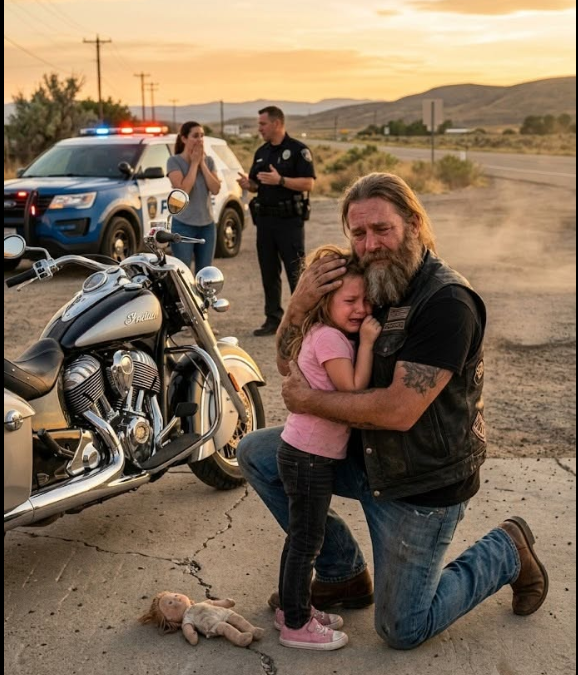
A5-Year-Old Girl Grabbed the Scariest Biker in the Parking Lot and Whispered, “Please Pretend You’re My Dad”—Then the Man She Was Hiding From Walked Out of the Store.
The five-year-old girl did not run toward the police, the cashier, or the woman loading groceries into an SUV.
She ran straight to the most dangerous-looking man in the parking lot.
She grabbed the tattooed biker’s hand with both of hers, looked up through tears, and whispered six words that cut deeper than anything Dominic “Stone” Hail had ever heard.
“Please pretend you’re my dad.”
By the time the stranger chasing her stepped out of the convenience store with a fake smile and dead eyes, the little girl had already chosen her monster.
And he was about to prove that not every frightening man was the one children needed to fear.
Dominic “Stone” Hail heard the scream before he saw the girl.
He was standing at pump number four, filling his Harley Road King under a white desert sun, thinking about nothing more complicated than the ride ahead and the black coffee waiting for him inside the convenience store.
His hands smelled like gasoline and leather.
His back ached from six straight hours on the highway, and the heat rising off the pavement pressed against him like a punishment.
Then came the sound.
High-pitched.
Raw.
Not the cry of a child denied candy.
Not the angry shriek of a tantrum.
This came from somewhere deeper.
Somewhere animal.
Somewhere ancient.
It was the sound of a child who understood, even at five years old, that something very bad was about to happen.
Dom’s head snapped toward the store.
Twenty-two years riding with the Hells Angels had taught him things no classroom ever could.
How to read a room in two seconds.
How to know when a man was lying before he finished his first sentence.
How to spot fear hiding behind manners.
How to recognize violence by the way silence changed shape around it.
And how to tell the difference between noise and terror.
This was terror.
His body moved before his mind gave permission.
That was how it worked when a man had lived long enough in places where hesitation got people hurt.
You did not think.
You responded.
But Dom never made it to the door.
The convenience store door flew open, and a little girl came running out like the building was on fire.
She was small.
Impossibly small.
Tangled blonde hair stuck to her wet cheeks. Her pink T-shirt hung past her shorts. One shoelace was untied, slapping against the pavement as she ran. Her face was red and twisted with panic, and she was moving with the desperate, clumsy speed of a child whose legs were barely keeping up with her fear.
She did not run toward the cashier visible through the window.
Not toward the truck driver smoking beside the air pump.
Not toward the woman loading groceries into a white SUV twenty feet away.
Not toward the older couple arguing over a map near the ice machine.
She ran to the biggest, scariest-looking man in the entire parking lot.
She ran to Dom.
Her tiny hands grabbed his right hand.
Both of her hands could not even wrap around three of his fingers.
She squeezed with everything she had, which was not much, and looked up at him with blue eyes blown wide open by a kind of fear no child should ever carry.
“Please,” she whispered.
Dom looked down at her.
His breath stopped.
“Please pretend you’re my dad.”
PART2:
Six words.
That was all it took.
In forty-four years of living, no one had ever said anything like that to Dominic “Stone” Hail.
No one had asked him to be anything close to a father.
He was the man people moved away from in restaurants.
The man cops watched through side mirrors.
The man mothers used as a warning without knowing his name.
He had scars across his knuckles, ink up his arms, a club patch on his back, and a face built by bad roads, harder rooms, and all the years he had refused to die when other men thought he should.
Children usually stared at him.
Some hid.
Some pointed until their mothers pulled their hands down and whispered, “Don’t.”
But this little girl had chosen him.
Not because he looked safe.
Because she needed someone dangerous enough to become safe.
Something shifted inside Dom’s chest.
Not broke.
Not cracked.
Shifted.
Like a door sealed shut for decades had moved a quarter inch.
He wrapped his hand around hers.
“Stay behind me,” he said.
His voice came out different than he expected.
Not the growl he used in bars.
Not the flat tone he gave police.
Something softer.
Something he did not recognize.
The girl obeyed instantly, pressing herself against his right leg, one little hand gripping the thick denim of his jeans.
The store door opened again.
A man walked out.
Mid-thirties.
PART3:
Brown hair neatly combed.
Khaki pants.
Blue button-down shirt.
Clean shoes.
He looked like he sold insurance.
Like he coached Little League.
Like he helped neighbors carry groceries.
Like the kind of man women apologized to after accidentally blocking him with shopping carts.
But his eyes were wrong.
Dom saw it immediately.
The man’s gaze swept the parking lot.
Not frantic.
Not panicked.
Not like a father searching for a lost child.
It moved methodically.
Pump by pump.
Car by car.
Face by face.
A hunter working a field after losing sight of prey.
Then his eyes found Dom.
Found the little girl pressed against Dom’s boot.
For one second, the man’s face changed.
Only one.
The mask slipped.
Anger flashed through.
Then he smiled.
A clean, practiced smile.
A smile polished by years of people believing what was easiest.
“There you are,” the man called, lifting one hand as if greeting a neighbor. “You scared me half to death.”
The little girl’s fingers dug harder into Dom’s jeans.
Dom did not move.
The man took three steps closer.
“Come on, sweetheart. Let’s not bother the gentleman.”
Dom’s left hand still held the gas nozzle.
His right hand held the girl’s tiny fingers.
He did not raise his voice.
He did not need to.
“Stop there.”
The man stopped.
His smile tightened.
“Excuse me?”
“I said stop there.”
The woman at pump three looked over again.
This time, she did not pull her purse closer.
She froze.
The truck driver by the air pump lowered his cigarette from his mouth.
Inside the convenience store, the cashier finally looked up from his phone.
The parking lot changed.
Not loudly.
But Dom felt it.
Attention gathering.
Fear noticing itself.
The man gave a soft laugh.
“I appreciate your concern, but this is my daughter. She gets emotional.”
The girl made a sound behind Dom’s leg.
Barely audible.
Not a word.
A wounded little breath.
Dom’s thumb moved once over her knuckles.
Not comfort exactly.
A signal.
I hear you.
The man noticed.
His eyes sharpened.
Dom said, “What’s her name?”
The man’s smile stayed in place.
“Excuse me?”
“You said she’s your daughter. What’s her name?”
“Lily.”
The child behind Dom whispered, “No.”
It was so soft only Dom heard it.
The man stepped forward.
Dom tilted his head.
The man stopped again.
“Her name is Lily,” he repeated. “Lily Harper. She’s five. She has anxiety. She runs off when she gets scared.”
Dom looked down without turning his head.
“What’s your name, sweetheart?”
The little girl swallowed.
“Mia,” she whispered.
The man’s jaw tightened.
Dom looked back at him.
“Mia,” he said. “Not Lily.”
The man laughed again, but this time there was no warmth in it.
“She gives strangers fake names. We’re working on it.”
“Last name?” Dom asked.
The man’s eyes flicked to the girl.
Then to Dom.
“Pardon?”
“Your daughter. What’s her last name?”
“Mine, obviously.”
“What is it?”
The man’s face hardened for half a breath.
Then the smile returned.
“This is ridiculous.”
“Usually is when men lie badly.”
The truck driver straightened beside the air pump.
The cashier came out from behind the counter and stood inside the glass door.
The woman at pump three had one hand on her phone now.
Good, Dom thought.
Keep looking.
Witnesses mattered.
Not because Dom feared the man.
Because he feared the story the man would try to tell afterward.
Bad men survived on confusion.
Dom had learned that long ago.
They did not always need strength.
Often, they only needed the first thirty seconds of uncertainty.
The man shifted his weight.
“Look, I don’t know who you think you are—”
“Her dad,” Dom said.
The words came out before he thought about them.
The little girl’s hand tightened around his.
The man blinked.
“What?”
Dom set the gas nozzle back into the pump slowly.
Then he turned his full body toward the man.
Six-foot-four.
Two hundred sixty pounds.
Leather vest.
Tattooed arms.
Sun-browned skin.
Gray in the beard.
Eyes that had seen enough of hell to recognize men who tried to bring pieces of it into daylight.
“She asked me to be her dad,” Dom said. “So until her real one or her mother says otherwise, that’s what I am.”
The man’s face went flat.
Not angry now.
Empty.
“Move.”
There it was.
The real voice.
No charm.
No smile.
No neighborly concern.
Just command.
The girl whimpered once.
Dom stepped in front of her completely.
“No.”
The man glanced around.
He was calculating.
Too many eyes now.
Too many phones.
Too much risk.
But risk did not always stop men like him.
Sometimes it made them desperate.
He lowered his voice.
“You have no idea what you’re getting involved in.”
Dom almost smiled.
The woman at pump three spoke up, voice trembling but clear.
“I’m calling 911.”
The man turned his head toward her.
“Mind your business.”
Dom’s voice cut in.
“You look at me.”
The man did.
That was the first mistake he made.
Dom had spent enough years around predators to know they hated being made small.
They hated losing control of the room.
They hated when someone refused the polite script.
The man’s eyes locked on Dom’s.
“You’re making a mistake.”
Dom bent slightly, not toward the man, but toward the little girl behind him.
“What’s your real name, baby girl?”
“Mia Grace Bell.”
“Where’s your mom?”
“In the bathroom,” she whispered. “He said she told him to take me to the car.”
“Did she?”
“No.”
“What did he do?”
Mia’s voice shook.
“He grabbed my arm by the candy. I screamed, and he covered my mouth, but I bit him.”
Dom’s vision narrowed.
Not from shock.
From control.
There are moments in a man’s life when anger becomes so hot it stops feeling like fire and starts feeling like ice.
Dom turned his eyes toward the man’s right hand.
There it was.
A fresh crescent of blood near the base of his thumb.
A child’s bite.
Dom lifted his chin.
“You want to show everyone your hand?”
The man looked down too late.
The woman at pump three had her phone pointed directly at him now.
The truck driver stepped away from the air pump and moved closer, not beside Dom, but near enough to matter.
“Police are on the line,” the woman said.
The man’s face changed again.
He was done pretending.
He stepped back once.
Then twice.
His eyes moved toward the edge of the parking lot.
Toward a dark gray sedan parked near the side entrance.
Its engine was running.
Dom noticed the license plate immediately.
Or at least the first three characters.
He had taught himself to do that after too many years around trouble.
The man turned and walked quickly toward the sedan.
The truck driver moved like he might block him.
Dom barked, “Don’t.”
The truck driver froze.
The man looked back, almost triumphant.
Dom was already pulling his phone from his vest.
He hit one contact.
“Bear,” he said when the line answered.
A deep voice came through.
“Stone.”
“Gray sedan. East side of Ralston Fuel on Route 18. Plate starts T9K. Male, mid-thirties, blue shirt, khakis. Tried to take a child. Don’t engage. Eyes only. Call it in.”
Bear said, “On it.”
That was the thing the man did not know.
He had walked into the wrong parking lot.
Not because Dom was violent.
Because Dom was not alone.
Thirty-two Hells Angels riders were less than three miles away at a roadside diner, waiting for Dom before the next leg of a veterans’ memorial ride. Men and women with engines warmed, phones charged, eyes sharp, and no patience for anyone who put hands on a child.
The sedan jerked out of the side lot.
The tires squealed.
The woman at pump three shouted the plate number into her phone.
The truck driver pointed after the car.
The cashier finally came running out.
“What happened?”
Dom did not answer him.
He crouched carefully, turning to face Mia.
She was shaking now.
Full body.
The kind of shaking that starts after danger pulls back far enough for the body to realize it is still alive.
Dom kept his hands visible.
“You did good,” he said.
Her lower lip trembled.
“I bit him.”
“You did real good.”
“He said Mommy told him.”
“I know.”
“She didn’t.”
“I know.”
“She told me if I ever got scared, find a woman with kids or a worker or somebody big and loud who everyone can see.”
Dom’s throat tightened.
“So you picked me?”
Mia nodded.
“You looked like nobody could make you move.”
He let out one breath that almost became a laugh and almost became something else.
“That’s about right.”
The convenience store door opened again.
A woman stumbled out, frantic, hair half loose, purse hanging from one shoulder, face drained of all color.
“Mia!”
The little girl turned.
“Mommy!”
She ran.
Dom rose as Mia crashed into her mother’s arms hard enough to knock them both backward against the ice machine.
The woman dropped to her knees, clutching Mia with both arms, one hand moving over her hair, her face, her shoulders, as if counting proof.
“Oh my God,” she sobbed. “Oh my God, baby. I turned around and you were gone.”
Mia cried then.
Not before.
Not while running.
Not while asking a stranger to become her father.
Not while staring down the man who had tried to take her.
Only now.
Because now there was room for being five years old again.
Dom stood back.
He had no right to touch that moment.
The mother looked up through tears.
“Who are you?”
“Dominic Hail.”
“She came to me.”
The woman stared at him.
Then at his vest.
Then back at his face.
For one second, Dom saw the same old calculation.
Leather.
Patch.
Tattoos.
Danger.
Then Mia pulled back from her mother just enough to point at him.
“He was my pretend dad.”
The woman’s face collapsed.
Not with fear.
With gratitude too big for language.
She covered her mouth and cried harder.
Police arrived six minutes later.
Too late to stop the man from leaving the lot.
Not too late to start closing the net.
Two patrol cars swung in first.
Then a county sheriff’s SUV.
The first officer out was young and built like he spent more time in the gym than in courtrooms. His hand hovered near his belt when he saw Dom.
Dom noticed.
Of course he noticed.
So did Mia’s mother.
She stood immediately, keeping Mia tucked against her side.
“He helped us,” she said sharply. “Do not come over here acting like he’s the problem.”
The young officer blinked.
Dom almost smiled.
Mia’s mother had tears on her face, hair stuck to her cheeks, and the raw expression of a woman who had almost lost the center of her world.
She was five-foot-three at most.
In that moment, she looked ready to fight every uniform in the lot.
The older deputy behind the young officer spoke first.
“Ma’am, I’m Deputy Waller. We got the call. Let’s start with your name.”
“Rachel Bell. This is my daughter, Mia.”
Waller nodded and looked at Dom.
“And you are?”
“Dominic Hail.”
“Stone Hail?”
Dom’s eyes narrowed slightly.
“You know me?”
“I know of you.”
“Most people say that like an insult.”
“Not today.”
That was when the rumble started.
Low at first.
Then growing.
Engines.
Many engines.
The sedan was gone, but the lot filled with sound as riders began arriving at the edges, not storming, not blocking police, not creating chaos.
Just appearing.
Bear came first on a matte black Street Glide, followed by six riders in staggered formation. Then more behind him. They parked along the far edge near the ditch, leaving the pumps clear, engines shutting off one by one.
Bear removed his helmet.
He was older than Dom by five years, bald, broad, with a white beard and the calm eyes of a man who knew exactly when not to speak.
He looked at Mia.
Then at Rachel.
Then at Dom.
“Gray sedan headed west on 18,” Bear said. “Rico spotted it turning toward County Line Road. He did not engage. Called it in. Two units are moving.”
Deputy Waller turned.
“Who’s Rico?”
“One of mine,” Dom said.
The young officer frowned.
“Your people are following a suspect?”
“No,” Dom said. “My people are watching roads and calling police. Big difference.”
Bear added, “Plate is T9K-4L2. Rico got the rest.”
Deputy Waller’s radio crackled a second later.
“Unit 12 has visual on gray sedan, Tennessee plate Tango Nine King Four Lima Two, westbound County Line. Requesting backup.”
The young officer looked at Dom.
Dom looked back.
No expression.
Waller spoke into his radio.
“Maintain distance. Suspect involved in attempted child abduction. Do not lose him.”
Rachel made a sound and held Mia tighter.
Mia buried her face against her mother’s shirt.
Dom stepped slightly aside, putting himself between the little girl and the cluster of strangers, not blocking police, just giving the child a wall.
The older deputy noticed.
So did Rachel.
The interview took place beside pump four because Mia refused to go back inside the store.
No one forced her.
For once, every adult understood that a child’s fear did not need a courtroom explanation to be respected.
Rachel told the story in pieces.
They had stopped for gas and snacks on the way to visit Rachel’s sister in Henderson. Mia needed the restroom. Rachel took her inside. Mia wanted candy. Rachel told her she could pick one thing while Rachel washed her hands in the restroom.
The restroom door stuck.
It had done that before, according to the cashier.
Rachel had only been inside maybe two minutes.
Two minutes.
Long enough for a man to step near the candy aisle and tell Mia, “Your mom said come outside.”
Mia asked why.
He smiled.
Said her mother had dropped something.
Took her wrist.
Mia pulled back.
He tightened his grip.
She screamed.
He covered her mouth.
She bit him.
He cursed.
She ran.
That was all.
That was almost everything.
The difference between a normal Saturday and the kind of story that destroys a family was two minutes, a sticky restroom door, and a little girl who remembered what her mother had taught her.
Find someone everyone can see.
Make noise.
Do not worry about being rude.
And if the scary-looking person feels safer than the smiling one, trust your stomach.
Rachel had taught her that last part because Rachel had learned it the hard way.
Not from this man.
From life.
“My husband died last year,” Rachel told Deputy Waller, voice hoarse. “Car wreck outside Memphis. Mia’s been scared of strangers since then. I told her if she ever couldn’t find me, find someone big enough to make trouble for whoever was scaring her.”
Her eyes moved to Dom.
“I guess she listened.”
Dom looked down at Mia, who was holding her mother’s shirt in one hand and Dom’s jeans in the other.
Somehow, she had reached back for him without anyone noticing.
He did not move away.
The man in the gray sedan did not make it far.
The riders did exactly what Dom told them to do.
Eyes only.
Distance.
No confrontation.
Rico spotted him turning toward County Line Road and gave the plate.
A woman rider named Jules saw him cut through an old service lane behind a closed furniture outlet and called the new direction.
Two brothers from the veteran ride staged near Exit 14 watched him abandon the sedan behind a self-storage facility.
They stayed back.
They reported.
They waited.
Sheriff’s deputies arrested him twelve minutes later trying to climb a fence behind the storage units.
No biker touched him.
No one threw a punch.
No one gave defense attorneys a headline about vigilantes.
That mattered.
Dom knew rage could ruin justice faster than cowardice.
The suspect’s name was Evan Mercer.
Thirty-six.
No local address.
A fake driver’s license in his wallet.
A second plate in the trunk.
A backpack with children’s hair clips, candy, zip ties, and three prepaid phones.
Rachel vomited beside the patrol car when Deputy Waller told her only the smallest safe portion of what they had found.
Mia heard none of it.
Dom made sure of that.
He had Bear take the riders farther down the lot and start their engines one at a time, not loud enough to frighten her, just enough to create a wall of sound so adult horror could not reach a child’s ears.
Mia sat on the curb beside Dom’s motorcycle, wrapped in a blanket the cashier had found in the lost and found bin.
It smelled faintly like old laundry and motor oil.
She did not seem to mind.
“Is he gone?” she asked.
Dom sat on the pavement several feet away, knees bent, forearms resting on them.
“He’s gone.”
“Jail gone?”
“Yeah.”
“For forever?”
“I don’t know about forever.”
Her face tightened.
Dom hated honest answers sometimes.
He gave them anyway.
“But he’s not coming back here today. Not tomorrow either. And there are a lot of people who know his face now.”
She studied him.
“Are you really a dad?”
The question hit him harder than he expected.
“No.”
“Why?”
Leave it to a child.
Adults would have gone around it.
They would have sensed the scar tissue and politely pretended not to see it.
A five-year-old simply stepped on it with both shoes.
Dom looked toward the horizon, where heat shimmered above the road.
“Life didn’t go that way for me.”
Mia thought about that.
“My daddy died.”
“I heard.”
“He was funny.”
“That’s good.”
“He made pancakes shaped like bears, but they looked like potatoes.”
Dom smiled despite himself.
“Sounds like a useful skill.”
“He said monsters are not always ugly.”
Dom’s smile faded.
Mia looked at the convenience store.
“He said sometimes they smile.”
Dom did not speak for a moment.
Then he said, “Your dad was right.”
She turned back to him.
“But you look like a monster.”
“I’ve been told.”
“You’re not.”
Dom looked at her.
The door inside his chest moved again.
A little wider this time.
“No,” he said quietly. “Not today.”
Rachel came over then, escorted by Deputy Waller. Her face was still pale, but her voice was steadier.
“Mia, sweetheart, we need to go to the station for a little while. They’re going to ask some questions, but I’ll be with you the whole time.”
Mia’s hand shot out and grabbed Dom’s fingers again.
“Can he come?”
Rachel looked at Dom.
Dom looked at Deputy Waller.
Waller sighed the sigh of a man who knew procedure had just become more complicated.
“He can come to the station,” Waller said. “But he does not sit in the forensic interview. Trained specialist only.”
“I don’t want him to leave,” Mia said.
Dom’s voice came soft.
“I’ll wait outside.”
She looked up at him.
“You promise?”
Dom had made a lot of promises in his life.
Some foolish.
Some angry.
Some drunk.
Some he had broken.
This one he treated carefully.
“I promise.”
At the sheriff’s office, Dom sat in a plastic chair under fluorescent lights for three hours.
A vending machine hummed nearby.
Bear sat beside him for the first forty minutes before Dom told him to take the others on to Henderson.
“You sure?” Bear asked.
“No.”
Bear stood.
“Good enough.”
The riders left reluctantly, but they left.
Dom stayed.
Rachel came out once to update him.
Mia was talking.
Crying some.
But talking.
A child advocate named Elise was with her.
Rachel’s sister was driving in.
Deputy Waller was handling updates.
Everything was moving.
But Dom stayed.
Around seven-thirty, Mia came out wrapped in a purple blanket with a stuffed dog someone had given her. Her eyes were swollen from crying. Her hair was messier than before.
She looked down the hallway.
Saw Dom.
And ran.
He stood just in time for her to hit his legs.
She wrapped both arms around him.
He froze for half a second.
Then carefully, awkwardly, he placed one hand on her back.
Rachel covered her mouth.
Dom looked over Mia’s head at her.
“I said I’d wait.”
Mia’s voice was muffled against his jeans.
“You didn’t leave.”
“No.”
“People leave.”
There it was.
Five years old, and she already knew that sentence too well.
Dom crouched slowly until he was level with her.
“Some do.”
He looked straight at her.
“Some don’t.”
Mia searched his face as if deciding where to place that truth.
Then she nodded once.
Not happy.
Not healed.
But maybe slightly less alone.
The story should have ended there.
That would have made it easier.
Little girl saved.
Bad man arrested.
Scary biker revealed as gentle protector.
Mother grateful.
Everyone goes home with a lesson simple enough to fit under a headline.
But real life rarely respects clean endings.
The next morning, Dom’s phone lit up before sunrise.
Bear sent the first link.
Then Jules.
Then Rico.
Then a dozen more.
The story had spread.
A blurry cellphone video showed Dom standing between Mia and Evan Mercer. The caption read:
HELLS ANGEL SAVES LITTLE GIRL FROM ABDUCTION AT GAS STATION.
By eight, local news had it.
By noon, national pages were sharing it.
By evening, strangers were calling Dom a hero.
He hated that word.
Hero made things too clean.
Hero made it sound like he had done something extraordinary instead of what any adult should have done.
Hero also made people comfortable again.
They could admire one frightening-looking man for acting kindly without asking why half the parking lot had frozen while a child chose him.
That bothered Dom more than the attention.
Because Mia had run past a lot of normal-looking people.
She had run past people who would have looked better in a news clip.
The woman loading groceries.
The cashier.
The older couple.
The truck driver.
All decent enough people, probably.
But she had chosen the one person whose appearance promised trouble.
Why?
Because children in danger do not always look for politeness.
They look for power that might stand still.
That thought stayed with Dom.
So did another.
Mia had asked him to pretend.
Please pretend you’re my dad.
Not help me.
Not call police.
Not save me.
Pretend.
A five-year-old had understood something adults often miss.
Sometimes survival begins with borrowing a role nobody else is filling.
Father.
Witness.
Wall.
Someone who will not move.
For three days, Dom avoided the press.
He ignored calls.
He ignored messages.
He went back to the clubhouse, then to his apartment above the garage, then back to the clubhouse.
Everywhere he went, people looked at him differently.
Some with pride.
Some with amusement.
Some with reverence he wanted to knock out of their hands.
Bear finally cornered him in the garage where Dom was pretending to adjust a carburetor that did not need adjusting.
“You gonna keep hiding?”
“Working.”
“That carb’s cleaner than a church window.”
Dom did not look up.
Bear leaned against the bench.
“Kid’s mother called.”
Dom’s hands stopped.
“She okay?”
“Which one?”
“Both.”
“They’re safe. Staying with Rachel’s sister for a while. Mia asked about you.”
Dom went back to the carburetor.
“She’s five. She’ll forget.”
Bear snorted.
“You remember being five?”
“No.”
“Exactly. Means you don’t know what sticks.”
Dom tightened a screw too hard.
Bear watched him.
“You know, there are easier ways to admit she got to you.”
“She was scared.”
“So were you.”
Dom looked up sharply.
Bear held his gaze.
Not challenging.
Not mocking.
Just seeing too much, the way old friends do.
Dom looked away first.
Bear’s voice softened.
“You been wearing that dead-man face since the gas station.”
“I’m fine.”
“No, you ain’t. And for once, that might be good.”
Dom set down the screwdriver.
“What’s that supposed to mean?”
“It means maybe that little girl handed you something you keep pretending you don’t want.”
Dom laughed once.
Cold.
“What, fatherhood?”
“Responsibility without violence.”
That shut him up.
Bear nodded toward the street outside.
“All these years, you been real good at being scary. Maybe now you figure out how to be safe too.”
Dom wanted to tell him to get out.
He did not.
Because Bear was right.
And Dom hated when people were right in ways he could not fight.
Rachel called that evening.
Dom almost did not answer.
Then he heard Mia’s voice on the message.
“Hi, pretend Dad. Mommy says I should ask before I call you that.”
Dom stared at the phone for a full minute before calling back.
Rachel answered.
“I’m sorry,” she said immediately. “She insisted. I told her it might be too much.”
“It’s fine.”
“No, really. I don’t want to put anything on you.”
Dom sat on the edge of his bed.
His apartment smelled like motor oil, dust, and the coffee he had forgotten to finish.
“What does she need?”
Rachel was quiet for a moment.
“She says she wants to hear your motorcycle so she knows you’re still real.”
Dom closed his eyes.
Not because it was silly.
Because it was not.
Trauma does strange things to children.
It turns ordinary proof into medicine.
A voice.
A sound.
A repeated promise.
A motorcycle engine through a phone.
“Put her on.”
There was rustling.
Then Mia.
“Hi.”
“Hey, bug.”
The nickname came from nowhere.
He regretted it instantly.
Mia did not.
She giggled once.
A tiny sound.
Fragile but real.
“Can I hear it?”
Dom walked downstairs to the garage with the phone in one hand.
“You know motorcycles are loud, right?”
“I know.”
“Don’t put the phone too close to your ear.”
“I won’t.”
He rolled the Road King out onto the alley, turned the key, and hit the starter.
The engine came alive with a deep rumble that filled the narrow space between buildings.
On the phone, Mia gasped.
Not scared.
Delighted.
“That’s you,” she said.
Dom looked down at the bike.
“Yeah.”
“If I hear motorcycles, I’ll know someone like you is there.”
He swallowed.
“Not every motorcycle.”
“I know,” she said seriously. “Some are probably mean.”
Dom almost smiled.
“Some.”
“But yours isn’t.”
He looked at the black tank, the chrome, the worn leather seat, the machine that had carried him through deserts, rain, fights, funerals, and years he did not like remembering.
“No,” he said. “Mine isn’t.”
After that, the calls became a thing.
Not every day.
Rachel was careful.
Dom appreciated that.
Once a week at first, then twice sometimes when Mia had a hard night.
Rachel would text first.
Bad dreams tonight. Could she hear the bike?
Dom always answered.
Sometimes he was at the clubhouse.
Sometimes at home.
Once at a gas station ninety miles away, where he started the bike in a dark lot while truckers stared and Mia listened through the phone.
It did not fix everything.
Nothing did.
But it helped.
And helping one child in one small repeatable way began to change the shape of Dom’s days.
The club noticed.
Of course they did.
Motorcycle clubs are terrible at privacy and excellent at pretending otherwise.
Rico caught him one evening standing outside during a meeting, phone held near the idling Road King.
When Dom came back in, Rico asked, “You running a bedtime engine service now?”
Dom gave him a look that would have made a stranger apologize.
Rico grinned.
“Just saying. Could charge subscription.”
Bear smacked him in the back of the head.
“Respect the ministry.”
The table laughed.
Dom did not.
But he also did not leave.
Two months later, Rachel asked if he would come to Mia’s kindergarten safety day.
Dom stared at the text so long Bear finally said, “Phone owe you money?”
Dom showed him.
Bear read it.
Then smiled.
“No.”
“No?”
“No, you’re not getting out of that.”
“I don’t do schools.”
“You do now.”
“I’m not walking into a kindergarten in a Hells Angels vest.”
“Yes, you are.”
“The parents will lose their minds.”
“Probably.”
“Kids will stare.”
“Definitely.”
Dom rubbed his forehead.
Bear looked too pleased.
“You know what that little girl learned? She learned scary-looking doesn’t always mean unsafe. Maybe some other kids need that too.”
So Dom went.
He parked at the far end of the elementary school lot, feeling more nervous than he had before certain bar fights, certain court dates, and one surgery where they told him the anesthesia might not play nice with his blood pressure.
He wore a clean black shirt.
His leather vest.
Jeans without holes.
Boots polished badly.
Rachel met him near the entrance.
She looked healthier than the last time he had seen her in person, though the fear had left fine lines around her eyes that probably were not going anywhere soon.
“Thank you for coming,” she said.
“I can wait outside.”
“No.”
Her voice was gentle but firm.
“She asked you to come inside.”
Mia saw him from the classroom doorway.
“Dom!”
Every adult head in the hallway turned.
A small blonde blur launched herself at him.
He crouched just before impact.
This time, the hug came without terror.
That almost hurt worse.
Inside the classroom, twenty-three children sat on a rug, staring.
Some with open mouths.
One little boy whispered, “Is he a pirate?”
Dom heard him.
The teacher did too.
She looked mortified.
Dom looked at the boy.
“No ship.”
The boy nodded solemnly, accepting the technical correction.
Rachel covered a smile.
The safety presentation was simple.
A school resource officer talked about not leaving with strangers.
A counselor talked about trusted adults.
Rachel spoke briefly, voice shaking, about using your voice even if someone tells you not to make a scene.
Then Mia raised her hand.
The counselor said, “Yes, Mia?”
Mia stood.
She pointed at Dom.
“If you’re scared, you can ask a big person to pretend until the real help comes.”
The counselor blinked.
Dom closed his eyes for one second.
Outranked by a five-year-old.
Again.
Mia continued, “But you have to pick someone who listens when you whisper.”
The room went silent.
Children understood pieces of it.
Adults understood enough to look at the floor.
The counselor swallowed.
“That’s very brave, Mia.”
Mia sat back down.
Dom looked at Rachel.
Rachel had tears in her eyes.
After the presentation, kids asked Dom questions.
Not about danger.
About motorcycles.
“Does your bike go faster than a police car?”
“No comment.”
“Do you sleep on it?”
“No.”
“Can it jump?”
“Once, badly.”
“Do you have a dragon tattoo?”
“No dragons.”
“Why is your beard like that?”
“Poor planning.”
By the time he left, one little girl had drawn him a picture of a motorcycle with a cape.
Dom folded it carefully and put it in his vest pocket.
That night, he took out the cigar box where he kept things he pretended not to care about.
Old photos.
A hospital bracelet from his mother’s last admission.
A cracked poker chip from a dead friend.
A postcard from Bear during a prison stretch years ago.
He placed the child’s drawing inside.
Then sat on the edge of the bed for a long time.
Because the box was starting to look less like a graveyard and more like a record that he had been alive after all.
Evan Mercer went to trial the following spring.
He had taken a plea before the full trial began, but there was still a sentencing hearing.
Rachel asked Dom to come.
He did.
He sat behind Mia and Rachel, hands folded, vest on, face blank.
Mercer never looked at him directly.
Mia held a stuffed rabbit in her lap and a small piece of Dom’s old bandanna tied around its neck.
Rachel spoke first.
Her voice shook, but she did not break.
She told the judge about the two minutes in the gas station.
About the sound of her daughter screaming.
About the way Mia woke from nightmares asking if blue shirts were allowed near the house.
About how a child should not know how to scan parking lots for exits.
Then Mia asked to speak.
The judge hesitated.
The prosecutor looked at Rachel.
Rachel looked at Dom.
Dom did nothing.
This was not his decision.
Mia stood on a step stool because the microphone was too high.
She unfolded a piece of paper covered in large uneven letters.
“My name is Mia Grace Bell,” she read.
Her voice was small but steady.
“You tried to make me quiet. I was not quiet. You tried to make me go with you. I did not go. You told me my mommy said to. She did not. I know my mommy’s voice, and you are not it.”
Mercer stared at the table.
Mia continued.
“I found someone bigger than you. I found someone who looked scary but listened. I hope you stay in jail until you learn that children are people and we can tell.”
Rachel cried silently.
The prosecutor wiped her cheek.
The judge stared at the bench for a moment before speaking.
Dom looked down at his hands.
He did not trust himself to look at Mia.
The sentence was long.
Not forever.
But long enough that Mia would be grown before Mercer could walk freely again.
Outside the courthouse, reporters waited.
Rachel said one sentence.
“My daughter saved herself because someone finally respected her fear.”
Then she took Mia home.
Dom thought about that line for weeks.
Respected her fear.
Not dismissed it.
Not polished it.
Not told her she was being dramatic.
Not told her to calm down.
Respected it.
Fear was not always weakness.
Sometimes fear was information arriving before proof.
Adults liked proof.
Children often had only instinct.
A stare that felt wrong.
A hand too tight on the wrist.
A smile that did not match the eyes.
A voice that said trust me while the body said run.
Dom began saying yes to more school safety days.
Then community centers.
Then self-defense clinics.
Not because he suddenly loved public speaking.
He hated it.
He hated microphones.
He hated folding chairs.
He hated the way adults sometimes treated him like a mascot for surprising goodness.
Look, children, even scary people can help.
He hated that version.
So he corrected it every time.
“I’m not safe because I ride a motorcycle,” he told one gym full of parents and kids. “I’m safe if I listen when a child says no. That’s the whole thing. Clothes don’t make a safe adult. Badges don’t automatically make one either. Smiles don’t. Money doesn’t. Church attendance doesn’t. What matters is behavior.”
Parents shifted uncomfortably.
Good.
Dom continued.
“If a child tells you someone made them uncomfortable, don’t start by defending the adult. Start by asking what happened.”
A woman in the back raised her hand.
“What if the child misunderstood?”
Dom looked at her.
“Then you find that out after listening. Not before.”
That sentence traveled.
Someone clipped it online.
It got shared more than he wanted.
The club started calling him Professor Stone.
He threatened everyone individually.
It did not help.
A year after the gas station, Rachel and Mia invited Dom to a small cookout in Rachel’s sister’s backyard.
He almost said no.
Then Mia sent him a handwritten invitation with a picture of him, her, and his motorcycle.
In the picture, he had six arms and square feet.
No man could refuse art like that.
He went.
Bear came too because Rachel insisted he had to bring “someone who would stop him from standing in the corner like a haunted refrigerator.”
Rachel had become braver.
Dom respected that.
The backyard smelled of charcoal, cut grass, sunscreen, and lemonade. Children ran through sprinklers. Adults sat in lawn chairs. Mia wore a purple dress and sneakers, both already grass-stained.
She pulled Dom toward a plastic table covered in craft supplies.
“We’re making family flags,” she announced.
“Family what?”
“Flags. For people who belong.”
Dom looked at Rachel.
Rachel shrugged.
“Therapist idea.”
“Of course.”
Mia handed him a square of cloth and a marker.
“You have to make one.”
“I don’t do crafts.”
“You do today.”
Bear laughed so hard he had to walk away.
Dom sat.
The marker looked ridiculous in his hand.
Mia leaned over her own flag, drawing carefully.
Rachel sat beside Dom.
“You don’t have to,” she said softly.
“Yes, he does,” Mia said without looking up.
Rachel smiled.
Dom stared at the cloth.
What was he supposed to draw?
A bike?
A skull?
A road?
For people who belong.
That phrase made his chest feel strange.
Finally, he drew a badly shaped motorcycle.
Then, after a pause, a small hand holding a large one.
The drawing was terrible.
Mia loved it.
She hung it on the clothesline with the others.
There were flags with houses, dogs, rainbows, stick people, names, hearts, suns, crooked stars, and one from Bear that said BBQ in block letters because Bear claimed food was his love language.
Dom’s flag moved in the summer breeze between Mia’s and Rachel’s.
He stared at it longer than he meant to.
Rachel came to stand beside him.
“She still calls you pretend Dad sometimes,” she said.
“I know.”
“Does that bother you?”
Dom watched Mia laughing near the sprinkler.
“No.”
Rachel nodded.
“She knows you’re not replacing him.”
“I know.”
“I think she needed to know more than one kind of father-shaped person could exist in the world.”
Dom swallowed.
“That sentence too expensive for me.”
Rachel smiled sadly.
“Therapy again.”
“Worth it?”
She looked at Mia.
“Yes.”
Later that night, after the cookout, Dom rode alone through the desert road outside town. The air had cooled. The sky had turned purple and orange over the low hills. His bike rumbled beneath him, steady and alive.
For years, the sound of the engine had meant escape.
From judgment.
From memory.
From rooms where people expected him to explain himself.
From the version of himself that knew only how to be feared.
But now the sound meant something else too.
It meant Mia sleeping better after hearing it through a phone.
It meant children at school asking if motorcycles could jump.
It meant a purple flag on a backyard clothesline.
It meant being chosen, not as a weapon, but as a wall.
That was different.
That was heavier.
That was better.
Two years later, Crossroads Fuel Stop changed ownership.
The new owner renovated the store, repainted the pumps, fixed the bathroom lock, installed security cameras that actually worked, and added a blue sign near the register.
IF A CHILD SAYS THEY ARE SCARED, BELIEVE THEM FIRST.
Underneath, in smaller letters:
ASK. LISTEN. ACT.
Dom hated being credited, so the sign did not mention him.
Mia knew anyway.
She was seven by then.
Still small.
Still sharp-eyed.
Still sometimes afraid of men in blue shirts, though not always.
Progress is rarely clean.
She and Rachel stopped at the store one afternoon after school. Dom happened to be there, because despite all his complaining, he still stopped at pump four more often than he needed gas.
Mia ran to him, then slowed before hugging him.
She had learned to ask.
“Can I?”
Dom crouched.
“Always.”
She hugged him hard.
Then she pointed at the sign.
“That’s because of me.”
Dom looked at it.
“Yes.”
“And you.”
“Yes.”
“And Mommy.”
“Yes.”
“And the lady who called 911.”
“Yes.”
“And Bear, because he is loud.”
“Especially Bear.”
Mia smiled.
Then she looked serious.
“Do you still pretend?”
Dom tilted his head.
“Pretend what?”
“That you’re my dad.”
He looked at Rachel.
Rachel said nothing.
This was his answer to give.
Dom looked back at Mia.
“I don’t think pretend is the right word anymore.”
Her eyebrows pulled together.
“Then what is it?”
He thought carefully.
Children deserved careful truth.
“I think I’m one of your people.”
Mia considered that.
“Like family?”
“If you want.”
She nodded once.
“I want.”
Dom’s throat tightened.
“Then yeah.”
She looked satisfied.
Then she ran inside to get a cherry slush.
Rachel stood beside Dom in the sun.
“You okay?”
He watched Mia through the glass.
“No.”
Rachel smiled.
“That’s allowed.”
“She say that to everybody now?”
“Mostly people she likes.”
Dom nodded.
Inside, Mia was talking to the cashier, pointing at the sign, explaining something with both hands.
The cashier listened.
Actually listened.
Dom watched that too.
Because that was the part that mattered most.
Not the old story.
Not the viral headline.
Not the frightening biker who turned out not to be the monster.
The listening.
That was what kept a child alive in more ways than one.
Years later, people would still tell the story wrong.
They would say a little girl asked a Hells Angel to pretend to be her dad and he saved her from a monster.
That was true.
But not complete.
The fuller truth was that a child trusted her fear.
A mother had taught her to make noise.
A frightening man chose gentleness when strength would have been easier.
A parking lot full of ordinary people finally looked up.
A club known for danger used discipline instead of rage.
A predator learned that not every child standing alone was unprotected.
And Dominic “Stone” Hail learned that being feared was a shallow kind of power compared to being trusted by a child.
He still carried that lesson.
Every time he stopped at pump four.
Every time a kid stared at his tattoos and he softened his face instead of scowling.
Every time Mia called to hear the engine.
Every time Rachel texted a picture from school, a lost tooth, a report card, a crooked craft project.
Every time someone called him a hero and he corrected them.
“I listened,” he would say.
That was all.
That was enough.
Because sometimes the difference between tragedy and survival is not a fist, a gun, a badge, or a dramatic speech.
Sometimes it is a large man kneeling down in a parking lot.
A small hand gripping leather.
A whispered sentence.
A promise borrowed until real help arrives.