PART2:
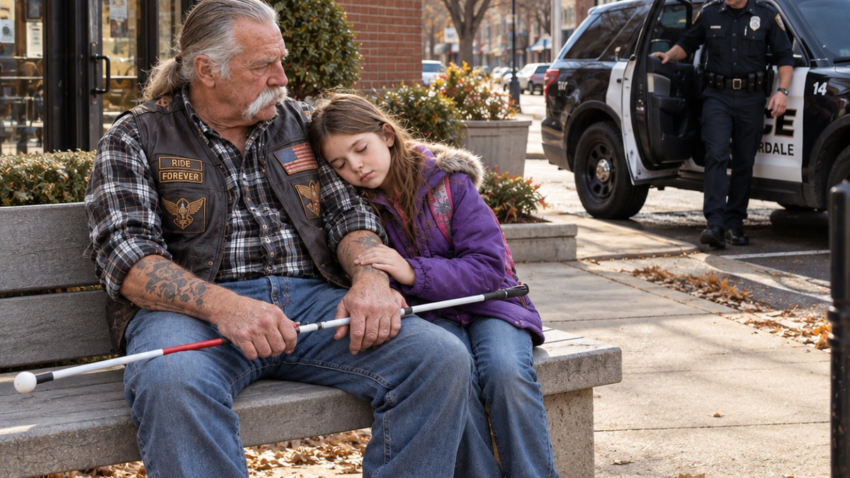
Sophie stood at the front door in her purple coat, her little red sneakers on, her white cane in one hand.
She had a field trip that day.
The apple orchard outside Mill Creek.
She had been counting down for weeks.
Every night before bed, she asked how many days were left. She had packed and repacked her little backpack three times. She wanted to touch the bark of the old apple trees. She wanted to smell cider being made. She wanted to bring home one apple for Mrs. Delgado and one for me.
“Truck’s being stubborn,” I said lightly.
Sophie tilted her head.
“Can you fix it?”
“Probably.”
“How long is probably?”
Too smart.
Always too smart.
I looked at her standing there in that purple coat, one hand wrapped around her cane, trying very hard not to look disappointed even though she could not see my face.
Something inside me made the decision before my head caught up.
I looked toward the garage.
My Harley Ultra Classic sat under a tarp.
Beside it was the sidecar I had built years ago for Rebecca when she was small.
Back then, she had begged to ride with me, but I would not put a child on a bike without walls around her. So I found an old sidecar frame, reinforced it, rebuilt the seat, added a five-point harness, painted a pink stripe along the side because Rebecca said plain black was “too serious,” and spent half a summer making it safe enough for my little girl.
Rebecca loved that thing.
She used to stick her hand out and pretend she was catching clouds.
I had not hooked it up in years.
Not since before she married Kyle.
I looked at Sophie again.
She was listening to the silence after the dead truck, waiting for me to decide whether her world would get smaller that morning.
I rolled the Ultra Classic out of the garage and hitched the sidecar.
Sophie heard the metal clank.
“Papa?”
“Yes, baby?”
“What are you doing?”
“Improvising.”
“That means you don’t have a plan.”
“It means I am building one very quickly.”
I lifted her into the sidecar.
She touched the seat, the side panel, the harness buckle.
Her face changed.
“Is this Mama’s sidecar?”
I swallowed.
“Yes.”
“The one with the pink stripe?”
“The same one.”
Her hand moved slowly along the edge until she found the raised line of paint.
“She was little when she rode in it?”
“Smaller than you.”
Sophie smiled.
That smile settled the matter.
I buckled her tight.
Not loose.
Not casual.
Tight.
Five-point harness locked across her shoulders and waist. I checked every strap twice, then a third time because I could hear Rebecca’s voice in my head telling me I had better not mess this up.
I put a helmet on Sophie.
It was DOT-certified, but a size too big because children’s helmets for blind eight-year-olds are not something you happen to have sitting on a shelf. I packed a scarf around the sides so it would not wobble and tugged the chin strap until it sat snug.
“Comfortable?” I asked.
“It smells like leather.”
“That’s because it is near a motorcycle.”
“Papa?”
“Yes?”
“I’ve never ridden on a motorcycle before.”
I looked down.
Her whole face had lit up like morning breaking over a field.
“Then I guess we better make the first ride a good one.”
I called the school and told them we were on our way.
Then I climbed onto the bike.
Before I started it, I turned toward her.
“You keep one hand on the sidecar grip and one hand on my arm when we’re stopped. You tell me if anything feels wrong. Understand?”
“Yes, Papa.”
“This is not about being brave. This is about being safe.”
“I understand.”
I turned the key.
The Harley rumbled to life.
Sophie gasped.
Not in fear.
In wonder.
She placed one mittened hand on the sidecar wall and laughed.
“I can feel it.”
“Feel what?”
“The sound.”
I drove her to school at twenty miles an hour with the flashers blinking the whole way.
The speed limit on Route 9 is forty-five.
I did not care.
Cars could go around me. People could honk. The whole county could line up behind us if they wanted.
My granddaughter was strapped into that sidecar like precious cargo, because that is exactly what she was.
The cold air came through the pines.
Sophie kept her face turned toward the wind.
At the school drop-off lot, kids started shouting.
“Whoa!”
“Look at Sophie!”
“Cool!”
Sophie turned toward the noise and waved.
Her teacher, Miss Anna, came out to meet us. She did not look scared. She did not look angry. She put both hands over her heart, then hugged Sophie and me right there by the curb.
“You made it,” she said.
Sophie beamed.
“Papa drove slow.”
“I bet he did.”
I helped Sophie out, handed her the cane, and watched her tap her way toward the school doors with Miss Anna beside her.
For one clean minute, I felt like I had done something right.
Monday morning, two police officers and a woman from child services stood on my porch.
The woman had a neat folder, a professional coat, and the careful expression people wear when they have already seen enough sadness to stop showing surprise.
“Mr. Ellis?” she asked.
“That’s me.”
“My name is Marisol Reyes. I’m with Child Protective Services. We need to speak with you.”
One officer stayed near the steps.
The other looked over my shoulder into the house.
My stomach tightened.
“What is this about?”
Ms. Reyes looked at me steadily.
“There has been a complaint.”
“Abuse?” I said. “I’d sooner cut my own hand off than raise it to that child.”
She shook her head.
“The allegation isn’t about physical abuse, sir.”
“Then what?”
She glanced down at the folder.
“It concerns endangerment. And custody.”
Custody.
That word did something to my knees.
I put one hand against the doorframe.
“I’ve been Sophie’s legal guardian for two years,” I said. “Family court signed off. Everything’s on file.”
“I understand that.”
“Then why are we talking about custody?”
“There has been a petition filed. The complaint is what brings us here today. The petition will be heard next month.”
“Who filed it?”
Ms. Reyes hesitated.
I knew before she said it.
“Harold and Diane Whitmore.”
Sophie’s other grandparents.
Her father’s parents.
I had not seen them since the funeral.
I stepped back and let them in because I had nothing to hide.
That does not mean I had nothing to fear.
Let me tell you about the Whitmores.
My daughter Rebecca married Kyle Whitmore when she was twenty-two.
Kyle was a good man.
Quiet.
Polite.
Worked at the credit union.
He grew up in a big house on the north side of town, the kind with a fountain out front and lawn stripes so straight they looked ironed.
His parents never liked Rebecca.
Not because Rebecca did anything wrong.
They never accused her of being unkind or lazy or foolish.
They just looked at her and saw me.
A father with a gray beard down to his chest.
A man who rode motorcycles, fixed engines, and worked with his hands.
A house that smelled like oil instead of polished wood.
At the wedding, Diane Whitmore introduced me to her friends as “Rebecca’s father, who works with his hands.”
She said it with a smile.
Like it was the polite version of something uglier.
Kyle did not care what his parents thought.
He loved my girl.
And when Sophie was born blind, he and Rebecca made a life.
A real one.
A small one.
A happy one.
They rented a little house on Cedar Street. They argued about grocery lists, sang badly in the kitchen, learned braille alongside their baby, and called me every time they needed something built, fixed, hauled, or explained.
When the drunk driver crossed the median, it took all of that from us.
At the funeral, Diane hugged me for the first and only time.
“We’ll figure this out together,” she whispered.
I thought she meant grief.
I found out later she meant Sophie.
The petition, Ms. Reyes explained, asked for full custody.
The Whitmores claimed I was an unfit guardian.
Too old.
Too rural.
Too rough.
Too closely tied to motorcycles.
Not equipped to raise a blind child.
The complaint that brought child services to my door was about the sidecar.
Someone at Sophie’s school had taken a picture Friday morning.
Me lifting Sophie out.
The Harley.
The sidecar with Rebecca’s pink stripe.
Sophie’s purple coat.
Her cane tucked under my arm.
A moment I would have framed and set on the mantle.
By Friday night, that photograph had been sent to the Whitmores’ lawyer.
Now it was evidence.
At the CPS office, they asked me questions for three hours.
Was I Sophie’s primary caregiver?
Yes.
Did I have adequate childcare arrangements?
Yes. Mrs. Delgado next door watched Sophie when I had to be gone longer than a quick errand.
Was Sophie enrolled in appropriate educational services?
Yes. She attended the county program for visually impaired students, and Miss Kendra came to the house twice a week to work on braille and mobility skills.
Did Sophie have a stable home environment?
Yes.
Did I ever transport Sophie in a way inconsistent with state safety regulations?
I paused.
Ms. Reyes noticed.
The officer in the corner noticed too.
I said, “Ma’am, I don’t know every regulation in that book. What I know is this. Friday morning, my truck was dead. My granddaughter had a field trip she’d been counting down to for weeks. My only other vehicle was that motorcycle.”
I leaned forward.
“I put her in a reinforced sidecar with a five-point harness I bought from a company in Oregon that makes adaptive restraints for disabled kids. I put a DOT-certified helmet on her. I padded the fit. I drove twenty miles an hour on a low-traffic road with flashers on. I checked the straps before I left and again when I arrived.”
My voice tightened.
“She was safer in that sidecar than half the kids I see bouncing around in the back of minivans with shoulder belts behind their backs.”
Ms. Reyes wrote something down.
She did not look up.
“The Whitmores’ attorney will argue there is no safe manner to transport a blind eight-year-old child on a motorcycle.”
“Their attorney can argue the moon is made of ham if he wants,” I said. “Sophie asked me that night if we could ride again on Saturday. That is what my granddaughter thought of it.”
Ms. Reyes finally looked up.
Something in her face shifted.
Not enough for me to trust it.
Enough for me to notice.
“I need to conduct a home visit tomorrow,” she said. “I’ll need to interview Sophie without you present.”
I nodded.
“You do what you need to do.”
I did not sleep that night.
I sat at the kitchen table with a cup of coffee that went cold in front of me and looked at Sophie’s things all over the house.
Her braille books stacked on the coffee table.
Her audiobook player beside the couch.
Her tactile map of the neighborhood, the one I had made out of felt, buttons, string, and glue.
Her red sneakers by the door, each lace sewn with a tiny bell so I could always hear where she was if she ran ahead.
Rebecca’s photograph sat on the mantle.
In the picture, she was twenty-five, holding baby Sophie against her chest, smiling like she had somehow tricked the whole world into giving her more joy than anyone deserved.
I thought about calling my lawyer.
I thought about calling my brother in Reno.
I thought about driving to the Whitmores’ house and saying things a judge would not appreciate.
What I did instead was go into Sophie’s room and sit on the floor beside her bed.
I listened to her breathe.
Around two in the morning, she woke.
She reached one hand out without opening her eyes.
“Papa?”
“I’m here, sweet pea.”
“You’re sitting on the floor.”
“How did you know?”
“Your voice is coming from down low.”
That girl notices everything.
She patted the mattress.
I climbed up beside her, boots and all.
She curled into my side.
“Papa, are you sad?”
“I’m just thinking, baby.”
“About Mama?”
I swallowed.
“About you.”
She was quiet for a moment.
Then she said, “Papa, don’t be sad about me. I’m the happiest kid in my class. Miss Anna told me.”
I could not answer.
I just held on to her for a while.
Ms. Reyes came at ten the next morning.
She had the same folder, a notebook, a small recorder, and a face that gave nothing away.
I showed her the house first.
The safety gate at the top of the stairs, which Sophie did not really need anymore but I kept anyway.
The stove with tactile knobs.
The braille labels on every drawer and cabinet.
The pantry shelves, each with little metal plates marked in raised dots.
Ms. Reyes stopped in front of them.
She ran one finger over a label.
“You did this?”
“Took me a month.”
She kept walking.
In the living room, I showed her Sophie’s reading corner.
Braille books.
Audiobook player.
A soft rug divided into different textures so Sophie could find her favorite spot.
I showed her Sophie’s bedroom.
Her bed with the bell on the frame in case she needed me at night.
Her wardrobe arranged so she could dress herself: tops on the left, bottoms on the right, every hanger marked with a fabric tag telling her the color.
In the backyard, I showed her the rope guide from the back door to the swing set.
The wind chimes near the fence.
The raised garden bed where Sophie grew mint because she liked plants she could smell.
At some point, Ms. Reyes stopped writing.
I do not know when.
Finally, she said, “Mr. Ellis, may I speak with Sophie now?”
“She’s in the kitchen with Mrs. Delgado. Take as long as you need.”
I went to the garage because I could not stand to be in the house while it happened.
I sat on my toolbox and stared at the sidecar.
Rebecca had been eight the first time I put her in it.
Same age as Sophie.
She used to make me drive past the ice cream shop three times before we stopped, just so she could wave at her reflection in the windows. She would stick her hand out and pretend to catch clouds.
Kyle loved that sidecar too.
When he was courting Rebecca, I made him ride in it once, just so he would know what he was marrying into.
He climbed out laughing so hard he had tears in his eyes.
I ran my hand along the pink stripe.
I thought about Diane Whitmore.
About what she must have told herself to justify this.
That she was saving Sophie.
That she was doing what Kyle would have wanted.
That a big house with a fountain, private tutors, a nanny, and a quiet driveway was better than braille labels, wind chimes, triangle pancakes, and a Harley sidecar.
Maybe she believed it.
Maybe grief had turned into something meaner in her chest and she could not tell the difference anymore.
I could not hate her sitting there.
I could only feel tired.
Ms. Reyes stayed in the kitchen with Sophie for nearly two hours.
When she came out, she did not say a word to me at first.
She walked to her car, sat in the driver’s seat, and made a phone call I could not hear.
I stood on the porch and waited.
Sophie came running through the front door.
She used the rope guide and found me.
Then she wrapped both arms around my leg.
“Papa, that lady asked me a lot of questions.”
“I know, baby. What did you tell her?”
Sophie thought about it.
“I told her about my room. And the wind chimes. And how you make pancakes shaped like triangles because I can feel the corners better.”
Something cracked open in my chest.
“She asked me about the motorcycle too.”
“What did you say?”
“I told her the motorcycle sounds like Papa’s heart.”
I could not breathe for a second.
Sophie leaned against my knee.
“It’s loud,” she said, “but it means somebody’s here.”
I had to sit down on the porch steps.
Ms. Reyes came back up the walk.
She stopped in front of me.
Sophie rested against my side.
“Mr. Ellis,” she said, “I’m going to be honest with you. This is not my final decision. There is still a court hearing. But my report will recommend that Sophie remain in your care. I’ll also be recommending that the complaint be dismissed.”
I could not get a word out.
She looked at the house.
Then at Sophie.
“For what it’s worth, Sophie is one of the most articulate and well-adjusted eight-year-olds I’ve ever interviewed. Whatever you are doing, keep doing it.”
Sophie smiled toward her voice.
“Bye, Ms. Reyes. Your voice is nice.”
Ms. Reyes laughed softly.
For the first time since she stepped onto my porch, she sounded like a person and not a file.
The hearing was three weeks later.
I wore a suit that had not fit right in a decade.
My lawyer, Patty Morgan, tugged at one of the sleeves before we entered the courtroom.
“You look like you borrowed that from a funeral home.”
“I did not ask for a fashion review.”
“You hired a lawyer who rides a Sportster on weekends. You get the whole package.”
Patty ran a two-person office above a hardware store and kept motorcycle gloves in her briefcase. She was sharp, blunt, and had already told me three times not to glare at the Whitmores unless I wanted the judge to think I was exactly what their lawyer claimed.
The Whitmores sat on the other side of the courtroom.
Diane would not look at me.
Harold looked at the floor.
Their lawyer wore a suit that probably cost more than my truck was worth before it died.
Sophie sat in the back with Mrs. Delgado, holding her cane across her lap.
She looked small in that room.
Too small for all those adults deciding where she belonged.
Ms. Reyes testified first.
She read from her report.
She talked about the home visit.
The adaptations.
The braille labels.
The rope guides.
Sophie’s academic progress.
Sophie’s emotional health.
She said I had created a stable, responsive, highly individualized environment for a visually impaired child.
I did not know what all those words meant together.
Patty whispered, “That’s good.”
The Whitmores’ lawyer stood.
He buttoned his jacket.
“Ms. Reyes,” he said, “are you aware Mr. Ellis transported this blind minor child on a motorcycle?”
“In a sidecar,” Ms. Reyes said.
“A motorcycle sidecar.”
“Yes.”
“Would you call that conventional?”
“No.”
“Would you call that appropriate?”
Ms. Reyes did not rush.
She looked down at her notes, then back at the lawyer.
“I would call it unconventional. I would not call it endangerment.”
The lawyer’s mouth tightened.
“Please explain.”
“Based on my review, Mr. Ellis used a reinforced sidecar fitted with a five-point harness. The child wore a DOT-certified helmet. He drove approximately twenty miles per hour with hazard lights engaged on a low-traffic rural road. The alternative that morning would have been the child missing a school event she had been anticipating for weeks or being left with a neighbor while Mr. Ellis attempted to secure other transportation.”
She paused.
“In my professional opinion, no abuse or neglect occurred.”
The courtroom felt very still.
The lawyer tried again.
“But you agree, Ms. Reyes, that a blind child may have unique vulnerabilities?”
“Of course.”
“And therefore requires more careful guardianship?”
“Yes.”
“Could that not suggest a more conventional home would better serve the child?”
Patty stood.
“Objection. Argumentative.”
“Sustained,” the judge said.
But Ms. Reyes looked at the judge and asked if she could answer.
He allowed it.
She turned slightly toward the bench.
“Your Honor, Sophie’s blindness is not being ignored in Mr. Ellis’s home. It is being accommodated in nearly every room. I found tactile systems, mobility guides, braille labels, consistent routines, educational support, and clear emotional attachment. In my assessment, Sophie is not being raised in spite of her blindness. She is being raised with respect for it.”
I looked down.
If I looked at Sophie then, I would have cried in court.
The judge asked whether Sophie wished to speak.
Patty had prepared her.
She had told Sophie she did not have to say anything.
That nobody would be angry.
That adults could handle the hard part.
Sophie stood.
“Yes, sir,” she said.
Mrs. Delgado helped guide her forward, but Sophie used her cane the last few steps.
Tap.
Tap.
Tap.
She stood before the judge’s bench in her purple sweater, tiny braids tied with white ribbons.
The judge leaned forward.
“Sophie, do you know why we are here today?”
“Yes, sir. Because my other grandparents want me to live with them.”
“That is right. Can you tell me where you want to live?”
Sophie thought about it.
The whole courtroom seemed to hold its breath.
“I want to live with Papa,” she said.
Diane lowered her head.
Sophie continued.
“Because Papa makes triangle pancakes so I can feel the corners. And because he built a rope so I can find the swing. And because when I have a bad dream, he sleeps on the floor next to my bed until I feel safe again.”
My hands closed around the edge of the table.
“And because the motorcycle sounds like his heart,” Sophie said. “And I don’t want to live somewhere that’s quiet.”
Diane Whitmore began crying.
I could not tell what kind of crying it was.
Regret.
Grief.
Anger.
Maybe all three.
The judge removed his glasses.
For a long moment, he said nothing.
Then he cleared his throat.
“Thank you, Sophie. You may go sit down now.”
The petition was denied that afternoon.
The complaint was dismissed.
Full guardianship remained with me.
No change in placement.
No temporary order.
No removal.
No condition that said I had to become someone else to keep loving the child already sleeping under my roof.
Patty walked me onto the courthouse steps.
“It’s done,” she said. “It’s really done.”
I could not answer.
I was holding Sophie’s hand.
Diane came out behind us.
Harold stood several feet back, twisting his hat in his hands.
“Frank,” Diane said.
I turned.
It was the first time she had said my name in two years.
“I thought I was doing what Kyle would have wanted.”
I looked at her.
She looked older than I remembered.
Grief had taken the sharp polish off her face and left something trembling beneath it.
“Kyle would have wanted Sophie to be loved,” I said. “She is.”
Diane nodded.
Her chin shook.
“Would you ever let us see her? Sometimes?”
I looked down at Sophie.
She was listening with her whole body, the way she does.
“That’s up to Sophie,” I said.
Sophie turned her face toward Diane’s voice.
“Grandma Diane?”
Diane’s hand flew to her mouth.
“Yes, honey?”
“You can come to my birthday. It’s in June. Papa’s making a cake shaped like a horse.”
Diane cried harder then.
This time, I understood what kind of crying it was.
The kind that comes when a door opens wider than you deserve.
We rode home in Patty’s car because I had not brought the motorcycle to court.
“Bad optics,” Patty had said.
For once, I had listened.
But when we pulled into the driveway, Sophie was humming in the back seat.
Tired.
Relieved.
Still holding her cane across her lap.
I looked back at her.
“Sweet pea?”
“Yes, Papa?”
“You want to go for a ride?”
She sat straight up.
“Right now?”
“Right now.”
Patty raised one eyebrow.
“Frank.”
“The hearing is over.”
“Do not make me regret defending you.”
“You ride a Sportster.”
“That is beside the point.”
But she was smiling.
I put the sidecar back on.
I strapped Sophie in.
Helmet.
Scarf.
Harness.
Three checks.
Then I climbed onto the Harley and let the engine rumble for a moment before putting it in gear.
Sophie reached over and placed her hand on the tank.
“Papa.”
“Yes, baby?”
“I can feel it.”
“Feel what?”
“Your heart.”
I could not answer.
I eased off the clutch.
We rode down Route 9 with the flashers on.
Twenty miles an hour.
The sun came through the pines in gold strips.
My granddaughter’s small hand rested on my sleeve.
I do not know what the neighbors thought when they saw us go by.
I do not know what Diane Whitmore would have thought if she had seen us.
I do not know what any lawyer, caseworker, or judge would write down about that ride.
What I know is this.
Sophie laughed.
Not politely.
Not quietly.
She laughed with her whole body, the way Rebecca used to laugh in that same sidecar when she pretended to catch clouds.
For two years, I had carried grief like a second spine.
I had tried to be father, mother, grandfather, teacher, cook, driver, repairman, and night watchman for one little girl who had already lost too much.
I had made mistakes.
I would make more.
I was not polished.
I was not rich.
I did not have a fountain in my yard or a nanny on call.
But I knew Sophie’s footsteps.
I knew how she liked her pancakes.
I knew which wind chime meant she was close to the fence.
I knew she smiled when the Harley started because to her, that sound meant I was near.
Maybe love does not always look safe to people who only see the leather vest, the beard, the motorcycle, the rural road, and the old man with oil under his nails.
Maybe they need paperwork to understand what a child already knows by sound.
But Sophie knew.
She knew when my voice came from the floor.
She knew when I was sad.
She knew the difference between quiet and peace.
And she knew where she belonged.
We reached the long bend near Miller’s Pond and I slowed even more.
Sophie tilted her face toward the wind.
“Papa?”
“Yes?”
“Can Mama hear us?”
My throat tightened.
“I don’t know, sweet pea.”
“She would like it.”
“Yes,” I said. “She would.”
Sophie smiled.
“I think she liked it first.”
I looked at the pink stripe on the sidecar.
Rebecca’s stripe.
Still bright after all these years.
“Yes,” I said. “She did.”
We rode until the sun dropped behind the trees.
Then we turned back toward the little house at the end of Route 9.
The house with braille labels.
The house with rope guides.
The house with wind chimes around the yard.
The house that was not quiet.
When I pulled into the driveway, Sophie kept her hand on my sleeve for a moment after the engine died.
The sudden silence settled around us.
She frowned.
“Papa?”
“What is it?”
“Can you start it again? Just for one second?”
So I did.
The Harley rumbled beneath us.
Sophie smiled.
Then she reached out and patted the tank gently, like she was thanking a living thing.
“That’s better,” she said.
And right there, with the evening air cooling around us and my granddaughter safe beside me, I understood something the courtroom never could.
Some families are built from blood.
Some are built from court orders.
Some are built from grief, screws, scarf padding, braille labels, dead pickup trucks, and one old Harley moving slowly down a road because a little girl deserved to feel the world show up for her.
I am sixty-two years old.
I ride a Harley.
I live at the end of Route 9.
And I am raising the brightest child God ever placed in my arms.
If loving her makes people question me, they can ask their questions.
I have my answer every time Sophie laughs from that sidecar.