PART2:
I knew better than to guess what a child could or could not do from looking at her.
My cousin Wren had cerebral palsy, too, and strangers had spent her whole life talking over her head as if the wheelchair had swallowed her intelligence. Wren was thirteen then. She loved astronomy, hated peas, knew every moon of Jupiter, and could win an argument with one raised eyebrow.
When Wren was little, adults used to ask my aunt questions while standing directly beside her.
Does she understand?
Can she hear me?
Does she know what’s going on?
Wren always understood.
She understood too much sometimes.
She understood pity before people noticed they were showing it. She understood impatience. She understood when someone saw a body and forgot there was a person inside it.
So I waited for June.
Her eyes moved to the menu, then back to Cal.
Cal leaned toward her.
“Chicken?”
June blinked once.
“Potatoes?”
A tiny movement at the corner of her mouth.
“Chocolate milkshake?”
Her eyes brightened.
Cal looked at me.
“Chicken and mashed potatoes for her. Small pieces. And a chocolate milkshake.”
“You got it.”
The wiry man beside him said, “Burger. Fries. Coffee. Black.”
Cal glanced at him.
“Mack, you could say please once this year.”
Mack looked at me.
“Please, ma’am.”
The others ordered burgers, fries, meatloaf, coffee, and one slice of apple pie “to start with,” which made Hazel glance over from behind the counter and mutter, “That man understands dinner.”
They looked rough under the fluorescent lights.
Leather vests.
Heavy boots.
Calloused hands.
Beards.
Scars.
The kind of men some people crossed the street to avoid.
But when June needed to turn her chair, all four of them moved without being asked. When her blanket slipped, one man caught the edge before it touched the floor. When I brought straws, Mack opened one and bent it carefully before placing it where Cal could reach it.
There was gentleness at that table.
A strange, practiced gentleness that did not match the noise they had made arriving.
I had worked at Hazel’s for three years by then. Most evenings, I could tell what a table needed before anyone asked.
More coffee.
Extra napkins.
A quiet minute.
The check.
At June’s table, I could not tell what they needed.
Not really.
I could tell they were hungry. I could tell they were tired. I could tell the men were watching Cal in a way they tried to hide, and that Cal was pretending not to notice.
His hands were steady when he helped June with her milkshake.
But his face looked worn thin.
Not tired in the ordinary way.
Not a man who had ridden too many miles.
A man who had been holding his life together with both hands for too long and could not let go because someone smaller was depending on him.
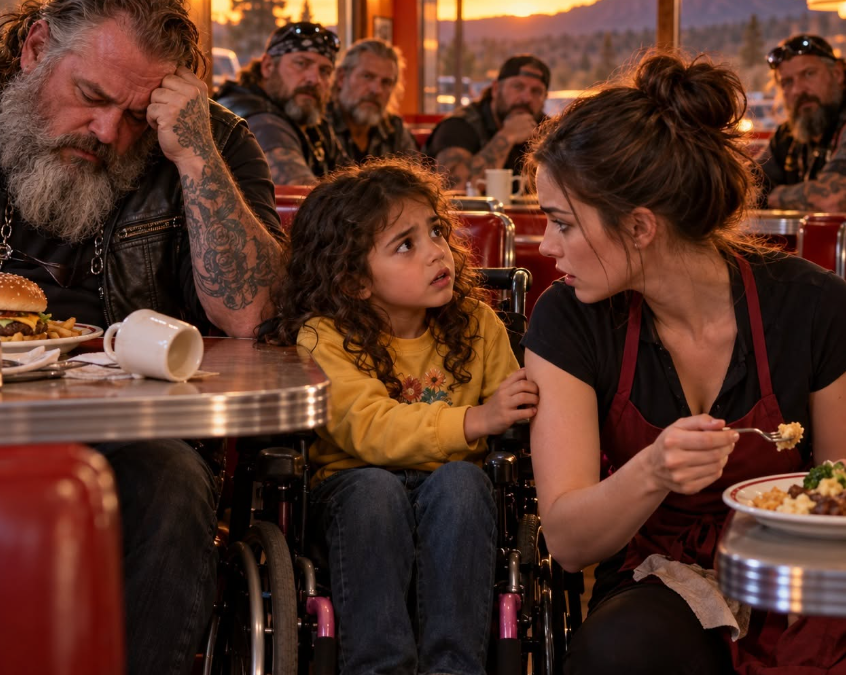
When I brought the food, Cal immediately began cutting June’s chicken.
Small pieces.
Soft pieces.
Exactly as he had asked.
His own plate sat in front of him untouched.
The burger was hot, steam rising from the bun. Fries crisp. Pickle spear on the side. He did not look at it.
Mack leaned toward him.
“You slept at all last night?”
Cal did not lift his head.
“I’m sitting right here.”
“That wasn’t the question.”
Cal gave him a look, and Mack fell quiet.
Cal tested the temperature of June’s potatoes against the inside of his wrist. He stirred them. Checked again. Added a little gravy. Then he lifted the fork toward her and waited.
June opened her mouth.
Slowly.
Carefully.
He fed her with the patience of a man who had learned that love sometimes meant moving at another person’s pace no matter how fast the world demanded you go.
I watched longer than I should have.
Hazel caught my eye from the counter.
She was in her late fifties, built like a woman who had survived three husbands, two recessions, and every health inspector in northern Arizona. She could silence drunk truckers with one look and bake coconut cream pie that made people confess things. She knew about Wren because my aunt sometimes brought her in after therapy appointments.
Hazel nodded toward June.
Go on, that nod said.
I wiped my hands on my apron and stepped closer.
“Cal?”
He looked up sharply.
A protector’s look.
Fast.
Hard.
Ready.
“Would you and June like me to help with dinner while you eat?”
His jaw tightened.
“I’ve got her.”
“I can see that.”
I kept my voice gentle.
“I’m offering you a break.”
The table went quiet.
June made a small sound.
Not a word.
A breath.
A plea, maybe.
Cal turned to her, and something passed between them that I could not read. Her eyes held his face, then moved toward his plate.
He looked back at me.
“Her food needs to be soft. Small bites. Give her time to swallow.”
“Of course.”
He hesitated before handing me the fork.
I understood that hesitation.
Letting a stranger help your child eat in a roadside diner must have felt like handing over something sacred. Maybe even dangerous. Maybe especially for a man like Cal, who looked as if he had spent months proving he could do everything alone.
I sat where June could see my face.
“Is this okay?” I asked her.
Her eyes stayed on mine.
One blink.
“I’m going to take that as yes. If I mess up, you give me the look. My cousin Wren gives me the look all the time.”
June’s mouth twitched.
I lifted a small piece of chicken.
“Ready?”
She opened her mouth a little.
I waited.
No rushing.
No pretending I did not notice the effort.
No talking over her.
Between bites, I told her about Wren’s dog, Jupiter, who had once stolen an entire loaf of bread from the kitchen counter and tried to hide it under a pillow.
“Which would have worked,” I said, “except the pillow was white and the bread was wheat.”
June laughed.
It came out as a breathy little sound, light and sudden, but everyone at the table heard it.
One of the bikers grinned into his coffee.
Mack looked down at his plate like he did not want anyone to see his face.
Beside me, Cal finally picked up his burger.
He took one bite.
Then another.
I kept feeding June slowly.
A little chicken.
A little potato.
A sip of milkshake.
Wait.
Watch.
Let her swallow.
Talk to her like she was a person in the room because she was.
After a few minutes, Cal leaned back.
He had eaten maybe a third of his burger.
It was not enough.
But it was something.
“Thank you,” he said.
His voice was so low I nearly missed it.
“You’re welcome.”
June had had enough. Her eyes moved away from the fork, and I understood.
“All done?”
One blink.
“Good call. Dessert exists, but so do limits.”
Her mouth lifted again.
I stood and placed the fork beside Cal’s plate.
“I’ll be back with the check whenever you’re ready.”
I turned to leave.
That was when June caught my eye again.
At first, I thought she wanted more milkshake.
But she was not looking at the glass.
She looked at Cal.
Then at me.
Then back at him.
The movement was small.
Deliberate.
Her eyes shifted to the white paper napkin beside his plate.
I thought she wanted it.
I picked it up and offered it to her.
She made a frustrated sound.
“Sorry,” I said quickly. “Show me again.”
Her eyes went to Cal’s hand.
That was when I saw the fork slip from his fingers.
It hit the plate with a soft metal clatter.
Cal caught the edge of the table.
His coffee tipped, spreading across the check and dripping onto the floor.
Mack jumped up.
For one second, Cal tried to stand, like maybe he could walk off whatever was happening, like stubbornness could force blood, breath, and bone back into obedience.
Then he sank back into the booth.
“Cal?” I said.
He did not answer.
His face had gone gray beneath the beard.
His eyes were open but unfocused.
June looked straight at me.
Terrified.
She had seen it coming before any of us.
I reached for my phone.
Cal’s hand closed around my wrist.
Weak.
Urgent.
“Please,” he whispered.
I bent closer.
His lips barely moved.
“Don’t let them take June.”
For a moment, the diner disappeared.
The clatter of plates.
The hum of the neon.
The smell of fries.
The bikers.
The sunset.
All of it narrowed to Cal’s hand on my wrist and June’s eyes fixed on mine.
“Who’s going to take her?” I asked.
Cal tried to answer.
His eyes closed.
His grip fell away.
I called 911.
Mack moved beside him with surprising speed, lowering him carefully against the booth. Hazel came from behind the counter with the first-aid kit and a calmness that made people listen.
“Clear the aisle,” she barked. “Earl, move your chair. Somebody get that rug out of the way. Erin, stay on the phone.”
I told the dispatcher what had happened.
Adult male.
Possible collapse.
Consciousness altered.
Breathing.
History unknown.
Roadside diner off Route 89.
Five minutes out of Flagstaff.
My voice shook only once.
Then I knelt in front of June.
Her whole body had gone rigid.
Her eyes were on Cal.
Not blinking.
Not looking away.
As if she could keep him alive by refusing to let him leave her sight.
“Help is coming for your dad,” I said.
She made a sound.
Small.
Broken.
“I’m not going to block your view.”
I shifted so she could see him.
“You can see him from here. I’m staying with you.”
Her eyes moved to me for half a second.
Then back to Cal.
Mack looked at me.
There was panic in his face now, raw and naked beneath the tattoos and road dust.
“He’s been pushing too hard,” he muttered. “I told him. I told him.”
“What’s wrong with him?” I asked.
Mack shook his head.
“Nothing. Everything. He don’t sleep. Don’t eat. Says he’s fine.”
The ambulance arrived in eight minutes.
It felt like thirty.
Two paramedics came through the door with a stretcher, and the diner parted around them. One medic spoke to Cal while the other asked Mack questions.
Name.
Age.
Medical history.
Medications.
Recent illness.
Mack answered what he could.
“Caleb Dawson. Forty-two. No known heart problems. Dehydrated maybe. Exhausted. He’s been on the road. He’s got his daughter. He won’t stop.”
Cal came around as they checked him.
Confused.
Trying to sit up.
Then he saw June.
“She stays with Mack,” he said.
His voice was hoarse but fierce.
Mack stepped forward immediately.
“I’ve got her, brother.”
Cal shook his head once, like that was not enough.
“No hospital people taking her.”
One paramedic glanced at me, then at June.
“Sir, we’re just taking care of you.”
Cal’s eyes were wild now.
“No. You don’t understand.”
June made a sound.
That stopped him.
He turned his head toward her.
She watched him with a concentration so fierce it felt bigger than her body. The medic paused, understanding somehow that this mattered.
Cal reached out.
The medic gave them a moment.
June pressed her cheek against his hand.
“I’m going to the hospital,” Cal told her, forcing every word to steady itself before it reached her. “Mack’s bringing you. You’ll see me there. I promise.”
June stared at him.
One blink.
Only after that did Cal let them move him.
Mack gathered her things with hands that were not as steady as he wanted them to be.
A canvas bag.
A folded blanket.
A small pouch of medication.
A laminated card tucked behind her wheelchair.
He pulled the card out and stared at it.
I saw the headings.
Meals.
Medication.
Communication.
Positioning.
Emergency contacts.
He knew where everything was.
He clearly loved her.
But he looked at that card like a man facing a test he could not afford to fail.
“I can come,” I said.
Mack looked up.
“You don’t have to.”
“I know.”
Hazel was already pulling at the knot of my apron.
“Go,” she said. “I’ll close.”
“But my tables—”
“Erin.”
Hazel’s face softened.
“Go.”
So I went.
I rode with Mack in his pickup while another rider followed in a van with June’s wheelchair secured inside. The ambulance lights flashed ahead of us, red fading into the desert dusk.
June sat in the back seat in a car seat setup adapted with straps and supports. Mack had installed it himself, checking each buckle twice before starting the engine. One of the other riders, a quiet man named Bishop, rode behind us with the wheelchair.
June’s eyes stayed on the windshield.
Mack kept glancing at her in the rearview mirror.
“He’s being looked after, Junebug,” he said. “They got him.”
I looked back.
She heard him.
Of course she heard him.
I had the instinct to say the same thing, to fill the silence with comfort.
But I stopped.
Children like June often spent their lives surrounded by adults repeating obvious things because nobody knew what else to do.
So instead, I said, “You saw it first.”
Her eyes moved to me.
“You were trying to tell me.”
One blink.
Mack’s jaw tightened.
“She always knows,” he said quietly. “Cal thinks he hides things from her.”
“He doesn’t?”
Mack gave a humorless laugh.
“That girl reads him better than any of us.”
At the hospital, Cal was awake.
Pale.
Humiliated.
Angry at his own body.
Doctors wanted tests. Blood work. Fluids. Cardiac monitoring. More evaluation. He asked when he could leave before they had even finished explaining why he needed to stay.
June was rolled beside his bed.
He reached for her immediately.
She leaned her face into his hand.
“I’m here,” he whispered. “I’m okay.”
She stared at him.
“Don’t give me that look,” he said softly. “I know.”
Her eyes did not move.
“I know,” he repeated, and this time his voice broke.
Mack stepped into the hallway.
I followed because the room suddenly felt too private.
The other riders gathered near the vending machines. Under hospital lights, they looked less intimidating and more exhausted. Men with oil under their fingernails, road grit on their jeans, and fear sitting heavy on their shoulders.
Mack rubbed both hands over his face.
“What happened?” I asked.
He looked toward Cal’s room.
Then at me.
“Long story.”
“I’m still here.”
That seemed to decide something for him.
“Cal and June left California four days ago. They’re headed to Tucson. His sister Denise lives there. She’s got a place, knows doctors, knows therapy programs. June’s mom walked out three months back.”
The words hit hard.
“Walked out?”
“Packed a suitcase and left while Cal was at work.”
I looked through the glass toward June.
“She left June?”
Mack’s face hardened.
“She left both of them. Said she couldn’t do it anymore. Said June needed too much. Said Cal made everything about doctors and appointments and equipment.”
His voice lowered.
“Cal came home and found June alone in her chair, crying. Olivia was gone.”
I felt sick.
“How long was she alone?”
“Maybe an hour. Maybe less. Long enough.”
A hospital cart rolled past us.
Mack waited until it was gone.
“After that, Cal stopped sleeping. Took every overtime job he could. Tried to cover rent, medical bills, everything. Wouldn’t ask for help. Then the landlord didn’t renew the lease. Said there were complaints about medical equipment in the hallway, wheelchair marks on the wall. Legal? Maybe not. Cal didn’t have fight left.”
“So Denise offered them a place?”
“Begged him to come. We joined the ride because he wouldn’t have made it alone.”
I looked back toward Cal.
“Why was he afraid they’d take June?”
Mack’s eyes darkened.
“Olivia called social services before she disappeared.”
“What?”
“She told them Cal couldn’t handle June’s care. Said he was overwhelmed. Said the apartment was unsafe. Said June would be better in a facility.”
I stared at him.
“That’s why he’s terrified.”
“He thinks if he looks weak for one second, somebody’s going to decide he’s not enough.”
Inside the room, Cal was watching June as if the whole hospital might vanish if he blinked.
Mack swallowed.
“He is enough. He’s just killing himself trying to prove it.”
Cal spent two nights in the hospital.
Dangerous dehydration.
Exhaustion.
Low blood sugar.
Stress.
No heart attack, thank God, but close enough to scare every man who had rolled into Hazel’s with him.
His sister Denise arrived from Tucson before dawn the next morning.
I was there because Hazel had told me not to come back to work until I knew how the little girl was doing, which was both kind and terrible for payroll.
Denise came down the hospital hallway carrying an overnight bag, a binder, two coffees, and the kind of controlled fury only sisters can carry.
She was younger than Cal by maybe five years, with dark hair pulled into a messy bun and eyes red from driving through the night. When she reached his room, she stopped in the doorway.
Cal looked at her.
For one second, he looked like a little boy caught doing something dangerous.
Denise set the bag down.
“You absolute idiot.”
His mouth twitched.
“Good to see you too.”
She crossed the room and hugged him hard.
He closed his eyes.
That was when I understood how tired he really was.
June made a sound.
Denise turned immediately.
“Junebug.”
Her whole face changed.
June’s mouth opened in a small smile.
Denise crouched beside the wheelchair.
“Hi, baby. I came as fast as I could.”
June leaned toward her.
Denise pressed her forehead gently to June’s.
“I know,” she whispered. “I know.”
Cal looked away.
Not because he did not love seeing them together.
Because relief can hurt when you have been surviving without it.
Later, in the hallway, Denise found me near the vending machines.
“You’re Erin?”
“Yes.”
She hugged me before I could prepare.
“Thank you.”
“I didn’t do much.”
Denise stepped back and looked at me with the fierce expression of a woman who had no patience for false modesty.
“You listened to my niece. That is more than most people do.”
I swallowed.
“She was trying so hard.”
“She always does.”
Denise glanced toward Cal’s room.
“He tell you anything?”
“Mack did.”
Her jaw tightened at the mention of Olivia.
“My brother should have called me sooner.”
“He probably thought getting to you would fix it.”
“That’s what he said.”
“Maybe he needed to believe there was one thing he could do by himself.”
Denise looked at me then, really looked.
“You know somebody like June?”
“My cousin Wren.”
That softened her.
“Then you know.”
“Yes.”
She leaned against the wall, suddenly looking exhausted.
“People think care is one big dramatic sacrifice. It isn’t. It’s a thousand small things every day. Insurance calls. Medication refills. Appointments. Feeding. Lifting. Stretching. Equipment. School meetings. Strangers staring. Family disappearing. And then everybody says, ‘You should ask for help,’ like help is sitting outside with a bow on it.”
I nodded.
“My aunt says the same thing.”
Denise looked toward the room.
“Cal loves June more than his own lungs. But love doesn’t make one person into a whole support system.”
That sentence stayed with me.
A hospital social worker named Ms. Reed came by that afternoon.
Cal went rigid the moment she introduced herself.
June noticed.
Of course she did.
Her eyes went from Ms. Reed to Cal, then to Denise.
Ms. Reed was gentle, experienced, and obviously aware that her presence frightened him.
“I’m not here to take your daughter,” she said.
Cal’s face closed.
“I’ve heard that before.”
“I’m here because when a caregiver collapses, we make sure the family has support.”
“I take care of her.”
“I can see that.”
“You don’t know anything.”
Ms. Reed did not react defensively.
“I know your daughter arrived clean, fed, with medication records, equipment, and people who know her routines. I know she looks to you and you look to her. I know exhaustion is not neglect.”
Cal looked down.
That sentence seemed to hit him where reassurance had not.
Exhaustion is not neglect.
Denise placed a hand on his shoulder.
Ms. Reed continued.
“I also know you need help before your body makes decisions for you again.”
Cal’s eyes went to June.
“I can’t lose her.”
June made a sound.
Denise knelt beside her.
“He’s not losing you, baby.”
June stared at Cal.
Her eyes were wet now.
Not crying the way other children cried.
But full.
Cal reached for her.
“I’m sorry,” he whispered. “I scared you.”
June held his fingers as best she could.
Her thumb moved once against his hand.
A tiny motion.
But he felt it.
His face crumpled.
That was the first time I saw Cal Dawson cry.
Not loudly.
Not dramatically.
Just a silent collapse of the walls he had been holding up for too long.
The bikers turned away.
Not because they were embarrassed.
Because men like that knew when grief needed privacy.
I went back to Hazel’s the next day.
The diner looked the same, but I did not.
The table by the window was empty.
I kept seeing June there, eyes moving from Cal to me.
I kept hearing his whisper.
Don’t let them take June.
Hazel let me work without asking too many questions.
At closing, she placed a slice of pie in front of me.
“You going to tell me what happened?”
I did.
All of it.
Hazel listened with her arms crossed, face unreadable.
When I finished, she said, “That little girl saved her daddy.”
“Yes.”
“And you heard her.”
“I almost didn’t.”
“But you did.”
I looked down at the pie.
“I want to do more than carry plates, Hazel.”
She softened.
“You thinking about nursing again?”
I had put aside the application twice.
Once because my car broke down.
Once because Wren’s medical bills had hit my aunt so hard I started helping with rent instead.
And because part of me was afraid.
Afraid I would fail.
Afraid I would get in and not be able to afford it.
Afraid wanting more was selfish when people I loved already needed so much.
“I don’t know how,” I said.
Hazel pointed a fork at me.
“Nobody ever knows how before they start.”
Cal was released after two nights.
Before he left the hospital, I stopped by his room.
He was sitting up, still pale but better. June was beside the bed. Denise was packing bags with the efficiency of a woman who had already taken charge of three impossible systems before breakfast. Mack leaned against the wall pretending he was not emotionally invested in everything.
Cal looked at me.
“I’m sorry I grabbed you.”
“I’m glad you did.”
His eyes went to June.
“I thought if I couldn’t take care of her, somebody would decide she’d be better off somewhere else.”
Denise set down the shirt she was folding.
“You should have told me how bad things had gotten.”
Cal closed his eyes.
“I thought getting to your place would fix it.”
“We’ll get there,” she said. “And we’ll work out what help she needs.”
“I don’t want to be a burden.”
Denise stared at him.
“You and June are not a burden. You are family. Those are different categories, Caleb.”
Mack muttered, “Been telling him that.”
Cal looked at his friend.
“You have a life.”
“Apparently,” Mack said. “I keep being informed.”
One of the other riders, Bishop, leaned in from the doorway.
“We voted. Your stubbornness is no longer in charge.”
Cal raised an eyebrow.
“There was a vote?”
“Four to one.”
“Who voted for me?”
“No one. You weren’t invited.”
For the first time since I met him, Cal laughed.
It was rusty, painful, but real.
June’s eyes brightened.
I crouched beside her.
“Wren would want to know whether the chocolate milkshake was worth the trouble.”
June gave me the same small smile she had given me in the diner.
One blink.
I carried that smile home.
For weeks, I wondered how they were doing.
I still had Cal’s number because Mack had asked me to hold some hospital paperwork and text him a photo of it. But I did not want to intrude.
That is another thing people do when they care.
They convince themselves silence is respect when sometimes it is fear.
Then, one Saturday in late spring, five motorcycles appeared outside Hazel’s again.
I heard them before I saw them.
Sugar dispensers trembled.
Mr. Bell lowered his newspaper.
Hazel looked up from the pie case and smiled like she had known they would come back.
Denise’s SUV pulled in behind them.
June came through the door first with Denise pushing her chair.
She wore the yellow sweatshirt.
Her curls were pulled back with two purple clips.
She looked around the diner until she found me.
Her face opened.
I nearly dropped a coffee pot.
“June.”
Cal came in behind her.
He looked different.
Still big.
Still bearded.
Still tattooed.
But rested.
Not fully healed, maybe.
But no longer disappearing from the inside out.
Mack followed with a box under one arm.
“Don’t just stand there,” Hazel called. “You people ordering or decorating?”
Mack grinned.
“Both, possibly.”
They took the same table.
This time, when I brought menus, Cal looked at June.
“Chocolate?”
Her eyes went to him.
Then to me.
One blink.
“Chocolate it is,” I said.
Cal ordered the same burger.
When it arrived, June watched him until he picked it up and took the first bite.
Only then did she relax.
Denise helped June with her potatoes.
Cal ate while the food was hot.
That small fact made me want to cry.
After lunch, Cal pushed the box toward me.
“For Wren.”
Inside was a small model of the solar system.
Not expensive.
Not fancy.
But beautiful, with little planets hanging from curved wires and Saturn’s rings painted gold.
“She likes astronomy, right?” he said.
I stared at it.
“You remembered?”
“June remembered.”
June’s mouth lifted.
My throat tightened.
“She’s going to love it.”
“She can argue with June about planets,” Denise said.
“Wren will win.”
June made a sound that was clearly disagreement.
Mack pointed at her.
“I’m with June. Saturn has rings. That’s flair.”
The diner laughed.
Something changed after that.
Cal and June did not become customers.
They became part of the strange extended family that happens in diners, hospitals, roadside breakdowns, and every place where people meet one another at the edge of fear.
They stopped at Hazel’s whenever they passed through Flagstaff for appointments.
Sometimes Denise came.
Sometimes Mack.
Sometimes all five riders.
Sometimes June and Wren video-called from the corner booth, communicating with tablets, expressions, blinks, and the kind of patience most adults could learn from.
Wren insisted Jupiter was the superior planet because of its storms and moons.
June insisted Saturn was better because of the rings.
Neither changed her mind.
The debate lasted years.
Over time, I learned more about Cal.
He had run a motorcycle repair shop in California with his younger brother before the brother died in an accident. He loved bad jokes, hated paperwork, and could fix almost anything with an engine. He had met Olivia when they were both too young to understand that love and endurance were different skills.
When June was diagnosed, Cal stayed.
Olivia tried.
That was how Denise put it.
“She tried until trying made her feel trapped,” she told me once. “Then she started blaming the trap on June.”
I wanted to hate Olivia completely.
Some days I did.
But the older I got, the more I understood that some people fail not because they feel nothing, but because they cannot bear what love asks of them.
That did not excuse leaving.
It only made it sadder.
Olivia signed paperwork eventually.
Custody stayed with Cal.
Denise helped with appointments.
Mack and the others built a ramp at Denise’s house in one weekend and argued for three hours about the correct angle.
Ms. Reed connected them with respite care.
Cal began sleeping.
Not enough at first.
Then more.
He learned to ask for help before his body collapsed.
Not perfectly.
Never perfectly.
But better.
And I applied to nursing school.
Not because life suddenly became easy.
It did not.
The application fee hurt.
The prerequisites were confusing.
The financial aid forms made me want to scream into a pillow.
But Mack came into Hazel’s one afternoon with a folder.
“My sister works at the community college,” he said.
“Hello to you too.”
He ignored that.
“She found a scholarship deadline you missed.”
I looked at the folder.
“Mack.”
“Don’t start.”
“I didn’t ask you to do that.”
“I know. That’s why it got done.”
Inside were application details, part-time program options, hospital tuition assistance information, and a handwritten note from his sister explaining which forms mattered most.
Hazel rearranged my shifts.
My aunt promised to quiz me while Wren did homework.
Dana from the dental office wrote me a recommendation letter even though I had once been late because of two road cats in another life.
Cal called and said, “June wants to know if nurses get to choose the good bandages.”
“Tell June that’s exactly why I’m applying.”
He paused.
Then said, “You’ll be good at it.”
I swallowed.
“You barely know me.”
“I know you listened when my daughter was trying to speak.”
That was the first time I believed I might actually do it.
I got the scholarship.
Not a full ride.
Not a miracle.
But enough.
I kept working weekends at Hazel’s through my first year. I studied in the back booth during slow hours, flashcards spread beside ketchup bottles. Hazel tested me on anatomy while refilling coffee. Mr. Bell asked whether his third cup counted as a fluid imbalance. Mack let me practice blood pressure readings on him and complained that the cuff was “personally aggressive.”
June became one of my best teachers.
Not officially.
But truly.
She taught me how much adults miss when they hurry.
She taught me that communication is not only speech.
She taught me that dignity lives in the details: asking before touching, waiting for an answer, explaining what you are doing, never assuming silence means absence.
Wren had taught me that too.
June made me understand it in a new way.
During my pediatric clinical rotation, I met children who reminded me of both of them. Children with feeding tubes. Wheelchairs. Seizure disorders. Communication devices. Anxiety. Bravery. Exhausted parents. Parents who knew every medication dose but could not remember when they last ate a full meal. Parents who snapped at nurses because fear had nowhere else to go. Parents who apologized afterward. Parents who never did.
On hard days, I thought about Cal’s untouched burger.
That became my symbol for caregiver exhaustion.
Food going cold in front of someone who is too busy keeping another person alive to keep himself alive too.
Three years passed.
Slowly, then all at once.
I graduated on a bright May afternoon with my aunt, Wren, Hazel, Cal, Denise, June, Mack, and the riders taking up most of a row like the strangest, loudest, most loyal cheering section the nursing program had ever seen.
When my name was called, I heard Wren first.
She had a voice that did not always do what she wanted, but joy came through clear enough.
Then the bikers.
They cheered like I had just won a prizefight.
June lifted both arms as far as she could, her face bright with effort and pride.
I almost tripped on the stage steps because I was crying.
Afterward, Cal found me in the crowd.
For once, he seemed to have no speech prepared.
He hugged me.
Not carefully.
Not politely.
Like family.
Then he stepped back and looked at the name on my certificate.
Erin Walker.
Registered Nurse.
“You did it,” he said.
“So did you,” I told him.
He glanced toward June, who was waiting beside Wren for her turn to congratulate me.
He understood.
Maybe we had both been saved in that diner, in different ways.
He had learned that needing help did not make him unworthy of June.
I had learned that helping for twenty minutes could become the beginning of a life’s work.
Years later, people still ask why I became a pediatric nurse.
I usually give the simple answer.
My cousin.
A little girl in a diner.
A father who collapsed.
But the truth is not simple.
The truth is a sunset outside Flagstaff and five motorcycles rattling the windows.
It is a big man cutting chicken into careful pieces while his own dinner goes cold.
It is a child in a yellow sweatshirt trying to tell the only waitress who knew how to watch her eyes that something was wrong.
It is Mack staring at a laminated care card like love had handed him a final exam.
It is Denise driving through the night because family should not have to break before help arrives.
It is Hazel untying my apron and saying, “Go.”
It is Wren arguing with June about planets, both of them refusing to surrender.
It is Cal learning to eat while someone else holds the fork.
I still work with children like June and Wren.
On difficult days, when charts pile up and families are scared and doctors are rushed and the world feels too loud, I remember that dinner.
I remember that June was the first to notice her father needed help.
I remember that she tried to tell us.
I remember that the most important thing I did was not dramatic.
I listened.
That is where care begins more often than people realize.
Not with answers.
Not with rescue.
With listening.
To the child who speaks with her eyes.
To the father who says he is fine while his hands are shaking.
To the friend who jokes because he is terrified.
To the sister who sounds angry because love and fear have become tangled in her throat.
To the quiet parts of a room where the truth is often waiting.
June still comes into Hazel’s whenever her family visits Flagstaff.
Hazel is older now, though she denies it violently.
Mr. Bell’s newspaper has become a tablet he pretends not to understand.
The neon sign still buzzes.
The pie is still too good.
And every time June comes in, she orders chocolate.
Cal orders the same burger.
When it arrives, June watches him.
She always does.
And Cal, who knows better now, picks it up while it is still hot and takes the first bite.
Only then does June smile.
Only then does the room settle.
And sometimes, if I am visiting on a day off, I sit beside her and tell her that Wren still thinks Jupiter is better.
June’s eyes sharpen.
Her mouth lifts.
One blink.
Saturn.
Always Saturn.
Then Cal laughs, Mack steals fries from somebody’s plate, Hazel threatens all of them with a coffee pot, and for a little while, the world feels less cruel than it did that first night.
A father eats.
A daughter watches.
Friends stay.
And I remember the moment everything changed.
Not when the motorcycles arrived.
Not when Cal collapsed.
Not even when the ambulance doors closed.
It changed when a little girl who could not shout looked at me across a diner table and trusted me to understand.
I was there to give her father twenty minutes to eat.
She was there to teach me what it means to truly see someone.