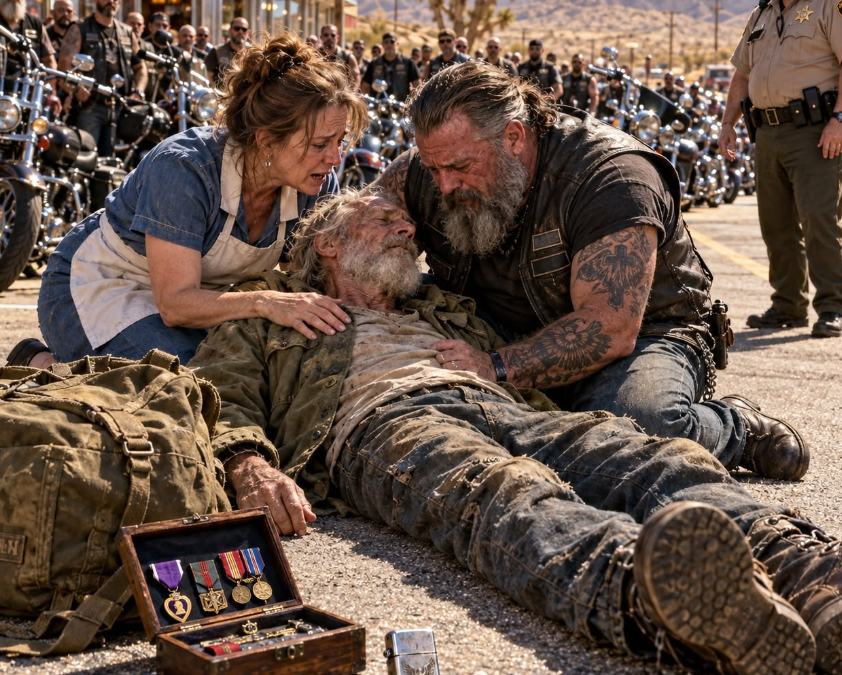
Two Hundred Bikers Stopped When a Homeless Man Collapsed Outside a Desert Diner—Then I Recognized the Medic Who Saved My Life in Iraq, and What Fell From His Bag Made Everything Around Him Suddenly Feel Wrong.
Two hundred motorcycles were rumbling behind me when a homeless man collapsed outside a roadside diner, and almost everyone on the sidewalk stepped back instead of stepping forward.
Then a scratched silver lighter rolled from his torn canvas bag, and the engraving sent me twenty years backward to Iraqi dirt, gunfire, and the combat medic who held my artery closed with his bare fingers while bullets hit the wall above us.
By the time I discovered why that decorated soldier was sleeping behind gas stations, the sheriff who had watched him fall was threatening my club, a developer had built an eight-million-dollar resort over his family home, and a forged signature was about to expose a conspiracy that had been burying vulnerable people for years.
My name is Jack Callahan.
Most people call me Bear.
The name has less to do with my personality than people think.
When I was nineteen, I was six-foot-three, two hundred and forty pounds, and stupid enough to believe that made me difficult to kill.
The Army corrected that assumption.
War has a way of correcting a lot of things.
I spent eight years in uniform, most of them trying to convince myself fear was something that happened to other men.
After I got out, I spent another decade learning that you can leave a war long before the war decides to leave you.
Eventually life carried me somewhere my mother would have hated on principle and loved once she met the men involved.
I became president of the Black Ridge Nomads.
Motorcycle club.
Veterans mostly.
Some construction workers.
A paramedic.
Three firefighters.
One high-school chemistry teacher who looked like he should be correcting algebra homework instead of riding a black Road Glide with skulls painted on the tank.
We had rough edges.
A few criminal records from younger, stupider years.
Divorces.
Nightmares.
Bad knees.
Worse tattoos.
But we had rules.
No drugs on club rides.
No violence unless somebody’s life was in immediate danger.
No abandoning a brother on the side of the road.
And when we raised money for wounded veterans, every dollar went where we said it would.
That mattered to us.
Maybe because most of us had lived long enough to know that trust is easy to wear on a patch and much harder to earn.
That August, nearly two hundred riders were crossing northern Arizona as part of our annual Miles for the Missing ride.
We were raising money for veterans living with catastrophic injuries and for families of service members who had died by suicide after coming home.
It was the largest ride we had ever organized.
The heat outside the little town of Red Mesa was brutal.
My bike thermometer showed 109 degrees.
The road shimmered.
The mountains in the distance looked painted onto the sky.
We had planned a fuel stop thirty miles farther west.
We never made it.
We were passing Rosie’s Route 40 Diner when I saw a cluster of people near the curb.
A woman in a white apron was kneeling on the pavement.
Someone else stood with a phone raised.
A couple tourists watched from the shade.
A sheriff’s cruiser sat crooked near the entrance.
Then a man fell sideways beside the diner sign.
I raised my fist.
PART2:
Two hundred motorcycles slowed behind me.
The sound changed from thunder to a low synchronized growl.
Wrench, my vice president, pulled alongside.
“What is it?”
“Man down.”
We parked along the shoulder.
I crossed the lot fast.
The woman in the apron had two fingers against the collapsed man’s neck.
“He was standing right here,” she said. “Then he just went down.”
She looked around fifty.
Dark hair tied back.
Name tag said RACHEL.
The man beneath her was thin enough that his Army field jacket looked borrowed.
Gray beard.
Cracked lips.
Sunken cheeks.
Boots worn almost through the soles.
There was dirt ground permanently into his hands.
He looked homeless.
That was what everybody saw first.
I wish I could tell you I was better.
I wasn’t.
For the first three seconds, that was what I saw too.
Homeless man.
Heat.
Collapse.
Possible overdose.
Dehydration.
Then I saw his jacket.
Old woodland pattern.
Army tape removed.
PART3:
A faded unit patch ghosted on one shoulder where something had been sewn for years.
One of my riders came running.
Aaron Wallace.
We called him Doc because before the beard, motorcycle, and questionable taste in music, Aaron had spent eleven years as an Army trauma nurse.
He dropped beside the man.
“Sir? Can you hear me?”
Nothing.
Doc checked breathing.
Pulse.
Pupils.
“Rachel, how long has he been down?”
“Maybe a minute.”
“Any medical history?”
“I don’t know.”
The sheriff stood ten feet away speaking into his radio.
Big man.
Late fifties.
Tan uniform immaculate despite the heat.
Nameplate: DEMPSEY.
I walked toward him.
“Ambulance coming?”
“County unit is tied up on a rollover.”
“How long?”
He shrugged.
“Twenty. Maybe thirty.”
Rachel looked up sharply.
“He doesn’t have thirty minutes, Carl.”
The fact that she used his first name told me something about small towns.
Everybody knows everybody.
The sheriff barely looked at her.
“I called it in.”
Doc opened the man’s shirt.
Sweat soaked through the undershirt.
Old surgical scars crossed his chest and abdomen.
“Bear.”
I looked.
Doc’s face had changed.
“Cardiac.”
“How bad?”
“Bad.”
The man’s belongings had spilled when he fell.
A canvas bag.
Blanket.
Canteen.
Two paperback books.
A wooden box.
Three pill bottles.
And a silver lighter.
It rolled beneath the bumper of a parked pickup.
I bent to retrieve it so nobody would drive over it.
The metal was scratched.
Dented at one corner.
The hinge barely held.
But I knew that lighter before I read the engraving.
My hand froze.
TO DOC BENNETT — FOR KEEPING US BREATHING.
RAMADI, 2006.
The parking lot disappeared.
Arizona vanished.
I was twenty-four again.
Hotter place.
Different dust.
Concrete wall exploding beside my head.
Somebody screaming into a radio.
Blood running warm beneath my collar.
I could smell burned insulation and sewage.
Hear an M240 hammering somewhere beyond the alley.
Then Ethan Bennett’s voice.
“Bear.”
Calm.
Too calm.
“Look at me.”
I was lying in Iraqi dirt.
My left hand wouldn’t work.
My neck felt like boiling water had been poured through it.
“Doc.”
“Look at me.”
“I’m bleeding.”
“No kidding.”
Even then.
Even with rounds hitting the wall.
Sarcasm.
“Am I dying?”
“No.”
He lied immediately.
That was how I knew I probably was.
Shrapnel had opened the side of my neck.
It missed my carotid by less than the width of a finger but damaged a major branch vessel.
Blood wouldn’t stop.
Ethan crawled through fire to reach me.
He jammed his fingers into the wound.
Pressed.
Hard.
I screamed.
“Good.”
His face hovered over mine.
“If you can scream, you can breathe.”
He held pressure for forty-three minutes.
I know because another soldier told me later.
Forty-three minutes in an alley while our squad fought its way to an evacuation route.
His gloves tore.
He used bare fingers.
When I tried to close my eyes, he slapped my helmet.
“Not yet, Bear.”
“I’m tired.”
“You can be tired on the helicopter.”
“I can’t feel my hand.”
“You don’t need your hand.”
“That’s stupid.”
“Argue later.”
Then he talked to me.
Baseball.
My mother.
The waitress I had been planning to ask out when we got home.
Anything to keep me conscious.
At one point I told him to leave me.
I remember that.
The shame of it never left.
“Go.”
He leaned closer.
“You’d have to die faster than this to get rid of me.”
I survived.
Twenty years later, I stood in Arizona holding his lighter.
I looked at the man on the pavement.
Older.
Emaciated.
Beard hiding half his face.
But now I saw it.
The line of the nose.
Scar near the right eyebrow.
The left ear with a notch missing.
My knees nearly gave out.
“Ethan?”
Rachel looked at me.
“You know him?”
I could barely speak.
“He saved my life.”
The sheriff finally looked interested.
Doc snapped, “Bear, I need an AED.”
I turned toward Dempsey.
“Your cruiser have one?”
“Yes.”
“Get it.”
He hesitated.
“It’s department equipment.”
I stared at him.
“What?”
“For authorized emergency use.”
Doc looked up.
“He is pulseless.”
The sheriff didn’t move.
Something dark rose in my chest.
I stepped closer.
“A decorated combat medic is dying ten feet from an AED.”
Dempsey’s expression tightened.
“You need to back up.”
Rachel stood.
“Carl, open the damn cruiser.”
People turned.
My riders had formed a wide semicircle but nobody approached.
Two hundred men in leather staring at one sheriff can change the atmosphere of a parking lot without anyone making a threat.
Dempsey looked around.
Maybe that did it.
Maybe Rachel did.
Maybe there was still enough decency somewhere beneath the badge.
He unlocked the cruiser.
Doc grabbed the AED.
Pads.
Analyzing.
No one spoke.
“Clear.”
Ethan’s body jerked.
Nothing.
Doc started compressions again.
Thirty.
Breaths.
The AED reset.
“Clear.”
Second shock.
Ethan jerked.
Three seconds.
Four.
Then he gasped.
It sounded terrible.
It sounded beautiful.
A weak rhythm appeared.
Rachel covered her mouth.
I realized I was crying when sweat and tears reached my lips at the same time.
Doc stabilized him as best he could.
Our support truck carried oxygen, trauma equipment, fluids, and supplies because two hundred motorcycles crossing desert require planning.
“We’re not waiting thirty minutes,” Doc said.
I looked at the sheriff.
“Closest hospital?”
“Flagstaff.”
“Time?”
“Hour and fifteen.”
Doc shook his head.
“He may not have it.”
“There’s an air ambulance station—”
“Where?”
Dempsey hesitated.
Rachel said, “Forty miles east.”
I pointed at Wrench.
“Call them.”
He was already dialing.
The helicopter met us eighteen minutes later at a highway maintenance yard.
We had fifty motorcycles ahead clearing every safe intersection and another hundred behind.
Not blocking.
Not breaking traffic laws.
Just visible.
People later called it an escort.
It didn’t feel like one.
It felt like we were trying to outrun death.
Ethan was flown to Flagstaff Memorial.
I rode behind the ambulance from the landing pad to emergency.
A cardiologist met us.
Massive myocardial infarction.
Multiple blocked vessels.
Severe malnutrition.
Dehydration.
Anemia.
Untreated hypertension.
Evidence that Ethan had survived cancer.
The doctor looked at me.
“You family?”
I hesitated.
“No.”
Then I looked through the glass at Ethan.
“Brother.”
The doctor nodded as if he understood exactly what I meant.
Five hours later, surgery began.
Triple bypass.
The waiting room filled with leather vests until hospital security politely asked half the club to wait outside.
Nobody argued.
Rachel drove up from Red Mesa.
She still wore the diner apron.
There was dried blood on one sleeve from where Ethan’s arm had scraped the pavement.
“He comes into Rosie’s three or four times a week,” she told me.
“For food?”
“Sometimes.”
“He pay?”
She gave me a look.
“Always.”
“How?”
“He works.”
“Doing what?”
“Anything.”
She counted on her fingers.
“Cleans grease traps. Sweeps. Repairs chairs. Unloads deliveries.”
Her eyes filled.
“One time my freezer broke. He fixed the relay with parts from an old radio and refused money because I had given him coffee.”
“That sounds like him.”
“He sleeps near the old rail depot when it’s cold.”
My throat tightened.
“Why didn’t somebody help him?”
Rachel looked at me.
“We tried.”
That answer bothered me.
“What does that mean?”
“He won’t stay at the shelter.”
“Why?”
“Sheriff’s department clears the camp sometimes.”
She looked toward the waiting-room doors.
“Ethan doesn’t trust them.”
I thought of Dempsey standing beside the cruiser.
AED locked.
“Why?”
Rachel lowered her voice.
“He used to own land outside Red Mesa.”
“How much land?”
“Big ranch. North side.”
“What happened?”
“No one knows the whole story.”
She hesitated.
“Or nobody says it.”
That was when Wrench walked in carrying Ethan’s canvas bag.
Leo Martinez had been my vice president for nine years.
Former Marine mechanic.
Five-foot-ten.
Built like a fire hydrant.
When Wrench looked worried, other men paid attention.
He sat beside me.
“You should see something.”
“What?”
He took a wooden box from Ethan’s bag.
Inside were documents folded so many times the creases had turned white.
Tax notices.
Property maps.
Photocopies.
VA letters.
A deed.
Wrench laid them on the table.
“Ethan owned one hundred eighty acres outside Red Mesa.”
Rachel leaned over.
“Bennett Ranch.”
Wrench pointed to a county parcel number.
“His grandfather bought it after Korea.”
I read.
Ethan Bennett.
Owner.
Then another document.
Notice of delinquent property tax.
$4,870.62.
“That took his ranch?”
“No.”
Wrench produced a quitclaim deed.
“Apparently this did.”
Grantor: Ethan James Bennett.
Grantee: Suncrest Development LLC.
I stared at the signature.
It looked wrong.
I had known Ethan twenty years earlier.
Men in the Army sign things constantly.
Leave forms.
Supply receipts.
Medical logs.
I had seen his signature.
Tight.
Slanted.
Fast.
This one was broad.
Slow.
Almost decorative.
“That isn’t his.”
Wrench nodded.
“My first thought too.”
Rachel looked pale.
“Suncrest?”
“You know them?”
“Everybody does.”
She looked at me.
“Grant Hollis.”
The name meant nothing to me.
Rachel explained.
Real estate developer.
Biggest employer in Red Mesa besides the county.
Built Desert Crown Resort.
Golf course.
Luxury homes.
Vacation rentals.
Campaign donor.
Town benefactor.
Wrench pulled up a photograph on his phone.
Hollis at a groundbreaking ceremony.
Next to him stood Sheriff Carl Dempsey.
Same sheriff.
They were shaking hands.
Rachel whispered, “Dempsey’s sister is married to Hollis.”
Wrench tapped another document.
Eviction order.
Ethan Bennett.
Unlawful occupancy.
Property now belonging to Suncrest.
Date.
Two years earlier.
I noticed the address listed for Ethan.
Veterans medical center in Phoenix.
“He was hospitalized.”
Wrench nodded.
“There’s more.”
He showed me an oncology summary.
Lymphoma.
Chemotherapy.
Ethan had been fighting cancer when the ranch transferred.
Then I saw the deed witness line.
NOTARY / OFFICIAL WITNESS:
CARL DEMPSEY, SHERIFF.
For a long time, none of us spoke.
Rachel sat down.
“Oh God.”
I read the signature twice.
Dempsey.
The man who had watched Ethan collapse.
The man reluctant to unlock an AED.
My hands curled.
Wrench looked at me.
“What are we doing?”
At thirty, I would have said something involving fists.
At forty-four, I might still have.
I was fifty-one that summer.
Age does not always make men wiser.
Sometimes it only gives them enough experience to know which kind of anger produces useful results.
I looked at Ethan through the ICU glass.
Machines.
Bandages.
A breathing tube.
A man who had once kept me alive with pressure and stubbornness.
“Call Sarah Whitmore.”
Wrench raised an eyebrow.
“The veterans attorney?”
“Yes.”
“Anyone else?”
“Dale Mercer.”
“Federal guy?”
“Retired.”
“Why?”
“Because if that deed is forged, I don’t want a biker club investigating corruption alone.”
Wrench almost smiled.
“That sentence would disappoint twenty-year-old you.”
“Twenty-year-old me ate crayons.”
“Marines eat crayons.”
“Same family.”
Within twelve hours, Black Ridge did what clubs like ours do best.
We called people.
Not because we had power.
Because we had numbers.
A retired federal investigator in Prescott.
A forensic document examiner in Phoenix.
A CPA whose son rode with our Tucson chapter.
Two veterans-rights attorneys.
A local title specialist.
A reporter I trusted because she had once written an unflattering but accurate piece about motorcycle charities.
No threats.
No trespassing.
No hacks.
No breaking into offices.
Evidence.
Public records.
Records are less satisfying than fists until you learn what they can destroy.
By morning, we had property-transfer histories.
Suncrest had acquired Ethan’s ranch for effectively nothing beyond assuming disputed tax debt and filing costs.
Six months later, Suncrest obtained permits.
Eight months after that, demolition.
The Bennett farmhouse disappeared.
Then construction began on the west section of Desert Crown Resort.
The current development value exceeded eight million dollars.
I stared at satellite images.
Pool.
Casitas.
Tennis courts.
Event pavilion.
Rachel leaned over my shoulder.
“The farmhouse used to be right there.”
She pointed at the resort pool.
Something cold moved through me.
Ethan’s mother had lived there.
I remembered him talking about her in Iraq.
She canned peaches.
Kept horses.
Sent cookies that arrived shattered but still got eaten.
I remembered Ethan saying someday he would go back and build her a porch wide enough for six rocking chairs.
Now tourists drank cocktails where the house had stood.
The next document made it worse.
Ethan had objected.
Three certified letters mailed from the VA hospital.
We found postal receipts inside the wooden box.
Addressed to the county assessor.
County treasurer.
Sheriff’s office.
But the county file showed no objections.
Nothing.
Dale Mercer, the retired federal investigator, studied the paperwork.
“Missing records.”
“Could be incompetence?”
“Could.”
“You think it is?”
“No.”
He turned another page.
“Because incompetence usually leaves random damage.”
He tapped the file.
“This damage is useful to someone.”
By the second day, we found another case.
Then another.
An eighty-two-year-old widow named Margaret Ellis lost twelve acres through a tax lien while recovering from a stroke.
Suncrest bought it.
A man with dementia supposedly signed a mineral-rights release benefiting a Hollis partner.
An elderly mechanic named Ray Pritchard transferred six commercial lots while living in assisted care.
His daughter claimed the signature was false.
A disabled Gulf War veteran lost a small desert parcel over code penalties that tripled while he was hospitalized.
Six properties.
All transferred through different mechanisms.
All later connected to Suncrest or related companies.
Three had documents witnessed or enforced through Dempsey’s office.
Wrench leaned back.
“This is organized.”
Dale corrected him.
“It’s a pattern.”
“What’s the difference?”
“Organized is a legal conclusion.”
Wrench sighed.
“This is why nobody invites investigators to parties.”
Dale looked at him.
“Correct.”
Ethan woke on the third day.
I was beside his bed.
His eyes opened slowly.
Focused on the ceiling.
Then me.
For maybe ten seconds, he just stared.
Finally:
“Bear?”
I laughed.
Then cried, because apparently middle-aged bikers have no dignity in cardiac wards.
“Yeah, Doc.”
His mouth moved.
“You got old.”
“You look homeless.”
His eyes closed.
I immediately regretted it.
Then he laughed.
Weak.
Painful.
Still Ethan.
“You always were an asshole.”
“Good to see you too.”
His eyes opened again.
He noticed the lighter on the bedside table.
“I thought I lost that.”
“You nearly did.”
He reached toward it.
I put it in his hand.
His fingers closed slowly.
“You kept yours?”
I nodded.
After Ramadi, six of us had bought Ethan matching engraved lighters.
I had carried mine for twenty years despite quitting cigarettes fifteen years earlier.
Some objects stop being objects.
Ethan turned his over.
Then his face changed.
“You looked in my bag.”
“We needed identification.”
He knew I was lying before I finished.
“Bear.”
“We know about the ranch.”
Fear entered his eyes.
Not anger.
Fear.
“Leave it.”
“No.”
“Leave it alone.”
“Ethan—”
His heart monitor sped up.
A nurse entered.
“Keep him calm.”
Ethan grabbed my wrist.
Surprisingly strong.
“You don’t understand.”
“Then tell me.”
“They own the courthouse.”
His voice cracked.
“I tried.”
The nurse looked at me.
I nodded.
“I’ll stop.”
Ethan released me.
But once his heart rate settled, I stayed.
An hour later, without me asking, he began talking.
After Iraq, he had done twelve years as a civilian paramedic and reserve military medic.
Then his sleep got worse.
Nightmares.
Panic.
He drank too much.
Stopped.
Started again.
Eventually sought treatment through the VA.
Then lymphoma.
Chemo.
Months in Phoenix.
While he was sick, letters arrived about property taxes.
He believed the account had been corrected because he had veterans disability exemptions and an automatic payment issue.
He wrote back.
Received no response.
Then chemotherapy nearly killed him.
By the time he returned to Red Mesa, there was a chain across his gate.
New locks.
Construction fencing.
He cut the chain.
Sheriff Dempsey arrived twenty minutes later.
Personally.
Ethan produced his deed.
Tax records.
Military discharge.
Everything.
Dempsey looked at the papers.
Then told him the property no longer belonged to him.
Ethan thought it was a mistake.
He tried to enter.
Dempsey put a hand on his weapon.
“You cross that fence again, I arrest you for criminal trespass.”
I felt my jaw tighten.
Ethan saw.
“Don’t.”
“Keep talking.”
He hired an attorney in Flagstaff.
The attorney filed an emergency challenge.
Two weeks later, the attorney withdrew.
“Why?”
“Said conflict of interest.”
“With who?”
“Wouldn’t tell me.”
Ethan contacted state agencies.
County officials.
Veterans advocates.
He wrote letters.
Some came back.
Some vanished.
He rented a motel room.
One night somebody broke in.
No television stolen.
No cash.
Only his property documents.
I looked toward the wooden box.
“Those survived.”
“Copies.”
He smiled bitterly.
“I kept them in the VA locker.”
After that, his health collapsed.
Cancer remission.
Then depression.
He stopped trusting people.
A motel became a truck.
Truck died.
Shelter beds.
Camps.
Odd jobs.
Rachel’s diner.
“Why didn’t you call anybody from the unit?”
He looked away.
That hurt.
“Ethan.”
“What was I supposed to say?”
“That you needed help.”
He laughed once.
No humor.
“To men I kept alive?”
“Yes.”
“No.”
“Why?”
His eyes filled.
“Because that wasn’t who I was.”
I understood too well.
Strong men often prefer disappearing to being witnessed as weak.
It is one of the dumbest ways pride kills us.
“You saved my life.”
“I was doing my job.”
“You crawled through fire.”
“My job.”
“You held my artery forty-three minutes.”
“Bear—”
“I built twenty years out of those forty-three minutes.”
His eyes met mine.
“I got married.”
Divorced, but that wasn’t the point.
“I held my daughter the day she was born.”
His face changed.
“You have a daughter?”
“Twenty-one.”
“Jesus.”
“She thinks you’re a legend.”
“I’m sleeping behind a rail depot.”
“Right now you’re sleeping in a hospital bed.”
“That better?”
“No.”
I leaned closer.
“But you’re not doing this alone anymore.”
Fear returned.
“Bear.”
“You don’t have to fight them.”
“Good.”
“Because we are.”
He closed his eyes.
“You always were stubborn.”
“You taught me.”
Four days later, Red Mesa woke to motorcycles.
Four hundred eighty-three.
The number grew because word spread.
Veterans clubs.
Independent riders.
Firefighters.
Nurses.
Families.
A retired school principal on a trike.
One ninety-year-old Korean War veteran whose grandson drove him in a pickup because his knees couldn’t handle a motorcycle anymore.
We had permits.
Routes approved.
Parking coordinated.
Sarah Whitmore, our lead attorney, gave everyone instructions the night before.
“No blocking entrances.”
A few men groaned.
“No threats.”
More groans.
“No touching anybody.”
Wrench raised his hand.
“What if they touch us?”
Sarah stared at him.
“Leo.”
“Hypothetical.”
“No.”
“What if—”
“No.”
He lowered his hand.
Sarah pointed around the room.
“If anyone gets arrested for acting stupid, I will personally leave you in jail until your mother comes.”
Half the room contained men over fifty.
Nobody doubted her.
At seven the next morning, engines rolled into Red Mesa.
The sound echoed off desert hills.
People came outside.
Diner customers.
Shop owners.
Tourists.
We parked legally around the courthouse square and along the public road near Suncrest headquarters.
Then we stood.
No revving.
No chants at first.
Just people.
Signs.
HE SAVED LIVES. WHO STOLE HIS HOME?
YOU CAN’T FORGE A MAN AWAY.
VETERANS ARE NOT VACANT PROPERTY.
Rachel closed Rosie’s for the morning and handed out water.
By nine, local news arrived.
By ten, Phoenix stations.
By noon, national veterans organizations were reposting the story.
Sheriff Dempsey held a press conference on the courthouse steps.
Big mistake.
He said:
“These outside agitators have entered our community based on misinformation concerning a private civil land dispute.”
Outside agitators.
Half the riders standing there had Arizona addresses.
Then he said Ethan had “a documented history of instability.”
My fists curled.
Sarah, beside me, whispered:
“He wants you angry.”
“He succeeded.”
“He wants you stupid.”
I looked at her.
She raised an eyebrow.
I stayed where I was.
Dempsey continued.
“We sympathize with Mr. Bennett’s medical and housing challenges, but those circumstances do not alter lawful property transfers.”
Rachel muttered, “Housing challenges?”
A reporter asked whether Dempsey had witnessed Ethan’s deed.
His face tightened.
“I have witnessed hundreds of documents in an official capacity.”
“Do you remember this one?”
“I don’t discuss active civil matters.”
“Did your sister’s husband purchase the property?”
“Suncrest is a legitimate local business.”
Not an answer.
By three that afternoon, the Arizona Attorney General’s office announced a preliminary review.
The crowd cheered.
I didn’t.
Reviews can disappear too.
Then something happened none of us planned.
An old woman walked through the riders toward Sarah.
White hair.
Oxygen tube beneath her nose.
Her daughter pushed a walker beside her.
The woman held a folder.
“My name is Margaret Ellis.”
I recognized the name.
One of the six properties.
“They stole mine too.”
Cameras turned.
Sarah crouched beside her.
“Mrs. Ellis, do you have an attorney?”
“No.”
“Do you want one?”
Margaret looked toward the courthouse.
“Yes.”
That afternoon, three more families came forward.
Then five.
One former county employee called our reporter anonymously.
By sunset, Red Mesa was no longer about one homeless veteran.
It was about a system.
Grant Hollis finally agreed to meet us the next morning.
His attorney insisted.
Sarah selected who entered.
Me.
Wrench.
Dale.
Two lawyers.
A CPA.
No club colors except mine and Wrench’s because Hollis’s team had spent the previous evening telling media he feared biker intimidation.
I almost wore a tie just to disappoint him.
Didn’t own one that fit.
Suncrest headquarters sat inside Desert Crown Resort.
Ethan’s land.
I had to drive beneath a stone sign with SUNCREST engraved across it.
Security gates.
Landscaped cactus.
Artificial stream.
The obscenity of water running decoratively through stolen desert land was not lost on me.
Hollis waited in a glass conference room.
Sixty.
Silver hair.
Tanned.
Tailored shirt.
No tie.
The cultivated casualness of rich men who want you to know they no longer have to dress for you.
Dempsey sat beside him.
I stopped.
“Why is he here?”
Hollis smiled.
“Sheriff Dempsey is familiar with the historical records.”
Sarah whispered, “Perfect.”
We sat.
Hollis looked at my vest.
“Mr. Callahan.”
“Mr. Hollis.”
“I understand you’re concerned about your friend.”
“Very.”
“I sympathize.”
“No, you don’t.”
Sarah gave me a sideways look.
I stopped.
She opened her folder.
“Forensic examination shows the Bennett signature on the quitclaim deed was not authored by Ethan Bennett.”
Hollis leaned back.
“Alleged.”
“Two independent examiners.”
She placed reports down.
“We also obtained Mr. Bennett’s verified signatures from military, VA, banking, and property records across twenty-five years.”
Hollis looked at Dempsey.
Then back.
“Our title company accepted the deed.”
Sarah placed another folder.
“Three former county employees state that objections filed by Mr. Bennett were removed from the active parcel file.”
Dempsey laughed.
“Anonymous allegations.”
“They’re not anonymous anymore.”
His smile disappeared.
Another document.
“Certified mail records establish receipt by your sheriff’s office.”
Dempsey said, “Mail gets lost.”
“Three separate objections?”
“It happens.”
Sarah nodded.
Then placed a spreadsheet on the table.
“Suncrest made quarterly payments to Red Mesa Public Safety Consulting.”
Hollis’s attorney moved.
“Where did you obtain—”
“Public business filings and disclosed bank records from related civil litigation.”
Sarah continued.
“Red Mesa Public Safety Consulting is owned by Deborah Dempsey.”
I looked at Carl.
His wife.
Hollis stopped moving.
Sarah stated the amounts.
Thirty-eight thousand.
Forty-one thousand.
Twenty-nine.
Consulting fees.
Risk assessments.
Security planning.
No meaningful deliverables located.
Hollis turned toward Dempsey.
“What is this?”
Dempsey said nothing.
Hollis’s attorney whispered urgently.
Sarah placed a flash drive on the table.
“And these are scanned copies of Mr. Bennett’s three objections.”
Dempsey’s head snapped up.
“Those don’t exist.”
The room went silent.
Hollis turned slowly.
“You said those letters never existed.”
Dempsey glared at him.
“Shut up.”
Sarah leaned back.
Wrench stared at the table because he was trying not to smile.
I understood why.
Sarah had notified every person before the meeting that audio recording would occur.
Written consent sat in the entry paperwork.
Dempsey had just contradicted himself on tape.
Hollis realized it too.
“You idiot.”
Sarah closed the folder.
“Gentlemen, I think we’re finished.”
The next morning, state investigators entered the county building.
Dempsey was placed on administrative leave.
Search warrants followed.
County property archives.
Sheriff’s office.
Suncrest offices.
The consulting company.
Computers.
Phones.
Financial records.
Hollis released a statement blaming “rogue local actors.”
Dempsey released one accusing Hollis of “mischaracterizing normal security contracts.”
They began eating each other alive before prosecutors filed anything.
That is another thing age teaches you.
Corrupt men are loyal until loyalty becomes expensive.
Ethan watched news coverage from his hospital bed.
He looked miserable.
“You did all this?”
“No.”
I gestured at the television.
“They did.”
“You brought four hundred bikers.”
“Four hundred eighty-three.”
“That detail doesn’t help.”
“You trained me to be accurate.”
He shook his head.
“What happens now?”
“Lawyers.”
“Terrifying.”
“Exactly.”
Then Sarah entered carrying a folder.
She placed it on Ethan’s lap.
“What’s this?”
“Your ranch.”
He stared at her.
“No.”
“Yes.”
“No.”
“Hollis has been removed from operational control by Suncrest’s board pending the investigation.”
Ethan’s fingers tightened around the folder.
Sarah continued.
“The company’s lenders are panicking. Their title insurer is panicking more. The resort sits on a parcel with a potentially void deed.”
I understood.
If Ethan’s transfer was fraudulent, everything built afterward had a poisoned title.
Mortgages.
Investors.
Insurance.
Guest contracts.
Suncrest had a financial disaster.
“They want to settle immediately,” Sarah said.
Ethan stared.
“Settle how?”
“Void the disputed transfer.”
His mouth opened.
“The land?”
“Your original one hundred eighty acres.”
He looked at me.
“And the resort?”
Sarah almost smiled.
“Real property improvements generally follow title unless otherwise resolved.”
Ethan looked horrified.
“I don’t want a resort.”
That was the first truly Ethan thing he had said since waking.
I laughed.
He glared.
“What did you do?”
“Nothing illegal.”
“That wasn’t the question.”
There he was.
Doc Bennett.
We negotiated.
Not overnight.
Not magically.
Months.
Suncrest investors had lawyers.
Banks had lawyers.
Ethan had better ones.
The state investigation strengthened his civil case.
Eventually, Suncrest agreed to restore title and then purchase back developed portions under a separate transaction.
The compensation was substantial.
Civil damages followed.
The exact number remained confidential.
Enough.
Enough that Ethan never needed to sleep outside again.
Enough to pay for care.
Enough to choose.
But before agreeing, Ethan insisted on keeping seventy acres surrounding the original farmhouse site.
“What are you going to do with seventy acres?” I asked.
He stared at a map.
“I don’t know.”
Rachel, sitting beside us, said:
“You’re terrible at retirement.”
He smiled.
The corruption case took longer.
Dempsey was indicted on charges related to records falsification, bribery, official misconduct, and conspiracy.
Hollis faced fraud and bribery allegations.
Not every charge survived.
Some were reduced.
Some merged.
Eventually, Dempsey pleaded guilty to several felony counts tied to falsified records and unlawful official assistance in property transfers.
Hollis entered a federal plea agreement involving fraud-related conduct and improper payments.
Other officials were investigated.
Two county employees received immunity for cooperation.
Properties were returned.
Families compensated.
One elderly owner had already died.
Her daughter cried when the title was restored to the estate.
Justice arrived too late for her mother to see it.
That mattered.
People like clean endings.
Real injustice leaves damage even after the paperwork says corrected.
Ethan understood that better than anyone.
One afternoon, six months after his heart attack, we rode to his seventy acres.
The resort was still visible in the distance.
But near the old homesite, desert had begun reclaiming disturbed ground.
Ethan stood where the farmhouse kitchen had been.
He knew exactly.
“My mother’s stove was there.”
Nothing remained.
He pointed.
“Porch.”
Dust.
“Barn.”
Scrub.
His face didn’t change much.
That worried me more.
“You okay?”
“No.”
Finally, an honest answer.
We stood quietly.
Then a pickup approached.
Rachel.
She climbed out carrying coffee.
“Figured two emotionally constipated veterans needed supervision.”
Ethan looked at her.
“I’m not emotionally constipated.”
“You lived behind a rail depot rather than call anybody.”
“That’s tactical isolation.”
“That’s stupidity with military branding.”
I liked Rachel more every day.
We sat on the tailgate.
Ethan looked across the land.
“What do homeless veterans need?”
The question seemed random.
Rachel answered anyway.
“Housing.”
I said, “Medical care.”
“Paperwork help,” Rachel added.
“Jobs.”
“Transportation.”
Ethan looked at me.
“Purpose.”
We both went quiet.
The idea began there.
Not as Bennett House.
Not as a grand foundation.
Three people drinking diner coffee on stolen land returned to its owner.
A place for veterans who had fallen between systems.
Not a shelter in the traditional sense.
Transitional cabins.
Case management.
Transportation to VA appointments.
Mental-health referrals.
Addiction recovery partnerships.
Legal aid.
A machine shop.
Motorcycle and small-engine repair.
A garden because Rachel insisted grown men need tomatoes more than another meeting room.
Ethan resisted naming it.
Naturally.
We filed nonprofit paperwork.
Black Ridge donated the first major chunk of money.
Other clubs contributed.
Unions sent labor.
A lumber company donated materials.
An electrician from Phoenix installed wiring at cost.
Veterans built cabins for veterans.
The first ten were finished before winter.
Each small.
Bed.
Bathroom.
Kitchenette.
Porch.
No luxury.
Privacy.
That mattered to Ethan.
“You know what I hated about shelters?”
“What?”
“Being watched.”
He stared at one finished cabin.
“Every failure becomes public when twenty men sleep in one room.”
So every resident at Bennett House got a door.
Their door.
Lock.
Key.
A place nobody entered without knocking.
We called the project the Bennett House because Ethan voted against it and lost seventeen to one.
His one vote.
“You people are terrible.”
Wrench smiled.
“Democracy.”
Rachel became program manager after leaving the diner.
She claimed it was temporary.
Everyone laughed.
Doc Wallace ran health-screening weekends.
Sarah created a monthly legal clinic.
Dale helped veterans rebuild lost identification and records.
I ran motorcycle workshops twice a month.
Ethan?
At first he tried to do everything.
Then his cardiologist threatened murder.
Eventually he settled into mentoring residents, fixing generators, and pretending he wasn’t in charge.
The first veteran moved in named Calvin Ross.
Marine.
Fifty-eight.
Had been sleeping in his truck.
The second was a woman named Teresa Cole.
Army logistics.
Domestic violence survivor.
Lost housing after an injury.
Then Marcus.
Air Force.
Addiction recovery.
Then Lou.
Vietnam veteran.
Seventy-two.
No family.
For every one who arrived, Ethan knew some version of the same shame.
“I should’ve handled it.”
“I used to have a house.”
“I used to have a job.”
“I used to be somebody.”
Ethan always answered the same way.
“You still are.”
The sentence sounded different from him.
Because he had needed somebody to say it too.
A year after the diner, I rode back to Bennett House alone.
Late afternoon.
Cottonwoods had been planted near the cabins.
Young trees.
Not much shade yet.
Ethan sat beneath the largest one anyway.
He looked like a different man.
Not young.
We weren’t getting miracles.
But heavier.
Healthier.
Trimmed beard.
Clean jeans.
Old Army field jacket over the chair.
I held something in my hand.
His lighter.
He looked at it.
“You kept that?”
“For twenty years.”
“That one isn’t yours.”
“I know.”
I tossed it.
He caught it.
Barely.
“Reflexes are terrible.”
“Heart surgery.”
“Excuses.”
He turned the lighter.
Read the engraving.
TO DOC BENNETT — FOR KEEPING US BREATHING.
RAMADI, 2006.
His thumb moved over the scratches.
“You guys were idiots.”
“You loved us.”
“I tolerated you medically.”
We watched two younger veterans work on an old Harley inside the shop.
One engine turned over.
Backfired.
Someone swore.
Ethan smiled.
Then went quiet.
“You know what hurt worst?”
I looked at him.
“Losing the ranch?”
“No.”
“The cancer?”
“No.”
“Dempsey?”
He shook his head.
“People stopped seeing me.”
I said nothing.
“When I had the uniform, strangers thanked me.”
His hand closed around the lighter.
“When I owned land, people called me Mr. Bennett.”
He looked toward the cabins.
“When I became homeless, I became ‘that guy.’”
His voice hardened.
“The guy outside the gas station.”
“The guy behind the depot.”
“The guy who shouldn’t be near customers.”
“The vagrant.”
I remembered the pavement outside Rosie’s.
People stepping around him.
Phones out.
Dempsey slow to open his cruiser.
“Same man,” Ethan said.
“Same war.”
“Same scars.”
“Same hands.”
He looked down at them.
“But once there wasn’t anything visible left to respect, people decided there was nothing there.”
I swallowed.
“I saw you.”
He smiled slightly.
“Eventually.”
“No.”
He looked at me.
I shook my head.
“You saw me first.”
His smile disappeared.
The years collapsed.
Ramadi.
Blood.
His hand against my neck.
Not yet, Bear.
I reached across.
He extended his hand.
We clasped forearms.
“You kept me breathing.”
“My job.”
“Stop saying that.”
He smiled.
“Never.”
The workshop engine started again.
This time clean.
A deep rumble rolled across the property.
Ethan looked toward it.
Not threatening.
Not angry.
Alive.
I thought about what brotherhood had meant to me when I was younger.
Patches.
Formation.
Fights.
Loyalty shouted loudly enough for strangers to hear.
I had been wrong.
Brotherhood was remembering a man after his usefulness to you ended.
It was answering a phone call at three in the morning.
It was noticing the quiet one.
It was asking for help before pride buried you.
It was showing up with attorneys when fists would only give corrupt men an excuse.
It was building cabins.
Filing forms.
Driving somebody to chemotherapy.
Sitting beside a hospital bed.
Checking whether a veteran sleeping in his truck had eaten.
Unromantic work.
Real work.
A few months later, Sheriff Dempsey was sentenced.
I attended.
Ethan almost didn’t.
Then Rachel told him closure wasn’t mandatory but avoidance wasn’t healing either.
He called her bossy.
She told him to wear a clean shirt.
The courtroom was full.
Victims.
Families.
Reporters.
Dempsey looked smaller without the uniform.
That surprised me.
For years, authority had enlarged him.
Without the badge, he was just a sixty-year-old man in a suit.
Several victims spoke.
Margaret Ellis did.
Her daughter stood beside her.
Then Ethan.
He walked slowly to the lectern.
No dramatic anger.
That was what made it powerful.
“My name is Ethan Bennett.”
Dempsey looked down.
“I served as an Army medic.”
Pause.
“I also owned property in Red Mesa.”
Another.
“For a period of time, I was homeless.”
He looked toward the judge.
“I want those facts said in the same paragraph.”
The room was silent.
“Because one did not erase the others.”
I felt my throat tighten.
“I became homeless after my property was taken through documents I did not sign and a process I could not successfully fight while receiving cancer treatment.”
He looked at Dempsey.
“But what damaged me most was not losing acreage.”
Dempsey finally looked up.
“It was being treated as if losing my property had also erased my credibility.”
Nobody moved.
“Once I slept outside, every complaint I made became the complaint of a homeless man.”
His hands rested on the lectern.
“When I said my signature was forged, I was confused.”
“When I said records were missing, I was paranoid.”
“When I entered my own land, I was a trespasser.”
“When I collapsed outside a diner, I was a problem in the parking lot.”
He breathed.
“I am not asking this court to punish Mr. Dempsey because I was once a soldier.”
That surprised some people.
“I am asking the court to recognize that the law is supposed to protect a man even after he loses the things that make other people respect him.”
The judge watched him carefully.
Ethan finished.
“The poor do not need less due process.”
“The sick do not need less credibility.”
“The homeless do not need less law.”
“They need the same law everybody else believes they have.”
Then he sat.
No applause.
Courtrooms are not biker rallies.
But I saw people crying.
Dempsey received prison time.
Not enough for some.
Too much according to his family.
Justice does not produce universal satisfaction.
It produces a record.
He did it.
The state named it.
Consequences followed.
Hollis’s sentencing came later.
His company survived under new ownership.
The resort remained on the developed acreage it had purchased back from Ethan through the settlement.
That bothered some people.
They wanted bulldozers.
Symbolic destruction.
Ethan refused.
“Why destroy working buildings?”
He negotiated annual payments from the hospitality company to Bennett House.
Wrench laughed when he heard.
“So tourists sleeping on your stolen land are funding homeless veterans?”
Ethan smiled.
“Seems efficient.”
I had never been prouder.
Bennett House expanded.
Twenty cabins.
Then twenty-eight.
A women’s wing.
Family cottages.
A small medical clinic.
The clinic was officially named the Bennett Medical Room.
Ethan objected again.
Ignored again.
One wall held photographs.
Not medals.
Not politicians.
Before-and-after photographs of residents.
Not the manipulative kind.
Just documents of presence.
Calvin asleep in his truck.
Calvin eight months later holding welding certification.
Teresa with a duffel bag on arrival.
Teresa later moving into an apartment with her daughter.
Lou sitting alone beneath a gas-station awning.
Lou teaching younger residents how to grow peppers.
Ethan refused to let the wall be called a success wall.
“People aren’t projects.”
So Rachel called it the Still Here Wall.
That name stayed.
Three years after the diner, a new resident arrived.
Name: Daniel Ruiz.
Thirty-four.
Marine veteran.
Missing two fingers.
Opioid addiction after combat injuries.
Estranged from family.
He came in angry.
At everybody.
Staff.
VA.
God.
Himself.
Ethan liked him immediately.
Of course.
One afternoon Daniel threw a wrench across the machine shop.
“Nothing works!”
The wrench hit the concrete.
Ethan continued cleaning a carburetor.
Daniel shouted:
“You don’t understand!”
Ethan looked up.
“I lived behind a railroad depot.”
Daniel stopped.
“I had cancer.”
Silence.
“Somebody stole my ranch while I was sick.”
Daniel stared.
Ethan held up a hand.
“And I still have all my fingers.”
Daniel almost smiled.
“Asshole.”
“Correct.”
That was Ethan’s gift.
He did not inspire people from above.
He sat beside them.
There is a difference.
Eventually Daniel reconciled with his sister.
Started recovery.
Became one of our best small-engine instructors.
The story attracted attention.
Too much sometimes.
Television crews wanted Ethan.
Documentaries.
Podcasts.
Politicians.
He hated all of it.
One gubernatorial candidate asked to hold an event at Bennett House.
Ethan declined every candidate from every party.
“Veterans have been used as wallpaper enough.”
That ended that conversation.
He did accept one national award.
Only because Rachel threatened to drug his coffee.
I traveled with him to Washington.
He wore a suit for the first time I had ever seen.
Looked furious.
At the ceremony, a presenter introduced him as:
“From homeless veteran to humanitarian leader.”
Ethan leaned toward me.
“I hate that.”
“Smile.”
“Why?”
“Cameras.”
He smiled like someone had stepped on his foot.
Later, at dinner, he explained.
“I wasn’t less human when I was homeless.”
“I know.”
“The sentence makes it sound like I became worthy when I built something.”
I looked at him.
“That’s not what they meant.”
“I know.”
He stirred his coffee.
“That’s why it matters.”
That stayed with me.
We love redemption stories.
Especially in America.
Man loses everything.
Man fights.
Man wins.
Man builds nonprofit.
Music.
Applause.
We are less comfortable with the middle.
The part where the man is still homeless.
Still sick.
Still angry.
Still unable to demonstrate how inspirational he will eventually become.
Would Ethan have mattered if he never recovered the ranch?
Yes.
Would he have deserved the AED if he had never served?
Yes.
Would the property fraud have been wrong if the victim had been an alcoholic nobody liked?
Yes.
Those were harder truths than the viral version.
I began saying them whenever people asked me to speak.
The Black Ridge Nomads became associated with Bennett House.
That helped our reputation.
Which made me uncomfortable.
Good work can become vanity fast.
So we created rules.
No club recruitment at the ranch.
No forced publicity.
Residents never had to appear in fundraising content.
No one owed us gratitude.
That last one bothered some volunteers.
It shouldn’t have.
Help stops being help when repayment is emotional obedience.
Ethan taught me that too.
Five years after the diner, Rachel and Ethan got married.
I know.
Nobody saw it coming except everyone.
They had spent years pretending they were merely coworkers.
Rachel told him she loved him first.
Ethan responded:
“That seems medically concerning.”
She walked away.
He chased her through the garden apologizing.
They married beneath the cottonwoods.
Small ceremony.
Bikers.
Veterans.
Rachel’s diner staff.
Sarah.
Dale.
Doc.
Wrench.
Margaret Ellis, ninety years old and still mean enough to frighten elected officials.
Ethan wore the lighter in his jacket pocket.
During my toast I said:
“Rachel, I want you to know Ethan has always been extremely brave unless confronted by emotional commitment.”
He threw a dinner roll at me.
Everybody laughed.
I looked at him.
Healthy.
Home.
Loved.
For one dangerous second I allowed myself to imagine the parking lot again.
Another ten minutes without the AED.
Another delay.
No reunion.
No investigation.
No Bennett House.
No wedding.
Lives are terrifying that way.
Whole futures hanging from ordinary decisions.
Unlock the cruiser.
Call the helicopter.
Pick up the lighter.
Look twice at a homeless man.
People say one person cannot change everything.
Obviously.
But one action can change what happens next.
Then the next thing changes another.
A chain.
Not magic.
Consequences.
That is both hopeful and frightening.
At sixty, I finally retired from club presidency.
Wrench took over.
His first official act was putting my face on a cake that made me look like a criminalized potato.
Respect is temporary.
I remained involved with Bennett House.
My daughter brought her own son there.
My grandson was six.
He saw Ethan’s missing ear notch.
“Did a bad guy do that?”
Ethan considered.
“Door.”
My grandson looked disappointed.
“The war didn’t do all the interesting damage.”
Then the boy noticed the lighter.
“What’s that?”
Ethan handed it over.
My grandson sounded out the engraving.
“For keeping us breathing.”
He looked at me.
“Did he save you?”
“Yes.”
“How?”
I looked at Ethan.
He shrugged.
“Bear was dramatic.”
“I was bleeding to death.”
“Exactly.”
My grandson examined us both.
Children judge history ruthlessly.
“So then you saved him?”
I started to answer.
Ethan did first.
“No.”
The boy frowned.
“But Grandpa found you.”
“He did.”
“And got your house back.”
“With help.”
“So he saved you.”
Ethan shook his head.
“He showed up.”
My grandson thought.
“What’s the difference?”
Ethan smiled.
“Important question.”
He looked at me.
“People use the word save too easily.”
Then to the boy:
“Your grandpa didn’t fix everything.”
“He found me when I couldn’t keep doing it alone.”
“He brought people.”
“Other people brought skills.”
“Lawyers brought law.”
“Doctors brought medicine.”
“Rachel brought food and common sense.”
“Everybody did part.”
My grandson nodded.
“So saving is teamwork?”
Ethan laughed.
“Yeah.”
“Usually.”
I loved that answer.
Because the heroic version of our story always irritated Ethan.
Two hundred bikers save homeless hero.
Good headline.
Incomplete.
Rachel ran first.
Doc restarted his heart.
Dempsey, reluctantly, unlocked the AED.
Hospital staff operated.
Wrench found documents.
Sarah used law.
Dale used experience.
Reporters created sunlight.
Victims spoke.
Investigators worked.
Judges ruled.
Donors built.
Ethan rebuilt himself.
No single savior.
A chain of people finally deciding not to look away.
That was the real story.
Years later, the silver lighter sits in a glass case at Bennett House.
Ethan hates that too.
Beside it is a small card.
Not about Ramadi.
Not about me.
Ethan wrote the card himself.
It says:
A HUMAN LIFE DOES NOT LOSE VALUE WHEN IT LOSES STATUS.
LOOK AGAIN.
That is all.
Visitors sometimes expect more.
They ask where the biker memorabilia is.
Where the sheriff photos are.
Where the forged deed is displayed.
Those records are archived.
Evidence served its purpose.
Ethan never wanted a museum of the men who hurt him.
He wanted a place for people who were still alive.
I understand.
Cruel people should not occupy more space in the ending than the people who survived them.
I am sixty-three now.
Ethan is sixty-five.
We move slower.
Our knees predict weather.
He still refuses to use a proper cane when his hip hurts.
Rachel still threatens him.
Bennett House has helped hundreds of veterans.
Not saved.
Helped.
Some succeeded spectacularly.
Some relapsed.
Some left angry.
Some came back.
Some disappeared.
We lost people.
That is another part inspirational stories omit.
Community does not make tragedy impossible.
It makes isolation less automatic.
There is a difference.
Every August, Black Ridge still rides through Red Mesa.
We stop at Rosie’s.
Rachel sold the diner to her niece, but the pie remains criminally good.
The sheriff’s office has different leadership now.
An AED sits in an unlocked emergency cabinet near the diner entrance.
A plaque above it says:
FOR ANYONE WHO NEEDS IT.
Ethan had it installed.
No name.
No veteran language.
Anyone.
The first time I saw that sign, I understood everything.
He could have demanded:
FOR VETERANS.
After what happened, nobody would have questioned it.
He didn’t.
Because the problem was never that Dempsey failed to recognize Ethan as a decorated medic.
The problem was that he thought a homeless man could wait.
That distinction matters.
One August afternoon, after the ride, Ethan and I sat outside Rosie’s.
Same parking lot.
New pavement.
Different tables.
I could still see where he fell.
“Do you remember anything?”
“From the heart attack?”
“Yeah.”
He thought.
“Rachel yelling.”
“She does that.”
“Engines.”
“Two hundred.”
“Show-off.”
“Then pain.”
He looked toward the road.
“Then hospital.”
“No lighter?”
“No.”
“Good.”
He smiled.
“Why?”
“Because that thing nearly gave me a heart attack.”
“Would’ve been efficient. Two for one.”
We laughed.
Then a young man crossed the parking lot pushing a shopping cart.
Backpack.
Dirty clothes.
People glanced.
A couple looked away.
The young man approached the diner door.
Hesitated.
Rachel’s niece stepped outside.
“Hungry?”
He nodded.
“Got money?”
He looked ashamed.
“No.”
She handed him a broom.
“Patio needs sweeping.”
His face changed.
Not humiliation.
Relief.
A trade.
Dignity.
I looked at Ethan.
He looked at me.
“Rachel?”
He nodded.
“She taught her.”
The young man began sweeping.
Ten minutes later, a burger waited inside.
Maybe he needed more help.
Maybe he had addiction.
Mental illness.
Bad choices.
Bad luck.
Probably some complicated combination.
We didn’t know.
That was the point.
We didn’t need his complete biography before deciding he deserved to eat without being degraded.
Ethan watched him.
Then said:
“That was me.”
“I know.”
“No.”
He shook his head.
“That could be anybody.”
I looked at him.
He tapped the table.
“That’s what people miss.”
He was right.
We like distance.
The homeless man.
The addict.
The veteran.
The widow.
The criminal.
The rich developer.
The biker.
Labels reduce complexity.
Makes judgment quicker.
Ethan Bennett had been a combat medic.
Paramedic.
Landowner.
Cancer patient.
Trauma survivor.
Alcoholic for a period.
Homeless man.
Fraud victim.
Husband.
Mentor.
Nonprofit founder.
Pain in my ass.
All true.
None complete.
So was I.
Soldier.
Biker.
Divorced father.
Club president.
Man who once told a medic to leave him to die.
Man who later spent twenty years wishing he could repay him.
People are rarely one noun.
The danger begins when power treats them as one.
“Vagrant.”
That word nearly buried Ethan.
Not legally by itself.
But culturally.
Once Dempsey could put Ethan inside that category, everything became easier.
Ignore his papers.
Question his memory.
Threaten arrest.
Delay aid.
Assume nobody important would ask questions.
Then the lighter rolled across the pavement.
Recognition changed the room.
Sometimes I still feel guilty about that.
Because what if I had not recognized him?
Would we have stayed?
Doc would have treated him.
I know that.
Would I have followed to the hospital?
Maybe.
Would we have opened his bag?
Probably not.
Would anybody have found the deed?
Maybe Rachel eventually.
Maybe nobody.
That question troubles me.
It should.
We should not need proof that a suffering stranger once did something heroic before deciding his suffering matters.
Ethan saved my life.
That made the story personal.
It did not make his rights more legitimate than Margaret Ellis’s.
Or the man with dementia.
Or the veteran whose desert lot was stolen.
Or the kid sweeping the diner patio.
Dignity cannot be a reward for a good biography.
That is the lesson I carry now.
Not brotherhood.
Not revenge.
Not even justice.
Recognition.
Seeing someone before credentials arrive.
When Ethan collapsed, I saw a homeless man.
Then I saw the lighter.
Then I saw Ethan.
I wish those had happened in the opposite order.
Human first.
Everything else second.
We are working on that.
All of us.
One look at a time.
Last fall, Ethan suffered another cardiac scare.
Not a heart attack.
Arrhythmia.
Still terrified me.
I drove three hours to the hospital.
Rachel met me in the hallway.
“He’s fine.”
“I heard that sentence twenty years ago.”
“He is actually fine.”
I entered.
Ethan sat in bed eating gelatin.
“Bear.”
“You look terrible.”
“You’re consistent.”
His heart was stable.
New medication.
Monitoring.
Before I left, he handed me the lighter.
“What?”
“Take it.”
“No.”
“Take it.”
“You’re not dying.”
“Neither were you in Ramadi, according to me.”
“Ethan.”
He smiled.
“I don’t need it anymore.”
I stared.
“What do you want me to do with it?”
“Give it back when I annoy you enough.”
“You’ll have it Tuesday.”
He laughed.
I brought it home.
For a week it sat on my desk.
Then I drove back to Bennett House.
Placed it in the display case.
Beside the card.
LOOK AGAIN.
Ethan came in while I was closing the case.
“You put it here?”
“Yeah.”
“Sentimental bastard.”
“Still.”
He stood beside me.
Both older.
Two men connected by forty-three minutes of pressure in an alley and twenty years of everything that followed.
“You know,” I said, “I never repaid you.”
He rolled his eyes.
“Don’t start.”
“Seriously.”
“Bear.”
“You saved my life.”
“My job.”
“You always say that.”
“Because it’s true.”
“Then what was Red Mesa?”
He looked around.
Veterans crossing the courtyard.
Workshop doors open.
Rachel arguing with a delivery driver.
A counselor walking beside a resident.
Young cottonwoods finally large enough to make real shade.
“This?”
He smiled.
“Everybody’s job.”
Then he walked away.
That is Ethan Bennett.
Always refusing the legend.
Maybe that is why I trust him.
If you ask people in Red Mesa what happened all those years ago, you will hear different versions.
Some say bikers invaded town and exposed corruption.
Some say a homeless veteran brought down a sheriff.
Some say Suncrest stole a ranch and got caught.
Some say a silver lighter changed everything.
All partly true.
My version is quieter.
A man collapsed.
A woman ran to him.
A medic knelt.
A sheriff hesitated.
A lighter rolled.
A friend remembered.
Documents survived.
People believed a man the system had decided not to believe.
Then enough of them stood beside him that ignoring him became harder than listening.
That is all justice sometimes needs at the beginning.
Not certainty.
Not heroism.
Someone willing to stop walking.
Ethan once held my artery closed with his bare hand because I was bleeding too badly to survive alone.
Twenty years later, he was bleeding in a different way.
Land.
Health.
Identity.
Trust.
Piece by piece.
No single hand could stop that.
So we used many.
Doctors.
Lawyers.
Reporters.
Accountants.
Veterans.
Neighbors.
Witnesses.
Families.
Four hundred eighty-three bikers who understood that sometimes showing up peacefully is more frightening to corrupt men than violence could ever be.
We did not give Ethan his dignity back.
I used to say that.
I was wrong.
Nobody had taken his dignity.
They took his ranch.
His documents.
His credibility in official rooms.
His shelter.
His sense that fighting would matter.
But dignity?
That remained his.
Even behind the rail depot.
Even sweeping Rosie’s patio for a hamburger.
Even lying unconscious in the heat.
What we helped restore was the world’s obligation to recognize it.
That distinction matters to me now.
Ethan did not become valuable when I recognized him.
He was valuable before the lighter rolled from the bag.
Before Ramadi.
Before the uniform.
Before Bennett House.
The lighter only reminded me of something I should have remembered without it.
Look again.
The man on the pavement has a name.
The woman in the shelter has a history.
The old veteran asking the same question for the third time may be terrified, not stupid.
The kid sleeping in his car may have once had an office.
The person you have reduced to one bad season may have lived entire decades you cannot see.
Look again.
That is what I tell new Nomads now.
Patches mean nothing if they only teach you to recognize your own.
Brotherhood that stops at club colors is just another tribe.
Real loyalty begins when there is no obvious reason the stranger should matter to you.
The final time I rode through Red Mesa that summer, two hundred motorcycles were behind me again.
Almost exactly like the day everything began.
We passed the diner.
I raised my fist.
The formation slowed.
Outside stood a small crowd.
For one split second, my heart jumped.
Then I saw why.
Ethan.
Rachel.
Daniel.
Calvin.
Half the Bennett House residents.
They held a banner.
BEAR, STOP BLOCKING TRAFFIC AND COME EAT PIE.
I laughed so hard I nearly missed the turn.
We parked.
Engines shut down one by one.
The sudden quiet felt enormous.
Ethan walked toward me.
No field jacket.
No canvas bag.
No fear in his eyes.
He still carried scars.
Still had bad nights.
Still distrusted county paperwork enough to make Sarah review anything with a seal on it.
Recovery does not mean becoming the person from before.
There is no before after enough things happen.
There is only next.
Ethan had built a good next.
So had I.
He held out his hand.
I took it.
Twenty years earlier, that hand kept blood inside my body.
Years later, mine helped pull documents into daylight.
Neither debt cancelled the other.
That is not how friendship works.
You do not keep score.
You keep showing up.
Behind Ethan, the diner door opened.
Rachel yelled:
“Food’s getting cold!”
Ethan looked at me.
“Still terrifying.”
“Absolutely.”
We walked inside.
On the wall near the register hung a photograph somebody had taken the day of the original ride.
Two hundred motorcycles.
Parking lot.
People gathered.
In the center, almost impossible to see unless you knew where to look, a man lay on the pavement.
I stood there staring.
Rachel came beside me.
“I almost took that down.”
“Why didn’t you?”
“Ethan said keep it.”
I looked at him across the diner.
Laughing with Wrench.
Alive.
“Why?”
Rachel shrugged.
“He said people remember endings too easily.”
I understood.
The ending was beautiful.
Bennett House.
Justice.
Marriage.
Land returned.
Men prosecuted.
The beginning was harder.
A sick homeless man collapsed.
People hesitated.
That part mattered too.
Maybe more.
Because every satisfying ending in the world is useless if we train ourselves to overlook people before their story becomes inspiring enough to care about.
I sat down across from Ethan.
He slid pie toward me.
“You’re staring.”
“Thinking.”
“Dangerous.”
“Remember the parking lot?”
His expression softened.
“Every day.”
“Regret anything?”
He looked toward the window.
The Arizona sun was dropping behind the hills.
Long shadows across the pavement.
“Yeah.”
“What?”
“Not calling you.”
I nodded.
“Me too.”
“What do you regret?”
“Needing the lighter.”
He frowned.
“To recognize you.”
Ethan looked at me for a long time.
Then nodded.
“Good.”
“Good?”
“That means you learned something.”
He took another bite of pie.
I laughed.
“Still teaching?”
“My job.”
Of course.
Some things never change.
Outside, motorcycles cooled in the desert evening.
Metal ticking softly.
Inside, veterans argued about baseball.
Rachel yelled at somebody for moving chairs.
Wrench cheated at cards.
The world was imperfect.
Still corrupt in places.
Still cruel.
Still too quick to decide who matters.
But in one diner, in one little Arizona town, nobody looked through Ethan Bennett anymore.
And at Bennett House, nobody had to earn a bed by proving they once were somebody.
That may be the victory I am proudest of.
Not that we exposed a sheriff.
Not that Hollis went down.
Not that Ethan recovered valuable land.
Those were victories.
Necessary ones.
But the larger victory was building something that contradicted the lie at the center of what happened to him.
The lie that when a man loses enough, he becomes less of a man.
Ethan Bennett lost his health.
His home.
His money.
His trust.
For a while, even his name seemed to vanish beneath the label other people gave him.
Homeless.
But he was never erased.
We were simply late in seeing him.
Twenty years earlier, I had lain in Iraqi dirt with blood pouring through Ethan’s fingers.
I told him I was tired.
He would not let me disappear.
Two decades later, he told me the same thing from a hospital bed in Arizona.
“I was tired.”
This time, we were the ones who refused to let that be the end.
Maybe life does not often give people a chance that symmetrical.
I know that.
Most debts cannot be repaid cleanly.
Most people who save us never need saving in exactly the right place at exactly the right moment.
But when life did give me that chance, I learned something I should have known all along.
The debt was never mine to repay.
Love is not debt.
Brotherhood is not accounting.
You help because someone is there.
You help because you can.
You help because once somebody is lying on the ground, their résumé no longer matters.
Their bank account doesn’t matter.
Their address doesn’t matter.
Their uniform doesn’t matter.
The engraved lighter doesn’t matter.
A person is there.
That should be enough.
Ethan once kept me breathing.
Years later, hundreds of us helped give him room to breathe again.
Not because he had earned it in Ramadi.
Not because he wore medals.
Not because a reporter discovered his story.
Because he was still here.
And sometimes the most important thing one human being can do for another is look at a life everyone else has reduced to a label and say:
I see you.
You are still here.
So am I.
View more