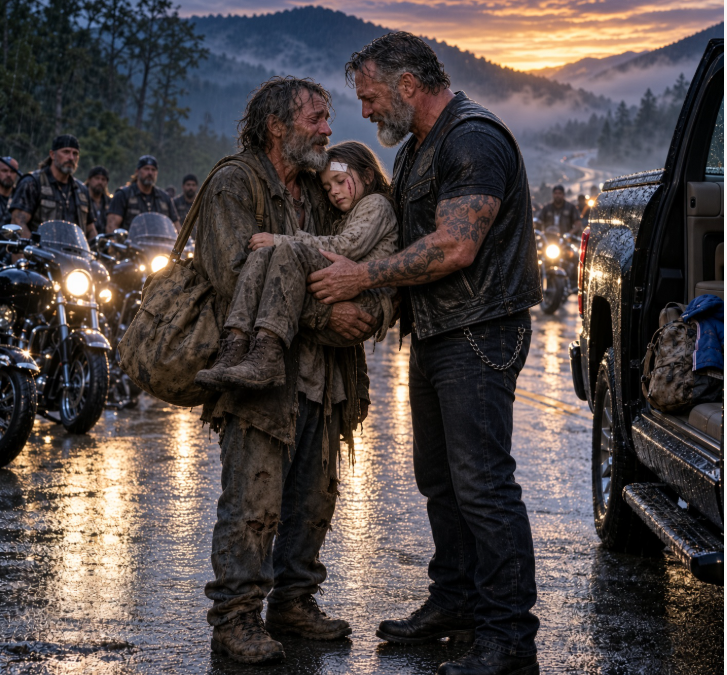
AHomeless Man Carried an Injured 9-Year-Old Girl Through a Rain-Soaked Mountain Night—Then Dozens of Bikers Appeared at Dawn, and He Realized Her Father Had Been Looking for More Than Just His Daughter.
Everyone searching for Sophie Brennan had already been warned about a homeless man seen on the mountain, so when Daniel Reed emerged at dawn carrying the missing nine-year-old on his back, dozens of bikers thought they had finally found the man who took her.
Daniel had spent twenty-two years believing he had forfeited the right to call himself a father, yet he carried another man’s daughter through freezing rain until his boots split and his feet bled rather than leave her alone.
What Sophie said when her father ran toward them cleared Daniel in seconds—but a humiliating public accusation, security footage from a dark roadside store, and one message from the daughter Daniel had abandoned would force an entire town to decide whether a broken man could ever deserve a second life.
“Please don’t hurt me.”
Those four words stopped me harder than any punch ever had.
I stood maybe eight feet from the little girl beneath a bent road sign while rain slid from my beard and ran down the back of my shirt.
She could not have been more than nine.
One shoe was missing.
Her jeans were dark with mud from the knee down.
Her left ankle had swollen so badly above the sock that even from where I stood I knew she was not walking anywhere on it.
She was soaked.
I was soaked.
The mountains around us were black.
And judging by the way she stared at me, I was the most frightening thing she had seen all night.
I could not blame her.
I looked down at myself.
Gray beard that needed trimming.
Canvas coat with one torn pocket.
Work pants stained with grease from the transmission shop.
Boots held together by old stitching, stubbornness, and probably mold.
A canvas bag hanging from my shoulder containing two shirts, one pair of socks, a paperback novel missing the cover, a dead prepaid phone, and almost everything else I owned.
I lifted both hands.
“Kid,” I said, “I was actually hoping you wouldn’t hurt me.”
For half a second, her mouth twitched.
Not quite a smile.
But close.
That was enough.
“My name’s Daniel.”
She did not answer.
“That’s okay. You don’t have to tell me yours yet.”
I slowly lowered myself onto the wet guardrail.
My knees did not appreciate the decision.
Neither did my back.
At fifty-three, sleeping on concrete had turned my joints into a committee of angry old men.
“I’m going to stay right here,” I said. “You stay there. Nobody has to do anything stupid.”
The girl looked toward the road behind me.
No headlights.
No cars.
No houses.
We were several miles up a mountain road outside Asheville, North Carolina, and the storm had emptied the place.
“Are you lost?” I asked.
She nodded.
“Anybody looking for you?”
Another nod.
“My dad.”
“What’s his name?”
She hesitated.
“Luke.”
“Luke what?”
“Brennan.”
The name meant nothing to me then.
PART2:
It would mean something to almost everybody else in the county.
My name was Daniel Reed.
At that point in my life, I was fifty-three years old, sixteen months sober, and homeless enough that people stopped making eye contact if I stood too close to the entrance of a store.
I slept in an abandoned bus shelter when nobody else claimed it.
Sometimes behind St. Matthew’s Episcopal Church, where a low brick wall blocked most of the wind.
During the coldest nights, Reverend Thomas let me sleep in the fellowship hall if there was no event scheduled and if I promised to be gone before the preschool staff arrived.
I had no tent.
Tents get stolen.
I had learned that the hard way.
On good weeks, Ed Lawson at Lawson Transmission gave me cash work.
Sweep the shop.
Sort scrap.
Clean parts.
Carry boxes.
I used to be a mechanic before my life collapsed, so sometimes he let me touch an actual engine if the regular guys were backed up.
That Thursday I had earned thirty dollars, a meatloaf sandwich wrapped in foil, and the luxury of washing my hands in a sink with hot water.
Then the rain started.
I was walking toward the bus shelter when I heard a noise beyond the guardrail.
At first I thought an animal had gotten caught in brush.
PART3:
Then I heard a voice.
“Help.”
That was how I found Sophie Brennan.
I pulled the phone from my bag.
Pressed the power button.
Nothing.
Again.
Nothing.
“Of course.”
Sophie watched me.
“Can you call my dad?”
“My phone has chosen tonight to die.”
Her lower lip trembled.
I immediately regretted the joke.
“Hey. That doesn’t mean we’re stuck.”
“How far is town?”
“Depends what you mean by town.”
She looked frightened again.
Wrong answer.
“There’s a gas station down the mountain,” I said. “Maybe three miles. Convenience store closer to four if I’m remembering right.”
“Is it open?”
“Probably not at this hour.”
Her face dropped.
“But it’ll have cover. Maybe a working outside phone. Maybe somebody drives by.”
That was mostly optimism wearing a fake mustache.
The gas station had closed months earlier.
I knew that.
But there was an awning.
And the road below it saw more traffic.
I pointed at her ankle.
“What happened?”
“I fell down the hill.”
“Hit your head?”
“I don’t think so.”
“You throw up?”
“No.”
“Feel dizzy?”
“No.”
“Can you wiggle your toes?”
She did.
“Good.”
“Are you a doctor?”
“No.”
“Then how do you know?”
“I don’t. I’m just pretending confidently.”
That earned the tiniest smile.
I took off my coat.
She immediately shook her head.
“No.”
“You’re freezing.”
“Then you’ll freeze.”
“I’m old. Complaining about the cold is basically one of our professional skills.”
“I’m nine. You’re not that old.”
“Thank you. Put the coat on.”
She hesitated.
I laid it halfway between us on the guardrail instead of walking toward her.
She stared at it.
Then at me.
That hurt in a way I could not explain.
Not because she was doing anything wrong.
She was doing exactly what children are taught to do around men who look like me.
Stranger.
Dirty.
Homeless.
Possibly dangerous.
The world had taught her to fear somebody who looked like he had nothing to lose.
I understood.
I just wished I had given the world less evidence.
Finally she stood on one leg and reached for the coat.
The second she tried putting weight on her left foot, her face went white.
Her knee folded.
I moved before thinking.
Caught her beneath the arms.
She screamed.
“Hey. Hey. Easy.”
I released her immediately and backed away.
“I’m sorry.”
Her breathing came fast.
“I’m sorry,” I said again. “You were falling.”
She nodded.
Tears mixed with rain on her cheeks.
“My ankle hurts.”
“I believe you.”
“My dad’s going to be scared.”
Something about the way she said scared instead of mad went through me.
Once, a long time earlier, I had been somebody’s father too.
Her name was Madison.
And if somebody asked me what happened, for years I gave answers.
Divorce.
Addiction.
Bad luck.
Her mother poisoning her against me.
A back injury.
Prescription pain pills.
Lost work.
Lost apartment.
Lost custody.
All technically true.
None of them the truth.
The truth was simpler.
My daughter needed a father.
I became unreliable.
Then frightening.
Then absent.
And eventually I discovered that shame was easier than trying to repair what I had destroyed.
The last time I had seen Madison, she was six.
She stood on her grandmother’s porch wearing purple sneakers with flashing lights in the heels.
I promised I would visit the following Saturday.
I did not.
Then I promised the Saturday after that.
Did not.
At some point nobody told her to keep waiting anymore.
She would be twenty-eight now.
I sometimes did the math when I could not sleep.
Looking at Sophie beneath that broken sign, I felt something old and rotten inside me turn over.
A child was waiting for an adult to behave like an adult.
I could at least get that right once.
I turned my back and crouched.
“What are you doing?” she asked.
“Climb on.”
She stared.
“You’re carrying me?”
“Unless you’ve got a helicopter hidden somewhere.”
“I don’t.”
“Then my terrible plan wins by default.”
She hesitated.
“Where are we going?”
“Down the mountain.”
“What if my dad is coming up?”
“Then we meet him halfway.”
That seemed to make sense.
She climbed onto my back.
Her arms went around my shoulders.
I stood.
She was light.
For about ten minutes.
Then she became heavier.
After half a mile she felt like a sack of wet cement.
After a mile my shoulders burned.
After two, both knees hurt and the sole of my right boot had started separating from the leather.
I kept walking.
The rain thickened.
Sophie held the coat closed around herself.
“What happened to your phone?”
“Old age.”
“You should charge it.”
“Excellent advice.”
“Do you have a charger?”
“Yes.”
“Why didn’t you charge it?”
“Because my wall outlet is currently imaginary.”
She went quiet.
I regretted that answer too.
After another minute she asked, “You really don’t have a house?”
“No.”
“Where do you sleep?”
“Different places.”
“Why?”
Children ask questions adults are too polite to ask.
Or too embarrassed.
“Made some bad choices.”
“What kind?”
“The grown-up kind.”
“That doesn’t explain anything.”
“You’re going to be difficult when you’re older.”
“My dad says I already am.”
“He sounds wise.”
“He says I get it from him.”
“Then maybe he’s less wise.”
She giggled against my shoulder.
That laugh did more for me than the meatloaf sandwich had.
We walked another half mile.
Then Sophie said, “Put me down.”
“Why?”
“You’re breathing funny.”
“I always breathe funny.”
“No you don’t.”
“You’ve known me thirty minutes.”
“Still.”
“I’m fine.”
“You’re lying.”
“Adults are allowed a small amount of strategic dishonesty.”
“My dad says lying is lying.”
“Your dad is becoming inconvenient.”
She laughed again.
I carried her until I found the closed convenience store.
A metal awning covered the front sidewalk.
I eased Sophie onto a dry section near the door.
My arms shook when her weight left them.
She noticed.
“See?”
“See what?”
“You’re tired.”
“I’m dramatically resting.”
I sat beside her.
There was a vending machine inside the dark store.
No power outside.
No phone.
A security camera pointed toward the front.
I noticed it but did not think about it again until the next day.
I opened my canvas bag.
The meatloaf sandwich was crushed.
I handed Sophie half.
“You need it.”
“So do you.”
“I ate earlier.”
That was a lie.
She stared at me.
“You said lying is allowed?”
“A small strategic amount.”
She tore the sandwich exactly in half.
Handed part back.
“Then strategically eat.”
I looked at her.
“Bossy.”
“My dad says that too.”
We ate.
I gave her half my water.
The rain drummed over our heads.
After a while she asked, “Do you have kids?”
“No.”
“You answered too fast.”
I looked toward the road.
“You interrogate every suspicious stranger this thoroughly?”
“Only ones carrying me.”
I smiled.
“I had a daughter.”
“Had?”
“She’s alive.”
Sophie frowned.
“Then you have a daughter.”
Nine years old and already more precise with language than I had been with responsibility.
“I haven’t seen her in a long time.”
“Why?”
I rubbed my hands together.
“Because I messed things up.”
“What did you do?”
“I drank too much.”
That was easier to say than pills.
“And?”
“And other things.”
“You could say sorry.”
“I did.”
“Did she forgive you?”
“No.”
“Maybe you didn’t say it right.”
I looked at her.
“How exactly do you say sorry right?”
“You stop doing the thing.”
The rain suddenly sounded louder.
I stared at that child.
There are moments when somebody says something so simple that every excuse you built over twenty years looks ridiculous.
I swallowed.
“Where’d you learn that?”
“My dad.”
“Of course.”
She leaned back against the glass door.
“My dad says sorry is what you do after the words.”
I looked away.
“Your dad talks a lot.”
“He does.”
“Tell me about him.”
Sophie brightened.
“He fixes motorcycles.”
“Mechanic?”
“He owns a shop.”
“What kind?”
“Custom bikes. Repairs too.”
That interested me despite myself.
“What does he ride?”
“Harley.”
“Of course.”
“He has lots of friends who ride with him.”
“Motorcycle gang?”
Her eyes widened.
“They’re not a gang.”
“Do they know that?”
That made her laugh hard enough she grabbed her ankle and winced.
“Careful.”
“They’re a club.”
“What’s the difference?”
“A gang does crimes.”
“Your dad’s club never commits crimes?”
She thought.
“Uncle Tiny got arrested once.”
“For what?”
“Punching someone.”
“That feels gang-adjacent.”
“He punched a man who hit a dog.”
I nodded.
“Fair.”
She continued.
“They do toy drives. And they fix veterans’ houses. And Dad gives free repairs to people when they really need their bikes for work.”
She sounded proud.
“My dad helps people.”
I looked down at my torn boots.
“Sounds like a good man.”
“He always comes when I need him.”
I hoped that was true.
We started moving again when the rain softened.
By then, neither of us knew that the camera above the convenience-store door had recorded almost forty minutes of us together.
It caught me placing my coat halfway between us.
Caught Sophie dividing the sandwich.
Caught me checking her swollen ankle.
Caught her climbing onto my back.
That video would matter later.
Because while we walked, the search for Sophie was turning ugly.
She had disappeared around six thirty that evening from a campground nearly five miles uphill.
Luke had brought Sophie to a small charity cookout organized by his riding club.
Rain hit earlier than expected.
People rushed to cover food and move equipment.
Sophie had gone back toward a trailhead looking for Scout, a beagle belonging to one of the riders.
Scout returned.
Sophie did not.
Within twenty minutes Luke Brennan had called 911.
Within an hour, county deputies, fire volunteers, park rangers, and nearly forty members of the Iron Hollow Riders were searching.
Luke did not care who found her.
He only wanted his daughter.
But around eleven, someone reported seeing “a homeless-looking man” walking along the lower road.
The report was vague.
Tall.
Gray beard.
Canvas bag.
That described me well enough.
Then another person remembered seeing me near Lawson Transmission earlier.
A local Facebook group did what local Facebook groups do.
It turned uncertainty into certainty in under an hour.
By midnight there were posts saying a transient man had been seen “lurking around the mountain.”
At one thirty somebody found an old booking photo of me from a public intoxication arrest four years earlier.
By two, my face was being shared beside Sophie’s school picture.
The words varied.
PERSON OF INTEREST?
HAS ANYONE SEEN THIS MAN?
HOMELESS MALE SPOTTED NEAR AREA WHERE CHILD VANISHED.
Law enforcement had not identified me as a suspect.
That distinction did not survive social media.
By three in the morning, people were telling one another I had abducted her.
I knew none of it.
I was carrying Sophie downhill.
Around four she fell asleep against my shoulder.
Her cheek rested near my neck.
Her arms loosened.
I stopped every few minutes to make sure she was breathing normally.
My legs began trembling.
The split sole on my boot opened farther.
Cold water soaked my sock.
Then the skin beneath my heel tore.
Every step burned.
I considered stopping until morning.
Just once.
There was a rocky overhang ahead.
We could stay dry.
Sophie was warm in my coat.
Maybe daylight would bring traffic.
I nearly turned toward it.
Then she stirred and whispered, half asleep, “My dad’s coming.”
I stood still.
“He always comes.”
I closed my eyes.
Twenty-two years earlier, Madison had probably believed that about me.
Until she learned not to.
I adjusted Sophie higher on my back.
“Then let’s make his job easier.”
I walked.
Near dawn we reached a long rise overlooking the lower highway.
The rain had become mist.
Gray morning gathered between the mountains.
Then I heard engines.
One.
Another.
Five.
Ten.
The sound multiplied.
Deep exhaust rolled through the valley like thunder coming uphill.
Sophie stirred.
Her head lifted.
“What?”
I listened.
More engines.
Then headlights began appearing between the trees.
Dozens.
Black motorcycles spread along the wet road.
Behind them came pickup trucks.
An SUV with emergency lights.
A county vehicle.
Sophie straightened so suddenly I nearly dropped her.
“That’s them.”
“You sure?”
“That’s Dad!”
She started waving both arms.
“Dad!”
A black pickup accelerated ahead of the motorcycles.
Tires hissed over wet pavement.
It stopped hard against the shoulder.
The driver door flew open.
A man got out.
I had met some large men in my life.
Luke Brennan was built like somebody had been instructed to make a normal human being and then added twenty percent.
Six-three, maybe.
Broad shoulders.
Gray-streaked beard.
Tattooed arms.
Black leather vest over a hooded sweatshirt.
Behind him, motorcycles stopped one after another.
Riders dismounted.
Twenty.
Thirty.
More.
Then I noticed something worse.
Several were staring at me in a way that had nothing to do with gratitude.
One man pointed.
“That’s him.”
I heard it clearly.
Another said, “That’s the guy from the picture.”
Picture?
Luke was already running.
His face looked terrifying.
I stopped.
There are decisions a person makes because he believes he has options.
Then there are decisions you make because thirty bikers and two sheriff’s vehicles have just found you holding an injured child.
I slowly crouched.
“Sophie.”
“Dad!”
“Easy. Let me get you down.”
Luke reached us.
Stopped six feet away.
For one endless second nobody spoke.
His eyes moved from my face to his daughter.
To her swollen ankle.
To my coat wrapped around her.
To my arms holding her.
Behind him, somebody said, “Luke, step back.”
A deputy approached quickly.
Hand near his holster.
“Sir, put the child down.”
I started lowering Sophie.
“She can’t stand.”
“Put her down now.”
Luke’s face tightened.
Sophie suddenly shouted, “Dad!”
Everything in him broke.
She reached for him.
Luke dropped to his knees.
I helped her slide from my back while keeping weight off her left ankle.
Luke grabbed her.
Held her so hard I thought he might crush her.
And then this huge man began crying.
Not quietly.
Not hiding.
His face disappeared into his daughter’s wet hair.
“Baby.”
“I’m okay.”
“Oh God.”
“I’m okay, Dad.”
“Where were you?”
“I got lost.”
He pulled back enough to look at her.
“Did he hurt you?”
The question hit me.
I should have expected it.
Still hit.
Sophie’s eyes widened.
“No.”
Luke looked toward me.
Behind him, the deputy moved closer.
Sophie pointed.
“He saved me.”
Everything stopped.
Not figuratively.
The deputy stopped.
The bikers stopped whispering.
Luke stopped breathing for a second.
Sophie continued.
“I fell and hurt my ankle. Daniel found me.”
One of the riders looked at the deputy.
The deputy looked at me.
Sophie said, louder, “He carried me all night.”
Luke’s eyes moved to my boots.
The split sole.
Blood visible where my sock met the leather.
Then to my bare arms.
Then to his daughter wrapped in my coat.
“You gave her your jacket?”
“It wasn’t doing much for me.”
A biker behind him made a sound that might have been a laugh.
Luke almost smiled.
Then Sophie’s face tightened.
“Dad, his phone died. He was taking me somewhere we could call you.”
The deputy lowered his hand.
But another officer arrived from behind.
Younger.
Sharp voice.
“Sir, I need you to turn around.”
I stared at him.
“For what?”
“We need to establish what happened.”
“Ask the girl.”
“We will.”
Luke stood.
His daughter clinging to him.
“Deputy.”
The younger officer looked at him.
“She just told you.”
“Luke, I understand—”
“No. You understand she’s been missing all night and this man brought her back.”
“We still need to follow procedure.”
I had heard that word used as a weapon before.
Procedure.
I put my hands behind my back.
“Fine.”
Sophie’s face changed.
“No.”
“It’s okay.”
The deputy cuffed me.
That was the humiliating part.
Not because he was necessarily wrong to investigate.
A child had been missing.
I understood that.
But cameras were already out.
Phones.
Riders.
Search volunteers.
Someone was streaming.
And the same man who had carried Sophie all night was suddenly standing barefoot in one ruined boot with his wrists behind his back while people who had spent hours calling him an abductor watched.
Sophie started crying.
“Dad, make them stop.”
Luke turned toward the deputy.
His voice changed.
Cold.
“You’ve got thirty seconds to explain why he’s in cuffs.”
“We received multiple reports—”
“Reports from who?”
“A possible suspect matching his description—”
“Did any witness see him take her?”
“No.”
“Did Sophie say he took her?”
“No.”
“Did she say he saved her?”
The deputy’s jaw tightened.
“Yes.”
“Then maybe don’t put handcuffs on the only man here who actually found my daughter.”
The older deputy stepped in.
“Take them off.”
The younger officer looked at him.
“Sergeant—”
“Now.”
The cuffs came off.
I rubbed my wrists.
Luke looked at me.
“I’m sorry.”
“You didn’t cuff me.”
“No.”
“But people looking for my kid put your face all over the county last night.”
That was how I learned.
One rider showed me his phone.
My old mugshot.
Beside Sophie’s school picture.
The caption made my stomach turn.
POSSIBLE ABDUCTOR?
I stared.
“That’s not from police,” the older deputy said quickly.
“Obviously.”
“We never named you as a suspect.”
“Didn’t stop anybody.”
“No.”
The sergeant’s face looked genuinely ashamed.
“That needs correcting.”
Luke handed Sophie to one of the women in the search group.
Then walked closer to me.
“I’m Luke Brennan.”
I nodded.
“Daniel Reed.”
He held out his hand.
I looked at it.
Then shook.
His grip was firm.
Not threatening.
“Daniel, I don’t know how to repay you.”
“You don’t.”
“I mean it.”
“So do I.”
I looked toward Sophie.
“She needed help.”
That was all.
At least I wanted it to be.
Sophie disagreed.
“Dad, Daniel doesn’t have a house.”
I closed my eyes.
“Sophie.”
“What?”
“Maybe don’t introduce me that way.”
One biker laughed.
Luke did not.
He studied me.
Not pity.
That mattered.
Questions.
I stepped toward my canvas bag.
“I should get going.”
“Where?”
“Town.”
“In those boots?”
I looked down.
The right sole was hanging loose.
“I’ve had worse.”
Luke took off his riding jacket.
Heavy black leather.
Held it out.
“No.”
“That wasn’t a question.”
“I don’t take charity.”
His expression changed.
“Neither do I.”
I looked at him.
He nodded toward Sophie.
“You helped my daughter because she needed help.”
“Yeah.”
“Now you need a ride.”
“Not the same.”
“No.”
He placed the jacket in my hands.
“It’s less.”
That shut me up.
Sophie said, “Come to the hospital.”
“I’ll be fine.”
“Daniel.”
“Kid.”
She gave me a look.
Luke smiled for the first time.
“Good luck saying no to her.”
“I noticed.”
So I went.
At urgent care, Sophie had a severe sprain.
No fracture.
Mild dehydration.
Scrapes.
A bruised shoulder.
Nothing worse.
When the doctor said she was going to be okay, Luke sat down like somebody had cut the strings holding him upright.
Three bikers bought breakfast for the entire waiting room.
Another found me dry socks.
One disappeared and came back with work boots roughly my size.
I refused them.
He placed them under my chair.
“Good thing I wasn’t asking.”
Apparently the whole club communicated like that.
The Iron Hollow Riders were not a gang.
They made that clear repeatedly.
Most were veterans.
Mechanics.
Electricians.
Welders.
Roofers.
Truck drivers.
Two nurses.
One middle-school principal who looked terrifying in leather and completely ordinary in reading glasses.
They organized toy drives.
Funeral escorts.
Food deliveries.
Home repairs for veterans.
They also had a reputation.
Thirty motorcycles arriving together will create one.
I learned Luke had founded the club after leaving the Marines fifteen years earlier.
He owned Brennan Custom Cycle, a motorcycle repair and fabrication shop near Asheville.
Sophie’s mother, Caroline, had died in a car accident four years earlier.
Luke had raised Sophie alone since.
That explained something about the way he held her.
He had already lost one person he loved unexpectedly.
For seven hours, he believed he might lose another.
When Sophie was discharged, she refused to leave until I came with them.
Luke looked at me.
“Breakfast.”
“I already ate.”
Sophie said, “Half a meatloaf sandwich.”
Luke’s eyebrows went up.
“Traitor,” I told her.
“I’m nine.”
“Excellent legal defense.”
We went to Brennan Custom Cycle.
The place occupied an old brick building beside a tire warehouse.
Three garage doors.
Painted sign.
Metal benches out front.
The moment I entered, engine smell hit me.
Oil.
Fuel.
Hot metal.
Rubber.
I stopped.
Memory is strange.
Twenty years of my life disappeared.
I was twenty-five again.
Clean hands only at the start of the day.
A wrench in my back pocket.
Madison’s baby photograph taped inside my toolbox.
Luke noticed.
“You know bikes?”
“A little.”
One of the mechanics laughed.
“Everybody says a little right before they destroy something.”
I ignored him.
There was an older Harley on the lift.
Tank removed.
Seat off.
Luke nodded toward it.
“Won’t start.”
“Battery?”
“Good.”
“Starter?”
“Good.”
“Relay?”
“Good.”
“Ground?”
The mechanic looked annoyed.
“Checked.”
I stepped closer.
“Mind?”
Luke gestured.
I leaned over.
The cable looked attached.
But green corrosion had formed beneath the terminal.
I removed it.
Cleaned the contact with abrasive cloth from the bench.
Tightened it.
“Try.”
The mechanic turned the key.
Engine came alive.
Everyone looked at me.
The mechanic stared at the bike.
“We spent two hours yesterday on that.”
“You spent two hours looking at it.”
Silence.
Then laughter.
I had not intended the joke.
That made it worse.
Luke leaned against the workbench.
“You looking for work?”
“No.”
That was pride.
Pure and stupid.
He seemed to recognize it.
“Let me ask differently.”
I waited.
“You willing to work?”
I looked at the motorcycle.
“Yes.”
“Start tomorrow at eight.”
“No.”
His eyes narrowed.
“I’m not taking a pity job because I carried your daughter.”
“Good.”
He pointed toward the motorcycle.
“Because I need a mechanic, not a hero.”
“I don’t have tools.”
“We have tools.”
“No transportation.”
“Bus stops thirty yards away.”
“I haven’t worked full-time in years.”
“You show up tomorrow. We see what you’ve got.”
I looked around.
Men pretending not to listen.
Sophie sitting on a stool with her wrapped ankle raised.
Luke folded his arms.
“You running out of excuses?”
Apparently I was.
I started the next morning.
Then the next.
And the one after that.
The first week was brutal.
My hands remembered more than my back did.
My mind still knew engines.
My body had forgotten eight-hour shifts.
Luke did not baby me.
That saved my pride.
On Tuesday he told me I had torqued something wrong.
Wednesday he made me redo a carburetor because I rushed.
Thursday he said nothing when I solved an electrical problem faster than the younger mechanics.
Friday he put an envelope beside my lunch.
“What’s that?”
“Pay.”
“You’ve been feeding me.”
“Food is food. Work is work.”
Inside was more money than I had held at one time in years.
Not a fortune.
A paycheck.
There is dignity in a paycheck when you have spent years being handed coins.
I looked down too long.
Luke noticed.
He turned toward the tool chest.
Pretended he had not.
That almost broke me.
The public story should have ended there.
It did not.
Because the photograph of me in handcuffs had traveled farther than the correction.
That is how these things work.
The accusation is interesting.
The truth is housekeeping.
A local Facebook page posted:
HOMELESS MAN QUESTIONED AFTER MISSING GIRL FOUND
Technically true.
Cruelly incomplete.
The comments were worse.
“Bet there’s more to this.”
“Why was he alone with her all night?”
“People are gullible. Maybe he created the situation.”
“Check his record.”
Someone did.
Old public intoxication arrest.
Trespassing citation.
Disorderly conduct.
A misdemeanor theft charge from twelve years earlier that had been dismissed but still appeared in some online database.
By Monday, three customers had called Brennan Custom Cycle asking why Luke had “hired the man involved in Sophie’s disappearance.”
Luke was furious.
I was humiliated.
I told him I would quit.
He stared at me.
“No.”
“Your business doesn’t need this.”
“My business needs mechanics.”
“Customers—”
“Customers can decide where to spend money.”
“You have employees.”
“Yes.”
“A daughter.”
“Yes.”
“And I’m bringing trouble.”
Luke came around the workbench.
“No.”
His voice was calm.
“You’re trying to run before somebody gets the chance to tell you to leave.”
The sentence landed harder than I wanted.
“You don’t know me.”
“I know that move.”
He pointed at himself.
“I’ve done it.”
“That different.”
“Probably.”
He leaned closer.
“But you’re not quitting because of a Facebook comment.”
I looked away.
He added, “If I fire you, it’ll be because you screw up an engine.”
“Comforting.”
“I’m a comforting guy.”
He was not.
The next day things got worse.
A local television reporter appeared outside the garage.
Luke told her no interview.
She waited anyway.
When I walked toward the bus stop after work, she followed.
“Mr. Reed?”
I kept moving.
“Can you explain why you were with Sophie Brennan during the hours she was missing?”
I stopped.
Turned.
There was a cameraman behind her.
The question made it sound like evidence.
“She was injured.”
“Did you know the Brennan family before that night?”
“No.”
“Were you questioned by police?”
“Yes.”
“Have you been arrested previously?”
I felt every mechanic in the garage watching.
“That’s enough,” Luke said behind me.
The reporter shifted.
“Mr. Brennan, the public has questions.”
“The public can ask me.”
“This involves Mr. Reed’s criminal history.”
Luke stepped between us.
“What criminal history?”
The reporter glanced at notes.
“Public intoxication. Disorderly conduct. Trespassing.”
Luke looked back at me.
I waited for his expression to change.
It did not.
He faced her again.
“You got anything involving children?”
“No.”
“Violence?”
“No.”
“Kidnapping?”
“No.”
“Then what exactly are you investigating?”
“We’re asking—”
“You’re using a man carrying my injured daughter to safety as bait because homeless mechanic isn’t interesting enough.”
The reporter’s face tightened.
“We’re simply trying to establish facts.”
“Start with the nine-year-old.”
Sophie had come outside on crutches.
None of us had noticed.
She stared at the reporter.
“He saved me.”
The woman softened.
“Sophie, sweetheart, you don’t have to—”
“Don’t call me sweetheart.”
I almost smiled.
Sophie continued.
“He gave me his coat.”
The camera was still rolling.
“Carried me because I couldn’t walk.”
Luke moved toward her.
But she kept going.
“He gave me his food even though he was hungry.”
The reporter lowered the microphone slightly.
“And then police put handcuffs on him because people online lied.”
Silence.
Luke looked at me.
I looked away.
That clip went online before dinner.
This time the story changed.
But the biggest change came the next morning.
Mr. Patel owned the closed convenience store where Sophie and I had rested.
He had watched the news.
He checked his security system.
Then called the sheriff.
The camera had recorded us.
Forty-one minutes.
No sound.
But sound was unnecessary.
It showed Sophie already injured when I arrived.
Showed me sitting at a distance.
Showed me offering the coat without approaching.
Showed her try to stand and collapse.
Showed me catching her.
Then immediately backing away.
Showed us eating.
Showed me tear nothing for myself until she handed food back.
Showed Sophie climbing voluntarily onto my back.
Showed me carrying her away.
The sheriff’s office released a statement.
They said there was no evidence I had any role in Sophie’s disappearance.
They confirmed Sophie’s account.
Then came the sentence everybody finally shared:
Mr. Daniel Reed appears to have rendered critical assistance to a lost and injured child during severe weather conditions and is not considered a suspect in any criminal matter related to her disappearance.
The television station aired the footage.
No mugshot this time.
Just grainy black-and-white video of a tired homeless man giving his only coat to a child.
People love redemption stories almost as much as they love accusations.
That made me uncomfortable too.
By noon, strangers were coming to the garage asking to meet me.
One woman wanted to give me five hundred dollars.
I refused.
A church offered a hotel room.
I refused.
Somebody started an online fundraiser without asking me.
I demanded Luke have it shut down.
He did.
“You’re an idiot,” Tiny said.
Tiny was six-foot-five and approximately the width of a refrigerator.
“Probably.”
“I would take five hundred dollars.”
“That’s because you have no principles.”
“I have expensive principles.”
Luke laughed.
Then one afternoon he gave me a key.
I looked at it.
“What?”
“Apartment upstairs.”
“What apartment?”
“There’s storage space over the rear office.”
“That is not an apartment.”
“Now it has a bed.”
My stomach tightened.
“No.”
Luke sighed.
“Daniel.”
“No.”
“Rent comes out of your pay.”
“I can’t afford—”
“You can.”
“What if I quit?”
“Then you move.”
“What if you fire me?”
“You definitely move.”
I stared.
He held the key closer.
“You keep turning help into charity because charity scares you.”
“I don’t want to owe anybody.”
“You think I don’t understand?”
“No.”
Luke’s face became serious.
“When Caroline died, everybody tried to save me.”
I said nothing.
“Food. Money. Childcare. Advice.”
His eyes moved toward Sophie’s school photograph taped near the office.
“I hated all of it.”
“Then you understand.”
“Yes.”
He looked back.
“I also understand I nearly drowned because I was too proud to let anybody hold the rope.”
I stared at the key.
“Pay rent?”
“Every month.”
“Market rate?”
“Don’t push it.”
“Luke.”
“It’s a room over a motorcycle shop. You’ll hear impact guns at seven in the morning. We’re not exactly operating a luxury property.”
I took the key.
That night I walked upstairs.
There was a used bed.
Table.
Dresser.
Tiny refrigerator.
A bathroom with a shower.
Clean towels.
The walls still smelled like paint.
I shut the door.
Locked it.
Then unlocked it.
Locked it again.
For years, I had slept with everything I owned under my head or tied to my wrist.
Privacy felt suspicious.
I sat on the bed for almost an hour.
Then somebody knocked.
I opened the door.
Sophie stood there on crutches.
She held a piece of paper.
“What’s this?”
She handed it to me.
Three stick figures.
One enormous man.
One small girl.
One thin gray-haired man.
Above them she had drawn three motorcycles.
I did not own one.
Luke barely fit on the page.
My stick figure had very long legs.
“What’s this supposed to be?”
“Our family.”
The word knocked the air out of me.
Sophie pointed at my figure.
“I made you taller.”
“Why?”
“Because you carried me.”
I turned away.
Pretended to inspect the refrigerator.
Kids see everything.
“You’re crying.”
“No.”
“You are.”
“There’s dust.”
“The room is clean.”
“You’re extremely annoying.”
“I know.”
Months passed.
My beard got trimmed.
I gained twelve pounds.
Bought my own boots.
Paid rent.
Opened a bank account.
Got a state ID again.
Then a driver’s license.
Luke increased my hours.
Later, my pay.
Customers started asking for me.
“Daniel fixed it last time.”
“Can Daniel listen to this noise?”
“Is the old guy here?”
I objected to that last one.
Tiny said, “You are old.”
“You’re older than me.”
“Not spiritually.”
I worked.
I saved.
I went to recovery meetings every Tuesday night because sobriety is not something I had earned once and could put on a shelf.
I had relapsed enough times to know better.
Sophie sometimes did homework in Luke’s office after school.
She asked questions about engines.
Then asked better questions.
“Why don’t you call your daughter?”
The first time, I ignored her.
Second time too.
Third time I said, “Because she doesn’t want to hear from me.”
“How do you know?”
“I know.”
“Did she say that?”
“Not recently.”
“Then you don’t know.”
“You’re nine.”
“Ten.”
Her birthday had happened the previous month.
“Congratulations on your vast wisdom.”
“Thank you.”
One afternoon I opened the drawer where I kept the old prepaid phone.
Dead.
Same one from the mountain.
I held it.
Then threw it away.
Bought a new phone.
For three days I stared at it.
On the fourth, I searched.
Madison Reed.
Too many.
Then Madison Reed Carver.
I remembered hearing her married name years earlier from my sister before my sister stopped taking my calls.
There she was.
My daughter.
Twenty-eight.
Brown hair like her mother’s.
Same eyes she had at six.
Married.
Living outside Knoxville, Tennessee.
One photograph showed her beside a little girl.
Maybe eight.
My granddaughter.
I had not known her name.
I sat at my table upstairs and stared at that photograph until the room went dark.
I started typing.
Deleted everything.
Typed again.
Deleted.
Finally I wrote:
Madison,
I don’t know if you want to hear from me. If you don’t, I will respect that.
I am sober. I have been sober for a while, but I know sobriety doesn’t erase anything I did. I have work now. I have a place to live. None of that is why I’m writing.
I’m writing because I owe you an apology that should have come twenty years ago without excuses attached to it.
You were a child. I was your father. You needed me. I failed you.
I kept telling myself addiction explained it. Maybe it explains some things, but it doesn’t give you back the Saturdays I promised and didn’t show up.
I am sorry.
I won’t ask you to forgive me. I won’t ask you to call. I just wanted you to hear the truth from me while I still have time to say it.
Dad
I stared at Dad.
Almost changed it to Daniel.
Then remembered Sophie’s words.
You have a daughter.
I sent it.
Three days.
Nothing.
A week.
Nothing.
Two weeks.
I told myself this was fair.
I had made Madison wait years.
I could survive fourteen days.
Then one Wednesday morning I was rebuilding a carburetor when my phone buzzed.
I wiped my hands.
One message.
Madison.
I could not open it.
Tiny walked past.
“You look like you’re having a stroke.”
“Go away.”
“Okay.”
He took three steps.
Turned.
“You actually having a stroke?”
“No.”
“Good.”
He left.
I opened the message.
I don’t know if I’m ready to forgive you.
My throat closed.
Then:
But I’m willing to talk.
I sat down on the concrete floor.
Luke found me there several minutes later.
“You okay?”
I handed him the phone.
He read it.
Then sat beside me.
No advice.
No “I told you so.”
No speech about second chances.
Just sat.
That was something I learned from Luke.
People who are good at showing up often know when not to talk.
Madison called Sunday.
The first five minutes were horrible.
“How are you?”
“Fine.”
“You?”
“Fine.”
Silence.
“How’s Tennessee?”
“Still Tennessee.”
“Right.”
Silence.
Then she said, “Why now?”
I told her about Sophie.
Not because I wanted credit.
I was careful about that.
“I found a little girl on a road.”
“I saw.”
Of course.
The story had traveled.
Madison continued.
“A friend sent it to me months ago.”
I stared at the wall.
“You knew?”
“Yes.”
“Why didn’t you contact me?”
“Because rescuing one child doesn’t undo abandoning another.”
There was no cruelty in her voice.
That made it hurt more.
“You’re right.”
Silence.
I added, “I know.”
She started crying.
Very quietly.
“Do you?”
“I think I’m starting to.”
We talked for forty-three minutes.
Most of it hurt.
She told me she waited by windows.
Told classmates I worked out of town because saying my father chose drugs was too hard.
She told me about her mother remarrying.
About calling another man Dad eventually.
That one hurt.
I deserved it.
She told me her mother’s husband, Gary, attended graduations.
Taught her to drive.
Walked her down the aisle.
I listened.
When she finished, I said, “I’m glad somebody did.”
She went quiet.
Then she cried harder.
“I thought you’d be angry.”
“I am.”
I swallowed.
“At myself.”
We did not heal twenty-two years in one call.
That would have been insulting.
We talked again three weeks later.
Then two weeks after that.
Sometimes Madison did not answer.
I did not punish her with guilt.
Sometimes she asked questions I hated.
I answered.
Sometimes I wanted to tell her how sick I had been.
Why.
What happened.
Then I remembered apologies are not courtrooms.
I was not there to win acquittal.
A year after the storm, Madison agreed to visit North Carolina.
She brought her daughter.
Emily.
Eight years old.
I did not sleep the night before.
I cleaned the apartment so thoroughly Tiny accused me of removing structural dirt.
Sophie made a sign.
WELCOME MADISON & EMILY.
Luke bought food.
I told him this was not a party.
He said, “That’s why I only ordered enough barbecue for twenty.”
Madison arrived at eleven eighteen.
I knew because I had been staring at the clock since nine.
She stepped from the car.
For one second I saw the six-year-old in purple flashing shoes.
Then she was a grown woman.
My daughter.
She looked at me.
I did not move.
She walked closer.
“Hi.”
“Hi.”
No hug.
That was okay.
Emily stood behind her.
Madison touched her shoulder.
“This is Emily.”
I crouched slightly.
“Hi, Emily.”
“Mom says you’re my grandpa.”
The word nearly took my knees out.
“If that’s okay with you.”
She considered.
“Do I have to call you Grandpa?”
“No.”
“Good.”
Madison looked horrified.
I laughed.
Emily smiled.
Then Sophie came running out of the garage.
She had grown an inch and gained approximately twelve thousand words.
She stopped beside me.
Looked at Emily.
Pointed at me.
“That’s Daniel.”
“Sophie.”
“What?”
She continued.
“He carries people when they get stuck.”
Madison looked at me.
Something softened.
Not forgiveness.
Not yet.
A door.
We ate lunch.
It was awkward.
Then less awkward.
Emily wanted to see motorcycles.
Tiny let her sit on one with the engine off.
Sophie explained everything incorrectly but confidently.
Madison watched me working.
At one point she noticed the photograph taped above my bench.
The drawing Sophie had made.
Our family.
Her face changed.
“You kept that?”
“Of course.”
She looked toward Sophie.
“She matters to you.”
“Yes.”
Madison nodded slowly.
Then asked the question I feared.
“Does she feel like a second chance?”
I thought carefully.
“No.”
She looked surprised.
“Sophie isn’t you.”
I wiped my hands.
“And she shouldn’t have to carry the weight of fixing what I did to you.”
Madison’s eyes filled.
“She gave me a chance to notice what kind of man I had become.”
I looked at her.
“But what happens between you and me has to be about you and me.”
She turned away.
Cried.
Then nodded.
That night she and Emily stayed at a hotel.
The next morning Madison came to the garage alone.
She held coffee.
One for her.
One for me.
I recognized the gesture for what it was.
Small.
Voluntary.
We sat outside.
She said, “I’m not ready to call you Dad like nothing happened.”
“I wouldn’t trust you if you were.”
She almost smiled.
“But I don’t want to lose whatever time is left either.”
I looked at her.
“I’ll take whatever you’re willing to give.”
She nodded.
“Okay.”
That was our beginning.
Not reunion.
Beginning.
The town eventually forgot my scandal.
That also happens.
For months I had been the homeless hero.
Then the suspected kidnapper.
Then the wrongly accused homeless hero.
Then the mechanic Luke Brennan hired.
Eventually I became Daniel.
That was my favorite stage.
One person did not forget.
Deputy Cole Mercer.
The younger officer who had handcuffed me that morning.
He came into the shop almost eighteen months later with a motorcycle that would not hold a charge.
I recognized him.
He recognized me.
The room became uncomfortable.
Tiny looked ready to enjoy whatever happened.
Mercer cleared his throat.
“If you’d rather someone else work on it—”
“I don’t care.”
I diagnosed a failing regulator.
Ordered the part.
Two days later, he returned.
Paid.
Then remained at the counter.
“What?”
He looked embarrassed.
“I owe you an apology.”
“You already apologized through the department.”
“That was the department.”
I waited.
He continued.
“I saw the posts before I saw you.”
That sentence mattered.
“I came up that road expecting to find a criminal.”
I crossed my arms.
“When Sophie told us what happened, I should have slowed down.”
“Yes.”
“I didn’t.”
“No.”
“My job is supposed to make me more careful with facts, not less.”
I said nothing.
He looked at the floor.
“I put cuffs on a man who had walked all night carrying a kid to safety.”
“Yes.”
“I’m sorry.”
I believed him.
Not because he sounded ashamed.
Because he had returned when he did not have to.
“Okay.”
He looked up.
“Okay?”
“It means I heard you.”
“That isn’t forgiveness.”
“No.”
He nodded.
“Fair.”
Then he left.
People should not always be rewarded with absolution for admitting wrong.
Sometimes accountability is being allowed to carry the discomfort without making the injured person remove it for you.
Luke taught me that too.
So did Madison.
Two years after the night I found Sophie, I signed a lease on a small apartment of my own.
Not above the garage.
Mine.
One bedroom.
Second floor.
Bad carpet.
Good windows.
The day I moved, the entire Iron Hollow Riders club showed up.
Thirty-four motorcycles.
Two pickup trucks.
One trailer.
My possessions fit in a single pickup bed.
They still turned it into a convoy.
“This is ridiculous,” I told Luke.
“Absolutely.”
“You know normal people rent a van.”
“We aren’t normal people.”
“That part is clear.”
Sophie carried my lamp.
Tiny carried the couch alone to prove a point.
Madison came from Tennessee.
Emily came too.
When we finished, everybody crowded into the living room.
There were too many boots.
Too many voices.
Food everywhere.
For years, home had meant a place I did not have.
That afternoon I understood home can become people before it becomes walls.
After everyone left, Madison stayed.
She stood by the window.
I washed paper plates.
Then she said, “Dad?”
I stopped.
She had called me Daniel for two years.
My hands stayed beneath the water.
I did not turn immediately because I was afraid any movement might scare the word away.
Finally I looked back.
She was crying.
“So you know,” she said, “I’m still angry.”
“I know.”
“And I’m not forgetting.”
“I don’t want you to.”
“I can’t promise everything will be normal.”
“I don’t know what normal would mean.”
She nodded.
Then smiled a little.
“But I think I’m ready to call you Dad.”
I gripped the counter.
For a moment I was fifty-three again.
Rain-soaked.
Homeless.
Carrying a nine-year-old stranger through the dark because her father was looking for her.
Then I was thirty-one.
Missing Madison’s Saturday.
Then twenty-eight.
Holding my newborn daughter.
Then fifty-five.
Standing inside an apartment I paid for with money earned honestly.
Life stacked itself all at once.
“I don’t deserve that,” I whispered.
Madison’s face tightened.
“Don’t.”
“What?”
“Don’t turn everything into what you deserve.”
I stared.
“That’s another way of making it about you.”
There she was.
My daughter.
Still capable of correcting me.
I nodded.
“Okay.”
She stepped closer.
“Just don’t disappear again.”
“I won’t.”
“You can’t promise you’ll never mess up.”
“No.”
“You can promise you’ll call.”
“Yes.”
“You can promise you’ll tell me if you’re struggling.”
“Yes.”
“You can promise not to make me find out after you’re already gone.”
My eyes filled.
“Yes.”
She hugged me.
The first hug in twenty-two years.
I did not squeeze too hard.
Did not make a speech.
Just held on.
Sophie is twelve now.
She still tells people I carried her down a mountain.
She adds distance every year.
Originally three or four miles.
Then six.
Last month she told someone it was nine.
“At sixteen,” I told her, “you’re going to have me climbing Everest barefoot.”
“You were basically barefoot.”
“One boot was damaged.”
“Same thing.”
Luke remains impossible.
Brennan Custom Cycle expanded.
I became shop foreman.
Tiny insists this is because everybody else refused.
Madison visits three or four times a year.
I visit Tennessee.
Emily eventually started calling me Grandpa without anybody asking.
The first time she did it, I dropped a socket wrench.
She laughed for five full minutes.
I still attend recovery meetings.
I still have nights when old shame starts whispering.
You ruined too much.
You’re pretending.
One good act does not make you good.
That last part is true.
One good act does not make you good.
Neither does one terrible act permanently define every remaining day.
We become what we repeatedly choose.
That is harder than redemption.
Redemption makes a good headline.
Daily choices are quieter.
Showing up.
Calling when you said you would.
Going to work.
Telling the truth.
Taking help without turning it into humiliation.
Making amends without demanding forgiveness.
Staying sober today.
Then doing it again tomorrow.
People sometimes tell me I saved Sophie’s life.
I usually correct them.
She was injured, not dying.
I got her warm.
Carried her.
Kept moving.
Maybe things would have turned out fine without me.
Maybe not.
It does not matter.
She needed someone and I was there.
That is the only heroic part, if there is one.
Being there.
Because I had spent most of my life after addiction believing the worst thing I did was losing my house.
It wasn’t.
It was becoming unavailable to the people who needed me.
That mountain road gave me a chance to practice the opposite.
Sophie needed carrying.
So I carried her.
Luke needed to search.
So he searched.
Later, I needed work.
Luke gave me work.
I needed a room.
He offered a room without asking me to call it charity.
I needed accountability.
Madison gave me that.
I needed time.
She gave some.
Not all at once.
Enough.
There is one photograph hanging above my workbench now.
Not the viral picture.
I hate that one.
Not the old mugshot either.
The photograph is from last summer.
Luke stands on one side.
Madison on the other.
Sophie and Emily are in front.
Tiny is making an obscene gesture in the background because apparently adulthood never reached him.
I am standing in the middle.
Gray beard trimmed.
Shop shirt.
Hands dirty.
Smiling.
Not because everything was fixed.
Some things do not get fixed.
The years I missed are gone.
Madison had birthdays without me.
Graduation without me.
Wedding without me.
Emily was born without me knowing.
There are empty spaces nobody gets to fill afterward.
Second chances do not erase first failures.
They simply ask what you plan to do with the time that remains.
Sometimes customers recognize me.
Less often now.
A man came in last month.
Looked at the photograph.
Then at me.
“Hey. Aren’t you the homeless guy who rescued the biker’s daughter?”
I looked at Luke across the shop.
He heard.
Smirked.
I said, “Used to be.”
The customer nodded.
“Hell of a story.”
“Yeah.”
“You got lucky.”
I looked around.
At the tools.
The shop.
Luke.
The photograph.
My phone charging near the register, with a recent message from Madison asking whether I wanted to visit Emily’s school play.
“Yeah,” I said.
“I did.”
But luck is only part of it.
That is what people miss.
Luke gave me an opportunity.
I still had to wake up.
Take the bus.
Stay sober.
Do the work.
Learn again.
Save money.
Call my daughter.
Hear things I did not want to hear.
Accept that apologies do not create obligations in the people we harmed.
Sophie did not rescue me by existing.
Luke did not rescue me by hiring me.
They opened doors.
I had to stop running past them.
Sometimes I drive that mountain road.
Not because I’m sentimental.
That is what I tell everyone.
There is a small pull-off near the broken sign.
The convenience store eventually reopened under new owners.
The old security camera is gone.
I once asked whether they still had the footage.
They didn’t.
That’s okay.
I don’t need it.
I remember.
Rain.
Cold.
A little girl backing away from me.
“Please don’t hurt me.”
I remember how those words felt.
There was a time when I would have heard accusation.
That night I heard responsibility.
A child was scared.
I could either become one more reason for her fear or prove the first impression wrong.
I sat down.
Kept my distance.
Gave her my coat.
Waited for trust.
That’s all.
Maybe life works like that more often than we admit.
People meet us after the worst years.
They see clothes.
Records.
Scars.
Rumors.
They back away.
We cannot demand trust because we are tired of being judged.
Trust is not owed.
You sit down.
Keep your hands where they can see them.
Tell the truth.
Do what you say.
Then maybe, over time, somebody comes closer.
Madison did.
Slowly.
I am grateful she was slow.
Fast forgiveness would have let me keep lying to myself.
Slow trust made me change.
Last fall, on the anniversary of the storm, Sophie asked me to come to her school.
Career day.
I laughed.
“What career am I presenting?”
“Mechanic.”
“Your father is a mechanic.”
“He’s boring.”
Luke was standing beside her.
“I heard that.”
She ignored him.
“And you have a better story.”
“I thought career day was about careers, not trauma.”
“My teacher said people can talk about life paths.”
Luke said, “You’ve definitely had a path.”
“Mostly downhill.”
Sophie smiled.
“Please?”
So I went.
A classroom full of twelve-year-olds stared at me while I explained engines.
Then questions drifted.
“Were you really homeless?”
“Yes.”
“Were you scared of the bikers?”
“Yes.”
Luke, sitting in the back, looked offended.
“Wouldn’t you be?” I asked.
The kids laughed.
A boy raised his hand.
“Did saving Sophie make you a good person?”
The room went quiet.
Even Luke stopped smiling.
I thought.
“No.”
The boy looked confused.
“Why not?”
“Because one thing doesn’t decide what kind of person you are.”
I leaned against the desk.
“I did a good thing that night.”
They listened.
“I had also done bad things before it.”
Nobody moved.
“The part that changed my life wasn’t that I carried Sophie.”
I looked toward her.
“It was realizing I wanted to become the man she thought I already was.”
Sophie lowered her eyes.
I continued.
“And that takes longer than one night.”
A girl near the window asked, “Are you that man now?”
Kids.
Always the impossible questions.
“Some days.”
They laughed.
I smiled.
“Some days I get closer.”
Afterward, Sophie hugged me in the hallway.
“You made me cry.”
“You invited me.”
“My mistake.”
Luke walked up.
“What did I miss?”
“Daniel said you’re boring.”
“I said no such thing.”
Sophie smiled.
“I’m strategically dishonest.”
I stared.
“You’ve been saving that for three years?”
“Yep.”
Luke laughed so loudly a teacher looked out of her classroom.
That evening I drove home.
My phone rang through the truck speakers.
Madison.
I answered.
“Hey.”
“Hey, Dad.”
Still gets me.
Every time.
She asked about work.
Emily’s grades.
Whether I could visit next month.
Normal conversation.
The kind I once thought I had permanently lost the right to have.
When the call ended, I sat in my parked truck for a minute.
Not sad.
Not exactly.
Just aware.
There are moments when you realize the life you are living was once completely impossible to imagine.
I used to own two shirts.
Now I complain about laundry.
I used to guard a canvas bag while sleeping behind a church.
Now I complain that my apartment neighbor plays television too loudly.
I used to stare at a dead phone and tell myself my daughter wanted nothing to do with me.
Now I have to remember to charge it because my granddaughter sends too many pictures.
Ordinary problems.
Beautiful things.
I still keep the old canvas bag.
It hangs on a hook inside my closet.
Luke thinks I should throw it away.
Sophie says it belongs in a museum.
Madison understands why I keep it.
Not because I miss homelessness.
Because sometimes you need evidence that you survived a version of yourself you thought would be permanent.
Inside the front pocket is the old prepaid phone.
I lied earlier.
I never threw it away.
I almost did.
Then retrieved it from the trash.
The battery is dead forever.
The screen is cracked.
It failed me on the most important night I ever needed it.
Or maybe it didn’t.
Had the phone worked, I would have called 911.
Waited with Sophie.
Deputies would have arrived.
Luke would have taken his daughter.
I would have walked back toward the bus shelter.
Maybe Luke would have thanked me.
Maybe given me twenty dollars.
Maybe nothing else would have happened.
Instead I carried her.
Mile after mile.
Long enough for a frightened child to ask about my daughter.
Long enough for me to hear myself admit the truth.
Long enough for pain to tear open something shame had sealed shut.
I am not saying everything happens for a reason.
I hate that phrase.
Children get hurt.
People relapse.
Spouses die.
Parents fail.
Houses burn.
Bodies break.
There is no sentence pretty enough to make every loss meaningful.
But after something happens, we still get choices.
That is where meaning can begin.
I found Sophie because I happened to be walking on the same mountain road in the same storm.
Chance.
I carried her because I chose to.
Luke offered work because he chose to.
I accepted because, for once, I chose not to disappear.
Madison answered because she chose to.
Then we all kept choosing.
That is the part worth remembering.
People still call me the homeless man who saved the biker’s daughter.
The description is accurate.
It is also incomplete.
I was homeless.
I found a girl.
I carried her.
But the story was never really about a biker leader owing a homeless man a debt.
Luke Brennan never paid me back for saving Sophie.
He did something harder.
He looked at me after the emergency was over and refused to freeze me inside the worst description of my life.
Not homeless.
Not addict.
Not hero.
Daniel.
Mechanic.
Employee.
Friend.
Eventually family.
Sophie did the same thing before everyone else.
The first thing she saw was a frightening stranger in wet clothes.
The second thing she saw was someone willing to sit down so she could stop being scared.
Children update their opinions faster than adults.
Maybe that is one reason they still have a chance.
Years ago, I abandoned a little girl who needed carrying in ways I did not understand.
I cannot go back.
I cannot pick six-year-old Madison up from that porch.
Cannot arrive on the Saturdays I missed.
Cannot erase what she learned about disappointment because of me.
But I can show up now.
That does not replace what was lost.
It honors what remains.
Last Christmas, Madison gave me a framed photograph.
Her and Emily.
On the back she had written:
For Dad. Keep showing up.
No speech.
No declaration that everything was forgiven.
Better than that.
An instruction.
A chance.
I keep it beside Sophie’s old drawing.
One says:
OUR FAMILY.
The other says:
KEEP SHOWING UP.
That is more or less my whole life now.
And every time I hear motorcycles rolling into the shop yard, I still remember dawn on that wet highway.
Thirty-seven riders.
Gray sky.
Cold hands.
A terrified father running toward me.
For one second I believed I had walked all night only to arrive somewhere I would be judged by the worst thing people thought I might be.
Then Sophie lifted her arm.
Pointed at me.
And said:
“He saved me.”
I thought those words changed my life.
They did.
Just not in the way people think.
They did not make me innocent of my past.
They did not make me a hero.
They did not erase addiction, failure, arrests, homelessness, or every promise I broke to my daughter.
They gave me one clean moment.
One thing I had done right.
And for the first time in years, instead of using my past as proof that I could never change, I used that moment as proof that maybe I still could.
A frightened child needed carrying.
So I carried her.
Later, my own life needed carrying too.
Luke helped for a while.
Sophie helped without knowing.
The Iron Hollow riders helped.
Recovery rooms helped.
A paycheck helped.
A locked door helped.
Madison’s anger helped.
Her boundaries helped.
Her eventual trust helped.
But eventually I had to put my own feet under me.
That’s the part nobody can do for you.
I know because I spent twenty years waiting for something outside me to make the walk easier.
It never came.
Then one freezing night, with fifty pounds of frightened little girl on my back and my boots falling apart beneath me, I discovered something I should have understood much earlier.
You do not need to see the whole road.
You need the next step.
Then another.
Then another.
Sometimes that is how you get a child home.