PART2:
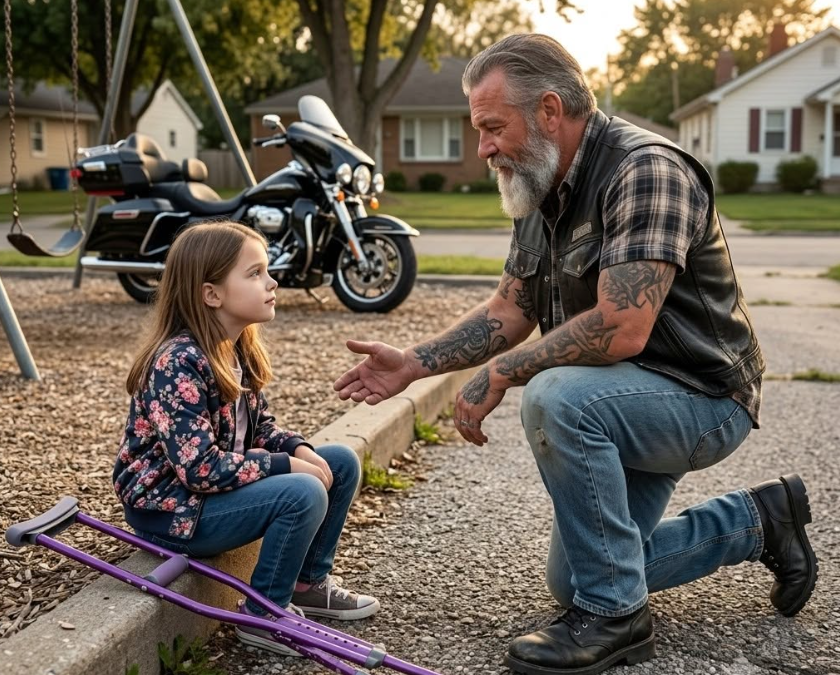
Through the sound of aluminum bending under Mason Reed’s foot.
Through the first awful attempt to stand, when my legs shook and folded and I hit the ground again.
But that question did it.
Those yours?
Like he knew.
Like he understood that the twisted metal on the ground was not just equipment.
Not just sticks.
Not just something replaceable if a family had the money and insurance had the mercy.
I started crying.
“They destroyed them.”
His expression changed.
Not dramatically.
That made it more frightening.
Some people get loud when they are angry.
This man got still.
“Who?”
“Mason Reed.”
He glanced toward the street.
“Older kid?”
I nodded.
“I can’t get home.”
The big man stood.
For one second, I thought he was leaving.
PART3:
Then he walked over, picked up both ruined crutches, and came back carrying them in one hand like evidence.
Then he held out the other hand.
“My name’s Gabriel Mercer,” he said. “Folks call me Bear.”
I stared at him.
He did not move closer.
“You don’t have to trust me,” he said. “But nobody should be crawling home while I’m standing here.”
Something about that sentence made me reach for him.
Bear lifted me as carefully as if I were made of glass.
That is where the story usually begins when people tell it now.
With the biker.
With the motorcycles.
With the whole street shaking.
But for me, the story began years before that, with my mother holding my hands between parallel bars while my legs refused to understand what everyone wanted from them.
My name is Maya Collins.
I was born with cerebral palsy.
When I was little, my legs rarely did exactly what I asked them to do. My muscles tightened without warning. My balance was terrible. My left foot dragged when I was tired. My hips got stiff. My knees sometimes felt like they belonged to someone else and had only been temporarily assigned to me.
Walking independently seemed like something that belonged to other kids.
For years, I used a wheelchair.
I hated how adults pushed me without asking.
I hated entering a room and watching people look at the chair before they looked at me.
I hated the way grown-ups talked softer when they saw me, like my legs had somehow made my ears fragile.
My mother hated that too.
She never let people speak over me if I was sitting right there.
“She can answer,” Mom would say.
Or, “Ask Maya.”
Or, if somebody got too comfortable treating me like furniture, “Her chair is not her personality.”
Mom was not a big woman.
But people learned quickly not to mistake small for weak.
Then came surgeries.
Physical therapy.
Braces.
Falls.
Tears.
Ice packs.
Heat packs.
Stretching until I was furious.
Exercises that seemed invented by people who hated children.
Thousands of repetitions of movements most people never think about.
Lift.
Step.
Balance.
Again.
Lift.
Step.
Balance.
Again.
The first time I stood without holding onto anything, Mom cried so hard the physical therapist had to hand her tissues.
The first time I took five steps with support, Mom called my aunt, my grandmother, and three people from work.
The first time I fell and did not cry, she cried later in the bathroom because she thought I could not hear her.
Eventually, I graduated to forearm crutches.
To everyone else, they were aluminum tubes with rubber tips.
To me, they were freedom.
I decorated mine with purple grip tape, tiny lightning-bolt stickers, and one ridiculous plastic charm shaped like a taco because my friend Hannah said every warrior needed a snack.
With those crutches, I could walk three blocks to the little market.
I could visit Hannah.
I could stand in line for an ice cream bar and pay for it myself.
Most importantly, Mom finally allowed me to go alone to Riverside Park, four blocks from our duplex in a worn-down Ohio neighborhood called Benton Heights.
Four blocks.
That might not sound like much.
But to me, those four blocks were a country.
That summer, Riverside Park felt like my kingdom.
There was a cracked basketball court, two old picnic tables, a playground with faded blue paint, and a big maple tree that dropped seeds shaped like helicopter blades. The accessible swing had been broken for as long as I could remember. The rubber pathway near the playground had buckled in places, making it harder for wheelchairs and walkers to roll smoothly, but I knew where every bad spot was.
I had routes.
I had timing.
I knew which sidewalk cracks to avoid and which stretch of curb had a dip low enough for me to step down safely.
I knew where to rest if my legs tightened.
I knew the bench near the old drinking fountain stayed shaded until almost three.
For the first time in my life, I had a place I could reach without someone pushing me, carrying me, or hovering close enough to make me feel like I was living under a warning label.
Then Mason Reed decided the park belonged to him.
Mason was fifteen.
He was not the biggest boy in the neighborhood, but he had mastered the trick of making other people afraid before they realized he was not particularly brave.
He usually traveled with two boys named Cole and Tyler.
Alone, they barely looked at me.
Together, they became cruel.
At first it was comments.
“Robot girl.”
“Need an oil change?”
“Race you.”
They would laugh like the joke improved every time they repeated it.
I learned to keep moving.
My mother had taught me that people looking for a reaction often got bored when they did not receive one.
“Some folks throw hooks,” she said. “You don’t have to bite.”
That advice worked until one brutally hot Thursday afternoon.
The air felt thick enough to chew. Heat shimmered over the basketball court. Somebody had left a half-empty soda bottle on the steps near the slide, and bees were gathering around it like they owned the park.
I was crossing the dusty area beside the playground when Mason stepped directly in front of me.
“Cool sticks,” he said.
I moved right.
He moved right.
I moved left.
He blocked me again.
“Mason,” I said, trying to sound bored instead of scared, “just let me through.”
Cole laughed.
Tyler said nothing, which I later understood was not the same thing as innocence.
Mason looked at my crutches.
Then he smiled.
It was the kind of smile that tells you something bad is about to happen while you still have time to understand it but not enough time to stop it.
He kicked the bottom of my right crutch.
The rubber tip jumped sideways.
My balance disappeared.
I hit the ground hard.
Pain shot through both knees, but embarrassment hurt worse.
The three boys laughed.
I reached for the crutch that had fallen beside me.
Mason stepped on it.
“Give it back.”
He looked down at me.
Then he lifted his foot and stomped directly on the aluminum shaft.
The metal bent.
I screamed.
Not because he had hurt me.
Because I knew exactly how much those crutches cost.
“Mason, stop!”
He stomped again.
The shaft buckled.
Then he grabbed my second crutch.
I tried to pull myself upright using the playground railing, but my legs would not cooperate fast enough.
Mason swung the crutch against a steel support post.
Once.
Twice.
The aluminum folded near the handle.
He threw it beside me.
“There,” he said.
“Walk home.”
They left laughing.
For several seconds, I did not move.
I stared at the purple tape wrapped around twisted metal.
My mother worked double shifts at a nursing home.
Our insurance had fought her for months before approving those crutches.
We could not simply buy another pair that afternoon.
Those boys had not broken equipment.
They had broken my independence.
I tried standing anyway.
I fell.
So I began crawling.
The gravel cut into my palms.
My knees burned against the dirt.
I remember thinking, Don’t cry here.
Then, I remember thinking, Nobody is here to see anyway.
That was worse.
I had gone perhaps twenty feet when I heard the motorcycle.
Bear carried me home with my broken crutches tucked under one arm.
I did not know what to do with my hands, so I held onto the side of his vest and tried not to cry into his shoulder. He smelled like leather, motor oil, sun, and the faint sharp scent of peppermint gum.
People stared from porches as he walked.
Benton Heights was the kind of neighborhood where everyone noticed everything and admitted very little.
Curtains shifted.
Doors opened a crack.
A woman watering flowers froze with the hose in her hand.
Bear did not look at any of them.
He just walked.
“What’s your address?” he asked.
I told him.
“You sure?”
“I’m disabled, not lost.”
He stopped for half a second.
Then he laughed.
It was not a big laugh.
But it was real.
“Fair enough.”
Mom nearly screamed when she saw us approaching our duplex.
She came out so fast the screen door hit the railing behind her.
“Maya!”
Bear stopped at the bottom of the porch steps and immediately explained.
No drama.
No extra words.
“Found her at Riverside Park. Three older boys broke her crutches. Her hands and knees are scraped. She said Mason Reed did it.”
Mom’s face changed five times before any words came out.
Fear.
Relief.
Anger.
Helplessness.
Then the one that hurt most.
Calculation.
Because poor parents learn to calculate even in emergencies.
When Mom saw my crutches, her face collapsed.
“They won’t replace those,” she whispered. “Not this soon.”
Bear looked at her.
“How much?”
Mom blinked.
“What?”
“How much?”
“Please,” she said quickly. “You’ve already helped enough.”
“How much?”
Mom glanced at me, then at the crutches, then toward the little stack of bills on the table visible through the open door.
“Nearly twelve hundred dollars.”
Bear nodded once.
Then he set the twisted crutches beside our porch.
“Take care of her hands.”
“Mr. Mercer—”
But he was already walking toward his motorcycle.
I thought that was the end of it.
I was wrong.
Years later, Bear told me where he went next.
Straight to the Iron Harbor clubhouse.
He walked inside carrying my broken crutches.
About thirty riders were there.
Some playing pool.
Some eating from paper plates.
Some arguing about a carburetor like national security depended on it.
Bear placed the twisted aluminum on a table.
Conversation stopped.
Then he told them what Mason had done.
Nobody laughed.
Nobody shouted.
One man pulled out forty dollars.
Another added twenty.
Then another.
Someone passed an old motorcycle helmet around the room.
Bills dropped in.
Tens.
Twenties.
Fives.
A folded hundred from a woman named Rosie who ran a towing business and scared insurance adjusters for sport.
By the time the helmet returned, there was more than enough money for replacement crutches.
But Bear told them money was not the real problem.
“A kid thinks he owns that neighborhood because everybody keeps looking away,” he said.
Their president, an older man named Cal Brennan, studied the shattered crutches.
Cal had white hair, a scar through one eyebrow, and the patience of someone who had learned long ago that volume and authority were not the same thing.
Then he stood.
“We don’t scare a fifteen-year-old,” Cal said.
Bear nodded.
“No.”
“We make sure the adults stop pretending they don’t see him.”
Exactly.
That evening, Mom was cleaning gravel from my palms when a vibration moved through our bathroom floor.
The medicine cabinet rattled.
I looked at Mom.
The rumble became thunder.
We went to the front window.
Motorcycles were turning onto our street.
Not two.
Not five.
Dozens.
Neighbors stepped onto their porches.
Engines rolled through Benton Heights until the entire block seemed to breathe with them.
Then the riders slowed.
And every one of them stopped directly outside our house.
Mom grabbed my shoulder.
“Oh God, Maya…”
The engines went silent.
That silence was bigger than the noise had been.
Bear removed his helmet.
But instead of walking toward our porch, he turned around, looked three houses down at Mason Reed’s home, and started walking straight toward it.
The first person out of Mason’s house was his father.
Derek Reed had a reputation in Benton Heights.
He owned a small construction company, sponsored youth baseball, knew several police officers, and behaved as if those facts made neighborhood rules optional.
He marched into the driveway wearing a polo shirt, work boots, and the expression of a man offended by consequences arriving without an appointment.
“What is this?”
Bear stopped at the sidewalk.
Cal stood beside him.
The other riders remained near their motorcycles.
Nobody surrounded the house.
Nobody shouted.
Nobody threatened anyone.
That detail mattered.
Because what happened next was not revenge.
It was something Mason had apparently never experienced.
Accountability.
Bear held up one of my broken crutches.
“Your son recognize this?”
Derek stared at it.
Then Mason appeared in the doorway.
I could see him from our window.
Even three houses away, I saw his face change.
Derek turned.
“Mason?”
No answer.
Bear did not raise his voice.
“This belongs to a ten-year-old girl who needs it to walk.”
Derek looked back at his son.
“What happened?”
Mason stared at the porch floor.
Bear answered.
“He kicked her down, destroyed both crutches, and left her in the park.”
Derek’s first instinct was exactly what everyone expected.
“My son says a lot of things happen differently than people claim.”
Cal nodded toward the street.
“Good thing Riverside Park has a security camera over the recreation building.”
That changed everything.
I had not known there was a camera.
Neither had Mason.
Bear had discovered it after leaving our house.
One of the riders managed maintenance contracts for the city and knew exactly whom to call.
The camera did not capture every angle.
But it captured enough.
Mason blocking me.
Me falling.
Mason lifting something metallic and striking it against the playground frame.
Most importantly, it captured Cole and Tyler standing nearby.
The two boys had already admitted what happened after their parents were contacted.
Mason’s shoulders dropped.
Derek looked at his son for what felt like forever.
Then something unexpected happened.
He did not defend him.
He sat down on the hood of his truck.
For the first time, he looked less like the powerful neighborhood businessman everyone knew and more like a tired father realizing he had ignored too many warning signs.
“Why?” he asked.
Mason muttered something.
“What?”
“I don’t know.”
Derek stood.
“You don’t know why you left a ten-year-old child crawling through a park?”
Mason started crying.
At ten, I expected that to make me feel better.
It did not.
Watching someone who hurt you become frightened does not magically repair what happened.
It just reminds you that cruelty often comes from people who are much smaller inside than they pretend to be.
Bear finally looked toward our house.
He saw me at the window.
Our eyes met.
Then he waved me over.
Mom immediately said, “No.”
I surprised both of us.
“I want to go.”
She stared at me.
“Maya—”
“I want to go.”
She found my old wheelchair in the hall closet.
I had not used it regularly in months.
Seeing it made my chest tighten.
The chair was not the enemy.
I know that now.
But at ten, it felt like being sent backward.
Like the world had taken one look at my hard-earned independence and said, Not so fast.
Mom helped me into it and pushed me down the sidewalk.
People moved aside.
Neighbors watched.
Some with concern.
Some with guilt.
Some with the strange hunger people get when a private wound becomes public enough to discuss.
Suddenly I was facing Mason.
He looked completely different without Cole and Tyler laughing beside him.
“You broke my crutches,” I said.
“I know.”
“Do you know what those meant?”
He stared at the ground.
“No.”
“They meant I didn’t need my mom to push me around.”
Mom squeezed my shoulder.
“They meant I could go somewhere by myself.”
Mason wiped his face.
“I was just messing around.”
That sentence made something hot rise in my throat.
“You were messing around for five minutes.”
I pointed toward the wheelchair.
“I lose my freedom until somebody buys me new ones.”
Nobody spoke.
Not Bear.
Not Cal.
Not Derek.
Nobody rescued Mason from the silence.
That may sound small.
It wasn’t.
Adults rescue boys like Mason from silence all the time.
They explain for them.
Soften for them.
Say he didn’t mean it.
Say boys are boys.
Say kids can be cruel.
Say don’t ruin his future over one mistake, as if the girl crawling home in the dirt was not having her future touched too.
But that evening, nobody did.
Finally, Mason whispered, “I’m sorry.”
I believed he was sorry.
But I also understood, even at ten, that sorry and repaired were not the same thing.
Bear seemed to understand that too.
“Apology is step one,” he said.
Derek looked at him.
“What do you want?”
Bear shook his head.
“Not what I want.”
Then he pointed toward me.
“What does she need?”
That may have been the most important question anybody asked that evening.
Not punishment.
Not humiliation.
Repair.
Mom explained the cost of the crutches.
Derek immediately offered to pay.
Cal interrupted.
“Replacement gear is already covered.”
Bear looked back toward the riders.
A giant man named Franklin held up an envelope.
They had collected $1,860.
Mom put both hands over her mouth.
“No.”
Bear smiled.
“That’s exactly what your mother said earlier.”
“I can’t take that,” Mom said.
“You can.”
“There are families who need it more.”
Bear looked at me.
“This isn’t charity. This is a neighborhood reminding one kid she matters.”
Derek went inside and returned with his checkbook anyway.
“If you’ve covered the crutches, then I’ll reimburse your collection.”
Cal shook his head.
“Put your money somewhere useful.”
Bear pointed toward Riverside Park.
“The accessible swing has been broken for two years.”
I stared at him.
It had.
The city kept promising to repair it.
Nothing happened.
Derek looked toward the park.
“What would it cost?”
“More than a pair of crutches,” Bear said.
Derek slowly nodded.
“Then I’ll fix it.”
Mason looked up.
Bear was not finished.
“Not your employees.”
He pointed toward Mason.
“He helps.”
Mason’s face went pale.
Derek nodded.
“He helps.”
The riders left shortly afterward.
Before Bear climbed onto his motorcycle, he came over to me.
He crouched so our eyes were level.
“You were brave today.”
“I cried.”
“So?”
“I crawled.”
“So?”
“I couldn’t stop them.”
Bear leaned closer.
“Kid, bravery isn’t stopping every bad thing before it happens.”
He tapped one thick finger against the center of my chest.
“Sometimes bravery is deciding the bad thing doesn’t get to tell you who you are afterward.”
I never forgot that.
Three days later, Mom drove me to a mobility clinic in Cleveland.
The Iron Harbor money bought me lightweight graphite forearm crutches far better than the pair Mason destroyed.
I chose purple cuffs.
Naturally.
But something still bothered me.
When I returned home, I asked Mom to drive past Riverside Park.
Derek’s construction trailer was there.
So was Mason.
He was hauling lumber beside two workers.
For the next several weekends, he helped rebuild the accessible section of the playground.
New ramps.
A transfer platform.
An adaptive swing.
A smooth rubber pathway wide enough for wheelchairs.
Derek paid for materials.
The city approved the plans.
Other neighborhood businesses donated equipment.
The Iron Harbor Riders returned too, but this time without the dramatic convoy.
They showed up in work clothes.
Some poured concrete.
Some painted railings.
Some carried lumber.
Bear spent an entire Saturday installing benches.
And me?
I supervised.
Very aggressively.
If a ramp angle looked wrong, I said so.
If someone stacked lumber where wheelchairs needed to roll, I corrected them.
If Mason tried to do something halfway, I stared until he fixed it.
Bear said I had the soul of a building inspector.
I said thank you.
Three weeks later, Riverside Park reopened.
Nearly two hundred people came.
There were kids everywhere.
Wheelchairs.
Walkers.
Crutches.
Strollers.
Bikes.
Scooters.
Nobody was separated into the kids who could play and the kids who watched.
I stood on my new purple crutches near the entrance and watched a little boy roll his wheelchair onto the smooth rubber pathway without help.
He laughed when his sister pushed him too fast.
His mother started crying and tried to hide it behind sunglasses.
My mother stood beside me and cried openly because she had never believed in hiding feelings that deserved air.
At one point, Mason approached me.
He had changed.
Not magically.
Real change rarely works like that.
He was quieter.
Less interested in being watched.
“I wanted to show you something,” he said.
Near the entrance stood a small metal sign:
PLAYGROUND FOR EVERYBODY.
No donor names.
No speeches.
No mention of what happened.
Just those three words.
“Dad wanted to put our company name on it,” Mason said. “I told him not to.”
“Why?”
He shrugged.
“Because it wasn’t supposed to be about us.”
For the first time since that horrible afternoon, I smiled at him.
“That’s actually a good answer.”
Mason nodded.
Then he walked away.
We never became friends.
I think that is important to say.
Forgiveness does not require pretending nothing happened.
Sometimes healing means someone takes responsibility, makes repairs, changes their behavior, and then both people are allowed to continue their lives.
Bear stayed in mine.
He showed up at my thirteenth birthday with a purple helmet sticker shaped like a lightning bolt.
He came to my eighth-grade promotion and complained that the folding chairs were designed by criminals.
When I started high school, he took me and Mom to breakfast and told me freshmen were just middle schoolers with bigger backpacks and worse judgment.
When I got my driver’s permit, he spent two hours teaching me how to check mirrors properly even though my mother said he was making me nervous.
He was at every big moment after that.
Not always in the front row.
Bear did not like front rows.
But he was there.
A black vest near the back of the room.
A gray beard in the crowd.
A hand lifted when I looked for him.
By then, I knew more about him.
Gabriel Mercer had not always been Bear.
He had been a mechanic.
A father once, though his son had died in a motorcycle accident at nineteen, years before I met him.
A husband too, until grief and silence swallowed the marriage from the inside.
The Iron Harbor Riders had found him the way he found me.
Not when he looked impressive.
When he was crawling through the worst part of his life and nobody knew what to say.
That is something people forget about scary-looking men.
Some of them built the scary part around the softest thing they had left.
When I was sixteen, I asked him why he had stopped that day.
He looked at me like the question offended him.
“You were on the ground.”
“So?”
“So I stopped.”
“That’s it?”
He took a sip of coffee.
“What else should there be?”
I had no answer.
Maybe that was the whole secret.
Some people need a reason to help.
Some people need a committee.
Some people need proof that the person suffering deserves the trouble.
Bear saw a child in the dirt and stopped.
That was it.
That was everything.
When I got accepted into Ohio State, he claimed somebody had gotten dust in his eyes.
It was February.
We were indoors.
There was no dust.
Years later, when I walked across the stage to receive my degree in occupational therapy, I spotted him in the audience before I spotted my own mother.
He was impossible to miss.
Gray beard.
Black vest.
Hands the size of baseball gloves.
Crying like a baby.
After graduation, I hugged him.
“You remember the park?” I asked.
“Every day.”
“I thought you were going to hurt Mason.”
Bear laughed.
“If I’d hurt that kid, what would you have learned?”
I did not answer.
He did.
“You would’ve learned that the biggest, scariest person gets to decide what’s right.”
He shook his head.
“That wasn’t the lesson you needed.”
“What was?”
Bear looked down at my crutches.
Yes, I still used them.
My legs never became magically perfect.
This is not that kind of story.
“The lesson,” he said, “was that strength is supposed to make room for people who have less of it. Not crush them.”
Bear died eleven years after that conversation.
A heart attack.
Sudden.
At his funeral, Mom and I expected maybe a hundred people.
There were hundreds.
Motorcycles filled the parking lot and stretched down the road.
Riders came from counties I had never heard of.
Veterans.
Mechanics.
Teachers.
Nurses.
Single mothers.
Old men.
Teenagers.
People whose cars he had fixed for free.
People whose ramps he had built.
People whose hospital bills he had quietly helped cover through fundraisers that never once used the word charity.
I saw Mason there too.
Older now.
A man with a wife and a toddler.
He stood near the back and did not come up to me until after the service.
“I’m sorry about Bear,” he said.
“Me too.”
He looked toward the line of motorcycles.
“I think about him a lot.”
I nodded.
“He had that effect.”
Mason swallowed.
“I coach youth baseball now. I don’t let kids bully each other. Not even a little.”
I studied his face.
He was not asking for absolution.
That mattered.
“Good,” I said.
He nodded once and stepped away.
Near the end of the service, Cal—older now, slower—walked toward me carrying a small cloth patch.
It was from Bear’s old vest.
On it was a simple embroidered lighthouse, the symbol of the Iron Harbor Riders.
“Bear left instructions,” Cal said.
“For me?”
He nodded.
I turned the patch over.
On the back, Bear had written four words in permanent marker.
Keep standing, however you can.
I couldn’t speak.
I pressed the patch against my chest and cried harder than I had cried in Riverside Park all those years before.
Today that patch hangs in my occupational therapy office.
Most of my patients are children.
Some use wheelchairs.
Some use braces.
Some use walkers.
Some use communication devices.
Some are learning how to hold a spoon, button a shirt, brush their teeth, or take three steps without falling.
When they tell me they feel different, I never tell them difference does not matter.
Because sometimes it does.
Sometimes the world is badly designed for you.
Sometimes people can be cruel.
Sometimes somebody really can break the thing that made you feel free.
Instead, I tell them about a ten-year-old girl lying in the dirt beside two destroyed purple crutches.
I tell them she thought she had lost everything that afternoon.
She hadn’t.
She had lost something important.
But not everything.
Because sometimes, when you are crawling through the worst moment of your life, help does not arrive looking the way you imagined.
Sometimes it arrives covered in tattoos.
Sometimes it rides a motorcycle.
Sometimes it speaks in a voice that sounds like gravel.
And sometimes the person you were taught to fear is the first person who looks at you—not your disability, not your weakness, not your broken equipment—and decides that leaving you in the dirt simply is not an option.
I still remember the sound of those motorcycles outside our house.
When I was ten, I thought it sounded like thunder.
Now I know better.
It was seventy strangers telling one frightened little girl something she had desperately needed to hear:
You are not invisible.
You are not disposable.
You are not alone in this street.
And the thing they broke was not the end of your freedom.
It was the beginning of everyone else finally being forced to see it.
Sometimes strength comes quietly.
Sometimes it crouches in the dirt and asks if you are hurt.
Sometimes it passes a helmet around a room until a child can walk again.
Sometimes it makes the whole street shake, not to frighten anyone, but to wake them up.
And sometimes, long after the engines fade, after the broken metal is replaced, after the park is rebuilt and the people who hurt you grow into different people or don’t, one sentence stays with you longer than all the noise: