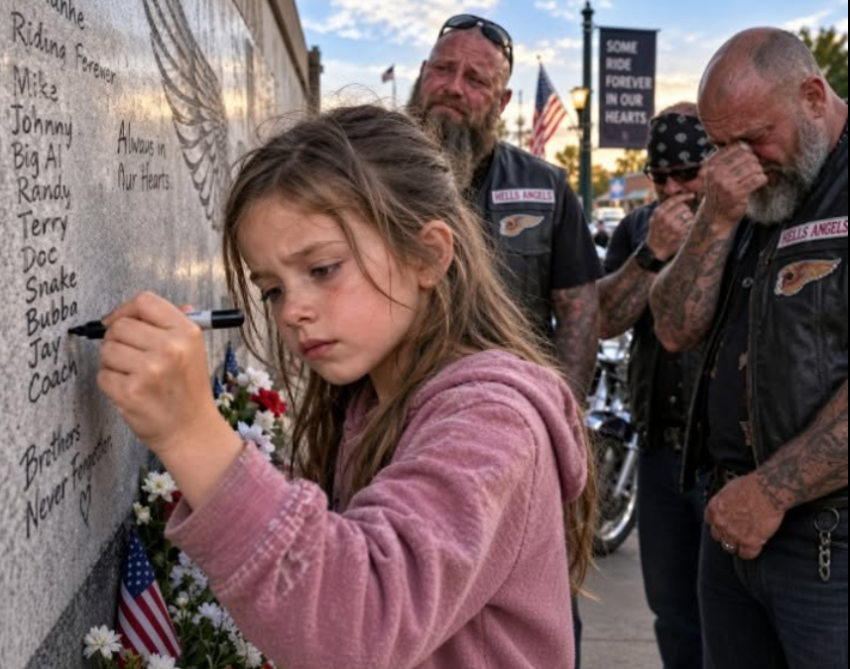
PART2:
Dad died on a Wednesday afternoon in April, three years before the mural.
A heart attack.
Not on the bike.
That was the cruel joke everyone kept stumbling around and never saying directly.
Daniel Hartwell, who had ridden through rainstorms, gravel roads, deer crossings, black ice, and the wild confidence of his own youth, did not die on a highway. He died in his own garage, lying beside the same Harley he had ridden for eighteen years, with a socket wrench near his hand and grease under his fingernails.
I was in Columbus when it happened.
Community college.
Second semester.
I had skipped his call that morning because I was late for class and figured I would call him back at lunch.
I did not call at lunch.
By dinner, Michael Doyle was knocking on the door of my apartment with his hat in both hands, and I knew before he opened his mouth.
Some news changes the room before anyone says it.
Michael had been my father’s closest friend for thirty years. He owned Doyle’s Garage behind the old brick wall. Broad shoulders, thinning gray hair, hands permanently stained with motor oil no soap could ever fully remove. When I was little, I thought Michael and my father were brothers because of the way they fought—loud, loyal, impossible to separate completely.
He told me my father was gone.
Then he caught me when my knees stopped working.
The funeral was full.
That is one of the things I remember most clearly and least usefully.
The parking lot outside the funeral home overflowed with motorcycles, trucks, cars, and men who stood in small groups with their hands folded in front of them because grief had made them unsure what to do with their bodies. The Iron Valley Riders wore their vests, not in display, but in respect. They stood quietly.
Too quietly.
The whole room seemed to be holding its breath around my father’s absence.
People told stories.
Dad fixed my transmission and wouldn’t let me pay him.
Daniel brought groceries when my surgery kept me off work.
Your father ran that toy drive like Christmas would be illegal if he didn’t.
He once drove three hours to help my son after his bike broke down.
He never told me any of those stories.
Not one.
That made me angry in a way I did not know where to put.
It felt unfair that strangers had pieces of him I did not have. It felt unfair that even while standing beside his casket, I was still learning who he had been.
After the funeral, I drifted.
That is the honest word.
I left Columbus and moved back to Springfield, though I told people it was because tuition was too expensive and I needed full-time work. I got a job at a print shop. I rented a small apartment above a laundromat. I stopped going to the clubhouse. I stopped visiting Doyle’s Garage unless my car needed something. I stopped riding in anything with two wheels. I stopped looking at leather vests in grocery store aisles.
I told myself I was moving forward.
Really, I was walking in a wide circle around the center of my grief.
For three years, I did not cry properly.
That sounds strange.
I cried at the funeral, of course. I cried when Michael gave me Dad’s toolbox. I cried when I found an old voicemail where Dad said, “Call me back when you get this, kiddo,” and nothing else.
But those were small cracks.
Controlled leaks.
My real grief sat somewhere deep and heavy and untouched, like an engine I was afraid to start because I knew it would shake the whole building.
Then Michael called me on a Tuesday evening in early April.
“Bex,” he said.
Only my father’s friends still called me that.
“You got a minute?”
I was standing in my apartment kitchen eating cereal out of a mug because all my bowls were dirty. The washing machine downstairs was thumping through someone else’s unbalanced load. Rain tapped against the window above the sink.
“I always have a minute for you,” I said.
He was quiet long enough for me to stop chewing.
“We lost another one.”
I sat down.
“Who?”
“Tommy Ashford.”
I closed my eyes.
“Heart?”
“Yeah. Same as your dad. Found him this morning.”
Tommy Ashford had taught me to ride a bicycle when I was six. My father had tried first, but he was too anxious and too loud, jogging beside me and shouting instructions until I cried. Tommy had taken over, one hand on the back of the seat, laughing every time I wobbled.
“Bex,” he had said, “bikes are like people. They go where you look. Stop staring at the ground unless that’s where you want to end up.”
I learned in ten minutes.
Now Tommy was gone too.
“I’m so sorry,” I whispered.
“That’s four in three years,” Michael said.
His voice sounded rougher than usual.
“Your dad. Big Pete. Sarah Nakamura. Now Tommy. Four people who used to fill the clubhouse with noise. And the younger ones coming in now, they never even met Daniel. They don’t know what Big Pete did in the flood back in ’09. They don’t know Sarah rode cross-country by herself at sixty-three just to prove she could. Hell, give it a few more years, and I’ll be the only one telling those stories.”
I understood what he was saying in a distant way.
I did not yet understand what it would come to require of me.
After we hung up, I did not sleep.
I lay in bed above the laundromat listening to dryers turn below me and thought about my father’s name.
Daniel Hartwell.
A name on a headstone.
A name in an obituary.
A name people still said, but less often now.
Every year, grief had fewer witnesses.
That was the part no one had warned me about.
At first, after someone dies, everyone remembers with you. The stories come fast. Their name fills rooms. Their absence is obvious because people are still shaped around it.
Then time passes.
People stop mentioning them because they do not want to hurt you.
Then because they are busy.
Then because new people enter the circle who never knew them.
And slowly, without cruelty, the person you loved becomes private property. Their memory shrinks until you are carrying it almost alone.
I thought about the old brick wall behind Doyle’s Garage.
The faded skull.
The weeds.
The blankness.
The next morning, I drove there before work.
Michael was in the first bay changing the oil on a customer’s truck. When he saw me, something in his face softened, like my presence answered a question he had been afraid to ask.
“Morning, Bex.”
“I want to see the wall.”
He raised an eyebrow.
But he did not ask.
He wiped his hands on a rag and led me around back, past stacked tires, a rusting dumpster, and the narrow strip of gravel where my father used to park his Harley.
The wall stood there exactly as it always had.
Thirty feet wide.
Almost eighteen feet tall at its highest point.
Cracked red brick.
Stained mortar.
Weeds at its base.
Old skull fading under weather.
Forgotten by everyone because everyone had learned to look past it.
I stood before it and felt something click into place inside my chest.
Not peace.
Not comfort.
Purpose.
That was different.
“Michael,” I said slowly, “how many riders has the club lost since it started?”
He looked at the wall.
Then at me.
“Ever?”
“Ever.”
He took off his cap and scratched the back of his head.
“Club founded in ’87. Counting everybody who rode with us seriously? Accidents, sickness, old age…”
He exhaled.
“Forty, maybe forty-five.”
“Get me the names.”
His expression changed.
“Why?”
“I want to paint them here.”
He said nothing.
“All of them,” I said. “Every rider the club lost. Names. Dates. Maybe something about who they were, if we can get it. I want to put them on this wall so nobody forgets.”
Michael looked at me for a long time.
Behind his eyes, I saw grief.
Hope.
Fear.
“That’s a hell of an undertaking, Bex.”
“I know.”
“No, you don’t.”
The words were not cruel.
They were true.
“You’d have to get the names right. Dates. Permission from families. You’d have to decide who counts, and that alone could start arguments. Then supplies. Scaffolding. Weather. Paint. Layout. That wall is bigger than it looks when you start putting letters on it.”
“I work at a print shop.”
“You print flyers and banners.”
“I know lettering.”
“You know small lettering.”
“I can learn big lettering.”
He almost smiled.
Almost.
“You got time for this?”
I looked at the wall.
“I have a reason.”
That silenced him.
I did not tell him the whole of it.
Not then.
I did not tell him that lately I had begun to feel like I was losing my father a second time. Not the sudden loss of his body, but the slow loss of his details. The exact sound of his laugh. The way he held a wrench. The smell of Lava soap and motor oil on his hands. The way he called every child under ten “boss.” The way he hummed when he was concentrating, badly and always off-key.
I was terrified that ten years from now I would remember him only in facts.
Father.
Machinist.
Rider.
Heart attack.
Dead at fifty-two.
That was not enough.
It was not nearly enough.
Michael understood more than I said.
He always had.
“Let me talk to the club,” he said. “This isn’t only yours to decide.”
The meeting happened on a Thursday night at the Iron Valley Riders clubhouse.
I had not been there in three years.
Walking in felt like entering a museum where all the exhibits still expected me to behave normally.
The building was an old warehouse at the edge of town, converted slowly over decades into something between a meeting hall, garage, family room, and sanctuary. The bar was built from salvaged motorcycle parts. Framed photographs covered the walls. Toy run posters. Rally flyers. Wedding pictures. Obituaries. A black-and-white photo of the founding members from 1987, all younger than I had ever known them, standing beside bikes with the outrageous confidence of people who had not yet buried each other.
Twenty-three riders sat at folding tables.
Some faces I recognized.
Some I did not.
That hurt more than I expected.
There were strangers in my father’s clubhouse.
Men and women who had joined after he died, who knew his name only because older members said it sometimes in a softened voice.
Michael stood at the front with me beside him.
Conversation faded.
“Some of you know Daniel Hartwell’s daughter,” he said. “Rebecca has an idea. I think you need to hear it.”
My hands trembled when I spoke.
I explained the wall.
The names.
The dates.
The idea of a memorial.
Not a graveyard, I said.
Not a sad thing only.
A record.
A place where the town could see that these riders had existed, that they had done more than wear leather and make noise on Main Street.
Faces shifted while I talked.
Confusion first.
Then curiosity.
Then something raw among the older members.
Dorothy Coleman sat near the back. Big Pete’s widow. She was smaller than I remembered, with silver hair pulled into a knot and hands folded around a tissue. Big Pete had died two years earlier, and I had been too deep in my own avoidance to visit her after the funeral.
When I mentioned families, Dorothy began crying quietly.
That nearly undid me.
But not everyone was moved.
A younger rider named Anthony Briggs leaned back in his chair with his arms folded. He could not have been more than thirty. Clean beard, new leather, the restless confidence of a man who had not yet learned how grief rearranges priorities.
“No offense,” he said, which meant offense was already on the way, “but why does a mural matter? They’re gone. Painting names on a wall doesn’t bring anybody back. It costs money and time we could use on things that actually help people who are still alive. Toy runs. Veteran support. Food drives.”
The room tightened.
I felt heat rise in my face because part of me understood his point.
That made it hurt worse.
Before I could answer, Dorothy did.
“You’re thirty years old, Anthony.”
Her voice was soft but clear.
“You didn’t know my husband.”
Anthony looked uncomfortable.
Dorothy continued.
“You don’t know Pete pulled three kids out of a flooded car during the ’09 storm and never told anybody because he didn’t think it was a big deal. You don’t know that when he died, half this town came to his funeral because of quiet things he did for thirty years. And now it’s already fading.”
She wiped her eyes.
“Give it twenty more years, and Pete will be a name in a photo box nobody opens.”
No one spoke.
Dorothy looked at me, then back at Anthony.
“That wall isn’t for the dead. The dead don’t need paint. It’s for everybody still walking around who deserves to know what kind of people came before them.”
Anthony looked down.
“I didn’t mean disrespect.”
“I know,” Dorothy said. “That’s why I’m explaining.”
The vote was nearly unanimous.
Two abstained.
No one voted against.
I should have felt relief.
I did, for about five seconds.
Then the size of what I had promised rose up in front of me like the wall itself.
Forty-five names.
Forty-five families.
Forty-five chances to get something wrong.
I spent the next three months learning that memory is not a list.
At first, I thought compiling the names would be hard in a practical way.
Old records.
Birth dates.
Death dates.
Club rosters.
Obituaries.
Permission from families.
It was all of that.
But the harder part was emotional.
You cannot ask for a name without opening a door.
Sometimes people invite you in.
Sometimes they barely crack it.
Sometimes they slam it because grief made them tired of visitors years ago.
The club records were incomplete. Michael had boxes of newsletters, old sign-in sheets, ride photos, charity event flyers, and handwritten notes. Some names were easy: Daniel Hartwell, Tommy Ashford, Big Pete Coleman, Sarah Nakamura. Others required detective work that took weeks. A death date from 1994 verified through the county historical society. A married name changed twice. A rider everyone called Short Fuse whose legal name nobody remembered until a cousin in Dayton found an old insurance card.
I began visiting families.
That changed everything.
I sat in Dorothy Coleman’s kitchen while she showed me photos of Big Pete holding newborn grandchildren and standing knee-deep in floodwater during the 2009 storm. She told me he used to buy extra batteries before every winter because he worried about elderly neighbors losing power. She laughed telling me he could not cook anything except chili, and even that was “an act of aggression.”
I visited John Whitfield, eighty-one years old, widower of Linda Whitfield, one of the club’s three female founding members. He still kept her riding gloves in a drawer beside his recliner.
“Linda was the fastest rider in Clark County,” he told me, tapping a photograph with one shaking finger. “Don’t let any of those old boys tell you different. She beat every one of them at the fairgrounds in ’89. If you put anything under her name, put that.”
So I wrote in my notebook:
LINDA WHITFIELD
The fastest rider in Clark County.
John cried when he saw me write it.
“Nobody asks about her stories anymore,” he said.
I visited Grace Nakamura, daughter of Sarah Nakamura, who showed me a photograph of Sarah at sixty-three, sitting astride her motorcycle at the edge of the Pacific Ocean after a solo cross-country ride from Ohio to California.
“She called me from a pay phone,” Grace said, smiling through tears. “She said, ‘Gracie, I made it, and I’m not done yet. Fifty more years and I’ll still be riding.’”
Grace looked down at the photo.
“She died four months later. Aneurysm. Completely sudden.”
That was where I finally broke.
Not neatly.
Not politely.
I sat in Grace Nakamura’s living room and cried harder than I had cried since the funeral. Not just for Sarah, a woman I had barely known. For my father. For Tommy. For Big Pete. For Linda. For every name in my notebook. For myself at twenty-two, still trying to earn a goodbye I had missed.
Grace did not tell me to stop.
She did not hand me a tissue immediately, which I appreciated because sometimes tissues feel like instructions.
She just held my hand and let me fall apart in her living room beneath a framed photo of her mother smiling beside the Pacific Ocean.
After that day, the project changed.
It became less about painting a wall and more about collecting proof that ordinary lives are never ordinary to the people saved by them.
My notebook filled with names, dates, nicknames, and small luminous details.
Ryan Castellano, died 2003, pulled a stranded motorist from a burning car on Route 68.
Amanda Ferris, rode until age seventy-nine, said age was just “a number the DMV keeps track of.”
Robert Ellison, Vietnam veteran, found peace on Ohio back roads.
Tommy Ashford, taught every kid in the club how to ride something: bicycles, dirt bikes, old lawn mowers, anything with wheels.
My father’s page was the hardest.
I thought I knew him.
I did not.
Not fully.
An old newsletter revealed that Daniel Hartwell had organized the annual toy run for eleven consecutive years, growing it from twenty bikes and a pickup truck into an event that delivered gifts to more than three hundred children at the county children’s hospital.
No one had told me that number.
Dad had only ever said, “Toy run’s Saturday. You helping sort boxes or what?”
Then Matthew Reyes called from Dayton.
He was thirty-one now.
When he was seventeen, he had wrecked his motorcycle on a county road and could not afford the repairs. His family was broke. He was ashamed. My father had quietly paid Doyle’s Garage directly and told Michael to say the bill had been “handled through a club fund.”
“I didn’t find out for years,” Matthew told me. “Your dad never wanted credit. But if you’re putting names on a wall, people should know he made sure a stupid kid didn’t lose the one thing keeping him out of trouble.”
I hung up the phone and sat in my car for twenty minutes.
Angry again.
Grateful again.
Grieving again.
The thing about learning new goodness about the dead is that it does not only comfort you.
It also wounds you.
Because you cannot tell them you know now.
By late July, I had confirmed all forty-five names.
By then, the wall no longer looked blank to me.
It looked waiting.
Michael helped secure donated paint from a local hardware store owner whose brother had died in a motorcycle accident years earlier. The club covered scaffolding rental. I designed layouts after work at the print shop, spreading sketches across my apartment floor, measuring letter height, spacing, line breaks, and visual balance.
I had some art background.
Two semesters of graphic design before I dropped out to work full-time.
That was enough to make me dangerous.
Not enough to make me prepared.
The wall humbled me immediately.
A letter that looked elegant on paper became clumsy at three feet tall. Paint behaved differently on old brick than on smooth board. The summer heat made edges dry too fast and colors shift. Mortar lines interrupted curves. My arms shook from reaching overhead. My shoulders burned. My palms blistered. Green paint got under my fingernails and stayed there no matter how hard I scrubbed.
I worked after my shifts at the print shop.
Five in the evening until dark.
Then later, under a work light Michael rigged from the garage, until the bugs came thick and the shadows made it hard to see whether a line was straight.
I skipped meals.
Lost weight.
Ignored texts.
Stopped cleaning my apartment except in the most emergency sense.
The mural consumed me.
Michael noticed before I did.
“You’re losing yourself in this, Bex,” he said one night, finding me still hunched over sketches in his garage office at nearly midnight.
“I’m not losing myself.”
I sounded defensive because I was.
“I think I’m finding something. I just don’t know what to call it yet.”
He leaned in the doorway, arms folded.
“Finding something shouldn’t look like punishing yourself.”
That made me angry.
Because it was too close.
“I promised them.”
“You promised to paint a wall, not disappear into it.”
“I’m fine.”
Michael winced.
My father used to hate that phrase from me too.
I looked away first.
Privately, doubt had already begun chewing at the edges of my purpose.
My aunt Patricia made it worse.
Patricia was my father’s older sister, a woman who expressed concern with the precision of someone placing knives on a table.
She called in August.
“I heard you’ve cut hours at the print shop.”
“Temporarily.”
“You’re spending all your money and time on this wall.”
“It’s a memorial.”
“It’s a wall, Rebecca.”
I stood in my apartment kitchen with my phone pressed too hard against my ear.
“Dad would have wanted me to remember him.”
“Your father would have wanted you to finish school, build a career, live your life. He would not want you exhausting yourself on scaffolding every night.”
“He isn’t here to ask.”
The words came out sharper than I intended.
Patricia went quiet.
When she spoke again, her voice softened.
“That is exactly what worries me.”
I hated her for that.
Not because she was wrong.
Because some tired part of me wondered the same thing.
Was I honoring my father or hiding from the quieter, harder work of living without him?
Was the mural love?
Or avoidance with better lettering?
By early September, twenty-eight names were finished.
Seventeen remained.
That number felt enormous.
Every time I looked at the unpainted space, it seemed to grow.
One evening, I sat on an overturned bucket beside the wall, hands aching, neck stiff, staring at the green names already completed.
Michael brought me a bottle of water and sat heavily beside me.
His knees cracked.
“That sounded expensive,” I said.
“My knees have been filing complaints since 1998.”
I smiled, then lost it.
“Michael?”
“Yeah?”
“Is this selfish?”
He looked at me.
“I mean it,” I said. “Some days I don’t know if I’m doing this for them or for me.”
He was quiet for a long moment.
Then he said, “Bex, I’ve known you since you were born. I watched your dad hold you at the hospital like you were made of glass and dynamite.”
I laughed despite myself.
“That sounds like him.”
“It was him.”
Michael looked at the wall.
“Grief isn’t clean. It doesn’t come in one piece with a label on it. You can be doing this for Daniel, and Tommy, and Sarah, and Pete, and Linda, and every family that gave you a story. And you can be doing it for yourself at the same time. None of those reasons cancel each other out.”
“Patricia thinks I’m avoiding real life.”
“Patricia buried her brother and went back to work three days later because that’s how she survived. Doesn’t make her wrong about herself. Doesn’t make her right about you.”
I wanted that to settle the matter.
It did not.
Doubt is stubborn when it has exhaustion helping it.
The lowest point came in mid-September.
A thunderstorm rolled in faster than the forecast predicted. One minute the sky was heavy but holding. The next, rain came down in sheets.
I had been painting Frank Kowalski’s name.
Founding member.
Died 1998.
Volunteer firefighter for forty years.
I had spent three careful hours on the lettering.
The rain hit before the paint cured.
I tried to cover it.
Too late.
Green ran down the brick in long, ugly streaks.
Letters blurred.
Edges bled.
Three hours of work ruined in less than a minute.
I stood in the rain and watched Frank’s name come apart.
Something in me came apart with it.
Not because of the paint only.
Because I was tired.
Because there were still seventeen names.
Because I had promised forty-five families.
Because I had turned grief into labor and discovered labor could fail too.
Because my father was still dead.
Because no wall would change that.
I stood there soaked and shaking, rain running down my face, and thought:
I cannot do this.
Michael found me twenty minutes later.
He did not rush.
He did not say my name in alarm.
He went into the garage, came back with two umbrellas, opened one over me, and stood beside me in the rain.
For a while, neither of us spoke.
Then I said, barely loud enough to hear over the storm, “I can’t do this.”
Michael waited.
“I thought I could, but I can’t. There are still seventeen names. I’m exhausted. I ruined Frank’s name. My hands hurt all the time. I’m behind at work. My apartment looks like a crime scene. I don’t have anything left.”
Michael held the umbrella steady.
Then he said the sentence that saved the mural.
“You’re not doing this alone.”
I wiped rain from my face.
“Yes, I am.”
“No,” he said quietly. “You never were. You just haven’t asked for help yet.”
I almost argued.
Pride is strange.
Even when you are drowning, you can become offended by the suggestion that water is involved.
But I looked at the ruined green paint streaking down the brick, and for once, I was too tired to defend my own loneliness.
The next morning, Michael made calls.
By afternoon, help arrived.
Four club members with painting or construction backgrounds.
Two folding tables.
A canopy tent.
Extra drop cloths.
Better brushes.
A portable heater to help cure paint on damp evenings.
Dorothy Coleman came with a cooler full of sandwiches, lemonade, apples, and the stern expression of a woman who had decided I had not been fed properly in weeks.
“You don’t finish something this size alone, honey,” she said, setting up the table. “Nobody expected you to.”
“I thought if other people painted, it wouldn’t feel like mine.”
Dorothy looked at me over the rim of her glasses.
“Did I say we were touching your names?”
I blinked.
She pointed to the wall.
“You paint. We make sure you can keep painting.”
So that became the system.
I still painted every name.
That mattered to me.
But others cleaned brick, mixed paint, traced chalk guidelines, steadied scaffolding, moved lights, checked spelling, handed me water, managed visitors, answered questions, and forced sandwiches into my hand when I forgot food existed.
The work accelerated.
But more than that, it changed.
The wall stopped being my private battlefield and became a gathering place.
People came in the evenings.
At first, a few.
Then more.
An elderly man stood silently for twenty minutes every night for a week before I learned his brother’s name was on the list. A young mother brought her son and pointed to names, telling stories she barely remembered but wanted him to hear. Three teenagers on bicycles came one evening to mock the “old biker wall” and ended up carrying paint cans, then returned the next night pretending they were “just passing by.”
The mural began doing its work before it was finished.
One evening in October, when thirty-eight names were done, I was sitting on the lowest scaffold platform drinking water and resting my arms when a man approached.
He was around fifty, dressed not in leather but in a button-down shirt and jeans. He stood with his hands in his pockets, staring at Tommy Ashford’s name.
“Rebecca Hartwell?” he asked.
“Yes.”
“I’m Gerald Ashford. Tommy’s brother.”
I stood too quickly.
“I didn’t know Tommy had a brother.”
His mouth tightened.
“Most people didn’t by the end.”
He kept looking at the wall.
“Tommy and I didn’t speak for the last fifteen years of his life. Stupid fight over our father’s estate. Neither of us let it go. I found out he died from an obituary three weeks after the funeral.”
I did not know what to say.
So, finally, I had learned to do what Grace Nakamura had done for me.
I stayed quiet.
Gerald swallowed.
“I drove from Cincinnati when I heard about this. I don’t know what I expected. Maybe to feel worse. Maybe to feel nothing. But seeing his name up there…”
His voice broke.
“I think I needed to know somebody valued him. Since apparently I didn’t value him enough while he was alive.”
I stepped closer.
“He mattered to a lot of people.”
He looked at me then.
“He taught me to ride a bicycle when I was six,” I said. “He ran beside me until I stopped staring at the ground.”
Gerald covered his face with one hand.
Then he cried.
Quietly.
Completely.
Beside the scaffolding, under his brother’s name.
That was when I finally understood what I was building.
Not a memorial for the dead.
A bridge for the living.
A place where love, regret, pride, sorrow, apology, memory, and unfinished conversations could land.
After Gerald, I began inviting families to come while I worked.
Not only to the unveiling.
Before.
During.
I asked them to bring stories.
Photos.
Details.
Anything.
I recorded them in a second notebook.
The booklet idea came from Dorothy.
“You can’t fit all that on a wall,” she said.
So we made a booklet.
Forty-five names.
Forty-five photographs when we could get them.
Forty-five short stories.
Not polished biographies.
Human ones.
The fastest rider in Clark County.
He never missed a toy run.
Two tours, then ten thousand miles of peace.
Forty years of volunteer firefighting.
She rode until seventy-nine.
He made sure no child went without at Christmas.
That last one was my father’s line.
I argued with myself for days before writing it.
It felt too small.
Then too sentimental.
Then too revealing.
Finally, I realized it was true.
And true was enough.
I painted Dad’s name near the center.
DANIEL HARTWELL
1967–2019
He made sure no child went without at Christmas.
I could not paint the line straight the first time because my hand shook.
Michael climbed the scaffold halfway, which he was absolutely not supposed to do, and stood below me with one hand on the rail.
“Take your time, Bex.”
“I’m trying.”
“No,” he said. “Take your time with him.”
So I did.
I painted my father’s name slowly.
Not like a task.
Like a conversation.
The mural was completed on the first Saturday of November, seven months after I first stood before the blank brick wall and thought I could save memory with paint.
The final name belonged to Amanda Ferris.
Rode until seventy-nine.
Age was just a number the DMV kept.
When I finished the last letter, no one cheered.
I was grateful for that.
Michael stood beside me.
Dorothy cried softly.
Grace Nakamura touched Sarah’s name.
Gerald Ashford took a photo of Tommy’s.
I climbed down from the scaffolding and looked at the wall in full.
Forty-five names in deep green lettering stretched across thirty feet of brick. Dates. Short lines. Space between them enough to breathe. Old red brick visible beneath and around them, weathered but holding.
A wall that had been forgotten now remembered.
The unveiling was supposed to be modest.
That is what Michael told me.
“Club members, families, a few local folks, maybe Rachel Kim from the paper again.”
Rachel was the reporter from the Springfield News-Sun who had written the first article about the mural back in summer. Her story had brought attention, supplies, and several people who wanted to help. I owed her more than I knew how to say.
Michael and the club spent two weeks organizing.
They reached out to families, local businesses, riding clubs in nearby counties, and community members. Someone arranged chairs. Someone borrowed a sound system. Someone printed the booklets at my print shop, which my boss insisted on doing at cost after seeing the wall.
Still, no one expected what came.
By 9 a.m. on the unveiling day, Cypress Street was lined with motorcycles as far as I could see.
Not dozens.
Hundreds.
Iron Valley riders, yes, but also clubs from across Ohio, Indiana, Kentucky, and West Virginia. Men and women I had never seen before stood beside bikes polished clean for the occasion. Some wore leather. Some denim. Some no club markings at all. There were families, neighbors, veterans, firefighters, factory workers, teenagers, old women with folding chairs, children sitting on curbs, and people from Springfield who had probably passed that wall for decades without once wondering why it existed.
Michael estimated nearly five hundred riders.
I stopped listening after that.
The mural was covered with a canvas tarp.
I stood in front of it feeling more frightened than I had felt on the highest scaffolding. Dorothy stood near me. Grace Nakamura. Gerald Ashford. John Whitfield. Matthew Reyes. Patricia, my aunt, near the back, arms folded, expression unreadable.
Michael spoke first.
Briefly.
He thanked people for coming. Explained the project had begun with a phone call after Tommy Ashford died. Explained that a daughter’s grief had become something larger because memory, like riding, was not meant to be done alone.
Then he turned to me.
I had notes.
I did not use them.
I looked at the crowd and saw not five hundred riders, but forty-five absences surrounded by everyone still carrying them.
“Seven months ago,” I began, “I asked Michael how many riders this club had lost since 1987. He told me forty-five.”
My voice shook at first.
Then steadied.
“Something about that number broke my heart because I realized that in another twenty years, if no one did anything, many of those forty-five people might simply be forgotten. Not because they didn’t matter, but because that’s what happens to ordinary people who do extraordinary things quietly and never ask to be recognized.”
I looked toward the covered wall.
“My father was one of those people. I thought I knew him. Then I started this project and discovered stories he never told me. He ran toy drives for eleven years. He paid repair bills in secret. He showed up for people and then came home like nothing special happened.”
My throat tightened.
“I almost let his story become nothing more than a name on a headstone because I did not know how to face missing him.”
The crowd was silent.
“This mural is not just forty-five names. It is forty-five entire lives. People who rode through snowstorms to help neighbors, pulled children from floodwater, served in wars, worked in factories, raised families, mentored strangers, fixed engines, delivered gifts, kept promises, and made this town better in ways no one documented at the time.”
I looked at the families.
“I painted their names so that fifty years from now, when none of us are here to remember them personally, someone will still walk past this wall and know these people existed.”
I turned toward the tarp.
“And that they mattered.”
Michael and two riders pulled the canvas down.
The mural appeared in full daylight for the first time.
For one second, nobody made a sound.
That second was the truest response.
Five hundred hardened riders, families, strangers, widows, children, old friends, and former skeptics stood before the wall and could not speak.
Then Dorothy sank to her knees in front of Big Pete’s name.
Three riders moved immediately to help her, but she waved them off and pressed both hands over her mouth.
Gerald Ashford stood in front of Tommy’s name, tears streaming freely down his face while his own children stood beside him, seeing the uncle they had never known become real.
Grace touched Sarah Nakamura’s line.
Fifty more years and still riding.
John Whitfield sat in his folding chair staring at Linda’s name, whispering, “Fastest rider in Clark County,” like a prayer.
Michael stood beside me.
He was crying openly.
I had seen Michael angry, tired, laughing, filthy from work, frustrated, proud.
I had never seen him cry like that.
A rider I did not know removed his sunglasses and wiped his face with both hands. Another put his arm around a man beside him. Engines clicked softly as they cooled along the street. Somewhere, a child asked what one of the lines meant, and an older woman bent down to explain.
Rachel Kim took photographs.
One of them later ran across regional news outlets: five hundred motorcycles lined down Cypress Street, riders standing in respectful silence before a wall of green names. The caption said something about a memorial for fallen riders, but captions are always too small.
What the photograph really captured was the scale of ordinary love when finally given somewhere to stand.
My aunt Patricia found me near the edge of the crowd afterward.
For once, she did not look certain.
“I was wrong,” she said.
I waited.
She seemed to struggle with the words, which made me trust them more.
“I thought you were running from grief. I didn’t understand you were running toward something.”
I looked back at the wall.
“You weren’t entirely wrong to worry.”
“No?”
“It cost me more than I expected. Money. Sleep. Work. Sanity.”
That almost made her smile.
“But I don’t think I could have gotten through losing Dad any other way,” I said. “I needed this.”
Patricia nodded.
Then, carefully, awkwardly, she hugged me.
I let her.
As the crowd dispersed that afternoon, engines started one by one, then in groups, until Cypress Street filled with a rolling thunder that no longer made me want to run.
It still hurt.
But differently now.
Less like a trapdoor.
More like a door opening.
Riders passed the wall slowly before leaving. Some touched two fingers to their helmets. Some nodded. Some simply looked. Michael stood beside me until the last group pulled away.
The late November sun caught the green letters.
Forty-five names on old brick.
Forty-five ordinary, extraordinary lives.
My father’s name near the center.
Michael said, “Your dad is proud of you.”
I looked at Daniel Hartwell’s name.
For three years, that sentence would have broken me because I wanted it too badly and did not believe I deserved it.
That day, I reached out and touched the cool brick beside his name.
“I think I finally believe it,” I said.
Michael put an arm around my shoulders.
We stood there until the last motorcycle faded into the distance.
The wall remained.
That was the miracle of it.
Not that people came.
Not that they cried.
Not even that they remembered.
The miracle was that when everyone left, the names stayed.
Rain would come.
Winter would come.
Paint would need touch-ups.
Weeds would keep trying at the base.
Kids would walk past and ask who these people were.
Someone would answer.
That was enough.
Months later, I still visited the wall after work.
Sometimes alone.
Sometimes with families.
Sometimes I found flowers there. Coins. Photographs. A toy motorcycle. A firefighter patch. A folded note tucked between bricks. Once, a child had drawn a picture of a green motorcycle and taped it under my father’s name.
The Iron Valley Riders created an annual memorial ride that ended at the wall.
Not a sad ride.
A remembering ride.
A ride that raised money for the toy run Dad had once expanded and for a scholarship in Sarah Nakamura’s name supporting women learning motorcycle repair.
Other clubs contacted me.
Not because I was an expert.
Because I had learned the hard way that memory needs structure if it is going to survive ordinary life.
I helped a club in Indiana start a photo archive. A women’s riding group in Kentucky create a memorial booklet. A veterans’ motorcycle association in Pennsylvania design a small traveling display for members they had lost to suicide, illness, accidents, and time.
I did not go back to the person I had been before the mural.
That person was gone.
Maybe she had been gone since the day Michael knocked on my apartment door in Columbus.
But I became someone I recognized.
Someone who could hear a Harley start cold without leaving the room.
Someone who could walk into the clubhouse and not feel only absence.
Someone who could say my father’s name and feel more than the way he died.
One evening the next spring, I sat behind Doyle’s Garage while Michael closed up. The wall glowed softly in the early sunset. A few weeds had come back along the base. I made a note to pull them.
Michael brought two sodas and handed me one.
“You know,” he said, “your dad would have hated all the attention.”
“Absolutely.”
“He’d have stood in the back and complained the lettering was too fancy.”
“He would not.”
“He would.”
I looked at Daniel Hartwell’s name.
“He would have cried in the truck later.”
Michael smiled.
“Yeah. He would’ve.”
For a while, we sat quietly.
Then I said, “I used to think I missed my chance to say goodbye.”
Michael looked at me.
“I wasn’t there when he died. I didn’t answer his last call. I thought that meant goodbye was over.”
The evening air smelled like cut grass, oil, and brick warming in the sun.
“But I think maybe goodbye isn’t one moment,” I said. “Maybe it’s work. Maybe you say it in pieces. A name. A story. A wall. A toy run. A life you keep living.”
Michael’s eyes shone.
“Sounds like something your dad would pretend not to understand.”
I laughed.
Then cried a little.
Not because grief had returned.
Because it had stayed, and I had finally made room for it.
That is what the wall became for me.
Room.
Room for forty-five names.
Room for my father’s stories.
Room for other people’s regret.
Room for widows to kneel.
Room for brothers to apologize too late and still be heard.
Room for young riders to learn who came before them.
Room for the truth that people are not gone just because the world gets busy.
If you ever pass through Springfield, Ohio, and turn down Cypress Street behind Doyle’s Garage, you will see the wall at the dead end.
Three stories of old brick.
Forty-five names in deep green paint.
Some lines funny.
Some heroic.
Some plain.
All true.
You might not know the names.
That is all right.
Most of them were not famous.
They were ordinary people who did extraordinary things quietly.
They rode.
They worked.
They loved.
They failed.
They helped.
They came home late.
They showed up early.
They fixed what they could.
They left behind people who still needed somewhere to put the love.
I painted their names because I was afraid of forgetting my father.
In the end, the wall taught me something better.
Remembering is not the opposite of losing.
It is the way love continues after loss has done all it can.
My father is still dead.
That fact has not softened.
But his story no longer lives only inside me, where grief could distort it or time could wear it thin.
It lives on brick now.
Beside Tommy, and Big Pete, and Sarah, and Linda, and Amanda, and Ryan, and Robert, and Frank, and all the others.
It lives in the toy run that still happens every December.
In the booklet that sits at the clubhouse.
In the riders who stop, read, and say, “I didn’t know that.”
In the kids who ask questions.
In the widows who answer.
In the engines that roll down Cypress Street once a year, not to drown out grief, but to carry it together for a few miles.
The day I finished the mural, I thought I had finally said goodbye to my father.
I was wrong.
I had not said goodbye.