The Biker Who Protected a Young Cashier Never Expected Her Secret to Lead Him to the Sister He Lost 34 Years Ago
“You’re in trouble. Pretend I’m your father.”
The words came from a broad-shouldered biker standing beside a grocery checkout in suburban Columbus, Ohio.
Twenty-five-year-old cashier Tessa Whitcomb looked up at the man she had known as a regular customer for six months. His name was Russell Maddox. He was fifty-two, owned a motorcycle repair shop, and belonged to a local riding club that organized charity events for veterans and struggling families.
With his gray beard, weathered face, tattooed arms, and worn leather vest, Russell looked like someone most strangers would avoid.
But Tessa had always found him kind.
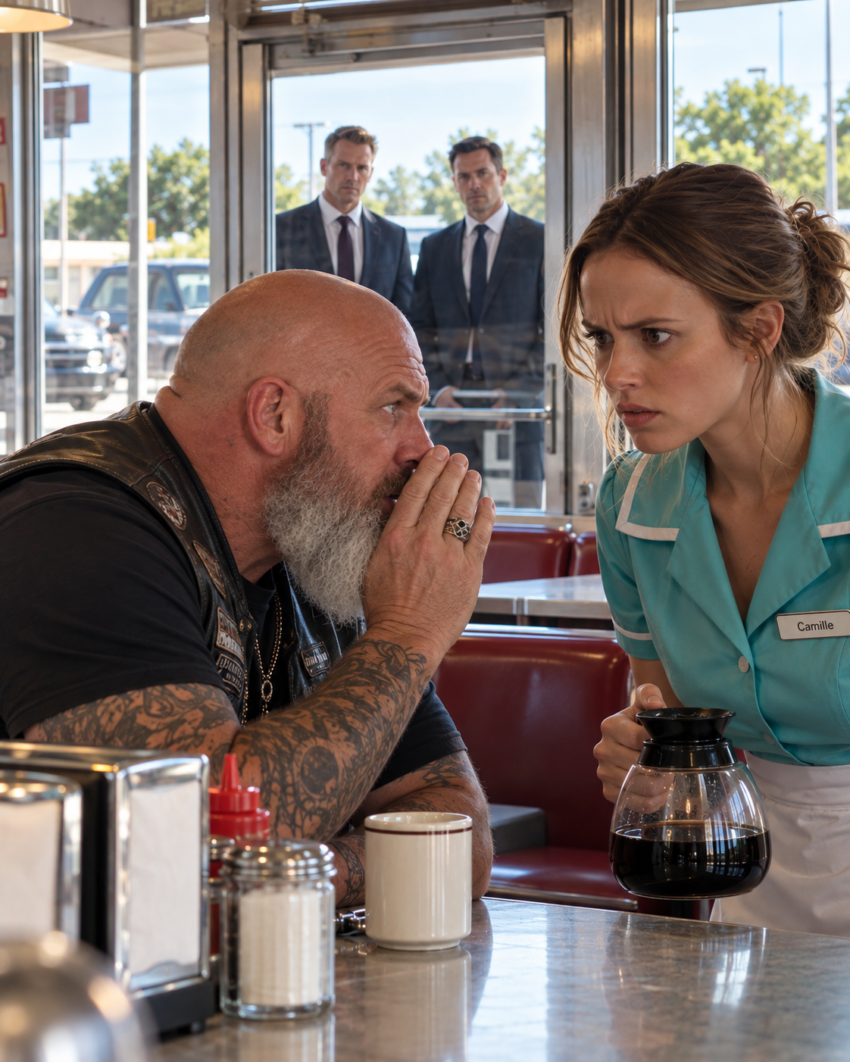
Now, as two men in expensive suits watched her from the end of the checkout lane, Russell’s familiar presence felt like the only safe thing in the store.
“Please,” she whispered. “I think they’re following me.”
Russell glanced at the men without turning his head.
Then he smiled at Tessa as though they were discussing an ordinary family dinner.
“Come on, sweetheart. Your dad’s taking you home.”
Neither of them knew that the decision he made that afternoon would reopen a mystery that had haunted Russell for thirty-four years.
And the truth waiting behind it would change both their lives.
A Familiar Face at the Checkout
Russell Maddox had been stopping at the same grocery store every Thursday since spring.
He usually bought coffee, sandwich bread, and whatever his mechanics had requested for lunch. Tessa often worked the afternoon shift, and over time, their brief conversations had become a pleasant routine.
She knew he repaired motorcycles in a brick garage outside Westerville. He knew she was taking evening accounting classes at Columbus State Community College.
He also knew her father had passed away the previous year.
Tessa had mentioned it once while ringing up his groceries.
“He worked in shipping and logistics,” she had explained. “I thought he’d be around forever.”
Russell had offered his condolences without asking questions.
That Thursday, however, something was different.
Tessa’s hands shook as she scanned a carton of milk. Her eyes kept moving toward two men standing near the customer service counter.
One wore a charcoal suit. The other carried a leather briefcase.
They weren’t shopping.
Russell noticed that immediately.
“You know those guys?” he asked quietly.
Tessa swallowed.
“They came to my apartment yesterday. They said they wanted something my father left behind.”
“Did they tell you who they worked for?”
“No. And when I asked, they wouldn’t answer.”
The taller man started walking toward them.
Russell leaned closer.
“You’re in trouble. Pretend I’m your father.”
Tessa stared at him for half a second before understanding.
“Dad,” she said, making her voice louder, “I told you I could get home myself.”
Russell chuckled naturally.
“And I told you I was already in the neighborhood.”
He looked toward the approaching man.
“Can I help you with something?”
The man stopped.
“We need to speak with Ms. Whitcomb about a private family matter.”
“Then you can contact her attorney,” Russell replied.
The second man stepped forward.
“This doesn’t concern you.”
Russell’s expression remained calm.
“She’s my daughter. That makes it my concern.”
When the taller man reached toward Tessa’s arm, Russell moved between them.
He didn’t raise his voice or make a threatening gesture.
Instead, he signaled to the store manager, who had been watching from nearby.
“Please save the security footage from this checkout lane,” Russell said. “And call 911. These gentlemen are refusing to leave an employee alone.”
The two men exchanged a quick glance.
Then they walked toward the exit.
Russell watched them leave, but he didn’t follow.
He knew that chasing them would accomplish nothing.
Keeping Tessa safe mattered more.
The Folder Her Father Left Behind
After the officers arrived, Tessa explained what had happened.
The manager confirmed that the men had approached her twice that afternoon. The store agreed to preserve the relevant surveillance footage.
Because the men had left before officers could speak with them, there was no immediate resolution. Tessa was advised to report any further contact.
Russell waited while she finished her statement.
Outside, the late afternoon sky had turned pale gray.
“Do you have somewhere safe to stay?” he asked.
“My aunt’s house,” Tessa replied. “But there’s something I haven’t told anyone.”
She opened her purse and removed a small blue folder.
Inside were photocopied invoices, shipping records, and a handwritten note.
“My father gave me this two weeks before he died. He said I should keep it somewhere nobody would think to look.”
Russell studied the first page.
At the top was a company name he didn’t recognize.
Below it appeared a project designation.
NORTHSTAR.
“What was your father’s name?” Russell asked.
“Calvin Whitcomb.”
“And how did he pass away?”
Tessa looked down.
“There was a fire at a warehouse where he worked. Investigators said they were still determining the cause.”
Russell’s eyes returned to the papers.
He didn’t understand the financial records, but one handwritten notation caught his attention.
E. Maddox — transferred, 1992.
His breathing changed.
Maddox was his surname.
And 1992 was the year his younger sister disappeared.
The Girl Who Never Came Home
Russell had been eighteen when his fourteen-year-old sister, Evelyn, vanished.
They had grown up in a modest house in central Ohio, raised by parents who worked long hours and expected their children to look after each other.
Evelyn had been bright, stubborn, and endlessly curious.
She loved drawing birds and collecting postcards from places she hoped to visit.
One October afternoon in 1992, she left home to meet a friend.
She never returned.
The family reported her missing. Police interviewed neighbors, checked the places she frequented, and followed several leads.
Nothing brought Evelyn home.
Their mother spent years keeping the porch light on.
Their father searched whenever a new tip surfaced.
Russell eventually stopped believing that someone would knock on their door with good news.
But he never stopped looking at old photographs.
Now, thirty-four years later, his sister’s initial and surname appeared in documents belonging to a deceased warehouse employee.
He turned to Tessa.
“My sister disappeared in 1992. Her name was Evelyn Maddox.”
Tessa’s eyes widened.
“You think my father knew her?”“I don’t know. But I need to find out.”
Russell carefully closed the folder.
“And we need someone qualified to look at these records.”
The Woman Who Understood the Numbers
The following morning, Russell contacted a local attorney, Maren Sloane, who had previously helped his motorcycle club establish a charitable fund.
After hearing the situation, Maren recommended that Tessa preserve the original documents and avoid confronting anyone connected to the company.
She also arranged for a forensic accountant to review the copies.
Three days later, the accountant called them into her office.
“These invoices appear to show the same emergency equipment being billed multiple times through different companies,” she explained.
The records referred to generators, portable medical units, and temporary housing supplies supposedly delivered after hurricanes, floods, and major storms.
Some shipments appeared to have been billed to more than one government contractor.
Other invoices referenced warehouses that had closed years earlier.
The companies involved had different names, but several shared mailing addresses, officers, or payment destinations.
“This may be part of a much larger contracting fraud,” the accountant said. “But these pages alone can’t establish the full scope.”
Maren agreed.
She prepared a referral to federal investigators, explaining why the records warranted further examination.
Tessa sat quietly through the meeting.
Finally, she asked the question that had been troubling her.
“Did my father discover something he wasn’t supposed to?”
Maren answered carefully.
“That’s possible. But we shouldn’t decide what happened to him before investigators examine the evidence.”
Russell placed a hand over Tessa’s trembling fingers.
“Whatever they find, you won’t have to face it by yourself.”
A Name Hidden in an Old Record
Two weeks later, a federal investigator contacted Maren.
The documents had been referred for further review, and agents wanted to speak with Tessa about her father’s work.
Russell attended the interview at Tessa’s request.
The investigators asked about Calvin’s employers, the warehouse, and the circumstances under which he had given his daughter the folder.
Russell mentioned the notation about Evelyn.
One agent, Special Agent Laura Kincaid, paused.
“Do you have a missing-person report for your sister?”
“My parents filed one in 1992,” Russell said. “I’ve kept copies of everything.”
He brought the records to their next meeting.
A week later, Kincaid called him.
“Mr. Maddox, we located an old employment record associated with your sister’s name.”
Russell gripped the phone.
“Does that mean she’s alive?”
“It means someone used that identity after she disappeared. We need to determine whether it was your sister.”
Russell wanted certainty.
Instead, he received another question.
Had Evelyn ever used the nickname Evie?
He closed his eyes.
“Every day of her life.”
The agent was silent for a moment.
“Then I think you should come in tomorrow.”
The Recording Calvin Saved
During the investigation, Tessa remembered something her father had said shortly before the warehouse fire.
He had asked her to keep an old digital voice recorder in a box of family photographs.
At the time, she assumed it contained personal messages.
She brought it to Maren, who arranged for investigators to receive it.
One recording was dated several weeks before Calvin’s death.
His voice sounded tired.
“If somebody finds this, I want it understood that these shipments weren’t what the paperwork claimed.”
He described invoices for emergency equipment that had never arrived, payments routed through companies that existed mostly on paper, and a senior executive who had demanded that employees approve false records.
Then Calvin mentioned a woman.
“There’s someone who can confirm how this started. She was brought into the operation years ago under another name. She has been trying to leave ever since.”
A second voice could be heard faintly in the background.
It was a woman’s voice.
“Calvin, please don’t use my real name.”
The recording ended shortly afterward.
Russell heard only a short portion of the audio when investigators later discussed its relevance with him.
But that woman’s voice stayed with him.
He couldn’t be certain after thirty-four years.
Still, something about its rhythm reminded him of the little sister who used to sing along with the radio in their parents’ kitchen.
Why Evelyn Stayed Missing
Federal investigators eventually traced the identity in Calvin’s records to a woman who had lived under several names across the Midwest.
Her history was complicated.
According to the information investigators later shared with the family, Evelyn had been drawn into the network as a teenager after accepting help from someone who claimed to offer employment and a safe place to stay.
By the time she understood that the organization was involved in fraudulent business operations, she had become dependent on the people controlling her housing, identification, and finances.
As an adult, she attempted to leave more than once.
Years earlier, she had sent information to a local law enforcement contact. Soon afterward, people associated with the network appeared at the place where she was staying.
Investigators were still examining how her location had been discovered.
Evelyn believed that someone had passed along her information.
After that, she was moved repeatedly and pressured to remain silent.
She had been told that contacting her family would put Russell in danger.
It wasn’t that Evelyn had never tried to return home.
She had come to believe that staying away was the only way to protect the people she loved.
Calvin Whitcomb had learned about her while reviewing suspicious shipping records.
He began helping her quietly, hoping to connect her with trustworthy investigators.
Before he could finish, the warehouse fire ended his life.
But the folder he gave Tessa preserved the beginning of the truth.
The Investigation That Reached Eleven States
Over the following months, federal agents and prosecutors examined the companies connected to Project Northstar.
The investigation eventually expanded across eleven states.
Authorities alleged that a network of shell companies had submitted false invoices for disaster-relief supplies and emergency equipment, diverting more than $200 million through fraudulent contracts and payments.
The central figure was a businessman named Victor Harlan, whose companies had received contracts for years.
Publicly, Harlan presented himself as a generous entrepreneur who supported rebuilding communities after natural disasters.
Behind that image, investigators alleged, he had directed an extensive system of false billing and concealed payments.
Tessa’s father’s records were not the only evidence.
Investigators obtained banking documents, interviewed former employees, and reviewed business correspondence through lawful investigative procedures.
Calvin’s recording helped identify individuals who could explain how the operation worked.
Russell did not participate in searches or attempt to confront Harlan.
He continued running his repair shop.
He checked on Tessa, drove her to meetings when she needed company, and answered investigators’ questions about Evelyn’s disappearance.
For the first time in his life, he understood that helping his sister did not mean trying to solve everything himself.
Sometimes it meant trusting the right people to do their jobs.
The Call Russell Had Waited Thirty-Four Years to Receive
One rainy Tuesday morning, Russell was replacing a motorcycle’s rear tire when his phone rang.
It was Agent Kincaid.
“Mr. Maddox, we found your sister.”
The wrench slipped from his hand.
“Is she all right?”
“She’s safe. She’s cooperating with investigators, and she’s receiving appropriate support.”
Russell sat down on a wooden stool.
For a long time, he couldn’t speak.
“Does she remember me?” he finally asked.
Kincaid’s voice softened.
“She asked about you before we mentioned your name.”
Evelyn was fifty years old now.
She had spent much of her adult life moving between temporary homes, carrying a past she could not safely discuss.
She had agreed to speak with investigators after being assured that she could obtain independent legal advice and appropriate protection.
When she learned that Russell had never stopped searching for her, she cried.
She had believed for years that he might have forgotten her.
Russell laughed through his own tears when Kincaid told him.
“Forgotten her? I still have the birthday card she made me when I turned sixteen.”
A meeting was arranged at a private location in Columbus.
Russell barely slept the night before.
The Sister Waiting by the Window
Evelyn stood beside a window when Russell entered the room.
Her hair had turned partly silver. Fine lines surrounded her eyes, and she held her hands tightly together.
Russell stopped just inside the doorway.
For a moment, he saw the fourteen-year-old girl from the last photograph taken before she disappeared.
Then he saw the woman standing in front of him.
“Evie?”
Her face crumpled.
“Russ?”
He crossed the room.
They held each other so tightly that neither could speak.
Thirty-four years had passed.
Their parents were gone. Their childhood home belonged to another family. The world had changed in ways neither could have imagined.
But Russell still remembered how Evelyn used to steal the marshmallows from his cereal.
And Evelyn still remembered how he had walked her to school whenever older children teased her.
“I tried to come home,” she whispered.
“I know.”
“They told me you’d be hurt if I contacted you.”
Russell pulled back enough to look at her.
“You don’t have to explain everything today.”
Tears ran down her face.
“I thought you’d hate me for staying away.”
“Evie, I’ve spent thirty-four years hoping you were somewhere in this world. That’s all that matters right now.”
She held him again.
For the first time in decades, she no longer had to imagine what it would feel like to be safe with her brother.
She was finally there.
The Day the Truth Reached the Courtroom
The federal case continued long after Evelyn returned.
Prosecutors presented financial records, witness testimony, and communications linking Victor Harlan to the fraudulent contracting network.
Following a lengthy trial, Harlan was convicted of federal fraud, conspiracy, and obstruction-related offenses.
The investigation into Calvin Whitcomb’s warehouse fire remained separate. Authorities continued examining the circumstances and any possible connection to individuals involved in the contracting scheme.
Tessa attended portions of the proceedings with her attorney.
She had once believed her father left behind only a few confusing papers.
Now she understood that he had been trying to protect others while preserving evidence of wrongdoing.
After the verdict, she stood outside the courthouse with Russell and Evelyn.
“I wish Dad could see this,” Tessa said.
Evelyn reached for her hand.
“Your father helped me when he didn’t have to. I wish I could thank him myself.”
Tessa smiled sadly.
“I think he’d be glad to know you’re home.”
Russell looked at the two women.
One had lost her father.
The other had lost thirty-four years with her family.
Neither could recover what had been taken from them.
But both had been given something they once thought impossible.
A chance to begin again.
The Family That Grew From One Small Act
Six months after Evelyn returned, Russell’s motorcycle club organized a community dinner at a veterans’ center outside Columbus.
Tessa helped serve food.
Evelyn brought homemade apple pie.
Russell stood near the entrance greeting families, looking as intimidating as ever in his black leather vest.
A little boy tugged at his mother’s sleeve.
“Mom, is that man scary?”
Russell heard him and smiled.
“Only if you try to take the last piece of pie.”
The boy laughed.
Across the room, Evelyn watched her brother with a warmth he had missed for most of his life.
Later that evening, Tessa joined them at a table.
“Do you ever think about what would’ve happened if you hadn’t come into the store that Thursday?” she asked.
Russell considered the question.
“Sometimes.”
“You could’ve walked right past those men.”
“I suppose I could have.”
“But you didn’t.”
He glanced at Evelyn.
“I spent most of my life wishing somebody had been there when my sister needed help. When I saw you frightened, I knew I couldn’t ignore it.”
Evelyn reached across the table and squeezed his hand.
“You couldn’t find me back then,” she said softly. “But you helped bring me home now.”
Russell looked down, overcome with emotion.
Outside, motorcycles stood in neat rows beneath the parking lot lights.
Inside, people laughed, shared food, and talked about ordinary things.
For Russell, those ordinary moments felt extraordinary.
At the end of the evening, Evelyn picked up her coat and stood beside him.
“Ready to go?” he asked.
She smiled.
“Take me home, Russell.”
And this time, her brother could.
Messages to Remember
Sometimes the most meaningful act of courage is not confronting the world with anger, but quietly standing beside someone who is frightened and showing them they no longer have to face their troubles alone.
A person’s appearance can never tell the whole story of their heart, because the stranger who looks intimidating from a distance may be the very person who offers kindness when everyone else looks away.
When someone trusts us enough to reveal their fear, we may not have all the answers, but listening carefully and helping them find the right support can change the direction of their life.
The people we love may carry stories we do not fully understand, and compassion often begins when we stop demanding explanations and simply let them know they are welcome.
Years of separation can change faces, routines, and circumstances, but genuine family love can survive even when the path back to one another seems impossibly long.
Doing the right thing does not always bring immediate rewards, yet a small decision made with honesty and kindness can create consequences more meaningful than we could ever predict.
When the truth is complicated, patience matters, because real justice often requires careful investigation, reliable evidence, and the courage of ordinary people willing to speak honestly.
No one can give back every year that was lost or erase every painful memory, but love can help people build a future that is not defined entirely by what happened before.
Sometimes family is strengthened not only by blood or shared history, but also by the people who choose to protect, support, and care for one another when life becomes difficult.
And perhaps the greatest lesson is that we should never underestimate the power of showing up for someone, because one ordinary afternoon of kindness may become the beginning of a homecoming that once seemed impossible.