PART 1 — THE KEY IN MY BROTHER’S SOCK
“I’m the one raising you, Noah. The least you can do is call me Dad.”
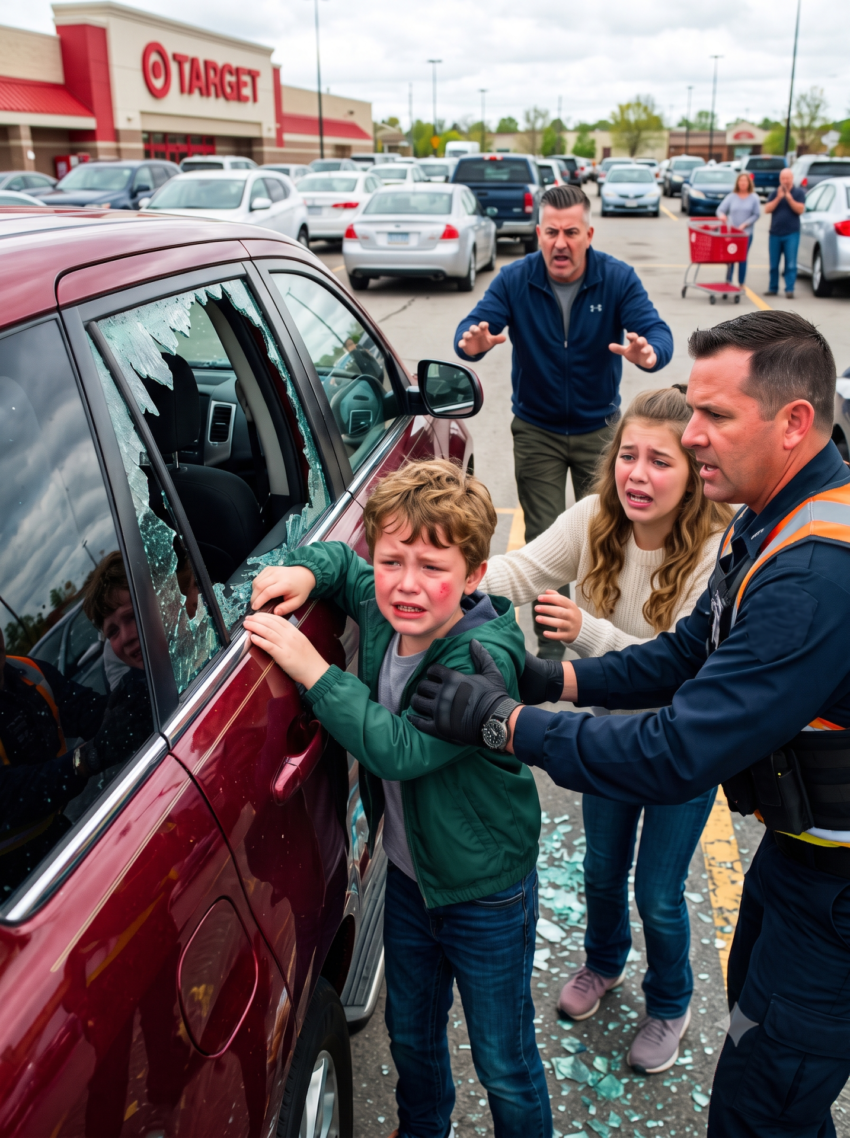
My stepfather said those words in the supermarket parking lot, looking directly at my seven-year-old brother. Fifteen minutes later, I found Noah locked inside our SUV with the engine off, his shirt soaked with sweat and a red mark across his cheek. But the thing that eventually frightened me most wasn’t the broken car window or even the ambulance. It was the little brass key Noah had hidden inside his sock.
I was seventeen that summer. Our mother, Sarah, worked as a nursing assistant at a residential care facility outside Chicago, often taking extra shifts to keep up with the mortgage. Michael had married her two years earlier, promising that she wouldn’t have to carry every responsibility alone.
For a while, he seemed to mean it. He fixed our leaking kitchen faucet, attended my school concerts, and taught Noah how to ride a bicycle. Mom was grateful, especially because our biological father had left when Noah was too young to remember him.
But Michael wanted Noah to call him Dad.
At first, he made it sound like a joke. Whenever Noah said Michael, he would smile and reply, “Try that again, buddy.” Eventually, the smile disappeared. He started taking away privileges, canceling outings, and making Noah repeat the word Dad before he could leave the dinner table.
Noah wasn’t trying to be disrespectful. He simply didn’t feel comfortable calling Michael something that personal.
One evening, after Michael had sent Noah to his room for using his first name, I confronted him in the kitchen.
“He’s only seven. You can’t force him to love you.”
Michael continued rinsing his coffee mug.
“I’m not forcing him to love me, Emily. I’m teaching him respect. There’s a difference.”
“Then why does he cry every time you correct him?”
He turned off the faucet and looked at me.
“Because your mother has spent years letting him do whatever he wants. I’m trying to give him some structure.”
Mom heard versions of these arguments, but never the worst of them. Michael usually waited until she was working. Whenever she questioned his punishments, he insisted Noah was exaggerating or that I was undermining him.
I should have told her more. Instead, I tried to keep Noah out of trouble.
That Saturday, the temperature was already above ninety degrees when Michael drove us to the supermarket. Mom had picked up a double shift, and he’d volunteered to buy groceries.
As we parked, Noah asked whether we could get chocolate pudding cups.
“Ask your dad,” Michael replied.
Noah glanced toward him.
“Michael, can we please get pudding?”
Michael switched off the engine.
“What did you call me?”
Noah looked down at the little plastic dinosaur in his hands.
“Michael.”
“You know better than that.”
I reached for the shopping bags.
“I’ll take Noah inside with me.”
Michael turned toward me.
“No. You get the groceries. Your brother and I need to have a conversation.”
Something in his voice made me hesitate. But Noah gave me a tiny nod, the same one he always used when he wanted me to stop worrying.
“I’ll be quick,” I told him.
Inside, I hurried through the aisles, grabbing milk, eggs, bread, and the ingredients Mom needed for dinner. My receipt showed that I paid at 2:18 p.m.
When I came outside, Michael was nowhere in sight.
Our SUV was parked three rows from the entrance. Every window was closed, and the engine was off. At first, I assumed Michael had taken Noah somewhere nearby.
Then I saw a small hand resting against the back passenger window.
I ran.
Noah was curled against the door, his face flushed and his hair stuck to his forehead. His shirt was dark with sweat.
I grabbed the handle.
Locked.
“Noah! Honey, open the door!”
His eyes moved toward me, but he didn’t reach for the lock.
I pressed my ear against the glass.
“Emily,” he whispered.
When he turned his head, I saw the red impression of a hand across his cheek.
I pulled out my phone and called 911, telling the dispatcher that my little brother was trapped in a locked vehicle and barely responding.
A parking attendant named Daniel heard me shouting. He ran over wearing a reflective vest and carrying a small maintenance tool.
“Is there a child inside?”
“Yes! My brother! I can’t open it!”
Daniel checked the doors, looked through the window, and told me to move back.
“Keep talking to the dispatcher. I’m getting him out.”
He struck the lower corner of the rear window. The glass cracked, but didn’t immediately break. After two more blows, it shattered.
Daniel carefully cleared the opening, reached inside, and unlocked the door.
Hot air rushed out.
He lifted Noah from the back seat and carried him into the shade. I knelt beside my brother, brushing his wet hair away from his forehead.
“I’m here, Noah. You’re okay. I’m right here.”
Noah looked at me with frightened eyes.
“I didn’t say it.”
“Say what?”
“Dad.”
My throat tightened.
“You don’t have to say anything. Just stay with me.”
Paramedics arrived within minutes. They began cooling Noah, checked his vital signs, and examined the mark on his face. One of them asked who had been responsible for him.
“Our stepfather,” I answered. “He was supposed to be waiting in the car.”
Two police officers spoke with Daniel and the witnesses while I explained what had happened before I entered the store.
I kept looking toward the parking lot, expecting Michael to appear.
He never did.
Then, while an officer was taking my statement, Noah tugged at my sleeve.
“Emily, I have something.”
He bent forward, removed one sneaker, and reached into his sock.
His fingers emerged holding a small brass key attached to a blue plastic tag.
The officer crouched beside him.
“Where did you get that, Noah?”
“From Michael’s cabinet.”
“Do you know what it opens?”
Noah nodded, then looked at me as though he needed permission to speak.
“The room he takes me to when I’m bad.”
I stared at him.
“What room, sweetheart?”
He swallowed.
“He said Mommy wasn’t supposed to know about it.”
The officer glanced at his partner before asking another question.
“Has Michael taken you there before?”
Noah held up two fingers.
“Twice.”
“What happened there?”
Noah’s eyes filled with tears.
“He made me practice calling him Dad. He said next time I might have to stay longer.”
The officer stopped questioning him and contacted a detective who worked with child-abuse investigations.
Mom arrived shortly afterward, still wearing her navy scrubs. She ran toward the ambulance, climbed inside, and wrapped Noah in her arms.
“What happened to my baby?”
Noah pressed his face against her shoulder.
“Michael got mad because I wouldn’t call him Dad.”
Mom looked at the mark on his cheek. Then she looked at me.
“Emily, did you know he was doing this?”
I could barely answer.
“I knew he was punishing Noah. I didn’t know about the room.”
She held Noah closer.
“You’re both coming home with me. Michael isn’t coming near either of you.”
At the hospital, doctors treated Noah for heat exposure and kept him under observation. Fortunately, his condition improved with treatment, and his initial tests showed no signs of serious lasting injury.
Meanwhile, Detective Laura Bennett began investigating the key.
The blue tag carried the name of a storage company and a unit number. With Mom’s permission, officers searched the SUV and found a rental agreement tucked behind the registration papers.
Michael had rented the storage unit eleven months earlier.
Mom stared at the document.
“He told me we couldn’t afford a new washing machine. He’s been paying for another place all this time?”
Detective Bennett asked whether Michael had ever mentioned taking Noah somewhere without her.
Mom shook her head.
“He threatened to leave when we argued about discipline. I thought he meant leaving me.”
The detective explained that investigators would need proper authorization before examining the unit. She also arranged for Noah to speak with a child advocate, so he wouldn’t have to repeat his account unnecessarily.
That evening, Noah told the advocate that Michael had taken him to the storage facility twice. He described a mattress, a blue backpack, and boxes stacked against the wall.
He said Michael made him sit there and repeat the word Dad.
But the most disturbing detail came when the advocate asked whether Michael had said anything about returning.
“He told me next time I wouldn’t come home until I learned,” Noah answered.
The following afternoon, after obtaining the necessary authorization, investigators searched the storage unit.
Mom and I were asked to identify some of the belongings they found. We waited outside while officers photographed and documented the contents.
When Detective Bennett finally allowed us to look through the open doorway, I recognized Noah’s old blue backpack immediately.
Mom had spent weeks searching for it the previous school year.
Beside the backpack was a thin mattress, folded children’s clothing, bottled water, and several plastic storage bins.
The bins had our names written on them.
SARAH.EMILY.
NOAH.
An officer opened one of the containers and showed Detective Bennett a stack of documents.
Mom’s driver’s license had been photocopied. So had our birth certificates, medical insurance cards, and Noah’s school records.
“Why would he keep all of this here?” Mom asked.
Detective Bennett didn’t answer immediately.
Then an officer pointed toward the back wall.
Taped above the mattress was a sealed envelope bearing three handwritten words.
FOR SARAH ONLY.
Mom took a step forward, but the detective gently stopped her.
“We need to process that as evidence first.”
“That’s my husband’s handwriting,” Mom whispered.
The detective nodded.
“Mrs. Harris, we’ve also found travel information and motel reservations among his papers. We need to establish what he was planning, but I think you should prepare yourself for a difficult conversation.”
Mom stared at the envelope.
“He wasn’t just trying to punish Noah, was he?”
Detective Bennett looked toward the small backpack and the folded clothes.
“That’s what we’re trying to find out.”
PART 2 — THE ROOM HE PREPARED FOR MY BROTHER
THE LETTER ADDRESSED TO MOM
Two days later, Detective Bennett called Mom and asked her to come to the police station.
Michael had been located and arrested in connection with the incident at the supermarket. A temporary protective order had been issued to prevent him from contacting us while the case proceeded.
Noah was home from the hospital, although he refused to sleep alone. I moved a spare mattress into my room so he could stay near me.
When Mom left for the station, a trusted neighbor stayed with him.
I accompanied Mom because she was exhausted and didn’t want to drive by herself.
Detective Bennett met us in a small interview room and placed several photographs on the table.
The first showed the storage unit. The second showed Noah’s belongings. The third showed a collection of papers investigators had found in a cardboard file box.
There were maps, printed driving directions, and receipts for prepaid motel reservations in southern Indiana.
Every reservation was under Michael’s name.
“Why Indiana?” Mom asked.
“We don’t know whether he intended to go there permanently,” Detective Bennett explained. “But the dates and the other preparations suggest he was considering leaving the area with Noah.”
She showed us a handwritten checklist.
Clothes.
Medication.
School records.
Cash.
Emergency contacts.
Beside the list, Michael had written Noah’s name.
Mine wasn’t there.
Mom covered her mouth.
“He was going to take my son.”
“The evidence suggests he was preparing for that possibility. We’re still investigating his intentions.”
Then Detective Bennett placed a copy of the letter from the envelope in front of Mom.
I watched her read the first paragraph.
Her expression changed slowly, as though she were trying to understand words written in a language she didn’t recognize.
“Emily,” she said quietly. “Read this.”
Michael had written the letter as if he were explaining a perfectly reasonable parenting decision.
He claimed Mom had allowed Noah to become disrespectful and that the boy needed time away from her influence. He insisted that a few weeks of strict discipline would teach Noah how to behave.
One sentence made my stomach turn.
When I bring him back, he will understand who his father is, and you will finally understand why I had to do this.
I read it twice.
“He thought he could just take Noah away?”
Detective Bennett nodded toward the papers.
“He appears to have been making preparations without your mother’s knowledge or consent.”
Mom stared at the letter.
“He kept telling me Noah needed a stronger father figure. I thought he meant more rules.”
She folded her hands on the table.
“I never agreed to any of this.”
“I understand,” the detective said. “That’s important, and we’ll document it.”
There was one more detail.
The facility’s access logs showed that Michael had visited the unit late at night on several occasions. Two dates matched evenings when he’d brought Noah home unusually late.
Mom remembered those nights.
Michael had said they were running errands.
Noah had gone straight to bed afterward, refusing dinner and barely speaking.
At the time, Mom thought he was tired.
Now she knew why.
THE THREAT NOAH HAD KEPT SECRET
When we returned home, Noah was sitting on the living room rug building a tower out of plastic blocks.
He looked up when Mom entered.
“Did you find my backpack?”
She knelt beside him.
“Yes, sweetheart. The police have it right now.”
“Can I get it back?”
“Eventually, maybe. But they need to keep it for a while.”
Noah nodded and returned to his blocks.
I sat beside him.
“Noah, can I ask you something?”
He looked at me.
“Okay.”
“Why did you take Michael’s key?”
He pressed two blocks together.
“Because he said we were going back.”
Mom sat down on his other side.
“When did he tell you that?”
“Friday night.”
I remembered Friday. Michael had taken us out for pizza, and Noah had called him Michael when asking for another slice.
Michael hadn’t shouted. He’d simply stopped talking for the rest of the evening.
I’d mistaken his silence for restraint.
“What did he say?” Mom asked gently.
Noah looked down.
“He said if I embarrassed him again, I wouldn’t come home until I learned to behave.”
Mom reached toward him, but he pulled away.
“Are you mad because I took the key?”
“No, honey.”
“Michael said stealing makes you bad.”
Mom waited until he met her eyes.
“You took it because you were frightened. You were trying to protect yourself. I’m not angry with you.”
Noah’s lips trembled.
“He said you’d choose him.”
Mom went very still.
“Choose him instead of what?”
“Me.”
For a moment, nobody spoke.
Then Mom pulled Noah into her arms.
“Noah, I would never choose someone who hurts you. You’re my son. Emily is my daughter. Keeping you safe is my job.”
He started crying against her shoulder.
“But you married him.”
Mom held him tighter.
“I did. And I was wrong about who he was. I’m going to fix what I can, starting now.”
That evening, Mom called an attorney to discuss divorce and custody-related protections. She changed the locks, updated our school emergency contacts, and made arrangements for Noah to begin counseling.
She also stopped trying to explain Michael’s behavior as stress.
For two years, she’d believed that if everyone made enough compromises, our household would become peaceful.
Now she understood that Noah had been making all the compromises, and Michael had been demanding more.
THE MAN WHO CALLED IT DISCIPLINE
The criminal case moved slowly.
Investigators collected security footage from the supermarket, statements from witnesses, medical records, and documentation from the storage facility.
Daniel, the parking attendant who had broken the window, provided a detailed account of Noah’s condition.
Michael’s attorney initially argued that the supermarket incident was an unfortunate misunderstanding. Michael claimed he had left Noah inside the SUV only briefly and believed the air conditioning was running.
But the engine had been off.
The doors were locked.
And the security footage showed Michael walking away from the vehicle while I was still inside the supermarket.
The storage unit raised additional concerns.
Michael claimed he had rented it for ordinary household belongings. His attorney argued that the mattress, clothing, and documents did not prove he intended to take Noah away.
Detective Bennett acknowledged that investigators couldn’t know exactly what Michael would have done.
But the letter, travel arrangements, and Noah’s statements were difficult to dismiss.
Meanwhile, Noah struggled with ordinary life.
He became frightened whenever someone raised their voice. He apologized constantly, even for accidents that weren’t his fault.
One evening, he dropped a drinking glass in the kitchen.
It shattered across the floor.
Noah immediately backed against the refrigerator.
“I’m sorry! I didn’t mean to!”
Mom reached for the broom.
“It’s okay, sweetheart. Nobody’s hurt.”
“Are you going to take away my dinner?”
She stopped moving.
“Of course not.”
“Michael did when I broke his mug.”
Mom put the broom down and crouched in front of him.
“You never have to worry about losing your dinner because you made a mistake.”
Noah looked at the broken glass.
“Even if it was expensive?”
“Even then.”
He began crying, and Mom held him while I cleaned up.
That night, I realized how much of our lives had revolved around keeping Michael satisfied.
I used to remind Noah to be quiet when Michael came home. I warned him not to interrupt, not to spill anything, and not to call Michael by the wrong name.
I thought I was helping him avoid trouble.
But a seven-year-old shouldn’t have to organize his entire day around preventing a grown man from getting angry.
I couldn’t change what had happened.
I could, however, stop treating Noah’s fear as something he needed to manage alone.
THE COURTROOM
Several months later, the criminal proceedings reached a decisive stage.
I had already given a detailed statement about the argument before I entered the supermarket and what I found when I returned.
Daniel’s account supported mine. The medical evidence documented Noah’s condition, and investigators had established the timeline through store records and surveillance footage.
Michael’s attorney questioned whether I had exaggerated the situation because I disliked my stepfather.
I answered carefully.
“I didn’t like how he treated Noah. But I didn’t invent what happened in that parking lot.”
The attorney asked whether I had personally seen Michael strike my brother.
“No,” I replied. “I saw the mark afterward, and Noah told the officers what happened.”
I was nervous, but I refused to claim I’d witnessed something I hadn’t.
Noah’s statements were handled through procedures intended to reduce unnecessary distress for a child witness. The professionals involved made sure he wasn’t repeatedly questioned without good reason.
Eventually, Michael entered a plea agreement on charges arising from Noah’s abuse and endangerment. He received a custodial sentence and restrictions on contact with Noah.
The storage-unit investigation helped establish the wider circumstances, although no one pretended the authorities could prove every future action Michael had contemplated.
Mom continued with the divorce.
She never visited Michael in custody.
When his attorney contacted her about the division of their belongings, she responded through her own lawyer.
She no longer felt obligated to explain why she wouldn’t give him another chance.
The divorce was finalized the following spring.
Mom came home that afternoon carrying a thin folder. She placed it in the kitchen drawer beside the old birthday cards from our biological father.
Then she asked what we wanted for dinner.
“Pancakes,” Noah said.
Mom smiled.
“Pancakes are usually breakfast.”
“You said I could choose.”
She laughed.
“You’re right. Pancakes it is.”
I helped him pour chocolate chips into the batter while Mom heated the skillet.
Nobody raised their voice when Noah spilled a few onto the counter.
Nobody told him he was being disrespectful.
We simply cleaned them up.
THE PARKING ATTENDANT
Almost a year after the incident, Mom arranged to meet Daniel at a diner near the supermarket.
Noah had been asking about the man who broke the window, and his therapist thought a brief meeting could be positive if Noah wanted it.
Daniel arrived wearing jeans and a baseball cap. He seemed embarrassed when Mom thanked him.
“You don’t owe me anything,” he said.
“I know,” she replied. “But I wanted you to hear it from us.”
Noah handed him a folded card.
Inside was a drawing of a red SUV, a bright yellow sun, and a man in an orange vest.
Daniel studied it.
“Is that supposed to be me?”
Noah nodded.
“I didn’t have a yellow marker.”
Daniel smiled.
“Orange looks pretty good on me.”
They talked about school, dinosaurs, and Noah’s favorite science project.
As we finished eating, Noah asked something that made Daniel set down his coffee.
“Were you scared when you broke the window?”
Daniel considered the question.
“A little. I was mostly worried about getting you out.”
“Did you think you’d get in trouble?”
“I figured we’d worry about that afterward. You needed help right then.”
Noah looked at him for a moment.
“I’m glad you did it.”
Daniel’s smile softened.
“Me too, buddy.”
When we left the diner, Noah reached for my hand as we crossed the parking lot.
He didn’t look frightened anymore.
He simply wanted to hold my hand.
THE NAME HE CHOSE
The brass key remained in police custody as evidence. Eventually, the storage unit was cleared through the appropriate legal process, and the rental agreement ended.
We never asked for the key back.
For a long time, I thought about how Noah had hidden it inside his sock. He’d been frightened, but he’d found a way to protect himself before anyone else understood the danger.
I also thought about how often I’d told him to be careful around Michael.
During one family counseling session, I admitted that I wished I’d done more.
“I should’ve told Mom everything,” I said. “I should’ve refused to leave him in the car.”
The therapist listened, then asked what I did differently now.
I looked toward Noah, who was arranging toy cars on the rug.
“I believe him when he says something feels wrong.”
Noah glanced up.
“Even if I can’t explain it?”
“Especially then.”
He smiled and returned to his cars.
The following summer, Mom took us back to the same supermarket for school supplies.
She offered to shop somewhere else, but Noah insisted that this store had the dinosaur pencils he liked.
We parked near the entrance.
For a moment, Noah looked toward the row where our old SUV had stood.
Mom noticed.
“We can leave if you’d rather go somewhere else.”
He shook his head.
“I want my pencils.”
Inside, he chose a green notebook, a shark-shaped pencil case, and a box of crayons. Mom also let him pick out chocolate pudding cups.
When we returned to the car, she opened the rear door and waited while he fastened his seat belt.
Noah looked up at her.
“Mom?”
“Yes, sweetheart?”
“Can I call you Sarah?”
Mom smiled.
“You can. Although I think I’ll always like Mom best.”
Noah grinned.
“Okay, Mom.”
She kissed his forehead, closed the door gently, and climbed into the driver’s seat.
Before pulling away, she looked in the rearview mirror.
“Everybody ready?”
“Ready!” Noah called.
Mom started the car, turned on the air conditioning, and drove us home.
This time, nobody had to earn the right to come with us.