PART2:
At five years old, he did not understand amputation as a word.
He understood absence.
The doctors told him his parents had died after a pickup truck ran a red light on Interstate 90 during a storm.
His mother died at the scene.
His father survived long enough to reach the hospital.
Six hours later, he was gone too.
Caleb survived.
But his left leg ended several inches below the knee.
Everybody called him lucky.
At five years old, Caleb had not understood why lucky hurt so much.
Three years later, he understood it better.
Lucky did not mean nothing bad happened.
Sometimes lucky simply meant you were the one left behind.
He attached the prosthetic.
Stood.
Winced.
Then reached for the crutch.
The house was quiet except for the refrigerator humming in the kitchen and the old floorboards giving him away as he moved down the narrow hallway. He passed the bathroom with the dripping faucet, the closet door that never closed properly, and the framed family photographs his grandmother refused to remove even though some days they made her cry.
Darla Whitmore was already awake.
At sixty-seven, she had learned to sleep lightly.
Life had taught her that bad news often arrived before breakfast.
She stood at the kitchen counter wearing a faded blue housecoat, pouring coffee into a chipped mug. Her gray hair was twisted into a knot, and one slipper had a crack along the sole that Caleb had noticed but never mentioned.
“You’re up early,” she said without turning around.
“Rally.”
She closed her eyes for half a second.
“Of course.”
PART3:
Caleb stood in the doorway wearing a faded T-shirt, shorts, the old prosthetic, one sneaker, and a canvas backpack hanging from his shoulder.
Darla immediately noticed the backpack.
“No.”
“I didn’t ask anything yet.”
“You have your father’s face when you’re about to ask something expensive.”
“The expensive one?”
Caleb smiled.
Darla tried not to.
Failed.
“The rally started yesterday,” he said.
“I know exactly when the rally started. Half the windows in this house have been vibrating since Thursday.”
“I just want to look at the bikes.”
“By yourself?”
“I know where it is.”
“That is not the same thing.”
“Grandma.”
“No.”
“Grandma.”
“Caleb.”
He leaned on his crutch.
That was unfair.
He knew it.
She knew it.
He had inherited his father’s talent for asking questions with his eyes, and Darla hated that the trait had skipped nobody. Michael had done the same thing at fourteen when he wanted his first broken-down dirt bike. At eighteen when he wanted to ride to Montana. At twenty-six when he wanted to marry a woman Darla thought was too sweet for his stubbornness and later loved like a daughter.
Caleb looked exactly like him when he wanted something.
That made saying no feel like refusing a ghost.
Darla took a slow sip of coffee.
“How far are you planning to go?”
“Main Street.”
“Absolutely not.”
“I won’t cross the road.”
“Caleb.”
“Dad used to take me.”
That changed the room.
Darla looked down at her coffee.
Caleb regretted saying it.
He had learned there were some memories that belonged to both of them but hurt differently depending on who touched them first.
“I just want to see them,” he said quietly.
Darla looked toward the photograph of her son on the wall.
His name had been Michael.
He had loved motorcycles since he was fourteen.
Never raced.
Never joined a club.
Never cared about looking tough.
He simply loved machines.
On Saturday mornings, Michael would push the Road King from the garage, turn on an old radio, open a dented tin of chrome polish, and spend hours making every piece shine. Caleb used to sit beside him on the concrete floor, legs stretched out, asking questions faster than Michael could answer.
What does this part do?
Why does that pipe get hot?
Why is it called a Road King?
Can I hold the rag?
Sometimes Michael let him.
Small circles.
Light pressure.
Never rush the chrome.
Let the cloth do the work.
Darla set her coffee down.
Then she opened the cabinet above the sink.
Caleb’s eyes widened.
From the back, behind old birthday candles, batteries, and a coffee can full of screws, Darla removed a small dented tin and a bundle of soft cotton cloths.
Caleb’s face changed.
He knew them instantly.
“Are those Dad’s?”
Darla placed them on the table.
“He kept everything.”
Caleb touched one rag with his fingertips.
There were faint gray stains in the fabric.
Old polish.
Old fingerprints.
Memory.
Darla’s voice came out rougher than she wanted.
“If I let you go, you stay on the sidewalks.”
“Yes.”
“You do not wander with strangers.”
“Yes.”
“You bring water.”
“Yes.”
“You come home by noon.”
Caleb nodded quickly.
Darla narrowed her eyes.
“What did I say?”
“Noon.”
“And if I call?”
“I answer.”
“And sunscreen.”
“Grandma.”
“Sunscreen.”
“Yes.”
She handed him the polish and rags.
Caleb slipped them into the backpack as carefully as if she had handed him something alive.
As he turned toward the door, Darla called, “Caleb.”
He looked back.
She wanted to say, Your father would be proud of you.
But the words felt dangerous that early in the morning.
Instead she said, “Don’t wear yourself out.”
Caleb smiled.
“I won’t.”
It was the first lie of the day.
The walk to the rally grounds took thirty-five minutes.
For most adults, it would have taken fifteen.
Caleb never complained about distance.
He measured distance differently.
Five blocks meant one rest against a fence.
The hill near Junction Avenue meant switching the crutch to the other side.
Crossing the long parking lot meant ignoring the pressure building inside the prosthetic socket.
By the time he reached the first line of motorcycles, sweat had already darkened the back of his shirt.
He stopped.
For several seconds, he simply stared.
Hundreds of motorcycles stretched ahead.
Black.
Red.
Blue.
Silver.
Candy orange.
Deep green.
Some were perfect.
Some were scratched.
Some were covered in dust from long rides across Wyoming, Montana, Nebraska, Colorado.
Some looked like they had been washed that morning by men who carried microfiber cloths and did not trust hotel towels.
Some looked like they had survived wars.
Caleb’s eyes moved slowly from one to another.
The Road Kings always made him stop longest.
They reminded him of his father.
A black Road Glide sat closest.
Its owner was nowhere nearby.
Dust marked the chrome exhaust.
Caleb looked around.
Then knelt.
He removed the tin.
Opened it.
The smell hit him immediately.
His throat tightened.
It smelled exactly like Saturday mornings in his father’s garage.
For a moment, the rally vanished.
He was four again.
Sitting on concrete.
His father humming badly to classic rock.
His mother coming out with lemonade and pretending not to smile at the streak of polish on Michael’s cheek.
Caleb closed his eyes.
Then opened them.
He dipped the cloth into the polish.
Circular motions.
Light pressure.
Never rush the chrome.
That was how Dad had done it.
When the haze dried, Caleb took another rag and buffed the metal until his reflection appeared.
He smiled.
Then moved to the next bike.
No one noticed him at first.
Why would they?
Sturgis was full of distractions.
Bands.
Vendors.
Thousands of riders.
Engines loud enough to shake windows.
An eight-year-old boy kneeling beside a motorcycle was easy to miss.
Especially when he was not asking for anything.
Caleb worked.
One motorcycle.
Then two.
Then four.
Then seven.
He polished exhaust pipes.
Handlebars.
Mirrors.
Fenders.
Fuel tank trim.
Sometimes he left paint alone because his father had warned him certain compounds could damage finishes.
Chrome only.
Work carefully.
Respect the machine.
At 8:47, Patty Morgan noticed him.
Patty was fifty-two and had been around motorcycles longer than some of the younger riders had been alive. Silver streaks ran through her dark braid. Her leather vest bore years of rally pins and patches. She had a reputation for being able to shut down an argument with one look and start one with another.
She sat outside the regional staging area with black coffee when she saw Caleb crouched beside a Harley.
At first she assumed he was touching something he should not.
She stood.
Then stopped.
The boy was polishing.
Patty watched him move the cloth.
Slow circles.
Buff.
Inspect.
Repeat.
Then Caleb shifted.
His prosthetic had begun hurting.
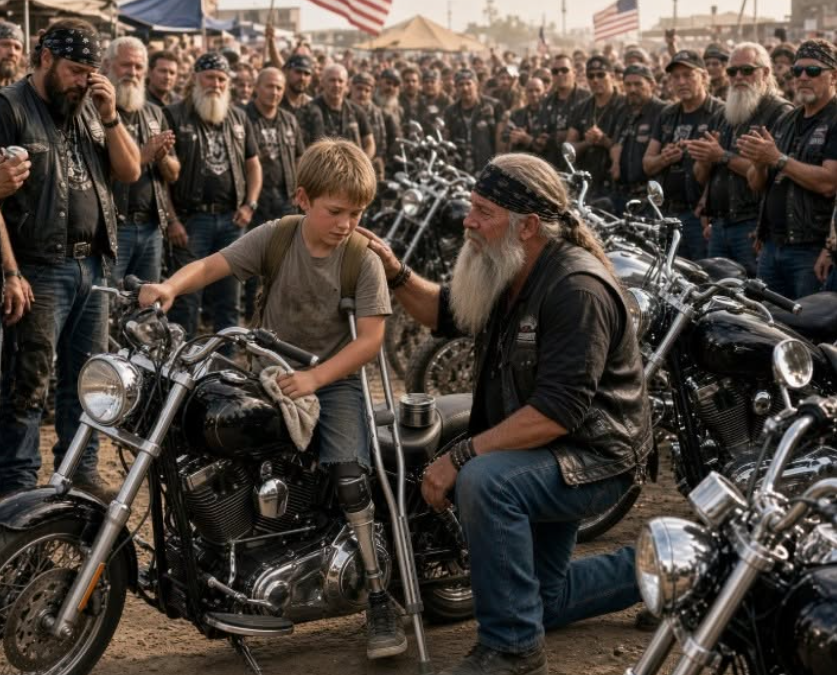
He quietly removed it behind the motorcycle, placed it in the backpack, and leaned his crutch against the neighboring bike.
Then he lowered himself onto one knee.
Patty’s coffee stopped halfway to her mouth.
“Hank.”
No answer.
“Hank.”
A large gray-bearded man emerged from behind the staging tent.
Hank Donnelly was fifty-six, six-foot-three, heavy through the shoulders, and looked exactly like the kind of biker tourists asked to photograph from a safe distance.
“What?”
Patty pointed.
Hank looked.
“What am I looking at?”
“The kid.”
“What about him?”
“Watch.”
They watched Caleb finish a chrome fender. He leaned close enough to inspect his reflection. Then he dragged his backpack and crutch to the next motorcycle.
That was when Hank saw the folded empty pant leg beneath the left knee.
His expression changed.
“He’s missing a leg.”
Patty nodded.
“And he’s been polishing our bikes for over an hour.”
“Whose kid?”
“No idea.”
“Some charity thing?”
“Don’t think so.”
“Is he collecting money?”
“No.”
Hank watched.
Caleb did not have a bucket.
No sign.
No tip jar.
He did not even look at passing riders.
He simply polished.
A third biker joined them.
Ray Sutton, the regional vice president.
Forty-eight.
Thin.
Suspicious by profession and personality.
“Somebody put him up to this?” Ray asked.
Patty shook her head.
“He came alone.”
Ray looked around.
“Parents?”
“None that I’ve seen.”
The three riders watched another minute.
Caleb wiped sweat from his forehead.
Then returned to work.
Ray frowned.
“Kid’s going to cook out there.”
Hank glanced at Patty.
“Get water over there.”
“Want me to talk to him?”
“Not yet.”
“Why?”
Hank watched Caleb move to the next motorcycle.
“Because I want to know what he does when nobody gives him attention.”
They found out.
He kept working.
At nine thirty, Caleb had completed ten motorcycles.
By ten thirty, fourteen.
The temperature climbed past ninety.
Sweat ran into his eyes.
His right knee was red from the pavement.
His hands were beginning to ache.
But every time exhaustion told him to stop, he looked at the chrome.
He remembered his father’s hands.
Keep the circles small, Cal.
Don’t press too hard.
Let the cloth do the work.
Caleb continued.
A bottle of water appeared beside his backpack.
He did not see who left it.
Twenty minutes later, a turkey sandwich appeared.
He ate half.
Wrapped the rest carefully.
Put it in his backpack.
Wade Perkins approached near eleven.
Wade was thirty-four and had the patience of an overheated engine. He stood over Caleb with his arms crossed, boots planted wide.
“Hey, kid.”
Caleb looked up.
“Yes, sir?”
“What are you doing?”
“Polishing your bike.”
“I can see that.”
Caleb waited.
“Nobody asked you to.”
“I know.”
“So why are you doing it?”
Caleb looked at the black Softail in front of him. Its exhaust now reflected his face, warped slightly by the curve of the pipe.
“Because it deserves to look good.”
Wade stared.
“That’s your reason?”
Caleb shrugged.
“My dad said motorcycles know when somebody takes care of them.”
Wade’s expression shifted.
“Your dad here?”
Caleb looked down.
“No, sir.”
Something in his voice stopped Wade from asking more.
He returned to the staging area.
Hank raised an eyebrow.
“Well?”
Wade looked back toward Caleb.
“Leave him alone.”
At 1:13, Caleb finally realized he was late.
He packed everything quickly.
The walk home took nearly an hour.
The right knee he had been kneeling on felt swollen. His hands were cramped. The remaining portion of his left leg was irritated from wearing the prosthetic during the walk.
When he reached Elm Street, Darla stood on the porch with her arms folded.
Caleb knew immediately.
“Sorry.”
“Do you understand what noon means?”
“Yes.”
“What time is it?”
“One.”
“One what?”
Caleb glanced at the sky.
“Something.”
Darla tried to stay angry.
Then she saw the way he was leaning on the crutch.
“Inside.”
“I’m fine.”
“Inside.”
He obeyed.
Darla sat him at the kitchen table.
She removed the prosthetic.
Her face tightened.
The skin around the socket was red and rubbed raw.
“Caleb.”
“It doesn’t hurt.”
“Do not lie to me about pain.”
He looked away.
Darla cleaned the irritated skin with shaking hands. She had cleaned scraped knees, stitches, road rash, fever sweat, and surgical scars. Still, every time she had to tend the place where his leg ended, she felt the same helpless rage.
He was eight.
He should have been running until he was breathless, not calculating how much pain was too much.
“You cannot keep doing this,” she said.
“There are hundreds more.”
“That is not your responsibility.”
“I know.”
“Then why?”
Caleb stared at his father’s old polishing rag on the table.
“I don’t know.”
Darla did.
She just did not say it.
Instead she made him a sandwich.
Caleb finished the half he had brought home first.
Darla noticed.
“Where did that come from?”
“Somebody gave it to me.”
“You saved half?”
Caleb nodded.
“For you.”
Darla turned toward the sink so he would not see her face.
That evening, after Caleb fell asleep, she sat at the kitchen table surrounded by envelopes.
Property tax.
Electricity.
Medical bills.
Orthopedic clinic.
She opened the orthopedic letter again.
Recommended pediatric adjustable prosthesis.
Estimated balance after insurance contribution:
$5,600.
She had $412 in savings.
Three months earlier, she had applied to two charities.
Rejected.
One foundation had placed Caleb on a waiting list.
Another required income documents she was still trying to obtain.
The church had given them three hundred dollars.
The congregation had also delivered meals for two weeks.
Darla appreciated every bit of it.
But appreciation did not change arithmetic.
She had already sold Michael’s truck.
Sold most of her jewelry.
Canceled her own dental appointment.
Stopped filling one prescription consistently.
Reduced groceries.
She had even sold the Road King two years after the accident to cover medical debt.
Caleb did not know that last sale had broken her heart almost as much as it had broken his.
The day the buyer came, Caleb had stood in the driveway and watched the black motorcycle roll onto a trailer.
He had not cried.
That was worse.
He had only asked, “Will Dad know?”
Darla had lied.
She said, “Your dad would want us to do what we need to do.”
It was true.
It was also not an answer.
Now she looked toward the hallway.
Her grandson slept.
At eight years old, he believed his only problem was an uncomfortable leg.
Darla intended to keep it that way for as long as she could.
The next morning, Caleb came into the kitchen dressed before six.
Darla stared.
“No.”
“I didn’t say anything.”
“You have your expensive face again.”
“I didn’t finish.”
“Your knee was bleeding.”
“I put a bandage on it.”
“Caleb.”
“Please.”
Darla rubbed her forehead.
Her son had possessed exactly the same stubbornness.
She hated genetics.
“Six o’clock home.”
Caleb smiled.
“Six.”
“Water.”
“Yes.”
“Sunscreen.”
“Yes.”
“If that leg hurts—”
“I stop.”
She pointed.
“I mean it.”
“I know.”
Caleb kissed her cheek.
Then left.
At the rally, Hank Donnelly was already making phone calls.
The previous evening he had asked around.
A convenience-store clerk knew the Whitmores.
Then a bartender recognized the name.
Then someone remembered the accident.
By midnight, Hank had enough pieces.
Caleb Whitmore.
Eight years old.
Parents killed in a crash on Interstate 90.
Lost his leg in the same wreck.
Lives with grandmother Darla.
Fixed income.
Medical expenses.
Father loved motorcycles.
Owned a black Road King.
Hank sat on the edge of his motel bed holding his phone long after the last call ended.
He had seen men endure pain.
He had known veterans who came home missing parts of themselves.
He had known riders who limped through rallies because the road had collected pieces of them years before.
But there was something about the boy’s quiet work that got under his skin.
Caleb did not polish like a kid trying to earn attention.
He polished like a mourner trying to keep a voice alive.
Hank called Patty.
“You awake?”
“It’s midnight.”
“That wasn’t the question.”
“I am now.”
“I found the kid.”
Silence.
“Tell me.”
Hank did.
By the end, Patty was no longer irritated about being awake.
“What are you thinking?” she asked.
“Officers meeting. Eight a.m.”
“How many chapters?”
“All the ones we can get.”
“Hank.”
“What?”
“This isn’t an officer meeting.”
“No.”
“What is it?”
Hank looked at the ceiling.
“I don’t know yet.”
The next morning, four hundred riders gathered behind the staging area.
Coffee cups steamed in large hands.
Engines cooled nearby.
A few men looked irritated to be summoned early.
That irritation disappeared when Hank began speaking.
“Most of you have seen the boy.”
Murmurs.
“Eight years old. One leg. Tin of polish.”
More nods.
“His name is Caleb Whitmore.”
Hank paused.
“Three years ago, a truck ran a red light during a rainstorm on I-90.”
The area became quieter.
“Caleb was in the car with his parents.”
Patty lowered her coffee.
“His mother died at the scene.”
Silence.
“His father lasted six hours.”
Nobody moved.
“The boy lost his left leg below the knee.”
A rider near the back whispered a curse.
Hank continued.
“His dad was a bike man.”
He pointed toward the rally grounds.
“Used to polish a 1998 Road King every Saturday.”
Several men looked toward the rows where Caleb was already working.
“The rags in that boy’s backpack belonged to his father.”
No one said anything now.
Hank swallowed.
“He lives with his grandmother. Sixty-seven. Social Security. Medical bills. House needs repairs.”
Ray folded his arms tighter.
“The prosthetic Caleb wears was fitted when he was five.”
A few riders looked at one another.
“He’s grown out of it.”
Hank’s voice became rough.
“It’s rubbing his skin raw.”
Patty turned away briefly.
“The new one costs fourteen thousand. Insurance covers part. His grandmother still needs fifty-six hundred dollars.”
Hank let the number settle.
“Yesterday that kid spent hours polishing motorcycles in ninety-degree heat.”
He looked across hundreds of faces.
“He didn’t ask anybody for money.”
The riders remained silent.
“Didn’t ask for food.”
Hank pointed at the ground.
“He got on one knee and worked.”
His gaze moved from rider to rider.
“I’m passing a helmet.”
Nobody needed further explanation.
“I’m not ordering anybody to do anything.”
Hank removed his helmet.
“But I’m putting five hundred dollars in it.”
He dropped the bills inside.
“If four hundred of us can spend thousands on chrome, engines, hotels, beer, and gas to come out here and we can’t help one kid whose father taught him to love the same machines we do…”
Hank shook his head.
“Then maybe we need to ask what all these patches actually mean.”
He handed the helmet left.
It began moving.
Twenty.
Fifty.
A hundred.
Another hundred.
Checks.
Cash.
One biker emptied every bill from his wallet.
Another removed a money clip and dropped the entire contents in.
Ray Sutton reached into his vest.
Five hundred.
Patty dropped in two hundred, then added another hundred.
“Thought you said two hundred,” Ray said.
“Mind your own wallet.”
The helmet kept moving.
Nobody clapped.
Nobody made speeches.
When it returned, it was overflowing.
They carried the money into the tent.
Three people counted.
Then counted again.
Patty looked at Hank.
“Twenty-three thousand four hundred.”
Hank sat down.
Nobody spoke for several seconds.
“That enough for the leg?” Ray asked.
“More than enough.”
Hank looked toward the rally.
Caleb had no idea.
He was kneeling beside another motorcycle.
Polishing.
Patty walked toward him.
She crouched beside the fender.
“Morning.”
Caleb looked up.
“Good morning, ma’am.”
“You can call me Patty.”
“Yes, ma’am.”
Patty smiled.
“Caleb?”
His hand stopped.
“How do you know my name?”
“People talk.”
He looked worried.
“Am I in trouble?”
“No.”
“You sure?”
“Very.”
She nodded toward the motorcycle.
“Can I ask you something?”
Caleb nodded.
“Why do you do this?”
“The polishing?”
“Yeah.”
Caleb looked at the rag.
He rubbed the fabric between two fingers.
“My dad used to do it every Saturday.”
Patty waited.
“He said chrome is like a mirror.”
“A mirror?”
“It shows if somebody cares.”
Caleb smiled faintly.
“He used to let me sit beside him.”
Patty’s eyes burned.
Caleb continued.
“I can’t build bikes.”
“You could learn.”
“Maybe.”
“And you could ride one someday.”
Caleb looked at his missing leg.
“Maybe.”
Then he looked back at the chrome.
“But I can do this now.”
Patty nodded.
Caleb’s voice became softer.
“When I polish them, it smells like Dad’s garage.”
Patty stopped breathing for a moment.
“He used the same stuff?”
“This was his.”
Caleb lifted the tin.
“And the rags.”
He went back to polishing.
“It feels like he’s here.”
Patty stood abruptly.
She walked away before Caleb could see her face.
Hank watched her return.
“Well?”
Patty wiped her eyes angrily.
“I hate you.”
“I didn’t do anything.”
“That kid just destroyed me.”
Hank nodded.
“Yeah.”
That afternoon, Hank Donnelly rode to Elm Street.
Darla heard the motorcycle first.
Then another.
Then silence.
She looked through the curtain.
A massive bearded biker stood on her porch.
She opened the door with the chain still attached.
“Yes?”
“Mrs. Whitmore?”
Her eyes immediately widened.
“Is Caleb okay?”
“Caleb is fine.”
She exhaled.
Hank removed his sunglasses.
“My name’s Hank Donnelly.”
“I know who you are.”
He raised an eyebrow.
“I live in Sturgis.”
“Fair point.”
“What happened?”
“Nothing bad.”
Darla studied him.
“Then why are you here?”
Hank looked past her toward the small house.
“Can I come in?”
She hesitated.
Then removed the chain.
Hank sat at the kitchen table.
His knees barely fit beneath it.
The photograph of Michael and his Road King hung on the wall behind Darla.
Hank noticed immediately.
“That him?”
“My son.”
Hank nodded.
“I can see Caleb.”
Darla folded her hands.
“Mr. Donnelly, if this is about Caleb touching motorcycles without permission—”
“It isn’t.”
“He told me he was polishing.”
“He is.”
“I told him to be respectful.”
“He’s been more respectful to those machines than half the people who own them.”
Darla blinked.
Hank took a breath.
“Mrs. Whitmore, we found out about the accident.”
Her expression closed.
“I see.”
“And his leg.”
Darla looked down.
“He shouldn’t have told people about money.”
“He didn’t.”
She looked up.
“He didn’t tell us anything.”
“Then how—”
“We asked around.”
Darla’s face tightened.
Hank raised one hand.
“Not to embarrass you.”
“I don’t need charity.”
“I figured you’d say that.”
“I mean it.”
Hank reached into his vest and placed a piece of paper on the table.
Darla did not touch it.
“What is that?”
“The total collected this morning.”
She looked.
$23,400.
Her face went blank.
“No.”
Hank waited.
“No,” Darla repeated.
“You haven’t heard the rest.”
“I don’t need to.”
“You probably do.”
“That is too much money.”
“It’s not all cash for you.”
Darla pushed the paper back.
“I cannot take twenty-three thousand dollars from strangers.”
Hank pushed it toward her again.
“They’re not strangers anymore.”
“You don’t know us.”
“We know enough.”
“No, you don’t.”
Hank leaned forward.
“We know your grandson came to our rally with one leg, a rag, and a can of polish.”
Darla’s mouth tightened.
“We know nobody asked him to work.”
Her eyes glistened.
“We know he didn’t ask for payment.”
Hank’s voice softened.
“We know he’s using his father’s rags.”
Darla looked away.
“That’s enough.”
“No.”
Hank’s voice remained gentle.
“It isn’t.”
Darla stared at him.
“We know the prosthetic is hurting him.”
Her face changed.
“He told you?”
“We saw him take it off.”
Darla swallowed.
“We know he needs a new one.”
Hank pointed toward the paper.
“The first money pays for that.”
She covered her mouth.
“We already called the specialist in Rapid City.”
Her eyes filled.
“They’re expecting him next week.”
Darla shook her head.
“I applied everywhere.”
“I know.”
“I filled out forms.”
“I believe you.”
“I called foundations.”
Hank nodded.
“I know.”
She laughed once, broken and exhausted.
“You don’t know.”
Then the first tear fell.
“I sold my son’s motorcycle.”
Hank said nothing.
“I sold his truck.”
Another tear.
“I stopped going to my doctor.”
She pressed both hands against her face.
“I’ve been cutting groceries.”
Hank looked toward the nearly empty fruit bowl.
“I keep telling Caleb we’re fine.”
Her shoulders began shaking.
“I’m so tired of telling him we’re fine.”
Hank remained silent.
Darla had been strong for three years because there had been no alternative.
Now somebody had finally given her one.
She cried.
Not politely.
Not quietly.
She cried like a woman who had buried a husband, then a son, then a daughter-in-law, and still gotten up the next morning because a five-year-old boy needed breakfast.
Hank waited.
Eventually Darla whispered, “Why would four hundred people do this?”
Hank stared at the photograph of Michael beside his bike.
“Because your grandson reminded us of something.”
“What?”
Hank thought carefully.
“That being tough isn’t what most of us pretend it is.”
Darla looked at him.
“Most people look at us and see motorcycles, prison records, fights, tattoos.”
A small smile touched his mouth.
“Some of that reputation we earned.”
Darla almost smiled.
“But strength isn’t any of that.”
Hank looked toward the hallway where Caleb’s crutch marks had scratched the baseboard over years.
“Strength is waking up missing something that isn’t coming back and still choosing to make something beautiful.”
Darla began crying again.
Hank stood.
“Tomorrow morning, bring Caleb to the staging area at eight.”
“Why?”
“We need to tell him.”
“He won’t like people making a fuss.”
“I noticed.”
“Four hundred bikers staring at him may scare him.”
Hank considered that.
“Fair.”
Darla looked at him.
“Can you make them less intimidating?”
“No.”
That made her laugh.
It was the first real laugh she had managed in weeks.
The next morning, Caleb arrived expecting to polish row five.
Instead, Darla walked beside him.
That was unusual.
More unusual was the silence.
Four hundred riders stood in a broad semicircle behind the staging tents.
Caleb slowed.
“Grandma?”
“I’m here.”
“Am I in trouble?”
“No.”
Hank stepped forward.
He was holding something behind his back.
Caleb looked at his grandmother.
Then Hank.
“Sir?”
Hank crouched until they were eye level.
“Caleb.”
“Yes, sir.”
“Do you know why everybody’s here?”
“No.”
“You know they’ve been watching you?”
Caleb looked embarrassed.
“I didn’t touch anything I shouldn’t.”
Hank smiled.
“This isn’t about that.”
He pointed toward the bikes.
“You polished a lot of motorcycles.”
“I’m not done.”
A few riders laughed.
Caleb looked confused.
Hank continued.
“We found out who you are.”
Caleb’s expression changed.
“Grandma?”
Darla touched his shoulder.
“It’s okay.”
Hank said, “We found out about your mom and dad.”
Caleb looked down.
“And the accident.”
His fingers tightened around the crutch.
“And your leg.”
Caleb’s face became guarded.
He hated pity.
Hank saw it.
“This is not pity.”
Caleb looked up.
Hank nodded toward the riders.
“These people don’t pity you.”
The bikers remained still.
“They respect you.”
Caleb frowned.
“Why?”
“Because you came out here and worked harder than grown men twice your size.”
A few riders murmured agreement.
“You didn’t ask for anything.”
Caleb shrugged.
“I just wanted the bikes to look good.”
“I know.”
Hank’s voice roughened.
“That’s why this matters.”
He turned and took a motorcycle helmet from Patty.
It contained an envelope.
Hank pulled it out.
“These people took up a collection.”
Caleb blinked.
“For what?”
“For you.”
His face changed immediately.
“No.”
Hank almost smiled.
“Your grandmother said the same thing.”
Caleb looked at Darla.
“I don’t need money.”
Hank nodded.
“Maybe not.”
He touched the crutch.
“But you need a leg that fits.”
Caleb froze.
Nobody spoke.
Hank continued.
“A specialist in Rapid City is expecting you.”
Caleb’s lower lip moved.
“They’re going to fit you for a new prosthetic.”
He stared.
“One that doesn’t hurt.”
Caleb looked at his grandmother.
She was crying.
That frightened him more than the bikers.
“Grandma?”
She knelt.
“It’s okay.”
“Are we in trouble?”
“No, sweetheart.”
“Did I do something?”
Darla pulled him close.
“You did something wonderful.”
Caleb looked over her shoulder toward Hank.
“How much does it cost?”
Hank hesitated.
“Enough.”
“Grandma said we couldn’t.”
Darla closed her eyes.
Caleb had heard more than she realized.
Hank answered.
“You can now.”
Caleb looked across the four hundred riders.
People he did not know.
People his grandmother had warned him not to bother.
People who looked intimidating enough that tourists photographed them from across streets.
“You did that?”
Patty nodded.
“All of us.”
Caleb swallowed.
“Why?”
Ray Sutton spoke from the group.
“Because you polished my bike better than I do.”
Laughter broke the tension.
Caleb smiled.
Then Hank said, “Because your dad taught you something worth keeping.”
That did it.
Caleb’s eyes filled.
He tried to blink the tears away.
Failed.
“I miss him.”
Hank’s face tightened.
“I know.”
“I don’t remember his voice all the time anymore.”
Darla covered her mouth.
Caleb looked toward the motorcycles.
“But when I smell this polish…”
He raised the tin.
“…I remember.”
Several riders lowered their heads.
Caleb wiped his face with the back of one hand.
“Thank you.”
Four hundred riders remained quiet.
Then Patty began clapping.
Slow.
One clap.
Another.
Ray joined.
Then Hank.
Then everyone.
The sound rolled across the staging area.
Caleb looked overwhelmed.
Hank smiled.
“You deserve it.”
Caleb looked at the rows of motorcycles.
Then at his backpack.
He reached inside.
Pulled out the polishing rag.
Hank stared.
“What are you doing?”
Caleb sniffed.
“I’m not finished.”
The riders laughed.
“Row five still needs doing.”
Hank stood.
“You are unbelievable.”
Caleb shifted toward the motorcycles.
Then stopped.
He looked around.
Four hundred bikers.
One boy.
A whole rally full of chrome.
Caleb held up the rag.
“You can help.”
That laughter could probably be heard halfway to Rapid City.
Hank took a rag.
Patty grabbed another.
Ray muttered something about child labor laws.
Wade handed him polish.
And that afternoon, hundreds of bikers knelt beside their own motorcycles while an eight-year-old boy instructed them how to polish properly.
“Small circles,” Caleb told one rider.
“I am doing small circles.”
“Those are big circles.”
The man looked at Hank.
“Is he always this bossy?”
Hank grinned.
“You donated. That means he outranks you.”
Caleb corrected them.
Inspected their work.
Made grown men redo sections.
When one young rider rushed a fuel tank, Caleb shook his head.
“My dad said you can tell when somebody rushes.”
The man redid the whole thing.
By late afternoon, the rows of motorcycles reflected the South Dakota sun like mirrors.
Caleb sat against a black Road King.
Exhausted.
His grandmother sat beside him.
For several minutes, neither spoke.
Then Caleb asked, “Was Dad’s bike like this?”
Darla looked at the Road King.
“Almost exactly.”
“Do you miss it?”
She thought of selling it.
The buyer loading it onto a trailer.
The empty garage afterward.
“Yes.”
Caleb rested his head against her shoulder.
“Me too.”
Patty walked past and heard them.
She kept going.
But she remembered.
Two weeks later, Caleb stood inside an orthopedic clinic in Rapid City.
The new prosthetic was nothing like the old one.
Adjustable.
Lighter.
Designed for growth.
Properly aligned.
The prosthetist spent hours fitting and adjusting.
Caleb stood.
Took one step.
Stopped.
Darla immediately leaned forward.
“Pain?”
Caleb shook his head.
He took another.
Then another.
His eyes widened.
He walked across the room.
Turned.
Walked back.
No crutch.
No grimace.
No compensating lean.
Just an eight-year-old boy walking.
Darla began to cry.
Caleb looked alarmed.
“Grandma.”
She laughed through the tears.
“I’m fine.”
“You cry when you’re fine a lot now.”
“Get used to it.”
Outside the clinic, Caleb walked across the parking lot beneath bright afternoon sun.
Darla remained by the car.
She wanted to watch every step.
Halfway across the pavement, Caleb sped up.
Not quite a run.
Not yet.
But close.
“Grandma!”
“What?”
“It fits!”
Darla covered her mouth.
“Yes.”
He took several more steps.
“It doesn’t hurt!”
“I know.”
Then he walked back toward her.
Faster.
Straight.
Proud.
Darla pulled him into her arms.
Over his shoulder, she could almost see Michael beside the old Road King.
Laughing.
Proud.
Alive for one impossible second in the boy they had left behind.
The remaining money paid overdue property taxes.
Repaired the leaking roof.
Covered several medical appointments.
Hank insisted Darla use part of it for groceries.
She resisted.
He threatened to have forty motorcycles deliver food every Tuesday.
She gave in.
The riders kept visiting.
At first one or two.
Then more.
Patty came by with a small leather vest.
Across the back, stitched carefully:
CALEB
Below it:
CHROME CREW
“No club colors,” Hank explained. “You earn those when you’re grown.”
Caleb touched the lettering.
“Can I wear it to school?”
Darla immediately said, “No.”
Hank said, “Yes.”
Darla glared at him.
Hank corrected himself.
“Ask your grandmother.”
The next August, Caleb returned to the rally.
This time he walked.
No crutch.
The prosthetic fit perfectly.
He carried the same old tin of polish.
The same cloths.
And when he reached Main Street, he stopped.
Waiting for him was a black 1998 Harley-Davidson Road King.
Restored.
Perfect.
Chrome gleaming.
Caleb froze.
Hank stood beside it.
Patty.
Ray.
Wade.
Darla covered her mouth.
Caleb whispered, “That looks like Dad’s.”
Hank smiled.
“It should.”
Caleb stared.
Darla looked at Hank sharply.
“What did you do?”
Hank reached into his pocket.
Pulled out an old photograph.
Michael Whitmore beside his bike.
“We found the man who bought it.”
Darla gasped.
“No.”
Caleb looked between them.
Hank placed his hand on the seat.
“It changed owners twice after you sold it.”
Darla stepped closer.
Her fingers touched the fuel tank.
“We tracked the VIN,” Patty said.
Ray muttered, “Wasn’t easy.”
Patty elbowed him.
Hank continued.
“The last owner heard the story.”
Caleb stared at the motorcycle.
“He sold it?”
Hank smiled.
“No.”
The boy looked confused.
“He gave it back.”
Caleb’s face went blank.
Darla began crying before Hank even finished.
“It belongs to your family again.”
Caleb took one step toward the bike.
Then another.
He touched the handlebar.
His father had held that handlebar.
His small fingers moved across the grip.
For a long time, he said nothing.
Then he opened his backpack.
Removed the polish.
Hank laughed softly.
“Of course.”
Caleb knelt beside the motorcycle.
Darla started to stop him.
Then she didn’t.
He dipped the old rag into the polish.
Small circles.
Light pressure.
Let the cloth do the work.
Four hundred riders stood nearby.
Nobody spoke.
Caleb polished the gas tank.
Then the chrome.
The motorcycle was already spotless.
That did not matter.
This was not maintenance.
It was ritual.
Memory.
Love made visible.
When he finished, Caleb could see himself reflected in the chrome.
He was taller now.
Stronger.
The new prosthetic visible beneath his shorts.
Behind his reflection stood hundreds of bikers.
Behind them stood his grandmother.
And somewhere inside the polished metal lived the memory of his father.
Caleb placed his hand flat against the tank.
“Hi, Dad.”
Darla turned away.
Hank lowered his head.
Patty wiped both eyes without pretending otherwise.
Caleb looked at Hank.
“Can we start it?”
Hank smiled.
“It’s yours.”
“I can’t ride.”
“Not yet.”
Caleb climbed carefully onto the seat.
His feet did not reach the ground.
Hank stood beside him, one hand on the handlebar.
Darla watched with tears in her eyes.
Caleb turned the key.
Hank helped him press the starter.
The Road King came alive.
Deep.
Heavy.
Familiar.
The sound rolled through Caleb’s body.
His eyes closed.
And suddenly he was four years old again.
Sitting in front of his father.
Small hands on the tank.
His mother laughing nearby.
A garage door open to the summer.
His father’s voice behind him.
You treat a bike right, Cal…
Caleb opened his eyes.
The entire rally had gone silent around him.
Hank leaned closer.
“You okay?”
Caleb nodded.
Then smiled.
“Yeah.”
He looked at the hundreds of riders.
“I remembered his voice.”
That sentence destroyed what little composure remained.
Ray looked at the ground.
Wade removed his sunglasses.
Patty hugged Darla.
Hank rubbed his beard hard, pretending his eyes were not wet.
Later that afternoon, riders began pulling out for the annual Black Hills run.
Caleb stood beside his father’s Road King.
Hank approached.
“You polishing today?”
Caleb looked over the rows of motorcycles.
Thousands of them.
Then shook his head.
“No.”
Hank raised an eyebrow.
“Retired?”
Caleb smiled.
“Just today.”
“Why?”
Caleb looked at his reflection in the Road King’s tank.
“Dad’s bike is clean.”
Hank nodded.
“That it is.”
“And I think he’d want me to look at the others now.”
Hank put a hand on his shoulder.
“Sounds right.”
Caleb stood beside the road as motorcycles rolled past.
One rider after another lifted a hand.
Some shouted his name.
Others simply nodded.
Four hundred riders had discovered who the quiet boy with one leg was.
But the truth was, Caleb had discovered something about them too.
The patches.
The tattoos.
The scars.
The roaring engines.
None of those things told the whole story.
His father had been right.
If you took care of something, eventually it reflected you back.
Caleb had spent two days polishing chrome because he missed his dad.
He thought he was only bringing old memories back to life.
Instead, each motorcycle became a mirror.
And in those mirrors, hundreds of hardened riders saw something they had almost forgotten.
Grief did not have to make you bitter.
Pain did not have to make you cruel.
Strength did not always roar.
Sometimes strength was eight years old.
Sometimes it moved through ninety-degree heat on one crutch.
Sometimes it knelt on one good leg with blistered hands and an old polishing rag.
Sometimes it missed two parents every single day and still found a reason to make something shine.
That evening, Caleb and Darla returned home.
The Road King came with them on a trailer.
Hank had arranged storage until Caleb was old enough to decide what he wanted to do with it.
Before bed, Caleb walked outside.
The motorcycle sat in the garage beneath one light.
He ran his fingers across the tank.
His reflection looked back.
Not the boy from the hospital.
Not the child everyone called brave because they did not know what else to say.
Just Caleb.
He smiled.
“Good night, Dad.”
Then he switched off the garage light.
And for the first time in years, the darkness did not feel like something had been taken away.
It felt like something was waiting there with him.
A memory.
A promise.
A road he was not ready to ride yet, but one day might.